

The Short History of a Prince
Jane Hamilton
Random House
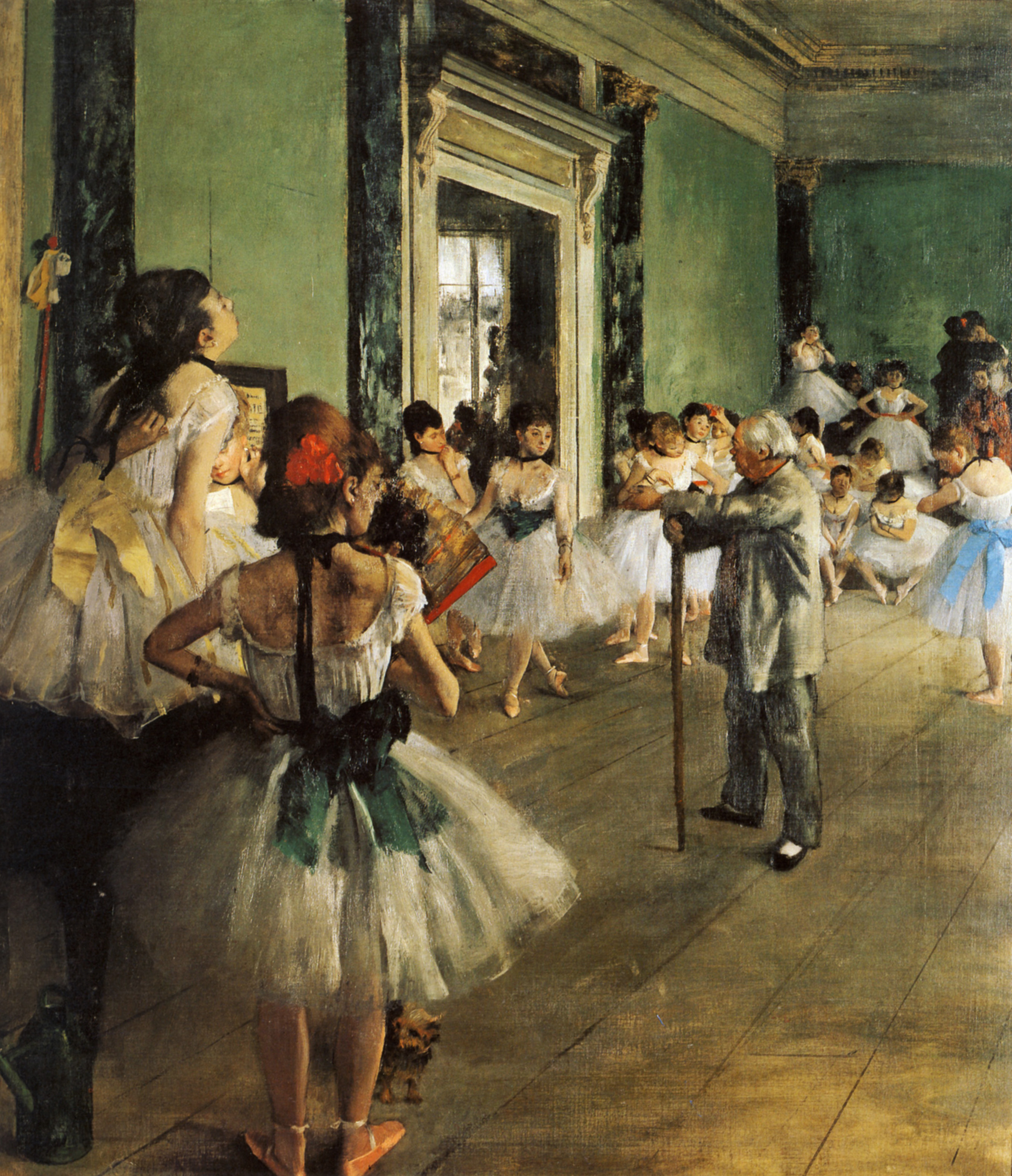
Classical bell tutus in The Dance Class by Degas, 1874
This well-told tale is about a wee poof called Walter (yes, quite) who is studying ballet and is an opera-lover (..). His two friends from his small Midwestern town, with whom he travels to Chicago four times a week to classes, are Mitch (whom he lusts after) and Susan (who goes on to be a professional in a moderately important company. Mitch vanishes midway through the narrative (he becomes a property developer in southern California). Although his personality is filtered through Walter’s perceptions, he is potentially the most interesting character in the novel. He engages in pretty heavy-duty (if low-level) sex with Walter. They are in their very early teens, at this stage, and Susan has transferred her affections from Mitch to Walter’s dying brother, Daniel. At a climatic (but not terribly convincing) scene, Mitch says to Walter “You’ll always be a homo”. Why the “always”? Walter suggests that Mitch – a brilliant performer – gives up on ballet because it is a “faggot world”. Persons sure of their sexuality would not be fazed by such a situation – even though this was in the very early 1970s – before the ‘explosion’ of ballet companies all over the USA [a bit of social / cultural history will do yiz good].
It is difficult to understand why Ms Hamilton decided to make her central character gay. Her approach to his sexuality is similar to the authors of 1960s pulp rubbish.
 There’s a touch of cross-dressing (not “drag”, which liberals tend to find even more puzzling than do standard-issue straights), transsexualism – and our old friend mental-arrestation loiters about like a child-molester at a nursery gate. For a man who lived through two cultural revolutions (Gay Liberation in the ‘70s and the interminable AI>DS crisis), and in New York, Walter McCloud is a curiously old-fashioned figure.
It would be unfair to Ms Hamilton and her potential readers to concentrate on the book’s blemishes (which include the glutinous title), as she has the born story-teller’s knack of keeping the reader interested. And, at heart, this is the story of a family and a house.
Reviewer: Carmen O’Sugan
Reviewed in ‘upstart’ in November 2000
 Please sign the Petition below


 This oddly named play is about James Connolly’s last few hours in the condemned cell. The greater part of the talk – there is very little action other than Connolly (Tim Loane) hobbling about the cell or being forced to crawl about it by two warders.
 The notion that there is a Gay sensibility has been controverted by some people but this film seems to me to be in a Gay mode – the word ‘tradition’ is too strong at present. Some of the set-pieces at the beginning of Orlando’s adventures in Elizabethan England reminded one of Paradjanov’s films specially Colour of Pomgranates. Not in their look but in the tretment of the screen as a ‘picture’ (that films started out as “motion pictures” is something that western European and especially British Isles film-makes have tended to forget). The ‘picture’ here were like those Tudor-period pictures where the subjects all look out at the viewer. The welcome for Queen Elizabeth I to Orlando’s parents house is clearly based on such paintings – the skating scenes where Orlando waxes rather too familiar with Sasha the Muscovite princess is a bit sneaky, it is more like a Victorian genre painting than the genuine Elizabethan article.
 original novel by Virginia Woolf are simply taken for granted. And they are very odd oddities, Orlando is granted immortality and in the middle of the eighteenth century changes gender! This is after a period where the “male” Orlando’s realtionship with the local Indian Rajah was less than entirely heterosexual (it is not implied that they were “at it” – but even for the period it is pictured as … unrestrained).


 by


