
ACOMSDave

Community Journalist

  • Home
  • Community Journalist
  • Events
  • Media Page and Press Kit
    • Projects and Work
  • Resources & Documents
    • LGBTQ+ Support Groups and Documents
  • NIGRA
  • Archives
  • Contact

‘Barbaric’ NHS Shock Therapy

08/01/2026 By ACOMSDave Leave a Comment

Investigation Reveals ‘Barbaric’ NHS Shock Therapy: LGBT Survivors Recount Their Experiences

 
'Barbaric' NHS Shock Therapy

WASHINGTON, DC – JUNE 26: Same-sex marriage supporter Vin Testa, of Washington, DC, waves a LGBTQIA pride flag in front of the U.S. Supreme Court Building as he makes pictures with his friend Donte Gonzalez to celebrate the anniversary of the United States v. Windsor and the Obergefell v. Hodges decisions on June 26, 2023 in Washington, DC. Today marks the 8th anniversary of the Supreme Court’s ruling in the Obergefell v. Hodges case that guaranteed the right to marriage for same-sex couples. (Photo by Anna Moneymaker/Getty Images)

In a recent investigation, the BBC has uncovered a disturbing history of Electric Shock Aversion Therapy (ESAT) administered within the National Health Service (NHS). Between 1965 and 1973, over 250 individuals were subjected to this practice, purportedly aimed at altering their sexual orientation or gender identity. This revelation has prompted serious concerns regarding medical ethics and patient rights during this period.


Survivor Testimonies

 
Several survivors have come forward to share their experiences, shedding light on the profound physical and psychological trauma they endured:
 
  • Jeremy Gavins: Mr Gavins, now 72, reports that the intensity of the electric shocks led to a loss of consciousness, with subsequent hospitalisation lasting three days.
  • Pauline Collier: Ms Collier, 80, underwent ESAT at the age of 19. She recalls the application of electrodes and the administration of painful shocks, further stating that the moments before receiving a shock would leave her “very anxious and very frightened.
  • Carolyn Mercer: Ms Mercer, 78, identifies as female despite being assigned male at birth. At 17, she was referred for ESAT, which she describes as “cruel, barbaric punishments – torture, not therapy.”
 
These cases represent a broader pattern of referrals from various authority figures, including educators, clergy members, and general practitioners. Concerns have also been raised regarding informed consent, with some individuals alleging they were explicitly instructed not to disclose the treatment to their parents.

Understanding Electric Shock Aversion Therapy

ESAT was a form of conversion practice predicated on associating same-sex attraction with pain. The procedure involved securing patients to a chair, applying electrodes, and administering electric shocks while presenting images intended to elicit same-sex attraction.
 
The BBC’s investigation reveals that, although participants were often described as “volunteers,” coercion played a role in numerous instances, with referrals originating from courts, educational institutions, and employers. Notably, some individuals subjected to ESAT were minors, with the youngest documented case being 12 years old.

Calls for Accountability and Redress

 
'Barbaric' NHS Shock TherapyLord Chris Smith, the United Kingdom’s first openly gay Member of Parliament, is advocating for a formal apology from both the government and the NHS. He has characterised the practice as “inhumane” and emphasised the need for accountability.

Current Legal and Ethical Landscape

 
While the British Psychological Society has discontinued the use of ESAT, conversion practices remain legal in the UK under certain circumstances. NHS England and the Royal College of Psychiatrists have pledged to cease administering conversion therapy; however, these practices persist in private settings.
 
Minister for Equalities Olivia Bailey has affirmed the government’s commitment to banning conversion practices and ensuring the protection of LGBT+ individuals.

Concluding Remarks

The revelations surrounding ESAT within the NHS underscore the importance of ongoing vigilance in safeguarding ethical medical practices and protecting vulnerable populations. Further dialogue and legislative action are warranted to ensure that such abuses are not repeated and that survivors receive appropriate recognition and support.
 
[Original article by Hayley Hassall, North West Investigations, 5 December 2025]
 
Links:
  • LGBT survivors tell of ‘barbaric’ NHS shock therapy
  • Here’s What It’s Like To Go Through Gay Conversion Therapy In Australia
  • Gay conversion therapy survivors share painful legacy of ‘ex-gay’ treatments
  • Wikipedia – Conversion Therapy

Filed Under: Community Journalist Tagged With: conversion therapy, ethics, healthcare, history, LGBT, LGBTQ, NHS, shock therapy, survivors, UK

UK Research: Anti-LGBTQ+ Hate and Rising Trends

04/11/2025 By ACOMSDave Leave a Comment

Hate Crime Statistics die Anti-LGBTQ+ Hate and Rising Trends

The data on UK hate crimes presents a complex picture. Recent official statistics show a 2% decrease in sexual orientation-related hate crimes (from 19,127 to 18,702) and an 11% decrease in transgender identity-related crimes (from 4,258 to 3,809) in 2024/25. However, advocacy groups caution that these figures don’t tell the full story.

The statistics exclude Metropolitan Police data due to reporting changes, which significantly affect LGBTQ+ data, given that many LGBTQ+ people live in London. Additionally, over the past five years, hate crimes based on sexual orientation have risen by around 44% and those based on trans identity have nearly doubled at 88%.

LGBTQ+ hate crime charity Galop saw a 60% increase in LGBTQ+ hate crime victims coming to them for support in 2024, suggesting the official figures underestimate the true scale of the problem. Fewer than one in ten LGBTQ+ people report hate crimes or incidents to police, with half feeling the police wouldn’t do anything.

The Supreme Court Ruling

In April 2025, the UK Supreme Court ruled unanimously that the legal definition of woman under the Equality Act 2010 refers to biological sex assigned at birth. The case originated from a challenge by For Women Scotland to Scottish legislation requiring 50% of public board members to be women, which included transgender women with gender recognition certificates.

The ruling determined that interpreting ‘sex’ as certificated sex would cut across the definitions of ‘man’ and ‘woman’ in an incoherent way, and that transgender women could be excluded from same-sex facilities such as changing rooms if proportionate.

Many LGBTQ+ people are living in fear following the Supreme Court judgment, according to advocacy groups, though this period doesn’t fall within the most recent hate crime statistics. The ruling effectively forced trans people to use sex-segregated public services and facilities according to their sex-assigned at birth, contrary to their identity and appearance.

Reform UK’s Growing Influence

Reform UK’s manifesto pledges to ban “transgender ideology” in primary and secondary schools, with no gender questioning, social transitioning or pronoun swapping, and mandates single-sex facilities in schools. The party also states it will scrap the 2010 Equality Act and eliminate diversity, equality and inclusion roles.

69% of Reform UK voters believe that trans people should not be able to legally change their gender via a gender recognition certificate, though 65% still believe same-sex couples should be allowed to marry. The 10 English councils now controlled by Reform have banned the flying of Pride flags, limiting flagpoles to the Union Jack and regional emblems.

Reform UK’s electoral threat has pushed both Conservative and Labour parties to adopt more conservative positions on gender self-identification and transgender rights, framing these policies around safeguarding concerns for cisgender women and children.

Online Harassment and Platform Safety

GLAAD’s 2025 Social Media Safety Index found that platforms broadly under-moderated anti-LBGTQ+ hate content while over-moderating LGBTQ+ users, including taking down hashtags containing phrases such as queer, trans and non-binary. In the UK, coordinated far-right and Christian extremist online campaigns have targeted Pride events with fabricated claims that they are “sexualising public spaces,” with these narratives emboldening physical protests and attacks such as those witnessed at London Pride in 2024.

Two in five LGBTQ+ young people, including 58% of trans young people, have been targets of homophobic, biphobic or transphobic online abuse, while nearly all (97%) have witnessed it. Less than half of LGBTQ+ victims of online abuse reported their experiences to social media platforms, and less than one in ten reported to police.

School Bullying

A 2024 YouGov poll found that 47% of LGBTQ+ youth in the UK have been bullied or discriminated against at school or university because of their sexual orientation, and 25% faced bullying due to their gender identity. Half of those who experienced bullying never reported it, and of those who did report it to staff, more than seven in ten said staff responded badly.

Respondents reported being locked in toilets, kicked, verbally and sexually abused, with some being driven to suicidal thoughts, while others complained of teachers purposefully misgendering and mocking them in classrooms. 43% of LGBT+ school students have been bullied compared to 21% of non-LGBT+ students.

Conclusion

The research confirms the article’s themes for the UK context: rising anti-LBGTQ+ sentiment manifesting in hate crimes, discriminatory political developments like the Supreme Court ruling, the growing influence of anti-trans political parties like Reform UK, widespread online harassment, and persistent bullying in schools. While official hate crime statistics show recent decreases, the broader five-year trend shows significant increases, and underreporting remains a major issue.

Anti-LGBTQ+ Hate and Rising Trends

Links:

  • Anti-LGBTQ+ hate is rising in Western nations both on & offline
  • Homophobia and Terrorism are not limited to Muslims.

#LGBTQRights #TransRights #HateCrimes #UKPOLITICS #QueerRights #EndTransphobia #EndHomophobia #ProtectTransYouth #Equality #HumanRights #LGBTQSafety #UKNews #StandWithLGBTQ


Filed Under: Anti-Bullying & Homophobia, Community Journalist Tagged With: AI moderation, ally, anti-LGBT bills, anti-trans legislation, asexual, bathroom bills, biological sex, bisexual, British politics, bullying, censorship, child protection, civil rights, coming out, conversion therapy, culture wars, detransition, digital rights, discrimination, diversity, equality, Equality Act, erasure, far-right politics, feminist discourse, For Women Scotland, Galop, gay, gender critical, gender identity, gender ideology, gender nonconforming, gender recognition, gender recognition certificate, gender self-identification, gender-affirming care, GLAAD, grassroots activism, hate crime statistics, HATE CRIMES, hate speech, homophobia, hormone therapy, Human Rights, inclusion, Institute for Strategic Dialogue, Intersectionality, ISD, lesbian, LGBT, lgbt history, LGBTQ, LGBTQ advocacy, LGBTQ charities, LGBTQ culture, LGBTQ discrimination, LGBTQ education, LGBTQ families, LGBTQ mental health, LGBTQ news, LGBTQ organizations, LGBTQ policy, LGBTQ research, LGBTQ safety, LGBTQ violence, LGBTQ+ activism, LGBTQ+ support, LGBTQ+ visibility, LGBTQ+ youth, medical transition, moral panic, nonbinary, online harassment, pansexual, parental rights, platform safety, police response, political backlash, Pride, puberty blockers, queer community, queer news, queer rights, Reform UK, religious extremism, safeguarding, same sex marriage, school bullying, sex segregated spaces, sex-based rights, sexual orientation, social justice, social media harassment, sports bans, stonewall, Supreme Court, trans community, trans healthcare, trans news, trans rights, trans youth, transgender, transphobia, UK, UK legislation, underreporting, United Kingdom, women's rights, workplace discrimination

The Killing of Georgie – Rod Stewart

15/08/2025 By ACOMSDave Leave a Comment

Unveiling the Powerful Story Behind Rod Stewart’s ‘The Killing of Georgie”

The Killing of GeorgieRod Stewart’s poignant ballad, “The Killing of Georgie,” provides a unique and powerful narrative that, drawing from the provided transcript, offers a groundbreaking portrayal of a non-straight individual and the challenges faced within society during a period of “changing ways” and “so-called liberated days”. The song traces the life and tragic death of Georgie, presenting a deeply personal story that was remarkable for the popular music of its era.


A Story of Identity and Rejection

The song introduces Georgie as a “Georgia boy”, a “kindest guy”. **Crucially, the narrative immediately establishes Georgie’s identity as non-straight through the reaction of his mother**, who questions “how can my son not be straight after all I’ve said and done for him”. This direct acknowledgement of his sexual orientation and his mother’s struggle with it, was a significant step for a mainstream song. As a result of this lack of acceptance, Georgie was “cast out by the ones he loves” and left home on a Greyhound bus. This highlights the painful reality of family rejection faced by many individuals identifying as non-straight.

Finding Acceptance in the City

Upon leaving his home, Georgie sought refuge and a new life in New York City. The song describes his swift integration and acceptance into a more liberal environment: “very quickly settle down, he soon became the toast of the Great White Way, accepted by Manhattan’s elite”. In New York, Georgie found a place where “no party was complete without [Georgie]”, suggesting a vibrant and accepting social circle. This stark contrast between the rejection he faced from his family and the widespread acceptance he found in the city provided a powerful commentary on the differing societal attitudes towards non-straight individuals. The song further reveals that “in the summer of ’75 he said he was in love,” indicating he found personal happiness and connection in this new environment.

The Tragic End and Societal Indifference

The narrative takes a dark turn with Georgie’s tragic death. While taking a shortcut home from another Broadway show, he was attacked on a side street by “a new church” with a “switchblade knife”. The source states that the assailant “did not intend to take his life, to just pushed his luck”, but the outcome was fatal. The song then poses a powerful question: “George is life and death, but I ask who cares?”. This rhetorical question implies a broader societal indifference or a lack of justice surrounding such incidents, particularly for those on the margins. Although the song doesn’t explicitly label it a hate crime, the sudden, violent nature of his death, coupled with the previous themes of rejection and the societal context, implicitly points to the dangers faced by non-straight individuals.

Georgie’s Enduring Philosophy

Beyond the tragedy, the song immortalises Georgie’s profound philosophy on life. According to the lyrics, Georgie once advised, “never wait or hesitate, get it, get before it’s turn you may never get another chance, cuz it’s a mask but they don’t last, live it long and live at fancy. Georgie was a friend of mine”. This message encourages living life fully and authentically, embracing opportunities without hesitation. In the context of a story about a non-straight individual who faced rejection but found acceptance and ultimately a tragic end, this philosophy becomes even more poignant, advocating for living one’s truth despite the brevity and fragility of life.

A Groundbreaking Contribution

“The Killing of Georgie” was groundbreaking not only for its ‘direct and empathetic portrayal of a non-straight character’s life journey’ but also for its ‘unflinching depiction of the societal challenges, from family rejection to tragic violence’, that such individuals could face. By bringing this personal story into the mainstream, Rod Stewart’s song contributed significantly to visibility and understanding, making it a pivotal work in the broader conversation about LGBT experiences.

Links:

  • Rod Stewart – The Killing Of Georgie (Part I & II) (Official Video)
  • Consign homophobia to history, urges ex-Irish president Mary McAleese
  • X-Men star opens up about first on-screen gay kiss in music video


Filed Under: Editor to ACOMSDave Tagged With: 1970s, acceptance, gay identity, Georgie., groundbreaking song, homosexuality, LGBT, music history, narrative, New York City, rejection, Rod Stewart, social commentary, The Killing of Georgie, tragedy

Hand Off – Gay Short Movie 2019 – Movie Review

06/05/2021 By ACOMSDave Leave a Comment

Hand OffHand Off is a movie written and directed by Chadlee Skrikker, is 24 minutes long and is about rugby in Cape Town, South Africa.  Jaco decides to admit his feelings about Willem just after they have come out of the changing room having cleaned up following rugby training. 

Willem is taken aback having had no inkling that Jaco was gay, and that he had feeling for him.  As they walk towards the car Willem walks on by leaving [Jaco] feeling isolated and downcast, and not knowing whether their friendship will continue.

He gets home and is met by his mother but moves away from her with a lame excuse and goes to his bedroom collapsing on his bed and falls into a fantasy world with an imaginary friend.  You can tell he is imaginary by the heavy gold on his forehead and his earrings – Leo then directs hisHand Off fantasy.  It at this stage almost has a feeling of Caravaggio or Sebastiane.  The languid bodies lying on rugs with cushions and roses set the scene.

Hand Off is a rugby term, it is when a ball-carrier is permitted to hand off an opponent provided excessive force is not used, to push him away whilst he (or she) continues with trying to get a try.

The actors are of a suitable build to all be rugby players, and indeed carry themselves as testosterone ladened lads. Jaco seems to move from training to his fantasy, all the while Willem is on the periphery reconciling what he has been told and trying to understand how it affects him and his friendship.

Jaco’s fantasy moves forward and becomes more sexually explicit, but the question that is raised is will he come back from fantasy?

Jaco then discovers that Willem (or someone) has told all his fellow team members that he is gay, and they take the action of shunning him with the stereotypical reactions that writers of these scenes often use.  He meets up with Willem expressing how he feels and Willem shows how good a friend he is and becomes the friend he was before Jaco came out.

Soundtracks:  there are several musical tracks used during the movie, but “Lucifer’s Tear” which was written by Ayden Marthinus stands out for me, and fortunately there seem to be three or 4 other tracks hidden away in YouTube.


Links:

  • YouTube – Hands Off
  • IMDB – Hand Off
  • https://acomsdave.com/campfire-kampvuur-gay-short-film-2000-movie-review/Campfire [Kampvuur]

Filed Under: Community Journalist, Movie Reviews Tagged With: afrikaans, Aidan Scott, Andahr Cotton, Arnold Horn, being outed, bullying, Chadlee Skrikker, coming out, gay, gay interest, imaginary friend, intolerance, LGBT, locker room, reconcile, republic of south africa, rugby, rugby team, scrimmage, south africa, team practice

The LGBT+ Traveller & Roma Calendar

21/03/2021 By ACOMSDave Leave a Comment

The LGBT+ Traveller & Roma CalendarThe National LGBT+ Traveller & Roma Action Group has proudly to produced its first ever LGBT+ Traveller & Roma Calendar and has begun distributing to national and regional Traveller and Roma organisations, as well as national and regional LGBT+ organisations this week. Traveller and Roma families and individuals who want to celebrate their LGBT+ identity or express their allyship with LGBT+ members of their communities will also receive copies through their relevant services.
“[It’s about} valuing people differently within our community, rather than coming down on anyone for their sexuality and gender. Accepting people for who they are, is the only way to be, as there is really no right way to be a Traveller. Live and let live!”  Senator Eileen Flynn

Eileen Flynn, the first female Traveller to become a Senator speaks as a proud member of the Action Group.  The National Action Group for LGBT+ Traveller & Roma Rights is a collective that aims to increase the promotion, protection, inclusion and celebration of LGBT+ Traveller & Roma individuals and their families within their communities and organisations and services. Membership of the Group consists of representatives from the LGBT+ Traveller & Roma communities, their national, regional and local organisations as well as LGBT+ organisations and services.

There are potentially 4,000 Travellers on the island of Ireland who are LGBT+ (All Ireland Traveller Health Study 2010; Equality Authority 2002). Higher levels of poor mental health are common both in the Traveller community and the LGBT+ community. Consequently, LGBT+ Travellers and Roma battle layers of discrimination as they strive to find self-acceptance, community acceptance and societal celebration of all of who they are.

“Being gay in the Travelling community is OK and needs more support. If not addressed then this is where the suicide thoughts and depression comes into effect, and when we see young lives dying” says Dillon Collins, an LGBT Traveller.

The Action Group hopes this first calendar will act as a symbol of positive visibility and allyship wherever it is displayed. It also aims to educate as each month marks key historical and important dates for both the Traveller and Roma communities, as well as the LGBTI+ community. Equally important is every month’s display of phone numbers of important mental health support services. The Action Group hopes that more LGBT+ individuals and any concerned family members will reach out to seek the help they need when they need it so that more LGBT+ Travellers and Roma find the peace which Pauline Reilly, LGBT Traveller, describes in the month of February:

“The heart is not bound by conditions of gender, love is an emotion that neither discriminates nor hesitates when it is felt by two people deeply in love”

For a digital copy click here: 2021 LGBT Traveller & Roma Calendar FINAL

Any other queries please email: BecomeaAlly@gmail.com

Filed Under: Anti-Bullying & Homophobia, History Tagged With: calendar, Ireland, LGBT, Roma

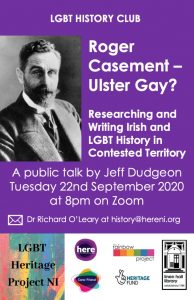
LGBT History club – Roger Casement

12/09/2020 By ACOMSDave

LGBT History Club - Jeff Dudgeon - Casement

Tagged With: history, Jeff Dudgeon, LGBT, politics, queer, Richard o'Leary

We Are Missing In Action Again

28/10/2017 By ACOMSDave Leave a Comment

Missing in Action is my terminology. The link at the bottom of this article shows a list of books recommended for everyone to read and understand the troubles!   But, both in terms of what it lists, but also in terms of what it leaves out.

[av_gallery ids=’8573,8572,8571′ style=’thumbnails’ preview_size=’portfolio’ crop_big_preview_thumbnail=’avia-gallery-big-crop-thumb’ thumb_size=’portfolio’ columns=’3′ imagelink=’lightbox’ lazyload=’avia_lazyload’ av_uid=’av-1xq1jr’ admin_preview_bg=”]


There are books covering aspects of both sides of paramilitaries, of ordinary people and how they were affected, but nothing about the military or the police, which to my mind is a shortfall. But even more glaringly obvious is the lack of any books covering the LGBT community during the trouble, either individually or as groups. For the military I suggest the following:

    • Contact by AFN Clark

  • A Long Long War: Voices from the British Army in Northern Ireland 1969-98


and for our community, possibly

    • When Love Comes to Town by Tom Lennon

    I would ask any of readers to suggest other books to cover all of our community.  But also remember to read the reviews that we have here on our own site, at NIGRA.

And just to add other spice to the mix:


Links:

    • NIGRA Book Review of ‘When Love Comes To Town
    • Breakfast on Pluto
    • Northern Ireland’s gay community and the 15 year fight for extension of 1967 Sexual Offences Act
    • A Good Hiding Place by Shirley-Anne McMillen (published
    • How we made The Crying Game


Source: The Troubles: Books about Ireland, Northern Ireland and the United Kingdom

Filed Under: Book Reviews, History Tagged With: Being left out, books, Films, LGBT, missing in action, movies

Screening of ‘Against the Law’ in Downing Street

06/07/2017 By ACOMSDave Leave a Comment


UK Government
The Rt Hon Justine Greening MP
Secretary of State for Education and Minister for Women and Equalities
requests the pleasure of the company of
Cllr Jeffrey Dudgeon MBE
at a screening of Against the Law
at 10 Downing Street
on Tuesday 11th July 2017 at 6.30 pm for 7.00 pm
Against the Law tells the story of Peter Wildeblood and one of the most explosive court cases of the 1950s – the infamous Montagu trial.
Along with the Conservative peer Lord Montagu of Beaulieu and their friend Michael Pitt-Rivers, Wildeblood was imprisoned for homosexual offences after his lover gave evidence against him under pressure from the authorities.
With his career in tatters and his private life painfully exposed, Wildeblood began his sentence a broken man, but he emerged from Wormwood Scrubs a year later determined to do all he could to change the laws against homosexuality.
His high-profile trial led the way to the creation of the Wolfenden Committee on sexual law reform which eventually resulted in the passing of the Sexual Offences Act 1967 – changing the lives of thousands of gay men with its partial decriminalisation of homosexual acts.
This powerful new drama forms part of a season of BBC programmes marking the fiftieth anniversary of that landmark change in the law. Starring Daniel Mays and directed by Fergus O’Brien, it is interspersed with moving testimonies from a chorus of men whose love and lives were against the law.

 
Screening of 'Against the Law' in No 10 Downing Street
Against the Law

Filed Under: Anti-Bullying & Homophobia Tagged With: Against the Law, Downing Street, Jeff Dudgeon, LGBT

Journalism and Activism:

06/07/2017 By ACOMSDave Leave a Comment

This article was originally published in iPOLITICS in May 2017. I have kept it hovering around until I had time to read it properly, and then found that elements of it are equally applicable to LGBT journalism and activism.  He was and is a composite journalist, indeed communicator, but he felt that the system of ‘carding’ as it is called in Canada, and what is called ‘Stop and Search’ in the UK, was intrusive and morally wrong.  He felt that having been stopped 50+ times, and the only apparent reason seemed to be because he was ‘black’, something had to be done!

In the UK ‘Stop and Search’ has been used by police forces throughout the UK as a means of ‘curtailing and controlling’ undesirables.  However, the statistics would indicate that profiling is going on, and that particular targetted groups are being harassed e.g. blacks, Muslims, LGBT individuals and groups (Black and minority ethnic groups increasingly more likely to be stopped and searched by police).

To go further, taken in conjunction with the continued encroachment of our civil liberties by government bodies who use the over-riding phrase ‘ we are protecting society by delving into your emails, phone calls, indeed anything we deem necessary, the phrase ‘ Big Brother’ is real and all encompassing; 1984 and the politics and control written about by George Orwell is effectively here.

Journalism and Activism


Police powers to stop and search: your rights

One of the proudest moments in the history of journalism came in 1898 when the French writer Émile Zola wrote his famous letter to the president of France, headlined ‘J’Accuse’.

Source: Journalists and activism: Desmond Cole and the Star

Filed Under: Community Journalist Tagged With: LGBT, police, politics, stop and search

Young and Old – time does make a difference!

18/05/2017 By ACOMSDave Leave a Comment

Young and OldOver the last 40+ years that I have been involved in the LGBTQ community, I have been privileged to witness the acceptance of gay people into the general community – young and old, we now have more freedoms; however this has only come about through the continued pressure from individuals, groups through lobbying and through legal cases.  We have in most parts of the UK an acceptance and understanding that being ‘gay’ is normal, that it does not require “treatment” to correct an illness!  Again I said in most parts, there are however still some groups and individuals who wish us to disappear or receive corrective treatment – in most companies LGBTQ rights are now accepted; but we cannot sit back on our backsides; if we do not keep monitoring and interacting with government (both local and national) then the rights that we have fought so hard to achieve will be taken away again.
What are your thoughts on this article; I would really like to hear what you think.  Comment now or email us.Young and Old
 
 
Source: Old and young see LGBT rights in contrast


Items for further reading:

  • 30 Essential LGBT Books for YA Readers
  • What are the best LGBT books for children, teenagers and YAs?
  • Top 10 LGBT books for pre-teens
  • Teaching Your Young Child about Homosexuality and Transgenderism
  • Labour pledges to include gay history in national curriculum

Filed Under: Anti-Bullying & Homophobia, History Tagged With: equality, gay rights, government, history, homophobia, Human Rights, LGBT

  • 1
  • 2
  • 3
  • …
  • 14
  • Next Page »

Categories

Copyright ACOMSDave.com © 2026