ACOMSDave

Community Journalist

  • Home
  • Community Journalist
  • Events
  • Media Page and Press Kit
    • Projects and Work
  • Resources & Documents
    • LGBTQ+ Support Groups and Documents
  • NIGRA
  • Archives
  • Contact

How to Edit Your Own Writing – The New York Times

26/07/2020 By ACOMSDave Leave a Comment

In writing you must kill all your darlings

Source: How to Edit Your Own Writing – The New York Times

For nearly 40 years I have been striving to learn to write, whether it be for examinations, letters to family and friends or indeed articles and reviews.  The one thing I have discovered is that something written at speed without time reconsider leads to disaster.  You need to take time out to edit your own writing.

In examinations, you have finite time and prescribed set of questions, and you need to set time aside to read, plan and then write and finally review what you have written.  I learned this as an adult doing trade examinations and also when I went back to college to continue my education.

For family and friends, this is a journey which is ongoing.  I think my first letter without supervision was when I was 8 or 9 – writing to thank family for looking after me on holiday.  I have continued to write, though less now with pen and paper and more with the computer in whichever mode I am using at the time (desktop, laptop, iPad or phone).  All have built-in spell checkers ( and some have even got grammar checkers), but it still takes a careful perusing after writing and before sending to ensure that I have not placed an incorrect word in the message (and it does happen regularly, even with the tools checking).

My writing of reviews and articles is more problematic.  Firstly it is time; there never seems to be enough time to do the research and reading necessary to build up sufficient working knowledge to write an in-depth piece.  Reviews are to a degree easier, they fall into a set piece of organisation.  I have developed a template for their structure. which enables me to fill the initial blocks in from various sites, but then it down to reading and/watching/or listening to the item. To think about how I feel afterwards and to ponder about whether I have come across any other pieces of work which are similar and whether they were better or worse.

So you can see, writing is something you need to practise.  It is something to think about.  And, it must never be confused with sending a quick message or tweet – though they should be actioned with discretion, and often aren’t.

Writing for me is a joy, a quilty sin, a pain and on its worse day a pain, but I wouldn’t give it up.

  • Amazon Link to – Politics and the English Language

    Editing and Writing

Filed Under: Community Journalist Tagged With: books, editing, movies, my thoughts, reviews, writing

Adventure Movies 2018

31/01/2019 By ACOMSDave Leave a Comment

According to one pundit,

Adventure Movies (Films) are exciting stories, with new experiences or exotic locales. Adventure Movies (films) are very similar to the action movie/film genre, in that they are designed to provide an action-filled, energetic experience for the movie/film viewer.

Another describes an adventure as an event or series of events that happen outside the course of the protagonist’s ordinary life, usually accompanied by danger, often by physical action. Which when you look at the 17 movies I have listed, and these are not all of those I could have listed, you can see that they appear to be nominated under the correct genre

  • Adventure Movie 1
  • Adventure Movie 2
  • Adventure Movie 3
  1. Venom
  2. The Nutcracker and the Four Realms
  3. Alpha
  4. Incredibles 2
  5. The Meg
  6. Avengers: Infinity War
  7. Christopher Robin
  8. The Spy Who Dumped Me
  9. Ant-man and the Wasp
  10. Aquaman
  11. Goosebumps: Haunted Halloween
  12. Solo: A Star Wars Story
  13. Johnny English Strikes Again
  14. Robin Hood
  15. Ralph Breaks The Internet: Wreck It Ralph 2
  16. Jurassic World: Fallen Kingdom
  17. Black Panther

Those of yo who read my article about movies, will have noted that I have bypassed the genre of ‘Adult Movies’ This is not because I am in any way prudish, however as everyone’s proclivities is different, no list for this genre would work I leave it up to you as an individual to delve into those places and find what takes your fancy

Further research:

  • Movieweb Lists
  • ACOMSDave – Movie Lists

Filed Under: Reviews Tagged With: lists, movies

We Are Missing In Action Again

28/10/2017 By ACOMSDave Leave a Comment

Missing in Action is my terminology. The link at the bottom of this article shows a list of books recommended for everyone to read and understand the troubles!   But, both in terms of what it lists, but also in terms of what it leaves out.

[av_gallery ids=’8573,8572,8571′ style=’thumbnails’ preview_size=’portfolio’ crop_big_preview_thumbnail=’avia-gallery-big-crop-thumb’ thumb_size=’portfolio’ columns=’3′ imagelink=’lightbox’ lazyload=’avia_lazyload’ av_uid=’av-1xq1jr’ admin_preview_bg=”]


There are books covering aspects of both sides of paramilitaries, of ordinary people and how they were affected, but nothing about the military or the police, which to my mind is a shortfall. But even more glaringly obvious is the lack of any books covering the LGBT community during the trouble, either individually or as groups. For the military I suggest the following:

    • Contact by AFN Clark

  • A Long Long War: Voices from the British Army in Northern Ireland 1969-98


and for our community, possibly

    • When Love Comes to Town by Tom Lennon

    I would ask any of readers to suggest other books to cover all of our community.  But also remember to read the reviews that we have here on our own site, at NIGRA.

And just to add other spice to the mix:


Links:

    • NIGRA Book Review of ‘When Love Comes To Town
    • Breakfast on Pluto
    • Northern Ireland’s gay community and the 15 year fight for extension of 1967 Sexual Offences Act
    • A Good Hiding Place by Shirley-Anne McMillen (published
    • How we made The Crying Game


Source: The Troubles: Books about Ireland, Northern Ireland and the United Kingdom

Filed Under: Book Reviews, History Tagged With: Being left out, books, Films, LGBT, missing in action, movies

Boys On Film 2: In Too Deep

15/08/2016 By ACOMSDave Leave a Comment

BOYS ON FILM 2
In Too Deep
Peccadillo Pictures
2007
5 060018 651637
peccapics.com
Boys On film 2: In Too Deep

**Boys On Film 2: In Too Deep: A Collection of Encountering Desire and Identity**

The title of this collection, *In Too Deep*, offers a cheeky nod to one of the contributions, “Kali Ma,” set near a swimming pool, hinting at the tangled web of sexual and emotional connections explored across the nine films compiled here. This eclectic mix features two entries from the USA, both set in the vibrant backdrop of New York City, alongside two from Australia’s sunny Sydney. Adding a splash of international flair, we have one film each from Sweden, Canada, France, and Mexico—where “Bramadero” unfolds, a visually striking piece that embraces the surreal, featuring two striking men meeting in a seemingly abandoned building. The film dances on the line between social realism and magic realism, artfully capturing their intimate encounter in a mesmerizing, desolate setting.

Among the shorter contributions, *The Island* from Canada presents Trevor Anderson trudging through the snowy expanse of northern Alberta. The film cleverly critiques a macho talk show suggestion that all “homos” should be isolated on an imaginary island to prevent the spread of HIV. As Trevor walks through the winter landscape, his daydream visions of a “homo utopia” burst forth in vibrant animation, humorously juxtaposing the harsh realities with fantastical notions of sunshine, sex, and sangria, excluding the chaos of storms or calamities. This delightful short is a warm breath of fresh air.

*Love Bite* dives into the lives of two teenage boys sharing a spliff and, ultimately, a secret. One boy, who believes the other is disgusted at the thought of him being queer, is actually hiding his own monstrous secret—he’s a werewolf. This lighthearted narrative takes a dark turn with a gory climax that leaves a lasting impression.

Then there’s *Working It Out*, a comedic examination of jealousy within a couple at the gym, where charm takes a backseat to style, and one partner’s insecurities are on full display. Despite the performers’ less than engaging presence and the gym’s unremarkable setting, the story captures a slice of modern relationship dynamics, though it may not resonate with everyone.

Futures & Derivatives offers a baffling narrative revolving around a businessman trying to impress his superiors with a presentation. However, the true focus shifts to a quirky outsider who, while working through the night, infuses the dull office environment with creativity—a charming mix of corporate seriousness and whimsical style.

Meanwhile, *Lucky Blue* transports us to Sweden, where the pet budgerigar of a traveling family becomes a sweet backdrop to young Lasse’s crush on Kevin, the tall, blonde boy he yearns for. The film wraps up with Lasse’s endearing love song to Kevin, leaving viewers with a sense of hopeful innocence.

*Cowboy*, hailing from Germany, introduces us to Oliver Scherz’s character—an estate agent surveying a rundown farm where he encounters a captivating, enigmatic wild boy played by Pit Bokowski. Their passionate, explicit connection amidst the decay of the farm hints at deeper themes of desire and escape.

*Weekend in the Countryside* presents an intriguing dynamic between two young men, Théo Frilet and Pierre Moure, and a slightly older man overseeing their stay at a rural estate. With fears and tensions simmering, the narrative captures complex emotions against the backdrop of the countryside, leading to an ambiguous conclusion that invites contemplation.

Finally, “Kali Ma” is a layered narrative set against the backdrop of New York City. It centers around a mother-son duo grappling with bullying and cultural identity. As *Ma*, portrayed by Kamini Khanna, confronts the tormentor of her son, the film evolves into a fierce exploration of maternal instincts and vengeance, culminating in a humorous yet poignant moment of rebirth and camaraderie between the boys.

Each film in *In Too Deep* explores the intersections of identity, desire, and intimacy, crafting narratives that resonate with the complexities of modern life. This collection invites viewers to reflect on their experiences and emotions while providing a richly diverse lens on love and the human condition. A captivating assembly, these films offer a fresh perspective, showcasing the vibrancy and diversity of contemporary storytelling across the globe.


Links:

  • Amazon.co.uk – Boys On Film 2: In Too Deep [DVD] [2008]
  • “Silver Road” – Gay Short Film 2006 – Movie Review
 
Segments and Cast:
  • “Cowboy” (Till Kleinert):
    • Oliver Scherz as Christian
    • Pit Bukowski as Cowboy
  • “Lucky Blue” (Håkon Liu):
    • Tobias Bengtsson as Olle
    • Tom Lofterud as Kevin
  • “Weekend In The Countryside”:
    • Théo Frilet as Pierre
    • Pierre Moure as Marc
    • Jean-Claude Dumas as Father
  • “Kali Ma”:
    • Kamini Khanna as Kali Ma
    • Brendan Bradley as Peter King
    • Manish Dayal as Santosh
  • “Bramadero”:
    • Cristhian Rodríguez as Hassen
    • Sergio Almazán as Jonás
  • “Love Bite”:
    • Will Field as Noah
    • Aidan Calabria as Gus
  • “The Island”:
    • Trevor Anderson as Himself
  • “Futures (and Derivatives)”:
    • Kelly Miller as Roger
    • Cam Kornman as Adele Lenz
    • Bill Barnett as Marty Simko
    • Bigi Ebbin as Roger’s Secretary
    • Vin Knight as Gordon Heath
    • Mark Hervey as Elliott
  • “Working It Out”:
    • Simon Kearney as Marcus
    • Paul Ross as Peter
    • Glaston Toft as Jeremy 
       

Filed Under: Movie Reviews Tagged With: boys, cowboys, gay, love, movies, werewolves

ROCK AGAINST BOWIE

21/02/2016 By ACOMSDave Leave a Comment

David Bowie (né Jones) died a short time ago, as ever on such occasions, tributes ‘poured in’, and there is no doubt that Bowie was an artist who could produce very interesting material. He could also, it should be said, produce whole albums-worth of dreck. The person who first broke ranks on the adulation was the comedian (and sharp investigative television reporter), Mark Thomas.

He noted Bowie (“the Thin White Duke”)’s Hitlerian salutes and straightforward racism, shouting “Keep Britain White”, and “Get the foreigners out” in the course of early 1970s gigs. Such people don’t ‘do’ irony, the fact that he was using African-American music crudified for honkie consumption never seems to have ‘fizzed’ on him.

He was, admittedly, one of the few people who composed ‘concept albums’ worth listening to – one on the theme of travelling from Vladivostok to Moscow along the Trans-Siberian Railway. That’s the sort of thing ‘Rock Stars’ did in those days, when not molesting under-age girls or chucking televisions out of hotel windows. Bowie was a quite inconsistent artist and some of his stuff is worthless. The guitarist Eric Clapton, of the band Cream, joined in the racist fun at his own gigs.

A result of this dangerous nonsense was the founding of Rock Against Racism, at the instigation of a professional photographer ‘Red’ Saunders, in a letter to the ‘music press’, presumably mainly NME (New Musical Express) a mass-circulation journal at the time. There already was a group called Rock Against Racism an arm of the SWP (still the International Socialists, becoming a ‘party’ in 1976). The SWP was very gratified at a sudden huge extension of its youth base.

It was less enthralled to learn that the great majority of the base thought their particular analysis of society was surplus to requirements. The SWP personnel were voted out of office in RAR, though the IS / SWP were allowed to sell their wares at RAR gigs – some of which were enormous. The racist Right found that “there ain’t no black in the Union Jack” stirred most teenagers to thump them rather than nod in agreement. Ska and reggae bands were ever-present at RAR gigs and rallies. RAR’s magazine Temporary Hoarding was first published on May Day 1977.

Despite that, the racist Right looked as if it was going to make inroads in electoralist politics, it got 10% of the vote in the 1974 London’s local elections. It certainly seemed to be making determined efforts to monopolise the streets. Kevin Gateley was killed in Notting Hill in the Summer of 1976, prior to that Enoch Powell, in April claimed that ‘Britain’ was being “hollowed from within…” a portentous remark, if not a particularly clear one. England, or at least London, experienced a number of long, hot summers. In August 1977 the National Front staged an “anti-mugging” march through Lewisham. It left the south London, largely plebeian borough in a mess, but did very little to wipe out ‘mugging’ (street theft of purses and money off isolated, working class people) mostly women out shopping.

There can be little doubt that the rank and file of the police were sympathetic to the NF. The ‘blacks’ had suddenly become a majority, allegedly, in some London boroughs and parts of other cities and towns. The ‘Asians’ were a slightly more ambiguous matter, they didn’t look all that out of the ordinary, at least when they didn’t wear ‘Asian’ clothes. And they had the proper attitude to women, they should be seen and not heard, and stay in the kitchen. The ‘Blacks’ largely of West Indian origin have now become observably English. Some third, and forth generation ‘Asians’ have reverted to wearing the sort of clothes worn in the Indian subcontinent. Given that even liberals can use phrases like “fourth generation immigrants” possibly this is not too blameworthy.

Rock Against Racism rather fizzled out in the course of the 1980s mainly because groups like the National Front did, there was nothing like an invasion (you’ll recalled Mrs Thatcher used similar language in the 1990s, when she was Prime MInister) or a ‘deluge’. It was for most towns and cities more of a trickle of immigrants. The people coming into the economy proved useful, – most of the Asians were middle class and educated. They were somewhat similar to the Poles of the ‘noughties’, nearly all of whom had skills. Despite which, the Daily Mail attempted to work up grievances against them – then they all went home.

It is worth mentioning that Blair Peach, a New Zealander was killed opposing a National Front celebration of St George’s Day (April 23rd) in Southall. It is in (far) west London, and was heavily populated by Indians – the biggest Hindu temple on the planet is in the area. Peach was part of a crowd of about 3,000 – they were managed by an astonishing number of police, about 2,500. Peach was killed some streets away clearly obviously trying to get away from a baton charge.

He didn’t manage to escape, and died next day of a physical trauma – a huge injury to the back of his head. The London Metropolitan Police took years to admit that they did it. And that they had been very heavy handed dealing with a crowd that was not being physically aggressive and was not much bigger than their own body of men. This was the socio-political ambience that Bowie and Clapton decided to throw their tuppence worth of racist bilge around.

Filed Under: Music Reviews Tagged With: composer, David Bowie, movies, music, performer

Why Star Wars Still Gives This Gay Kid Hope

11/01/2016 By ACOMSDave Leave a Comment

advocate_logoBY JASE PEEPLES
DECEMBER 18 2015 5:21 AM EST
Jase Peeples (Right)

Advocate entertainment editor Jase Peeples reveals how Star Wars boosted his self-esteem as a gay kid and why The Force Awakens will do the same for a new generation.
“Come on, son. We’re going to be late,” my dad said as he encouraged me to slip my 5-year-old feet into my favorite pair of red KangaROOS. “You don’t want to miss the new Star Wars.” I had no idea what this “Star Wars” was, but the way my father, stepmother, aunt Cindy, and uncle Bruce were talking about it, I was certain it was supposed to be something good. However, I wasn’t convinced.
Even at 5 years old I had already begun to realize I wasn’t like other boys my age. I had no interest in sports, preferring instead to dance around my room to my copy of Disney’s Disco Mickey on my Fisher-Price record player and loving any chance I got to play with my older cousin’s Easy-Bake Oven rather than the Hot Wheels toys that littered my bedroom floor. I knew what I was “supposed” to like, but the things that caught my young eye didn’t often fall into the predetermined “for boys” category. I was a sassy, effeminate, imaginative boy who felt stuffed animals were superior to toy guns and loved gathering kids together on the playground to make up our own adventures in the merry old land of Oz rather than play something boring, like cowboys and indians, with the other boys.
So when we got to the theater and began waiting in what I was certain was the longest line ever, I was sure I was going to have to suffer through a film that couldn’t possibly be as good as my family said. But as the movie began and the words “The Empire Strikes Back” started to scroll up the screen, I was immediately transported to a galaxy far, far away. For the next two hours and four minutes I sat transfixed by the sprawling space saga, but as impressive as the universe of aliens, starships, and lightsabers was, I found I was completely captivated by two characters that had a profound impact on me that day.
Luke Skywalker was unlike any of the leading men I’d seen before. The typical hero machismo that Harrison Ford played up with undeniable charm as Han Solo was nowhere to be found in Mark Hamill’s portrayal of the less butch son of Skywalker. All the ingredients that make a great hero were still there — courage, strength, honestly — but because they weren’t dripping with the trappings of traditional masculinity, Luke resonated with me on a level I’d never experienced before. Looking back, I now understand why my heart beat a little faster every time a scene of Luke training on Dagobah in his sleeveless undershirt flickered across the screen or why I gasped when Darth Vader sliced off his son’s hand during their lightsaber duel. Luke was my first crush. Hamill’s portrayal of a kinder, gentler hero made the character feel approachable, and I was infatuated with him by the time the end credits rolled.

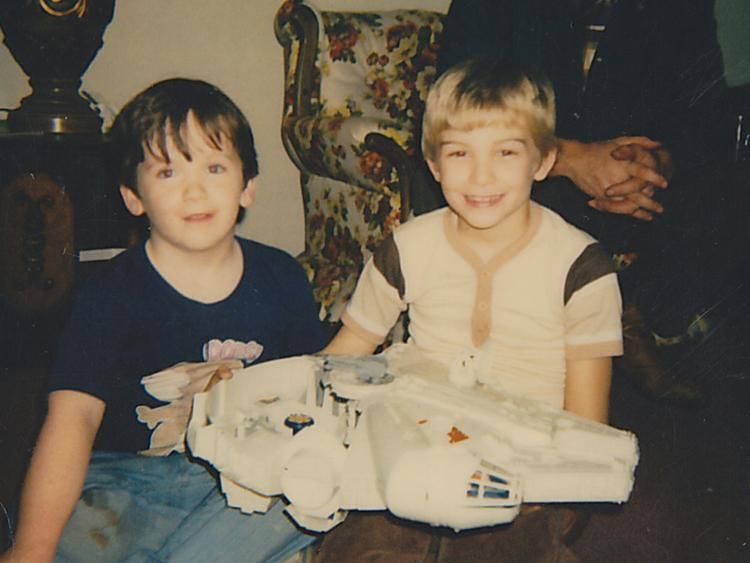
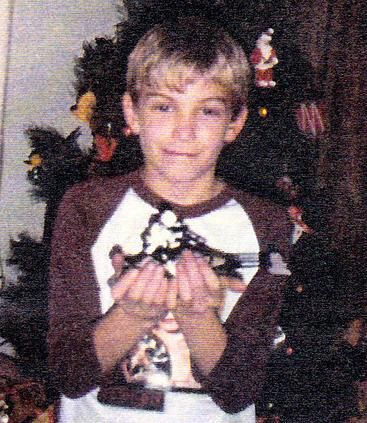
Jase Peeples (9 Years Old)

Pictured above: Peeples (at 9) posing with his a Speeder Bike and Scout Trooper action figure on Christmas Eve, 1983.
But while the young Jedi was awakening a force of one kind in me, Carrie Fisher’s Princess Leia made my young imagination jump to light speed. Every aspect of my own personality that earned me ridicule on the playground was a strength for the rebel princess. Leia was strong without compromising her femininity. She could serve sassy one-liners that rivaled Han Solo’s, and she still managed to look fabulous whether she was running through the belly of a space worm or brandishing a blaster on Bespin. I may have adored Luke, but Leia was my hero, and I soon became obsessed with Star Wars, snapping up every bit of merchandise I could get from anEmpire Strikes Back sleeping bag and T-shirts to the awesome action figures and play sets from Kenner toys.
Star Wars became a safe space for me, a fantasy world that was acceptable to visit on the playground or at home — one that never brought the ridicule that accompanied playing with Barbie dolls or skipping down the sidewalk singing, “Follow the yellow brick road.” My Star Wars action figure collection — which included Princess Leia in every available outfit — gave me the opportunity to role-play as characters that had a wide range of personality traits. I could be the sinister Darth Vader, the prissy C-3PO, the handsome Luke Skywalker, or the fierce Princess Leia. It only depended on the mood I was in.
When Return of the Jedi was released, my love of the space opera dramatically increased. The revelation that Luke was Leia’s brother made it easier to see him as an object of affection — though at the time I didn’t fully understand that’s what he was for me — since there was now no chance of a pesky heterosexual romance getting in the way. Their relationship was one that paralleled those I was forming with girls in my life at a time when other boys my age were just beginning to notice girls in another way.

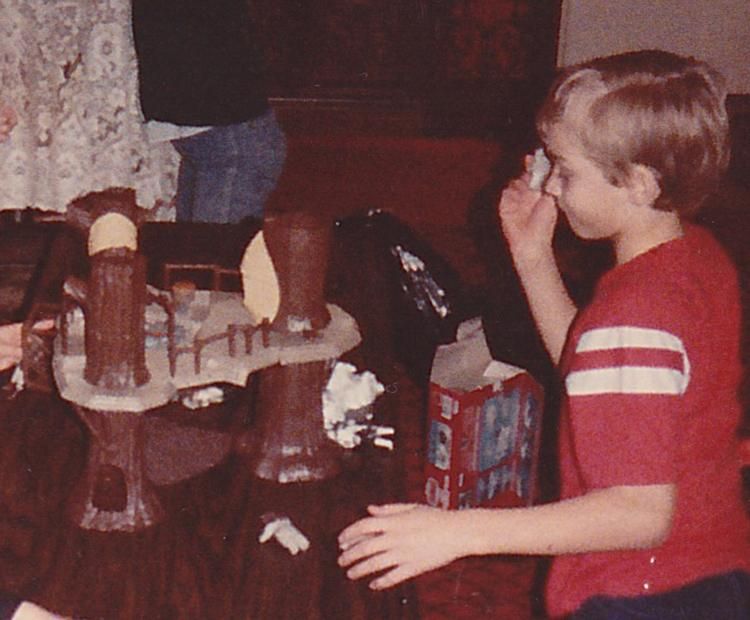
Jase Peeples (9 Years Old)

Pictured above: Peeples with the Ewok Village play set.
Topping it all off was the introduction of the Ewoks, warrior teddy bears who could take down even the biggest bullies and were about the coolest thing I had seen.  Carrying around a teddy bear at my age would elicit giggles and laughs, but a plush Wicket the Ewok? Well, that was just awesome!
Years later I would realize many other themes inherent in the Star Wars films that resonated with me as a gay kid, and I discovered many others felt those stirrings in the Force as well. While the story of a young man who leaves behind his small town to become his true self isn’t exclusive to the LGBT population, there are elements within the films that parallel our lives, and viewing the movies through a queer lens only makes the journey that much more personal. It’s this universality that has made Star Wars a pop culture touchstone for so many different people, a modern myth for anyone who needed to overcome the adversity of their own Galactic Empire.
The Star Wars universe was not only a place where I could freely express myself as a boy who often felt like an outsider, it also gave me a way to connect with my peers socially that leveled the playing field. As I sat in the theater watching The Force Awakens this week, I realized how this new installment of the franchise has the opportunity to do the same for an even greater number of young people.

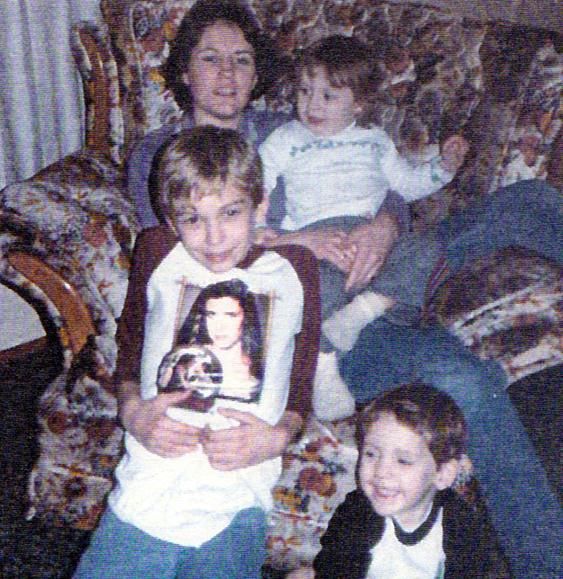
Jase Peeples and family.

Pictured above: Peeples rocks his favorite Princess Leia T-shirt. 
For the first time in a Star Wars film, a person of color isn’t a supporting character like Lando Calrissian or a wise teacher like Mace Windu who helps the heroes on their journey. Instead, John Boyega’s Finn is a character at the center of the story, finally giving young people of color a way to see themselves in a galaxy far, far away like they never have before.
Similarly, women hold positions of power in this film that were only hinted at in earlier instalments. Sure, Leia and Padme were strong, brave leaders, but as wonderful as they are, they were still side characters in a man’s story. In The Force Awakens, not only is Daisy Ridley’s Rey one of the two main characters, she’s a hero who greatly surpasses her female predecessors in the Star Wars films. She needs no man to rescue her and is fully capable of handling herself in a scuffle on the ground or a dogfight behind the controls of a starship. She’s stronger than Luke and twice as smart as Anakin.
However, Rey is far from the only powerful woman in Episode VII. From the return of Leia (now a general and the leader of the Resistance) to the mysterious Chrome-clad Stormtrooper Captain Phasma and the wise Maz Kanata (played by Lupita Nyong’o), it is the women who are both the action stars and the advisers in this film.
Star Wars: The Force Awakens has changed the game. Women and people of color are no longer represented by tokens and background players in a franchise that has been a global phenomenon for nearly 40 years. Images of Finn and Rey are currently plastered around every corner of the globe, even in countries where racist and sexist attitudes are more openly expressed than in the U.S., and those images bring with them the potential for social change around the world.

Jase Peeples and Family

It makes me smile thinking that a new generation of young girls and people of color will have an even better experience than the one I did on that Saturday in 1980. Millions of kids will leave the theater with a greater sense of what they can achieve because they saw someone like themselves projected on the screen. They won’t have to dig through alternate meanings or filter the movie through a different lens to feel included. Those images are already sculpted into action figures with multiple points of articulation, plastered on bags of potato chips, and adorn multiple pieces of activewear.
The images we see in entertainment influence our world view, not only in how we see ourselves, but in how we see others who are different. Disney and J.J. Abrams have used a globally loved piece of pop culture to move the needle forward for diversity with The Force Awakens, and that gives me hope that one day a young queer kid will have the chance to see a gay Jedi on the silver screen and realize that the Force is with him too … always.
JASE PEEPLES is The Advocate‘s entertainment editor and a contributor for Out and Plus magazine. He lives in Los Angeles. Follow him on Twitter @JasePeeples.

Filed Under: Movie Reviews Tagged With: entertainment, LGBT, movies, Star Wars

X-Men star opens up about first on-screen gay kiss in music video

03/01/2016 By ACOMSDave Leave a Comment

Troye Sivan had his first on-screen gay kiss in the video

Troye Sivan had his first on-screen gay kiss in the video

Actor and singer Troye Sivan has spoken about his first on-screen same-sex kiss, which took place in a video trilogy for his album Blue Neighbourhood.

The X-Men Origins: Wolverine star opened up about the emotional video trilogy which was directed by Tim Mattia.
Featuring three songs – ‘Wild’, ‘Fools’, and ‘Talk Me Down’, the videos follow a gay couple from their childhood friendship to a tragic ending.
1449284484900

“I heard these three songs but I just never listened to them in that particular order before”, Sivan said.

“You see a little girl and a little boy holding hands and everyone’s like, ‘Aww, sweet! When are you guys going to get married?’ I wanted to show that for young LGBT kids.’”
Of the passionate kissing scenes with co-star Matthew Eriksson, Sivan said he had not done anything quite like that before.
“I’d actually done it before with girls… It was my first time kissing a guy on screen. We had been friends on Facebook for a really long time but we had never met in person. The day after we met he was shirtless with his legs wrapped around me.”
Check out the video trilogy below:


https://www.pinknews.co.uk/2016/01/02/x-men-star-opens-up-about-first-on-screen-gay-kiss-in-music-video/

Filed Under: Movie Reviews, Music Reviews Tagged With: gay kiss, movies, music, Troye Sivan, x-men

The 10 Best LGBT Documentaries of 2015 (USA)

26/12/2015 By ACOMSDave Leave a Comment

OUT dot com logo
BY DANIEL REYNOLDS
THU, 2015-12-24

The year included some great investigations into queer stories.


Best of Enemies
This documentary covers the legendary televised 1968 political debates between liberal Gore Vidaland conservative William F. Buckley Jr., in which the two intellectuals didn’t always keep their rhetoric lofty — at one point Vidal called Buckley a “pro-crypto-Nazi” and Buckley responded by calling Vidal “queer” and threatening to punch him. Directed by Morgan Neville (an Oscar-winner forTwenty Feet From Stardom) and Robert Gordon, Best of Enemies is not only a master class in debate, it’s also one of the most entertaining films of the year.

Tig
In 2012, Tig Notaro made comic history when she joked about her cancer onstage at a club in Los Angeles. The heartfelt routine launched her into fame and the national spotlight. And Tig, a new Netflix movie, chronicles the aftermath, a story of a lesbian comedian and cancer survivor who is searching for meaning, love, and perhaps parenthood through surrogacy.

Tab Hunter Confidential
Hollywood’s all-American boy Tab Hunter is setting the record straight (by coming out as gay) in his new documentary, Tab Hunter Confidential. Based on his 2005 autobiography of the same title, the film by Jeffrey Schwarz (Vito, I Am Divine) explores how Hunter dealt with decades in the closet while making dozens of films and delves into as personal details like his love affair with Anthony Perkins. Sadly, Hunter’s struggle remains relevant in Tinseltown, as A-list stars are still grappling with the love that dare not speak its name. Perhaps they will find some courage from watching this insightful documentary.

Seed Money: The Chuck Holmes Story 
For nearly 30 years, Chuck Holmes’s Falcon Studios was the world’s largest producer of gay pornography, altering the way a generation of gay men saw themselves and their sexuality. Thestory of its founder is told in this insightful new documentary, Seed Money: The Chuck Holmes Story,directed by Mike Stabile. Through archival footage and interviews with porn stars, as well as Holmes’s long-term partner, Steven Scarborough, the documentary shows how one man achieved wealth and fame by reinventing how mainstream culture perceived gay men, while navigating the dangerous early days of the adult film industry.
RELATED | An Oral History of Early Gay Porn

Do I Sound Gay?
Is there such a thing as “gay voice”? That’s what David Thorpe’s documentary explores, with input from celebs including Margaret Cho, Tim Gunn, Don Lemon, Dan Savage, David Sedaris, and George Takei. A hit at film festivals and with critics, Do I Sound Gay? features conversations with linguists, family members, and strangers on the street to weigh in about one of the most personal and perhaps revealing parts of ourselves: our voice.

Larry Kramer in Love and Anger 
It’s been a landmark year for Larry Kramer. The HIV activist turned 80, released the book The American People: Volume 1, and was nominated for a slew of awards for the recent HBO adaptation of his 1985 play The Normal Heart. And now he’s the subject of a new documentary, Larry Kramer in Love and Anger, which documents his fight as a firebrand activist to make AIDS a national issue and change public health policy. Don’t miss the making of one of the LGBT community’s great activists.

The Glamour & The Squalor
Directed by Marq Evans, The Glamour & The Squalor tells the story of the legendary rock radio DJ Marco Collins. As a gatekeeper and great lover of music, Collins helped make the careers of bands like Weezer, Nirvana, and Pearl Jam by broadcasting their songs to the public. But in his private life, the Seattle-based figure was battling demons and struggling to keep his sexuality out of the public eye. Archival footage, animated re-creations, and interviews with artists like Carrie Brownstein, Macklemore, and Collins himself help tell one of the year’s most glam tales.

The Royal Road
One of the year’s most poetic documentaries comes from filmmaker Jenni Olson, who in addition to her cinematic contributions, is known as one of the founders of PlanetOut.com. Olson calls her new film, The Royal Road, “a cinematic essay in defense of remembering” as well as “a primer on the Spanish colonization of California and the Mexican American War alongside intimate reflections on nostalgia, butch identity, the pursuit of unavailable women and Alfred Hitchcock’s Vertigo — all against a contemplative backdrop of 16mm urban California landscapes, and featuring a voice-over cameo by Tony Kushner.” What’s not to love?

Mala Mala
Mala Mala is a timely new documentary that shows portraits of the transgender community in Puerto Rico. A hairstylist, a prostitute, an activist, and a RuPaul’s Drag Race star (April Carrion) are several of the subjects interviewed by directors Dan Sickles and Antonio Santini, who capture the discrimination and hardship that can come from one’s journey to selfhood.

A Sinner in Mecca
A gay Muslim filmmaker comes to term with his sexuality and his religion in A Sinner in Mecca. In this documentary, Parvez Sharma embarks on a hajj (a pilgrimage to Mecca) in Saudi Arabia, where it is not only a crime to be gay, it’s punishable by death. It is also forbidden to film in Mecca, making Sharma’s film an unprecedented view into a place and culture off-limits to most of the world

Filed Under: Movie Reviews Tagged With: best of, documentary, LGBT, LGBT Documentaries, movies

The 10 Best LGBT Films of 2015

23/12/2015 By ACOMSDave Leave a Comment

advocate_logo
 

i-am-michael-x750_2It’s the holiday season, which means it’s time to carol. Or at least, it’s time to sing our praises forCarol and the other LGBT cinematic standouts of the year.

Making a film with LGBT characters and themes is no easy task, even in a post–marriage equality country like the United States. Yet around the world, brave filmmakers continue to try, and they often succeed in creating stories that increase visibility and move the cultural needle for the LGBT community.
The Advocate salutes all these filmmakers and would like to give special recognition to several standout productions. Thus, here is a list of 10 of our favorite films from 2015 (in no specific order).

The New Girlfriend
Channeling Brian De Palma and Alfred Hitchcock, The New Girlfriend is a gender-bending new film by François Ozon (Swimming Pool). Set in France, the plot centers on the relationship between the characters of Claire and David. David’s wife (and Claire’s best friend) has recently died, and her passing makes David come to terms with their gender identity. Claire is at first alarmed, and then is seduced by “The New Girlfriend” in her life, as were we.

Carol
It’s New York in the 1950s. You’re working as a shopgirl in a department store, when suddenly, you lock eyes with a gorgeous older woman in a fur coat. You sell her a train set, but she forgets her gloves on the counter. Perhaps you should give her a call. So begins the electrifying romance between Therese (Rooney Mara) and Carol (Cate Blanchett), women who develop a friendship and then something far deeper in a time when same-sex love still dared not speak its name. Directed by Todd Haynes (Far From Heaven), the film was adapted for the screen by Phyllis Nagy from The Price of Salt, a 1952 romance novel written by Patricia Highsmith under the cover of a pen name. At the time, the story was highly unconventional, as its lesbian characters did not die or “meet the right man” or join a convent. It took decades before the world was ready for a film adaptation. At long last, audiences can see Carol in all its glory.

The Danish Girl
Eddie Redmayne delivers an astounding performance as 20th-century transgender icon Lili Elbe in director Tom Hooper’s The Danish Girl. An adaptation of a book of the same name by David Ebershoff, the film follows the remarkable love story inspired by the lives of artists Lili Elbe and Gerda Wegener (played by Alicia Vikander) as their relationship evolves while the two navigate Lili’s groundbreaking journey to discover her true self. “I hope others are as inspired by Lili’s story as I was and continue to be,” Redmayne told The Advocate. “At a time in which there were no predecessors that she knew of, she still had the absolute knowledge in herself of who she was and what she needed to do to liberate herself. The fact that she valued life and authenticity enough to give her everything and anything, I think that is extraordinary.”

Grandma
Grandma marks Lily Tomlin’s first lead role in a film in nearly three decades, which is one reason to celebrate. Another reason? The lesbian actress portrays a lesbian character — Ellie, a poet whose partner has recently died. The film, which has generated much-deserved acclaim for Tomlin’s performance, centers on the relationship between Ellie and her granddaughter as they go on a road trip together and confront their pain. What are grandmas for, darlin’?

Tangerine
Tangerine is one of the year’s most acclaimed independent darlings. Directed by Sean S. Baker and Chris Bergoch, the film follows the story of two friends, who also happen to be transgender sex workers, Alexandra and Sin-Dee Rella, across the backdrop of the saturated streets of Hollywood. And it’s shot entirely on an iPhone 5s. The story goes: Sin-Dee, after being released from prison, discovers that her boyfriend has been cheating on her with a white cisgender woman. Furious, she goes on a hunt for revenge and solicits Alexandra as an accomplice. And in the process, the friends show the audience a side of Los Angeles that is rarely seen in media. Nominated for four Spirit Awards, including acting nods for its leads, Tangerine is a must-see film.

Bessie
Queen Latifah stars as legendary bisexual blues singer Bessie Smith in the HBO film Bessie. Directed by out filmmaker Dee Rees (Pariah), the production charts Smith’s rise to fame through the 1920s and ’30s as one of the greatest talents of her time. It also stars Oscar winner Mo’Nique as her mentor (and rumored lover) Ma Rainey. Ooh-la-la! Don’t miss this Emmy Award–winning production.

I Am Michael
Michael Glatze, a former LGBT activist, ignited a firestorm of controversy when he publicly renounced his homosexuality and became an antigay born-again Christian. This “ex-gay” story is told cinematically in I Am Michael by writer and director Justin Kelly, who based the screenplay on a New York Times Magazine article by Benoit Denizet-Lewis. Glatze himselfpraised lead actor James Franco, whose performance he credits with being part of his own “gigantic healing process.” The rest of the cast, including Zachary Quinto as his ex-partner, do a wonderful job of telling a story that could have been quite judgmental but succeeds in recounting one man’s struggle for identity.

Eisenstein in Guanajuato
Soviet filmmaker Sergei Eisenstein, known for his 1925 classic Battleship Potemkin, is depicted in new, sensual light in the international biopic Eisenstein in Guanajuato. The film, which shows Eisenstein’s relationship with another man during his time in Mexico, has incited controversy in Eisenstein’s native Russia, which considers him a national hero from its cultural past. Directed by British filmmaker Peter Greenaway, Eisenstein in Guanajuato has been attacked for its accuracy (or lack thereof), but it has already proved itself a relevant, passionate, and much-needed film in a world that still tries to erase LGBT history.

Boy Meets Girl
Boy Meets Girl is a romantic comedy that crosses gender lines and is set (and was filmed in) rural Kentucky. The plot centers around four characters in a small town: a transgender woman (Michelle Hendley), a barista who aspires to be a fashion designer, a car mechanic (Michael Welch), a Southern belle (Alexandra Turshen), and a military veteran. As each of them grapples with love and identity, Boy Meets Girl itself becomes a quiet revolution in how a film with LGBT characters can be made.

Girlhood
French filmmaker Céline Sciamma is known for her coming-of-age classics like Water Lilies andTomboy, which explore how young people grapple with sexuality and gender identity. Her latest film, the acclaimed Girlhood, is no less revolutionary in its portrayal of a group of African-French teens navigating race, gender, class, and their own sexual identities in the Paris suburbs
 
Editorial
 
Now this list is what The Advocate has published, the question for our readers which LGBT film do they think is the best in 2015 – please let us know by writing in on our comments board and we will gather your votes and publish them.
 
leave-a-comment
 

Filed Under: Movie Reviews Tagged With: 2015, best of, Films, LGBT, movies

Holly Woodlawn – Transgender Artist

11/12/2015 By ACOMSDave Leave a Comment

15479

Holly Woodlawn | Getty Images | 15479

Holly Woodlawn, the transgender actress made famous by Andy Warhol and Paul Morrissey in their 1970s films Trash and Women in Revolt, has died after a battle with cancer at the age of 69 in Los Angeles. Holly was born Haroldo Santiago Franceschi Rodriguez Danhakl in Juana Diaz, Puerto Rico, in 1946.

At the age of 15, she took on the name Holly Woodlawn after running away from home and hitchhiking to New York City, where she became one of Warhol’s drag queen ‘superstars’.

These were a collection of New York personalities who appeared in Warhol’s artworks and accompanied him on social outings.
Holly’s story was immortalized in the first lines of the Lou Reed song Walk on the Wild Side.

‘Holly came from Miami, F.L.A. Hitchhiked her way across the U.S.A. Plucked her eyebrows on the way. Shaved her legs and then he was a she. She says, “Hey, babe, take a walk on the wild side.”‘

She took her first name from Holly Golightly, the heroine in Truman Capote’s novel Breakfast at Tiffany’s. The last name came from the Woodlawn Cemetery.

Holly Woodlawn, actress, born October 26, 1946, Juana Díaz, Puerto Rico, died December 6, 2015, Los Angeles.


WOMEN IN REVOLT (Paul Morrissey, 1971) (NSFW) from Spectacle Theater on Vimeo.

Filed Under: Movie Reviews Tagged With: Andy Warhol, movies, Paul Morrissey, transgender, Trash and Women in Revolt

  • 1
  • 2
  • Next Page »

Categories

Copyright ACOMSDave.com © 2026