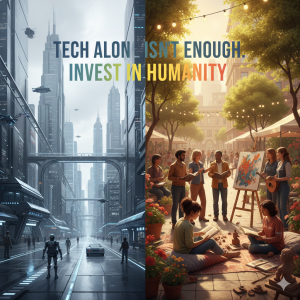
 Elif Shafak’s recent article in ‘The Observer’ really struck a chord with me. It’s a powerful reminder of why the humanities – literature, arts, history, philosophy – aren’t just nice-to-haves, but essential for a healthy society.
Shafak draws on Jules Verne’s forgotten dystopian novel, ‘Paris in the Twentieth Century’, where a poet is ridiculed for his “useless” skills in a world dominated by business and technology. Verne, known for his uncanny predictions, paints a bleak picture of a future devoid of human connection and empathy.
The article challenges the notion that the humanities are in decline, citing the steady readership of fiction worldwide. It emphasises the importance of “kairos” – deep time focused on meaning – over the fleeting “chronos” of our fast-paced world. Literature, Shafak argues, nourishes our need for meaning and connection, just like food and water.
However, the crux of the issue is that the humanities are under threat. Universities are shifting focus to “high-income disciplines,” devaluing subjects that foster critical thinking, empathy, and cultural understanding. As Shafak points out, cutting funding for culture has serious social and political consequences.
Empathy, that ability to “feel into” another’s existence, is crucial for a harmonious society. Literature allows us to step outside ourselves and connect with others, fostering understanding and breaking down barriers.
Shafak also connects the humanities to broader issues, such as climate change, water scarcity, and women’s rights, reminding us that everything is interconnected. A society that values only profit and technological advancement risks losing its sense of purpose.
Verne’s father wanted him to be a lawyer, but Verne’s heart was in storytelling. We need to encourage young people to pursue their passions, whether it’s law, math, or poetry. As the saying (often attributed to Verne) goes, we need to “dream with our eyes open,” combining imagination with knowledge and critical thinking.
The humanities aren’t a luxury; they’re a necessity. They equip us with the tools to navigate a complex world, connect with others, and build a more just and compassionate future. Let’s not let Verne’s dystopia become our reality.

 BRI
BRI
 Failure is not an option

 In the ‘i’ published on the 13 December 2016, Richard Vaughan wrote an article ‘Super-selective schools ‘would transform state education’. The article was reporting on Lord O’Shaughnessy’s call for the introduction of a network of highly selective comprehensive schools to cater for the most ‘cognitively able’children.
 division and privilege. Because of this in 1965, the government ordered local education authorities to start phasing out grammar schools and secondary moderns to be replaced with a comprehensive system.
 My take on this and other reports is that selection into special schools doesn’t need to occur. What we need is more resources into all of our schools, not the dilution of what we currently have. Teachers, as I have written about before, need resources (these are not just the things like buildings that are a fit for purpose, equipment that is up to date, books etc; but also more time to plan and to support children at all levels). I cannot and do not see that introducing a new ‘grammar stream system’ in ‘special schools’ who will of course get all the new resources, will help the rest of the children not attending those schools!