ACOMSDave

Community Journalist

  • Home
  • Community Journalist
  • Events
  • Media Page and Press Kit
    • Projects and Work
  • Resources & Documents
    • LGBTQ+ Support Groups and Documents
  • NIGRA
  • Archives
  • Contact

Archives for March 2015

The Happy Gordons

25/03/2015 By David McFarlane Leave a Comment

The Happy Gordons

Lakme Productions

This video documentary sets out to examine Gay life in Ireland, and gives most of its 26 minutes to Irish lesbians and gay men in New York.  These include Anne Maguire of the ILGO (Irish Lesbian and Gay Organisation) taking being arrested and hassled by Noo Yoicks Finest (the polis) calmly in her stride, Billy Quinn a Dublin-born artist and Tariach MacNaillais.
Tariach came to Gay politics by way of the Hunger Strikes agitation and says he was told than an out Gay man was not going to be employed in his field of Youth and Community Work.  The other person from Northern Ireland who spoke, Cherry Smyth, lives in London (England, UK).  She is of middle-class, liberal Protestant origin.  Her parents had she makes clear, no insuperable problems with her sexuality.  She also said things about “being Irish” which I found difficult to grasp.  You don’t have to be Catholic and Gaelic to be Irish.  Who said you did?  Why does “being Irish” matter?
Billy Quinn is a working class Dubliner who was sexually abused in his childhood and has worked in bars from a very yong age.  Where he acquired his rather plummy accent is a mystery.  He compared Molly Bloom unfavourably with Jane Austen’s heroines.  The latter were prissy and repressed but James Joyce’s Molly was a great sexual Earth-Mother.  This proves he hasn’t read either Joyce or Austen.  Compared, for example, with Chaucer’s Wife of Bath, Molly is positively south.  Jane Austen, a great comic writer, is central to English, even British culture.  Joyce is not central to modern Irish culture.  Billy Quinn’s paintings, founded, so far as one could see, in a culture of “wee holy pictures” and fold Catholicism seems far more relevant to what one could almost call a post-Catholic Republic than Joyce, the middle-European intellectual.
Quinn says that many of his friends found the news that Ireland had abandoned practically all of the laws criminalising Gay sexuality almost impossible to believe.  Kieran Rose explained why it was not impossible in the rather short amount of time he was allowed.  Mike Quinlan said that ten years ago a Pride demo “ran down Grafton Street”, implying that this was nervousness on the part of the marchers – rather than the fact that a decision was taken to hurry us up with fantastic disco tracks.  In 1992, GLEN (the Gay and Lesbian Equality Network) decided on a Pride for Dublin: the fact that Galway was organising its third and Belfast its second Pride[s] was neither here nor there of course … not.
The video looks very good.  You can’t really miss with the New York skyline and the Irish scenery, and the excitement of a big public ceremony, namely St Patrick’s Day parade.  A flash of wit was a group of red-necks carrying an AOH banner marked ‘Orange County’.  There was a flash of Belfat Pride with a bible-0thumper given more time to talk than the locals.  There was a cut to Catholic objectors to Dublin Pride, which appeared to be saying that one was as bad as the other.  But the Paisleyites put up a bigger (if not a better) show.
The Sin Fein banner was shown at the Dublin Pride demo (it was the one which came days after the change in the law).  Why, one wonders?  There were a dozen – at least – ‘straight’ political groups there, including Democratic Left and its leader De Rossa.  There was also the Socialist Workers Movement, which has been assiduous in it support of Gay groups – to the point of being irritating.  Why were they not shown?
There did seem to be a rather simple-minded (straight) political agenda behind these images or lack of the, including the non-appearance of people who actually live in Northern Ireland (not to mention the rest of the island).
This sort of thing is not inherently a bad thing artistically – it can give a certain flavour to a work.  But the special flavour of the place (Ireland-in-general and Northern Ireland in particular) leached away, mainly because most of the people talking had lived outside of the island for the greater part of their short lives.
There were really two videos fighting to get out of this one.  Maybe Paula Crickard, the director, should re-splice the material and produce one on New York and one (possibly even two) on Ireland – there are plenty of tales worth the telling.
 
Reviewer; Sean McGouran  Reprinted from upstart print edition

Should the YouTube copy of this documentary stop working, then it can also be viewed at the Northern Visions Archive

Filed Under: Movie Reviews Tagged With: Gay Pride, Irish Diaspora, lakme productions, Lesbianism, LGBT, New York, northern visions, St. Patrick's Day

My boyfriend killed himself because his family couldn’t accept that he was gay

25/03/2015 By David McFarlane Leave a Comment

Nazim Mahmood jumped to his death from a balcony seven months ago after coming out to his parents. His partner of 13 years, Matthew Ogston, talks to Sarfraz Manzoor
Matthew Ogston Nazeem Mahmood
Nazim Mahmood and Matthew Ogston in Iceland in 2008.
Sarfraz Manzoor
Saturday 21 March 2015 05.59 GMT Last modified on Monday 23 March 2015 15.32 GMT
In the spring of last year, Matthew Ogston and Nazim Mahmood moved into their dream home. The apartment, on the top floor of a mansion block in north-west London, offered stunning panoramic views of London. Nazim was a doctor who ran three London clinics, Matthew a web designer.
The life Nazim enjoyed seemed a world away from the working-class traditional Muslim community in which he had been raised. It was that world – conservative and closed – that he had left behind for a new life. In their first week in the flat, the two men stood on the balcony as London glittered in front of them. Matthew looked at Nazim and said, “Darling, I think we’ve finally made it.” They both smiled. Four months later, Nazim jumped off the edge of that same balcony to his death. He was 34.
Nazim was 21 when he met Matthew in November 2001. Matthew was at a gay nightclub in Birmingham, when Nazim approached with the words, “Excuse me, may I sit here?” Something about Nazim’s shy demeanour appealed to Matthew. They started talking. “There was an instant connection,” he recalls.
We are in the living room of the apartment. It is more than seven months since Nazim’s death but the condolence cards are still on display. This is the first time Matthew has agreed to talk openly, and during the hours we talk, words tumble and tears flow. It was only minutes after first meeting him that Nazim had said to Matthew: “I’m a Muslim, is that going to be a problem?”
Matthew Ogston
Matthew Ogston Facebook Twitter Pinterest
Matthew and Nazim with their dog Charlie in 2007.
The two were soon inseparable. Matthew was working as a web designer and Nazim was a medical student. Their families did not know they were gay. After a year they bought a house. It had two bedrooms so their families might assume they were just housemates. “We used to have to keep the window blinds in our front room closed so no one would see us,” says Matthew. “When we walked down the street we made sure there was some distance between us just in case a family member of his spotted us together.”
They grew tired of looking over their shoulders and wanted to stop hiding, so when Nazim was offered a job at a London hospital in 2004 they seized the opportunity to move to the capital. They would be far from their families, in a city where they knew no one and could fashion a new life together. “In London we felt free,” Matthew says. “We didn’t have to worry about bumping into our parents.”
They made friends and created a social world that reflected the people they were. Of necessity, this new life was founded on sadness and deceptions. Nazim was leading a double life: his family had barely met Matthew and thought he was merely an investor in their son’s flat. On the rare occasions they visited London, Matthew had to spend the night in a bed and breakfast. “We had to ‘de-gay’ the house,” says Matthew. “That meant putting pictures of Kylie into the cupboard, Cher too – and any photo or memento that suggested a relationship had to go.”
Nazim didn’t like to talk about his family. He had left Birmingham and felt that to talk about pain or sadness or guilt would have infected the new life they had created in London – he was resigned to playing the dutiful Muslim boy to his family in Birmingham when, in fact, he was a happily gay man in London.
To celebrate the 10th anniversary of their first meeting, Matthew and Nazim threw a party at a London club. Nazim was now a GP as well as running his own business – three London clinics that offered Botox treatments – and Matthew was doing well working for a software company. During the party, Matthew asked the DJ to lower the music. He led Nazim into the DJ booth, got down on one knee and proposed. “He looked at me and his face was just lit up,” says Matthew.
The following year, Matthew came out to his parents, who were loving and accepting of both of them, but for Nazim, whose family were culturally conservative Muslims, the only strategy was to keep the solid borderlines between the old life in Birmingham and the new life in London.
On the last Saturday of July 2014, Nazim and Matthew drove north to Birmingham. It was a strange time: a close friend had died and they had to be back in London on the Monday for his memorial service. It was also the weekend of Eid, the Muslim festival.
When he arrived, Nazim’s family were annoyed that he was late for the Eid celebrations and planned to leave early for the memorial. Things were said – Matthew does not know what, exactly – that left Nazim distraught. “I am a good person,” Nazim said, weeping. “Why can’t people accept me for who I am?”
“Is it because you like men?” his mother had asked him, out of the blue. And Nazim, who had spent years hiding and pretending, to protect his relationship with Matthew, did something he had never expected to do: on the spur of the moment, he told them everything.
Matthew Ogston
Matthew and Nazim at a friend’s wedding in 2005.
Nazim was in a state of shock as he drove back to London. It emerged at the inquest in December 2014 that he had told his mother he was gay and had been in a relationship with a man for 13 years, and planned to marry him. Her response was to tell Nazim to consult a psychiatrist with a view to being “cured”.
The coroner, Mary Hassell, ruled that Nazeem killed himself. She said: “It seems incredible that a young man with so much going for him could have taken his own life. But what I’ve heard is that he had one great sadness which was the difficulty his family had in accepting his sexuality.”
Nazim had never planned to reveal his sexuality and found it hard to process his mother’s extreme reaction.
The couple went to the service for their dead friend that evening and a second ceremony the following day, but Matthew recalls Nazim being distant, but trying to put on a brave face. On Tuesday evening, Nazim helped with paperwork for the new job Matthew would start the following morning and then they retired to bed.
In the office next day, Matthew got a text from his sister, saying simply “call me now”. It was early evening on Wednesday 30 July. He rang her and was told to go home immediately; she would not say why. It couldn’t be Nazim – they had talked at lunchtime and Nazim had called again at just after 3pm and then twice after 5pm, but it was Matthew’s first day in a new office and he had been too busy in meetings to take the calls, though he had tried to call Nazim back. Had there been a bomb scare at the flat?
As he left West Hampstead station Matthew began to run. “It was like I was running for my life,” he recalls.
As he speaks, he is clutching himself tightly, right hand gripping his biceps. “I was pushing people out of the way and as I came round the corner I saw flashing blue lights and police cordon tape, then I saw this red blanket on the floor covering something up.”
He began to scream. He was bundled into a police car as friends started to show up, faces grey with shock.

A TV interview with Matthew about the problems faced by many Asian men in coming out to their families.
Matthew arrived at Handsworth cemetery early on the day of Nazim’s funeral. In the aftermath of the death, Matthew had met Nazim’s family but the encounters were tense and uncomfortable. It appears that they did not want to have to deal with what they considered the shame of having had a gay son, and a gay son with a non-Muslim lover. Out of respect for Nazim’s mother’s plea not to make a scene at Nazim’s burial, Matthew agreed not to ask for a major role at the funeral, which was due to take place at 3.30pm.
With less than half an hour to go, nobody else had arrived and Matthew began to worry. In the distance he could see a burial taking place. “I went over and asked one of the officials where Nazim was being buried,” he said. “She said, ‘I’m really sorry – they have already buried him.’”
He ran out and saw Nazim’s family pouring dirt on to the coffin. “I was so angry,” Matthew tells me, tears streaming down his face, “I could not move. My arms and legs were just clenched. I felt completely betrayed.”
Nazim’s family had apparently given him the wrong time for the funeral.
He returned to London feeling desperately low. “I wanted to end it all,” he says quietly. “Follow Naz and leap off the balcony.”
His friends ensured he always had at least three people with him round the clock. “Every time I tried to get to the edge of the balcony, my friends would stop me. I couldn’t find a reason to stay alive.”
Then, in his distress, Matthew recalls: “I heard Naz’s voice.”
He is convinced that Nazim spoke to him, telling him to set up a foundation to help other young gay men and women driven to depression because of religious homophobia. He had a reason to go on at last.
The Naz and Matt Foundation was announced at a special service held in London for Nazim, two weeks after his funeral. The service featured contributions from a gay Muslim, gay Hindu, a gay vicar, a trainee Rabbi and a lesbian interfaith minister. Matthew has been seeing a psychotherapist but he doubts any counsellor can help to liberate him from the questions that haunt him. “I don’t have answers to the questions I have and I can’t find peace of mind because there are no answers.”
Who does Matthew blame for Nazim’s death? “I blame a community that is so closed minded to allow these bigoted views that make families believe that their honour is more important than loving their children,” he says. “The respect and honour of the family is more important than the happiness of the children they gave birth to. How sick is that?”
The purpose of the Naz and Matt Foundation is to confront and challenge these views. Matthew says the foundation has given him a reason to stay alive but he is still finding it hard to come to terms with Nazim’s death. “I am on medication for sleep and anxiety,” he says. “I can’t face going to sleep because I know I will have to wake up and face more sadness, because he’s not there.”
Nazim is gone but in the home they shared he is everywhere. A large painting of him rests against one wall, photographs arranged around the room. The condolence cards read “With deepest sympathy”, and “So sorry for your loss” and so on.
We have talked for more than five hours and Matthew looks emotionally exhausted as I prepare to leave. A digital picture frame has settled on an image from the party where Matthew proposed to Nazim. They were engaged for three years but didn’t marry. “I have applied to have my name changed by deed poll to the name I would have adopted when we got married,” he says.
Why didn’t they get married? “Naz said it would not feel right to marry without being able to invite his mother,” says Matthew. “He wanted the unconditional love of his mum – that was all he had ever wanted: love and acceptance.”
nazandmattfoundation.org
@sarfrazmanzoor
Samaritans: 08457 909090 (24-hour national helpline)
 
Read more: http://www.theguardian.com/lifeandstyle/2015/mar/21/my-boyfriend-killed-himself-because-his-family-couldnt-accept-that-he-was-gay

Filed Under: Anti-Bullying & Homophobia Tagged With: Bereavement, Birmingham, Death and dying, Doctors, family, gay marriage, homophobia, Islam, LGBT rights, Parents and parenting

£2 Million Awards Announced From Homophobic Bullying Fund

25/03/2015 By David McFarlane Leave a Comment

Image result for political dogma cartoons northern irelandHomophobic bullying is still happening throughout society, and in particular in our schools.  None of us condone it, but very few of us actually do anything concrete to stop it, and in particular families of LGBT kids are often to quiet in challenging schools/colleges/universities when they are aware of what has happened to their child or to someone they know.

In our previous comment on the Ashers Bakery case, we noted that the Office of the First MInister along with the Deputy First Minister funds the Equality Commission, this means they are responsible for ensuring equality in our schools but why is it that our legislative bodies seem to be dragging their feet over ensuring that our children our safe from any kind of bullying in our schools?

Is political dogma getting in the why of natural rights?  I will let you decide when you next speak to your MLA/MP and at the ballot box.

£2 Million Awards Announced From Homophobic Bullying Fund

By The Gay UK, Mar 24 2015 03:43PM

Funds awarded to projects to train school staff and provide support for pupils affected by homophobic, biphobic and transphobic bullying.

◉ Stonewall awarded nearly half million pounds of the £2million total.
◉ Minister for Women and Equalities Jo Swinson, said, “It’s good news that schools are making progress on homophobic bullying
Classroom (C) Thomas Favre-Bulle via Flickr

Classroom (C) Thomas Favre-Bulle via Flickr
Today eight organisations will be told they are to get a share of £2 million to help prevent and eradicate homophobic, biphobic and transphobic (HBT) bullying. The funding was announced by Jo Swinson, Minister for Women and Equalities, and Secretary of State for Education, Nicky Morgan, in October 2014.
Homophobic bullying in schools is decreasing: 55 per cent of lesbian, gay and bisexual young people surveyed for Stonewall’s 2012 School Report said they had experienced homophobic bullying, down from 65 per cent in 2009.
However further action is still needed. Metro’s Youth Chances Survey 2014 found that more than half of gay young people had experienced either discrimination or harassment. In a report from Stonewall last year 86 per cent of secondary school teachers and 45 per cent of primary school teachers said pupils at their school had experienced homophobic bullying. Most (89 per cent for secondary schools and 70 per cent for primary) had heard homophobic language used. Teachers say they lack the knowledge and confidence to tackle HBT bullying effectively. These projects will help to build that confidence by providing training and resources for school staff.
Minister for Women and Equalities, Jo Swinson, said, “It’s good news that schools are making progress on homophobic bullying, but it must be eradicated entirely. The trauma of being bullied at school can stay with you for life, and it is absolutely unacceptable that those who may be gay, lesbian, bisexual and transgender are being targeted. Teachers need specialist support and training to help them stamp out homophobic bullying, which is why we have funded these excellent projects which are designed to tackle this issue head on.”
The organisations awarded funding are:
Anne Frank Trust (£104,894) – to run workshops and educate young people about prejudice and the impact of the Holocaust on lesbian, gay and bisexual people.
Barnardo’s (£263,218) – to provide face-to-face support for victims of HBT bullying and training for staff with a focus on cultural issues in schools in Leeds and Wakefield.
Diversity Role Models with Brook (£277,722) – to develop and deliver training on tackling HBT bullying to 10,000 teachers and staff in 400 schools.
EACH (£189,304) – to deliver a training and resource programme in schools across Avon and Somerset.
Educate and Celebrate (£214,048) – to train staff in 60 schools, giving them confidence and strategies to address HBT language and bullying and promote inclusiveness throughout the school environment and the curriculum.
National Children’s Bureau (£128,754)– to train 1,500 teachers on tackling homophobia, biphobia and transphobia through PSHE.
Show Racism the Red Card (£119,557)– to hold workshops with 2,000 young people at football clubs around England, train 200 teachers and run a film competition for young people on tackling HBT bullying.
Stonewall (£465,594) – to extend and share its ‘train the trainer’ course with 60 partner organisations, enabling them to run the programme with schools in their local communities and giving them the skills to tackle HBT bullying.
ALSO READ:1 in ten calls to Samartians are worried about their sexualityMarcel Varney, Assistant Director for Barnardo’s, said, “At Barnardo’s, we hear about HBT bullying from the young people we work with across the organisation. We know that the bullying of a young person because of their sexuality can be incredibly damaging and can impact dramatically on a young person’s ability to succeed at school.
“This commitment from the government will enable us to reach hundreds of young people to alert them to the impact of HBT bullying. It‘s a big step towards stamping out HBT bullying. We aim to improve the visibility of LGBT lives in the school environment and ensure that young people are supported regardless of culture or religion.”

Filed Under: Anti-Bullying & Homophobia Tagged With: bullying, homophobia, news, politics, UK

Peter Robinson hits out at cost of Ashers Bakery court case

25/03/2015 By David McFarlane Leave a Comment


As with all reporting, a balance must be sought between both sides of a dispute.  When a legal case was not sought or indeed envisaged by the person who placed the ordr for the cake, nor I am certain were Asher’s wishing to be in the limelight for an equality case, the fact is that they both are now tangent to what is happening.  The Equality Commission, established in 1998, has duties which derive from a number of statutes which have been enacted over the last decades, providing protection against discrimination on the grounds of age, disability, race, religion and political opinion, sex and sexual orientation. They also have responsibilities arising from the Northern Ireland Act 1998 in respect of the statutory equality and good relations duties which apply to public authorities. However, importantly, they are sponsoring Department is the Office of the First and deputy First Minister which carries responsibilities for equality policy and legislation in the Northern Ireland Executive.
With these facts in mind, it is obvious that the Equality Commission is fulfilling its mission within the statues.  What is not so obvious is why the Office of the First Minister in the person of Rt Hon Peter D Robinson MLA would seem to be at odds with the body that it provides funding for.  However, politics does make strange bedfellows, as can be seen in the Belfast Telegraph report below.
But before you make your mind up on this case, please remember that all legal cases have an impact on our future; and that if we allow politicians to ram down our throats that we are second class citizens for any reason, what next in our rights will be eroded away?
I will also note that most of the newspapers have carefully put a photograph of the Asher family to the front, with the inference being that here is the ‘perfect, normal’ family which the DUP and its supporters rave about!
Pacemaker Press 6/11/2014<br /><br /><br /><br />
Daniel  and Amy McArthur with their Baby Girl Elia,  Daniel from Ashers Baking Company refused to bake a cake with a pro-gay marriage slogan.  The Equality Commission are now going  to take  civil action against a Christian-owned bakery firm.<br /><br /><br /><br />
Pic Colm Lenaghan/Pacemaker

Pacemaker Press 6/11/2014 Daniel and Amy McArthur with their Baby Girl Elia, Daniel from Ashers Baking Company refused to bake a cake with a pro-gay marriage slogan. The Equality Commission are now going to take civil action against a Christian-owned bakery firm. Pic Colm Lenaghan/Pacemaker

BY JOANNE SWEENEY – 24 MARCH 2015

First Minister Peter Robinson has accused the Equality Commission of spending up to £33,000 to seek court damages worth £500 from a Christian-owned bakery.

The commission has brought a civil case against Ashers Baking Company after it refused to bake a cake with a pro-gay marriage slogan. The two-day hearing is due in the High Court later this week.
The DUP leader said: “When you consider that they have set aside the potential of spending £33,000 on this court case where they are seeking damages of £500 against Ashers, there is a better use that could be put to that money, particularly in the tight fiscal situation the Executive faces.” Ashers is facing the action after it refused to supply a pro-gay marriage cake on grounds of the owners’ religious views.
A new poll released yesterday found that more than 70% of people believe it is wrong for a Christian bakery to be taken to court over its refusal to make a cake supporting gay marriage. As the case approaches, the debate has intensifed between Christian-based groups, including church leaders, and pro-gay groups.

 A human rights academic has claimed that businesses owned by Christians have a legal way of providing services while not approving of gay relationships.

Professor Steven Greer has suggested that busin esses can print a disclaimer on invoices, websites, and other business documents, to say that compliance with statutory requirements does not constitute approval of the activities in question. In a commentary piece, the Bristol University professor argues that the courts need to strike a balance between competing rights and interests.
Mr Greer believes that a ‘conscience clause’ bill proposed to the Assembly by the DUP’s Paul Givan has little chance of ever being introduced as it would be repealed by Westminster and legally challenged in Strasbourg.
He suggests: “Those providing goods and services in Northern Ireland who do not approve of gay relationships, could and should simply issue a disclaimer on their invoices, websites, and other business documents to the effect that compliance with relevant statutory requirements does not necessarily constitute approval of the activities in question.”

Churches across Northern Ireland have been encouraged by the Christian Institute to highlight a support meeting to their members tonight at Belfast’s Waterfront Hall while pro-gay rights rallies have been held in various towns.

‘How simple disclaimer could be solution to the rights versus conscience deadlock’

There could be a way round the difficulties thrown up by the Ashers case, writes Prof Steven Greer:

This Thursday, the District Judges Court in Belfast will begin hearing a case, brought by the Equality Commission for Northern Ireland on behalf of gay activist Mr Gareth Lee, against Ashers Baking Company for alleged breach of statutory duty not to discriminate on the grounds of sexual orientation in the provision of goods or services.

On the basis of strongly held Christian beliefs, the bakery declined an order from Mr Lee for a cake decorated with Sesame Street characters Bert and Ernie in a friendly but not intimate embrace, the logo of the campaign group ‘QueerSpace’, and the slogan ‘Support Gay Marriage’.

There seems little doubt that Ashers will lose the litigation, and that Mr Lee will be modestly compensated, because the legislation in question, the Equality Act (Sexual Orientation) Regulations (Northern Ireland) 2006, does not provide an exemption on any ground, including religious faith.

Possibly anticipating this outcome, DUP Assembly member, Paul Givan, is seeking to provide one by way of a Private Members Bill supported by his party and the Catholic Church amongst others. Mr Givan’s amendment would not legalise all refusals to supply goods and services to gays in Northern Ireland.

It would, instead, provide a ‘conscience clause’ permitting those with strongly held religious views to avoid ‘endorsing, promoting or facilitating behaviour or beliefs’ which conflict with these convictions. Some have claimed that the current position in Northern Ireland is ‘Christianophobic’ — intolerant of and discriminatory towards Christians. And, according to First Minister Peter Robinson, the Equality Commission’s case amounts simply to ‘bullying’.

For these and others, the proposed amendment would, merely provide an appropriate, measured solution to a genuine conflict between the right to freedom of thought, conscience and religion, on the one hand, and the right not to be discriminated against due to sexual preference on the other. By contrast, others regard it as an attempt to legalise homophobia.

The right not to be discriminated against on the basis of sexual preference is clear in international human rights law with, for example, the decriminalization of private, consensual, adult, gay sex mandatory throughout the 47-member Council of Europe, no matter how strong national or regional opposition. And for good reason.

Gay, lesbian, bisexual and transgender people have long suffered, not just discrimination, but often savage mistreatment merely for claiming identities or engaging in private, consensual, adult sexual activities, of which others disapprove. The scope of the right to freedom of thought, conscience and religion is, however, less clear.

Since it unquestionably includes the right not to be compelled to believe against conscience, religious conservatives are well within their rights to regard gay sex as inherently wrong because God forbids it.

But the permissibility of the expression of religious belief, in commercial and other spheres, hinges fundamentally upon its consequences, including and especially how others are affected.

Were Mr Givan’s amendment to be passed, same-sex couples in Northern Ireland could, for example, be lawfully denied a table at a restaurant, a room in a hotel, or a mortgage, on the grounds that this would otherwise endorse or facilitate same-sex unions.

But, apart from a sense of discomfort, distaste or outrage, it is not at all clear what loss or damage is suffered by those who feel that being required to provide gays with customised goods and services compels them to act contrary to their core religious beliefs.

Such a ‘loss’, if a loss it is at all, pales into insignificance compared with the tangible and potentially substantial damage which could be sustained by gay couples in such circumstances.

There is, in any case, a simpler solution to these difficulties. Instead of an exemption from the 2006 regulations, those providing goods and services in Northern Ireland who do not approve of gay relationships, could and should simply issue a disclaimer on their invoices, websites, and other business documents to the effect that compliance with relevant statutory requirements does not necessarily constitute approval of the activities in question.

Steven Greer was born and raised in Belfast and is currently Professor of Human Rights at the University of Bristol Law School

Filed Under: Anti-Bullying & Homophobia, History Tagged With: Ashers bakery, equality commission, Jeff Dudgeon, law in northern ireland, LGBT, peter robinson MLA, william crawley

Dafydd from BBC Wales Playhouse Series

24/03/2015 By David McFarlane Leave a Comment

Reviewed in ‘upstart‘

  • Actors: Richard Harrington, William Thomas
  • Directors: Ceri Sherlock
  • Producers: Gareth Rowlands

 
BBC Cymru/BBC Wales – Wales Playhouse TV Series
the problem with this 55 minute long program/video/movie (directed by Ruth Caleb, distributed by Pride Video [Currently unavailable] is that it attempts too much and too little.  Dafydd, from Pontypridd, meets David Davies in Amsterdam.  Dafydd is a rent boy (how he got to Amsterdam, why he is a rent boyand not a druggie like the rest of the boys is not explained.  His only characteristic, apart from being Welsh-speaking, is a love of opera).  Davies (William Thomas) is something in music, he tells Dafydd he is a teacher, but appears to be in Amsterdam on administrative business.
Davies’ brutal death, apparently at the hands of a (female) prostitute and her pimp ends the drama.  It doesn’t ring true, nor do a lot of other incidents in this movie, not even as dramatic devices.  The pimp, earlier, sems to have been asking Dafydd for (at least) physical comfort.  The “real” Gay boys in this drama are quite effeminate.  They are seen hanging about the quays and toilets.
Richard Harrington (Dafydd) is the psossessor of the most eloquent nostrils since Kenneth Williams’ heyday.  He’s playing against type here.  David Davies is described in the blurb as having problems with his sexuality.  This is demonstrated by showing images of (her) SM.  In “real life” he’d be bisexual.  It seems that bi’s are going through the grisly murder/pathetic suicide cycle (like lesbians and homosexual men) before being absorbed into drama as characters in teir own right.
This little drama has all of the Beeb’s virtues and failings.  There are brilliant production values, photography and acting.  There is also timidity.  Sex is not a cheerful subject.  The cheeriest scene is where Dafydd and two sissy boys break into a disco and dance – and drink and take drugs – with their kit all the way off.  This video breaks no new ground, other than to put Welsh intto the mouths of the protagonists, and to introduce Richard Harrington to a wider audience.  (He is very comely in the buff, as smooth-skinned and hairless as an Irish boy).
Well, then |NorIrl Beeb and UTV, when are we getting an Ulster spin on matters Gay?  How about a wee (Gay girl from the Shankill meets a wee similar from the (Short) Strand in ’72 and live in connubial bliss in Sunnyside Street?Dafydd (1995) Poster
 
Reviewer:  Sean McGouran
 
Further reading:

  • IMDB – Wales Playhouse: Season 3, Episode 2 Dafydd (17 Jan 1995)

Filed Under: TV programme reviews Tagged With: BBC Cymry, BBC Wales, Pride Productions, Richard Harrington, Ruth Caleb

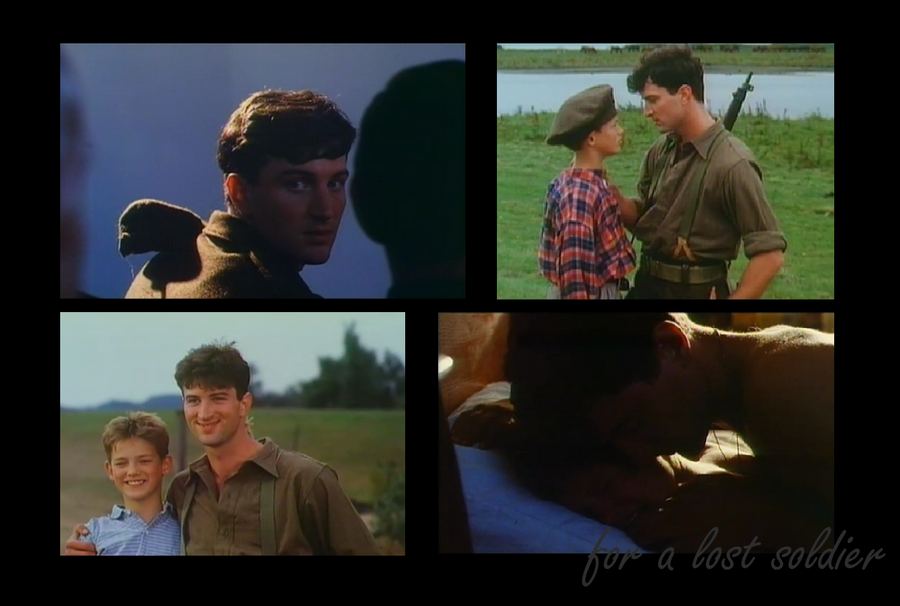
For a lost soldier [1992] – Movie Review

24/03/2015 By David McFarlane 1 Comment

For A Lost Soldier [1992]

  • Studio: Strand Home Video
  • Actors: Maarten Smit, Andrew Kelley, Jeroen Krabbé, Freark Smink, Elsje de Wijn
  • Directors: Roeland Kerbosch
  • Writers: Roeland Kerbosch, Don Bloch, Rudi van Dantzig
  • Producers: Guurtje Buddenberg, Matthijs van Heijningen

‘For a lost soldier‘  breaks all the barriers regarding male sex – a young boy reaching puberty introduced to the pleasure of love with an adult man.  A man who is a transient soldier,
 
Based during the Second World War in Holland when the Allies started liberating Europe, this film stirs something in everybody, whether it be loathing, liking or ambivalence.
I loved this film  The main characters, 12-year-old Jeroen (Marten Smit) and Walt (Andrew Kelley) are totally believable.  They both bring a spark of originality to what could have been a very low key, possibly boring story.
My only criticism is regarding the actor playing the adult Jeroen, he did not in my view do justice to the acting of the boy.  He did not convince me in his description of the dance moves, or in his part.  Possibly this could be the directing, but I do not feel so.
Please do not come to this film expecting excitement, blood or guts, you won’t get them.  This film is full of tenderness, love and the possibility of a happy-ever-after ending.
Get it out on DVD, or see it in the cinema, you won’t be disappointed.


Links:

  • You tube – For a lost soldier
  • Wikipedia – For a lost solider
  • You Tube – Voor een verloren soldaat (For a Lost Soldier) 1992 Full Movie
  • Video Review: ONE IN FIVE BRITISH GAY TEENS BULLIED IN SCHOOL BY TEACHERS OR OTHER ADULTS
  • Grief – 1993 (Movie Review)

Filed Under: Book Reviews, Movie Reviews Tagged With: Andrew Kelley, Elsje de Wijn, Freark Smink, Holland, Jeroen Krabbé, Maarten Smit, man boy love, Netherlands, Roeland Kerbosch, Strand Home Video

Ballet Boyz

22/03/2015 By David McFarlane Leave a Comment

Television Review – Ballet Boys
 

BalletBoyz is the brainchild of Michael Nunn and Billy Trevitt who founded the company in 2001.

BalletBoyz is the brainchild of Michael Nunn and Billy Trevitt who founded the company in 2001.


Germane to the review on ‘The Short History of a Prince’ was a 3-part series on Channel 4 early in 2000.  It was Ballet Boyz videotaped by Trevitt and Nunn, two fairly senior dancers with the Royal Ballet.  The series was quite interesting for the balletomane, but the real drama (whereby Trevitt, Nunn and three other premiers danseurs went off to form a company in Japan) was largely left camera.  There was a shot or two of the celebrations on the contract signing.  Trevitt (24 at the time) said it was the first adult act of his life.
The most interesting aspect of this series was the attitude taken to it (and to Trevitt and Nunn) by the television critics.  The Indy’s man thought that the spelling “boyz”, and Trevitt’s being called ‘Billy’ meant that we were getting a “butch” message.  (They don’t get out often enough, poor dears:  too much telly).
The Grauniad man “puzzled over why ballet-master Christopher Carr should be nicknamed ‘Vicki’.  Mr Carr was not as camp as the proverbial row of tents, so much as a full-scale International Jamboree.  Both these reporters (and John Lyttle in the Daily Express) made an issue of these two men “rush[ing] out [to] record evidence that they are both married with children” [Guardian].  It was largely a few shots of Trevitt’s beautiful children, as they learned how to use the video equipment.  And surely everybody points their camera at the family on first getting one?
The most dramatic moment in the series was when Anthony Dowell, Director of the Royal Ballet, led them into the refurbished Covent Garden opera house. (The opera and ballet companies had led a nomadic life for three or four years).  This was the point where they had decided to fly the nest.  Dowell, a great dramatic dancer for a quarter century, looked directly through the camera-lens into Trevitt’s eyes: he knew.

 
Reviewer: Angus CAMERON
 

Filed Under: TV programme reviews Tagged With: Anthony Dowell, Billy Trevitt, Christopher Carr, Daily Express, John Lyttle, Michael Nunn, The Guardian, The Independent

A Christian Outlook

21/03/2015 By David McFarlane Leave a Comment

Posted by Emma Hyland – 20/03/2015 – The OutMostarchibishop dublinDUBLIN’S ARCHBISHOP CRITICISES “UNCHRISTIAN, OBNOXIOUS” LANGUAGE OF ‘NO’ CAMP

THE ARCHBISHOP OF DUBLIN HAS CRITICISED THOSE ARGUING FOR A NO VOTE IN MAY’S MARRIAGE REFERENDUM, FOR USING “UNCHRISTIAN” LANGUAGE TOWARDS GAY AND LESBIAN PEOPLE.

 
At ‘The Teaching of the Church on Marriage Today‘ discussion last night, Archbishop of Dublin Dr Diarmuid Martin discussed marriage, family and children.
The Archbishop revealed that, in the lead-up to the referendum, he has received communication from No voters that is “not just intemperate but obnoxious, insulting and unchristian in regard to gay and lesbian people”.
At the talk, hosted by the Iona Institute, he warned those correspondents that using such language shows “that they have forgotten something essential about the Christian message”.
The Archbishop agrees with equality for gay people but does not agree with same-sex marriage. He said that achieving equality for gay and lesbian people does not mean that they should have equal marriage.
“There can be an ethic of equality, which is an ethic of recognising and respecting difference.”
Instead, Dr Martin suggested that an inclusive society could find ways in which gay people had their relationships recognised – without marriage – because heterosexual relationships are ‘unique’.
“I’m not saying that gay and lesbian people are unloving or that their love is somehow deficient compared to others, I am talking about a uniqueness in the male-female relationship,” he said.

The Archbishop also challenged the Children and Family Relationships Bill, as children are born biologically to one woman and one man.
“Even if it were possible to clone a child, that child would still bear the genetic imprint of a male and a female. Genetic parentage is not irrelevant,” he said.
He acknowledged, however, that people will rightly question why he can lecture on a theme about which he has no experience.
“I must be honest and say that I am also lacking in knowledge of more fundamental day-to-day realities of the sexual, marital or parental experiences in a family,” he said.
The Archbishop, earlier this month, refused to back the Bishop of Elphin Kevin Doran following his controversial anti-gay comments, wherein he stated that gay parents of children are “not parents”.

Filed Under: Anti-Bullying & Homophobia Tagged With: christina outlook, gay marriage, legislation, same sex marriage

Gay Parenting

21/03/2015 By David McFarlane Leave a Comment

Dear Heather Barwick, Don’t Blame the Gay Community

Republished from Huffpost Gay Voices

Posted: 03/20/2015 9:02 am EDT Updated: 03/20/2015 9:59 am EDT
SIDNEYSWITZERMOMSONETIMEUSE
Gay community, I am also your daughter. My moms raised me from birth. The only dad I had was a sperm donor who was anonymous. I was raised in a wonderful family. The only ignorance I have faced was from those who felt a father is necessary in raising a child. I have worked for years educating the gay and straight community alike that my family structure is just as good for raising children as any other, so I feel the need to respond to Heather Barwick, a daughter of gay moms, who believes her family structure (my family structure) was detrimental to her upbringing.
In her article on The Federalist, Heather explains that her mom left her dad when she was 3. Not only does she openly admit that her father “wasn’t a great guy,” but she says that he abandoned her after the divorce, and that her mother’s new same-sex partner didn’t fill the spot of her father.
I want to first say that her feelings about her father are legitimate. However, they are not relevant to the argument that she needed a father in her upbringing. As with many children of divorced parents, she didn’t feel like the new replacement for her old parent was suitable. Regardless of gender, she wouldn’t have felt like the new person dating her mother would have been what she needed. What she felt she needed wasn’ta dad but her dad.
As for Heather’s mother, I do agree that she made a mistake in failing to consider her daughter’s feelings. But this has nothing to do with her sexual orientation. Heather was surrounded by negative man haters. She also had a mother who didn’t make her feel like she could talk about her feelings. Had her mother been heterosexual and acted this way, it would have been equally detrimental to her child. The environment her mother put her in, the people and attitudes she exposed her to, and her failure to acknowledge her child’s needs are likely the causes of her detriment.
At the age of 12, I joined a travel softball team. Having experienced hateful comments on a previous team, I asked my moms if it would be OK to keep the gay thing under wraps. Though they’d been out of the closet for nearly 20 years, they were full-heartedly supportive and gave me my time to “come out of the closet.” They admitted years later that they were secretly hurt by my wanting to hide them, but they knew that they had been given time to come out, so I should be given the same courtesy. They listened to their daughter’s insecurity about having gay parents and supported me. It wasn’t long until I got some self-confidence and stopped being upset by negative comments. I just needed some time and understanding parents.
When Heather’s mother and new same-sex partner made her feel like her feelings were wrong and she didn’t have a voice, it was not poor gay parenting. It was poor parenting, period.
Parents, gay and straight alike, parent poorly sometimes. Kids who come from heterosexual parents may have parents who, they feel, don’t listen to them. They may even have parents who are abusive. Heather had an experience with a messy divorce, a dad who left her, and less-than-adequate parenting that happened to be done by two women. She’s now seeing a great parent in her husband and assuming that his great parenting can only be done by a male.
Heather, you may be looking at your lovely family and think that your husband is an amazing father, and I’m sure he is. This doesn’t mean that you can discount my family structure because of the lack of structure you were raised in. There are plenty of dysfunctional families led by a mother and a father, and there are plenty of wonderful families led by single parents, grandparents, same-sex parents, etc.
I have no hole to fill. I am lucky to have two wonderful parents who love me. I don’t “desperately need a daddy,” because mine didn’t leave me. My parents support me and have surrounded me with a great community of LGBT and heterosexual people who are positive role models. There were no man haters in my community. My parents listen to my concerns and do their very best to help me. I have two loving parents who taught me about the ignorant people who will hold up those “Gods Hates Fags” signs and didn’t let me worry about it, because I was taught that those people were closed-minded, ignorant, full of hate, and in no way worth my tears. I was encouraged to be patient and educate, but not to be bothered by them. I have two parents who raised my two brothers and me as independent thinkers who have their own voices.
So please, Heather, in regard to your less-than-adequate upbringing, don’t play the “gay card.” Your parents may not have supported you, but do not put the blame on my family’s, or any other LGBT family’s, structure. Your family being dysfunctional had nothing to do with your mother being gay. It had everything to do with having a father, a mother and a stepmother who all failed you as parents in some way or another.
You are right in that there are hard topics that need to be talked about. Divorce is a hard topic. A parent leaving you is a hard topic. Being surrounded by negative role models is a hard topic. As a young girl, you were abandoned and raised in a negative, man-hating environment where you felt you couldn’t speak, but this does not give you the right to strike out at the gay community as a whole.
Talk about how your parents didn’t parent correctly to whatever excess you please, but do not make a blanket statement about gay parenting simply because your family is dysfunctional and an abandoned little girl inside you is hurt.
2015-03-19-1426784491-7604551-18691_10151189133311482_1757713230_n.jpg

Filed Under: Anti-Bullying & Homophobia Tagged With: families, gay parenting, same sex marriage, straight kids

Roger Casement

21/03/2015 By David McFarlane Leave a Comment

“Historians in England will say I am a liar, but history is written by those who have hanged heroes.”

— Robert the Bruce, Braveheart

Remembering Casement’s patriotism, not his personal life

Reprinted from the Irish Examiner – Monday, February 23, 2015
By Ryle Dwyer
On the 50th anniversary of the repatriation of Roger Casement’s remains, Ryle Dwyer contends that perfection is not a requirement of patriotism.
TODAY is the 50th anniversary of the repatriation of the body of Roger Casement — more than 48 years after his execution.
His return reignited the controversy over his so-called Black Diaries, which have been an irrelevant distraction over the greater part of a century.
Casement was hanged for high treason after trying to enlist German help for the Easter Rebellion. Realising that the Germans were not going to provide sufficient military help, Casement returned home to call off the rebellion, which he believed was doomed.
From the Irish perspective he was striving for the independence of his native country, but the British saw his actions as treasonous. Yet they ultimately frustrated his efforts to undo what they considered his treasonous behaviour.
He confided in Robert Monteith — who accompanied him on the U-boat from Germany in April 1916 — that he wished to stop the rebellion.
Unfortunately, Casement became ill on the voyage. His condition was not helped by being dumped into the cold water from the small boat that he and his two colleagues used to get from the U-boat on that Good Friday morning. They were soaking wet, with no change of clothes, on reaching land.
Casement was in no condition to walk the 13km to Tralee, so he went into hiding in a ring fort overlooking the beach, while Monteith and Daniel Bailey went for help.
Monteith informed Austin Stack, the local republican commander, that Casement wished to stop the Rising.
“Monteith told me what purported to be the view of Sir Roger Casement with regard to the Rising,” Stack later wrote. “The attempt would be pure madness at the moment.”
Stack insisted on hearing this from Casement himself, but when they went to Banna to pick up Casement in a car, they found the area swarming with police. Casement was arrested in the early afternoon.
Although he could easily have been rescued from police custody in Tralee, Stack was unwilling to act, because Patrick Pearse had ordered that nothing should happened in Tralee prior to the planned landing of German arms at the nearby port of Fenit on Easter Sunday.
In desperation that Friday night, Casement requested to speak to a Catholic priest. He asked Fr Frank Ryan, from the nearby Dominican priory, to get an urgent message to the Volunteers, to call off the rising. Fr Ryan was reluctant to get involved.
He agonised over the weekend before passing the message to local republicans in Tralee on Monday morning.
By then, the rebellion was already beginning in Dublin.
Casement was moved from Tralee to Britain, via Dublin, on the Saturday. Admiral Reginald ‘Blinker’ Hall, head of British naval intelligence, questioned him in London on Easter Sunday.
Realising that Hall was aware of the planned rebellion, Casement asked to be allowed to appeal publicly for the rebellion to be called off in order to “stop the useless bloodshed”.
But Hall wished the rising to go ahead in order to provide British forces with an excuse for suppressing the rebels.
“It is better that a cankering sore like this should be cut out,” Hall told Casement.
The Easter Rising was the military disaster that Casement predicted. In its aftermath, the leaders were summarily executed. Casement went on trial for high treason on June 26, 1916, and he was convicted and sentenced to death three days later. His appeal was dismissed the following month, and he was duly hanged at Pentonville Prison on August 3, 1916.
Before his execution, there were calls for clemency, which were undermined by a whispering campaign about graphic evidence in Casement’s diaries suggesting he was gay.
The British Attorney General had tried to use the diaries against Casement, but they had nothing to do with the charge of high treason.
Although the Attorney General was unable to use that material at his trial, Basil Thompson, head of Scotland Yard’s Special Branch, began surreptitiously circulating salacious extracts to selected journalists. The purpose was clear — to depict Casement as a moral degenerate in order to undermine the clemency campaign.
This sparked another controversy over much of the ensuing century. In 1936 William J Maloney wrote The Forged Casement Diaries, contending that the British had forged the diaries. Maloney had never met Casement and never even saw the diaries. It is now widely accepted, after exhaustive forensic tests, that the diaries are authentic.
This controversy suited those who had tried to use the diaries to discredit Casement. Instead of concentrating on the miscarriage of justice in relation to his execution, the focus turned on the irrelevant issue of whether he was gay.
It seemed Irish people could not accept that a patriot could have human failings or imperfections. It is puerile to think that real heroes should fit conventional norms in every respect.
With the centenary of Casement’s death next year, surely the focus should be on his accomplishments and what he tried to do, not what some might have considered his human flaws.

© Irish Examiner Ltd. All rights reserved
 
“It is easy to rewrite history when the few who know the truth are unable to make themselves heard.”

—Phantom, Last Scenario


Further Reading:

  1. Wikipdeia – Roger Casement

Filed Under: Book Reviews, History Tagged With: Belfast Press, black diaries, Easter Rebellion, jeffrey dudgeon, Seamas O'Siochain, University College Dublin Press

  • « Previous Page
  • 1
  • 2
  • 3
  • 4
  • …
  • 7
  • Next Page »

Categories

Copyright ACOMSDave.com © 2026