
ACOMSDave

Community Journalist

  • Home
  • Community Journalist
  • Events
  • Media Page and Press Kit
    • Projects and Work
  • Resources & Documents
    • LGBTQ+ Support Groups and Documents
  • NIGRA
  • Archives
  • Contact

UK Research: Anti-LGBTQ+ Hate and Rising Trends

04/11/2025 By ACOMSDave Leave a Comment

Hate Crime Statistics die Anti-LGBTQ+ Hate and Rising Trends

The data on UK hate crimes presents a complex picture. Recent official statistics show a 2% decrease in sexual orientation-related hate crimes (from 19,127 to 18,702) and an 11% decrease in transgender identity-related crimes (from 4,258 to 3,809) in 2024/25. However, advocacy groups caution that these figures don’t tell the full story.

The statistics exclude Metropolitan Police data due to reporting changes, which significantly affect LGBTQ+ data, given that many LGBTQ+ people live in London. Additionally, over the past five years, hate crimes based on sexual orientation have risen by around 44% and those based on trans identity have nearly doubled at 88%.

LGBTQ+ hate crime charity Galop saw a 60% increase in LGBTQ+ hate crime victims coming to them for support in 2024, suggesting the official figures underestimate the true scale of the problem. Fewer than one in ten LGBTQ+ people report hate crimes or incidents to police, with half feeling the police wouldn’t do anything.

The Supreme Court Ruling

In April 2025, the UK Supreme Court ruled unanimously that the legal definition of woman under the Equality Act 2010 refers to biological sex assigned at birth. The case originated from a challenge by For Women Scotland to Scottish legislation requiring 50% of public board members to be women, which included transgender women with gender recognition certificates.

The ruling determined that interpreting ‘sex’ as certificated sex would cut across the definitions of ‘man’ and ‘woman’ in an incoherent way, and that transgender women could be excluded from same-sex facilities such as changing rooms if proportionate.

Many LGBTQ+ people are living in fear following the Supreme Court judgment, according to advocacy groups, though this period doesn’t fall within the most recent hate crime statistics. The ruling effectively forced trans people to use sex-segregated public services and facilities according to their sex-assigned at birth, contrary to their identity and appearance.

Reform UK’s Growing Influence

Reform UK’s manifesto pledges to ban “transgender ideology” in primary and secondary schools, with no gender questioning, social transitioning or pronoun swapping, and mandates single-sex facilities in schools. The party also states it will scrap the 2010 Equality Act and eliminate diversity, equality and inclusion roles.

69% of Reform UK voters believe that trans people should not be able to legally change their gender via a gender recognition certificate, though 65% still believe same-sex couples should be allowed to marry. The 10 English councils now controlled by Reform have banned the flying of Pride flags, limiting flagpoles to the Union Jack and regional emblems.

Reform UK’s electoral threat has pushed both Conservative and Labour parties to adopt more conservative positions on gender self-identification and transgender rights, framing these policies around safeguarding concerns for cisgender women and children.

Online Harassment and Platform Safety

GLAAD’s 2025 Social Media Safety Index found that platforms broadly under-moderated anti-LBGTQ+ hate content while over-moderating LGBTQ+ users, including taking down hashtags containing phrases such as queer, trans and non-binary. In the UK, coordinated far-right and Christian extremist online campaigns have targeted Pride events with fabricated claims that they are “sexualising public spaces,” with these narratives emboldening physical protests and attacks such as those witnessed at London Pride in 2024.

Two in five LGBTQ+ young people, including 58% of trans young people, have been targets of homophobic, biphobic or transphobic online abuse, while nearly all (97%) have witnessed it. Less than half of LGBTQ+ victims of online abuse reported their experiences to social media platforms, and less than one in ten reported to police.

School Bullying

A 2024 YouGov poll found that 47% of LGBTQ+ youth in the UK have been bullied or discriminated against at school or university because of their sexual orientation, and 25% faced bullying due to their gender identity. Half of those who experienced bullying never reported it, and of those who did report it to staff, more than seven in ten said staff responded badly.

Respondents reported being locked in toilets, kicked, verbally and sexually abused, with some being driven to suicidal thoughts, while others complained of teachers purposefully misgendering and mocking them in classrooms. 43% of LGBT+ school students have been bullied compared to 21% of non-LGBT+ students.

Conclusion

The research confirms the article’s themes for the UK context: rising anti-LBGTQ+ sentiment manifesting in hate crimes, discriminatory political developments like the Supreme Court ruling, the growing influence of anti-trans political parties like Reform UK, widespread online harassment, and persistent bullying in schools. While official hate crime statistics show recent decreases, the broader five-year trend shows significant increases, and underreporting remains a major issue.

Anti-LGBTQ+ Hate and Rising Trends

Links:

  • Anti-LGBTQ+ hate is rising in Western nations both on & offline
  • Homophobia and Terrorism are not limited to Muslims.

#LGBTQRights #TransRights #HateCrimes #UKPOLITICS #QueerRights #EndTransphobia #EndHomophobia #ProtectTransYouth #Equality #HumanRights #LGBTQSafety #UKNews #StandWithLGBTQ

 

Filed Under: Anti-Bullying & Homophobia, Community Journalist Tagged With: AI moderation, ally, anti-LGBT bills, anti-trans legislation, asexual, bathroom bills, biological sex, bisexual, British politics, bullying, censorship, child protection, civil rights, coming out, conversion therapy, culture wars, detransition, digital rights, discrimination, diversity, equality, Equality Act, erasure, far-right politics, feminist discourse, For Women Scotland, Galop, gay, gender critical, gender identity, gender ideology, gender nonconforming, gender recognition, gender recognition certificate, gender self-identification, gender-affirming care, GLAAD, grassroots activism, hate crime statistics, HATE CRIMES, hate speech, homophobia, hormone therapy, Human Rights, inclusion, Institute for Strategic Dialogue, Intersectionality, ISD, lesbian, LGBT, lgbt history, LGBTQ, LGBTQ advocacy, LGBTQ charities, LGBTQ culture, LGBTQ discrimination, LGBTQ education, LGBTQ families, LGBTQ mental health, LGBTQ news, LGBTQ organizations, LGBTQ policy, LGBTQ research, LGBTQ safety, LGBTQ violence, LGBTQ+ activism, LGBTQ+ support, LGBTQ+ visibility, LGBTQ+ youth, medical transition, moral panic, nonbinary, online harassment, pansexual, parental rights, platform safety, police response, political backlash, Pride, puberty blockers, queer community, queer news, queer rights, Reform UK, religious extremism, safeguarding, same sex marriage, school bullying, sex segregated spaces, sex-based rights, sexual orientation, social justice, social media harassment, sports bans, stonewall, Supreme Court, trans community, trans healthcare, trans news, trans rights, trans youth, transgender, transphobia, UK, UK legislation, underreporting, United Kingdom, women's rights, workplace discrimination

Tel Aviv's Gay Holocaust Victims Memorial Unveiled

12/01/2014 By David McFarlane Leave a Comment

By ARON HELLER 01/10/14 11:49 AM ET EST AP
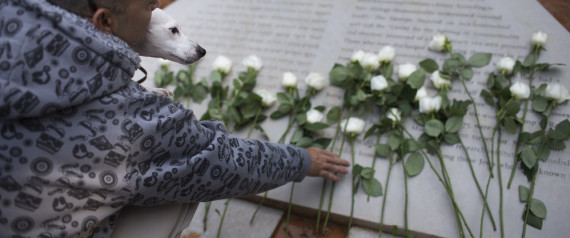
tel aviv gay holocaust memorial

TEL AVIV, Israel (AP) — Israel’s cultural and financial capital unveiled a memorial Friday honoring gays and lesbians persecuted by the Nazis, the first specific recognition in Israel for non-Jewish victims of the Holocaust.
Tucked away in a Tel Aviv park, a concrete, triangle-shaped plaque details the plight of lesbian, gay, bisexual and transgender people under Adolf Hitler’s Third Reich. It resembles the pink triangles Nazis forced gays to wear in concentration camps during World War II and states in English, Hebrew and German: “In memory of those persecuted by the Nazi regime for their sexual orientation and gender identity.”
The landmark joins similar memorials in Amsterdam, Berlin, San Francisco and Sydney dedicated to gay victims of the Holocaust. While Israel has scores of monuments for the genocide, the Tel Aviv memorial is the first that deals universally with Jewish and non-Jewish victims alike and highlights the Jewish state’s rise as one of the world’s most progressive countries for gay rights.
“I think in Israel today it is very important to show that a human being is a human being is a human being,” Mayor Ron Huldai said at the dedication ceremony, where a rainbow flag waved alongside Israel’s blue-and-white flag. “It shows that we are not only caring for ourselves but for everybody who suffered. These are our values — to see everyone as a human being.”
Israel was born out of the Holocaust and its 6 million Jewish victims remains seared in the country’s psyche. Israel holds an annual memorial day where sirens stop traffic across the nation, it sends soldiers and youth on trips to concentration camp sites and often cites the Holocaust as justification for an independent Jewish state so Jews will “never again” be defenseless.
But after 70 years, Tel Aviv councilman Eran Lev thought it was time to add a universal element to the commemoration. Lev is one of many gays elected to public office in Tel Aviv, a city with a vibrant gay scene that has emerged as a top international destination for gay tourism.
“The significance here is that we are recognizing that there were other victims of the Holocaust, not just Jews,” said Lev, who initiated the project during his brief term in office.
As part of their persecution of gays, the Nazis kept files on 100,000 people, mostly men. About 15,000 were sent to camps and at least half were killed. Other Nazi targets included communists, Slavs, gypsies and Jehovah’s Witnesses.
Unlike their persecution of Jews, however, there was no grand Nazi plan to exterminate gays. Nazis viewed being gay as a “public health problem” since those German men did not produce children, said Deborah Dwork, director of the Strassler Family Center for Holocaust and Genocide Studies at Clark University in Worcester, Mass.

“The idea was to change their behavior, not to eradicate them, not to murder them,” Dwork said.
The policy was far from sweeping — as evidenced by the rampant homosexuality among the ranks of the Nazi Party’s SA paramilitary wing, which helped pave Hitler’s path to power. The most famous gay Nazi was Ernst Röhm, one of the most powerful men in the party before Hitler had him executed in 1934.
Later, the Nazis outlawed homosexuality and the Gestapo set up a special unit targeting homosexuality. In the Buchenwald concentration camp, the Nazis carried out experiments to try and “cure” homosexuality. Those sent to the camps were forced to wear pink triangles, compared to the yellow stars that Jews bore on their clothing. Gay Jews wore an emblem that combined the two colors.
Today, Israel is one of the world’s most progressive countries in terms of gay rights. Gays serve openly in Israel’s military and parliament. The Supreme Court grants a variety of family rights such as inheritance and survivors’ benefits. Gays, lesbians and a transsexual are among the country’s most popular musicians and actors.
Moshe Zimmermann, a professor from the Hebrew University of Jerusalem and the memorial project’s historical adviser, said the Tel Aviv monument marked a big step in Israel by ridding itself from what he called a monopoly of victim hood.
“We are finally shedding the load of being the lone and ultimate victim,” he said. “We can learn from this that by recognizing the victimhood of others, it does not diminish the uniqueness of your own victim hood.”
 
Further reading:
 

  1. Original Article – Huffington Post
  2. BBC News Article
  3. BN&S Commentary
  4. The Gay Holocaust Lagers

Filed Under: Anti-Bullying & Homophobia, History Tagged With: Adolf Hitler, Anti-Gay Discrimination, civil rights, Gay Discrimination, Gay Holocaust Victims, gay rights, Gay Voices News, Genocide, Israel Gay Holocaust Monument, Nazi Germany, Tel Aviv, Tel Aviv Gay Holocaust Monument, The Holocaust

Charles Kenny – "Eulogy at Mervyn Kingston’s funeral"

03/09/2013 By David McFarlane Leave a Comment

rev-kingston
 
“Eulogy at Mervyn Kingston’s funeral”
It is a privilege to have been asked to speak publicly as we meet here today formally to express our sorrow at the death of our brother, friend, fellow-churchman, Mervyn, to thank God for his life and work, and to show our sympathy to those nearest and dearest to him, especially to Richard his partner.
George Mervyn Kingston was born in Florida Drive, East Belfast. In those difficult post-war yrs his twin sister Jill and he attended Nettlefield School and Willowfield Parish Ch. Both of these institutions were from the beginning important to Mervyn and I think he knew they were to influence, even determine, the course of his life. The PE school prepared him for Grosvenor High School on the other side of the city; and the parish church and its parochial halls were a wonderful outlet for this young boy. He thrived in the life of this big and busy Parish Church on My Lady’s Road; for the C of I of the time, it gave unusual prominence and opportunity to lay people in worship and parochial organisations. Many good parishioners participated hands-on in the day-to-day and Sunday by Sunday running of the parish. (The General Vestries were sometimes eye-opening.) These experiences gave Mervyn a vocation to the sacred ministry.   I knew Mervyn in the first decade and a half of his life, but not well; a 12 yr old boy doesn’t have much in common with a 4 yr old who isn’t his brother and I left these shores in 1962 but I remember the pleasure of my parents in a blue aerogramme to me telling me the news: did I remember young Mervyn Kingston? well, he had been accepted for ordination. He would be going down to  Dublin in September. My parents and everyone else around the church were delighted. There was a detail in this development which was indicative of something that would be seen again in the future. As a child and teenager Mervyn had quite a bad stammer which he had overcome; he didn’t give up easily. Also by then he was finding fulfilment in his work in Social Services; but he felt the call to the Ministry and the Church recognised and welcomed that in 1969.
The Revd Mr Kingston was ordained for the curacy of Comber Parish to learn the trade and the practice from Hammy Leckie (this was a good choice, he reckoned at the time and subsequently), then back in E Belfast he served in St Donard’s where he appreciated Pat Synnott as mentor, followed by Down Cathedral with particular concern for Ardglass. Later in the mid 80s he crossed the river to Connor and the housing estate at the top of the Shankill Road; then down to a spur of Armagh Diocese that curiously reaches the sea near Dundalk, a care of souls which includes Carlingford and Crossmaglen.
Obviously these locations are very diverse and varied in every way but in all these milieux Mervyn was a consistent cleric and pastor. He began during the most destructive and murderous years of the Troubles and that affected his perception of what he believed God was asking of his people. Mervyn never lost the mind-set, the aspirations and the vocabulary of evangelical churchmanship. He was an evangelical true to the Gospel. In later years he often gently queried his more radical friends and colleagues who tend to dismiss the evangelical tradition as a discredited and spent force, always in hock to biblical idolatry which precludes any sort of prophetic Xnity, and which had played its part in creating debased Irish Xnity. Mervyn rejected this emphatically remembering the good people of his youth. But he knew what the epistoler James had in mind when James derides faith that is not evidenced in practice or in life. Mervyn was by nature conciliatory, seeing the best in everyone, aware of reasons, explanations of bad attitudes and deeds; he understood the power of history and environment; he tried to explain, to educate, willing people to see something differently, to read the words of Our Lord with openness and insight (as if for the first time), to try to separate the gospel imperatives from local cultural assumptions, to be sure they were questioning the latter in the light of the former, as Jesus did continually. He respected others’ opinions even when he felt in conscience that there was a better way and that it was his parsonical duty at least to present an alternative Xn position. But he always laid it on the line when he was seeking a new post. The elephant in the room was identified starkly; if you choose me you are getting an ecumenical C of I rector. “Ourselves alone” is heretical; I will want to work with those of other traditions; I will work for rapport between them and us. Furthermore I will work with and for those on the edge, those at the margins, (as the Lord did); indeed the faithfulness of our Gospel will be determined by how successful we are in these two regards. These are not negotiable, they are sine qua nons of Xnity.
About 35 yrs ago quite a few young people were frequenting St Donard’s Church and its youth club and recently Mervyn mentioned with pleasure to me that altho’ sometimes they vigorously challenged or rejected some advice of their curate, the verdict of one of them was: “You made us think!” How many of us pastors have had that accolade?
In the mid 80s Mervyn’s institution in St Andrew’s at the top of the Shankill Road was attended by one of his friends Fr Joseph Campbell in his robes, (he had also attended his ordination 10 yrs earlier). Some months later his parishioners were enchanted by a sermon from a nun in their pulpit. This was the pattern throughout his incumbencies, contact with the other, encouraging the C of I faithful to be open to others, “the other side”. Mervyn believed in that and practiced it, no more fervently than in his last incumbency at Creggan and Ballymascanlon. Here was a conspicuous opportunity of living out that old Anglican adage about rectors being there for the benefit of all of the people physically in their cure. The rector of Creggan ministered to the small protestant minority who felt under pressure and also to all who lived there; he met, liaised with, negotiated, socialised with the local people, and their political representatives. This caused surprise at first but went down well when it became apparent that things got done, attitudes mellowed, to the benefit of the whole community.
Back in 1969 it had been a revelatory experience for a young school leaver from Florida Drive to work for 4 yrs out of a Supplementary Benefits office in west Belfast. He and his office became known for his understanding, non-judgmental approach, general humanity and sympathy. This was instinctive to Mervyn as the mindset natural to any follower of Jesus. I’m told that in the office the nickname for this junior civil servant was Santa Claus.
The other elephant in the room was caused by the increasing awareness during our lifetimes that not everyone is heterosexual. For many yrs Mervyn had been drawn to quiet involvement in mixed marriages, to help with, encourage and sometimes to offer private blessings for mixed couples, or for divorced couples not welcome in their own church who still wanted a Godly benediction on their union.  Mervyn is among those who came, after much thought, study, prayerful consideration, to a similar openness towards same gender couples, those whose natural and only search for love, for mutual comfort help and society that the one should have of the other that the BCP so correctly stresses as the foundation of life among almost all of us. Xns who were gay were beginning to emerge from the shadows in the 1980s and Mervyn was among them. But there was a change of gear, a new burst of energy, with the setting up of Changing Attitude Ireland in 2007. Here for the first time was concerted public involvement by church men and women, gay and straight, within the C of I, and all other Irish Churches, pointing out simply the unjust and socially damaging and downright cruel nature of conventional Xn dismissal of the unhappiness and anxiety of gay Xns. You are welcome in the church only if you pretend you are not what you are. The founders and inspiration behind CAI were Mervyn and Richard O’Leary. I dare to say that future generations of our church, if not the present one, will recognise this enterprise and thank God for it.
In 2002 the rector of Creggan and Ballymascanlon was diagnosed with prostate cancer and the following year was incapable of full-time ministry. The Diocese recognised this, made him a minor canon of Armagh Cathedral with the title of Vicar Choral. (Music, ecclesiastical and other, singing was always a joy to Mervyn.) This obtained until 2007 when he retired.
Since then, Mervyn has been increasingly looked after and sustained by Richard. The professionals from the Hospice helped, the input of two individual carers went far beyond duty. This meant Mervyn has continued faithfully to fight the good fight to the very end, to fulfil his godly calling to leave this world, this country and his beloved church in a state more pleasing to the Almighty for his having been with us. The struggle goes on: from his labours may Mervyn rest in peace.

Filed Under: History Tagged With: Charles Kenny, civil rights, civil rights activist, eulogy, gay, LGBT, reformer, Rev Mervyn Kingston

Categories

Copyright ACOMSDave.com © 2026