
ACOMSDave

Community Journalist

  • Home
  • Community Journalist
  • Events
  • Media Page and Press Kit
    • Projects and Work
  • Resources & Documents
    • LGBTQ+ Support Groups and Documents
  • NIGRA
  • Archives
  • Contact

AI is shaking up the job landscape

05/03/2026 By ACOMSDave Leave a Comment

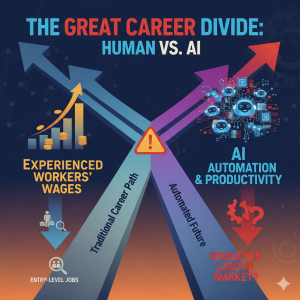
AI changing the wage landscapeAI is shaking up the job landscape in ways we’ve never seen before. A recent Dallas Fed report dives deep into how artificial intelligence is reshaping wages and employment opportunities, especially for different experience levels. The headline? Wages for experienced workers are climbing, while entry-level jobs are vanishing faster than you can say “automation.”
 
Here’s the real deal: AI-driven automation is creating a wage gap that favours seasoned professionals. Companies are investing in AI to boost productivity, but that often comes at the expense of entry-level roles—those starting points for many. The report highlights a troubling trend: as AI becomes more sophisticated, it replaces routine tasks, pushing lower-skilled workers out of the job market. Meanwhile, experienced employees who can work alongside AI are seeing wage increases, sometimes significantly.
 
This isn’t just about tech; it’s about social equity and economic stability. When entry-level jobs disappear, it’s often the most vulnerable populations that bear the brunt—young workers, minorities, and those with fewer resources. This shift risks deepening inequality, fueling social unrest, and creating a fractured economy where opportunity is reserved for the already privileged.
 
But let’s not be all doom and gloom. The report also sparks a conversation about adaptation. How do we prepare the workforce for this AI-driven future? Reskilling, education, and policy reforms are critical. We need to advocate for programs that help displaced workers transition into new roles—roles that AI can’t easily replace, like creative, strategic, and interpersonal jobs.
 
The broader theme here? AI’s impact is a mirror reflecting our societal priorities. Are we going to let automation widen the wealth gap, or will we harness its potential to create a more equitable economy? The choice is ours. As consumers, workers, and policymakers, we must push for responsible AI integration—one that benefits all, not just the top tier.
 
This report is a wake-up call. The future of work isn’t written yet, but it’s clear AI is steering the wheel. Will we steer responsibly? That’s the real question.
 
Links:
 
  • Report: AI Lifts Wages for Seasoned Workers as Entry-Level Jobs Shrink
  • The Robot Takeover Has a Timeline

#AI #JobMarket #Wages #EmploymentTrends #Automation #Economy #Workforce #FutureOfWork #TechImpact #DallasFed


Filed Under: Editor to ACOMSDave Tagged With: AI impact, artificial intelligence, automation, Dallas Fed, economic analysis, employment trends, entry-level jobs, experienced workers, job market, wages

The Robot Takeover Has a Timeline

26/02/2026 By ACOMSDave Leave a Comment

The Robot Takeover Has a Timeline — And It’s Closer Than You Think


Let’s stop tiptoeing around it: AI-driven robots are coming for human jobs, and now we finally have a timeline. Rob Garlick, former head of innovation, technology, and future of work at Citi Global Insights, just dropped a prediction that should jolt every worker — and policymaker — out of complacency. Over the next few decades, he warns, the number of moving robots will surpass the global working population. And when you add AI agents to the mix? It’s going to “explode.”

Garlick’s frank words to CNBC say it all: “Artificial intelligence will be able to do more and more, better and better, cheaper and cheaper — and that will substitute for people. Humans can’t compete on this basis.” That’s not dystopian fiction. That’s a former Wall Street insider who ran the numbers.

And what numbers they are. A 2024 Citi report led by Garlick projects that AI robots — from humanoids to autonomous vehicles to cleaning bots — will reach 1.3 billion by 2035, surging past 4 billion by 2050. More chilling? A $35,000 robot can pay for itself in under nine weeks when it replaces a worker earning $41 an hour. Nine weeks. That’s a fiscal quarter short of a fiscal quarter.

The Robot Takeover

The Robot Takeover – Right now, we’re watching the preview. Boston Dynamics’ Atlas robot is already deployed on the Hyundai factory floor near Savannah, Georgia. Tesla’s Optimus is slated for public sale in 2027. Companies like Amazon, Salesforce, and Accenture are already citing AI as justification for eliminating thousands of roles. Meanwhile, McKinsey now runs 20,000 AI agents alongside 40,000 human employees — up from just 3,000 agents a year ago. The pace is vertiginous.

The IMF’s Kristalina Georgieva describes AI as hitting the labour market “like a tsunami,” warning that most countries and most businesses simply aren’t prepared. She’s right. Policy is lagging catastrophically behind technology, and workers — particularly those in manual, repetitive, and lower-wage roles — are being set up to absorb the shock without a safety net.

To be fair, not every job is on the chopping block tomorrow. Leadership, creative work, emotional intelligence, complex judgment — these remain stubbornly human. And there’s a credible case that robots free people from dull, dangerous, and degrading labour. But that rosy scenario requires investment in retraining, social support, and political will that is, so far, largely absent.

The robot revolution isn’t a distant hypothetical. It’s a timed detonation. The countdown is running. The real question isn’t if your industry gets disrupted — it’s whether society will build the parachutes before the floor gives way.

Links:

  • Article developed from reporting by eWeek and supporting data from Citi Global Insights, CNBC, McKinsey, and the IMF.
  • Why the Three Laws of Robotics Fall Short in the Age of AI


#AIRobots #FutureOfWork #Automation #HumanoidRobots #JobDisplacement #AIRevolution #WorkforceDisruption #TechTrends2026 #RobotEconomy #ArtificialIntelligence

Filed Under: Editor to ACOMSDave Tagged With: AI and employment, AI labor disruption, ai robots replacing workers, Boston Dynamics Atlas, Citi AI report, future of work AI, humanoid robots timeline, job automation 2026, robot workforce 2035, Tesla Optimus robot

Humanities SOS: Jules Verne’s Warning & Our Future

15/02/2026 By ACOMSDave Leave a Comment

Jules Verne's WarningElif Shafak’s recent article in ‘The Observer’ really struck a chord with me. It’s a powerful reminder of why the humanities – literature, arts, history, philosophy – aren’t just nice-to-haves, but essential for a healthy society.

Shafak draws on Jules Verne’s forgotten dystopian novel, ‘Paris in the Twentieth Century’, where a poet is ridiculed for his “useless” skills in a world dominated by business and technology. Verne, known for his uncanny predictions, paints a bleak picture of a future devoid of human connection and empathy.

The article challenges the notion that the humanities are in decline, citing the steady readership of fiction worldwide. It emphasises the importance of “kairos” – deep time focused on meaning – over the fleeting “chronos” of our fast-paced world. Literature, Shafak argues, nourishes our need for meaning and connection, just like food and water.

However, the crux of the issue is that the humanities are under threat. Universities are shifting focus to “high-income disciplines,” devaluing subjects that foster critical thinking, empathy, and cultural understanding. As Shafak points out, cutting funding for culture has serious social and political consequences.

Empathy, that ability to “feel into” another’s existence, is crucial for a harmonious society. Literature allows us to step outside ourselves and connect with others, fostering understanding and breaking down barriers.

Shafak also connects the humanities to broader issues, such as climate change, water scarcity, and women’s rights, reminding us that everything is interconnected. A society that values only profit and technological advancement risks losing its sense of purpose.

Verne’s father wanted him to be a lawyer, but Verne’s heart was in storytelling. We need to encourage young people to pursue their passions, whether it’s law, math, or poetry. As the saying (often attributed to Verne) goes, we need to “dream with our eyes open,” combining imagination with knowledge and critical thinking.

The humanities aren’t a luxury; they’re a necessity. They equip us with the tools to navigate a complex world, connect with others, and build a more just and compassionate future. Let’s not let Verne’s dystopia become our reality.

 
  • The Observer -Jules Verne’s dystopia was a world without humanities. Don’t let his nightmare come true
  • Education Shortfalls – for better or poorer

Filed Under: Community Journalist, Editor to ACOMSDave Tagged With: critical thinking, culture, education, Elif Shafak, empathy, future, humanities, Jules Verne, literature, social commentary

The Catch Trap by Marion Zimmer Bradley – Review

30/10/2025 By ACOMSDave Leave a Comment

The Catch TrapA forgotten period masterpiece – Marion Zimmer Bradley’s The Catch Trap, published in 1979, represents a significant departure from the author’s more celebrated work in fantasy and science fiction. Set within the American circus world of the 1930s through 1950s, this novel centres on the professional and romantic partnership between two trapeze artists, exploring both the technical mastery of their craft and the emotional complexity of a relationship constrained by the rigid morality of mid-century America.

The narrative follows Tommy Zane, son of a lion tamer, whose natural gift for flying leads him to become the protégé and catcher to Mario Santelli, an established star of the trapeze. As their aerial act achieves renown, the pair must navigate not only the physical dangers of attempting the triple somersault – that most treacherous of circus feats – but also the tensions within their circus family and, more significantly, the necessity of concealing the true nature of their bond from a society unprepared to acknowledge it.

Bradley’s considerable achievement here lies in her meticulous attention to the technicalities of trapeze work. The descriptions of aerial acts are breathtakingly detailed, drawing readers into the physicality, precision, and danger inherent in the art. The reader gains an authentic sense of the rigorous training, the split-second timing, the absolute trust required between flyer and catcher. This is no romanticised or superficial treatment of circus life; rather, Bradley presents it as demanding physical labour, a discipline as exacting as any art form. The circus itself becomes more than mere backdrop – it functions as a fully realised world with its own hierarchies, traditions, and codes of behaviour. Indeed, the high-flying artistry of the trapeze serves as a metaphor for the characters’ yearning for freedom and transcendence over societal limitations.

What distinguishes The Catch Trap from much gay fiction of its era is Bradley’s refusal to sensationalise or apologise for the relationship at its centre. Tommy’s journey from naïve teenager to confident artist and self-aware individual forms the emotional core of the novel, with Mario serving as both mentor and eventual lover – a deeply charismatic figure whose experiences and convictions guide Tommy through his personal and professional growth. Their love is presented neither as tragedy nor as manifesto, but simply as the central emotional reality around which all else turns. The constraints they face are real – the period setting ensures that discretion is not merely advisable but essential – yet Bradley affords her characters both dignity and complexity. They are not reduced to their sexuality; they are artists, sons, colleagues, individuals shaped by circumstance yet possessing agency within those limitations.

Bradley’s portrayal operates as incisive social commentary, critiquing the rigid structures of heteronormativity and the oppressive expectations imposed on those who deviate from convention. The circus, traditionally a space of marginality and otherness, becomes a microcosm where characters grapple with questions of identity, belonging, and resistance to conventional morality. The generational tensions within the Santelli family add further depth, as Mario struggles to honour his family’s circus traditions while forging his own path – a conflict between preserving heritage and pursuing individual desires that underscores the weight of legacy as both pride and burden.

The novel’s treatment of relationships, whether romantic, familial, or professional, is layered and nuanced. Bradley’s prose possesses a lyrical quality and emotional resonance that renders the camaraderie and rivalries among circus performers with authenticity, creating a palpable sense of community and shared struggle. The parallels between the trust required in a trapeze act – where one’s life depends absolutely upon one’s partner – and the vulnerability inherent in any loving relationship are never belaboured but remain powerfully implicit throughout.

Yet the novel is not without its problematic aspects. The depiction of Mario and Tommy’s relationship, particularly given their significant age difference and the inherent power imbalance between mentor and protégé, raises uncomfortable questions about agency and ethical boundaries. While the narrative frames their bond as consensual and deeply loving, contemporary readers may find themselves troubled by dynamics that the text itself presents uncritically. Bradley challenges readers to grapple with complex moral and emotional terrain, though whether she fully confronts these complications or merely reproduces them remains open to debate.

The novel shares, too, certain weaknesses common to its genre and period. At times the prose tends toward melodrama, and some secondary characters remain rather thinly drawn, serving more as obstacles or facilitators to the central relationship than as fully developed persons in their own right. The historical setting, while providing necessary context for the couple’s secrecy, occasionally feels more imposed than organic, as though Bradley were more comfortable with the circus milieu than with the broader social landscape of post-war America.

Yet these are considerations rather than fatal flaws in a work that succeeds admirably in its primary aims. Bradley has written a novel that illuminates both a specialised professional world and a particular emotional experience with equal authenticity. The Catch Trap is a story of resilience and courage, celebrating the triumphs of the human spirit even in the face of societal condemnation and personal sacrifice. It invites readers into a world of dazzling artistry and intense emotional stakes, where characters navigate the precarious balance between their public and private selves.

The Catch Trap serves as an important reminder that Bradley’s talents extended well beyond the fantasy fiction for which she is primarily remembered. This is not a ‘gay novel’ inThe Catch Trap any limiting sense, but rather a novel about human beings whose capacity for love, ambition, fear, and courage transcends any single aspect of their identity. The fact that it depicts a same-sex relationship with such matter-of-fact seriousness – neither apologising for it nor making it the sole focus – represented a significant achievement for 1979, even as certain aspects of that depiction now invite more critical scrutiny.

For readers interested in LGBTQ historical fiction, or indeed for anyone drawn to stories of obsessive dedication to craft and the complications of partnerships both professional and personal, The Catch Trap deserves attention. It is a novel written with confidence and care, illuminating corners of human experience that remain as relevant today as they were in the circus rings of mid-century America. Bradley’s ability to craft a narrative that is both deeply personal and broadly reflective of larger societal issues ensures that the novel resonates long after its final page.

Title: The Catch Trap
Author: Marion Zimmer Bradley
Original Publication: 1979
Current Publisher: Open Road Media


#TheCatchTrap #MarionZimmerBradley #BookReview #LGBTQFiction #QueerLiterature #HistoricalFiction #GayFiction #CircusNovel #LGBTQBooks #QueerBooks #BookBlog #LiteraryFiction #1930s #GayRomance #QueerHistory #LGBTQReads #ClassicFiction #BookRecommendations


Links:

  • Wikipedia: The Catch Trap
  • Amazon UK: The Catch Trap
  • Eustace Chisholm and the Works and A Domestic Animal – two book reviews

Filed Under: Editor to ACOMSDave Tagged With: 1930s America, acrobat fiction, American circus, book blog, book review, circus life, circus novel, gay historical fiction, gay modern classics, gay romance, LGBTQ fiction, LGBTQ historical fiction, literary fiction, Marion Zimmer Bradley, Marion Zimmer Bradley novels, mid-century gay fiction, queer historical romance, queer literature, The Catch Trap, trapeze artists

ECHR Debate: Political Theatre or Genuine Crisis?

29/10/2025 By ACOMSDave Leave a Comment

ECHR Debate

The Observer’s deep dive into the European Convention on Human Rights (ECHR Debate ) debate exposes something uncomfortable: much of what we’ve been told about human rights law blocking deportations is complete nonsense. Remember the Albanian criminal supposedly kept in Britain because his son didn’t like foreign chicken nuggets? Never happened. The Iranian who couldn’t be deported so he could cut his son’s hair? Fabricated. These myths have poisoned the political debate, yet politicians from Kemi Badenoch to Nigel Farage continue weaponising them.

The Positives:

The article’s fact-checking is thorough and necessary. Oxford University’s Bonavero Institute data reveals that only 0.73% of foreign national offenders successfully appeal deportation on human rights grounds. The Strasbourg court has ruled against the UK just three times in 45 years on immigration cases. These statistics demolish the narrative that the ECHR is some insurmountable barrier to border control.

The piece also provides valuable historical context—reminding us that British lawyers drafted the ECHR after World War II, and it’s helped secure justice for Hillsborough families and protected vulnerable people during the pandemic. The practical complications of withdrawal are clearly laid out: the Good Friday Agreement embeds the ECHR, and leaving it would reduce European cooperation on asylum seekers.

The Negatives:

What’s deeply concerning is the cynicism on display. Politicians across the spectrum are treating human rights as a “useful political scapegoat” (as Liberty’s Akiko Hart notes), offering “disingenuous solutions” they know won’t work. Reform UK’s promise of a “department of believers” staffed by anti-ECHR civil servants sounds dystopian. Even Labour MPs in red wall seats are signalling hostility to human rights to appear tough on immigration.

The article perhaps doesn’t emphasise enough how dangerous this erosion of principle is. As former Lord Chancellor Charlie Falconer warns, abandoning rights for immigrants sets a precedent:

“there is essentially no limitation on what the government may do in other areas where there is political pressure.”

For Keir Starmer—who once called the ECHR his “lodestar”—this represents a pivotal test. Will he defend fundamental rights against populist pressure, or will he join the race to the bottom? The answer matters far beyond immigration policy. When politicians compete to see who can abandon human rights fastest, we all lose.

We All Lose


#ECHR #HumanRights #UKPolitics #Immigration #FactCheck #BorderControl #AsylumSeekers #PoliticalDebate #LegalAnalysis #MythBusting #Brexit #ReformUK #Labour #Conservatives #UKImmigration #HumanRightsAct #GoodFridayAgreement #Deportation #PoliticalAccountability #UKNews


Links:

  • The Observer – Misinformation and myth: the UK’s phoney war over human rights
  • Human Rights – The Legal Act in the UK

Filed Under: Editor to ACOMSDave Tagged With: asylum seekers, border control, Brexit, deportation laws, ECHR, European Convention on Human Rights, Good Friday Agreement, Human Rights Act, human rights debate, immigration myths, Keir Starmer, Kemi Badenoch, legal analysis, political scapegoating, Reform UK, UK immigration

Attack on Libraries Should Terrify Us All

27/10/2025 By ACOMSDave Leave a Comment

Attack On LibrariesAttack on Libraries – When I think about libraries, I think about freedom. Not the abstract, flag-waving kind—but the real, tangible freedom to walk into a room and discover ideas that might change your life. The freedom to read without someone looking over your shoulder, deciding what you’re allowed to know.

That freedom is under attack in America right now. And what’s happening there should be a wake-up call for the rest of us.

Book Banning Has Gone From Rare to Epidemic

Here’s a stat that should stop you in your tracks: between 2001 and 2020, an average of 273 book titles were challenged in US libraries each year. In 2023 alone? Over 9,000 titles were targeted. That’s not a trend—it’s an avalanche.

We’re not talking about obscure edge cases. Books by Maya Angelou, Toni Morrison, and Judy Blume are being pulled from shelves. A graphic novel about the Holocaust was banned in Tennessee. Even a children’s book about seahorses faced removal because—wait for it—it showed them mating.

The targets are predictable: anything involving LGBTQ+ themes (39% of challenged titles in 2024), books about race and racial justice, and materials related to sex education. But the scale is what’s new. This is no longer scattered local outrage. It’s organised, well-funded, and strategic.

It’s Not Grassroots—It’s Astroturfed

Groups like Moms for Liberty—which sounds wholesome enough—are actually connected to extremist organisations like the Proud Boys and QAnon conspiracy theorists. They’ve systematically taken over local library boards, using social media to manufacture outrage and fund candidates who’ll do their bidding.

One of the Proud Boys’ leaders literally called Moms for Liberty “the Gestapo with vaginas.” When fascists are giving you compliments, you might want to reconsider your strategy.

Librarians are facing death threats for doing their jobs. Amanda Jones, a Louisiana school librarian, spoke out against book banning at a board meeting. She was immediately accused of grooming children and received such terrifying threats that she now sleeps with a shotgun under her bed. Think about that—a school librarian needs weapons to feel safe because she defends books.

Trump’s Making It Official Policy

Things escalated dramatically when Trump returned to office. In February 2025, Dr. Colleen Shogan—the head of the US National Archives—was fired without explanation. In May, Dr Carla Hayden, the brilliant librarian of Congress, got an email: “Your position is terminated effective immediately.”

Her replacement? Todd Blanche—Trump’s lawyer from the Stormy Daniels case. That’s right: America replaced one of the world’s most accomplished librarians with a defence attorney. The symbolism couldn’t be clearer.

Meanwhile, government datasets are being scrubbed from websites. Environmental data, public health information, disease control statistics—all disappearing down the memory hole. Volunteer librarians are racing to save what they can, but established institutions need to step up and host this rescued data before it’s lost forever.

Why “Just Books” Matters More Than You Think

There’s a quote from philosopher Jacques Derrida that sums this up: “There is no political power without power over the archive.” Whoever controls what gets remembered—what gets preserved, what’s accessible—controls the narrative. They control history itself.

When a Florida judge ruled that public libraries are “government speech” and citizens have no First Amendment right to access books there, it wasn’t just about books anymore. It was about whether we’re allowed to think independently of what the government wants us to think.

It’s Already Crossing the Atlantic

Don’t think this is just an American problem. In Ireland, groups modelled directly on Moms for Liberty are targeting libraries with the same playbook. In the UK, 82% of librarians reported increased pressure to remove books in 2023, especially LGBTQ+ titles.

This August, a mob firebombed Spellow library in Liverpool because it served immigrant communities. A Reform UK councillor in Kent boasted about ordering the removal of “trans-ideological material” from children’s sections—material that didn’t even exist.

The tactics are spreading, and underfunded UK libraries are vulnerable.

What We Need to Do

Libraries have been the “pristine brand” of civic institutions for generations—universally trusted, politically neutral spaces. That brand is being deliberately tarnished, and we can’t let it happen.

We need to fund libraries properly, support librarians who face harassment, and push back loudly when books are targeted. We need to remember that free people read freely—and that freedom isn’t free if someone else decides what you’re allowed to know.

As Helen Keller wrote in 1933, when the Nazis were burning books: “You may burn my books and the books of the best minds in Europe, but the ideas those books contain have passed through millions of channels and will go on.”

Ideas are resilient. But they need defenders. Libraries aren’t just buildings with books—they’re the hidden infrastructure of democracy itself.


Links:

  • Gay Rights: From Revolution to Reflection
  • The Observer – ‘There is no political power without power over the archive’ -Richard Ovenden
  • The Linen Hall Library

#FreedomToRead
#StopBookBans
#DefendLibraries
#NoToCensorship
#ReadingIsResistance

Filed Under: Campaigns, Editor to ACOMSDave Tagged With: archive preservation, banned books, book banning, book challenges, censorship, cultural censorship, democracy, Donald Trump, First Amendment, free speech, Freedom of Information, government censorship, information access, information control, Intellectual freedom, LGBTQ+ rights, librarian attacks, libraries, library censorship, literary freedom, Moms for Liberty, public libraries, reading rights, school libraries, Trump administration

The Troubles Legacy: A One-Sided Search for Truth

23/10/2025 By ACOMSDave Leave a Comment

“Here is equal participation, the truth will remain buried with those who refuse to speak.”

The Troubles Legacy – Northern Ireland Secretary Hilary Benn wants to find the truth about The Troubles. Noble goal, but after 30 years of failure, we should ask why the current approach won’t work.

Here’s the uncomfortable reality: of 3,600 deaths during The Troubles, over 90% were caused by terrorists. Yet terrorists rarely participate in truth-seeking. They’ve melted into the shadows, and their political allies—now sitting in government—keep their secrets locked tight.

The Troubles Legacy

The system is fundamentally unbalanced. The Ministry of Defence must hand over records and produce witnesses. Sinn Féin, the IRA’s political wing, does neither. Neither do loyalist parties connected to paramilitaries. This creates a process biased against the army and RUC—the only participants actually cooperating.

Consider what happens to soldiers who do cooperate. Two soldiers were promised no retribution by the McCann family for helping find closure. They told the truth about shooting an IRA leader during an arrest. Their reward? Five years of prosecution before acquittal. Dennis Hutchings endured seven years of legal torment and died during the trial.

The message is clear: cooperate and face years of legal hell. Stay silent and walk free.

Benn’s “new” framework isn’t new—it’s the same adversarial court system that’s failed for three decades. Defence lawyers will advise clients not to engage, creating no admissible evidence. Meanwhile, security services hold files and recordings that could reveal the truth, but refuse to open them.

If we genuinely want the truth, we need equal participation. Political parties linked to paramilitaries must share what they know, or be excluded from demanding investigations. Until then, this process will continue targeting military and police who kept records and cooperated, while the real secrets remain buried with those who refuse to talk.

#TheTroubles #NorthernIreland #LegacyIssues #Veterans #BritishArmy #RUC #SinnFein #IRA #MilitaryJustice #PeaceProcess #Terrorism #VeteransRights #HilaryBenn #NILegacy #ArmedForces

Links:

  • The Legacy of the Troubles: A Joint Framework between the Government of the United Kingdom of Great Britain and Northern Ireland and the Government of Ireland
  • Gay history – Kate Hoey speech
  • The Critic – Hilary Benn is repeating a failed approach to The Troubles


Filed Under: Editor to ACOMSDave Tagged With: British Army veterans, Dennis Hutchings, Hilary Benn, IRA, Joe McCann, legacy investigations, legacy issues, military prosecution, Northern Ireland, paramilitaries, peace process, RUC, sinn fein, terrorism, The Troubles, veterans rights

The Wolfenden Report: A Turning Point for Gay Rights

05/10/2025 By ACOMSDave Leave a Comment

Wolfenden ReportWolfenden Report

When the Wolfenden Report was published on 4 September 1957, its dry, academic 155 pages sparked an unexpected firestorm. The first print run of 5,000 copies sold out within hours, and Sir John Wolfenden found himself cursed by religious groups and confronting graffiti outside his home.

A Response to Government Discomfort

Home Secretary Sir David Maxwell Fyfe had commissioned the committee to address two issues troubling the government: the visibility of sex workers on London’s streets and the rising arrests of gay men. Ironically, this increase stemmed from Maxwell Fyfe’s own policy of deliberate police entrapment of homosexual men.

The crackdown had ensnared high-profile figures including codebreaker Alan Turing, actor Sir John Gielgud, and Lord Montagu of Beaulieu. These prosecutions embarrassed the establishment and generated extensive press coverage—exactly what the government hoped to avoid.

“You knew what could happen,” recalled Rex Batten, a gay man living in London at the time. “You knew the cases that had come up, the people who were in jail for a year, two years, three years.”

Groundbreaking Yet Flawed Recommendations

After three years of testimony from police, psychiatrists, religious leaders, and some affected gay men, the committee recommended that consensual homosexual acts between men over 21 in private should no longer be criminal. The report’s philosophy was clear: “We’re concerned primarily with public order and not with private morality,” Sir John told the BBC.

However, the recommendations weren’t pioneering—many European countries, including France, Italy, and the Netherlands, had already decriminalized homosexuality. The report also contradicted itself by condemning homosexuality as “immoral” and “psychologically destructive” while rejecting the idea that it was a mental illness.

Harsh Treatment of Sex Workers

The report’s stance on prostitution was far more punitive. Rather than decriminalisation, it recommended harsher penalties, including three months’ imprisonment for third offences. Sir John justified this by wanting to avoid making detours when walking with his teenage daughter through certain London streets. Notably, the committee never consulted any sex workers.

Public Backlash and Eventual Success

The report faced fierce opposition. The Daily Mail warned that “great nations have fallen and empires decayed because corruption became socially acceptable.” Even Maxwell Fyfe rejected the homosexuality recommendations, though the government quickly adopted the prostitution measures in the 1959 Street Offences Act.

Despite resistance, the report sparked a crucial public debate. The Homosexual Law Reform Society was formed in 1958 to campaign for change. A decade later, the 1967 Sexual Offences Act finally decriminalised consensual homosexual acts in England and Wales, though it took until 1980 for Scotland and 1982 for Northern Ireland to follow.

Legacy

While deeply flawed, the Wolfenden Report opened a conversation about equal rights and the state’s role in private behaviour. As Rex Batten reflected: “We just wanted to be left alone to live our lives.” That simple wish, eventually granted, remains the report’s most important legacy.


Links:

  • ‘It provoked a fierce public debate’: The 1957 homosexuality report that divided the UK
  • Beyond The Law by Charles Upchurch – Gay Book Review

Filed Under: Editor to ACOMSDave Tagged With: 1950s Britain, 1967 Sexual Offences Act, Alan Turing, British legal history, gay rights movement, gay rights UK, homosexual law reform, homosexuality decriminalization, LGBTQ legislation, LGBTQ+ History, Maxwell Fyfe, prostitution laws, queer history, sex work laws, sexual offences law, Sir John Wolfenden, social justice history, Street Offences Act 1959, UK civil rights, Wolfenden Report

Belfast Mela 2025

24/09/2025 By ACOMSDave Leave a Comment


Belfast Mela 2025Belfast Mela 2025 – More Than a Festival, But Still Room to Grow

I visited the Belfast Mela 2025 on the Sunday afternoon, stepping through the gates of Botanic Gardens with ticket in hand and the Ulster Museum standing quietly behind. Almost at once, I felt swept into something bigger than an event—a living mosaic of people, colours, sounds, scents. It’s a festival that doesn’t so much wait for you to explore it as it enfolds you in its rhythm.

I moved slowly, never hurrying. The Mela is not about rushing from one thing to the next; it’s about letting it happen around you. Dancers warmed up on the grass, children left bright smudges of colour on a communal canvas, and under a tree someone tuned what I thought was a sitar, its notes carrying faintly through the early autumn leaves.

The stalls were plentiful, scattered across the park like a trail of curiosities. I stopped at a stand of handmade jewellery influenced by Indian folk designs, beautiful in its detail. And yet, when it came to food, I couldn’t help but notice a limitation. There was plenty on offer—samosas, curries, noodles, churros—but the breadth of cultures represented on stage and in the crowds wasn’t reflected fully in what could be tasted. For a festival whose heartbeat is diversity, I found myself wishing the food matched the same scale of imagination: dishes from Africa, the Middle East, South America, even local fusion from Belfast’s own communities. Food is often the easiest bridge between cultures, and at the Mela, that bridge deserves to be longer, wider, more adventurous.

Later, the stages took over the day. At the World Stage I watched the Filipino dancers—disciplined yet joyful—while behind me a group of teenagers tried to copy their steps, laughing as they stumbled into rhythm. That moment struck me: the Mela isn’t just spectacle, it’s participation. The same could be true of the food—more interactive experiences, tasting, sharing, even cooking demos—ways for visitors not just to consume but to join in.

By the time I reached the Healing Arts tent, the pace had shifted: incense curling, music low, a sense of quiet after the bustle. It reminded me that the Mela isn’t just about celebration—it also makes room for stillness.

Near the rose garden, as evening settled and shadows lengthened, I paused with others simply listening. Not to anything specific—just to the gathering itself, the collective hum. It felt quietly extraordinary, that sense of shared presence.


I won’t attempt to catalogue every performance or every stall. That would miss the point. What I will say is this: Belfast Mela 2025, once again, reminded me that togetherness is not an abstract ideal—it is something you can stand inside of, feel with all your senses. Still, as it continues to grow, I hope the Mela leans further into its own promise, letting food and flavour become as central a language of culture as music and dance already are.

And if you haven’t yet been, go next year. You won’t just see the world—you’ll taste it too, if the organisers are bold enough to let that happen.

DSCF1195

DSCF1195
Image 1 of 43

Links:

  • Belfast Maritime Festival 2025
  • Belfast Mela
  • BBC Belfast Mela Begins


Filed Under: Community Journalist, Editor to ACOMSDave Tagged With: Belfast cultural events, Belfast festivals, Belfast food culture, Belfast Mela 2025, Belfast Mela review, Botanic Gardens events, community celebration Belfast, cultural diversity Belfast, global food festival, international dance Belfast, Irish festivals 2025, multicultural Belfast, Northern Ireland events, world culture festival Ireland, world music Belfast

Belfast Maritime Festival 2025

21/09/2025 By ACOMSDave Leave a Comment

Belfast Maritime Festival Brings Crowds Despite Torrential Rain

The Belfast Maritime Festival 2025 returned to the city’s quaysides last weekend, drawing thousands of visitors to celebrate the city’s seafaring heritage — despite heavy rain that persisted throughout Sunday afternoon.

The three-day event, which ran from Friday, 12 September, to Sunday, 14 September, featured a few tall ships, naval vessels (including the Irish Lights vessel ILV Granuaile), Belfast Maritime Festival 2025live music, food stalls, and family entertainment across Queen’s Quay and Sailortown. Organisers reported strong attendance across the weekend, with Saturday’s clearer skies drawing the biggest crowds.

By contrast, Sunday was very wet indeed. I visited in the afternoon, and the rain was relentless — at times a mist, and at other times a sharp downpour that soaked through coats and shoes. The quayside was slick with water, umbrellas jostled in the crowd, and yet the festival pressed on with good humour. Families pushed prams wrapped in rain covers, children splashed through puddles, and food stalls sent up steam and savoury smells that carried on the damp air.

There was still plenty to see: open-deck tours of the visiting tall ships, live traditional music that lifted spirits in the rain, and exhibitions marking the 120th anniversary of Belfast’s shipbuilding story. One highlight was the sight of naval vessels moored alongside the quayside, their crews welcoming visitors despite the weather.

Speaking to attendees, the mood was stoic but cheerful. “It wouldn’t be Belfast without the rain,” one visitor said. Another described the festival as “wet, but wonderful,” summing up the mix of soggy clothes and resilient enjoyment.

Organisers declared the event a success. A spokesperson said: “We are delighted to see so many people braving the elements to celebrate Belfast’s maritime story. The rain didn’t dampen the spirit — in fact, it added to the atmosphere.”

The Belfast Maritime Festival has become a fixture in the city’s cultural calendar, and plans are already underway for its 2026 return.


Links:

  • The Follies
  • Visit Belfast – Belfast Maritime Festival 2025

DSCF1264

DSCF1264
Image 1 of 21

Filed Under: Editor to ACOMSDave Tagged With: Belfast Events, Belfast festival, Belfast harbour festival, Belfast Maritime Festival 2025, Belfast tourism, Belfast waterfront, maritime heritage, Northern Ireland events, tall ships Belfast

  • 1
  • 2
  • 3
  • …
  • 9
  • Next Page »

Categories

Copyright ACOMSDave.com © 2026