ACOMSDave

Community Journalist

  • Home
  • Community Journalist
  • Events
  • Media Page and Press Kit
    • Projects and Work
  • Resources & Documents
    • LGBTQ+ Support Groups and Documents
  • NIGRA
  • Archives
  • Contact

Breaking the Gay Code in the Movies

26/04/2015 By ACOMSDave Leave a Comment

Breaking the Gay code in the movies shows how, before obviously gay characters were allowed on the big screen, subtle (and not so subtle) indicators were used. Here are our favourite 12.

The Advocate: BY CHRISTOPHER HARRITY AND TRUDY RING

APRIL 23 2015 5:00 AM


It took a long time for Hollywood to call a spade a spade. Then it took even longer for positive representation, so get prepared for weak but psychotic murderers and the like. Now that it’s all out in the open, the hide-and-seek aspects of these old film characters seem like risqué fun. Back then, for those in the know, there was nothing ambiguous here — like a big wink from Hollywood.

John “Plato” Crawford (Sal Mineo), Rebel Without a Cause, 1955 
In the tribute montage above (which includes some beefcake of Mineo for good measure) it’s hard to see how people didn’t understand that Plato was, well, in love with James Dean’s character. And Dean is doing nothing to discourage it. Just follow Mineo’s eyes. The mirror on his locker, with the photo of Alan Ladd, are like giant hairpins dropping. — C.H.

Luz (Mercedes McCambridge), Giant, 1956 
OK, first of all, her name is Luz. Get it? Plus Giant gets some kind of an award for the most gay and bisexual actors ever in one film: James Dean, Rock Hudson, Sal Mineo, Earl Holliman, and while Mercedes never personally came out, she played the most fiercely dykey roles on-screen to perfection.  — C.H.

Jo (Barbara Stanwyck), Walk on the Wild Side, 1966
Even the ferociously closeted actress Barbara Stanwyck admitted that her character, the madam of the bordello, Jo Courtney, is a lesbian. And in the spooky way that only Hollywood can create, the love interest/prostitute is Capucine, one of the most beautiful but icily sexless women to have graced the silver screen. Stanwyck smacks Capucine around some, which is the equivalent at the time of hot lesbian sex, at least in the male film creator’s eyes. Don’t miss the very hot Jane Fonda as a baby whore and Anne Baxter as a Mexican. — C.H.

Dill Harris (John Megna) and Scout (Mary Badham), To Kill a Mockingbird, 1962
I would love to have been on the set of this film when the director, Robert Mulligan, told John Megna, the actor playing Dill, to swish it up somewhat. Megna actually nails it without a lot of fuss. Dill Harris is based on Truman Capote, author Harper Lee’s childhood friend. Lee later helped Truman with his work on In Cold Blood. That the Harper character is named Scout and has a haircut that looks as it was done with an egg beater is sophisticated gender role-play for the time.— C.H.

Brandon (John Dall) and Phillip (Farley Granger) Rope, 1948
Alfred Hitchcock was fascinated by gay and lesbian characters, and there are sly and not so sly references in many of his films. Rope is fairly overt. The movie is based on a play, which was based on the the true story of Nathan Leopold and Richard Loeb, who murdered 14-year-old Bobby Franks in Chicago in 1924. This time bi actor Farley Granger gets to be smacked around some for being hysterical and nelly, which is definitely code for gay. But the biggest whiff of lavender is that two young well-dressed male roommates are throwing an odd dinner–cocktail party hybrid. Who does that? James Stewart’s Rupert Cadell may or may not be gay in intention, but if the original casting choice of Ray Milland had played the role we would have been much more likely to see him as gay. — C.H.

Phillip Vandamm (James Mason) and Leonard (Martin Landau), North by Northwest, 1959
In another gay-inclusive Hitchcock classic, suave villain Phillip Vandamm has a thing going with Eve Kendall (Eva Marie Saint), who’s actually an American spy trying to find out how he’s exporting secrets to our Cold War–era enemies. He also may have a thing going with his devoted “right hand,” Leonard, or at least Leonard would like that to be the case. Leonard is suspicious of Eve, leading Vandamm to say, “I think you’re jealous.” “Call it my woman’s intuition,” Leonard responds. He’s undoubtedly jealous but he’s also on to her, and he ends up pursuing Eve and the film’s reluctant hero, Roger Thornhill (Cary Grant), in a climactic chase over Mount Rushmore. —T.R.

Joel Cairo (Peter Lorre), The Maltese Falcon, 1941
The effete, curly-haired, heavily perfumed Joel Cairo is among the shady characters seeking the priceless title statuette; detective Sam Spade (Humphrey Bogart) goes along with the quest in order to find out who killed his business partner. Cairo was clearly gay in the 1930 Dashiell Hammett novel on which the film is based; movies of the era couldn’t be quite so overt, but Lorre’s Cairo is so effeminate that he fits a certain stereotype of a gay man. Also, as The Peter Lorre Companion notes, he suggestively fondles an umbrella handle and gets his hand on Spade’s posterior briefly. Film experts have also observed that Kasper Gutman (Sydney Greenstreet) and his “gunsel,” Wilmer (Elisha Cook Jr.), seem to be a couple. — T.R.

Mrs. Danvers (Judith Anderson), Rebecca, 1940
In Hitchcock’s first U.S. release, soon after British aristocrat Maxim de Winter (Laurence Olivier) brings his new bride (Joan Fontaine) home to his great estate Manderley, we learn that Mrs. Danvers, the housekeeper, “adored Rebecca,” Maxim’s now-deceased first wife. That point is driven home as “Danny” fondles Rebecca’s lingerie — “Did you ever see anything so delicate?” she tells Fontaine’s character. “Look, you can see my hand through it!” She resents the presence of the second Mrs. De Winter (“Even in the same dress you couldn’t compare”) and does all she can to get rid of the new wife, and she also fondly remembers brushing Rebecca’s hair and laughing with her at the idea that Rebecca could ever love any man. Every housekeeper is that devoted, right? — T.R.

Bruno (Robert Walker), Strangers on a Train, 1951
In this Hitchcock film about a plot to trade murders , Farley Granger plays the hot straight guy that the unctuous Bruno, played by Robert Walker, inveigles into his lurid plan. Bruno’s nelliness would have been enough — plus he practically drools on Farley’s extra-wide lapels — but Hitchcock wants no ambiguity, so two-tone spectator shoes and flashy dressing gowns are used for the less-than-perceptive. — C.H.

Addison DeWitt (George Sanders), All About Eve, 1950
One of the greatest pleasures in a film with many is Sanders’s performance as drama critic Addison DeWitt, with his pitch-perfect delivery of Joseph L. Mankiewicz’s sardonic dialogue: “To those of you who do not read, attend the theater, listen to unsponsored radio programs, or know anything of the world in which you live, it is perhaps necessary to introduce myself,” he says in a voice-over as the movie begins. Addison is the ultimate condescending snob, described by one character as a “venomous fishwife”; in a less censored time, that would be “bitchy queen.” Along with his high-toned manner of speaking, his impeccable clothing and cigarette holder signal gayness, and he seems interested in women only to make them stars. “That I should want you at all suddenly strikes me as the height of improbability,” he says to the titular Eve (Anne Baxter). Addison is said to have been based on one of two acerbic New York critics of the 20th century, George Jean Nathan (apparently straight) or Alexander Woollcott, who was gay. Woollcott inspired other film portrayals as well; read on. — T.R.

Waldo Lydecker (Clifton Webb), Laura, 1944
Another character based on Woollcott, Waldo Lydecker is just as bitchy as Addison DeWitt and a lot more queeny. A powerful columnist and radio commentator, he’s helped the film’s title character to rise in the advertising business and he’s obsessed with her, but there are several indicators that his obsession isn’t of a sexual nature — those interests lie elsewhere. Key signs: the elaborately decorated apartment (“It’s lavish, but I call it home”), the walking stick, the perfection in dress and diction, and the fact that he answers questions from a hunky detective while in the bathtub. Played unforgettably by gay actor Clifton Webb, Waldo is the most fascinating character in the film, and he’d agree with that assessment. “In my case, self-absorption is completely justified,” he says at one point. “I have never discovered any other subject quite so worthy of my attention.” — T.R.

Sheridan Whiteside (Monty Woolley), The Man Who Came to Dinner, 1942
Is it a sign of our culture’s dumbing-down or just its fragmentation that we can’t think of any contemporary figure who’d inspire three fictional portrayals? Yet another character based on Woollcott is famed critic Sheridan Whiteside, a sophisticated New Yorker who gets stuck at a bourgeois Ohio couple’s home when he slips on the ice and breaks his leg while visiting. In this film adaptation of the George S. Kaufman–Moss Hart play, “Sherry” (played by gay actor Monty Woolley, a pal of Cole Porter’s) make lifes miserable for the couple, his nurse, and his secretary, and encourages his hosts’ son and daughter to rebel. Like Addison DeWitt and Waldo Lydecker, he does not lack for ego; “Is there a man in the world who suffers as I do from the gross inadequacies of the human race?” he wonders. Also like them, he has an effete manner and acid tongue that mark him as a certain type of gay man. And when a local journalist asks him how he thinks Ohio women stack up, he responds, “I’ve never gone in for stacking women up, so I really can’t say.” Whiteside entertains some showbiz visitors during his convalescence. They include playwright Beverly Carlton, who talks about seducing South Seas maidens but, as played by Reginald Gardiner, reads as pretty gay, and after all, the character is based on Noël Coward. Then there’s comedian Banjo (Jimmy Durante), inspired by Harpo Marx, with whom Woollcott was in love. Whether Harpo reciprocated is subject to debate. — T.R.

 
Links:
  • The Sal Mineo Mystery
  • Orange Cheesecake

Filed Under: Movie Reviews Tagged With: film, gay, gay codes, hidden agenda, hidden codes, hollywood, homosexual, LGBT, movies

Young Gay Film Maker Needs Help To Get To Cannes

18/04/2015 By ACOMSDave Leave a Comment

By The Gay UK, Apr 17 2015 08:20AM
The ultimate high for every established filmmaker is to have your work accepted by the prestigious Cannes Film Festival, so you can imagine what a remarkable achievement this is when you are still a student and this is your very first film. This is exactly what happened to Robert Doobay a student at the University of Central Florida
Earlier this year in January he created a film with the help of his two best friends Gordon and Andrew for Campus Movie Fest 2015, and when it came to awards time they took home the Top Four and Best Directing Awards. They then got an offer of a screening in Hollywood this coming July, but then in early April, he received an email with news that their short film had been selected to play at Cannes.
Attending Cannes will open up huge doors for anyone who attends, as they will be able to network with industry professionals, attend production workshops, buy and sell rights to production companies, and, of course, watch great films. The problem, a huge one for a student, is that it costs money to get there, so Robert has opened an appeal for help raise this on gofundme.com
We are happy to lend our support and we think you will too after you watch his wee film which will hit a chord with anyone who has ever had a Grindr encounter.
Click on the link to the film, and then you can click on the link to donate. Every little bit will help send this talented young man on his way to fulfill his dream (and maybe encourage him to even get back on line again).
Click here to go directly to the GoFundMe page
by @RogerWalkerDack

Filed Under: Campaigns, Movie Reviews Tagged With: Florida, gay film maker, MovieNews, movies, news, RogerWalkerDack, USA, world, young

GLAAD: LGBT Characters All But Disappeared in Movies

17/04/2015 By ACOMSDave Leave a Comment

GLAAD’s 2015 survey reports that only 17.5 percent of Hollywood studio films featured LGBT characters — and gives failing grades to Sony and Disney.
Republished from The Advocate: BY ADAM SANDEL  APRIL 15 2015 11:40 AM ET

GLAAD monitored films such as The Interview with Eminem.

GLAAD monitored films such as The Interview with Eminem.


In its third annual survey of LGBT representation in Hollywood movies, GLAAD reports that only 17.5 percent of studio releases featured queer characters — and many of them appear only fleetingly.
No studio earned an “excellent” grade in GLAAD’s report. Warner Bros. was graded “good,” Fox, Lionsgate, Paramount and Universal were deemed “adequate,” while Sony and Disney “failed.”
Although fewer defamatory LGBT images appeared in Hollywood films than in years past, Exodus: Gods and Kings, Horrible Bosses 2, and the Will Ferrell comedy Get Hard featured damaging attitudes and stereotypes.
“More inclusive portrayals of LGBT characters are being seen on television and through streamed content than ever before,” says GLAAD President and CEO Sarah Kate Ellis. “But according to GLAAD’s third annual Studio Responsibility Index, released today, America’s major film studios lag far behind other media when it comes to nuanced portrayals of LGBT people.” Ellis also explores the findings of this year’s report in this Hollywood Reporter column.
Read the complete 2015 Studio Responsibility Index.
GLAAD monitored films such as The Interview with Eminem.
 

Filed Under: Movie Reviews Tagged With: film, GLAAD, movie, survey

Chad Allen

12/04/2015 By ACOMSDave Leave a Comment

Actor once outed by tabloid publicly bids farewell to acting career after 30-plus years

Chad Allen was regular on TV’s Dr. Quinn: Medicine Woman and went on to play many gay roles
Reprinted from GayStarNews:  09 APRIL 2015 | BY GREG HERNANDEZ
When Chad Allen was in the middle of a six-year run playing Jane Seymour’s son on the TV series Dr. Quinn: Medicine Woman, he was cruelly outed when photos of him kissing a guy were sold to a tabloid in 1996.
But instead of going away, Allen spent nearly two more decades working on television, in movies and on the stage as an openly gay actor.
This week, Allen publicly said goodbye to that part of his life – on his terms.
Allen, 40, posted a YouTube video commemorating the end of his fansite and said he has been studying the past two years to be a clinical psychologist.Chad Allen
‘It’s been an incredible journey … working on the incredible shows that I’ve been able to work on over the years,’ he said in the video. ‘I’m incredibly grateful and always will be.’
His most recent acting credit was the 2011 film Fright Flick and a 2010 episode of Dexter.
‘My life has taken me on a very different trajectory and after 30-plus years as an actor. I made a decision a couple of years ago to let go of that side of my life go and I’ve been focusing on my education.’
A child star who had a recurring roles on St. Elsewhere, Webster, My Two Dads and Our House, Allen’s biggest success was on Dr. Quinn in the role of Matthew Cooper.
After the end of Dr. Quinn in 1998, Allen went on to become a high-profile LGBTI activist.
He also took on several gay roles on stage in The Little Dog Laughed, in the feature films Save Me and Hollywood, je t’aime, and on television on General Hospital: Night Shift and in a series of TV movies as private eye Donald Strachey.
Last fall, Allen raised more than $13,000 for people living with HiV/AIDS by running a marathon in Australia.
‘That work won’t end,’ he says of his HIV-AIDS fundraising. ‘I promise you.’

Further reading:

  • Actor Chad Allen’s coming out story—in his own words
  • Chad Allen Facebook Page
  • Chad Allen – IMDB Page

Filed Under: Anti-Bullying & Homophobia, Movie Reviews Tagged With: chad allen, clinical psychologist, coming out story, Dr. Quinn: Medicine Woman, gay actor

For Harry Potter Fans

12/04/2015 By ACOMSDave Leave a Comment

Harry Potter star makes fans’ fantasies come true with April Fools’ joke

Tom Felton posted a picture of him and Daniel Radcliffe with the caption ‘We’re together now’ on Instagram
GayStarNews:  04 APRIL 2015 | BY STEFANIE GERDIS
source: Instagram
 
 
With his April Fools’ Day joke actor Tom Felton tricked the internet into believing some Harry Potter fans’ dream had finally come true.
Felton, best known for playing Draco Malfoy in the Harry Potter movies, posted a photoshopped picture of him and on-screen enemy Daniel Radcliffe on Instagram.Tom Felton Photoshop for Harry Pottter
The black and white picture shows the topless actors lying head to head and is captioned: ‘May as well just say it. We’re together now x #drarry’.
Drarry is often used to tag fan works, including fan fiction, to indicate a fictional romantic relationship between Harry and Draco.
The pairing, one of the most popular among fans, became even bigger after the publication of Harry Potter and the Half-Blood Prince, in which author J.K. Rowling included the line ‘he was rapidly becoming obsessed with Draco Malfoy.’
Following his use of the hashtag, Instagram and Twitter exploded and fans discussed their favorite pairing from the Harry Potter universe in the comments.
Felton frequently posts pictures of reunions with other Harry Potter cast members on social media and also uses fan jargon in his posts.
Most fans did not fall for the joke but rather took it as a nod to the fandom and a way for Felton to show his awareness and appreciation of fan art.

Filed Under: Movie Reviews Tagged With: daniel radcliffe, Draco Malfoy, harry potter, Tom Felton

The Boys In The Band

09/04/2015 By ACOMSDave Leave a Comment

  • Actors: Kenneth Nelson, Peter White, Leonard Frey, Frederick Combs, Cliff Gorman
  • Directors: William Friedkin
  • Writers: Mart Crowley
  • Producers: Dominick Dunne, Joe Allen, Kenneth Utt, Mart Crowley, Robert Jiras
  • Format: Colour, DVD-Video, Widescreen, NTSC
  • Studio: Paramount


Time remembers the seminal stage play and film “The Boys in The Band”, which made its film debut 45 years ago on 17 March 1970, making history because it was one of the first American films to focus on gay characters. Adapted from Mart Crowley’s 1968 off-Broadway play, and directed by William Friedkin, the movie, funded by the CBS television network, was a candid illustration of gay life in New York at the time, and its’ realism helped it succeed.

The original 1968 Off-Broadway, New York stage cast and production | Unknown photographer | San Francisco Sentinel | 15052
The film featured Kenneth Nelson, Leonard Frey, Cliff Gorman, Frederick Combs, Keith Prentice, Robert La Tourneaux, Reuben Greene, Peter White, Maud Adams and Elaine Kaufman (the last two uncredited on the movie titles).
Sascha Cohen puts the film into context:

To the generation of gay Americans who came of age amidst the positive imagery of the contemporary LGBT rights movement — pride, love, rainbows and the message that “It Gets Better” — the plight of these men can look unrecognizable. With its bitter angst and grim outlook (the film’s most famous line is “show me a happy homosexual and I’ll show you a gay corpse”) The Boys in the Band feels like something of a relic.
But in 1970, it was a milestone for gay representation in Hollywood. For decades, homosexuality did not appear onscreen at all; the 1930 Motion Picture Production Code, enforced until 1968, prohibited the portrayal of “sex perversion.” Although a handful of characters from classic films — Plato in Rebel Without a Cause, the “sissy” cowardly lion in The Wizard of Oz and the murderous aesthetes in Hitchcock’s Rope — managed to slip past the censors, those who would interpret such figures as gay are stuck reading subtext. In The Boys in the Band, on the other hand, gay desire and identity are explicit; each character announces his presence as a “fairy” or a “queen.” The film helped make the gay community culturally visible during a moment in which openly discussing homosexuality was still taboo, and many Americans had yet to encounter an “out” gay man in person.

Mart Crowley’s commented, “What did I have to lose?” to explain how a fey Hollywood failure wrote the play in a week, won a five-day workshop way off-off Broadway that turned into the event absolutely Everybody Had to See, then turned down big Tinsel town money to insist the 1970 film be made with its original, very brave, cast of unknowns,

wrote Seán Martinfield of the San Francisco Sentinel, reviewing the event “The Making of The Boys” which took place at San Francisco’s 33rd Frameline Film Festival, in an undated article.

Filed Under: Movie Reviews, Theatre Reviews Tagged With: Cliff Gorman, Frederick Combs, Kenneth Nelson, Leonard Frey, Paramount, Peter White, William Friedkin

21 million people take part in global LGBTI film festival

26/03/2015 By David McFarlane Leave a Comment

21 million people take part in global LGBTI film festival

fiveFilms4freedom LGBT film festival finds audience in over 125 countries.
Gay Star News:  25 MARCH 2015 | BY GARETH JOHNSON
Image courtesy of BFI Flare festival.
LGBTI Film Festival

LGBTI Film Festival

The BFI Flare film festivalis popular enough that even if you live in London you have to be lucky to get a ticket to watch the LGBT themed films being shown.
If you are LGBT and live in countries such as India, Poland, or the Ukraine, your opportunities of being able to watch movies that reflect your sexuality and your experiences will be even more remote.
The British Council, which is a UK organisation that internationally promotes British culture and education, has partnered with the BFI Flare festival and UK charity Stonewallto create a digital, global, LGBT film festival.
UK film-maker Paul Greengrass (director of movies such as The Bourne Supremacy, and Captain Phillips) is actively supporting the positive role that film festivals can play:
‘Film festivals at their best are a window and also a mirror’ said Greengrass. ‘…a window through which we can see the world, and a mirror in which we can see ourselves.’
The 5Films4freedom festival runs from 19-29 March 2015, the five films available through the online festival have already reached over 21 million people in 125 different countries around the world.
The five short films that are screening as part of the festival are:
An Afternoon (En Eftermiddag)
Director Søren Green’s new short film is an exploration of nascent sexuality. Mathias and Frederik are two friends who spend an afternoon together; Mathias has decided that this is the time to tell Frederik that he is in love with him.
Chance
Jake Graf’s self-funded short film focuses on older gay love and overcoming loneliness as a chance encounter between Trevor and a mysterious stranger equally troubled by his own past, forces both men to start to live again.
Code Academy
Canadian writer and director Nisha Ganatra is best known as Producer/Director of Transparent, the Golden Globe-winning TV series. When searching for love in all the virtual places, Frankie, Libby and Sheridan of The Code Academy are their own worst enemy.
Morning Is Broken
Director and writer Simon Anderson’s 2014 film is a coming-of-age drama set in the English countryside, following a young man’s struggle to come to terms with his sexuality while at his older brother’s wedding.
True Wheel
Director Nora Mandray’s 2015 documentary focuses on Fender Bender, an inspirational bicycle workshop for Detroit’s queer and transgender communities.
The films showing as part of the festival can be viewed via the BFI online player.

Filed Under: Movie Reviews Tagged With: bfi flare, British Council, British films, British people, Captain, Cinema of the United Kingdom, director, entertainment, Film festival, Independent films, LGBT culture in India, London, Paul Greengrass, Poland, Social Issues, the BFI Flare festival, Ukraine, United Kingdom

The Happy Gordons

25/03/2015 By David McFarlane Leave a Comment

The Happy Gordons

Lakme Productions

This video documentary sets out to examine Gay life in Ireland, and gives most of its 26 minutes to Irish lesbians and gay men in New York.  These include Anne Maguire of the ILGO (Irish Lesbian and Gay Organisation) taking being arrested and hassled by Noo Yoicks Finest (the polis) calmly in her stride, Billy Quinn a Dublin-born artist and Tariach MacNaillais.
Tariach came to Gay politics by way of the Hunger Strikes agitation and says he was told than an out Gay man was not going to be employed in his field of Youth and Community Work.  The other person from Northern Ireland who spoke, Cherry Smyth, lives in London (England, UK).  She is of middle-class, liberal Protestant origin.  Her parents had she makes clear, no insuperable problems with her sexuality.  She also said things about “being Irish” which I found difficult to grasp.  You don’t have to be Catholic and Gaelic to be Irish.  Who said you did?  Why does “being Irish” matter?
Billy Quinn is a working class Dubliner who was sexually abused in his childhood and has worked in bars from a very yong age.  Where he acquired his rather plummy accent is a mystery.  He compared Molly Bloom unfavourably with Jane Austen’s heroines.  The latter were prissy and repressed but James Joyce’s Molly was a great sexual Earth-Mother.  This proves he hasn’t read either Joyce or Austen.  Compared, for example, with Chaucer’s Wife of Bath, Molly is positively south.  Jane Austen, a great comic writer, is central to English, even British culture.  Joyce is not central to modern Irish culture.  Billy Quinn’s paintings, founded, so far as one could see, in a culture of “wee holy pictures” and fold Catholicism seems far more relevant to what one could almost call a post-Catholic Republic than Joyce, the middle-European intellectual.
Quinn says that many of his friends found the news that Ireland had abandoned practically all of the laws criminalising Gay sexuality almost impossible to believe.  Kieran Rose explained why it was not impossible in the rather short amount of time he was allowed.  Mike Quinlan said that ten years ago a Pride demo “ran down Grafton Street”, implying that this was nervousness on the part of the marchers – rather than the fact that a decision was taken to hurry us up with fantastic disco tracks.  In 1992, GLEN (the Gay and Lesbian Equality Network) decided on a Pride for Dublin: the fact that Galway was organising its third and Belfast its second Pride[s] was neither here nor there of course … not.
The video looks very good.  You can’t really miss with the New York skyline and the Irish scenery, and the excitement of a big public ceremony, namely St Patrick’s Day parade.  A flash of wit was a group of red-necks carrying an AOH banner marked ‘Orange County’.  There was a flash of Belfat Pride with a bible-0thumper given more time to talk than the locals.  There was a cut to Catholic objectors to Dublin Pride, which appeared to be saying that one was as bad as the other.  But the Paisleyites put up a bigger (if not a better) show.
The Sin Fein banner was shown at the Dublin Pride demo (it was the one which came days after the change in the law).  Why, one wonders?  There were a dozen – at least – ‘straight’ political groups there, including Democratic Left and its leader De Rossa.  There was also the Socialist Workers Movement, which has been assiduous in it support of Gay groups – to the point of being irritating.  Why were they not shown?
There did seem to be a rather simple-minded (straight) political agenda behind these images or lack of the, including the non-appearance of people who actually live in Northern Ireland (not to mention the rest of the island).
This sort of thing is not inherently a bad thing artistically – it can give a certain flavour to a work.  But the special flavour of the place (Ireland-in-general and Northern Ireland in particular) leached away, mainly because most of the people talking had lived outside of the island for the greater part of their short lives.
There were really two videos fighting to get out of this one.  Maybe Paula Crickard, the director, should re-splice the material and produce one on New York and one (possibly even two) on Ireland – there are plenty of tales worth the telling.
 
Reviewer; Sean McGouran  Reprinted from upstart print edition

Should the YouTube copy of this documentary stop working, then it can also be viewed at the Northern Visions Archive

Filed Under: Movie Reviews Tagged With: Gay Pride, Irish Diaspora, lakme productions, Lesbianism, LGBT, New York, northern visions, St. Patrick's Day

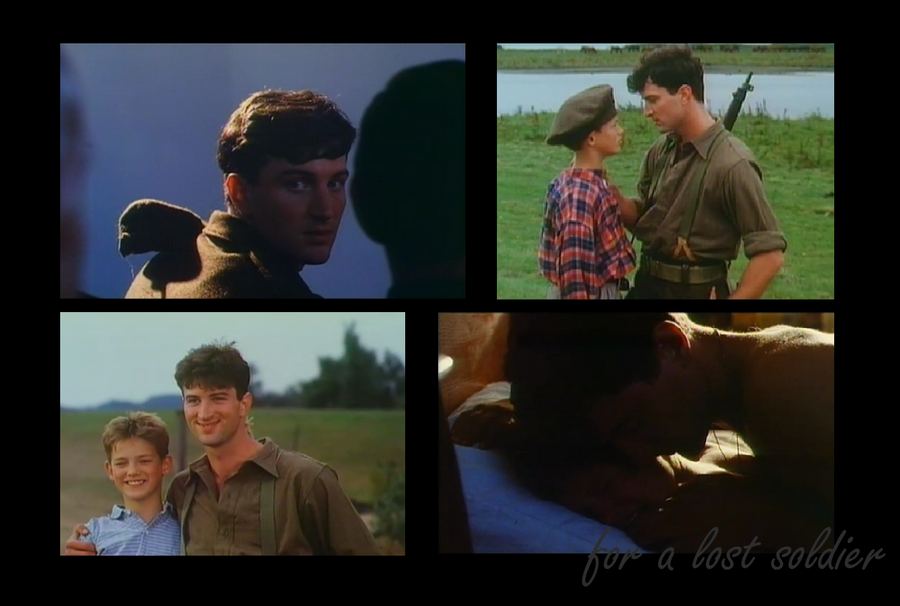
For a lost soldier [1992] – Movie Review

24/03/2015 By David McFarlane 1 Comment

For A Lost Soldier [1992]

  • Studio: Strand Home Video
  • Actors: Maarten Smit, Andrew Kelley, Jeroen Krabbé, Freark Smink, Elsje de Wijn
  • Directors: Roeland Kerbosch
  • Writers: Roeland Kerbosch, Don Bloch, Rudi van Dantzig
  • Producers: Guurtje Buddenberg, Matthijs van Heijningen

‘For a lost soldier‘  breaks all the barriers regarding male sex – a young boy reaching puberty introduced to the pleasure of love with an adult man.  A man who is a transient soldier,
 
Based during the Second World War in Holland when the Allies started liberating Europe, this film stirs something in everybody, whether it be loathing, liking or ambivalence.
I loved this film  The main characters, 12-year-old Jeroen (Marten Smit) and Walt (Andrew Kelley) are totally believable.  They both bring a spark of originality to what could have been a very low key, possibly boring story.
My only criticism is regarding the actor playing the adult Jeroen, he did not in my view do justice to the acting of the boy.  He did not convince me in his description of the dance moves, or in his part.  Possibly this could be the directing, but I do not feel so.
Please do not come to this film expecting excitement, blood or guts, you won’t get them.  This film is full of tenderness, love and the possibility of a happy-ever-after ending.
Get it out on DVD, or see it in the cinema, you won’t be disappointed.


Links:

  • You tube – For a lost soldier
  • Wikipedia – For a lost solider
  • You Tube – Voor een verloren soldaat (For a Lost Soldier) 1992 Full Movie
  • Video Review: ONE IN FIVE BRITISH GAY TEENS BULLIED IN SCHOOL BY TEACHERS OR OTHER ADULTS
  • Grief – 1993 (Movie Review)

Filed Under: Book Reviews, Movie Reviews Tagged With: Andrew Kelley, Elsje de Wijn, Freark Smink, Holland, Jeroen Krabbé, Maarten Smit, man boy love, Netherlands, Roeland Kerbosch, Strand Home Video

Orlando

19/03/2015 By David McFarlane Leave a Comment


Orlando
UK/Rus/France/Germany co-production
Director/Screenplay: Sally Potter
Cert: PG
93 mins
OrlandoThe notion that there is a Gay sensibility has been controverted by some people but this film seems to me to be in a Gay mode – the word ‘tradition’ is too strong at present. Some of the set-pieces at the beginning of Orlando’s adventures in Elizabethan England reminded one of Paradjanov’s films specially Colour of Pomgranates. Not in their look but in the tretment of the screen as a ‘picture’ (that films started out as “motion pictures” is something that western European and especially British Isles film-makes have tended to forget). The ‘picture’ here were like those Tudor-period pictures where the subjects all look out at the viewer. The welcome for Queen Elizabeth I to Orlando’s parents house is clearly based on such paintings – the skating scenes where Orlando waxes rather too familiar with Sasha the Muscovite princess is a bit sneaky, it is more like a Victorian genre painting than the genuine Elizabethan article.
Paradjanov (whose name was Paradjanian, it’s an Armenian name, but he was born in Moscow! – the joys of [federal] union!) based his images on the art of the Christian Caucasian peoples and also to some extent on Islamic art – his images are static like icons; they are also stunningly beautiful. This film might not be quite so overwhelming for people who live in these isles but it has been very popular in American (and it probably will be in Europe).
So far as the narrative itself is concerned, it is handled quite straight, so the oddities in the Orlandooriginal novel by Virginia Woolf are simply taken for granted. And they are very odd oddities, Orlando is granted immortality and in the middle of the eighteenth century changes gender! This is after a period where the “male” Orlando’s realtionship with the local Indian Rajah was less than entirely heterosexual (it is not implied that they were “at it” – but even for the period it is pictured as … unrestrained).
Having become a female, Orlando is dragged through the law courts because she cannot be the owner of the stately pile we first saw in the 1500s, this last lasts somewhere in the region of 200 years … Orolando meets a number of Georgian intellectuals, Steele, Swift, Goldsmith and drinks tea with them. A hundred years later she has a fling with Shelmerdine, a Byronic freedom fighter, played by the beautiful Billy Zane. The last few scenes do not ring true – the action is updated to the 1990s, it should have been left in the 1920s.
The director of Orlando is Sally Potter who did Oranges Are Not The ONly Fruit for the BBC. As well as the high art mentioned in the first sentence she also employs other aspects of Gay sensibility – camp, for example. Orlando talks straight to the audience like a character from one of the Carry On films and we also have Jimmy Somerville as an Elizabethan castrato and a 1990s angel!
Tilda Swinton’s performance as Orlando is amazing, if only because she is not in the least believeable as a woman, or as a man.
Orlando is a lovely film to look at, it is funny and sad, has some great performances, and engrossing story and the viewer is not required to gawp at acres of flesh – I wouldn’t have minded a bit more of Billy Zane’s, though!
 
Reviewer: RL.  Published in ‘upstart’ April 1993

Filed Under: Movie Reviews Tagged With: artificial eye studio, billy zane, movie review, review, sally potter, tilda swinton

  • « Previous Page
  • 1
  • …
  • 13
  • 14
  • 15
  • 16
  • 17
  • Next Page »

Categories

Copyright ACOMSDave.com © 2026