ACOMSDave

Community Journalist

  • Home
  • Community Journalist
  • Events
  • Media Page and Press Kit
    • Projects and Work
  • Resources & Documents
    • LGBTQ+ Support Groups and Documents
  • NIGRA
  • Archives
  • Contact

The Tearoom: the gay cruising 

23/07/2017 By ACOMSDave Leave a Comment

The TearoomThe game is a foot, but that is probably in some peoples dream.  The Tearoom being referred to here is that of the men’s toilet, where before the law was changed, and indeed even afterwards, men who wanted ‘gay sex’ use to frequent and attempt to have sex or do a pick up without the police catching them.
Often the police use to have sting operations using ‘molly boys’ or ‘honey traps’ where they used young men (sometimes underage or new policemen) to frequent these areas, lead the man on, and then arrest him.
This practice is still being used today by ISIS, as can be seen the article ‘Islamic State’s secret flirting squads expose gay men for trial and execution’ published by the Daily Star Sunday, In may 2015
To add to this, Sean McGouran brought to my attention that there was a ballet / dance about such things Joseph Mercier’s Cruising, Clubbing Fucking: An Elegy – he mentioned that he had performed in Belfast a number of times (at the OutBurst festival).
He and dancer Sebastian Langueneur ended up in their birthday suits…
 

TRAILER Cruising, Clubbing, Fucking: an elegy from PanicLab on Vimeo.
Further reading:

  • Homosexuality in the Eighteenth Century – Molly
  • Wikipedia – Honey Trapping
  • Wikipedia – Gay Bathhouse
  • Tearoom Trade And The Study Of Sex In Public Places

 
Robert Yang has created a ‘dick pic simulator’ and a game about consent and BDSM. Now he’s tackling the risks surrounding gay sex in the 60s
Source: The Tearoom: the gay cruising game challenging industry norms | Technology | The Guardian

Filed Under: Movie Reviews Tagged With: ballet, games, gay sex, molly boys, sugar trap

365 Without 377 – Movie Review

31/12/2016 By ACOMSDave Leave a Comment

365 without 377Name of movie: 365 Without 377
Date: 2011
Length (hrs): 53 mins
Film genre: Documentary
Characters: Beena, Pallav and Abhenna.
Director: Adele Tulli, who graduated in South Asian Studies and has worked on several activist projects in India and Europe
Setting: India
 
Plot information: A documentary following the decriminalizing of Section 377 of the Indian Penal Code which criminalized any sexual acts between consenting adults of the same sex.
When does the movie take place? July 2009
What happens in the movie? Imposed under the British colonial rule in 1860, Section 377 of the Indian Penal Code criminalize any sexual acts between consenting adults of the same sex, stigmatizing them as ‘against the order of nature’. On 2ND July 2009 the Delhi High Court passed a landmark judgement scrapping this clause, thus fulfilling the most basic demand of the Indian LGBTQ community, which had been fighting this law for the past 10 years. Three characters, Beena, Pallav and Abheena travel through the city of Bombay heading to the celebrations for the first anniversary of the historic verdict. ‘365 without 377’ is the story of their journey towards freedom. (IMDB)

What makes the movie interesting? The chance to see a different culture handling a British imposed culture, and how they developed as people and overcame the challenges of being ‘gay’ in India, where even though the law as been annulled by the Delhi High Court, for many they still believe it will take much more than this to change the mindset of the Indian community as a whole
What is the best part? The best parts for me was looking at the three main characters lives, and how just like ourselves they are ordinary, but have developed as people and are willing to stand up for their beliefs and rights.
How do you feel when the movie ended? Neither sad or happy, but I did feel that I wanted to learn more, and hope that another documentary will do a follow-up say in 5 years time.
Who will like this move? People with an interest in LGBT activism, people with an interest in humanity, people who like India
On a scale of 1 (don’t like) – 5 (like), how do you rate this movie? For me definitely a 4

Filed Under: Movie Reviews Tagged With: British imperialism, culture, India, law, LGBT

GOODBYE LENIN!

15/08/2016 By ACOMSDave Leave a Comment

Good Bye LeninGOODBYE LENIN! – 2003
Bavaria Film International
Director: Wolfgang Becker
good bye Lenin good-bye-lenin-!
This genuinely charming movie stars the handsome, and talented, Daniel Brühl, as Alex. Daniel BrühlHe’s the son of Christiane (Katrin Sass – who doesn’t really look old enough to be his Mam), though it is implied that she was taken advantage of by the absent father who fled ‘West’.  Alex daydreams occasionally about the Da, usually imagining him very rich and driving a huge Merc. Said Father turns up in the course of the action, and while well-off[ish], isn’t super-rich. I don’t know which side of the Wall the makers come from, but this is a quite sharp point, the Eastern media tell the populace that the West is US-occupied, poor and backward: meanwhile everybody really thinks that ‘Wessies’ have money goodbye-lenin-1squirting out their ears.
The comedy consists in the fact that some days before The [Berlin] Wall comes down Christiane has a heart attack, and is hospitalised. She sees her son taking part in a protest march, mainly about the fact that the Wall is still standing,  he is struck by an ‘Ossie’ cop. Her response has partly to do with the fact that, as a True Believer, she thought that such brutality only happened in the oppressed West.
While she is in hospital, seen as ‘state-of-the-art’ modern, there’s no ‘Ostalgia’ but no denegation of the ‘system’ either – the Wall is broken down.  Alex and his techie-nerd friend Denis (Florian Lukas) conspire, when his mother

Florian Lukas

GOOD BYE LENIN!, Florian Lukas, Daniel Bruhl, 2003, (c) Sony Pictures Classics


is released from hospital, with the warn-ing that a shock, or even mild surprise, could kill her, to pretend that the ‘East’ (GDR – German Democratic Republic) still exists. It gets harder and harder by the hour, even foodstuffs are dumped, and Alex has to hoke about in garbage to find the bottles and labels from the old days. Fortunately for him the ‘old days’ were not so long ago though his mother was in hospital for months after the Wall came down.
Fortunately the taste of the food is unchanged (possibly another indication that not everything ‘Ossie’ was questionable.)  This is acceptable now, but fifteen years ago when this movie was made it was seriously ‘pushing the envelope’ to even hint at such a matter. Alex gets away with a lot, his friend Denis making videos of fake television news items and delivering them in a dreadful plasticky suit presumably of the sort worn by ‘Eastern’ media persons, which they play to his mother. She, inevitably, learns how to use the channel changer and, becomes very confused by what she sees.
They ‘lose’ the implement.
As she gets less fragile, she decides to have a wander outside, and is very confused by what she sees. There are ‘Western’ cars, clothes, and people: one piece of furniture, about to be moved into their block of flats, has an image of the Sacred Heart sitting on a shelf. She asks a young man moving this furniture where he comes from, and he answers “Wurtemburg”, which borders the Rhine. She is totally confused at this, but is returned to the hospital. Alex decides that the news film she views must be doctored. He and Denis show her the breaking down of the Wall – but imply it was Wessies escaping into East Germany that was happening. This stretched one viewers credibility somewhat; it is doubtful if there was much in the way of graffiti on the eastern side of the Wall. But the Western side was heavily graffiti’d. She swallows the notion that the crowds running away from the Wall westwards were actually fleeing eastwards. And the people from, for instance, Wurtemburg are refugees from the benighted West.
She dies shortly after this, Daniel Brühl manages to look simultaneously businesslike and ‘little-boy-lost’-like (like most adults, in a similar situation I assume; you wouldn’t mind a “wee greet”. But matters have to be taken in hand…).
This is a lovely, funny, humane film, see it, you’ll have a lot of laughs, a wee sniffle (or two). For Gay men there is also the prospect of seeing Daniel Brühl in his longish black gunks, (underpants, for the uncultured) he has smooth pale skin and slender, but athletic body. Don’t cheat and flick through the DVD just to see it. Anyway, it’s worth the wait.
Joe Dalton
 
Links:

  • Amazon.co.uk – Good Bye Lenin

Filed Under: Movie Reviews Tagged With: Berlin Wall, comedy, Daniel Brühl, Florian Lukas, Germany, Katrin Sass, lenin

Boys On Film 2: In Too Deep

15/08/2016 By ACOMSDave Leave a Comment

BOYS ON FILM 2
In Too Deep
Peccadillo Pictures
2007
5 060018 651637
peccapics.com
Boys On film 2: In Too Deep

**Boys On Film 2: In Too Deep: A Collection of Encountering Desire and Identity**

The title of this collection, *In Too Deep*, offers a cheeky nod to one of the contributions, “Kali Ma,” set near a swimming pool, hinting at the tangled web of sexual and emotional connections explored across the nine films compiled here. This eclectic mix features two entries from the USA, both set in the vibrant backdrop of New York City, alongside two from Australia’s sunny Sydney. Adding a splash of international flair, we have one film each from Sweden, Canada, France, and Mexico—where “Bramadero” unfolds, a visually striking piece that embraces the surreal, featuring two striking men meeting in a seemingly abandoned building. The film dances on the line between social realism and magic realism, artfully capturing their intimate encounter in a mesmerizing, desolate setting.

Among the shorter contributions, *The Island* from Canada presents Trevor Anderson trudging through the snowy expanse of northern Alberta. The film cleverly critiques a macho talk show suggestion that all “homos” should be isolated on an imaginary island to prevent the spread of HIV. As Trevor walks through the winter landscape, his daydream visions of a “homo utopia” burst forth in vibrant animation, humorously juxtaposing the harsh realities with fantastical notions of sunshine, sex, and sangria, excluding the chaos of storms or calamities. This delightful short is a warm breath of fresh air.

*Love Bite* dives into the lives of two teenage boys sharing a spliff and, ultimately, a secret. One boy, who believes the other is disgusted at the thought of him being queer, is actually hiding his own monstrous secret—he’s a werewolf. This lighthearted narrative takes a dark turn with a gory climax that leaves a lasting impression.

Then there’s *Working It Out*, a comedic examination of jealousy within a couple at the gym, where charm takes a backseat to style, and one partner’s insecurities are on full display. Despite the performers’ less than engaging presence and the gym’s unremarkable setting, the story captures a slice of modern relationship dynamics, though it may not resonate with everyone.

Futures & Derivatives offers a baffling narrative revolving around a businessman trying to impress his superiors with a presentation. However, the true focus shifts to a quirky outsider who, while working through the night, infuses the dull office environment with creativity—a charming mix of corporate seriousness and whimsical style.

Meanwhile, *Lucky Blue* transports us to Sweden, where the pet budgerigar of a traveling family becomes a sweet backdrop to young Lasse’s crush on Kevin, the tall, blonde boy he yearns for. The film wraps up with Lasse’s endearing love song to Kevin, leaving viewers with a sense of hopeful innocence.

*Cowboy*, hailing from Germany, introduces us to Oliver Scherz’s character—an estate agent surveying a rundown farm where he encounters a captivating, enigmatic wild boy played by Pit Bokowski. Their passionate, explicit connection amidst the decay of the farm hints at deeper themes of desire and escape.

*Weekend in the Countryside* presents an intriguing dynamic between two young men, Théo Frilet and Pierre Moure, and a slightly older man overseeing their stay at a rural estate. With fears and tensions simmering, the narrative captures complex emotions against the backdrop of the countryside, leading to an ambiguous conclusion that invites contemplation.

Finally, “Kali Ma” is a layered narrative set against the backdrop of New York City. It centers around a mother-son duo grappling with bullying and cultural identity. As *Ma*, portrayed by Kamini Khanna, confronts the tormentor of her son, the film evolves into a fierce exploration of maternal instincts and vengeance, culminating in a humorous yet poignant moment of rebirth and camaraderie between the boys.

Each film in *In Too Deep* explores the intersections of identity, desire, and intimacy, crafting narratives that resonate with the complexities of modern life. This collection invites viewers to reflect on their experiences and emotions while providing a richly diverse lens on love and the human condition. A captivating assembly, these films offer a fresh perspective, showcasing the vibrancy and diversity of contemporary storytelling across the globe.


Links:

  • Amazon.co.uk – Boys On Film 2: In Too Deep [DVD] [2008]
  • “Silver Road” – Gay Short Film 2006 – Movie Review
 
Segments and Cast:
  • “Cowboy” (Till Kleinert):
    • Oliver Scherz as Christian
    • Pit Bukowski as Cowboy
  • “Lucky Blue” (Håkon Liu):
    • Tobias Bengtsson as Olle
    • Tom Lofterud as Kevin
  • “Weekend In The Countryside”:
    • Théo Frilet as Pierre
    • Pierre Moure as Marc
    • Jean-Claude Dumas as Father
  • “Kali Ma”:
    • Kamini Khanna as Kali Ma
    • Brendan Bradley as Peter King
    • Manish Dayal as Santosh
  • “Bramadero”:
    • Cristhian Rodríguez as Hassen
    • Sergio Almazán as Jonás
  • “Love Bite”:
    • Will Field as Noah
    • Aidan Calabria as Gus
  • “The Island”:
    • Trevor Anderson as Himself
  • “Futures (and Derivatives)”:
    • Kelly Miller as Roger
    • Cam Kornman as Adele Lenz
    • Bill Barnett as Marty Simko
    • Bigi Ebbin as Roger’s Secretary
    • Vin Knight as Gordon Heath
    • Mark Hervey as Elliott
  • “Working It Out”:
    • Simon Kearney as Marcus
    • Paul Ross as Peter
    • Glaston Toft as Jeremy 
       

Filed Under: Movie Reviews Tagged With: boys, cowboys, gay, love, movies, werewolves

German gay literature’s use of suicide to make political points

14/01/2016 By ACOMSDave Leave a Comment

Published by Gay History –

by Paul

15436

A still image from the 1919 German film Anders als die Andern (Different from the Others) depicting a concert violinist who killed himself because of adverse publicity about his homosexual orientation | 15436

Historian Samuel Clowes Huneke has discovered that gay suicide is a historical phenomenon, with a distinct and varied past. Huneke is the first scholar in the field of modern German history to examine the relationship between suicide and gay identity. He is also the first to historicize gay suicide and trace the ways in which it pervades the late 19th and early 20th centuries.

“A striking trend of gay suicide evolved in German culture in the late 19th and early 20th centuries,” he said. Through a close examination of German suicide notes, letters, diaries, medical records, gay literary magazines and novels, Huneke has identified clear connections between the suicide trope and the development of gay identity in modern Germany.

“In the late 1860s, just at the moment when the earliest texts on homosexuality began to appear, German doctors, activists, and writers also began to discuss and depict gay suicide with increasing frequency.” This phenomenon of linking homosexuality with suicide sparked the beginning of what he sees as a trend in poetry, plays and novels in which suicide is a recurring theme. This group “pointed to a handful of gay suicides in order to claim that there was an epidemic of gay men killing themselves because of anti-sodomy laws and fear of exposure.”

Klaus Mann, the first prominent German gay novelist in Western history, was the son of writer Thomas Mann. Klaus Mann published in the 1920s, and his work treated homosexuality openly. The suicide of gay characters recurs in most of Mann’s books. In his novel Treffpunkt im Unendlichen (Meeting-Point at Infinity, 1932), the unrequited love of a gay man for a heterosexual man leads the gay character to take his own life. Mann chose to make the suicide appear romantic and gentle: The gay man committed suicide in the straight man’s bed, in what Mann describes as a wedding-night scene. “It’s seen as a romantic fulfillment of life … instead of depicting something like suicide as a brutal, tragic act, it is depicted as a grand capstone to a miserable life. As if the best thing this character has done with his life is to kill himself.”

Klaus Mann himself committed suicide in a hotel in Cannes, in 1949.

http://phys.org/news/2015-11-historian-uncovers-historical-insidious-gay.html

Filed Under: Movie Reviews, Theatre Reviews Tagged With: gay history, gay literature, Gay suicide, LGBT literature

Why Star Wars Still Gives This Gay Kid Hope

11/01/2016 By ACOMSDave Leave a Comment

advocate_logoBY JASE PEEPLES
DECEMBER 18 2015 5:21 AM EST
Jase Peeples (Right)

Advocate entertainment editor Jase Peeples reveals how Star Wars boosted his self-esteem as a gay kid and why The Force Awakens will do the same for a new generation.
“Come on, son. We’re going to be late,” my dad said as he encouraged me to slip my 5-year-old feet into my favorite pair of red KangaROOS. “You don’t want to miss the new Star Wars.” I had no idea what this “Star Wars” was, but the way my father, stepmother, aunt Cindy, and uncle Bruce were talking about it, I was certain it was supposed to be something good. However, I wasn’t convinced.
Even at 5 years old I had already begun to realize I wasn’t like other boys my age. I had no interest in sports, preferring instead to dance around my room to my copy of Disney’s Disco Mickey on my Fisher-Price record player and loving any chance I got to play with my older cousin’s Easy-Bake Oven rather than the Hot Wheels toys that littered my bedroom floor. I knew what I was “supposed” to like, but the things that caught my young eye didn’t often fall into the predetermined “for boys” category. I was a sassy, effeminate, imaginative boy who felt stuffed animals were superior to toy guns and loved gathering kids together on the playground to make up our own adventures in the merry old land of Oz rather than play something boring, like cowboys and indians, with the other boys.
So when we got to the theater and began waiting in what I was certain was the longest line ever, I was sure I was going to have to suffer through a film that couldn’t possibly be as good as my family said. But as the movie began and the words “The Empire Strikes Back” started to scroll up the screen, I was immediately transported to a galaxy far, far away. For the next two hours and four minutes I sat transfixed by the sprawling space saga, but as impressive as the universe of aliens, starships, and lightsabers was, I found I was completely captivated by two characters that had a profound impact on me that day.
Luke Skywalker was unlike any of the leading men I’d seen before. The typical hero machismo that Harrison Ford played up with undeniable charm as Han Solo was nowhere to be found in Mark Hamill’s portrayal of the less butch son of Skywalker. All the ingredients that make a great hero were still there — courage, strength, honestly — but because they weren’t dripping with the trappings of traditional masculinity, Luke resonated with me on a level I’d never experienced before. Looking back, I now understand why my heart beat a little faster every time a scene of Luke training on Dagobah in his sleeveless undershirt flickered across the screen or why I gasped when Darth Vader sliced off his son’s hand during their lightsaber duel. Luke was my first crush. Hamill’s portrayal of a kinder, gentler hero made the character feel approachable, and I was infatuated with him by the time the end credits rolled.

Jase Peeples (9 Years Old)

Pictured above: Peeples (at 9) posing with his a Speeder Bike and Scout Trooper action figure on Christmas Eve, 1983.
But while the young Jedi was awakening a force of one kind in me, Carrie Fisher’s Princess Leia made my young imagination jump to light speed. Every aspect of my own personality that earned me ridicule on the playground was a strength for the rebel princess. Leia was strong without compromising her femininity. She could serve sassy one-liners that rivaled Han Solo’s, and she still managed to look fabulous whether she was running through the belly of a space worm or brandishing a blaster on Bespin. I may have adored Luke, but Leia was my hero, and I soon became obsessed with Star Wars, snapping up every bit of merchandise I could get from anEmpire Strikes Back sleeping bag and T-shirts to the awesome action figures and play sets from Kenner toys.
Star Wars became a safe space for me, a fantasy world that was acceptable to visit on the playground or at home — one that never brought the ridicule that accompanied playing with Barbie dolls or skipping down the sidewalk singing, “Follow the yellow brick road.” My Star Wars action figure collection — which included Princess Leia in every available outfit — gave me the opportunity to role-play as characters that had a wide range of personality traits. I could be the sinister Darth Vader, the prissy C-3PO, the handsome Luke Skywalker, or the fierce Princess Leia. It only depended on the mood I was in.
When Return of the Jedi was released, my love of the space opera dramatically increased. The revelation that Luke was Leia’s brother made it easier to see him as an object of affection — though at the time I didn’t fully understand that’s what he was for me — since there was now no chance of a pesky heterosexual romance getting in the way. Their relationship was one that paralleled those I was forming with girls in my life at a time when other boys my age were just beginning to notice girls in another way.

Jase Peeples (9 Years Old)

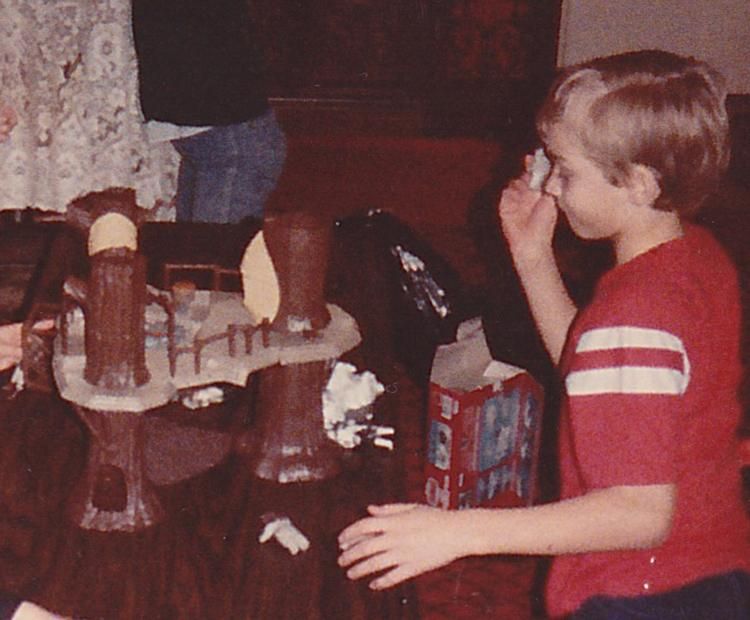
Pictured above: Peeples with the Ewok Village play set.
Topping it all off was the introduction of the Ewoks, warrior teddy bears who could take down even the biggest bullies and were about the coolest thing I had seen.  Carrying around a teddy bear at my age would elicit giggles and laughs, but a plush Wicket the Ewok? Well, that was just awesome!
Years later I would realize many other themes inherent in the Star Wars films that resonated with me as a gay kid, and I discovered many others felt those stirrings in the Force as well. While the story of a young man who leaves behind his small town to become his true self isn’t exclusive to the LGBT population, there are elements within the films that parallel our lives, and viewing the movies through a queer lens only makes the journey that much more personal. It’s this universality that has made Star Wars a pop culture touchstone for so many different people, a modern myth for anyone who needed to overcome the adversity of their own Galactic Empire.
The Star Wars universe was not only a place where I could freely express myself as a boy who often felt like an outsider, it also gave me a way to connect with my peers socially that leveled the playing field. As I sat in the theater watching The Force Awakens this week, I realized how this new installment of the franchise has the opportunity to do the same for an even greater number of young people.

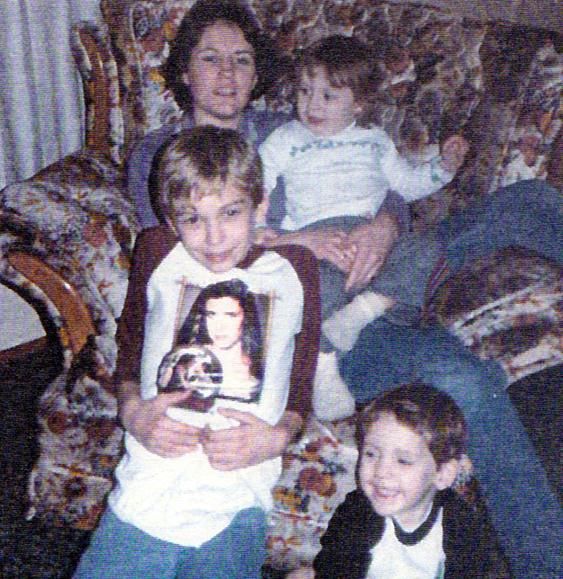
Jase Peeples and family.

Pictured above: Peeples rocks his favorite Princess Leia T-shirt. 
For the first time in a Star Wars film, a person of color isn’t a supporting character like Lando Calrissian or a wise teacher like Mace Windu who helps the heroes on their journey. Instead, John Boyega’s Finn is a character at the center of the story, finally giving young people of color a way to see themselves in a galaxy far, far away like they never have before.
Similarly, women hold positions of power in this film that were only hinted at in earlier instalments. Sure, Leia and Padme were strong, brave leaders, but as wonderful as they are, they were still side characters in a man’s story. In The Force Awakens, not only is Daisy Ridley’s Rey one of the two main characters, she’s a hero who greatly surpasses her female predecessors in the Star Wars films. She needs no man to rescue her and is fully capable of handling herself in a scuffle on the ground or a dogfight behind the controls of a starship. She’s stronger than Luke and twice as smart as Anakin.
However, Rey is far from the only powerful woman in Episode VII. From the return of Leia (now a general and the leader of the Resistance) to the mysterious Chrome-clad Stormtrooper Captain Phasma and the wise Maz Kanata (played by Lupita Nyong’o), it is the women who are both the action stars and the advisers in this film.
Star Wars: The Force Awakens has changed the game. Women and people of color are no longer represented by tokens and background players in a franchise that has been a global phenomenon for nearly 40 years. Images of Finn and Rey are currently plastered around every corner of the globe, even in countries where racist and sexist attitudes are more openly expressed than in the U.S., and those images bring with them the potential for social change around the world.

Jase Peeples and Family

It makes me smile thinking that a new generation of young girls and people of color will have an even better experience than the one I did on that Saturday in 1980. Millions of kids will leave the theater with a greater sense of what they can achieve because they saw someone like themselves projected on the screen. They won’t have to dig through alternate meanings or filter the movie through a different lens to feel included. Those images are already sculpted into action figures with multiple points of articulation, plastered on bags of potato chips, and adorn multiple pieces of activewear.
The images we see in entertainment influence our world view, not only in how we see ourselves, but in how we see others who are different. Disney and J.J. Abrams have used a globally loved piece of pop culture to move the needle forward for diversity with The Force Awakens, and that gives me hope that one day a young queer kid will have the chance to see a gay Jedi on the silver screen and realize that the Force is with him too … always.
JASE PEEPLES is The Advocate‘s entertainment editor and a contributor for Out and Plus magazine. He lives in Los Angeles. Follow him on Twitter @JasePeeples.

Filed Under: Movie Reviews Tagged With: entertainment, LGBT, movies, Star Wars

John Gielgud’s little porn play

10/01/2016 By ACOMSDave Leave a Comment

 
15408
John Gielgud, pictured in 1950 | Jane Bown | 15408
A gay porn film based on a screenplay written by the late Sir John Gielgud has finished production, despite opposition from his estate. Trouser Bar is set in a menswear shop where an orgy takes place and stars Nigel Havers and Julian Clary as passersby. The screenplay was secretly written by Gielgud – known for his roles in Julius Caesar and Arthur – for Peter de Rome. David McGillivray, the producer, told The Guardian:

“Pornography is still a stigma in this country, but Sir John loved porn and, in his letters, he talks about visiting gay cinemas,” he said. “I was shocked when the trust didn’t give me permission. We stuck to Sir John’s script very tightly when we made the film a couple of weeks ago. He was very specific about the clothes he wanted the actors to wear.”
The script, written in the late 1970s, was passed on from de Rome to McGillivray before his death last year. The low-budget feature now risks a legal battle before finding an audience. “They have come down heavily on me,” McGillivray said. “They are using intellectual copyright as an excuse.”

The late actor’s estate are trying to block the film.
The actor and theatre director Sir Arthur John Gielgud, OM, CH was born on 14 April 1904 and died on 21 May 2000. With Ralph Richardson and Laurence Olivier, he was one of the trinity of actors who dominated the British stage for much of the 20th century. He was born into a large theatrical family, one of his brothers, Val, securing a job at the BBC as head of BBC radio drama. Sir John’s acting career began in 1921.
Wikipedia notes

After his return from America in February 1937 Gielgud starred in He Was Born Gay by Emlyn Williams. This romantic tragedy about French royalty after the Revolution was quite well received during its pre-London tour, but was savaged by the critics in the West End.

On the evening of 20 October 1953, Gielgud, just knighted, usually highly discreet about casual sex, was arrested in Chelsea for cruising in a public lavatory. Gielgud was fined.
http://www.theguardian.com/film/2015/oct/28/john-gielgud-scripted-gay-porn-film-still-faces-estate-opposition

Filed Under: Movie Reviews Tagged With: gay history, Julian Clary, menswear, Nigel Havers, porn movie, Trouser Bar

Jack Larson

06/01/2016 By ACOMSDave Leave a Comment

by Paul

15364

Jack Larson (left) as “Jimmy Olsen” and George Reeves (r)| CNN | 15364

Gay Actor Jack Larson has died, age 87. Mr Larson became well known for playing Jimmy Olsen of “Superman” on American television in the 1950s. The Washington Post describes him as a gifted writer and gay man whose talents and personal struggles were overshadowed by his role as Superman’s flunky, “Jimmy Olsen”, which he commenced in 1951 age 18.

“I didn’t want to do it,” Larson said, ”but my agent said, ‘Look, you want to get to New York. You don’t have any money. Nobody will ever see this show so take the money and run.”’

Larson did. For $350 an episode, he completed the show and went to the Big Apple. And he was living there when the show he had dismissed became one of the most iconic in TV history — even though it was pretty bad. … “To me, it was a nightmare,” he said in 2006. “Everywhere I went, it was, ‘Jimmy! Jimmy! Hey, Jimmy, where’s Superman?’ Suddenly, I couldn’t take the bus or the subway anymore. It absolutely freaked me out.”

While in Hollywood, he became involved with screen legend Montgomery Clift, and met his future longtime companion, director James Bridges.

In the end, though, the Superman role became something he began to enjoy, and it made him famous.

“Everywhere I go, I get the warmest feelings from people about Jimmy,” he said. “They love him, and I grew to feel that I could never have done anything more special than be Jimmy Olsen.”

Jack Larson was born on February 8, 1928 and died on September 20, 2015. Gay History sends condolences to family, friends and colleagues.

http://www.washingtonpost.com/news/morning-mix/wp/2015/09/22/how-superman-ruined-a-gay-actors-life-then-saved-it-jack-larson-jimmy-olsen-dead-at-87/

Filed Under: Movie Reviews, TV programme reviews Tagged With: Actor, death, history, Movie History, Superman, TV hisotry

X-Men star opens up about first on-screen gay kiss in music video

03/01/2016 By ACOMSDave Leave a Comment

Troye Sivan had his first on-screen gay kiss in the video

Troye Sivan had his first on-screen gay kiss in the video

Actor and singer Troye Sivan has spoken about his first on-screen same-sex kiss, which took place in a video trilogy for his album Blue Neighbourhood.

The X-Men Origins: Wolverine star opened up about the emotional video trilogy which was directed by Tim Mattia.
Featuring three songs – ‘Wild’, ‘Fools’, and ‘Talk Me Down’, the videos follow a gay couple from their childhood friendship to a tragic ending.
1449284484900

“I heard these three songs but I just never listened to them in that particular order before”, Sivan said.

“You see a little girl and a little boy holding hands and everyone’s like, ‘Aww, sweet! When are you guys going to get married?’ I wanted to show that for young LGBT kids.’”
Of the passionate kissing scenes with co-star Matthew Eriksson, Sivan said he had not done anything quite like that before.
“I’d actually done it before with girls… It was my first time kissing a guy on screen. We had been friends on Facebook for a really long time but we had never met in person. The day after we met he was shirtless with his legs wrapped around me.”
Check out the video trilogy below:


https://www.pinknews.co.uk/2016/01/02/x-men-star-opens-up-about-first-on-screen-gay-kiss-in-music-video/

Filed Under: Movie Reviews, Music Reviews Tagged With: gay kiss, movies, music, Troye Sivan, x-men

The 10 Best LGBT Documentaries of 2015 (USA)

26/12/2015 By ACOMSDave Leave a Comment

OUT dot com logo
BY DANIEL REYNOLDS
THU, 2015-12-24

The year included some great investigations into queer stories.


Best of Enemies
This documentary covers the legendary televised 1968 political debates between liberal Gore Vidaland conservative William F. Buckley Jr., in which the two intellectuals didn’t always keep their rhetoric lofty — at one point Vidal called Buckley a “pro-crypto-Nazi” and Buckley responded by calling Vidal “queer” and threatening to punch him. Directed by Morgan Neville (an Oscar-winner forTwenty Feet From Stardom) and Robert Gordon, Best of Enemies is not only a master class in debate, it’s also one of the most entertaining films of the year.

Tig
In 2012, Tig Notaro made comic history when she joked about her cancer onstage at a club in Los Angeles. The heartfelt routine launched her into fame and the national spotlight. And Tig, a new Netflix movie, chronicles the aftermath, a story of a lesbian comedian and cancer survivor who is searching for meaning, love, and perhaps parenthood through surrogacy.

Tab Hunter Confidential
Hollywood’s all-American boy Tab Hunter is setting the record straight (by coming out as gay) in his new documentary, Tab Hunter Confidential. Based on his 2005 autobiography of the same title, the film by Jeffrey Schwarz (Vito, I Am Divine) explores how Hunter dealt with decades in the closet while making dozens of films and delves into as personal details like his love affair with Anthony Perkins. Sadly, Hunter’s struggle remains relevant in Tinseltown, as A-list stars are still grappling with the love that dare not speak its name. Perhaps they will find some courage from watching this insightful documentary.

Seed Money: The Chuck Holmes Story 
For nearly 30 years, Chuck Holmes’s Falcon Studios was the world’s largest producer of gay pornography, altering the way a generation of gay men saw themselves and their sexuality. Thestory of its founder is told in this insightful new documentary, Seed Money: The Chuck Holmes Story,directed by Mike Stabile. Through archival footage and interviews with porn stars, as well as Holmes’s long-term partner, Steven Scarborough, the documentary shows how one man achieved wealth and fame by reinventing how mainstream culture perceived gay men, while navigating the dangerous early days of the adult film industry.
RELATED | An Oral History of Early Gay Porn

Do I Sound Gay?
Is there such a thing as “gay voice”? That’s what David Thorpe’s documentary explores, with input from celebs including Margaret Cho, Tim Gunn, Don Lemon, Dan Savage, David Sedaris, and George Takei. A hit at film festivals and with critics, Do I Sound Gay? features conversations with linguists, family members, and strangers on the street to weigh in about one of the most personal and perhaps revealing parts of ourselves: our voice.

Larry Kramer in Love and Anger 
It’s been a landmark year for Larry Kramer. The HIV activist turned 80, released the book The American People: Volume 1, and was nominated for a slew of awards for the recent HBO adaptation of his 1985 play The Normal Heart. And now he’s the subject of a new documentary, Larry Kramer in Love and Anger, which documents his fight as a firebrand activist to make AIDS a national issue and change public health policy. Don’t miss the making of one of the LGBT community’s great activists.

The Glamour & The Squalor
Directed by Marq Evans, The Glamour & The Squalor tells the story of the legendary rock radio DJ Marco Collins. As a gatekeeper and great lover of music, Collins helped make the careers of bands like Weezer, Nirvana, and Pearl Jam by broadcasting their songs to the public. But in his private life, the Seattle-based figure was battling demons and struggling to keep his sexuality out of the public eye. Archival footage, animated re-creations, and interviews with artists like Carrie Brownstein, Macklemore, and Collins himself help tell one of the year’s most glam tales.

The Royal Road
One of the year’s most poetic documentaries comes from filmmaker Jenni Olson, who in addition to her cinematic contributions, is known as one of the founders of PlanetOut.com. Olson calls her new film, The Royal Road, “a cinematic essay in defense of remembering” as well as “a primer on the Spanish colonization of California and the Mexican American War alongside intimate reflections on nostalgia, butch identity, the pursuit of unavailable women and Alfred Hitchcock’s Vertigo — all against a contemplative backdrop of 16mm urban California landscapes, and featuring a voice-over cameo by Tony Kushner.” What’s not to love?

Mala Mala
Mala Mala is a timely new documentary that shows portraits of the transgender community in Puerto Rico. A hairstylist, a prostitute, an activist, and a RuPaul’s Drag Race star (April Carrion) are several of the subjects interviewed by directors Dan Sickles and Antonio Santini, who capture the discrimination and hardship that can come from one’s journey to selfhood.

A Sinner in Mecca
A gay Muslim filmmaker comes to term with his sexuality and his religion in A Sinner in Mecca. In this documentary, Parvez Sharma embarks on a hajj (a pilgrimage to Mecca) in Saudi Arabia, where it is not only a crime to be gay, it’s punishable by death. It is also forbidden to film in Mecca, making Sharma’s film an unprecedented view into a place and culture off-limits to most of the world

Filed Under: Movie Reviews Tagged With: best of, documentary, LGBT, LGBT Documentaries, movies

  • « Previous Page
  • 1
  • …
  • 5
  • 6
  • 7
  • 8
  • 9
  • …
  • 17
  • Next Page »

Categories

Copyright ACOMSDave.com © 2026