ACOMSDave

Community Journalist

  • Home
  • Community Journalist
  • Events
  • Media Page and Press Kit
    • Projects and Work
  • Resources & Documents
    • LGBTQ+ Support Groups and Documents
  • NIGRA
  • Archives
  • Contact

Magnus Hirschfeld – saint or sinner

03/10/2023 By ACOMSDave Leave a Comment

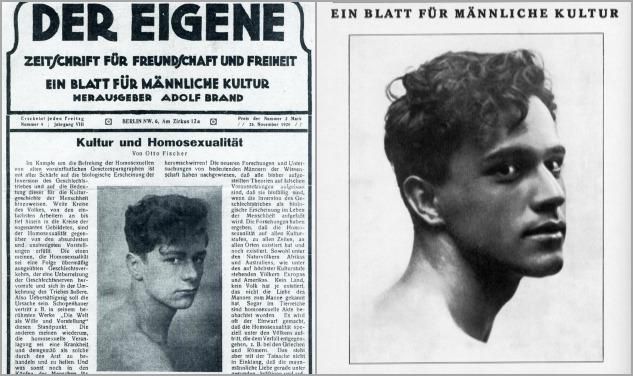
Magnus HirschfeldLike all people, Magnus Hirschfeld is a man who adjusted to his situation.  He was a researcher, a scientist, and a supporter of sexual minorities.  He founded the Scientific-Minorities Committed and World League of Sexual Reform.  He purchased and then set up the Institute of Sexual Research on 6th July 1919, in the liberal atmosphere of the newly founded Weimar Republic.  The institute came to house his immense archives and library on sexuality and provided educational services and medical consultations; it also housed the Museum of Sex.  This all ended in 1932 when Chancellor Franz von Papen carried out a coup that exposed the Braun government in Prussia.  Papen was a conservative Catholic with a long vocal history of criticism of homosexuality.  He ordered the Prussian police to start enforcing Paragraph 175 (Does anyone see similarities with Section 28 in the UK much later in history from Margaret Thatcher?).  In January 1933, Paul von Hindenburg appointed Adolf Hitler as chancellor of Germany, and less than four months later after the Nazis took power, and the Hirschfield’s Institute was sacked, this was followed by another ‘attack’ on May 6th, and the institute was finally forced to close.Magnus Hirschfeld

Magnus Hirschfeld, had by this stage left Germany, but throughout his travels, he hoped for a a return to Germany and to the liberal country that he had known. (Switzerland, France).  But his impact was felt worldwide, e.g. Henry Gerber formed the Society for Human Rights following World War 1, and Harry Hay in 1950 formed the Mattachine Society because one of the members of the Society for Human Rights had communicated the existence to Harry Hay.  In Ireland, the National LGBT Federation established the Hirschfield Centre in 1979.

 But as I put in my title, was Magnus Hirschfeld a saint or a sinner?   Fred Sargeant has written a large, extremely well-researched article ‘The dark legacy of Magnus Hirschfeld’ published 1st October 2023 in Spiked.  The article concludes:

…Magnus Hirschfeld’s attempts to decriminalise homosexuality are to be admired. But his belief in eugenics, his flirtation with racial theory and his contribution to gender ideology are all deeply troubling. The legacy he has left is far more ambiguous than his contemporary champions would have us to believe…

I am going to leave you to make your own mind up, and I will leave you with links to various articles/websites for you to read and then come back and let us have your thoughts.


Links:

  • Wikipedia – Magnus Hirschfeld
  • Britannica – Magnus Hirschfeld
  • Holocaust Encyclopedia -MAGNUS HIRSCHFELD
  • Scientific American – The Forgotten History of the World’s First Trans Clinic
  • Spiked – The dark legacy of Magnus Hirschfeld
  • ACOMSDave – Gay History: 50 years ago today, gay rights activists took to the streets
  • ACOMSDave – The History of LGBT (now LGBTQ+) in Northern Ireland
Magnus Hirschfeld

Filed Under: Community Journalist, History Tagged With: Gay Pride Belfast, Germany, Hirschfeld, Magnus, Magnus Hirschfeld, Nazi, sexual history, sexual minorities, teh Hirschfeld Centre Ireland

The Glamour Boys – 17 MPs (some gay) who fought appeasement

08/11/2020 By ACOMSDave Leave a Comment

The Glamour Boys: The Secret Story of the Rebels who Fought for Britain to Defeat Hitler

The Glamour Boys by Chris Bryant review – the rebels who fought for Britain

The Glamour Boys by Chris Bryant review – the rebels who fought for Britain

As Simon Callow’s review points out not all of ‘the 17-strong Glamour Boys’ were gay, as they also included luminaries like Harold Macmillan, Anthony Eden, Duncan Sandys, Leo Amery and Winston Churchill.

However, what does stand out, is that the leadership of this group who opening stood up against appeasement when the government of the day believed unequivocally in negotiating with Hitler for peace is a testament to their strength of will.  For the gay MPs, this could come at a very high price – if they were found to be in a ‘gay’ relationship of any kind they could have been in court with severe charges against them, and also the adverse publicity which as had happened in the past (Oscar Wilde) would possibly have led to them fleeing the country (but where to you might ask in the light of what was happening in German!).

There is much to recommend in this book, the accomplished multi-biography, the sensitivity in which he handles the material, the research and referencing.

In a time when we need heroes, this book highlights 17 of them to us as a nation, and in particular those of us who are gay.


  • The Guardian – The Glamour Boys by Chris Bryant review – the rebels who fought for Britain
  • Simon Callow reads Oscar Wilde’s Famous Prison Gay Love Letter | Attitude Pride at Home


  • The Man Who Made Magazines Gay

The Man Who Made Magazines Gay

Filed Under: Book Reviews, Community Journalist, History Tagged With: boys, Germany, glamour, government, Hitler, MPs, rebels, secrets

The Collini Case – Book Review

11/06/2019 By ACOMSDave Leave a Comment

Title The Collini Case
Place West Germany
Publication date 4th July 2013
Pages PB 208
Price PB £7.18
Author Ferdinand von Sabruch
Publisher Penquin
Edition  
Special features (maps, etc.)  
ISBN  978-0718159207

Firstly I must note my self-interest in legal stories, and ‘The Collini Case’ delivers for me in every way. whether it be in book form, TV, radio or movie. 

I remember watching Perry Mason, The Defenders, and lately (ITV Series taken from USA).  But also The Client by ….. Grisham which I read as a book and then watched as a movie and TV series.

I am also an ardent fan of police/detective procedural, having read the Moonstone when I was 8 years old, all of Sherlock Holmes, and most of John Buchan’s books; never mind the various police TV series over the years.

Yes I love the law, but I am not a lawyer/solicitor/or policeman!

So when I picked up this book, ‘The Collini Case’ second hand in a charity shop for £0.50, it was firstly because it was about the law, more specifically the law in Germany; and that it was about the second World War, the Nazi and economic regime over that period, and the fall out after the war, and it was about people.

The people are easily defined:

  • the lawyer
  • the murderer
  • the murdered person
  • the love interest
  • The mentor (?)

The law in this case is that of the law in Germany following reunification of West and East Germany.  The German legal system is that of civil law which is founded on the principles laid out by the ‘Basic Law for the Federal Map of Germany, … but many of the most important laws were developed prior to the 1949 constitution.  It is comprised of ‘public law’ which regulates the relationship between a citizen/person and the state…  This area of law has also been subject to a wide array of influence from Roman Law to Napoleonic law.

I have already mentioned the main characters in general terms, the story is relatively simple; ‘a man walks into a hotel and kills another man.  The murderer is a well-respected Mercedes-Benz worker, Fabrizio Collini – a man of unblemished record, and with no apparent reason for committing the murder. He doesn’t run away but refuses to defend himself to the police.  His lawyer, assigned by the court, gets nowhere with him, and even though he is almost concerned with ‘just’ doing his job, he follows his legal nose, discovers his client’s past and therefore his reason for the murder and then he has to put together a mechanism for the prosecution to introduce the evidence so that he has the right of rebuttal.

Apart from the initial murder, there is no further ‘American’ style action.  It is a story about thinking, about research and also about the good, old-fashioned dogged investigation.

The sting in the tale is the impact that this story had on the German legal system and the German government after its publication.  The outcry over ‘war criminals’ escaping justice led to the German government reviewing its legal system.

Links:

  1. Amazon: The Collini Case
  2. Cineuropa trailer:

Filed Under: Reviews Tagged With: book review, Collini Case, Germany, law, Lawyer, legal whodunit, murder, Nazi, police, whodunnit

GOODBYE LENIN!

15/08/2016 By ACOMSDave Leave a Comment

Good Bye LeninGOODBYE LENIN! – 2003
Bavaria Film International
Director: Wolfgang Becker
good bye Lenin good-bye-lenin-!
This genuinely charming movie stars the handsome, and talented, Daniel Brühl, as Alex. Daniel BrühlHe’s the son of Christiane (Katrin Sass – who doesn’t really look old enough to be his Mam), though it is implied that she was taken advantage of by the absent father who fled ‘West’.  Alex daydreams occasionally about the Da, usually imagining him very rich and driving a huge Merc. Said Father turns up in the course of the action, and while well-off[ish], isn’t super-rich. I don’t know which side of the Wall the makers come from, but this is a quite sharp point, the Eastern media tell the populace that the West is US-occupied, poor and backward: meanwhile everybody really thinks that ‘Wessies’ have money goodbye-lenin-1squirting out their ears.
The comedy consists in the fact that some days before The [Berlin] Wall comes down Christiane has a heart attack, and is hospitalised. She sees her son taking part in a protest march, mainly about the fact that the Wall is still standing,  he is struck by an ‘Ossie’ cop. Her response has partly to do with the fact that, as a True Believer, she thought that such brutality only happened in the oppressed West.
While she is in hospital, seen as ‘state-of-the-art’ modern, there’s no ‘Ostalgia’ but no denegation of the ‘system’ either – the Wall is broken down.  Alex and his techie-nerd friend Denis (Florian Lukas) conspire, when his mother

Florian Lukas

GOOD BYE LENIN!, Florian Lukas, Daniel Bruhl, 2003, (c) Sony Pictures Classics


is released from hospital, with the warn-ing that a shock, or even mild surprise, could kill her, to pretend that the ‘East’ (GDR – German Democratic Republic) still exists. It gets harder and harder by the hour, even foodstuffs are dumped, and Alex has to hoke about in garbage to find the bottles and labels from the old days. Fortunately for him the ‘old days’ were not so long ago though his mother was in hospital for months after the Wall came down.
Fortunately the taste of the food is unchanged (possibly another indication that not everything ‘Ossie’ was questionable.)  This is acceptable now, but fifteen years ago when this movie was made it was seriously ‘pushing the envelope’ to even hint at such a matter. Alex gets away with a lot, his friend Denis making videos of fake television news items and delivering them in a dreadful plasticky suit presumably of the sort worn by ‘Eastern’ media persons, which they play to his mother. She, inevitably, learns how to use the channel changer and, becomes very confused by what she sees.
They ‘lose’ the implement.
As she gets less fragile, she decides to have a wander outside, and is very confused by what she sees. There are ‘Western’ cars, clothes, and people: one piece of furniture, about to be moved into their block of flats, has an image of the Sacred Heart sitting on a shelf. She asks a young man moving this furniture where he comes from, and he answers “Wurtemburg”, which borders the Rhine. She is totally confused at this, but is returned to the hospital. Alex decides that the news film she views must be doctored. He and Denis show her the breaking down of the Wall – but imply it was Wessies escaping into East Germany that was happening. This stretched one viewers credibility somewhat; it is doubtful if there was much in the way of graffiti on the eastern side of the Wall. But the Western side was heavily graffiti’d. She swallows the notion that the crowds running away from the Wall westwards were actually fleeing eastwards. And the people from, for instance, Wurtemburg are refugees from the benighted West.
She dies shortly after this, Daniel Brühl manages to look simultaneously businesslike and ‘little-boy-lost’-like (like most adults, in a similar situation I assume; you wouldn’t mind a “wee greet”. But matters have to be taken in hand…).
This is a lovely, funny, humane film, see it, you’ll have a lot of laughs, a wee sniffle (or two). For Gay men there is also the prospect of seeing Daniel Brühl in his longish black gunks, (underpants, for the uncultured) he has smooth pale skin and slender, but athletic body. Don’t cheat and flick through the DVD just to see it. Anyway, it’s worth the wait.
Joe Dalton
 
Links:

  • Amazon.co.uk – Good Bye Lenin

Filed Under: Movie Reviews Tagged With: Berlin Wall, comedy, Daniel Brühl, Florian Lukas, Germany, Katrin Sass, lenin

Novel Ideas – Roger Casement

29/07/2016 By ACOMSDave Leave a Comment

Jeffrey Dudgeon with his lovely tieJeffrey Edward Anthony “Jeff” Dudgeon MBE is a Northern Irish politician, historian (his books on Roger Casement are extremely well researched and very readable)  and gay political activist. He currently sits as a Ulster Unionist Party councillor for the Balmoral area of Belfast City Council.  He is best known for bringing a case to the European Court of Human Rights which successfully challenged Northern Ireland’s laws criminalising consensual sexual acts between men in private. He is currently one of three openly gay politicians elected to the City Council along with Mary Ellen Campbell of Sinn Féin and Julie-Anne Corr of the Progressive Unionist Party
 
The following extract from an interview in The Irish Times, gives an insight into Jeffrey, who he is and what he has become…

“I’ve always been a reformer. A rebel and a radical, yes, but I wasn’t a revolutionary,” Dudgeon says, looking back on his 1981 victory in the European Court of Human Rights, which decriminalised homosexuality in Northern Ireland.

What was life like, as a young gay man, before the Strasbourg win? Dudgeon sums it up in one word: isolation.

“I knew all about homosexuality, and by my midteens I had ascertained that fact about myself. But I just didn’t know how to meet other people, and I was petrified at the thought of it. You just couldn’t say the words to anyone.”…

the-diaries Dev-at-the-re-Burial-of-Roger-Casement-in-Glasnevin.-I-believe-it-was-a-bitter-cold-day-and-Dev-who-was-very-sick-at-the-time-went-against-his-doctors-advice.-300x240 3_1_Sir_Roger_Casement

Unknown Roger Casement letter 6208307701_1f5a8d9937_b Roger Casement Diaries

In the video below Ciarán Ó Brolcháin discusses with author Jeffrey Dudgeon and Dr. Margaret O’Callaghan the book – “Roger Casement: The Black Diaries” which explores the life of Roger Casement – a study of his social background, political life and his contribution to Irish political life.


Filed Under: Book Reviews, History Tagged With: black, Casement, diaries, Dudgeon, Germany, Jeffrey, Roger

The Irish vote for gay marriage reverberates through Germany

21/06/2015 By Dave McFarlane Leave a Comment

The Economist – Jun 20th 2015 | BERLIN | From the print edition

German same-sex unions

At the end of the Regenbogen

The Irish vote for gay marriage reverberates through Germany

SINCE Ireland voted in May to allow same-sex marriage, Europe has had a clear divide: liberal in the west but more illiberal going east. Germany is in the middle. Since 2001 gay and lesbian couples have been able to enter civil unions, and 35,000 have done so. They enjoy the same rights as heterosexual spouses for tax and inheritance. But same-sex couples do not have full adoption rights, and their union is not called marriage.
Many Germans find this embarrassing. A 2013 poll found 74% in favour of full marriage rights for homosexuals. So are the opposition Greens and Die Linke (The Left) in parliament, as well as the Social Democrats, the junior party in the ruling grand coalition. The upper-house Bundesrat, where these three parties have a majority, recently passed a non-binding resolution urging the government to make marriage available to all.
That was largely symbolic, because of opposition within Chancellor Angela Merkel’s centre-right block, consisting of two “Christian” parties: her own Christian Democratic Union (CDU) and the more conservative Bavarian Christian Social Union. The phrase “Christian union” came from a post-war confessional alliance between Catholic and Lutheran parties from the Weimar Republic. But conservatives now invoke Christian values to argue against same-sex marriage. Annegret Kramp-Karrenbauer, the premier of Saarland, who is often touted as a possible successor to Mrs Merkel, recently argued that if you allow gay marriage, incestuous or polygamous nuptials might be next.
Yet within the CDU attitudes are changing. The defence minister, Ursula von der Leyen, another possible successor to Mrs Merkel, this month told the party’s executive committee that “something fundamental has changed in society.” If Irish Catholics can relax about gay marriage, so can German ones, says Jens Spahn, a gay member of the committee. Mrs Merkel, the daughter of a Lutheran pastor, has been coy but is thought to be tolerant in private. She visibly squirmed when asked during the 2013 campaign to explain her party’s rejection of gay marriage. But she knows she has moved the CDU leftward in the 15 years she has led it. Many blame her for the emergence of a new party on the right, the Alternative for Germany, which attracts disgruntled former Christian Democrats.
Such objections are tactical, says Alexander Vogt, leader of the gay-and-lesbian club within the CDU. As is her wont, Mrs Merkel chooses battles carefully. Right now—with Grexit, Brexit and Ukraine—she faces many. She might also like to keep gay marriage alive as an issue to concede to the Greens, whom she may prefer as a coalition partner after the 2017 election. One way or another, says Mr Vogt, Germany will have same-sex marriage soon afterwards.

Filed Under: Anti-Bullying & Homophobia, History Tagged With: gay marriage, Germany

LGBT Remembrance at Belfast Cenotaph

07/11/2013 By David McFarlane Leave a Comment

Those who gathered to remember past LGBT people persecuted for their sexual orientation or gender identity. Photo: Simon Rea.

Those who gathered to remember past LGBT people persecuted for their sexual orientation or gender identity. Photo: Simon Rea.


This morning about ten to eleven, a number of members of the LGBT community from the city of Belfast gathered to stand in solidarity and remembrance for all those in Germany, and all nations who lost their lives or were imprisoned for their sexual orientation or gender identity.
The short simple act of remembrance was instituted and organised in the past by PA MagLochlainn, who died about this time a year ago. This year, Andrew Smyth from Cara-Friend organised the event and we were pleased to support it.
We heard from a number of readings including an extract from The Men with the Pink Triangle by Heinz Heger which was read by John O’Doherty of The Rainbow Project.

The prisoners’ uniforms were marked with a coloured cloth triangle to denote their offence or origin.
…
Yellow for Jews, black for anti-socials, red for politicalise, purple for Jehovah’s Witnesses, green for criminals, blue for emigrants, pink for homosexuals, brown for gypsies.
The pink triangle, however, was about 2 or 3 centimetres larger that the others, so that we could be clearly recognised from a distance. (from The Men with the Pink Triangle)

A wreath in the shape of a pink triangle was laid at the Cenotaph by Jeff Dudgeon and Andrew Smyth and we stood together in silence to remember those that suffered at the hands of the Nazis and all who have suffered persecution because of their sexual orientation or gender identity.

Filed Under: History Tagged With: Belfast, Cenotaph, Germany, Heinz Heger, Jeff Dudgeon, LGBT, NIGRA, Pink Triangle, Rainbow project

Categories

Copyright ACOMSDave.com © 2026