ACOMSDave

Community Journalist

  • Home
  • Community Journalist
  • Events
  • Media Page and Press Kit
    • Projects and Work
  • Resources & Documents
    • LGBTQ+ Support Groups and Documents
  • NIGRA
  • Archives
  • Contact

Sean Morrin: human rights activist – RIP

24/09/2013 By David McFarlane Leave a Comment

Our thoughts are with the friends, family, and work colleagues of Sean Morrin who died at the weekend in Derry.
I heard the news about Sean’s passing late on Sunday night, and immediately I thought of our friends in The Rainbow Project where Sean worked. But Sean’s life touched many more people than them.
Two members of UNISON who knes Sean much, much better than I did, wrote the following tributes, which I received in an email as a UNISON member.
“Sean Morrin who was a lifelong gay rights activist and our first ever UNISON ‘out’ gay member in the early 90s died suddenly over the weekend at his home in Derry. He was a founder member of Foyle Pride, both a volunteer and staff member with the Rainbow Project, set up AA/NA for LGB&T people in Derry, was involved in history projects and arts projects to raise the profile of LGB&T people, was a volunteer with Foyle hospice and more recently had been supporting the Trans Derry group. In between that he just helped and supported people in his own quiet way, offering his sofa, a listening ear and hope to many. When he wasn’t adopting people he was fostering cats and dogs, trying to get new homes for them. I will always remember him for his positivity of spirit and his optimism, he really did see the good in people even when it could be hard to find. I will be among many who will miss him. A rainbow flag is currently flying at half mast over the Free Derry wall. For those who would like to attend his funeral, it will be at 10am mass on Thursday in St Mary’s church in Creggan.” said Fidelma Carolan, of UNISON.
unisonlogoAnother member of UNISON, Ronan Doherty, who is currently in Cuba as part of his medical training at Kings College (he started with the Union as a nurse) wrote a lovely tribute which gives a real sense of Sean even to those who didn’t know him.
“I was sitting in Cuba when I received the horrifying news of Sean leaving us! There happened to be some Irish people there so before I realised I had a whiskey in one hand and a cigarette in the other! I was surrounded by people who I made friends with on my travels! I was physically unable to speak and shaking so hard I couldn’t smoke the cigarette I’d been given!
“When I finally managed to utter some words I realised that there was a grief in all their hearts just from seeing the effect of this news on me! There were 2 irish, 2 cubans, one indian girl and me! Eventually one of them asked me to please tell them about Sean! It seemed a fair point as they sat with me and grieved for a man they’d never met!
“I sat trying to find the words to describe the man I loved and who now I’d lost! However I struggled and I realised at that point that there were no words! No words seemed to do him justice! Kind, generous, radiant, forgiving, protecting, loving…. No words are enough! However I tried to tell them about Sean and how I’d come to love him!
“I’d spent my short time with these people discussing and debating life! (Usually over a bottle of rum). We had discussed everything from right and wrong to life in Cuba and uk and Ireland, poverty, wealth, health, homelessness and human rights! It was in those moments of trying to describe Sean that i realised how many of my values I had inherited from him! Basically all of them. And in everything I discussed about my opinions, values and principles over the past few weeks and probably past years- there he was!
“I met Sean Morrin when I was 15! Life was out of control and I was struggling with many things! It’s not a unique story for a young gay man but at that time I didn’t know this! All I knew was life sucked! I loved Sean the minute I met him and his radiance, smile and ability to make you feel whole and worth something emanated out of his every fibre!
“Soon after I first met him I came to meet him for dinner one evening in derry! I was in my school uniform and he would often remind me of that and laugh! I didn’t know what I needed but knew I needed something! I’d decided to move out of home and asked Sean if I could rent once of his many rooms at the time that he seemed to have for wayward gays!
“I had it planned that I would get a part time job to pay my rent and remain at school! In hindsight it was a ridiculous plan that never would of worked! However I was determined and Sean never disagreed or disrespected my ideas! I imagine he knew it was not a feasible idea and something would give but he never dismissed me! He said as long as I can pay my way I’m welcome in his home!
“Thankfully I never did follow through with that plan and on reflection I didn’t really need to after that! Just hearing that it was fine and that I had the option was support enough! As sure as I know Sean knew it was a ridiculous idea I think he knew I just needed the reassurance that I had options and his respect and support were more than enough to help me more than anything!
“He helped me in so many ways that they would be impossible to list! I have no doubt that I probably wouldn’t be here today if it weren’t for him! How do you repay someone the debt of saving your life! A good friend of mine now, who i later learned Sean also lifted from despair, and I often talk and laugh about Sean’s influence on our lives! And we wonder about how many other people have the exact same story! How many people would not be here today if it were not for him! I’m sure it must run to hundreds if not thousands!
“You see, I know my relationship with Sean was special and unique to me however i also know that Sean’s relationship with me, although just as special to him was not unique! He helped and befriended everyone and had such an impact on lives it’s hard to even begin to count!

Sean Morrin pictured at Foyle Pride (Photo: Anne Ramsey)

Sean Morrin pictured at Foyle Pride (Photo: Anne Ramsey)

“Sean loved people! Many people describe Sean as an LGBT campaigner or a gay rights activist! Personally I find this a little upsetting! It is true that Sean had an immeasurable impact on the LGBT community and that’s where he is most known! However for me Sean was not an LGBT activist, Sean was a human rights activist! His campaigning and work and life not only influenced the gay community but dozens of other causes! Sean loved the Martin Luther king phrase “injustice anywhere is a threat to justice everywhere” and Sean would combat injustice anywhere he could see it and especially for anyone who couldn’t combat it themselves!
“And his love didn’t even stop there! He loved animals to such an extent I sometimes feared his house would turn into a sanctuary! His love seemed to have no limit and know no bounds! It was like a bottomless well that never ran dry! Sean always forgave people no matter how many times they made mistakes- myself include! Most people have a limit to their forgiveness but his was immeasurable and was never exhausted! He believed in the good in people despite any odds and gave people chance after chance! One of his favourite things to tell me when people did something wrong was that “only hurt people hurt people”.
“Many times I watched him give someone his last £5 because he knew they needed it more than he! I would get angry and ask how was he going to manage now and his response was always “the universe will provide”. His generosity knew no bounds and he never kept count! Sean is the reason I always give homeless people money even when friends argue that they just want it to buy alcohol! He taught me that giving to those with less is everything we can do and respecting that person as a human means giving without conditions and without keeping score!
“I read the hundreds of facebook comments people where posting and it proves what I already knew in that his effect on me was not unique and hundreds of other people have felt the love, respect and warmth of knowing Sean Morrin! The last picture I saw on Sean’s Facebook was of him at foyle pride holding a banner saying “marching for those who can’t”! I found this so appropriate as the friend I’ve now lost devoted his life “marching” for those who couldn’t!
“There is a huge dark hole in the earth today where his presence once stood and an even larger hole in my heart! The world feels like it had stopped spinning! However there is also a new star in the sky which shines just as bright as he did on earth! In true Sean style I choose to focus on the light and not the dark! I’ll carry everything he taught me in my heart and continue to live by the principles he taught me- respecting every other person, fighting for those who can’t, and giving to those who need! Although I have no doubt I will never be the man that he is I don’t fret! For even if i live twice as long and yet I only manage to do a thousandth of the good he did in his lifetime I will die a happy man!
“RIP Sean Morrin!”

Filed Under: History

Charles Kenny – "Eulogy at Mervyn Kingston’s funeral"

03/09/2013 By David McFarlane Leave a Comment

rev-kingston
 
“Eulogy at Mervyn Kingston’s funeral”
It is a privilege to have been asked to speak publicly as we meet here today formally to express our sorrow at the death of our brother, friend, fellow-churchman, Mervyn, to thank God for his life and work, and to show our sympathy to those nearest and dearest to him, especially to Richard his partner.
George Mervyn Kingston was born in Florida Drive, East Belfast. In those difficult post-war yrs his twin sister Jill and he attended Nettlefield School and Willowfield Parish Ch. Both of these institutions were from the beginning important to Mervyn and I think he knew they were to influence, even determine, the course of his life. The PE school prepared him for Grosvenor High School on the other side of the city; and the parish church and its parochial halls were a wonderful outlet for this young boy. He thrived in the life of this big and busy Parish Church on My Lady’s Road; for the C of I of the time, it gave unusual prominence and opportunity to lay people in worship and parochial organisations. Many good parishioners participated hands-on in the day-to-day and Sunday by Sunday running of the parish. (The General Vestries were sometimes eye-opening.) These experiences gave Mervyn a vocation to the sacred ministry.   I knew Mervyn in the first decade and a half of his life, but not well; a 12 yr old boy doesn’t have much in common with a 4 yr old who isn’t his brother and I left these shores in 1962 but I remember the pleasure of my parents in a blue aerogramme to me telling me the news: did I remember young Mervyn Kingston? well, he had been accepted for ordination. He would be going down to  Dublin in September. My parents and everyone else around the church were delighted. There was a detail in this development which was indicative of something that would be seen again in the future. As a child and teenager Mervyn had quite a bad stammer which he had overcome; he didn’t give up easily. Also by then he was finding fulfilment in his work in Social Services; but he felt the call to the Ministry and the Church recognised and welcomed that in 1969.
The Revd Mr Kingston was ordained for the curacy of Comber Parish to learn the trade and the practice from Hammy Leckie (this was a good choice, he reckoned at the time and subsequently), then back in E Belfast he served in St Donard’s where he appreciated Pat Synnott as mentor, followed by Down Cathedral with particular concern for Ardglass. Later in the mid 80s he crossed the river to Connor and the housing estate at the top of the Shankill Road; then down to a spur of Armagh Diocese that curiously reaches the sea near Dundalk, a care of souls which includes Carlingford and Crossmaglen.
Obviously these locations are very diverse and varied in every way but in all these milieux Mervyn was a consistent cleric and pastor. He began during the most destructive and murderous years of the Troubles and that affected his perception of what he believed God was asking of his people. Mervyn never lost the mind-set, the aspirations and the vocabulary of evangelical churchmanship. He was an evangelical true to the Gospel. In later years he often gently queried his more radical friends and colleagues who tend to dismiss the evangelical tradition as a discredited and spent force, always in hock to biblical idolatry which precludes any sort of prophetic Xnity, and which had played its part in creating debased Irish Xnity. Mervyn rejected this emphatically remembering the good people of his youth. But he knew what the epistoler James had in mind when James derides faith that is not evidenced in practice or in life. Mervyn was by nature conciliatory, seeing the best in everyone, aware of reasons, explanations of bad attitudes and deeds; he understood the power of history and environment; he tried to explain, to educate, willing people to see something differently, to read the words of Our Lord with openness and insight (as if for the first time), to try to separate the gospel imperatives from local cultural assumptions, to be sure they were questioning the latter in the light of the former, as Jesus did continually. He respected others’ opinions even when he felt in conscience that there was a better way and that it was his parsonical duty at least to present an alternative Xn position. But he always laid it on the line when he was seeking a new post. The elephant in the room was identified starkly; if you choose me you are getting an ecumenical C of I rector. “Ourselves alone” is heretical; I will want to work with those of other traditions; I will work for rapport between them and us. Furthermore I will work with and for those on the edge, those at the margins, (as the Lord did); indeed the faithfulness of our Gospel will be determined by how successful we are in these two regards. These are not negotiable, they are sine qua nons of Xnity.
About 35 yrs ago quite a few young people were frequenting St Donard’s Church and its youth club and recently Mervyn mentioned with pleasure to me that altho’ sometimes they vigorously challenged or rejected some advice of their curate, the verdict of one of them was: “You made us think!” How many of us pastors have had that accolade?
In the mid 80s Mervyn’s institution in St Andrew’s at the top of the Shankill Road was attended by one of his friends Fr Joseph Campbell in his robes, (he had also attended his ordination 10 yrs earlier). Some months later his parishioners were enchanted by a sermon from a nun in their pulpit. This was the pattern throughout his incumbencies, contact with the other, encouraging the C of I faithful to be open to others, “the other side”. Mervyn believed in that and practiced it, no more fervently than in his last incumbency at Creggan and Ballymascanlon. Here was a conspicuous opportunity of living out that old Anglican adage about rectors being there for the benefit of all of the people physically in their cure. The rector of Creggan ministered to the small protestant minority who felt under pressure and also to all who lived there; he met, liaised with, negotiated, socialised with the local people, and their political representatives. This caused surprise at first but went down well when it became apparent that things got done, attitudes mellowed, to the benefit of the whole community.
Back in 1969 it had been a revelatory experience for a young school leaver from Florida Drive to work for 4 yrs out of a Supplementary Benefits office in west Belfast. He and his office became known for his understanding, non-judgmental approach, general humanity and sympathy. This was instinctive to Mervyn as the mindset natural to any follower of Jesus. I’m told that in the office the nickname for this junior civil servant was Santa Claus.
The other elephant in the room was caused by the increasing awareness during our lifetimes that not everyone is heterosexual. For many yrs Mervyn had been drawn to quiet involvement in mixed marriages, to help with, encourage and sometimes to offer private blessings for mixed couples, or for divorced couples not welcome in their own church who still wanted a Godly benediction on their union.  Mervyn is among those who came, after much thought, study, prayerful consideration, to a similar openness towards same gender couples, those whose natural and only search for love, for mutual comfort help and society that the one should have of the other that the BCP so correctly stresses as the foundation of life among almost all of us. Xns who were gay were beginning to emerge from the shadows in the 1980s and Mervyn was among them. But there was a change of gear, a new burst of energy, with the setting up of Changing Attitude Ireland in 2007. Here for the first time was concerted public involvement by church men and women, gay and straight, within the C of I, and all other Irish Churches, pointing out simply the unjust and socially damaging and downright cruel nature of conventional Xn dismissal of the unhappiness and anxiety of gay Xns. You are welcome in the church only if you pretend you are not what you are. The founders and inspiration behind CAI were Mervyn and Richard O’Leary. I dare to say that future generations of our church, if not the present one, will recognise this enterprise and thank God for it.
In 2002 the rector of Creggan and Ballymascanlon was diagnosed with prostate cancer and the following year was incapable of full-time ministry. The Diocese recognised this, made him a minor canon of Armagh Cathedral with the title of Vicar Choral. (Music, ecclesiastical and other, singing was always a joy to Mervyn.) This obtained until 2007 when he retired.
Since then, Mervyn has been increasingly looked after and sustained by Richard. The professionals from the Hospice helped, the input of two individual carers went far beyond duty. This meant Mervyn has continued faithfully to fight the good fight to the very end, to fulfil his godly calling to leave this world, this country and his beloved church in a state more pleasing to the Almighty for his having been with us. The struggle goes on: from his labours may Mervyn rest in peace.

Filed Under: History Tagged With: Charles Kenny, civil rights, civil rights activist, eulogy, gay, LGBT, reformer, Rev Mervyn Kingston

Civil Liberties – is the legacy living on?

02/09/2013 By David McFarlane Leave a Comment

Martin Luther King jnr
 

Over the last few weeks papers, television and radio have been referring to Martin Luther King jnr’s speech ‘I have a dream’ which was delivered in Washington on August 28, 1963.

The speech was the high point of the March on Washington for Jobs and Freedom; which in itself became the focal point of a campaign against discrimination, voting restrictions, unfair treatment by the police and statutory barriers against social mobility and economic opportunity.
The impact of this speech was felt across America, and then across the world, and whilst MLK was not initially billed as the main speaker, his speech has now become synonymous with Civil Rights, and led within two years to the Civil Rights Act of 1964 and the 1965 Voting Rights Act being passed in the USA.
Rustin Bayard and Martin Luther King jnrMLK developed his commitment to a principle of non-violent action through the tutelage of Bayard Rustin, a man March on Washington Aug 28who was black, gay, and a Quaker.  Bayard’s own life had been through many phases. Bayard was brought up by his grandparents acting as his parents, who were methodists ( he later found out that his ‘sister’ was his mother).  He was a member of the Young Communist League until 1941 after the Nazi invasion of Russia led the U.S. party to switch gears into building American opposition to fascism, and racial justice issues fell by the wayside.
Rustin was a deeply committed pacifist, owing largely to his Quaker background, and got thrown in jail for conscientiously objecting to service in World War II. It was his introduction of Gandhi’s tactics of nonviolent resistance (which he learned when visiting independence activists in India) to the Rev. Martin Luther King Jr which served as a platform for MLK’s enduring success in civil liberties along with his oratory.
Bayard being gay, and also that he had been arrested for 1953 and sentenced under the lesser charge of ‘sex perversion’, was often used by his enemies both in the establishment and in the civil liberties camp as an indication of his unsuitability.  However, it is interesting to read the FBI synopsis on him:
Federal Bureau of Investigation internal memorandum (25th January, 1966)
Rustin is a very competent individual who is widely known in the civil rights field. He is personally familiar with numerous individuals with communist backgrounds. As one of Martin Luther King’s closest advisers, he is in a position to wield considerable influence on King’s activities. Technical coverage of Rustin is an important part of the overall coverage of King, who is the most prominent civil rights in the country today. Because of the influence being exerted on King by persons with subversive backgrounds, it is necessary for us to maintain coverage of individuals such as Rustin. In order to fulfill the Bureau’s responsibilities to uncover communist influence in racial matters, it is recommended that technical coverage of Rustin be continued.
Bayard SingsBayard Rustin, has been a man written out of history due to his abilities and to him being black and gay; fortunately society has moved on today, and more importantly the USA has a black president who this year has recognised the importance of Bayard by awarding him Presidential Medal of Freedom earlier this month.
Unfortunately some 50 years after MLK’s speech, and it’s impact worldwide, I must report that civil liberties in the United Kingdom are under threat.  Our freedoms, whether we are of the LGBT community, black, white, religious or non-religious are important to us.  History has shown that we must fight and succor our civil liberties; that we must not allow governments to sequester them int he pursuit of security.  So having said this how do we in one of the first democracies of the world now have one and a half times as many surveillance cameras as communist China (Tom Kelly, Mail Online,  Aug 2009).  According to the Association of Chief Police Officers,  as at Aug 2011, there are in actuality 1.85 million CCTV cameras in the united kingdom.
To this we can also see the implementation of ‘Stop and Search’.  In June of this year, it was stated that there were a million stops each year, with only 9% leading to court cases (BBC, July 2, 2013).  However an article in the Sunday Post dated August 25, 2013, said that in the last year the Scottish Police have actioned six hundred and twelve thousand (612,000) stop and searches in the last year – approximately a 50% increase, with only thirteen percent (13%) possibly finding anything!
I do not believe that England and Wales only did 400,000 stop and searches over this period, and looking back a few years ago I wrote about the police tactics of stopping people and confiscating cameras and videos during various times of unrest ‘in the interest of the public’. A tactic which has since been clarified as being unjustified.
Our civil liberties belong to us:
Civil liberties in the United Kingdom have a long and formative history. This is usually considered to have begun with the English legal charter the Magna Carta of 1215, following its predecessor the English Charter of Liberties, a landmark document in English legal history.  However it could be argued that the Declaration of Arbroath of 1320 in Scotland was the first attempted implementation of civil liberties in part of the United Kingdom.  Today the United Kingdom’s relationship to civil liberties has been mediated through its membership of the European Convention on Human Rights.
In other words, civil liberties are the “rights” or “freedoms” which underpin democracy. This usually means the right to vote, the right to life, the prohibition on torture, security of the person, the right to personal liberty and due process of law, freedom of expression and freedom of association.[3]
(Wikipedia, 2013)
I call upon everyone to monitor their police and security forces, their local and national government – don’t allow the United Kingdom to become a ‘police’ state.
banksy-search S&S KNow Your Rights
 
Further Reading:
Wikipedia –Civil Liberties in the United Kingdom
Wikipedia – Bayard Rustin
The Atlantic – Article by Kerry Eleveld ‘Obama, Bayard Rustin, and the New LGBT Civil Rights Movement‘
Spartacus Educational – Bayard Rustin
Washington Post – Wonkblog – Meet Bayard Rustin, the gay socialist pacifist who planned the 1963 march on Washington

Filed Under: Anti-Bullying & Homophobia, History Tagged With: bayard rustin, CCTV, civil, civil libeties, liberties, martin luther king jnr, stop & search, stop and search

Fearless love in a gentle soul

09/08/2013 By David McFarlane Leave a Comment

The Rev. Canon Albert Ogle – SDGLN Contributor
August 9th, 2013
The Rev. Mervyn Kingston
ENLARGE
The Rev. Mervyn Kingston    The Rev. Mervyn Kingston
Mervyn Kingston was born with many challenges. He grew up in Ireland where it was illegal to be LGBT for half of his life. He grew up in an evangelical Anglican church in Belfast at the height of the sectarian violence and although the evangelical world condemned him for being gay, he ended up his own reconciliation project with Richard O’Leary, who was a Roman Catholic from the Republic of Ireland.
They were a transformative couple over their 24 years together and entered into civil partnership in 2005. He was to all outward appearances a “nerd” and his life as a Church of Ireland clergyman for 34 years was not exactly about setting the world on fire, but behind these appearances was a remarkable man the world is missing already.
More Photos
RGOD2: Fearless love in a gentle soul
Fifty years in the making
I knew Meryvn since I was 11 years old and we had a lot in common, though we didn’t know that until relatively recently. We attended the same grammar school, “Grosvenor High” in Belfast, and I remember him as a Prefect in the Sixth Form … about five years ahead of me. He was most memorable for a very pronounced stammer and it was butt-clenchingly painful to listen to Mervyn read from Scriptures at morning chapel when it came his turn. Sniggers and pure discomfort were all around and there was a kind of “please Lord – help him just get through this” kind of prayer some of us offered to the Almighty.
My connection with him grew initially from these painful encounters because I too had a stammer and I knew how incredibly difficult it was for Mervyn to stand up in front of an audience of about 1,000 people knowing he was going to stutter on every fifth word! So I was a secret admirer of his courage and shared his wound.
A form of self-sabotage
There are many theories about stammering and some would claim it is a kind of self-sabotage. It is a way of limiting our ability to communicate and between anger and self-knowledge, it was a kind of social disguise of not being too articulate for one’s own good.
People around you could hurt you if you really spoke your mind in this Irish working class and violently homophobic culture of the 1970s. So, like the nerdy, churchy costume that Mervyn wore, I too was influenced by these kinds of survival skills. “The King’s Speech” has wonderfully portrayed the issue of stammering that has been an unexplored taboo for most of my life and there is often a misinformed parallel drawn between stammering and having a learning disability. It is socially and professionally debilitating when a stammer chats and robs you of public speaking skills or simple conversational aptitude. People who stammer don’t when they sing and so Mervyn was a big part of the school’s music program.
Our paths would cross many times and most significantly during the ordination process. I was ordained before he was, even though he was older and I reckon my speech impediment issues were not as much as a concern for the authorities as his were. I worked very hard at overcoming my stammer and what began as my “thorn in the flesh” forced me to develop my communication skills. I love public speaking and preaching and with God’s help, the journey to this place has not been easy, but here we are. We are witnesses of the miraculous in many simple ways and sometimes it is purely about practice and honing skills that others take for granted.
Impediments to ordination to the priesthood
What Mervyn and I did not know about each other was that we were both struggling with issues of sexual identity and its relationship to us becoming priests at a time when being gay was illegal.
In many ways, my stammer was much more a serious practical impediment to my ordination that my sexual orientation given the amount of public speaking and social intercourse required by the work. Yet, I knew God loved me and if God could call a couple of Irish stammers into the priesthood, then he could probably handle my sexual orientation and the men who came into my life over the past 50 years. They too shaped this imperfect priest and God was present in these deep relationships. God always calls the most unlikely people into ministry and leadership and the pattern usually follows that we feel totally inadequate for the task, yet with God’s help and the beloved community around us, we find a way to move shuffle forward.
Moses had a similar speech problem which rabbis claim was most likely a stammer and he is reluctant to take on God’s task of liberating the Egyptian Jewish slaves because he feels he just cannot speak properly. So God provides Aaron to do his public speaking and the reluctant stammerer Moses –reluctantly leads.
Mervyn was a relatively rare and early ecumenist in the sectarian violent Northern Ireland society of the 1970s and 1980s. At his ordination in east Belfast in 1973 he invited a Roman Catholic priest to prominently attend, ecumenical actions he repeated in the 1980s when he was serving in the parish of Glencairn in exclusively Protestant loyalist west Belfast. In sharp contrast his next appointment was as rector to the group of parishes which included overwhelming Catholic and republican south Armagh. Mervyn quickly established fruitful relationships with his Catholic neighbors. Mervyn saw his ministry and social outreach as one for all the people – Protestant and Catholic, loyalist and republican.
A pioneer of LGBT pastoral care and rights in a difficult global context
When I was fired from my work in a parish in the Republic of Ireland in 1980, Mervyn and many clergy friends were sympathetic but the church was a bastion of homophobia and no dissention or discussion on these issues was allowed.
I can understand the religious climate in Russia or Africa where Archbishops still rule with impunity. In Russia today, any LGBT sympathetic clergy are simply excommunicated. It is not that long ago when we clearly had the same experience in Ireland both within Anglicanism and Roman Catholicism. I had to leave Ireland and Mervyn and others like him stayed to do the difficult work of transformation. He met Richard O’Leary, a delightfully sweet and self-effacing academic who later taught at Queens University in Belfast, and they began to work really intentionally at bringing Ireland into the 21st century around LGBT rights and faith. His obituary reads:
“The Revd Kingston was a pioneer of the gay Christian movement in Ireland since the early 1980s as well as a member of the Northern Ireland Gay Rights Association (NIGRA). He was a serving clergyman in the Church of Ireland for over 30 years until he retired in 2003 on health grounds as rector of the Creggan and Ballymascanlon group of parishes which straddled the Irish border. In that same year he co-founded Changing Attitude Ireland (CAI) as a group of Christians, gay and straight, lay and ordained persons, which has campaigned for the full inclusion of LGBT persons in the churches.”
Early retirement
In 2002 Mervyn was diagnosed with cancer and retired early at 60 in 2007. He claimed his church pension and sought to establish Richard’s entitlement to a survivor’s pension as his civil partner. He then had to fight the Church of Ireland to ensure his FULL pension rights could be transferred to his legal partner and when I spent two years back in Ireland in 2007, Richard and Mervyn were in the throes of this important battle. Eventually, Richard was given the same right of access to pension that other married clergy are entitled to and the pension policy was changed for other civil partnered couples.
Although Archbishop Alan Harper was pastorally supportive of him, Mervyn’s own bishop refused to license him to preach or celebrate the eucharist in his local parish church. (Ironically, a memorial service was held there this week). The Bishop of Down and Dromore, Harold Miller, is a contemporary of mine and like Mervyn comes from evangelical roots, but this “good cop- bad cop” strategy by our church leaders is a far cry from the ministry of Jesus. I don’t know what version of the Bible these guys read.
I remember often visiting them and walking on the beach near their seaside home and listening to the exhausting effects of a church that simply could not deal with the realities of having to engage fully with a gay person (or clergyperson), even when they had dedicated most of their life to its mission, as Mervyn had done. The courage and the tenacity, the sense of justice was palpable. These were holy men who were engaged in their own process of grief and loss with Mervyn’s terminal illness, while they were vicariously fighting for the rights and dignity of others. It was another remarkable witness behind all the apparent conservative exterior, there was a lion, a tower of strength, a prophet crying in the wilderness. Fearless love in a gentle soul.
Comrades in the global battle for LGBT equality
We continued to communicate when I returned home to the U.S. and worked together on a video and some publications. Mervyn was the editor of “Share Your Story: Gay and Lesbian Experiences of Church” (2010, CAI) and the author of “Church Needs To Listen To Its Gay Clergy” (in “Moving Forward Together: Homosexuality and the Church of Ireland” 2011, CAI). They supported the work of our St. Paul’s Foundation and hosted Ugandan Bishop Christopher Senyonjo once in Ireland.
I always considered Mervyn and Richard were bravely dealing with as difficult a religious context as any African country because they remained totally excluded from the life of the mainstream church and were treated as a kind of pariah by many of their contemporaries (especially almost all of the bishops). If these bishops had only approached this situation differently, their legacy and their common humanity might have been more compassionate. These bishops remain on the wrong side of justice and have failed to offer any significant contribution to the public debate, which has now passed them by.
The Church of England mirrors much of this similar response. History will judge these acts of cowardice disguised as a concern for church orthodoxy. Not to permit a dying priest permission to celebrate the eucharist or share the Word of God through preaching just because he is in a legal partnership with another man is simply another form of clergy abuse by Bishop Harold Miller.
Mervyn died on Aug. 2 and was buried in Downpatrick on Tuesday. My love goes out to Richard, who remained at his side even during these tough years when the institutional church failed them.
A tribute to our heroes

In remembrance of Rev Mervyn Kingston

So it has been a difficult week for me with the burialof two LGBT heroes, Eric Lembembe in Cameroon and the Rev. Mervyn Kingston in Ireland. In tribute to both of them and representing the LGBT diaspora, I share one of my favorite poems written by an early LGBT theorist from the late 19th century and Anglican clergyman, Edward Carpenter. These men lived and loved deeply and have shaped who we are and what we are becoming. They rest in the earth’s womb which brought them forth and inspired them to do the kingdom work that we are all invited to participate in doing. Unlikely leaders, yes. But what wounded and challenged them became their strength and shaped their legacies. They shaped us.

”The Lake of Beauty”

Let your mind be quiet, realizing the beauty of the world, and the immense the boundless treasures that it holds in store.
All that you have within you, all that your heart desires, all that your Nature so specially fits for you- that or the counterpart of it waits for you embedded in the great Whole, for you. It will surely come to you.
Yet equally surely not one moment before its appointed time will it come. All your crying and fever and reaching out of hands will make no difference.
Therefore do not begin that game at all.
Do not recklessly spill the waters of your mind in this direction and in that, lest you become like a spring lost and dissipated in the desert.
But draw them together into a little compass, and hold them still, so still.
And let them become clear, so clear- so limpid, so mirror-like;
At last the mountains and the sky shall glass themselves in peaceful beauty.
And the antelope shall descend to drink, and to gaze at his reflected image, and the lion to quench his thirst,
And Love himself shall come and bend over, and catch his own likeness in you.

RGOD2, written by the Rev. Canon Albert Ogle of St. Paul’s Cathedral in San Diego, looks at faith and religion from an LGBT point of view. Ogle is known around the world for his work in support of LGBT rights and HIV-prevention efforts. He is president of St. Paul’s Foundation for International Reconciliation. Donations to the foundation can be made by clicking HERE.
 
Further information links:
 

  1. LGBT History Project
  2. Irish Times – Church of Ireland priest who championed gay rights and ecumenism
  3. Letter to Irish Times from Rupert Moreton (Revd)

Filed Under: History Tagged With: church, church politics, Jeff Dudgeon, LGBT, love, obituary, partnership, religion, Rupert Moreton

Research on the implications of public spending cuts on LGBT people

08/08/2013 By David McFarlane Leave a Comment

We need your help!

The impacts of the Government’s spending cuts are wide ranging. However more information is needed to understand the implications for lesbian, gay, bisexual and transgender people.


The impacts of the Government’s spending cuts are wide ranging. However more information is needed to understand the implications for lesbian, gay, bisexual and transgender people.
NatCen Social Research, an independent social research organisation, has been commissioned by UNISON to explore whether and how public spending cuts of recent years have affected LGBT people. We are interested in hearing from LGBT people who have used publicly funded services or people who provide services to LGBT people in the last two years.
We are inviting you to contribute your views on the implications of austerity for LGBT people. Taking part is completely confidential and no individual or organisation will be identified. Click on this link http://www.natcen.ac.uk/study/implications-of-austerity-on-lgbt-people-in-public-services  to visit the study website where you can find out more about the research and take part. To take part, click the ‘Take part in the research’ button on the webpage.
 
Yours sincerely
Dr Martin Mitchell


0-0-0-0-0-0

[highlight color=”blue”]Research on the implications of public spending cuts on LGBT people[/highlight]

[highlight color=”pink”]What is the research about?[/highlight]
The implications of austerity (cuts in public and voluntary sector funding and budgets) may be far reaching but little information is available, beyond anecdotal evidence. UNISON has commissioned this study to find out more about how the austerity measures of recent years have affected lesbian, gay, bisexual and transgender (LGBT) people.
[highlight color=”pink”]Key aims of the study are to:[/highlight]
Explore the way cuts to public and community services may be affecting LGBT people from the perspective of LGBT service users and people who provide services to LGBT people.
Gather suggestions of ways UNISON and its members can respond to cuts in public and voluntary sector funding and budgets.
[highlight color=”pink”]Who can take part?[/highlight]
Any LGBT person aged 16 or over who has accessed publicly funded services in the last two years.
Anyone who has provided publicly funded services to LGBT people in the last two years; either specific services targeted at LGBT people or mainstream services accessed by LGBT people.
If you are unsure if you are eligible to take part, please contact the research team who will be happy to help you. See ‘ How do I get in touch?’ below.
[highlight color=”pink”]Who is funding the research?[/highlight]
The research is being funded by UNISON, one of Britain largest trade unions with members in the public, community and private sectors. UNISON has asked NatCen Social Research to conduct the study on their behalf.
[highlight color=”pink”]Who are NatCen Social Research?[/highlight]
NatCen Social Research is an independent and not-for-profit social research organisation. NatCen designs and carries out high quality research studies in the fields of social and public policy. Learn more about us at www.natcen.ac.uk .
[highlight color=”pink”]What is involved in taking part?[/highlight]
There are three ways that you can take part in the study:
1.      Make a short written submission via a secure website in response to five questions. Submissions can be made at any time up until midday on 30th September 2013. This will involve preparing short written answers to five questions that may take up to 30 minutes.
2.      Take part in a 30-40 minute telephone interview. We would arrange a time and date that is most convenient for you.
3.      Make both a written submission and take part in a telephone interview.
[highlight color=”pink”]Do I have to take part?[/highlight]
Taking part is voluntary.  It is entirely up to you if you want to take part in the research and you can change your mind at any point.
You do not have to give answers to all the questions on the online written submission website or in the telephone interview and you can choose to stop at any time.
[highlight color=”pink”]Who will know what I say?[/highlight]
We will write a report based on what people have said. The names of the people who have taken part will not be in the report and it will not be possible for you to be identified.
If you choose to participate in a telephone interview, we will ask to audio record the discussion so that we have an accurate record of what you say. This recording will be stored securely at NatCen’s offices and only the research team will be able to listen to it.
[highlight color=”pink”]Why take part?[/highlight]
This is your opportunity to have a say. Your views will be important in indentifying whether austerity has implications for LGBT people and will help to inform UNISON’s campaigns, recruitment and other work in this area.
[highlight color=”pink”]How do I get in touch?[/highlight]
If you have any questions or concerns, please contact a member of the research team by emailing AusterityandLGBT@natcen.ac.uk or calling our freephone on 0808 178 9054.

Filed Under: History Tagged With: government cuts, LGBT, survey into government cuts

Australian LGBT Refugees – Stop them sending them to Papua New Guinea

05/08/2013 By David McFarlane Leave a Comment

Australia has just guaranteed that lesbian, gay, bisexual and transgender (LGBT) refugees, who arrive by boat, will be sent to Papua New Guinea – where being gay could get you 14 years in jail.Australia is one of the few countries in the region that openly accepts LGBT people. It has always been a safe haven for refugees fleeing persecution. Now, only weeks out from an election, the government has thrown together this controversial policy in the hope of winning votes. Worse yet, the opposition party are proposing an even more extreme policy.
The policy has already begun to backfire, with Australians taking to the streets in protest and former Prime Ministers publicly denouncing the move. Local outrage has all parties contesting the election scrambling to respond.
Will you join the call for Australia to drop its dangerous new policy that denies hope and safety to those who they need it most?
www.allout.org/australian-home

In Papua New Guinea, it’s a crime to be gay. Because of that, any person seeking asylum there can automatically be turned away. Every LGBT person who arrives by boat will have little choice but to lie about who they are to avoid being sent home.
With their reputation under attack, Australia’s leaders could be pushed to stop violating the Geneva Conventions and protect the most vulnerable.
Sign this petition and tell Australia that you won’t stand for this:
www.allout.org/australian-home
The full policy states that all people arriving by boat to seek asylum will be relocated to Papua New Guinea where their refugee claims will be assessed, and only then allowed to settle in the community. Legal experts have already denounced the plan for breaching international law. It is singling out people on boats for taking the last resort available to them.
Hiding on a leaky boat, crossing some of the world’s most dangerous oceans, is the most difficult way to reach such an isolated country. No one would take such a risky boat journey if their very lives weren’t on the line.
Will you sign the petition against the Australian government’s plan to force people back into danger?
www.allout.org/australian-home
All Out’s first ever campaign successfully halted the deportation of Ugandan lesbian Brenda Namagadde from the UK back to her home country. Since then, we’ve become a powerful movement of over 1.7 million people fighting anti-gay laws around the world. Take a stand against Australia’s unfair targeting of asylum seekers – sign the petition:
www.allout.org/australian-home
Thanks for going All Out.
Andre, Hayley, Jeremy, Marie, Marie-Marguerite, Sara, and the rest of the All Out team.
SOURCES:
UN refugee agency raises more concerns over Labor’s PNG solution – The Guardian,  26 July 2013
www.theguardian.com/world/2013/jul/26/united-nations-agency-asylum-policy

Rudd plan in tatters as camps labelled ‘gulags’ – Sydney Morning Herald, 25 July 2013
www.smh.com.au/federal-politics/federal-election-2013/rudd-plan-in-tatters-as-camps-labelled-gulags

Coalition wants military led campaign against people smugglers – ABC, 25 July 2013 
www.abc.net.au/news/2013-07-25/coalition-wants-military-led-campaign-against-people-smugglers

How to break the people smugglers real business model – Inside Story, 25 July 2013
www.inside.org.au/how-to-break-the-people-smugglers-real-business-model

More than a legal issue, PNG plan challenges core principles – Sydney Morning Herald, 23 July 2013
www.smh.com.au/comment/more-than-a-legal-issue-png-plan-challenges-core-principles

 
Support All Out!
We don’t take money from governments or corporations, so the only people we have to listen to are our members. Our tiny team stretches every contribution to make them count. Donate
All Out is bringing people together in every corner of the planet and of every identity – lesbian, gay, straight, bisexual, transgender and all that’s between and beyond – to build a world in which everyone can live freely and be embraced for who they are.
This is a campaign of Purpose Action, a 501(c)(4) nonprofit organization.
Our mailing address is:
Purpose Action
115 Fifth Avenue
New York, NY 10003
USA
Copyright © 2013 AllOut.org, All rights reserved.

Filed Under: Anti-Bullying & Homophobia, Campaigns, History Tagged With: Australia, bi-sexual, gay, lesbian, LGBT, LGBT refugees, minorities, refuges, transgender

What Does the Northern Ireland Assembly Know on Homosexuality?

29/07/2013 By David McFarlane Leave a Comment

A reflection of our times:
 

The City Hall in its coat of many colours

The City Hall in its coat of many colours


Stormont Northern Ireland

Stormont remains in its ‘vanilla’ coat


The following two motions were put forward to the Assembly in December 2012, both motions highlight just how the assembly still is failing the LGBT part of the community, because both motions have still be acted upon.
 

  • Lifting the Ban on Homosexual Men Donating Blood

That this Assembly notes that Northern Ireland is now the only region in the United Kingdom where homosexual men are banned from donating blood; further notes the findings of the report on Blood Donor Selection Criteria Review in April 2011; considers it to be unreasonable and intolerant to continue to turn away suitable donors; and calls on the Minister of Health, Social Services and Public Safety to lift the ban and to adopt the same safeguards as those that have been implemented across the rest of the United Kingdom.
[Mr J McCallister]
[Mr S Gardiner]
 

  • Bullying in Schools

That this Assembly acknowledges the negative impacts of bullying in schools; recognises the increase in cyber bullying and the endemic nature of homophobic bullying in schools in Northern Ireland; notes that bullying is linked to an increased risk of isolation, depression, self harm and suicidal ideation among young people; calls on the Minister of Education to acknowledge the particular issue of homophobic bullying; and further calls on the Minister to develop immediately a comprehensive and wide ranging anti-bullying action plan and to begin a programme of work, with schools, to make them safe and welcoming environments for all our young people.
[Mr S Rogers]
[Mrs D Kelly]
[04 September 2012]
Notes from the Northern Ireland Assembly
An article by Eamonn McCann ‘Stormon in Dark Ages over homosexuality’, published  in the Belfast Telegraph 18 July 2013,  would seem to give further evidence towards this in a small way, but what was more enlightening was the off-the-cuff comment by the young woman at the desk of the British Museum on being told that there was little represenation of the Celts or the Ulsters Scots in the British Museum’s sumptuous collection of gay artifacts from civilisations across the globe and down the ages – “Well, they’ve always been a bit odd over there, haven’t they?”
In July 2011, Dolores Kelly said ‘…members of the lesbian, gay, bisexual and transgender community must “push” to make their voice heard.
“I think they need to push hard and hold to account their political representatives,” Ms Kelly said.
“Particularly the leader of the biggest party here in the north which is of course the DUP and I think they have to be challenged on all fronts.”
Politics in Northern Ireland is not just about religion, it is about bias and ignorance on many fronts,  The LGBT community needs to organise itself and to communicate with and pursue its local and national representatives into supporting the needs of our community.  (UTV Report)
 
Just after I wrote this piece, I was forwarded an notification on the

UN Human Rights Office Launches Unprecedented Global Campaign for Lesbian, Gay, Bisexual and Transgender Equality

I am attaching a copy of the document for information and look forward to our community being actively involved in delivering ‘Equality for the LGBT Community’

UN Human Rights Office Launches Unprecedented Global Campaign for Lesbian, Gay, Bisexual and Transgender Equality

human rights defenderUnited Nations HUman Rights - Office of the High Commissioner

 
human-rights-not-an-option

Filed Under: History Tagged With: Belfast Telegraph, British Museum, gay, homosexuality, Human Rights, human rights defender, LGBT, Stormont, united nations

An participant's report on Belfast Pride 2013

17/07/2013 By David McFarlane Leave a Comment

Belfast Telegraph - Picture of Belfast Pride 2013Last weekend Belfast LGBT pride march was very successful, and as a Gay man i was proud to march with a poster calling for the  ‘freedom of Bradley Manning’,  a Gay man jailed in the Untied States for exposing war crimes against humanity.
Belfast pride is now the biggest LGBT pride in Ireland , while this is a victory we must remember why we are marching .  Homophobia has died down but it is not yet fully dead and until it is dead we must march with pride and stand in solidarity with the LGBT movement to kill it.
Here in the North of Ireland Gay and Bi sexual men are refused the right to give blood and blood is a much need thing to save lives , yet Gay and Bisexual men can not give blood that would save peoples lives  –  this is being seen as outright Homophobia by Health Minster Edwin Poots., and illogical in the light of measures taken in other parts of the United Kingdom.
Both the Orange order and the Catholic church stand united in their opposition to LGBT marriage.  The right of LGBT Northern Irish Citizens to marriage is a right that Stormont has blocked.
Queer bashing is still something that many LGBT people in the North of Ireland encounter, and they suffer mental heath issues which results in them taking their own lives.
Many LGBT people in the North still have a fear about coming out.  In state schools many young LGBT students face homophobic bullying which the schools do not proactively handle.  Until and unless the school system in the North Of Ireland is separated from the church , this abomination of abuse of power by the church will continue to impact on LGBT youth.
The word GAY means Good as You and we are.  Some day we shall have our liberation and no more shall Gay people live in fear  We shall over come some day.
 
Seán óg Garland


Filed Under: History Tagged With: belfast pride 2012, bi-sexual, civil liberties, gay, lesbian, LGBT rights, pride 2013, transgender

Queers in Exile: the Unforgotten Legacies of LGBTQ Homeless Youth

17/07/2013 By David McFarlane Leave a Comment

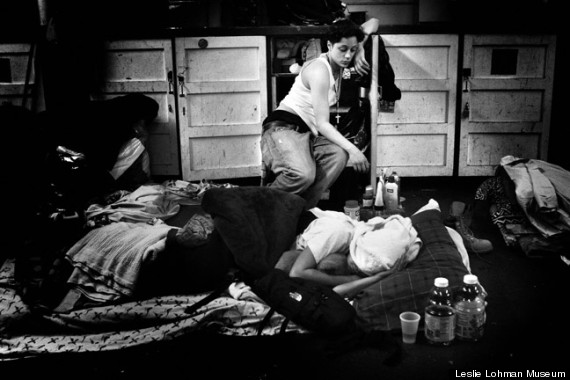
LGBT Homeless Youth Documented In ‘Queers in Exile’ At The Leslie Lohman Museum (PHOTOS)

The Huffington Post  |  By Priscilla Frank Posted: 07/16/2013 8:09 am EDT  |  Updated: 07/17/2013 10:01 am EDT
An exhibition entitled “Queers in Exile: the Unforgotten Legacies of LGBTQ Homeless Youth” will provide a historical narrative and abundance of images to the long-silenced tale of homeless queer youth.
lgbtq homeless youth
The exhibition, curated by Alexis Heller, will illuminate the untold street stories from 1969’s Stonewall riots to present day, revealing years of persecution, determination and hope. From pop master Andy Warhol to LGBTQ documentary photographer Samantha Box, the selected artists capture the all too invisible generations of survivors, creators and revolutionaries who call the streets their home.
The show takes its name from Sylvia Rivera’s essay “Queens in Exile, The Forgotten Ones,” which demands respect and change for LGBTQ communities. In the spirit of Rivera’s essay, the Leslie Lohman Museum explains how their exhibition does not just seek to revisit the past but change the present and what is to come.

“It is a view of history told by those who live/lived it within a community often silenced and ignored, but the vision goes beyond visibility. It is about collective memory and conscience, and repositioning queer homeless young people from ‘other’ to ‘our own’… It offers homeless youth a place by grounding them within an empowered history and lineage, honors their struggle, and reflects that they matter.”

“Queers in Exile” runs from July 18 – July 28, 2013 at the Leslie Lohman Museum of Gay and Lesbian Art in New York. See a preview of the exhibition in the slideshow below and let us know your thoughts in the comments.

Filed Under: Anti-Bullying & Homophobia, History Tagged With: Andy Warhol, Gay Voices News, Leslie/Lohman Museum Of Gay And Lesbian Art, LGBT, LGBT Homeless, Lgbtq Art, LGBTQ Homeless, Queers In Exile, Samantha Box

HPV vaccination should be extended to gay men

17/07/2013 By David McFarlane Leave a Comment

make-the-right-decisions.005

  •  Denis Campbell
  • The Guardian, Tuesday 12 June 2012 12.30 BST
Campaigners are hoping that the jab given to protect against cervical cancer will be widened to include gay men

It is estimated that of the 77,917 gay men who visited a sexual health clinic in 2010, 16,962 of those under 26 would have been eligible to have the jab if it were available. Photograph: Alamy


Human papilloma virus (HPV) is best known for causing most cases of cervical cancer. But Pavol Krascenic became infected as a result of having sex with his then boyfriend. Unfortunately for Krascenic, as a result of contracting HPV, he was diagnosed with a precursor to anal cancer, which is hard to treat. Despite four operations to curb its spread, he is in terrible pain much of the time. “The steroid cream I got from a London hospital made no difference and the painkillers I take every day are so strong they make me feel like I’m on another planet, like I’m drunk, and even then I still have the pain and often have to lie down to relieve it,” says the 31-year-old who was a chef in London until 2009 when his condition left him unable to work and seriously depressed.
The pre-cancerous growths in the anus also weaken a sufferer’s immune system and, for gay men, leaves them more likely to get infected with HIV. In 2008, Krascenic was diagnosed with that too, which made the growths more painful. “A lot of gay men don’t know about HPV or think that it only affects girls, but HPV is dangerous,” he says. “Gay men are often shocked and surprised when they find out it’s something that can affect them too.”
Krascenic is supporting a new campaign by doctors, sexual health experts, politicians and charities, including the Terrence Higgins Trust, for gay men to be offered a vaccination against HPV in the same way that 12- and 13-year-old girls already are in order to protect them against cervical cancer – research suggests the vaccination is effective for those under 26. “If I’d known there was a vaccination against HPV I would have paid for it myself, given what I know about the virus,” says Krascenic.
The possibility of gay men becoming eligible for the HPV vaccination may move closer on Wednesday when the Joint Committee on Vaccination and Immunisation (JCVI) – experts who advise the government on the use of vaccination to tackle any medical condition – discuss the issue. If they approve it, this would prevent gay men worried about HPV having to pay up to £450 to be immunised privately, which at the moment is their only option. Of the 77,917 gay men who visited a sexual health clinic in 2010, 16,962 of those under 26 would have been eligible to have the jab if it were available, sexual health experts estimate.
Lord Fowler, widely admired for his work as the Conservative government’s health secretary when Aids emerged in the 1980s, has written to Anne Milton, the public health minister, calling gay men’s exclusion from HPV jabs “clearly unequal and unfair”.
He wrote: “There is a clear inequity in the HPV vaccination programme offered to all 12- and 13-year-old girls. As the four strains of HPV vaccinated against are sexually transmitted, heterosexual males will eventually receive indirect protection against the related cancers and genital warts by a herd immunity effect. Men who have sex with men, meanwhile, receive no such protection, despite increasing rates of anal cancer in this group.”
The number of men in Britain diagnosed with anal cancer rose from 100 a year in 1975-77 to around 370 a year in 2007-2009. The number of deaths went from 20 to 120 a year over the same period, according to Cancer Research UK. HPV also causes penile, oral and throat cancers in gay men, with the virus again transmitted sexually. Extending HPV jabs to gay men would be cost-effective and save the NHS money, it is argued.
Peter Greenhouse, a gynaecologist specialising in sexual health and spokesman for the British Association of Sexual Health and HIV (BASHH), says the UK should learn from Australia where there has been a huge drop in genital warts in both young women and young men since it began giving girls the HPV jab in 2007. Young gay men, though, have not seen the same benefit. “That has prompted some sexual health clinics to start offering them the injections so that their future sexual behaviour does not harm their health, in the same way that gay men in both Australia and the UK are already immunised against Hepatitis B,” he says.
The Australian government’s pharmaceutical benefits advisory committee last year advised ministers that boys as well as girls aged 12 and 13 should receive the vaccine, though the federal health minister has yet to concur. Similarly, in the US the federal advisory committee on immunisation practices (ACIP) has recommended that the jab be offered to 11- and 12-year-old boys and males aged 13 to 21 who were not vaccinated previously, as well as men aged 22 to 26 who are gay, bisexual or who have a compromised immune system. The US government has yet to respond.
In the UK, Krascenic is in no doubt about what the JCVI’s decision should be: “It’s unfair that the vaccine is only for girls and that gay men can’t get it. This is a public health problem, so the vaccination should be free on the NHS.” He adds: “I’m costing the government much more now, in healthcare costs and welfare benefits, because I’m ill and out of work. But if the vaccine had been available, I might have avoided this.”
 
Further reading:
 

  1. Wikipedia on HPV
  2. NHS Choices on HPV

Filed Under: History Tagged With: gay, government, HPV, LGBT, medical, NHS, vaccination

  • « Previous Page
  • 1
  • …
  • 24
  • 25
  • 26
  • 27
  • 28
  • …
  • 35
  • Next Page »

Categories

Copyright ACOMSDave.com © 2026