ACOMSDave

Community Journalist

  • Home
  • Community Journalist
  • Events
  • Media Page and Press Kit
    • Projects and Work
  • Resources & Documents
    • LGBTQ+ Support Groups and Documents
  • NIGRA
  • Archives
  • Contact

UK armed forces recruits to be asked if they are gay

12/01/2015 By David McFarlane Leave a Comment

Move introduced in bid to foster greater tolerance within the military, but recruits will be allowed to ‘prefer not to say’

  • Press Association
  • The Guardian, Sunday 11 January 2015 08.28 GMT
British troops
The British armed forces only allowed gay soldiers to openly serve in 2000. Photograph: Ben Birchall/PA Archive/Press Association Ima
Recruits to the British armed forces will be asked whether they are gay in a move to improve diversity in the military.
Details of the service personnel’s sexual preference will be stored, and recruits will have the option to “prefer not to say”. The measure has been introduced in a bid to foster greater tolerance within the armed forces, which have allowed gay soldiers to openly serve since 2000.
Recruits will also be invited to provide additional information on how open they feel they can be regarding their sexual orientation. The information will not be visible on individual personal records or to chain of command or managers, and will be anonymised before being collated to ensure no one can be identified by their personal diversity information.
A Ministry of Defence (MoD) spokesman said: “The MoD proudly encourages diversity at all levels. Service personnel are now encouraged to declare their sexual orientation. Although this is not mandatory, collecting this data will give us a better understanding of the composition of our armed forces and help ensure our policies and practices fully support our personnel.”
This move to encourage recruits to declare their sexual orientation was introduced last November. The armed forces said it believed the new policy would shed new light on its workforce and help create a more inclusive organisation.

Filed Under: History Tagged With: armed forces, gay, recruits, UK

Y-fronts celebrate 80th birthday

11/01/2015 By David McFarlane Leave a Comment

Undated handout photo issued by Jockey International of a model wearing Y-fronts

Undated handout photo issued by Jockey International of a model wearing Y-fronts

BY PRESS ASSOCIATION, 3 JANUARY 2015 10.09AM. UPDATED: 5 JANUARY 2015 10:56PM.

The Y-front is set to celebrate its 80-year history which has seen it go from a hurriedly-removed window display in a Chicago department store to underwear staple for men the world over.

Arthur Kneibler’s Jockey briefs first went on sale on January 19, 1935 at the Marshall Field & Co department store, placed on show in the window during one of the worst blizzards of the winter.
The store’s managers promptly demanded the display be removed, thinking it ridiculous to flaunt such a skimpy design in the middle of winter – but not before customers had snapped up 600 pairs.
Some 30,000 pairs were sold in the next three months alone.
Mr Kneibler, the vice president of marketing at a company called Coopers, was inspired by a picture of a man in a sleek, supportive swimsuit, going on to encourage his design team to create a new kind of underwear called “the brief”.
The only successor to the long john had been the boxer short, a cotton version of trunks worn by boxers.
They did not sell well with customers due to their lack of support, but the “jock strap”, mostly worn by the jockeys or messengers who rode penny farthings, did.
Mr Kneibler named his new creation the Jockey brief, and Coopers is now known as Jockey International.
They went on sale in Britain in 1938, at Simpsons in Piccadilly, where they sold at a rate of 3,000 a week.
In 1948 every male athlete in the British Olympic team was given a free pair of Y-fronts.
To date, it has been banned for being too skimpy, survived the recession to outsell its more glamorous cousin the boxer short and has become a Christmas staple across the world for men of all ages.
According to Debenhams, sales of Y-fronts increased by 35% in 2009 and outsold boxer shorts in March of that year for the first time since the early 1990s – the last time Britain was in recession.
Three years earlier, a pair of 37-year-old Y-fronts were sold in the UK on eBay for £127.
A second pair sold for £90 to a buyer in Hong Kong.
Jockey marketing manager Ruth Stevens said: ” Although competition from the boxer is fierce, time and time again the Y-front has been used in ultra-masculine ads and films, such as From Russia With Love when they appeared on the ultimate man’s man James Bond in 1963, all the way up to 2012 where Zac Efron spent much of his time in them in the film The Paperboy.
“This positioning of the Y-front as masculine yet practical ensures its popularity remains high.
“Underwear trends seem to be coming full circle as we head back towards the classics. Y-fronts are cool.”

Filed Under: History Tagged With: history, underwear, y-fronts

Edwin Poots: ban on gay blood was biased, High Court rules

09/01/2015 By David McFarlane Leave a Comment

Previously we have commented and written about the ex-Minister Edwin Poots apparent bias (prejudice) against the LGBT community.
 
2013/9/19 – Article on Minister’s use of public funds defending the appeal againsgt his ban on gay blood donations and gay adoption.
2013/9/21 – Petition for Minister’s resignation
2014/12/25 – The US Food and Drug Administration (FDA) has recommended the end of a three-decade ban on blood donations
 
Former Stormont's Health minister Edwin Poots.Today we are reprinting the news article from BBC News reporting on the judicial case and Mr Justice Treacy’s comments  that the Ban by Edwin Poots ‘infected by apparent bias’.  The verdict strengthens a previous finding in October 2013 that the ban is irrational.
 
The gay blood ban, put in place during the 1980s AIDS threat, was lifted in England, Scotland and Wales in November 2011.
A former health minister’s ban on the donation of blood from gay men in Northern Ireland was “infected by apparent bias”, a court has ruled.
A judge also backed claims from lawyers for a gay man that Edwin Poots’ stance was influenced by Christian beliefs.
The High Court ruling strengthens a previous finding in October 2013 that the ban was irrational.
Mr Poots, who is to appeal that ruling, was replaced as Stormont’s health minister last year.
The gay blood ban, put in place during the 1980s AIDS threat, was lifted in England, Scotland and Wales in November 2011.
The minister has consistently rejected claims that his position may have been influenced by his religious views
It was replaced by new rules which allow donations from gay men who had not had sexual contact with another man for more than a year.
But Mr Poots maintained the prohibition in Northern Ireland on the basis of ensuring public safety.
The minister has consistently rejected claims that his position may have been influenced by religious views.
But lawyers for the gay man who brought the challenge, introduced remarks made by Mr Poots in the Northern Ireland Assembly.
The DUP MLA was recorded as saying: “There is a continual battering of Christian principles, and I have to say this – shame on the courts, for going down the route of constantly attacking Christian principles, Christian ethics and Christian morals, on which this society was based and which have given us a very good foundation.”
The judge cited a news article from 2001 in which Mr Poots spoke of the rights of those receiving donations to be told they were getting “clean blood” uncontaminated by the HIV virus.
He added: “The minister’s very troubling lack of candour and his attempt to conceal the fact that he had made a decision are plainly circumstances that are material to whether a fair-minded and informed observer would conclude that there was a real possibility of bias.”

  •  http://www.bbc.co.uk/news/uk-northern-ireland-30733667
  • http://www.belfasttelegraph.co.uk/news/local-national/northern-ireland/edwin-poots-ban-on-gay-blood-was-biased-high-court-rules-30892626.html
  • http://en.wikipedia.org/wiki/Edwin_Poots


Filed Under: Anti-Bullying & Homophobia Tagged With: blood ban, court case, Edwin Poots, homosexual bias, legal ruling, Northern Ireland Health Minister

The Controversial Cartoons that are Said to Have Inspired the Terrorist Attack Against Charlie Hebdo

09/01/2015 By David McFarlane Leave a Comment

Freedom to speak ‘within the law’ is a fundamental right for all civilised people.  It is not that long ago that Mary Whitehouse seeked to prevent plays, TV programmes and publications that reflected our LGBT society.  Our own government has been equally two faced in the past when it comes to LGBT rights, including initiating surveillance on individuals and organisations, including trade unions, who did (do) not meet with its agenda.

We as individuals and as part of the wider society, owe it to ourselves and our future to be vigilant and fight and secure our rights and our liberties.

CharlieHebdo010815

Yesterday was an extreme case of horror, but it’s not Charlie Hebdo’s first experience with violence. The newspaper’s history of taboo-challenging content is as old as the magazine itself.

Published: January 8, 2015 | Authors: Jessica Goldstein | ThinkProgress | News Investigation
At least 12 people were killed in a shooting at the offices of French satirical magazine Charlie Hebdo Wednesday morning. Multiple masked gunmen entered the building, opened fire on the writers, and escaped in a getaway car. The shooters reportedly yelled “Allahu Akhbar” (“God is greatest”) during the assault and “We have avenged the prophet” as they sped out of the office. Among the confirmed dead are two police officers and Stephane Charbonnier, a journalist and editorial director. French President Francois Hollande has called the shooting “a terrorist attack.” The gunmen and driver are still at large.
The French Muslim community has condemned the attack. Dalil Boubakeur, rector of the Great Mosque of Paris, announced on behalf of French Muslims, “I want to denounce the horror and the unspeakable and show our compassion. We condemn what just [happened] in the name of all Muslims. This is an act of war in the middle of Paris. “
Chances are, if you’ve heard of Charlie Hebdo before, it has been because their satire has inspired the ire of Islamic extremists; the target of the magazine’s humor is frequently religious, political and social mores.
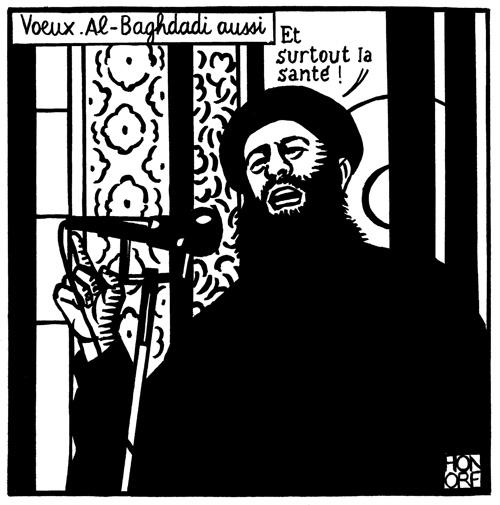
The Guardian‘s Anne Penketh reported from Paris that the magazine’s latest cover (featured in the most recent tweet from @Charlie_Hebdo_) took aim at Islam:

The weekly’s latest jibe, published on Twitter moments before the terrorist attack, was a cartoon wishing a Happy New Year ‘and particularly good health’ to Abu Bakr Al-Baghdadi, the leader of the Islamic militant group Islamic State (Isis).
The magazine describes itself on the social network as the ‘irresponsible newspaper’. Its cover this week features the provocative new novel by Michel Houellebecq, Submission, which satirises France under a Muslim president.
Charlie Hebdo’s editor, Stéphane Charbonnier, has received death threats and lives under police protection. He has always insisted that the cartoons depicting the Prophet were harmless fun, although he is well aware that Islam does not allow public images of Muhammad, which are believed by Muslims to be sacrilegious.
View image on Twitter

Today is an extreme case of horror, but it’s not Charlie Hebdo’s first experience with violence.
The offices were firebombed in late 2011, after running a spoof issue “guest edited” by the Prophet Muhammad honoring an Islamist party’s victory in Tunisian elections. The special issue, in a winking reference to “Shariah law,” was named “Charia Hebdo,” and showed a cartoon of Muhammad along with the line, “100 lashes if you don’t die of laughter.” At the time, editor Stephane Charbonnier described the post-attack wreckage of the office: “We can’t put out the magazine under these conditions. The stocks are burned, smoke is everywhere, the paste-up board is unusable, everything is melted, there’s no more electricity.” The website was also hacked, and members of the staff received death threats.
Charlie-Hebdo
Less than a week later, the magazine’s front page read “L’Amour plus fort que la haine” (Love is stronger than hate) and showed a male Charlie Hebdo cartoonist and a bearded Muslim man engaged in a kiss, the still-smoking magazine Charlie Hebdo offices burning in the background.
In 2012, the magazine included multiple caricatures of the Prophet Mohammad in which he appeared naked; one was called “Mohammad: a star is born,” and showed a man bent over so his beard was the only thing covering the lower half of his body. The cover depicted Mohammad in a wheelchair being pushed by an Orthodox Jew.

rsz_charlie-hedbo-18-sept-2012

The French government implored the magazine not to publish the issue — at the time, protests over a prophet-mocking video produced in the U.S., “The Innocence of Muslims,” were raging across South Asia and the Middle East — but Charlie Hebdo persisted; the government shut down schools, consulates, cultural centers and embassies in 20 counties as a precautionary measure. Riot police were also stationed at the Charlie Hebdo offices for protection.
The then-editor-in-chief, Gérard Biard, did not back down from the magazine’s call to publish the issue. “We’re a newspaper that respects French law. Now, if there’s a law that is different in Kabul or Riyadh, we’re not going to bother ourselves with respecting it. What are we supposed to do when there’s news like this?” Biard went on to describe the magazine as “atheist,” “democratic,” and a supporter of “laïcité,” France’s secularity.
Charlie Hebdo republished cartoons of Mohammad in 2006 that had originally appeared in a Danish newspaper; the images sparked protests throughout the Muslim community.
Charlie Hebdo’s history of taboo-challenging content is as old as the magazine itself. Its earlier form, Hara-Kiri Hebdo, was banned in 1970 for spoofing what they saw as the too-deferential coverage of former president Charles de Gaulle’s death by the French media. Editors picked Charlie Hebdo as a new name to get around the ban; the new title jokingly referenced both de Gaulle and a monthly comic book, Charlie Mensuel, which got its name from Charlie Brown.
The magazine, which comes out every Wednesday, came on the scene in 1969; it folded in 1981 due to poor sales but was revived 11 years later. Charbonnier, one of today’s victims, had held his post as editor in chief since 2012. This is reportedly his last cartoon:
View image on Twitter
Former French President Nicolas Sarkozy issued a statement, reported in Le Monde, expressing outrage at the violence and affirming the importance of French free speech: “This attack is a national tragedy. This is a direct, savage attack on one of our most cherished republican principles: freedom of expression. Our democracy has been attacked. We must defend it without any weakness. Absolute resoluteness is the only possible response. Our nation is in mourning, struck in the heart, the Republic must gather assemble together. I call on all French people to reject the temptation of stereotyping.”

Filed Under: Book Reviews, History Tagged With: cartoons, charlie hebdo, satire

A campaign against homophobia will be held during Baku European Games

09/01/2015 By David McFarlane Leave a Comment

 
As we know, Baku is hosting First European Games this year. Nefes LGBT Azerbaijan Alliance will hold “Compete 4 Equality” campaign during this event. The target group of this campaign is European Parliament, International Olympic Committee, ILGA World and ILGA Europe, Olympic Committees and Ministries of Foreign Affairs of European Council member states, and international organizations working with human rights. Of course, holding this campaign doesn’t mean the cancellation of Baku European Games. The goal is to draw the attention of Europe and the world to the current situation of homophobia and fundamental human and LGBT rights in Azerbaijan, as well as achieving the needed action from the government for improving the current situation in the country. During this campaign, the logo of First European games will be used in rainbow colors in order to achieve the main goal.
The main goal of our first stage is to bring attention to the positive message of our “Compete 4 Equality!” campaign in local and international public spheres. We will hold support campaigns in front of Azerbaijan embassies around the world. Local LGBT organizations and individuals from anywhere can take a photo with the rainbow flag, our slogan “Compete 4 Equality!” and the Azerbaijan embassy in the background and send them to nefeslgbt.az@gmail.com.

We need cooperation with all of which have interests in this campaign totally. Please join us and help support us and the LGBT community in Azerbaijan. Be the intermediary to spread the positive message of our campaign.
10913633 1038103689540551 56682449 n
Click the Pink Compete for Equality to be taken the site and VOTE YES!!
Javid(Atilla) Nabiyev
President of Nefes LGBT Azerbaijan Alliance
tel | +994553407008
e-mail | nefeslgbt.az@gmail.com
facepage | facebook.com/nefeslgbt
twitter | @LGBT_Azerbaycan
web | lgbtaz.org/

Filed Under: Anti-Bullying & Homophobia, Campaigns Tagged With: azerbaijan alliance, baku, homophobia, LGBT, nefes

20 Books That Changed The Way We Felt About Ourselves As LGBT People

28/12/2014 By David McFarlane Leave a Comment

The Huffington Post  |  By Curtis M. Wong

Posted: 12/21/2014 8:46 am EST Updated: 12/22/2014 8:59 am EST
GAY BOOK

“It’s in literature that true life can be found,” Nobel Prize-winning author Gao Xingjian was once quoted as saying.
The Chinese novelist and playwright may not have been speaking directly to lesbian, gay, bisexual and transgender (LGBT) people, but to those of us in the community, he might as well have been. Widespread representation of LGBT life in literature was present well before Hollywood came to embrace it; scribes like Leslie Feinberg andDavid Sedaris have been making us laugh, cry and feel all the feelings for decades — and who could ever forget their first encounter with Armistead Maupin or Oscar Wilde?
We asked our readers to name the books that shaped the way they felt about themselves as LGBT people. While this is by no means a definitive literary list, the responses we received on Facebook and Twitter reflect the community’s wit, strength and overall diversity.
Take a look at 20 books that changed the way we felt about ourselves as LGBT people below.

  • TALES OF THE CITY by Armistead Maupin
    Amazon
    “When I discovered Tales of the City by Armistead Maupin, I knew in my heart that it was time to go out into the world and be the man I was born to be and truly live life. His stories are a blessing to us all.” –Chad Thompson, Facebook
  • STONE BUTCH BLUES by Leslie Feinberg
    Amazon
    “…Not because I identify as stone butch, but because it taught me about our history, how far we’ve come and how far we’ve yet to go.” — Charli Brown, Facebook
  • THE WORLD ACCORDING TO GARP by John Irving
    “I hadn’t ever seen or read about a trans character who was accepted with love.” –Daya Curley, Twitter
  • MIDDLESEX by Jeffrey Eugenides
    Amazon
    “Amazing!” — Zoe Brinnand, Facebook
  • THE PICTURE OF DORIAN GRAY by Oscar Wilde
    Amazon
    — Julian Damiani, Facebook
  • ME TALK PRETTY ONE DAY by David Sedaris
    “[David Sedaris] just slayed me. I never laughed so hard in my life.” — Todd Vaughn Wright, Facebook
  • RUBYFRUIT JUNGLE by Rita Mae Brown
    Amazon
    — Sonya Race, Facebook
  • THE BEST LITTLE BOY IN THE WORLD, by Andrew Tobias
    Amazon
    “Read it in the stacks at NYU as a freshman in 1978.” — Tom Judson, Twitter
  • COMING OUT: AN ACT OF LOVE by Rob Eichberg
    Amazon
    “Twenty years ago, I bought Rob Eichberg’s Coming Out: An Act of Love. I had thought I was about to ruin my life by coming out, but with this book (which I relied on for a few years, as well as with the help of a counselor), I somehow made it through. I kept the book as a reminder never to live a lie again or be so afraid.” — Laurie Dominick, Facebook
  • MAN ALIVE by Thomas Page McBee
    Amazon
    “So many, but Man Alive by Thomas Page McBee helped give me courage and language for who I am.” — Emmett Findley, Twitter
  • GAY SOUL by Mark Thompson
    Amazon
    “It taught me that we are a unique tribe, but that sexuality was only one facet of who I really am.” — Preston McKinley, Facebook
  • STRANGER AT THE GATE by Mel White
    Amazon
    “The book that stands out most for me was a book I gave my conservative Christian parents that helped them accept my being gay: Stranger at the Gate by Mel White.” –Steve Cooper, Facebook
  • THE BOY WHO PICKED THE BULLETS UP by Charles Nelson
    “So many great bueer books out there, but Charles Nelson’s The Boy Who Picked the Bullets Up is my underrepresented favorite.” –Joe, Twitter
  • BECOMING A MAN: HALF A LIFE STORY by Paul Monette
    Barnes and Noble
    “Becoming a Man: Half a Life Story by Paul Monette caused me to re-examine my past (especially my childhood), and I was astonished to find just how much my life and my relationships had been affected by being closeted for so long. Suddenly so many things make so much more sense.” –Christopher Twyman, Facebook
  • THE FRONT RUNNER by Patricia Nell Warren
    Amazon
    “[This book] and Gordon Merrick’s works made me believe I could have the world: career success, great friends, and true love.” — Gerald Stover, Facebook
  • LIKE PEOPLE IN HISTORY: A GAY AMERICAN EPIC by Felice Picano
    “The book that changed my soul.” — Todd Vaughan Wright, Facebook
  • OTHER VOICES, OTHER ROOMS by Truman Capote
    Amazon
    — Don Levy, Facebook
  • THE SOUL BENEATH THE SKIN by David Nimmons
    Amazon
    “Nimmons inspired me to ‘be the change.'” — Nick Sabatasso, Facebook
  • BOY MEETS BOY by David Levithan
    Amazon
    “David Levithan’s Boy Meets Boy was the first LGBT book I ever read and it’s stuck with me all these years.” –Peter Wright, Facebook
  • THE SWIMMING POOL LIBRARY by Alan Hollinghurst
    Amazon
    — Sasha Quentin, Facebook

Filed Under: Book Reviews Tagged With: books, feelings, LGBT

Meet the Russian who would have bee Mary Whitehouse's bed-fellow

28/12/2014 By David McFarlane Leave a Comment

Shades of Mary Whitehouse and her moral indignation come to mind when I read this article.
Constance Mary Whitehouse, CBE (née Hutcheson, 13 June 1910 – 23 November 2001) was an English social activist known for her strong opposition to social liberalism and the mainstream British media, both of which she accused of encouraging a more permissive society. She was the founder and first president of the National Viewers’ and Listeners’ Association, through which she led a longstanding campaign against the British Broadcasting Corporation (BBC). A staunch social conservative, she was disparagingly termed a reactionary by her socially liberal opponents. Her motivation derived from her traditional Christian beliefs, her aversion to the rapid social and political changes in British society of the 1960s and her work as a teacher of sex education.
 
Now ‘Meet the Russian who has had over 30 teachers fired for being gay’

 Pictures of teachers hugging loved ones is being sent to officials in order to have them fired for ‘immoral behavior’
26 DECEMBER 2014 | BY JOE MORGAN
Timur Isaev: Persecuting LGBTI teachers in Russia.

A music teacher who worked with disabled children in St Petersburg was fired for being gay this month, the latest in a long line of educators who have become victims of Russia’s ‘gay propaganda’ law.
Anastasia (not her real name) was called into the principal’s office on 8 December. She was told that pictures of her hugging her girlfriend had been forwarded to the school and a demand she be fired for ‘immoral behavior’.
The pictures and demand was also sent to local government officials.
‘You belong with gay people,’ the teacher was told. ‘You are not allowed to work with children.’
This was another ‘win’ for Timur Isaev, a man who boasts he has had over 30 teachers fired for being gay.
Among his other victims include Ilya Kolmanovsky, an award-winning biology teacher at a top public school, who was fired in January.
‘I have been fired from the school where I worked for seven years,’ he wrote on Facebook.
‘My opponents found about me and my school and sent complaints to the administration, and on Monday the principal told me he is firing me to save the school.’
‘I don’t blame the principal,’ he added. ‘He knows better who is dealing with.’
Isaev does not hide the fact he is helping teachers get fired. On his VK page, it reads: ‘Russia – It’s hell for gays, let them get used to it!’
‘If people are unhealthy and have psychiatric abnormalities such as being a lesbian, then it is clear the law states they are unacceptable for doing this type of work,’ he says.
‘Homosexuality is not normal,’ he told Meduza. ‘It is a disease that is treated with hormone therapy.’
He is now working to fire other teachers, making sure no other LGBTI person ‘influences’ a child.
The nationwide ‘gay propaganda’ law was enforced in Russia in June 2013.

– See more at: http://www.gaystarnews.com/article/meet-russian-who-has-had-over-30-teachers-fired-being-gay261214#sthash.9eithlYN.dpuf

Filed Under: Anti-Bullying & Homophobia Tagged With: homophobia, mary whitehouse, persecution, Russia, teachers

Watch teaser: First gay local high school drama to hit Australian screens

28/12/2014 By David McFarlane Leave a Comment

Producers expect to show the pilot episode at festivals next year with hopes of a TV pick-up later in 2015

27 DECEMBER 2014
Cast of Subject to Change

Photo: Subjecttochange.com.au
An independent coming-of-age drama featuring same-sex attracted lead characters at a suburban Australian public high school is expected to hit local and international screens next year.
‘Through its coming-of-age narrative, Subject to Change will confront the harsh difficulties faced in suburban Australia by following these young adults as they deal with their complex and conflicting emotions. It will be a rocky road to love and inclusion through their final years of high school,’ the website reads.
Creator and executive producer by Daniel Mercieca said, ‘We’re setting it in a suburban Australian public high school, well outside the inner city comfort zone of rainbow flags and wear-it-purple days.’
‘It’s going to be a rough, homophobic experience for young same sex attracted students.’
The independently produced pilot episode of the television program is currently in post production and producers hope to show it at festivals next year.
A thirteen episode series of 22-25 minute episodes is currently in development.
Mercieca added that they currently have no development funding and are seeking discussions with interested co-producers in the new year.

– See more at: http://www.gaystarnews.com/article/watch-teaser-first-gay-local-high-school-drama-hit-australian-screens271214#sthash.szOL5S6s.dpuf

Filed Under: Anti-Bullying & Homophobia Tagged With: Australia, gay, teen, tv drama

Coming out online as a gay teen: Good or bad?

28/12/2014 By David McFarlane Leave a Comment

For those who missed this interesting tit-bit, I reprint it from the BBC Newbeat Site (Coming out…)
 

Tom Daley with his boyfriend Dustin Lance Black

In 2013, Tom Daley used the internet to come out publicly, posting a video on YouTube.

At the time he said: “My life changed massively when I met someone, and they make me feel so happy, so safe and everything just feels great. That someone is a guy.”
For someone in the media spotlight, it was a bold move to do it so publicly.
But what’s it like for other gay teenagers wanting to come out? Does the internet make it easier?
As a guest editor of BBC Radio 4’s Today programme, singer Tracey Thorn wanted to find out whether that was the case.
She’d noticed a lack of positive stories about young people and the internet so got author and presenter Damian Barr to sit down with several gay teenagers to find out how the internet helped them, or not.
Here are Maddie and Tom’s stories.

Gay pride flag

Maddie, 16

“I think the first person I told physically was a teacher. She wasn’t gay. She was just a nice person and I think I was 13.
Before that I talked to quite a lot of people online, who gave me the courage to come out at school.
I actually met my ‘best internet friend’ over a fan-fiction website. We wrote about Glee! I met my other ‘best internet friend’ through Tumblr.
I told her that I really liked her blog and she became one of my main support systems. We’ve actually met twice in real life which was pretty surreal.
The internet was the only thing I had prior to coming out. I wasn’t specifically looking for gay people, they just seemed to be there.
I came out on Facebook. I put a post saying ‘There are rumours I’m a lesbian and I’m not going to deny that’ and I got loads of good responses on the Facebook status
But I also had an ask.fm account attached to my Facebook and had hundreds of messages telling me to kill myself.
I think it was just a few people sending a lot of messages so it was really difficult. I should be allowed to have internet access without the fear of abuse.”

Tom, 16

“I recently told my teacher and cried in front of her. I was really embarrassed and did not know how she’d react but I felt much stronger and more powerful as a result. I thought that someone does accept me!
I don’t think I came out online but the internet helped me find the resources to come out and to be sure I am interested in men only because I was really confused about whether that was my sexual orientation.
I realised that’s what I like and it won’t change. The internet helped me to realise that’s my reality.
I also watched gay Youtubers talk about how they know. I think I watched every single gay title about coming out. It made me feel that I’m not alone and there is somewhere I belong.
People also asked me on Facebook ‘are you gay?’. I was really hurt because I believed being gay was a curse. It’s been hurtful but I’m really happy to be over it.”

Filed Under: Anti-Bullying & Homophobia Tagged With: BBC, coming out, online, Tom Daley

Out in Mumbai Director Adele Tulli on India's Queer Future

25/12/2014 By David McFarlane Leave a Comment

I was given a DVD of this doucmentary some time ago, and unfortunately forgot that I had it.  I found it very interesting, firstly as it is a continent that I have not explored, and secondly as I have some gay friends living and working in India.  Sunneil and Leslie worked with me in the Middle East, and then returned to India.
They have often been in my thoughts, and having watched the documentary it has re-ignited my interested in going to visit them.
Try and find the full documentary and watch it – you will be enthralled by the diversity and the culture.
The documentarian discusses LGBT life in India after the repeal of the country’s most notorious antigay law.

Republished from The Advocate BY Daniel Villarreal

March 28 2013 4:00 AM ET

Adele Tulli


Adele Tulli’s documentary Out in Mumbai, which follows three LGBT Indian natives in the run-up to Mumbai’s first Pride celebration, begins with a focus on Section 377 of the Indian Penal Code. It is a colonial-era law criminalizing any sexual activity “against the order of nature,” particularly intercourse between adults of the same sex.
On July 2009, the High Court of Delhi overturned the 150-year-old law as it violated consenting adults’ constitutional right to legal equality before the law.
We spoke to Tulli about her documentary — which premiered this month on the gay TV network HereTV — and about the future of India’s LGBT movement, the role she hopes her film plays in moving Indian queer rights forward, and more.
The Advocate: What compelled you to make the documentary and how did you go about finding its subjects?
Adele Tulli: I have been traveling to India for the last 10 years, lots of different reasons brought me there, among those my studies. I studied South Asian studies, focusing on social movements in contemporary India, mainly feminist and LGBT movements. When Section 377, the colonial law that criminalized homosexuality in the country, was finally repealed in 2009, the impact was amazing. LGBT issues were all over the news and for the first time the whole indian society had to acknowledge them. I was in Mumbai a year later and the energy among the LGBT community was still so vibrant. We were preparing the celebrations for the first anniversary of Section 377’s repeal and there came the idea of making it into a film. The documentary follows three people from Mumbai’s LGBT community that find themselves in the middle of this historic moment of India’s LGBT history. They are all close friends who were willing to share their personal stories, so to find them was not so difficult.
What have been your personal experiences with LGBT discrimination and community in Mumbai?
I recognize the importance of identity politics at a political level, but at a personal level I tend to avoid labels. If I had to choose one, maybe I would say queer. It depends on the context, if I am with a girlfriend in a very hetero-normative context, I would definitely call myself a lesbian. My experience with LGBT discrimination in Mumbai is not so different from a lot of other places where being gay is still very hard, Italy, where I come from, included. While I consider myself lucky to have had the opportunity of being in Mumbai during the first year of freedom of the LGBT community, the energy was so empowering. After years of invisibility, the struggles of the community were finally acknowledged and even if a law does not change society in one day, the impact it had on people was extraordinary. So many people came out, joined the community, and so many LGBT events, support groups, organizations were born.
According to Wikipedia, “The [Section 377] has not been used against homosexuals (or against consenting adults) is borne out by the history of convictions under this law in India, wherein there has been no case of a consensual homosexual act being prosecuted / convicted under this act.” Is this true?
It is true that convictions under the law were rare, but the main problem of Section 377 was that it was often used by police and social bigots to intimidate, threaten, harass and blackmail the gay and hijra community, preventing them from accessing legal protection from violence. The criminalization justified the social stigma and perpetuated a culture of silence around homosexuality that resulted in denial and rejection at home along with discrimination in workplaces and public spaces. It also constituted an impediment for organizations working on HIV prevention to provide health services and HIV/AIDS related information to sexual minority groups, etc.
What do you think are the top political priorities and future challenges for the LGBT movement in India?
First of all, [the Indian LGBT movement wants to] make sure that the Supreme Court approves the Delhi High Court judgement on Section 377. The Delhi High Court’s historic verdict of 2009 that read down Section 377 has been contested by a group of opponents and at the moment the Supreme Court is still due to rule its final verdict, so the case is still pending.
Then, the LGBT movement has still to face a large section of Indian society that is deeply conservative and homophobic. There are limits to which a law can change society. So this has to be done by grass-root politics, campaigning, creating safe spaces to allow LGBT people to come together and fight. The battle has just began, as Pallav [a gay activist that appears in Out in Mumbai] says in the film.
What do you hope to make happen with your film, in terms of cultural change and social awareness?
The film is probably just a drop in the ocean, but I hope it can help the LGBT cause, not only in India, but everywhere. I strongly believe in the political strength of personal stories. I hope that watching the film anyone could connect at a human level with the three characters and understand that sexuality and gender identities are personal matters, there shouldn’t be any social norm regulating them, let alone a law criminalizing them.
http://youtu.be/ug7h_S5jTsY

Filed Under: Anti-Bullying & Homophobia Tagged With: adele tulli, India, LGBT, Mumbai, queer

  • « Previous Page
  • 1
  • …
  • 12
  • 13
  • 14
  • 15
  • 16
  • …
  • 41
  • Next Page »

Categories

Copyright ACOMSDave.com © 2026