
Have you ever wondered which prominent male celebrities straight guys find attractive?
Buzzfeed is here with another video that aims to tackle this very question. The video brings together several pairs of straight guys and shows them pictures of famous men.
The results are surprisingly honest and, if these guys are being truthful, could reveal a lot about the nature of human attraction.
So what do these guys think about John Stamos? Drake? Justin Timberlake?
Only one way to find out — check out the video above.
Here's What The World's Queer Community Has Already Accomplished (Or Hasn't Yet) This Century
The question for us in Northern Ireland and Great Britain is ‘ Is this the sum total of what we have achieved in the LGBT front? Is there something missing from this timeline? If you think the timeline needs amending, then write to us and let us know!’


The Huffington Post | By Sara Boboltz
Posted: Updated:
For queer people, in many ways, there has never been a time in history like the present. Although oppression and inequality are still rampant, there have also in recent years been a number of firsts, breakthroughs and other positive developments that once seemed like they would never come.
2014 was an especially good year for queer equality in the U.S. Over 60 percent of Americans now live in states that permit same-sex marriage, and advocates in ever-increasing numbers are speaking out for the cause.
We don’t mean to suggest that there haven’t been setbacks, or that things aren’t still wildly unjust in almost every part of the world. But at the same time, we think it’s worth observing, and celebrating, the real progress that the 21st century has brought to many.
Below, we’ve rounded up some of the most important milestones in queer rights from the past 14 years. We can’t wait to see what’s in store for 2015 and beyond.
Note: For ease of navigation, we recommend viewing on a non-mobile device.
Link to Timeline
Emily Brothers
 |
|||||||||||||||||||||||
|
|||||||||||||||||||||||
|
|||||||||||||||||||||||
|
|||||||||||||||||||||||
|
|||||||||||||||||||||||
|
|||||||||||||||||||||||


Northern Ireland Annual Human Rights Commission Report – 2014
This annual human rights statement which has a useful traffic light system to highlight where the rights are from “done” to still to be started shows the situation in Northern Ireland.
Daniel J Danielsen – a pioneering humanitarian who helped Roger Casement expose the horror of Belgian rule in the Congo
An Irishman’s Diary on a Faroese hero
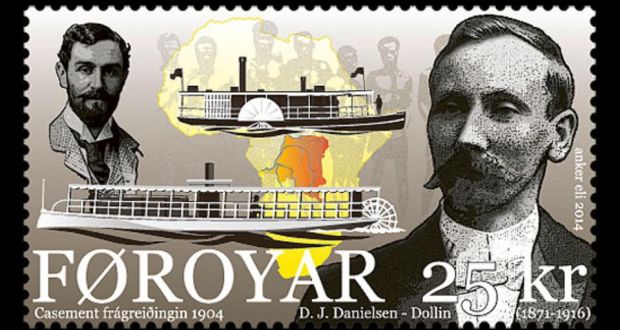 The Faroese government has issued a stamp with pictures of both Daniel J Danielsen and Roger Casement
In the campaign to expose the appalling enslavement and exploitation of Congo natives by King Leopold II of Belgium, the names of two great humanitarians, Roger Casement (the 150th anniversary of whose birth occurred this year) and ED Morel, deservedly stand out. Now, thanks to the researches of Óli Jacobsen, a third name may be added – that of a humble Faroese missionary called Daniel J Danielsen.
Óli Jacobsen’s book on his fellow Faroese national has just been published and, to mark the occasion, the Faroese government has issued a stamp with pictures of both Danielsen and Casement. Adam Hochschild, the author of King Leopold’s Ghost, has described the book as doing “a fascinating job of restoring a previously forgotten man to his rightful place in the 20th century’s first great humanitarian crusade”.
Danielsen is remembered today, if at all, in the Faroes as one of the very early evangelists of the Plymouth Brethren movement there. He was also the first Faroese to serve as a missionary outside the islands, when he worked for the Congo Balolo Mission from 1901 to 1903.
Faroes
Óli Jacobsen had been writing short biographies of significant Faroese personalities when he decided to investigate Danielsen’s story. He had no expectation of finding anything of consequence to any history beyond that of the Faroes, so it came as a surprise to him to discover Danielsen’s significant contribution to Roger Casement’s investigation into conditions in the Belgian Congo on behalf of the British government.
ED Morel had been running a sustained writing campaign in Britain about the way natives of the Congo Free State were being treated, his information coming from British, American and Scandinavian missionaries, among others. Eventually the issue was taken up in parliament and the result of the debate was that Casement, the British consul in the Congo region, was sent to investigate the allegations.
In order to carry out an adequate investigation, Casement needed to be able to travel freely in the area but, hardly surprisingly, the Belgian authorities were not altogether willing to cooperate. He had to find an independent means of transport, especially to be able to travel up the Congo river to visit some of the more remote villages.
He had already established contact with Protestant English-speaking missionaries and eventually succeeded in hiring a steamer, the SS Henry Reed, from the American Baptist Missionary Union. The steamer was not in great working order and he was fortunate to meet and persuade Danielsen, who was an engineer, to accompany him on his journey.
He afterwards recorded his indebtedness to Danielsen, in a letter to the British foreign secretary, the Marquess of Lansdowne. “Mr Danielsen’s services were of the very greatest value: indeed without his help, I could not have proceeded very far on my journey. The Henry Reed is one of the oldest vessels still navigating the Upper Congo, having been launched in 1885. I think it was chiefly due to Mr Danielsen’s skill and hard work that she was kept running so long with me on board. As it was, we sprang a leak coming down the river on 13th September and apart from other consideration, I do not think it would have been possible to have the vessel continue running much longer.”
As well as acknowledging Danielsen’s invaluable help, Casement was writing to Lord Lansdowne to explain that he had refused to accept any remuneration whatsoever and to ask his superior to authorise him to make a modest donation to the Congo Balolo Mission, for which Danielsen worked.
Brutal flogging, the cutting off of hands and the taking of women hostage for the good behaviour of their menfolk were some of the barbaric practices perpetrated upon exploited Congo natives that Casement heard about, witnessed the results of and wrote about in his report, which caused a sensation when it was published and proved to be a turning point in the campaign to put an end to such atrocities.
Danielsen took some shocking photographs while accompanying Casement. Óli Jacobsen argues that these were of great importance in the public campaign that followed in Britain, because it was the first time an account of an atrocity could be illustrated so clearly to the public. Danielsen afterwards used the photos in lantern-slide shows at public lectures he gave as he campaigned to end the barbarities being inflicted on innocent natives in the Belgian colony of the Congo Free State.
Daniel J Danielsen and the Congo: Missionary Campaigns and Atrocity Photographsis available from olijacobsen@olivant.fo
AIDS In Tunisia Is No Myth, Even If It's Rarely Talked About
HuffPost Tunisia | By Sandro Lutyens
Posted: Updated:

Ghalia had dressed up for the occasion.
The woman, who is homeless and HIV-positive, was participating in a press conference organized by the Tunisian Organization for the Fight Against STDs and AIDS (ATLMST) on Dec. 2, World AIDS Day. On the stage, professionals were discussing the crisis using acronyms — HIV, MSM (Men who have Sex with Men), UID (Users of Intravenous Drugs). We had to listen carefully just to follow along. Few journalists showed up.
Ghalia, who asked to remain anonymous because many of her friends and family members don’t know she’s HIV-positive, says her husband infected her in 2006. Ghalia claims her husband knew he carried the virus, but never told her. “He said it was out of love,” she explained. She says that’s how she realized he had been cheating on her.
AIDS infection rates in Tunisia are generally low. According to UNAIDS, 3,400 people are living with the virus. ATLMST says Tunisia’s Ministry of Health puts the number at 1,900.
Professor Ridha Kamoun, ATLMST’s director, credits various societal taboos for the country’s low infection rate. “We quickly noticed the link between conservative mores and a low infection rate,” he said. Others argue, however, that taboos represent more of an obstacle than an opportunity, and that the numbers could be much lower if it weren’t for those taboos.
The epidemic mostly affects parts of the population that are already heavily stigmatized, like sex workers, gays and intravenous drug users. These groups are not only marginalized by society, but also criminalized by the justice system. The sentence for drug use, for example, is one year in prison. Sodomy is also a charge in Tunisia, and can lead to three years in prison.
Since the state is legally prohibited from working with criminalized populations, prevention work is left to other organizations — quite a paradox for a country that guarantees free medical treatment to its citizens.
Funded in part by the Global Fund to Fight AIDS, the few Tunisian organizations that are active in the field concentrate on outreach work. These volunteers, for the most part HIV-positive, are active in their communities and organize workshops.
ATLMST recently started two shelters for drug users in the cities of Nabeul and Melassine.
Boxes filled with lubricant, clean syringes and condoms are stacked in ATLMST’s offices, waiting to be unpacked and distributed. The symbol of the fight against AIDS, the red ribbon, decorates the walls and computers.
ATLMST follows about 400 people. Many of the patients interviewed talk about their lives in terms of “before” and “after.” Many of them struggled before getting infected; Ridha Kamoun says drug users experienced trouble with the police, gays had trouble with their social status, and sex workers often had trouble with money.
Most of them lost their jobs after being diagnosed. Some have lost their families or their friends. They’ve all lost part of their health.
Ghalia belonged to the middle class and worked in the pharmaceutical industry before her diagnosis. Since then, she has resigned from her job, unable to tolerate the discrimination any longer — at one point she was banned from using the public restrooms at her workplace.
Her family knows and accepts her situation. From time to time she goes to eat at her parents’ house, where her brothers and their families also live. After finishing the meal, she says, her sisters-in-law throw out the plate and silverware she used.
Ghalia has made several attempts to take her own life.

Supporters of the Ennahda party in Tunisia, where attitudes towards people at risk of HIV-Aids are proving slow to change. Photograph: Mohamed Messara/EPA
Past studies have indicated that the suicide risk among HIV-positive patients may be higher than for those with other chronic illnesses. The risk can increase in particular during the initial weeks following a diagnosis of the disease, and when a patient’s health declines. It appears that since the introduction of highly active antiretroviral therapy (HAART), suicide among HIV-infected patients may be mediated more often by factors other than HIV, including depression, alcohol or other substance-related disorders.
In the past, Dr. Kamoun encouraged infected individuals to tell their friends. Now, he’s changed his mind. Even among the activists working for his organization, there are many who keep their status private. Their stories are hard to tell. “It’s hard, sometimes too hard, to hear their stories,” Kamoun says.
This piece originally appeared on HuffPost Tunisia and was translated from French.
Naked For The First Time
Republished from The Huffington Post | By James Nichols
Posted: Updated:
A fun way to get to know your best mate.
What’s it like to see your buddy naked for the first time after knowing him for years?
Buzzfeed tackled this question over the weekend in one of their latest videos, aptly titled “Guy Friends See Each Other Naked For The First Time.” In the clip, which you can view above, men in a variety of close relationships strip down and bare it all for one another.
The brilliant (and fun) breaking down of traditional expectations of masculinity through shamelessness at play here makes this one of our favorite videos we’ve seen from Buzzfeed… for more reasons than one.
'Cucumber' And 'Banana', Queer Dramas, To Air On Logo TV
The Huffington Post | By James Nichols
Posted: Updated:
‘Cucumber’ and ‘Banana’ – vegetable or fruit hitting your screens soon
Are you ready for your new favorite queer television shows?
From the writer of the iconic “Queer As Folk” and the much beloved “Dr. Who” comes “Cucumber,” “Banana” and “Tofu,” three interlinked gay dramas that are already receiving buzz for their unapologetic portrayals of queer life. “Cucumber,” “Banana” and “Tofu” will premiere across Channel 4, E4 and 4oD in the UK in 2015.
Logo TV will run “Cucumber” and “Banana” on Logo TV in early 2015 in the U.S. The network has not announced plans regarding “Tofu.”
“Whether he’s reinventing Doctor Who for a whole new generation, or creating riveting gay and lesbian characters on the original ‘Queer as Folk,’ Russell T Davies always pushes television forward,” Stephen Friedman, President of MTV and Logo TV, said in a statement sent to The Huffington Post. “’Cucumber’ and ‘Banana’ are groundbreaking for the way they show intertwined narratives from two generations’ different perspectives. Even more importantly, the shows tell hilarious, incisive and very human stories.”
“It’s an honour and delight to team up with Logo for these brand new dramas,” Davies said in a statement. “It’s 16 years since I created ‘Queer As Folk,’ which means I’ve had 16 years to build up new characters, new stories, and new insights into our lives. Across both series, we explore gay, lesbian, bisexual and transgender stories, as well as love beyond labels – this is 50 shades of gay, and beyond!”
Check out the trailer above.
Belfast artist Jane Moore tells Una Brankin about her unique art project, and telling her parents that she was gay
Reprinted from Belfast Telegraph an article on Jane Moore, artist, who has some lovely pieces for sale, and who just happens to be gay as well. 01 DECEMBER 2014
Belfast artist Jane Moore: ‘I couldn’t give up chocolate for a whole year,
but I knew I could do a sketch every single day’
Within 24 hours of the death of screen legend Lauren Bacall (89) earlier this year, her famous sultry gaze and perfect bone structure were captured beautifully by Belfast-born Jane Moore.
The drawing was part of the illustrator’s ambitious year-long Sketch a Day project, and one of the highlights of the 365 artworks she was planning to exhibit in January.
But she has been left devastated by the theft of the sketch and six others of hers from the Winter Pride Art Awards, a gay event in London celebrating diversity and sexuality. The deeply personal selection was snatched in the early hours of the morning two weekends ago – along with a memorial print by another artist – by three men posing as volunteers, who removed the artwork at around 2-3am when the only people left at the end of the evening were the curating team, security and bar staff.
“They were brazen – the staff thought they were part of the arts team,” says Jane (32). “I got a call from the curator the next morning. I left feeling sick and gutted. It’s not so much about the money, but one of the pieces was a self-portrait I spent a lot of time on. I’m not a big fan of self- portraits in general, so it was a big deal to me. It took four hours of the little time I’d set aside each day to work on this project. I don’t want to prosecute anyone; I just want them back.”
Insurance will cover the eight originals – valued at £6,000 – but Jane’s seven are the equivalent of a week’s gap in her 365 day project, spanning the whole of 2013. The art college graduate began the creative odyssey initially as a new year’s resolution.
“I could never stick to going to the gym or giving up chocolate so I picked something I knew I’d stick to every day and definitely do it,” she says, speaking at her parents’ home in Ballygowan, Co Down. “I wanted to do it for a while but I knew it would take dedication and time. It was difficult to be motivated some days, like when I was feeling poorly, so I’d pick a topic I could sketch pretty quickly, like a figure drawing. Sometimes if I’m busy in work I can only spare 30 or 40 minutes but I always managed to fit it in.”
The original self-portrait depicts the artist in a simple black T-shirt, tattooed arms raised, with her platinum-blonde hair falling loose on her shoulders (she’s growing out the pudding-bowl fringe look, recently sported by Beyonce). Her pretty features are presented expertly in monotone, which – while striking – misses out on the vivid blue of her wide-set eyes. She enhances them with lots of black eyeliner, making the cerulean irises pop out against her fair complexion and even paler hair, which is shaven at the back.
“The self-portrait was the one I was most proud of,” she admits. “I did it from a series of photos a friend took; I used a mirror as well. Looking at a photo, only, changes your perception of yourself because of the 2D. I had a big problem with the eyes – they’re the feature which stands out. Once you capture the essence of a person, the rest falls into place pretty easily.”
Currently in talks with exhibition venues in Belfast, Jane is back home from her base in London and a recent three-month stint in Barcelona to stay in the scenic Ballygowan countryside with her parents, James, a structural technician, and Sarah, a window display artist. It’s a chance to catch up with younger sister Rebecca (30), a paediatrician, and her sister’s children Michael (5) andNicole (2).
Openly gay, Auntie Jane came out of the closet long before her niece and nephew were born, just as she was moving to London to work after graduating 10 years ago. “My parents were shocked – I’ve always been quite feminine,” she laughs. “But they and my friends have been really supportive. I knew I was gay by my late teens. It was harder in Northern Ireland when I was younger but attitudes are changing now. It’s still not as open here as in London; there is greater acceptance there, you can be who you are.”
So what does she think of the continued hush-up of homosexuality in A-list circles, both in the UK and Hollywood?
“Well, the actress Ellen Page coming out recently, in her late 20s, is very encouraging. The younger generation is not ashamed of their sexuality.”
Androgynous images feature prominently in Jane’s work, although she doesn’t consider lesbianism as a major theme in it. She’s currently single and wouldn’t rule out having children in the future, but art comes first at the moment.
She excelled in the subject at Grosvenor Grammar School, and went on to study as the Creative College of Arts Art in Surrey after her foundation degree with the University of Ulster’s art college in Belfast.
Her talent and qualifications led to jobs in fashion promotion and illustration, magazine work and story-board commissions for production companies and theatre directors.
Seemingly inexhaustible, she now works for both private and corporate clients, as well as continuing her now annual Sketch A Day project.
Her commitments don’t hinder her free-spirited lifestyle, however, which allows her to travel.
Goya and Andy Warhol are influences on her work, as are fashion illustrators Rene Gruau, the inspiration for a recent John Galliano couture collection for Dior, and the legendary French image-maker Georges Barbier: “Our styles are similar in that my artwork can be quite decorative and I like to use muted colours.”
While prolific, it’s doubtful whether these great artists managed a drawing per day. Where does she get the inspiration for such a mammoth task?
“I do a lot of portraits, mostly of friends, and I like drawing animals in human clothing,” she giggles. “I draw 24/7 – I never run out of inspiration. I keep them all in a note-book I carry about with me. It’s full of fashion and figure pieces too.
“I’m continuing the project into next year, with more colour pastels, oil paint, water colours. My favourite is oil but it’s slower. Watercolour’s quicker and dries faster.”
Impressively, Jane is also working on illustrations for a children’s book. She came up with a plot and outline, while a friend is writing the narrative. They hope to publish next year. In the meantime, she’s exhibiting some of her work in a trendy Notting Hill gallery and running a Kickstarter Crowdfunding campaign, until December 11, as a means to fund her huge Sketch A Day exhibition in London and Belfast, and to self-publish her Sketch A Day book.
“I’ve poured my heart into this project and to get it out there, I’m selling the framed original drawings, prints, book and other merchandise,” she concludes.
“After that I’m just looking forward to spending Christmas with my family. Ballygowan’s beautiful and it will always be home.”
To purchase from Jane Moore’s Sketch A Day collection, click here.
Egyptian TV crew criticised over police raid on Cairo bath house
At least 25 men arrested in raid, in latest example of crackdown on gay community and of collaboration between media and state

A year-long crackdown on Egypt’s gay community continued this week with the arrest of at least 25 men at a bathhouse in central Cairo in a sting operation apparently initiated by a television crew.
The men were dragged half-naked into police trucks in the late night raid, which was filmed by a private television crew headed by presenter Mona Iraqi.
Iraqi and her colleagues later claimed on Facebook and in a YouTube video that they had led the police to the bathhouse on the unsubstantiated suspicion that its customers were a potential source of Aids.
“Watch the bold Mona Iraqi reveal in a series of investigative episodes the secret behind the spreading of Aids in Egypt,” stated a trailer for their programme, which was presented as a journalistic scoop and a tie-in with World Aids Day.
“For the first time in the history of Egyptian and Arabic media, we lead the morality police to storm the biggest den for male group sex in the heart of Cairo.”
Iraqi posted pictures of the raid on her Facebook page, including one of herself filming the men on a smartphone. She accompanied the photos with a since-deleted blogpost, explaining that her crew had “managed to make a filmed investigation to prove incidents of group perversion and record the confessions of the owners of this den”.
Her words largely attracted condemnation. “You see the picture of you filming with your phone?” replied Hossam Bahgat, a journalist and former head of a prominent rights group. “Your picture will be spread for years to come with every article, investigation or book on the collapse of Egyptian media ethics.”
The raid was the latest example of a crackdown on homosexuality and of collaboration between Egypt’s media and government. In November,eight men were jailed after being accused of taking part in a marriage-like ceremony on the river Nile. This year, there have been a number ofraids on private properties, street arrests targeting Egypt’s LGBT community and a surge in homophobic media coverage of gay life in Egypt.
Scott Long, the author of widely cited research on earlier crackdowns, wrote on Monday: “I hadn’t believed tensions around sexuality and gender could rise higher in Egypt. But they have. A brutal campaign of arrests continues, and the media incitement steadily intensifies.”
Homosexuality is not illegal in Egypt, but it is a social taboo and allegedly gay men have historically often been arrested on charges of immorality. In the largest case,
52 allegedly gay men were seized from a floating disco on the Nile in 2001 and charged with immorality.
Activists speculate that the recent rise in arrests is linked to the government’s desire to prove that it can be as socially conservative as the Muslim Brotherhood, which was ousted from power in July 2013.
Independent newspapers and channels have largely become cheerleaders for Abdel Fatah al-Sisi’s administration, with the editors of some of Egypt’s leading publications joining forces last month to jointly reject criticism of the army, police and judiciary.
• Additional reporting by Manu Abdo
- « Previous Page
- 1
- …
- 14
- 15
- 16
- 17
- 18
- …
- 41
- Next Page »