ACOMSDave

Community Journalist

  • Home
  • Community Journalist
  • Events
  • Media Page and Press Kit
    • Projects and Work
  • Resources & Documents
    • LGBTQ+ Support Groups and Documents
  • NIGRA
  • Archives
  • Contact

Love Is

11/01/2021 By ACOMSDave Leave a Comment

Love is a memory

In the 1960s Kim Grove started a craze by drawing personal cartoons (Love is) for her future husband, Roberto Casali.  Then over time they were published both in booklets and later in strip form in a newspaper in 1970, under the pen name “Kim”.

Her most memorable one was “Love is…being able to say you are sorry.”

Love is


The series hit something in everyone, and it gained an international following.  However, in 1975, Kim stopped working on the cartoon because her husband Roberto was diagnosed with terminal cancer.

At this time Kim commissioned London-based British cartoonist Bill Asprey to take over the writing and drawing of the cartoon series., which he is still doing.

What was also very poignant was that in 1970 the movie ‘Love Story’ and it had the signature line “Love means never having to say you’re sorry.”


Links:

  • Love is website
  • Bill Asprey website


What does love mean?

And now I have come across this lovely posting on Facebook.

A group of professional people posed this question to a group of 4 to 8 year-olds, ‘What does love mean?’ The answers they got were broader, deeper, and more profound than anyone could have ever imagined!

‘When my grandmother got arthritis, she couldn’t bend over and paint her toenails anymore… So my grandfather does it for her all the time, even when his hands got arthritis too. That’s love.’ Rebecca – age 8

‘When someone loves you, the way they say your name is different. You just know that your name is safe in their mouth.’ Billy – age 4

‘Love is when a girl puts on perfume and a boy puts on shaving cologne and they go out and smell each other.’ Karl – age 5

‘Love is when you go out to eat and give somebody most of your French fries without making them give you any of theirs.’ Chrissy – age 6

‘Love is what makes you smile when you’re tired.’ Terri – age 4

‘Love is when my mommy makes coffee for my daddy and she takes a sip before giving it to him, to make sure the taste is OK.’ Danny – age 8

‘Love is what’s in the room with you at Christmas if you stop opening presents and just listen.’ Bobby – age 7 (Wow!)

‘If you want to learn to love better, you should start with a friend who you hate.’ Nikka – age 6

(we need a few million more Nikka’s on this planet)

‘Love is when you tell a guy you like his shirt, then he wears it every day.’ Noelle – age 7

‘Love is like a little old woman and a little old man who are still friends even after they know each other so well.’ Tommy – age 6

‘During my piano recital, I was on a stage and I was scared. I looked at all the people watching me and saw my daddy waving and smiling.

He was the only one doing that. I wasn’t scared anymore.’ Cindy – age 8

‘My mommy loves me more than anybody. You don’t see anyone else kissing me to sleep at night.’ Clare – age 6

‘Love is when Mommy gives Daddy the best piece of chicken.’ Elaine – age 5

‘Love is when Mommy sees Daddy smelly and sweaty and still says he is handsomer than Robert Redford.’ Chris – age 7

‘Love is when your puppy licks your face even after you left him alone all day.’ Mary Ann – age 4

‘I know my older sister loves me because she gives me all her old clothes and has to go out and buy new ones.’ Lauren – age 4

‘When you love somebody, your eyelashes go up and down and little stars come out of you.’ (what an image!) Karen – age 7

‘Love is when Mommy sees Daddy on the toilet and she doesn’t think it’s gross…’ Mark – age 6

‘You really shouldn’t say ‘I love you’ unless you mean it. But if you mean it, you should say it a lot. People forget.’ Jessica – age 8

And the final one: The winner was a four year old child whose next door neighbor was an elderly gentleman who had recently lost his wife. Upon seeing the man cry, the little boy went into the old gentleman’s yard, climbed onto his lap, and just sat there. When his mother asked what he had said to the neighbor, the little boy said, ‘Nothing, I just helped him cry.’

Now, take 60 seconds and post this for other to see. And then be a child again today


Filed Under: Editor to ACOMSDave Tagged With: Andy Williams, Bill Asprey, cartoons, Kim Grove, love is, Roberto Casali

The Controversial Cartoons that are Said to Have Inspired the Terrorist Attack Against Charlie Hebdo

09/01/2015 By David McFarlane Leave a Comment

Freedom to speak ‘within the law’ is a fundamental right for all civilised people.  It is not that long ago that Mary Whitehouse seeked to prevent plays, TV programmes and publications that reflected our LGBT society.  Our own government has been equally two faced in the past when it comes to LGBT rights, including initiating surveillance on individuals and organisations, including trade unions, who did (do) not meet with its agenda.

We as individuals and as part of the wider society, owe it to ourselves and our future to be vigilant and fight and secure our rights and our liberties.

CharlieHebdo010815

Yesterday was an extreme case of horror, but it’s not Charlie Hebdo’s first experience with violence. The newspaper’s history of taboo-challenging content is as old as the magazine itself.

Published: January 8, 2015 | Authors: Jessica Goldstein | ThinkProgress | News Investigation
At least 12 people were killed in a shooting at the offices of French satirical magazine Charlie Hebdo Wednesday morning. Multiple masked gunmen entered the building, opened fire on the writers, and escaped in a getaway car. The shooters reportedly yelled “Allahu Akhbar” (“God is greatest”) during the assault and “We have avenged the prophet” as they sped out of the office. Among the confirmed dead are two police officers and Stephane Charbonnier, a journalist and editorial director. French President Francois Hollande has called the shooting “a terrorist attack.” The gunmen and driver are still at large.
The French Muslim community has condemned the attack. Dalil Boubakeur, rector of the Great Mosque of Paris, announced on behalf of French Muslims, “I want to denounce the horror and the unspeakable and show our compassion. We condemn what just [happened] in the name of all Muslims. This is an act of war in the middle of Paris. “
Chances are, if you’ve heard of Charlie Hebdo before, it has been because their satire has inspired the ire of Islamic extremists; the target of the magazine’s humor is frequently religious, political and social mores.
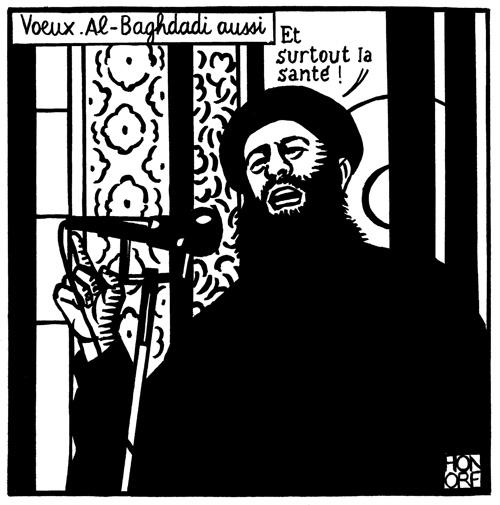
The Guardian‘s Anne Penketh reported from Paris that the magazine’s latest cover (featured in the most recent tweet from @Charlie_Hebdo_) took aim at Islam:

The weekly’s latest jibe, published on Twitter moments before the terrorist attack, was a cartoon wishing a Happy New Year ‘and particularly good health’ to Abu Bakr Al-Baghdadi, the leader of the Islamic militant group Islamic State (Isis).
The magazine describes itself on the social network as the ‘irresponsible newspaper’. Its cover this week features the provocative new novel by Michel Houellebecq, Submission, which satirises France under a Muslim president.
Charlie Hebdo’s editor, Stéphane Charbonnier, has received death threats and lives under police protection. He has always insisted that the cartoons depicting the Prophet were harmless fun, although he is well aware that Islam does not allow public images of Muhammad, which are believed by Muslims to be sacrilegious.
View image on Twitter

Today is an extreme case of horror, but it’s not Charlie Hebdo’s first experience with violence.
The offices were firebombed in late 2011, after running a spoof issue “guest edited” by the Prophet Muhammad honoring an Islamist party’s victory in Tunisian elections. The special issue, in a winking reference to “Shariah law,” was named “Charia Hebdo,” and showed a cartoon of Muhammad along with the line, “100 lashes if you don’t die of laughter.” At the time, editor Stephane Charbonnier described the post-attack wreckage of the office: “We can’t put out the magazine under these conditions. The stocks are burned, smoke is everywhere, the paste-up board is unusable, everything is melted, there’s no more electricity.” The website was also hacked, and members of the staff received death threats.
Charlie-Hebdo
Less than a week later, the magazine’s front page read “L’Amour plus fort que la haine” (Love is stronger than hate) and showed a male Charlie Hebdo cartoonist and a bearded Muslim man engaged in a kiss, the still-smoking magazine Charlie Hebdo offices burning in the background.
In 2012, the magazine included multiple caricatures of the Prophet Mohammad in which he appeared naked; one was called “Mohammad: a star is born,” and showed a man bent over so his beard was the only thing covering the lower half of his body. The cover depicted Mohammad in a wheelchair being pushed by an Orthodox Jew.

rsz_charlie-hedbo-18-sept-2012

The French government implored the magazine not to publish the issue — at the time, protests over a prophet-mocking video produced in the U.S., “The Innocence of Muslims,” were raging across South Asia and the Middle East — but Charlie Hebdo persisted; the government shut down schools, consulates, cultural centers and embassies in 20 counties as a precautionary measure. Riot police were also stationed at the Charlie Hebdo offices for protection.
The then-editor-in-chief, Gérard Biard, did not back down from the magazine’s call to publish the issue. “We’re a newspaper that respects French law. Now, if there’s a law that is different in Kabul or Riyadh, we’re not going to bother ourselves with respecting it. What are we supposed to do when there’s news like this?” Biard went on to describe the magazine as “atheist,” “democratic,” and a supporter of “laïcité,” France’s secularity.
Charlie Hebdo republished cartoons of Mohammad in 2006 that had originally appeared in a Danish newspaper; the images sparked protests throughout the Muslim community.
Charlie Hebdo’s history of taboo-challenging content is as old as the magazine itself. Its earlier form, Hara-Kiri Hebdo, was banned in 1970 for spoofing what they saw as the too-deferential coverage of former president Charles de Gaulle’s death by the French media. Editors picked Charlie Hebdo as a new name to get around the ban; the new title jokingly referenced both de Gaulle and a monthly comic book, Charlie Mensuel, which got its name from Charlie Brown.
The magazine, which comes out every Wednesday, came on the scene in 1969; it folded in 1981 due to poor sales but was revived 11 years later. Charbonnier, one of today’s victims, had held his post as editor in chief since 2012. This is reportedly his last cartoon:
View image on Twitter
Former French President Nicolas Sarkozy issued a statement, reported in Le Monde, expressing outrage at the violence and affirming the importance of French free speech: “This attack is a national tragedy. This is a direct, savage attack on one of our most cherished republican principles: freedom of expression. Our democracy has been attacked. We must defend it without any weakness. Absolute resoluteness is the only possible response. Our nation is in mourning, struck in the heart, the Republic must gather assemble together. I call on all French people to reject the temptation of stereotyping.”

Filed Under: Book Reviews, History Tagged With: cartoons, charlie hebdo, satire

Categories

Copyright ACOMSDave.com © 2026