ACOMSDave

Community Journalist

  • Home
  • Community Journalist
  • Events
  • Media Page and Press Kit
    • Projects and Work
  • Resources & Documents
    • LGBTQ+ Support Groups and Documents
  • NIGRA
  • Archives
  • Contact

Archives for 2025

Andy Marshalls, a humble oyster fisherman – Movie Review

16/02/2025 By ACOMSDave Leave a Comment

a humble oyster fisherman

Andy Marshall – a humble oyster fisherman

Once a humble oyster fisherman, Andy Marshall escaped to the vibrant chaos of London, where he found a mentor in the avant-garde filmmaker Derek Jarman. He wasn’t just a captivating personality; he was also an innovative furniture designer who became the star of a groundbreaking documentary on gay life.

In the summer of 1982, the promising filmmaker Paul Oremland wandered into a leather and denim pub in East London, ready to meet someone who would profoundly impact his life. “Andy was unforgettable,” Oremland reminisces. “He had remarkable stories, alongside a deep understanding of people and the quirky nightlife of London.”

At the time, Oremland was discussing the creation of a documentary series with Channel 4, focusing on gay life during an era marred by the AIDS crisis, Thatcher’s conservative policies, and rampant homophobia. Television rarely painted gay individuals in a positive light; they were often portrayed as objects of ridicule or shame. Enter Andy Marshall (a humble oyster fisherman), a proud member of the LGBTQ+ community who defied all stereotypes with his dynamic blend of toughness and vulnerability. Oremland immediately decided to feature him in the network’s trailblazing Six of Hearts series.

In the film ‘Andy the Furniture Maker’, you understand immediately what Oremland saw in Marshall. Bursting with charisma in his mid-20s, his cheeky grin concealed an exhilarating sense of danger. His creative genius shines as the documentary captures his unique ability to transform discarded materials from skips and dilapidated buildings into stunningly original furniture. Giant chairs built from hefty slabs of timber and stool tops crafted from salvaged joists all came to life when Marshall, out of sheer boredom, realized he had no furniture to sit on.

This endeavour transcended simple DIY. Norman Rosenthal, the exhibitions secretary at the Royal Academy of Arts, passionately claims on-screen, “It’s got loads of style… it’s really sculpture at heart.” Production designer Christopher Hobbs connects Marshall’s work to the punk movement, recognizing his creations as a “rebellion against conventional furniture.”

As the documentary unfolds, we’re drawn into Marshall’s unconventional life journey. He began as an oyster fisher in Brightlingsea—one incident saw him dunked underwater by the boat’s propeller for talking back. By the age of 15, he had joined the merchant navy, only to declare it a “terrible experience” marked by relentless teasing. Ultimately, he escaped to London, immersing himself in a whirlwind of nightlife that he described as packed with “every degenerate you can imagine.” When his finances ran dry, he turned to sex work, often catering to straight men looking for discreet encounters in the absence of female sex workers. “I’d hop in the car and ask, ‘Will I do?’ And 99% of the time, it worked out, because all they wanted was a release.”

His life took a turn when he caught Jarman’s interest, who bailed him out of jail and quickly enlisted him to work on his film sets, aided by Hobbs. Jarman praised Marshall’s creations as akin to the works of renowned designers like William Morris and Charles Rennie Mackintosh, admiring his extraordinary eye and the minimalist beauty of his living space. It’s no wonder that those who crossed paths with him were enchanted.

Scarlett Cannon, a longtime friend, was brought on board to interview Marshall for the film. “You couldn’t help but remember Andy; he was so endearing,” she describes. “He looked like he needed a hug, though you might mistake him for a docker or a builder.”

At 22, Cannon exuded fabulousness with her Blitz Kid-style shaved head and dramatic makeup. Reflecting on the film’s production, she recalls, “We had a blast making it.” Their friendship allowed Cannon to coax out incredible stories from Marshall, including one outrageous adventure where he swiped a Chevrolet Impala, wrecked a Mini, and then narrowly escaped police capture by hiding under another car. While she was sceptical of some of his more outrageous tales—particularly the ones about his escapades with rugged fishermen—visiting Brightlingsea confirmed that many of his stories were grounded in truth, albeit with a hint of embellishment.

Yet, as joyful as these anecdotes are, there’s an underlying darkness to Marshall. Rosenthal hints at his “self-destructive” tendencies, while Cannon reveals the painful truth that marred his upbringing—an abusive childhood and a pervasive feeling of unworthiness. The film carefully sidesteps this troubled past at Marshall’s behest; Oremland acknowledges the courage it took for Marshall to agree to be featured, as this kind of openly gay man had rarely been represented on screen in the UK.

*Andy the Furniture Maker* became the most memorable of Oremland’s shorts, showcasing the LGBTQ+ experience alongside lives of influential figures, like lesbian comic Carol Prior and activist Kris Kirk. “Neither of us anticipated the overwhelmingly positive response,” Oremland reflects, crediting Marshall for contributing many of the film’s standout ideas, including the decision to film him in shadow when discussing his past as a rent boy. The soundtrack, too, resonates powerfully, featuring songs like Max Wall’s *Dream Tobacco,* which Marshall cherished.

As the film nears its conclusion, we witness Marshall—having risen above his modest beginnings—dining luxuriously among a diverse, artistic crowd. “Andy’s friends were a mix—hardened gangsters to lords,” Oremland notes. “I thought it fitting for them to share a meal together.” Cannon recalls the boisterous atmosphere, noting somberly, “So many people around that table are now gone due to AIDS.”

While Marshall sidestepped that tragic fate, his own struggles were profound. “He fell into a dark spiral,” Cannon recalls. “By the end, he had grown negative and often drunk, sinking into a despair that pushed friends away.” His battle with alcoholism culminated in stomach cancer, a cruel twist for someone who had once radiated such vibrant energy.

As his drinking escalated, his creativity waned. In the mid-2000s, Cannon recounts a fateful bicycle accident that left him with brain swelling severe enough to require part of his skull to be removed. Eventually, he found himself in a hospice, having surrendered to despair. “He had given up on life,” lamented Cannon.

Yet, watching *Andy the Furniture Maker* is a celebration of a truly rebellious spirit, making it hard to reconcile the bright, daring personality of Marshall with the tragedy of his demise. “That film captured the essence of Andy,” Cannon states. “The fact that it’s still being watched and discussed—his legacy endures.”

Catch *Andy the Furniture Maker,* part of the *Queer on 4* series, at the Triangle LGBTQ+ Cultural Centre in London on February 1st.


Links:

  • YouTube – Andy The Furniture Maker1
  • The Guardian – ‘He was unforgettable’: the mesmerising star of cult documentary Andy the Furniture Maker
  • “The Woodfolk” : Movie Review

Filed Under: Movie Reviews Tagged With: andy marshall, artistic brilliance, documentary, film, furniture maker, gay icon, LGBTQ, London, queer scene, rebellion, six of hearts series

Jag ar Polisen – Gay Movie Review

02/02/2025 By ACOMSDave Leave a Comment

Jag ar PolisenSet against the backdrop of Southern Sweden, Jag ar Polisen tells the compelling tale of a mismatched pair: a Swedish police officer grappling with a malfunctioning police car and a Dutch hitchhiker. Their journey along a remote road to a gas station seems unremarkable at first, but everything shifts when they encounter two other police officers. In this moment, their need for each other becomes undeniable.

Marco van Bergen’s films always challenge and intrigue, and this one is no exception. With a narrative defined by its subtle nuances, the story captures the interaction between two young men who find themselves thrown together in an isolated setting. Their trek toward the gas station is not just physical; it as a journey into the complexities of human connection and the truths that lie beneath the surface. The simplicity of a broken car, an open road, and a gas station sets the stage for profound character development, marked by sharp dialogue and transformative meetings.

The performances are commendable, delivering a valuable lesson wrapped in a narrative that lingers in memory long after viewing. Jag ar PolisenWith its deft construction and thoughtful use of ambiguity, Jag ar Polisen* offers a poignant exploration of loneliness, openness, and the instinct to judge what we don’t fully understand. Marco van Bergen, renowned for his thought-provoking short films such as ‘WATER VATTNET’ and ‘WASTELANDS’, once again showcases his mastery in storytelling, crafting a film that resonates deeply on multiple levels.

Directed by
Marco van Bergen

Writing Credits 
Marco van Bergen

Cast
Tobias Kersloot Tobias Kersloot … Kieran Toussaint
Jochum van der Woude Jochum van der Woude … Lasse Kristensen
Boel Larsson Boel Larsson … Beatrice Ahlström (as Boel Marie Larsson)
Oskar Larsson Oskar Larsson … Conny Luthander

Rest of cast listed alphabetically:
Kristofer Ahlm  … Polis 2
Gustav Akerman G … Polis 1 

Links:

  • You Tube – Jag ar Polisen (2014)
  • IMDB – Jag ar Polisen (2014)
  • The Woodfolk : Movie Review

Filed Under: Movie Reviews

Gay history – Kate Hoey speech

27/01/2025 By ACOMSDave Leave a Comment

Ma

Gay History - Baroness Hoey

May 11, 2023, Baroness Hoey’s amendment on gay history did not connect with the Lords!  


Sadly none of the gay peers offered to help Kate go to a vote on her amendment so she didn’t press for a division.

It would have been great watching the progressive peers in turmoil wondering whether to vote for or against a gay matter.

There was also zero interest in intersectional circles in Belfast and the BBC was unusually mute on her amendment despite their gay staffers.


…

Gay history amendment draft remarks for Baroness Hoey submitted by Jeff Dudgeon

My second amendment, number 118 to Clause 46, refers to the Bill’s required production of
an analysis of patterns and themes in events during the Troubles. It adds to the specific
mention of women and girls, research on the experience of the gay and lesbian community.
This is a small minority, just 2% of our people according to the recent census figure, but it
figured centrally in disputes and debates throughout the decades, perhaps more so than any
other group outside the two main communities.
The process from decriminalisation to now gay equality was effected in a long series of
legislative steps, always at Westminster.
I played, as I said at Committee, a small part in 1994 with an amendment to keep Northern
Ireland in line with the rest of Britain on the gay age of consent. Tony Blair, who was then
Shadow Home Secretary, helped me whip sufficient support from MPs across the parties,
enabling my amendment to win by 254 votes to 141.
The particular reason why the gay community’s experience needs addressing is that it
suffered, as we all did, from death and injury through killings, bombings and shootings by
illegal organisations. But it then had, separately, to face those organisations when they
brought further death and destruction – specifically to the gay community.
That even occurred after the 1995 ceasefires, in the case of a police officer, who was
murdered by the INLA in 1997 and the Reverend David Templeton by the UVF, both in 1997.
Their killings followed a series of bombings of gay venues over thirty years by the IRA and
loyalist paramilitaries, and of murders of gay men – often picked off the street – especially in
the darkest days of the 1970s.
I note for the record Strasbourg is not calling for reinvestigation in these cases.
Academic research can provide not just a record of those events but a valuable analysis of
how life amidst death was experienced.
I sincerely hope that the Minister will look favourably on the matter and provide more
reassurance than at Committee when he said, “The provisions of the Bill as drafted would not
preclude relevant research into LGBT experiences.”
Inclusion is needed not a lack of precluding such research.
Indeed if the NIO is requiring in draft regulations – as it is this month – that our schools
update their teaching on sexuality, it seems necessary and consistent for this amendment to
go into the Bill.
END
Links:
  • Twitter – Jeff Dudgeon – Hansard 
  • Wikipedia – Kate Hoey, Baroness
  • Gayfest 82
 

Filed Under: Community Journalist Tagged With: community experiences, gay history, history of discrimination, inclusion, legal reforms, legislation, LGBTQ+ rights, Northern Ireland, social justice, Troubles

Gayfest 82

23/01/2025 By ACOMSDave Leave a Comment

GAYFEST 82

Three NIGRA (from Sean McGouran’s recollection [Sean, Ho Mun Chien and Mark McKeronon]) persons went to the Gay Fest for a jaunt. 


Gayfest

PeaceGdnsSheffd

‘’’Our first impression of the People’s Republic of South Yorkshire was good – incredibly low bus fares.  The second was dire, Sheffield (appears) to have the dourest population imaginable.  The Gayfest was held in the Polytechnic, a teacher training college with delusions of grandeur, its architecture based on the labyrinth principle.  We had to walk to the opposite end of the campus to get to our billet, a very comfortable two-bedroom.  This is more than can be said for some of the other beds/rooms we slept in that weekend.

Apart from continually walking into closed meetings of CHE (the Campaign for Homosexual Equality) and into a wrangle between the SWPGG (Socialist Workers Party Gay Group) and a nice young man from the Spartacus League*.  (The SL and SWP are among the 57 varieties of Trot groupeens), the young ‘Spart’ compared their ‘line’ on Ireland with that of Iran.  The SWP gave undifferentiated support to the anti-Shah opposition, and look at what the Iranians got!  In Ireland, Master Spartacus said they supported anti-Gay and anti-women forces.  This led to the epochal event of a member of the SWP admitting that his Party was small and not about to seize power just yet.

The next meeting I attended was a duo between the Liberal Gay Action Group (LibGAG) and the Gay Social Democrats (GSD).  The Libs were very lordly and made rather injudiciously nostalgic remarks about the Lib-Lab pact pipe dream of the early ’70s (i. e. a governing alliance of Labour and the Liberals).  The GSD took it in good part and asked sharp questions, like will the Liberals’ portmanteau Bill of Rights be feasible?

Others attended the Gay Youth Movement (GYM)’s AGM, where a snide article about them in the Gay Gazette (the Festival’s journal) was attacked and the author ‘Pandora’ asked to apologise and also admit his / her name.  [It was Eric Presland / Peter Scott Presland – currently still playwriting and producing a history of CHE].  The youth groups GYM and the Joint Council for Gay Teenagers (JCGT) threaten to boycott next year’s Gay Fest. 

Three of us attended the SHRG (Scottish Homosexual Rights Group)’s seminar on S / M (sado-masochism).  It had a very good attendance neck and neck with the Labour Campaign for Gay Rights’ meeting which had the ‘bisexual’ MP for Bootle, Allan Roberts as guest speaker.  [One of us ought to have gone – but ‘sex’ proved more of an attraction  – upstart 2013]

The rest of Saturday was spent boozing and inflicting Gay Star on unsuspecting Brits.  Thus we missed the Workshop on Sexism and an explanation of what was the Gay Community Organisation [GCO – CHE split itself into a ‘political / campaigning side – CHE, and a ‘social’ side the GCO.  It was disastrous, GCO barely lasted out the year, and CHE was seriously weakened – upstart 2013].  We did get an ear-bashing about how wonderful Friday’s disco had been.  It sounded great until we were told the Gay’s are only allowed in once a month! 

We did see Eric Presland’s Teatrolley, or a Midsummer Night’s Scream, done by Consenting Adults in Public, in the open air.  Drink, damp grass, and an aversion to cod-Shakespeare, somewhat cloud one’s judgement, but generally the parade of Gay ‘types’ was interesting: the two Liberationists offering tea and ideological purity – the clones, the leathermen (played by an actor of great beauty and courage…  Anyone who would expose his bum to the inclemencies of an English Autumn, and an audience made up entirely of Gay women and men would have to be).  There was also a policeman who turns almost human.

The evening ended on a deliberately sour note when Consenting Adults… handed out leaflets recounting the horrors while befell the Kasir family and their small business.

On Sunday morning after carefully avoiding the Act of Worship, and not being lucky enough to avoid the truly dreadful breakfast, we nipped into the Gay Rights at Work meeting, where we learned that Judith Williams is getting fed up with a dreary round of meeting – and general unpleasantness.

We then went off to the worst-attended, but in many ways the most interesting meeting of the weekend.  The Revolutionary Gay Men’s Caucus organised Political Activity and Social Life, which was a pretty punchy attack on the Gay Liberation Movement.  According to their outlook the radicals, the lobbyists / civil-righters and the Gay proprietors were as one in seeing the oppression of Gays as a ‘technical matter of the distribution of resources’.  Meanwhile, whole categories of people are excluded from the Gay ‘scene’ – women, the disabled, the elderly, Black Gays, and to an extent, the unemployed.  The Gay Liberation Front had married revolutionary rhetoric to feeble reformist demands.  Thus they had to defend sexual pluralism under any guise, e. g., pornography, S / M – one of the RGMC defended pædophilia, presumably on the grounds that it wasn’t exploitative.

The arguments of the Caucus were rather like traversing a superbly engineered bridge, which one suddenly realises does not quite reach to opposite shore.  They offered no programme – ‘shopping lists of demands were useless without money or power’.  And some of the building materials of the bridge were questionable.  The ‘working class’ was referred to as if it were a solid entity.  Questioning brought the admission that it was difficult to define the working class, and that it is wracked with deep contradictions anyway; racism, sexism and so forth. 

Their attitude to ‘Ireland’ was, roughly: the Brits are in Ireland for imperialist reasons, therefore it was a brill idea to chuck ’em out.  The people who said this did admit that they were not entirely happy about the results for Gay people. 

An overall impression of the Festival: the price of set meals did tend to put a damper on socialising over meals, the restaurants and cafés on Eccleshall Road did a roaring trade.  The youth groups and ILIS (International Lesbian Information Service) met in separate venues from the (‘adult’) male, or anyway, male-oriented groups.  We only saw them striding purposely about from place to place.

The main corridor, from the bar to the gym-cum-disco area, was crowded with stalls hired by all sorts of Gay groups; revolutionaries, Tories (but no fascists – yet), humanists, Christians (but no Muslims or Hindus), weekend walkers, real ale freaks, pure-as-the-driven-snow bookshops, and bookshops selling porn.  There were bisexuals and leather people, but no (overt) pædophiles, young people, and a considerable number of decidedly elderly people.  People selling good papers, people selling bad papers, and people selling… um… Gay Star.

A Workshop deriving from Saturday’s seminar on S / M was very interesting and would have been more interesting if it had not been decided to split us into two groups.  In a small room, this caused both sessions to be incomprehensible.  People admitted to being nervous about some of the accoutrements of S / M sex and admitted that their fascination with the outer manifestations of dominance was distressing to them. Admittedly, some others did not find such things in the least distressing. 

Early in the session, someone launched a shrill and rather over-heated attack on S / M, suggesting that people into S / M are also into ‘terminal sex’.  The argument is self-evidently foolish.  Not everybody is a Mistress / Master, and anyway the economics of sex intervenes.  If you constantly bump people off, apart from the fact that it becomes rather noticeable even in the most closeted of scenes, you will find that people will no longer accept your invitations to light torture sessions.  Possibly this person was trying to say, in the manner of Freudian psychoanalysis, that S / M is something else.  Leather-sex people are ‘really’ repressed corpse-fuckers.

So far as we were concerned, the Festival ended roughly here.  We went off to the Stars disco later in the evening.  The organisers’ “five minute’s walk” proved to be wildly over-optimistic; it was more like half an hour.  The disco (run by Mecca, inventors of ‘Miss World’) was pretty drab.  It had a curious, limp, pre-liberation feel – there were lots of black’n’white pics of 1940s Hollywood ‘stars’.  There were lots of Muir caps with Anglo-Saxon potato faces under them.  The huge bar sold flat beer at inflated prices, and the dance floor was small. 

The only Gay elements were the Muir caps and the poppers.  The Gays are allowed into Stars once a fortnight.

Editorial report


* This was probably called the Spartacist League – a ‘Spartacus League’ was, or had been, the youth wing of the SWP (in its early IS / International Socialist guise).  This may not be entirely accurate – but the niceties of British Trotskyist history are very complex.  [upstart 2013].

This was the last Gay Fest – they had been run by CHE – presumably, there was some debate about whether or not it was a ‘political’ or a ‘social’ event.

Fortunately, CHE decided some years ago that the political and the social are no longer incompatible…

Gayfest

Unidentified young man at the CHE Conference 1975 (LSE HCA Archive)

Links:

  • Manchesterhive – Lesbian and Gay politics
  • LGBT Archive – Sheffield
  • University of Sheffield – Gay Pride, 1968 – 1979
  • LGBTQIA+ Heritage Symposium 2024

Filed Under: Editor to ACOMSDave, History Tagged With: 1970sGayRights, Activism, ArtInActivism, Bisexuality, CampaignForHomosexualEquality, CulturalCritique, CulturalFestival, GayActivism, GayCulture, GAYFEST82, GayLiberation, GaySocialDemocrats, HistoricalEvents, HomosexualRights, Intersectionality, LGBTQCommunity, LGBTQEvents, LGBTQIdentity, LGBTQYouth, PoliticalActivism, PublicDiscourse, QueerHistory, QueerPolitics, QueerStudies, QueerTheories, RevolutionaryCaucus, SadoMasochism, SexualPluralism, Sheffield, SheffieldPolytechnic, SocialJustice, Trotskyism

Catflap – Book Review

23/01/2025 By ACOMSDave Leave a Comment

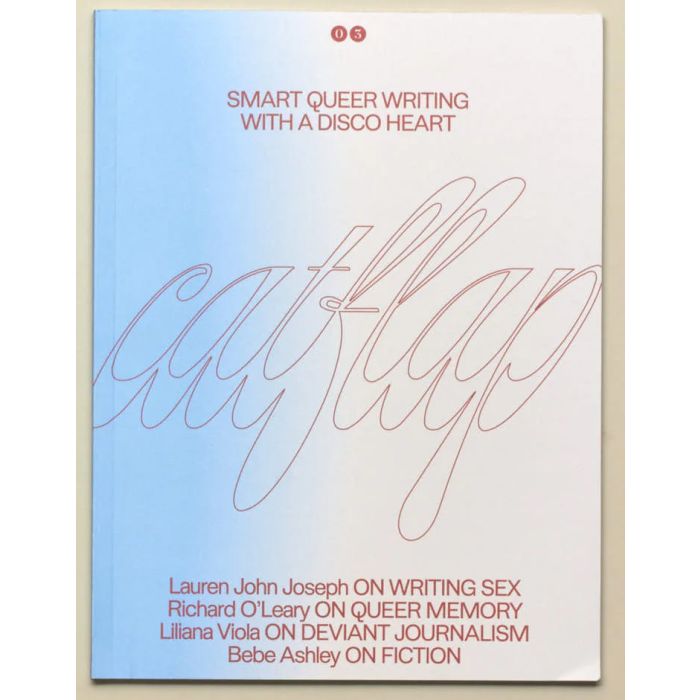
Catflap is a ‘literary journal’ of queer non-fiction and poetry from people in Belfast and Ireland with the title ‘Smart Queer Writing With A disco Heart’.  The copy I have (issue 3) incorporated works by:

Catflap

Bebe Ahsley – the Olive Branch
Samson Furlong Tighe – Found Poem in Loughlistown
Liliana Viola – SOY: Proof of Queer Life
Richard O’Leary – Objects of Desire: Portrait of the Homoseachai
Zara Meadows – Sign
Ian Macartney – Yesterday, Forth Rail Bridge (December 2-16)
Lauren John Joseph – Writing Sex
Anna Loughran – Nude & In the Gardens
Marc Gregg – Fuck Me Thru The Phone
(DW) Dean Black – essiage
Laima Kreivyte – Waiting & a feminist asks questions in church
Charlie McIlwain – Blue is Blue & Yes
Adam James Martin – Cross & Out
Dear Hole (Advice Column)

The journal consists of 89 pages, 87 in print.


It isn’t easy to put a finger on this journal, to me it is one for dipping into and finding that which you like and disregarding the rest.  But then on another day those that you have disregarded may have meaning.

Directly the piece about Richar O’Leary did appeal, as I know Richard, indeed I had the pleasure of listening to him and one of his pieces at last year’s Cara Friend sponsored meeting at Queens University (with his props).  Richard’s stories are interesting and thought-provoking; he has led an interesting life, had a wonderful partner, and now enjoys educating people about being gay in Ireland’s past.


Zara Meadows ‘Sign’  is a poem of seven verses – it is very descriptive

…Muggy night on Castle Lane

The rain falls on your jacket

Like paper planes on fire


Made from receipts

Stolen out from the pockets

Of corrupt politicians…


I am not a poet (I have only written one poem in my life at that was about World War 1 whilst I was at secondary school), and often I find poems do little for me.  I think it takes time again to read and digest what each poet is saying, an example being Robert Forst’s poems which often have at least three levels to read and understand them by.

I am gong to suggest that you become readers of ‘Catflap’ editions published by Outburst Arts Festival.  Give them the support that all writers and publishers need, especially in these times, and read about being gay in Belfast and Northern Ireland


Links:

  • Books Ireland – Smart queer writing, with a disco heart—catflap
  • Conchies by Ann Kramer – Book Review

Filed Under: Book Reviews Tagged With: AuthorSpotlight, BelfastArtsScene, BelfastWriters, CatflapJournal, CelebrateDiversity, CulturalCommentary, EmergingWriters, LGBTQPoetry, LiteraryCommunity, LiteraryJournals, NonFiction, NorthernIrelandArts, OutburstArtsFestival, PersonalNarratives, PoeticExpression, PoetryReview, QueerIdentity, QueerLiterature, QueerVoices, WritingAboutQueerness

Reform The House of Lords?

07/01/2025 By ACOMSDave Leave a Comment

Reform the House of LordsI discussed how we might reform the House of Lords, even the House of Commons with Sean McGouran last weekend.  The surprising thing was that I was the one coming up with radical ideas!

I decided to do some further reading and the following ideas isolated themselves:


Here’s a summary of ideas for revamping the House of Lords:

1. Reforming Membership

  • Abolition of Life Peers: Replace life peerages with term-limited appointments to ensure turnover.
  • Reducing Membership: Limit the number of members to make the chamber more manageable and efficient.
  • Regional Representation: Appoint or elect members to represent regions or nations of the UK, improving local representation.
  • Removal of Hereditary Peers: Eliminate the remaining hereditary peers to modernize the chamber.
  • Merit-Based Appointments: Introduce a system where members are selected based on professional or academic achievements.

2. Electoral Reforms

  • Fully Elected Chamber: Transform the Lords into a wholly elected body to enhance democratic accountability.
  • Partially Elected/Hybrid Model: Combine elected members with appointed experts to retain diverse expertise.
  • Proportional Representation: Use proportional representation for elections to better reflect public opinion.

3. Functional and Structural Changes

  • Advisory Role Only: Restrict the Lords to a purely advisory function, with no legislative blocking powers.
  • Enhanced Scrutiny: Focus on improving legislative scrutiny, especially for complex policies.
  • Term Limits: Impose term limits on all members to prevent lifetime positions.

4. Transparency and Accountability

  • Code of Conduct: Strengthen ethics rules and enforce stricter accountability for members.
  • Public Involvement: Create mechanisms for citizens to nominate or select members for appointment.

5. Complete Replacement

  • Senate Model: Replace the Lords with a second chamber modelled after senates in other countries, such as the U.S. or Australia.
  • Citizen Assembly: Replace the Lords with a randomly selected citizen assembly to ensure diverse representation.

6. Abolition

  • Unicameral System: Abolish the House of Lords entirely, leaving the House of Commons as the sole legislative body.

7. Devolutionary Considerations

  • Federal Chamber: Recast the Lords as a federal body representing the UK’s devolved nations and regions.
  • National Assemblies Input: Allow devolved governments a role in selecting or appointing members.

8. Cultural and Symbolic Changes

  • Rebranding: Rename the chamber to reflect modern values (e.g., “Senate” or “Council of the Nations”).
  • Relocation: Move the chamber outside London to symbolize decentralization and inclusivity.

Each proposal has its advantages and challenges, often balancing tradition, expertise, democratic legitimacy, and efficiency.’


During Sean’s and my discussion, I suggested the reform of The House of Lords could encompass:

  • remove the clergy from the House
  • No one should be made a peer unless they have achieved something of note in society (e.g. a Senior Trade Unionist who has worked his/her way through the ranks, not just an economics/politics degree)

there were other ideas, but the list above is probably more comprehensive.

I do honestly believe that the House of Lords should stay as a bugger to the House of Commmons – which now seems to be filled with ‘career’ politicians in the main, who seem to be more interested in their career than the country; there have been to many scandals, with too many public enquiries which take too long to reach a verdict (if they even do) – and often when the enquiry is finished it has little or no impact.


[What are the tricks used by the government that most people don’t know?


Private Inquiries – used as a convenient method to kick any awkward questions for government into the VERY long grass.

  • Public Inquiries – to appoint a chair to oversee such a body – with the nudge that they will receive a preferment of knighthood/damehood or be elevated to the upper house if they come out in favour of the fraudulent government requirement – usually through corruption or incompetence or both, and to probably keep the inquiry going for so long, that people responsible for such a travesty conveniently forget, while the press and the public lose interest.
  • Variations on the above – to exculpate any notion of impropriety from the government or their political party, or indeed anyone or anything remotely associated with them.

Leaks: probably originally emanating from the top No 10.

These are particularly useful when a member of the government makes a total ‘balls-up’ of something, A contrary public relations propaganda campaign is quickly utilized, to fabricate and provide an illusion that everything was carried out by the government/cabinet member in the strictest form according to the very highest principles, and the media – or most of them – accede to the deception and manipulation, or else they face consequences!

Whisper Campaigns

Rumours, innuendo, and slanderous statements are quietly conveyed in order to damage reputations and/or dry up funding sources and support. Because the allegations are not made publicly, the target is caught in a Catch-22: if the candidate publicly denounces the rumours, it calls attention to the issue. If the candidate ignores the behind-the-back rumours, the campaign can be damaged.

Push Polling

Push polling is an unfair and unethical political device used to communicate negative messages. Under the guise of conducting a legitimate poll, defamatory or otherwise negative and usually false information is conveyed.

Unfair Competition

Practices that hamper the opponent’s ability to fairly compete are unethical. You will sometimes see wealthy candidates hiring as many political consultants as are available, not for their services, but to keep them from working for the opponent. If a candidate condones the removal of posters or any behaviour that stifles the opponent’s message, he or she is engaging in unethical campaigning.

Interference with the Electoral Process

Any campaign practice that provides an obstacle to a citizen’s ability to vote interferes with our democratic notions of fair and free elections. Destruction of mail-in ballots, deliberately staged traffic jams on Election Day, and voter intimidation at the polls are all examples of unethical – and in many instances illegal — tactics designed to discourage voting.

The October Surprise

The infamous “October surprise” is the generic term for a negative attack that comes out shortly before an election, giving the target of the attack little or no time to respond. If the attack is subject to denial or rational explanation, the interests of an informed electorate – if indeed there is such an entity – require that assertions be timed in such a way as to allow a response.]


Links:

  • What are the most tricks used by the government that most people don’t know?
  • Boris Johnson’s clever trick to get away with anything – even the Covid catastrophe
  • Rogue Element in British Politics


Filed Under: Editor to ACOMSDave Tagged With: electoral reform, House of Lords reform, legislative scrutiny, modernization, Politics in the UK, regional representation, term limits, UK parliament

Rogue Element in British Politics

07/01/2025 By ACOMSDave Leave a Comment

Rogue Element in British PoliticsA week into the new year, British politics has been dominated by Elon Musk, and outside ‘Rogue Element’. The focus has shifted to the grooming gangs scandal, which continues to make headlines, with victims failed by police, social services, and politicians for decades. Musk’s intervention in this long-standing issue has finally prompted action. The government is now considering the key recommendations from Professor Alexis Jay’s 2022 report on child sexual abuse, with Home Secretary Yvette Cooper announcing plans for implementation.

Musk, though not a British citizen, has become an influential figure in UK politics, particularly through his feud with Prime Minister Rishi Sunak and his support for far-right figures like Tommy Robinson. His recent remarks have added fuel to the fire, even as he seeks to undermine British democracy by questioning the legitimacy of the UK electoral system. This has forced Labour and the Conservatives to react, with both sides grappling with Musk’s influence.

The Tories are carefully navigating the situation, capitalizing on the grooming scandal to target Labour, but they too are vulnerable. Musk’s rhetoric, including promoting a petition for a new election, has sparked discontent with the political system. Nigel Farage (an internal Rogue Element), aware of the potential damage Musk’s involvement could cause, warns that it could further erode trust in Westminster. As the situation unfolds, both major parties find themselves under pressure, with Musk’s influence serving as a disruptive force in British politics.


Links:

  • Water and Politics, A dirty business
  • Women in Politics
  • Morning Call: Why Elon Musk is a danger to the Tories


Filed Under: Editor to ACOMSDave Tagged With: 2025 UK news, British democracy, british government, child sexual abuse, conservative party, Elon Musk, grooming gangs, Labour Party, Nigel Farage, political influence, political scandal, Reform Party, Rishi Sunak, Tommy Robinson, UK politics, Yvette Cooper

  • « Previous Page
  • 1
  • …
  • 7
  • 8
  • 9

Categories

Copyright ACOMSDave.com © 2026