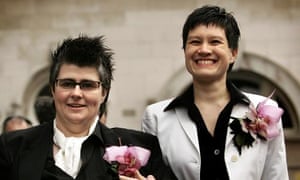
The SDLP has been challenged over its stance on gay marriage, after one of its council leaders declined to toe the party line during a vote on the issue.
Despite the official SDLP policy of supporting gay marriage, its leader on the Causeway Coast and Glens council abstained on the matter on Tuesday night, and then refused to explain why when asked.
Sinn Fein accused the SDLP of trying to “ride two horses”, and revealed that it will soon bring another motion to Stormont asking MLAs to back gay marriage.
It will be the fifth such motion since 2011, something which the DUP described as a bid to “flog the same dead horse”.
On each occasion the matter has come up at the Assembly, MLAs have rejected it – with the most recent such rejection coming just four months ago.
When a pro-gay marriage motion came before a committee of Causeway Coast and Glens councillors on Tuesday, only one out of its three SDLP councillors was present – group leader Maura Hickey.
Asked why she abstained, Councillor Hickey politely told the News Letter: “I don’t wish to comment at this moment in time, if that’s alright.”
By contrast, the very same night the SDLP’s Newry branch was hosting a tribute event to PA Mag Lochlainn, a veteran gay campaigner who died in 2012.
When it comes to the differing approach shown towards gay marriage by SDLP members across the councils, Sinn Fein said last night: “Their hypocrisy on this issue knows no bounds…
“This is not the first time that the SDLP has attempted to ride two horses on the issue and their failure is another let down to the lesbian, gay, bisexual and transgender (LGBT) community.”
When Sinn Fein’s criticisms were put to her, SDLP Causeway Coast leader Maura Hickey she said: “Again, I don’t wish to comment on it at this moment in time.”
She added that the other two SDLP councillors who could have voted at Tuesday’s meeting (Orla Beattie and Stephanie Quigley) had been on holiday at the time.
She would not comment on how they would have voted if they had been present.
The SDLP’s party headquarters said last night: “The SDLP remains committed to marriage equality with robust protection for faith groups.
“This is a matter for the Northern Ireland Assembly, where a majority of SDLP MLAs continue to vote in favour of the change.
“Since its inception, the SDLP has believed in the power of persuasion and we will continue to make the case for equal marriage and pursue equal rights for the LGBT community.”
Fellow SDLP Causeway Coast councillor Gerry Mullan said: “Obviously it’s a very, very emotive issue, and one people will have very, very strong personal views on.
“And whilst the party may have a line on issues, individuals at the end of the day are free, and given the freedom, to decide which way they want to vote themselves.
“So this is obviously a case of Maura having her own very strong opinions for either religious or moral grounds. And I am happy to support her and her own personal view, but it may not well reflect the position of the party itself.”
His own view is that he supports gay marriage.
Asked about Sinn Fein’s criticisms, he said: “They would say that. They’re playing politics with it obviously, as usual.”
Although the Causeway Coast motion supporting gay marriage failed, it will come back to the full council, possibly as early as next Tuesday.
At that stage all councillors – not just those from that one committee – can debate the matter and vote.
Meanwhile Sinn Fein’s pledge to bring the matter to Stormont yet again was derided by the DUP last night.
Chief whip Peter Weir MLA noted it had been voted down on each consecutive occasion it had appeared.
Mr Weir said: “It’s hard not to see this as a certain form of Groundhog Day, with people trying to flog the same dead horse.”
He noted that the make-up of the Assembly has barely changed since 2011, and added: “When something has been brought forward for the fifth time with the same people, I would assume the result would be the same.”
The image that Challah Connection put on its homepage
The image that Challah Connection put on its homepage following the SCOTUS marriage equality decision sparked hate mail from some, kudos from others — and a fresh sense of social activism in the company’s owner.
What do cookies, marriage equality and Jewish identity have to do with one another? For Challah Connection owner Jane Moritz of Norwalk, Connecticut, the three have become indelibly linked.
You might have read about the not-so-sweet situation: Soon after the Supreme Court announced its Obergefell v. Hodges decision, codifying the right of LGBT Americans to marry across the country, Moritz placed a picture of kosher rainbow cookies on the homepage of her company website, along with the line, “Never have these treasured cookies had such meaning.”
Image: Ann DelaurentisChallah Connection’s Jane Moritz
And that’s when the hate mail and angry social-media postings began to arrive. Moritz received letters expressing outrage, questioning her Judaism and asking how she could consider her site kosher while supporting what the Torah condemns.
“What this did is reinforce what I already knew,” Moritz said. “We’re all Jews, but there are factions, and my little cookies seem to have brought that up.”
She forwarded me a few sample scribbles: You consider yourselves a “kosher” site?!? How dare you support what the Torah considers an abomination!! You should be ashamed of yourselves! You just lost my business. And that of anyone I know. Hopefully the word will spread. ur so so twisted. if u claim to be so jewish, then u must know that g-d hates homosexuality and it’s a terrible sin. while we must love e/o created in g-d’s image, we must condemn this sin and those who commit it. what is WRONG with u?!
Moritz held her ground, and a funny thing happened. “It kind of ignited something in me,” she said. “I didn’t plan this. I put what I felt was true to my own heart and once I got challenged I became resolved in what I wanted to put out there, and I’ve become even stronger in my resolve.”
Knowing what she knows now, would she do it again? In a heartbeat.
“If it comes up again, I’m not backing down. I have some pretty conservative upbringing, but I have my own version of being Jewish, and anybody who want to challenge me, I’m ready to take them on.”
Moritz is quick to note that positive feedback outweighed the negative. And while the hate mail has subsided, she’s still receiving messages of support.
“I got a call Friday afternoon from a rabbi in Oklahoma to say how pleased and happy he was that I had stood up for this, that it showed all this moral fortitude,” Moritz said. “He said it was strong of me to put my business at risk.”
As it happens, though, orders for rainbow cookies only increased in the immediate aftermath. (They subsequently leveled off.)
“There was an overwhelming majority of people who supported my stand,” Moritz said. “I think there are a lot of people out there who feel the way we do, that Judaism is something we can all take part in and it doesn’t have to be prescribed in a certain way. We’re all one big family.”
As we were saying goodbye, Moritz asked me to think of her if I ever heard about food-related initiatives spearheading social action.
“As I say,” she said, “it ignited something in me.” Liza Schoenfein is food editor of the Forward. Contact her at schoenfein@forward.com.
Read more: http://forward.com/food/312160/kosher-cookie-clash-sparks-social-activism/#ixzz3imYTbOqf
A rally in support of gay marriage in Belfast last month
10:00Monday 06 July 2015
An overwhelming majority of Northern Ireland people now support gay marriage, a poll has suggested.
The Ipsos MORI survey found that 68 per cent of adults in the Province back the right of same-sex couples to marry.
The News Letter published a brief summary of the findings in Saturday’s paper.
We can now reveal more data.
The survey found that 82 per cent of the 16 to 34 age group support gay marriage, dropping slightly to 75 per cent among 35 to 54-year-olds, and falling sharply to 47 per cent of anyone older than that.
Support was highest in greater Belfast, at 75 per cent, and in other areas it dipped to 63 per cent support.
There was much higher support among Catholics (75 per cent) than Protestants (57 per cent).
Ipsos MORI broke down support by political affiliation. Support ranged from 80 per cent of Sinn Fein voters, to 79 per cent of Alliance voters, 61 per cent of SDLP voters, 49 per cent of Ulster Unionist voters, and 45 per cent of DUP voters.
Some people who saw Saturday’s report have asked about details for which we had no space, such as sample size.
Ipsos MORI say they asked 1,000 adults aged over 16 across Northern Ireland. Interviews were carried out in person from May 20 to June 8.
The data was weighted to match the population profile.
The pollsters say no other group commissioned the survey.
They asked the same question their London team asked in England prior to the 2013 law change there: “To what extent do you agree that homosexual couples should be allowed to marry each other?”
Prior to the Republic’s referendum, surveys over-estimated support for gay marriage by around seven per cent compared to the final 62 per cent Yes vote
View PhotoReuters/Reuters – A couple walks hand in hand from the count centre in Dublin in this May 23, 2015 file photo. REUTERS/Cathal McNaughton
DUBLIN (Reuters) – Legislation allowing same-sex couples to marry in Ireland will be delayed until later this year following a legal challenge against last month’s gay marriage referendum, a government minister was quoted as saying on Tuesday.
The government had planned to enact the required laws before parliament goes into recess at the end of July.
However two men who unsuccessfully sought to challenge the result in the High Court will have their case heard by Ireland’s Court of Appeal on July 30, local media reported. According to one of the them, the outcome had been unfairly influenced by government parties that had not been impartial in campaigning for a ‘Yes’ vote.
“If the courts are going to hear a case, we can’t proceed with legislation until that case is decided,” Health Minister Leo Varadkar was quotes as saying in the Irish Times newspaper.
“It is disappointing but we have to respect the division of powers and separation of powers that exists between the courts and the government.”
Results of referendums in Ireland are often challenged in the courts, causing delays in the formality of passing the relevant legislation but not threatening the result.
Same-sex marriage was backed by 62 percent of voters in one of the largest turnouts ever in a referendum in Ireland, marking a dramatic shift in a traditionally Catholic country that only decriminalised homosexuality two decades ago.
“We are most concerned that these appeals are frustrating the overwhelming will of the people as expressed in the referendum,” Kieran Rose, chairman of Ireland’s Gay and Lesbian Equality Network, said in a statement.
(Reporting by Padraic Halpin; Editing by Robin Pomeroy)
In a historic ruling, the Supreme Court extended gay marriage rights to couples in all 50 states.
By Cristina Maza | Christian Science Monitor – 17 hours ago
Same sex marriage is now legal in every state in the United States after a historic Supreme Court ruling declared that the right to marriage equality is enshrined under the equal protection clause of the 14th Amendment.
In what marriage equality advocates have called the most important civil rights case in a generation, 5 out of 9 court justices ruled in favor of same-sex marriage. This means the remaining 14 states that did not recognize same-sex marriage, most of which are in the South and Midwest, will no longer be able to enforce bans on the marriages of gay couples.
The results of this historic case, known as Obergefell v. Hodges after an Ohio man who sued the state to get his name listed on his late husband’s death certificate, mark a long-sought victory for LGBT rights activists who have campaigned for decades in favor of marriage equality.
“No union is more profound than marriage, for it embodies the highest ideals of love, fidelity, devotion, sacrifice, and family. It would misunderstand these men and women to say they disrespect the idea of marriage. Their plea is that they do respect it, respect it so deeply that they seek to find its fulfillment for themselves,” Justice Anthony Kennedy said in his closing opinion.
“Their hope is not to be condemned to live in loneliness, excluded from one of civilization’s oldest institutions. They ask for equal dignity in the eyes of the law. The Constitution grants them that right. The judgment of the Court of Appeals for the Sixth Circuit is reversed.”
Each of the four opposing justices issued separate dissenting opinions. “This court is not a legislature. Whether same-sex marriage is a good idea should be of no concern to us,” wrote Cheif Justice John Roberts.
“If you are among the many Americans — of whatever sexual orientation — who favor expanding same-sex marriage, by all means celebrate today’s decision,” Roberts said, reading his opinion from the bench. “But do not celebrate the Constitution. It had nothing to do with it.”
The Obama administration supports same-sex marriage, and many high-profile politicians such asPresident Obama and Democratic presidential nominee Hillary Clinton took to their Twitter accounts to celebrate the Supreme Court’s decision. Today is a big step in our march toward equality. Gay and lesbian couples now have the right to marry, just like anyone else. #LoveWins— President Obama (@POTUS) June 26, 2015 Proud to celebrate a historic victory for marriage equality—& the courage & determination of LGBT Americans who made it possible. -H— Hillary Clinton (@HillaryClinton) June 26, 2015
The ruling will not take effect immediately because the court gives the losing side around 3 weeks to ask for the decision to be reconsidered.
According to UCLA’s Williams Institute, which tracks the demographics of gay and lesbian Americans, there are an estimated 390,000 married same-sex couples in the United States. Another 70,000 couples living in states that do not currently permit them to get married are expected to hear to the alter over the the next three years, the institute says. Roughly 1 million same-sex couples, married and unmarried, live together in the United States.
Henry McDonald Ireland correspondent
Friday 26 June 2015 12.39 BST Last modified on Saturday 27 June 2015 00.01 BST
Grainne Close and Shannon Sickles became the first gay couple in the UK to enter a civil partnership at Belfast city hall in 2005. Photograph: Peter Macdiarmid/Getty Images
First couples in UK to enter civil partnerships delighted with result of legal battle, saying religious views should not affect public policy
The first two couples to become civil partners in the UK have won the right to have the same-sex marriage ban in Northern Ireland subjected to judicial review.
A Belfast high court judge ruled on Friday that Grainne Close and Shannon Sickles, and Charles and Henry Flanagan-Kane, should be granted the review, which is set for the autumn.
Both couples’ civil partnership ceremonies were held at Belfast city hall, just a short distance from the high court, 10 years ago.
The review is likely to be held in November, alongside several other legal challenges taken by gay couples in the region, and who are backed by the Rainbow Project, an LGBT rights organisation.
Neither couple was in court for Friday’s ruling but their barrister and senior counsel representing the Northern Ireland regional government were present to hear Mr Justice Treacy say that he had read the case papers and had already satisfied himself that the matter should proceed to judicial review. “The applicant has an arguable case,” he said.
Members of the Rainbow Project and Amnesty International were also in court. Others supporting the legal challenge included the former CEO of the Marie Stopes clinic in Belfast Dawn Purvis and the actor Nuala McKeever.
Outside court, solicitor Mark O’Connor issued a statement on behalf of both couples: “We are delighted that we have been able to get over the first hurdle in relation to the judicial process and that the judge today has granted leave for us to bring this judicial review.
“We are thankful that the judge has made that decision today. We believe that religious policy and religious views shouldn’t be affecting public policy. Thankfully today the judge appears to have accepted that there is an arguable case to answer … and hopefully we will have success in the future in relation to this matter.”
Advertisement
Prior to the hearing Grainne Close had said: “This is not a religious issue, it is a human rights issue. That is why we are going to court.”
Close said she and her US partner had been inspired by Ireland’s overwhelming vote in favour of gay marriage last month and the joyous scenes that greeted the result of the referendum at Dublin castle.
The Rainbow Project’s director, John O’Doherty, welcomed Treacy’s ruling. “We are pleased that this case is progressing and that it will likely be heard alongside our client’s case challenging the failure of the Northern Ireland government to recognise their lawful marriage.
“The current illogical patchwork of marriage laws created by the Westminster government is placing LGBT people in Northern Ireland at an inexcusable disadvantage and we hope that the courts will agree and find that there must be a harmonisation of marriage laws across the UK.”
A Sinn Féin motion on marriage equality was defeated in April, with 47 Northern Ireland assembly members voting in support, but 49 unionists against. Even if there had been a small majority in favour, the Democratic Unionist party would have exercised a special veto drawn up under devolution.
The petition of concern rule allows any party to veto legislation if it can argue the law would not have sufficient cross-community or Protestant/Catholic support.
Earlier this month, 20,000 trade unionists staged a rally in Belfast city centre to support gay marriage in Northern Ireland, the only part of the UK where LGBT couples cannot be married.
Amnesty International said the ban has turned Northern Ireland into a “discriminatory backwater for the gay and lesbian community”.
Shannon Sickles and Grainne Close, and Chris and Henry Flanagan-Kane, the first UK couples in civil partnerships, pursue legal battle over full marriage equality
A rally calling for same-sex marriage to be made legal, in Belfast, earlier this month. Sinn Fein has called for a referendum on the issue in the province. Photograph: Charles McQuillan/Getty Images
An American woman and her partner, who were the first couple in the UK to have a civil partnership ceremony, are to challenge Northern Ireland’s ban on gay marriages.
Shannon Sickles, a US citizen, and Grainne Close made history a decade ago when they were the first gay couple to have a civil partnership in Britain, sealing their union at a ceremony at Belfast city hall.
Now the couple are taking part in a legal case to overturn the bar on LGBT couples getting married in Northern Ireland. They will launch their legal case on Friday morning.
Shannon Sickles (l), and Grainne Close at Belfast city hall in 2005. Theirs was one of the first gay civil partnerships in the UK. Photograph: Paul Faith/Press Association
Northern Ireland remains the only part of the UK where there is no gay marriage equality. The deputy first minister, Martin McGuinness, has suggested a regional referendum – similar to the one that passed in the Irish Republic last month – on gay marriage.
Sinn Féin and other parties have made repeated attempts to legislate for gay marriage equality in the Northern Ireland assembly, but their proposals have been voted down by unionists. The evangelical Christian wing of the Democratic Unionist party has mounted fierce opposition to introducing gay marriage equality in the province.
Close and Sickles will be joined by a male couple, Chris and Henry Flanagan-Kane (previously Christopher Flanagan and Henry Kane) in seeking a judicial review of the ban.
On her Facebook page, Close posted on Wednesday: “This year, December 19th, 2015 Shannon and I, along with Chris and Henry Flanagan-Kane, will celebrate 10 years of our civil partnerships.
“Northern Ireland was the first place in the UK to recognise civil partnership legislation and is now the last place in the UK and Ireland to recognise equal marriage.
“On June 26th, 10am in the high court, the four of us are bringing a legal challenge for a judicial review of the legislative prohibition preventing us from entering into civil marriage.”
“Our barrister, Laura McMahon, will argue that to bar equal marriage is a fundamental discrimination of our rights under the European convention on human rights, which is without justification.”
Henry Kane (R) and Christopher Flanagan had a civil ceremony on the same day in 2005 in Belfast. They are also fighting the ban on gay marriage in the region. Photograph: Peter Macdiarmid/Getty Images
She added: “You will hear the arguments from DUP and other religious groups (all the same that have been played out in the Irish referendum) that we have civil partnership, so why marriage?
“The fact that we have to stand in a different queue from opposite-sex peers when it comes to having our relationship recognised by the state is itself indicative that we are treated differently.”
The Rainbow Project, one of the main gay rights organisations in Northern Ireland, said it will attend the hearing in Belfast this Friday, in solidarity with the couples.
“Anything that tests the legal basis of Northern Ireland’s ban on civil marriage is a positive step,” said John O’Doherty, the Rainbow Project’s director. The organisation has been planning to launch its own legal challenge, based on human rights legislation, this autumn.
Earlier this month, thousands attended a rally in Belfast organised by the trade union movement and Amnesty International, calling for gay marriage equality in Northern Ireland.
The Irish Congress of Trade Unions has backed the campaign to lift the ban, claiming that it not only violates European human rights law but also equality legislation contained within the 1998 Good Friday Agreement.
The Irish vote for gay marriage reverberates through Germany
SINCE Ireland voted in May to allow same-sex marriage, Europe has had a clear divide: liberal in the west but more illiberal going east. Germany is in the middle. Since 2001 gay and lesbian couples have been able to enter civil unions, and 35,000 have done so. They enjoy the same rights as heterosexual spouses for tax and inheritance. But same-sex couples do not have full adoption rights, and their union is not called marriage.
Many Germans find this embarrassing. A 2013 poll found 74% in favour of full marriage rights for homosexuals. So are the opposition Greens and Die Linke (The Left) in parliament, as well as the Social Democrats, the junior party in the ruling grand coalition. The upper-house Bundesrat, where these three parties have a majority, recently passed a non-binding resolution urging the government to make marriage available to all.
That was largely symbolic, because of opposition within Chancellor Angela Merkel’s centre-right block, consisting of two “Christian” parties: her own Christian Democratic Union (CDU) and the more conservative Bavarian Christian Social Union. The phrase “Christian union” came from a post-war confessional alliance between Catholic and Lutheran parties from the Weimar Republic. But conservatives now invoke Christian values to argue against same-sex marriage. Annegret Kramp-Karrenbauer, the premier of Saarland, who is often touted as a possible successor to Mrs Merkel, recently argued that if you allow gay marriage, incestuous or polygamous nuptials might be next.
Yet within the CDU attitudes are changing. The defence minister, Ursula von der Leyen, another possible successor to Mrs Merkel, this month told the party’s executive committee that “something fundamental has changed in society.” If Irish Catholics can relax about gay marriage, so can German ones, says Jens Spahn, a gay member of the committee. Mrs Merkel, the daughter of a Lutheran pastor, has been coy but is thought to be tolerant in private. She visibly squirmed when asked during the 2013 campaign to explain her party’s rejection of gay marriage. But she knows she has moved the CDU leftward in the 15 years she has led it. Many blame her for the emergence of a new party on the right, the Alternative for Germany, which attracts disgruntled former Christian Democrats.
Such objections are tactical, says Alexander Vogt, leader of the gay-and-lesbian club within the CDU. As is her wont, Mrs Merkel chooses battles carefully. Right now—with Grexit, Brexit and Ukraine—she faces many. She might also like to keep gay marriage alive as an issue to concede to the Greens, whom she may prefer as a coalition partner after the 2017 election. One way or another, says Mr Vogt, Germany will have same-sex marriage soon afterwards.
Campaigners attend a rally in Belfast to show their support for marriage equality
Belfast demo seeks equality for LGBT people
by Mike Hamilton in Belfast
ABOUT 20,000 gay rights supporters marched through Belfast city centre on Saturday to demand that the legal recognition of same-sex marriage be extended to Northern Ireland.
The protest wound its way through the main shopping district to Belfast City Hall, where a large open-air rally took place.
The action was jointly organised by the Irish Congress of Trade Unions (ICTU), Amnesty International and the Rainbow Project.
Participants included a wide range of individuals and movements, including LGBT groups, trade unions, charities, human and civil rights organisations, churches, political parties and pressure groups.
The huge turnout surprised even the organisers, who were forced to make repeated calls for participants to use all available space at both sides of the staging to allow thousands more people in to hear from a variety of invited guests.
Among the speakers was ICTU LGBT committee chairman Daire Toner, who said: “I dream one day of getting married, but my dreams are shattered by the laws that govern this state.
“Even if I got married elsewhere, a flight or a train journey would make it invalid.”
Rainbow Project director John O’Doherty added: “The numbers here say it all. We want our voice heard. We need to go out and tell our story, play our part in a new Northern Ireland. They can’t ignore us any more.”
Amnesty International Northern Ireland director Patrick Corrigan put it simply: “All people are equal — the state should protect all people equally.”
In 2005, while under direct rule by Westminster, Northern Ireland became the first part of the UK to introduce civil partnerships, but since the power-sharing institutions were restored at Stormont, the fight for equality has gone into reverse gear.
The most obvious manifestation of this was an attempt to introduce a “conscience clause” amendment to equality law which would have allowed firms owned by people of faith to discriminate against LGBT customers.
Members of the Northern Irish Assembly proposed motions supporting equality in civil marriage four times in the last parliament.
But, each time, the Democratic Unionist Party blocked it, using a device known as a “petition of concern,” which requires majorities on both the nationalist and unionist benches.
Further links:
UK minister comes out as gay after 29-year secret affair Nick Gibb said he will marry Michael Simmonds, the chief executive of the Populus polling organization, in November, having just last week come out to his family as gay.
The Times India | Jun 7, 2015, 12.28 AM IST
LONDON: Britain’s schools minister has announced he would be tying the knot with his male partner after a nearly 29-year secret affair.
Nick Gibb said he will marry Michael Simmonds, the chief executive of the Populus polling organization, in November, having just last week come out to his family as gay. Gibb told The Times that he and Simmonds had enjoyed a “wonderful life” together but said the forthcoming wedding had necessitated the “practical” step of informing his 79-year-old mother and other relatives.
“If one of us was ill and had to go to hospital it would be awful if we couldn’t be there for each other,” he said.
The 54-year-old told the newspaper that he and his partner had met and fell in love in a “different era”, but that both had been comfortable keeping their relationship a secret.
“We realised very quickly we had an interest in common and it was pretty rapid. We fell in love very quickly,” he said.
“It was harder then. [Homosexuality] was only made legal in 1967. There was discrimination in industry and professions. It was easier to have a relationship that wasn’t known about. It didn’t really bother us, we both had successful careers. We just got on with life.”
Of his announcement, he added: “I think my mother was initially shocked — that’s an age thing — but then very supportive and what she wants is for me to be happy. We are close, so to her being a loving family is more important than anything else.”



 Reuters

 By Cristina Maza | Christian Science Monitor – 17 hours ago
 court justices ruled in favor of same-sex marriage. This means the remaining 14 states that did not recognize same-sex marriage, most of which are in the South and Midwest, will no longer be able to enforce bans on the marriages of gay couples.