

Henry McDonald Ireland correspondent
Friday 26 June 2015 12.39 BST Last modified on Saturday 27 June 2015 00.01 BST
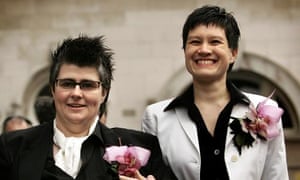
Grainne Close and Shannon Sickles became the first gay couple in the UK to enter a civil partnership at Belfast city hall in 2005. Photograph: Peter Macdiarmid/Getty Images
First couples in UK to enter civil partnerships delighted with result of legal battle, saying religious views should not affect public policy
The first two couples to become civil partners in the UK have won the right to have the same-sex marriage ban in Northern Ireland subjected to judicial review.
A Belfast high court judge ruled on Friday that Grainne Close and Shannon Sickles, and Charles and Henry Flanagan-Kane, should be granted the review, which is set for the autumn.
Both couples’ civil partnership ceremonies were held at Belfast city hall, just a short distance from the high court, 10 years ago.
The review is likely to be held in November, alongside several other legal challenges taken by gay couples in the region, and who are backed by the Rainbow Project, an LGBT rights organisation.
Neither couple was in court for Friday’s ruling but their barrister and senior counsel representing the Northern Ireland regional government were present to hear Mr Justice Treacy say that he had read the case papers and had already satisfied himself that the matter should proceed to judicial review. “The applicant has an arguable case,” he said.
Members of the Rainbow Project and Amnesty International were also in court. Others supporting the legal challenge included the former CEO of the Marie Stopes clinic in Belfast Dawn Purvis and the actor Nuala McKeever.
Outside court, solicitor Mark O’Connor issued a statement on behalf of both couples: “We are delighted that we have been able to get over the first hurdle in relation to the judicial process and that the judge today has granted leave for us to bring this judicial review.
“We are thankful that the judge has made that decision today. We believe that religious policy and religious views shouldn’t be affecting public policy. Thankfully today the judge appears to have accepted that there is an arguable case to answer … and hopefully we will have success in the future in relation to this matter.”
Advertisement
Prior to the hearing Grainne Close had said: “This is not a religious issue, it is a human rights issue. That is why we are going to court.”
Close said she and her US partner had been inspired by Ireland’s overwhelming vote in favour of gay marriage last month and the joyous scenes that greeted the result of the referendum at Dublin castle.
The Rainbow Project’s director, John O’Doherty, welcomed Treacy’s ruling. “We are pleased that this case is progressing and that it will likely be heard alongside our client’s case challenging the failure of the Northern Ireland government to recognise their lawful marriage.
“The current illogical patchwork of marriage laws created by the Westminster government is placing LGBT people in Northern Ireland at an inexcusable disadvantage and we hope that the courts will agree and find that there must be a harmonisation of marriage laws across the UK.”
A Sinn Féin motion on marriage equality was defeated in April, with 47 Northern Ireland assembly members voting in support, but 49 unionists against. Even if there had been a small majority in favour, the Democratic Unionist party would have exercised a special veto drawn up under devolution.
The petition of concern rule allows any party to veto legislation if it can argue the law would not have sufficient cross-community or Protestant/Catholic support.
Earlier this month, 20,000 trade unionists staged a rally in Belfast city centre to support gay marriage in Northern Ireland, the only part of the UK where LGBT couples cannot be married.
Amnesty International said the ban has turned Northern Ireland into a “discriminatory backwater for the gay and lesbian community”.
