
ACOMSDave

Community Journalist

  • Home
  • Community Journalist
  • Events
  • Media Page and Press Kit
    • Projects and Work
  • Resources & Documents
    • LGBTQ+ Support Groups and Documents
  • NIGRA
  • Archives
  • Contact

Northern Ireland gay marriage ban faces judicial review

27/06/2015 By ACOMSDave Leave a Comment


Henry McDonald Ireland correspondent
Friday 26 June 2015 12.39 BST Last modified on Saturday 27 June 2015 00.01 BST
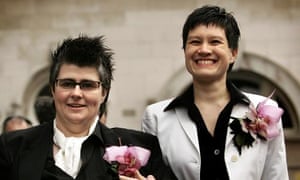
Grainne Close and Shannon Sickles

Grainne Close and Shannon Sickles became the first gay couple in the UK to enter a civil partnership at Belfast city hall in 2005. Photograph: Peter Macdiarmid/Getty Images


First couples in UK to enter civil partnerships delighted with result of legal battle, saying religious views should not affect public policy
The first two couples to become civil partners in the UK have won the right to have the same-sex marriage ban in Northern Ireland subjected to judicial review.
A Belfast high court judge ruled on Friday that Grainne Close and Shannon Sickles, and Charles and Henry Flanagan-Kane, should be granted the review, which is set for the autumn.
Both couples’ civil partnership ceremonies were held at Belfast city hall, just a short distance from the high court, 10 years ago.
The review is likely to be held in November, alongside several other legal challenges taken by gay couples in the region, and who are backed by the Rainbow Project, an LGBT rights organisation.
Neither couple was in court for Friday’s ruling but their barrister and senior counsel representing the Northern Ireland regional government were present to hear Mr Justice Treacy say that he had read the case papers and had already satisfied himself that the matter should proceed to judicial review. “The applicant has an arguable case,” he said.
Members of the Rainbow Project and Amnesty International were also in court. Others supporting the legal challenge included the former CEO of the Marie Stopes clinic in Belfast Dawn Purvis and the actor Nuala McKeever.
Outside court, solicitor Mark O’Connor issued a statement on behalf of both couples: “We are delighted that we have been able to get over the first hurdle in relation to the judicial process and that the judge today has granted leave for us to bring this judicial review.
“We are thankful that the judge has made that decision today. We believe that religious policy and religious views shouldn’t be affecting public policy. Thankfully today the judge appears to have accepted that there is an arguable case to answer … and hopefully we will have success in the future in relation to this matter.”
Advertisement
Prior to the hearing Grainne Close had said: “This is not a religious issue, it is a human rights issue. That is why we are going to court.”
Close said she and her US partner had been inspired by Ireland’s overwhelming vote in favour of gay marriage last month and the joyous scenes that greeted the result of the referendum at Dublin castle.
The Rainbow Project’s director, John O’Doherty, welcomed Treacy’s ruling. “We are pleased that this case is progressing and that it will likely be heard alongside our client’s case challenging the failure of the Northern Ireland government to recognise their lawful marriage.
“The current illogical patchwork of marriage laws created by the Westminster government is placing LGBT people in Northern Ireland at an inexcusable disadvantage and we hope that the courts will agree and find that there must be a harmonisation of marriage laws across the UK.”
A Sinn Féin motion on marriage equality was defeated in April, with 47 Northern Ireland assembly members voting in support, but 49 unionists against. Even if there had been a small majority in favour, the Democratic Unionist party would have exercised a special veto drawn up under devolution.
The petition of concern rule allows any party to veto legislation if it can argue the law would not have sufficient cross-community or Protestant/Catholic support.
Earlier this month, 20,000 trade unionists staged a rally in Belfast city centre to support gay marriage in Northern Ireland, the only part of the UK where LGBT couples cannot be married.
Amnesty International said the ban has turned Northern Ireland into a “discriminatory backwater for the gay and lesbian community”.

Filed Under: Anti-Bullying & Homophobia, History Tagged With: Camden and Islington LGBT, civil partnerships, gay marriage, Irish politics, marriage equality, Northern Ireland election debate

HISTORICAL GAY CAMDEN…

14/07/2013 By David McFarlane Leave a Comment

camdenlgbtforumCamden LGBT Forum issued early in the year an A5 booklet Camden & Islington LGBT History Month 2013.  Which was just as well as History Month is, effectively a Camden phenomenon. There was an event in deepest Clapham, south London run by QuAC (Queers Against the Cuts) though the date might have been just happenstantial).  And not much elsewhere in what might vaguely be called inner London, though there were events in Croydon and other places.
 
Room 106… Room T 102… [?]
‘My’ first event was in SOAS (School of Oriental and African Studies), LGBTQ and Religion / Faith.  It was held in Room 106. The organisers, (“… [s]peakers from the Christian and Muslim communities, as well as SOAS lecturer and writer, Ben Murtagh”) did not turn up!)).  A ‘Room T 102’, on the same floor as the room we were on, is mentioned at the back of the booklet in connection with this discussion.  Most of us probably spent the evening wondering if we should be in another Room (even building; UL, and SOAS itself are enormous) we got on with it anyway.  There was one Irish, one Polish and one Italian Catholic, all male, in my case ‘collapsed’, two Jewish persons, one transgender, a ‘lapsed Anglican’, (a young heterosexual man who is doing a MA on religion and sexuality), and ‘Lee’ / ‘Leigh’ who’s background was Pentecostal.  There were two largely quiet young women of Anglo-Caribbean (and Pentecostal) origin.
In the nature of things very few conclusions were come to, we simply discussed our inherited faiths and our environments.  Catholic Irish don’t take a denunciatory attitude to Gay people, they never have; sex, sexuality, and orientation simply were not discussed.  ‘Sex education’ was handled very awkwardly, if at all.  (Currently sex education in the Republic is quite open, and – ‘liberal’ is the word, – probably due to a number of female, Fianna Fáil, Education ministers, Máire Geogeghan Quinn and Mary Burke.  LGBT matters are dealt with, though as ever, the B and T tend to be neglected).  The Pole and the Italian said that homosexuality was not discussed, except in terms of total rejection.  The M-to-F Trans woman was of quite rigidly Orthodox background, and said her own feeling was that anything other than heterosex was frowned upon. Sex variant people were simply perverts – end of story.   Or get lost – you were no longer of the Faith – or the family.  She had had a long and problematical journey out of this mind-set.
A problem with religion in our political context is that all the parties have similar policies.  They’ll do as little as possible to put them into effect, and we can always expect half a dozen Tory closets to do something stupid.  (The fact that there is – in context – a major homophobic party in Northern Ireland is more useful than not.  It means than nearly everyone else feels the need to be pro-LGBT, or at least, consider the matter.  The current leader of the UUP has attended Belfast LGBT Pride for a number of years now.  As have all the other (non-‘Paisleyite’) parties).
The churches can treat LGBT members any way they feel.
Vincent Nichol, immediately on becoming Archbishop of Westminster and RC Primate of England unilaterally closed down the Soho-based LGBT Apostolate and masses for LGBT people.  Quite what this has to do with Christian charity it is difficult to fathom.  And may create a problem of authority.  They’ll probably continue in disguised form.
So far as the ‘Room 106’ discussion was concerned, it is a pity nobody turned up with a notion of how to lead such.   (Michael Brown took the chair at – basically, -my request, but obviously could only facilitate the conversation; not lead it).  We, inevitably, gave our ‘testimonies’ and left, we didn’t even swap e-mail addresses.  Which was a bit of a lost opportunity.  I managed not to get to other events, partly because some were at awkward times, an interesting talk on Magnus Hirschfeld, The Scientific-Humanitarian Committee and the First Wave of the Queer Movement in Germany 1897 – 1933, was held in Islington Town Hall at six in the evening.  The time and venue were not problematical for me.  I didn’t remember the event until about 6.15 p. m. on the actual day.
I didn’t, but probably I ought to, have gone to Jonathan Kemp’s readings from his books in Islington Museum.  I felt it was somewhat redundant, and I should just read and review the books in the standard fashion.
 
QuACers
QUAC’s event was held in an architectural wonder – the Mary Seacole Centre – (the central (?) library in Peckham) it is spheroid.  The rooms and study pods do have corners.  I inserted myself into a corner furthest from the door – nearest the wine – but ought not to have.  I had a very heavy cold and a braying cough, as did a woman near the door.  We both had to leave the room and share Fisherperson’s Friends as the rest of the audience simply could not hear the speaker from Syriza.  I asked him if he could send upstart a version of his talk.  He said that he only had notes, but would try to do something
 
Links:
 
Camden and Islington LGBT Forum

S McGouran

Filed Under: History Tagged With: Camden, Camden and Islington LGBT, History Month, Islington, LGBT, LGBT Forum

Categories

Copyright ACOMSDave.com © 2026