
|
Today the U.S. government treats immigrants from Latin America the way liberated Jews were treated after World War II. Then a presidential aid reported: “we appear to be treating the Jews as the Nazis treated them except that we do not exterminate them. They are in concentration camps in large numbers under our military guard instead of S.S.
|
|||
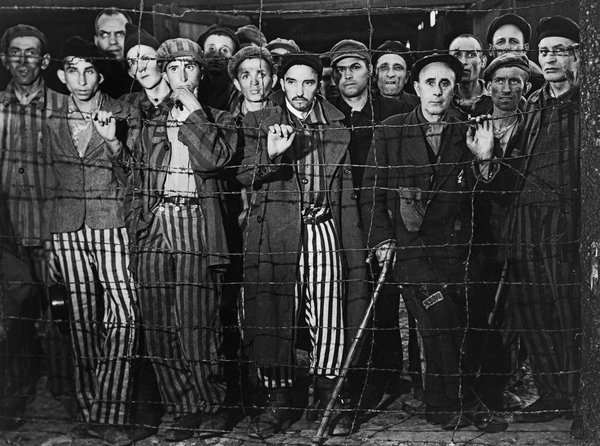
Prisoners at the Buchenwald concentration camp, near Weimar, Germany, as it was liberated by American forces in April 1945., Margaret Bourke-White/Time & Life Pictures – Getty Images // The New York Times,
|
|||
|
World leaders gathered at Auschwitz last month to mark the liberation 70 years earlier of the Nazis’ most infamous concentration camp. More ceremonies will follow in coming months to remember the Allied forces’ discovery, in rapid succession, of other Nazi concentration camps at places like Bergen-Belsen that winter and spring of 1945.
Largely lost to history, however, is the cruel reality of what “liberation” actually meant for hundreds of thousands of Holocaust survivors discovered barely alive in the Nazi camps. Even after the victorious American and Allied forces took control of the camps, the survivors – mainly Jews, but also small numbers of gays, Roma, Communists, Jehovah’s Witnesses and others – remained for months behind barbed wire and under armed guard in what became known euphemistically as displaced persons, or D.P., camps. Many Jews were left wearing the same notorious striped pajamas that the Nazis first gave them. With the American forces overwhelmed by the sheer numbers of refugees under their control, underfed survivors lived for months in decrepit camps in Germany and Austria – a number of them on the same grounds as the concentration camps. Even after conditions improved, thousands of former prisoners remained inside and in limbo for as long as five years because the United States and most other nations refused to let them in. In the early months after the war, thousands of survivors died from disease and malnutrition. Food was so scarce that rioting broke out at some camps, as Allied commanders refused to give extra food rations to Jewish survivors because they did not want to be seen as giving them preferential treatment over German P.O.W.s and other prisoners. Faced with complaints by outside Jewish groups about conditions of “abject misery,” President Harry S. Truman sent a former immigration official, Earl Harrison, to Europe to inspect the camps. His findings were blistering. The survivors “have been `liberated’ more in a military sense than actually,” Harrison wrote Truman in the summer of 1945. “As matters now stand,” he wrote, “we appear to be treating the Jews as the Nazis treated them except that we do not exterminate them. They are in concentration camps in large numbers under our military guard instead of S.S. troops.” I ran across Harrison’s report a few years ago while researching a book on the flight of Nazis to the United States after the war. As I examined the path the Nazis took out of Europe, I struggled to understand how so many of them had made it to America so easily while so many Holocaust survivors were left behind. One answer came in a copy of Gen. George S. Patton’s handwritten journal. In one entry from 1945, Patton, who oversaw the D.P. operations for the United States, seethed after reading Harrison’s findings, which he saw – quite accurately – as an attack on his own command. “Harrison and his ilk believe that the Displaced Person is a human being, which he is not, and this applies particularly to the Jews who are lower than animals,” Patton wrote. He complained of how the Jews in one camp, with “no sense of human relationships,” would defecate on the floors and live in filth like lazy “locusts,” and he told of taking his commander, Gen. Dwight D. Eisenhower, to tour a makeshift synagogue set up to commemorate the holy day of Yom Kippur. “We entered the synagogue, which was packed with the greatest stinking mass of humanity I have ever seen,” Patton wrote. “Of course, I have seen them since the beginning and marveled that beings alleged to be made in the form of God can look the way they do or act the way they act.” Other evidence emerged revealing not only Patton’s disdain for the Jews in the camps, but an odd admiration for the Nazi prisoners of war under his watch. Under Patton, Nazis prisoners were not only bunked at times with Jewish survivors, but were even allowed to hold positions of authority, despite orders from Eisenhower to “de-Nazify” the camps. “Listen,” Patton told one of his officers of the Nazis, “if you need these men, keep them and don’t worry about anything else.” Following Harrison’s scathing report to Truman, conditions in the camps slowly became more livable, with schools, synagogues and markets sprouting up and fewer restrictions. But malaise set in, as survivors realized they had no place to go. Hundreds of thousands of war refugees from Eastern Europe – including many top Nazi collaborators – gained entry to the United States in the first few years after the war, but visas were scarce for those left in the camps. Some Washington policy makers were actively opposed to the idea of taking in Holocaust survivors because of lingering anti-Semitism. At Bergen-Belsen, as many as 12,000 Jewish survivors at a time remained there until the camp was closed in 1951. Menachem Z. Rosensaft was born at the camp in 1948 to two Holocaust survivors. He said in an interview that he believed that the survivors’ hardships after the war had often been overlooked because “it doesn’t neatly fit the story line that we won the war and liberated the camps.” Mr. Rosensaft, the editor of a new book by Holocaust descendants called “God, Faith and Identity from the Ashes,” added: “Nobody wanted them. They became an inconvenience to the world.” Joe Sachs, an 88-year-old Holocaust survivor who now lives outside Miami, said his three and a half years in a displaced person camp were tolerable. He met his wife there, learned a trade as a dental technician, and, on most days at least, there was enough food for everyone to get a piece of bread or meat. Compared with the Nazi camps, “it was heaven,” he said. “But of course we felt abandoned,” Mr. Sachs added. “We were treated not quite as human beings. In a camp like that with a few thousand people, the only thing you feel is abnormal.” The State Department finally approved visas for Mr. Sachs and his wife and their 18-month-old daughter in 1949, just as Holocaust survivors were finally being allowed into the country in large numbers, and they left for New York City. That, he said, was truly liberating. [Eric Lichtblau is a Washington correspondent for The New York Times and the author of “The Nazis Next Door: How America Became a Safe Haven for Hitler’s Men.”] |
|||
Gay People and Gay Bars
 On the 1st April 2014, the BBC News magazine ran an article ‘Do gay people still need gay bars’
By the end of the article, the answer was that whilst society has changed, there still appears to be a demand for gay people to socialise – the bars today are less about meeting people for sex. The development of social media, whether it is Facebook, Grindr, Glaad, gays.com, etc. to name a few has revolutionised how people interact with each other, develop friendships and meet. However, like any meeting place, you do need to exercise caution and be safe.
But where I do take umbrage with the article is that there is no reference to Scotland and N Ireland. I would not  dare to write about Scotland’s gay scene, however being a resident of Northern Ireland I do feel qualified to stat that N Ireland does have a vibrant scene. Whilst predominantly based in Belfast with over 17 venues on various nights, there are pockets of activity throughout the counties.
It should be further noted gay relationships between men in Northern Ireland were illegal until December 1982 when the legal case taken by Jeff Dudgeon against the United Kingdom government was decided in his favour in the European Court of Human Rights.
 The ‘troubles’ which are often referred to, did not prevent gay men or women from meeting regularly in a few supportive venues; and in particular the Carpenter Club in Long Lane, Belfast which was an extensive, unlicensed disco and coffee bar on two floors, as well as providing the Cara Friend office, and various meeting room including a library of LGBT newspapers, magazines and books.
The law reform in Northern Ireland was 15 years after England and Wales, and even today the LGBT community still have to fight for equality. The Office of the First Minister and Deputy First Minister are (OFMDFM – what a mouthful) are still pedalling slowly on producing the ‘sexual Orientation Strategy’ which was part of the consultation process of 2006. The OFMDFM opened a consultative process on the document in early March 2014 – eight years after it was first voiced, and with still no clarification why there has been a delay.
N Ireland’s politics are different from those Great Britain; unfortunately there is not always the separation of church and state that you would wish for. As a consequence when you look at the statistics of police reported cases of harassment in the sector for 2012-13, there were 246 of which 149 not stated as being criminal offences.
Being a member of the LGBT community is never easy anywhere, but when the legal supportive framework and  societal framework are lacking or tardy in being developed and enforced there must by necessity be a need for gay bars and meeting places.
Link to:
Belfast’s LGBT nightlife hub centres
Floral Hall – Belfast
On Wednesday 21, 2015 Linda Stewart wrote in the Belfast Telegraph about the Floral Hall at Bellvue and the campaign to try and save it and restore it to its past glory. Having read the article, and looked at the Facebook campaign page, with its photos, I got to wondering how many of you remember going to any of the events at the Floral Hall, was there a ‘scene’ , albeit hidden, at the Floral Hall.
Why not write an let us know your memories, and with your permission we will print them
The Floral Hall, was built in the 1930s and was used as a dance hall for many years.
Located within the grounds of the zoo is a 1930s art deco ballroom, the Floral Hall. The Hall was popular venue in its time and during the war the Hall had blackouts fitted to the windows so that dances could continue. In the 1960s, the hall was visited by musical artists such as Pink Floyd and Small Faces. The Floral Hall closed to the public on 2 April 1972 and has remained derelict since the outbreak of the Troubles in the 1970s.
During the 1990s the Floral Hall had been given Listed Building Status.
In December 2011 saw the creation of a Facebook page based around sharing old photos of the Floral Hall including interior shots of the hall today, the following year an online petition, addressed to the City Council was created to help raise awareness and to progress with the restoration project of the hall.
With such an iconic building, and the fact that it was a venue for so many different kind of events, I wonder how many of the LGBT community in Ireland, or anywhere for that matter, can remember going to any kind of event. If you do why not write to us letting us know your memories.
NUS: Less than 20% of students discuss LGBT issues in sex education
 An interesting survey, I wonder how much slant the survey took when students from Northern Ireland were incorporated – indeed what is not indicated is whether Queen’s University, Belfast or the Ulster University were included in the survey.
Less than a fifth of all university students discussed LGBT issues in their Sex and Relationships Education (SRE), a survey by the National Union of Students (NUS) reveals.
Gaps in teaching were uncovered, with three-quarters (75%) saying they found out about sex and relationships through friends.
According to respondents, consent was never touched upon in lessons for two-thirds of them, while relationships were covered for less than half.
The NUS said more than a third did not rate their SRE positively on equality and diversity, with less than a fifth saying they were taught about LGBT relationships.
More than half felt the issues they needed to know about were not taught, with only a third feeling they could practically apply their SRE to their real life.
Students agreed that porn was now a standard part of a young person’s life, but three-quarters felt it provided “unrealistic expectations”.
The union, which surveyed 2,500 students, said the results showed an urgent need for statutory SRE in all schools.
The NUS is calling for the measure to be introduced as part of its New Deal general election manifesto.
NUS Vice President Colum McGuire said: “SRE is failing millions. It is not currently compulsory for schools to teach young people about sexual consent and healthy relationships, and LGBT relationships.
“Ignoring all of this is just completely unrealistic. It will never go away – its life. Sexual consent, learning about equal and respectful relationships and gender stereotypes must be alien to this government as they don’t rate them high on the list to educate young people on.
“The government has a responsibility to provide a safe and reliable environment to explore sex and relationships. This is about providing the knowledge young people need in order to make good decisions for themselves.”
A Department for Education spokesman said: “Good quality relationship education is an important part of preparing young people for life in modern Britain, and our statutory guidance makes clear that it must be taught in an age appropriate way.
“Sex and relationship education is compulsory in all maintained secondary schools and many primary schools also teach it in an age appropriate manner.
“We also expect academies and free schools to deliver relationship education as part of their provision of a broad and balanced curriculum.
“We have set up a new expert subject group on personal, social and health education (PSHE) to support teachers, made up of leading professionals in the field, and will clarify the key areas on which teachers most need further support and produce new resources where necessary.”
The Education Select Committee will publish its findings on SRE in schools imminently, with the Conservatives yet to announce their position. Both Labour and the Liberal Democrats Labour are committed to introducing compulsory SRE
Statutory status would allow SRE to be treated as other subjects – with teachers getting enhanced training, and enough time being allocated in school time-tables for the subject to address real life issues including – respectful relationships consent and LGBT.
Original article: http://www.pinknews.co.uk/2015/01/29/nus-less-than-20-of-students-discuss-lgbt-issues-in-sex-education/
University Supports LGBT History Month
 The question that this article raises, is will either of our universities in Northern Ireland take up the challenge and support LGBT History Month this year and in the future years. Queen’s University and the Ulster University talk about doing things, but isn’t it about time that they actually did something that stands out in support of our LGBT community?
| Published: 26th January 2015 11:28 |
LGBT History Month takes place every year in February. It celebrates the lives, achievements and promotes awareness of the LGBT community.
As part of the celebrations the University and Portsmouth, supported by the LGBT Staff Forum, is supporting a range of events through the month open to all staff and students:
- Tuesday 3-Thursday 26 February. In partnership with Portsmouth Film Society, the University will be hosting the ‘Pride LGBT Film Festival’. One of the highlights will the opening night screening on Tuesday 3 February of the recent film release Pride, a historical comedy-drama film about UK gay activists work to help miners during their lengthy strike in the Summer of 1984. Mike Jackson, the original chairperson of ‘Lesbians and Gays Support the Miners’ and one of the main characters portrayed in the film, with be attending and taking a Q&A after the screening. This in one of seven films being shown throughout the month.
- Wednesday 11 February. A public lecture by Peter Tatchell, political campaigner best known for his work with LGBT social movements – despite great progress on LGBTI rights in the UK, there are still injustices. Same-sex marriage is separate and unequal to marriage. Equality laws have exemptions for religious organisations. Hundreds of thousands of people are victims of homophobic hate crime and bullying in schools. Many geniune LGBTI refugees are detained and refused asylum. HIV and sex and relationship education mostly ignores LGBTI pupils. Much more needs to be done to secure LGBTI acceptance, equality and inclusion.
- Wednesday 18 February. Hosted by the University and Portsmouth City Council, an evening panel event at John Pounds Community Centre, on LGBT equality and prize-winning film screening. Chaired by Dr Páraic Finnerty, speakers include: Dr Soozi Mead, ‘Historians on LGBT History’; Dr Sue Bruley , ‘Uppity women: Lesbians in the Women’s Liberation Movement in 1970s Britain’; Dr Paul Flenley, ‘Gay Rights in Russia: the cultural and political context’; Dr Deborah Shaw, ‘A whistle-stop tour of lesbians on screen’. Film: Sweat (15mins, Dir: John Lochland).
Full details of all events and booking arrangements can be found at http://www.port.ac.uk/departments/services/equalityanddiversity/staffforums/lgbtstaffforum/
Further Reading:
LGBT Victim Support Helpline Opens In UK
By The Gay UK, Jan 26 2015 02:28PM
Stop Hate UK are pleased to announce the launch of a helpline offering advice, support and telephone-based advocacy to victims of Lesbian, Gay, Bisexual and Transgender Hate Crime.

The service has been funded until March 2016 by the Equality and Human Rights Commission and will operate across England, Scotland and Wales. The national charity, founded in 1995, will work closely with the LGBT Consortium and other third sector organisations, local authorities and police commissioning areas to ensure the helpline is accessible to all who need it including those in rural areas.Rose Simkins, Chief Executive for Stop Hate UK, said,
“Our existing helplines have received increasing numbers of callers over the past few years and we are pleased to have provided support to so many people who have suffered as victims of Hate Crime because of some aspect of their identity. We hope that the launch of this new service for LGB&T people, introducing a varied range of reporting methods, will empower and facilitate more people to step forward to seek support.”
The Gay British Crime Survey (Stonewall/YouGov, 2013) found that 1 in 6 lesbian, gay and bisexual people had suffered from a hate incident or crime within the previous 3 years. However, only one third of these crimes and incidents have been reported. Various reasons for not reporting were given, including concern that they would not be taken seriously and fear of reprisal.
The Stop Hate UK LGB&T helpline offers people an alternative method of reporting with additional support if required.
Alex, from the organisation safeT UK – strength, awareness, freedom and empowerment for Transgender people, said,
“I received a brilliant service from Stop Hate UK when I was subject to repeated transphobic hate crime. It’s very reassuring to see that Stop Hate UK are able to extend their services to include more support for Transgender victims of hate crime across a wider area of the UK ”
People across England, Scotland and Wales who have experienced, witnessed or know someone who is experiencing Lesbian, Gay, Bisexual and Transgender Hate Crime can contact the LGB&T Hate Crime helpline on 0808 801 0661, or visit our website www.stophateuk.org, for support and information. The helpline is open 24 hours a day, 365 days a year; calls are free from landlines and most mobiles but we can always call you back if you want.
Calls are confidential and ongoing support will be offered. Referrals to other services, including the police, are made where consent has been given by the victim.
Callers can also report hate crimes and incidents by text, text relay, web chat, online forms, post and email.
Holocaust Memorial Day: The Nazi Bid to Exterminate Gay People
Posted: Updated:


“We must exterminate these people (homosexuals) root and branch… We can’t permit such danger to the country; the homosexual must be entirely eliminated.”
With these chilling words, the head of the SS, Heinrich Himmler, set out the Nazi master plan for the sexual cleansing of the Aryan race.
Heinz F was a care-free young German gay man in the early 1930s. He had no idea of what was about to happen. “I didn’t fully understand the situation,” he admitted with pained regret. One morning, out of the blue, the police knocked on his door. “You are suspected of being a homosexual,” they told him. “You are hereby under arrest.”
“What could I do? Off I went to Dachau, without a trial,” he recalls in an interview for the documentary film  Paragraph 175.
After spending a year and a half in Dachau, Heinz was released but soon rearrested and sent to Buchenwald. He was stunned to discover the grisly fate of gay and bisexual men. “Almost all the homosexuals…nearly all of them…were killed.”
Heinz amazingly survived a total of eight-plus years in concentration camps. Following the war, he never spoke to anyone about his experiences. He was afraid. Gay ex-prisoners were regarded as common criminals – not victims of Nazism. With tears trickling down his cheeks, he lamented: “Nobody wanted to hear about it.”
His life had been very different up until 1933. Berlin was the gay capital of the world, with a huge, buzzing gay scene of bars and clubs. It boasted gay magazines and gay arts and sports associations, as well as organisations campaigning for greater understanding and rights. Life in Berlin was good – and getting better – for lesbian, gay, bisexual, transgender and inter-sex (LGBTI) people.
Although homosexuality was illegal under paragraph 175 of the German criminal code, it was relatively rarely enforced. In the Reichstag, MPs were on the verge of securing its repeal. A new era of freedom seemed to be dawning. Then came the horrors of Nazism.
Within weeks of assuming power in 1933, Hitler outlawed homosexual organisations and publications. Gay bars and clubs were closed down soon afterwards. Storm troopers ransacked the headquarters of the gay rights movement, the Institute of Sexual Science, and publicly burned its vast library of “degenerate” books. Before the end of the year, the first homosexuals were deported to newly established concentration camps.
In 1934, the Nazis stepped up their anti-gay campaign, with the creation of the Reich Office for Combating Abortion and Homosexuality. According to Himmler: “Those who practice homosexuality deprive Germany of the children they owe her … our nation will fall to pieces because of that plague.” The police were ordered to draw up “pink lists” of known or suspected homosexuals. Mass arrests followed.
The Nazis again intensified the war against what they called “abnormal existence” in 1935, broadening the definition of homosexual behaviour and the grounds for arrest. Gossip and innuendo became evidence. A man could be incarcerated on the basis of a mere touch, gesture or look.
Later, Himmler authorised a ‘scientific’ programme for the eradication of “this vice.” Gay prisoners were subjected to gruesome medical experiments in a bid to “cure” their homosexuality – including hormone implants and castration.
From 1933-1945, an estimated 50,000 to 100,000 men were arrested under paragraph 175 for the crime of homosexuality. Some were tried and sentenced in the courts; others were sent direct to concentration camps without any trial or formal sentence. The death rate of gay prisoners in the camps was over 50%, the highest among non-Jewish victims.
Heinz Dormer and Gad Beck were also interviewed for the film Paragraph 175. Dormer spent nearly ten years in prisons and concentration camps. He remembers the haunting, agonised cries from “the singing forest”, a row of tall poles on which condemned men were hung: “Everyone who was sentenced to death would be lifted up onto the hook. The howling and screaming were inhuman… Beyond human comprehension.”
The Nazi ‘homocaust’ sought to completely eliminate gay and bisexual men. It was an integral part of the Holocaust. Contrary to false histories that claim the persecution of Jewish people was entirely distinct and separate from the victimisation of other minorities, the mass murder of Jews was part of Hitler’s grand design for the racial and genetic purification of the German volk. The Nazis set out to eradicate what they deemed to be racial and genetic “inferiors” – not just Jews, but also gay, disabled, Slav, Roma and Sinti people.
Gad Beck carried a double burden. He was gay and Jewish. He recalls his first sexual experience as a teenage schoolboy:
“I ran home to my mother and said: ‘Mother, today I had my first man.'” Luckily, his parents accepted his homosexuality. But they feared for his safety: “They said: ‘Oh my god, he’s Jewish and he’s gay. Either way he’ll be persecuted. This cannot end well.'”
But Beck survived the war, although nearly everyone around him perished. Two of his lovers were seized by the Nazis:
“I met this beautiful blonde Jew. He invited me to spend the night. In the morning the Gestapo came … I showed my ID – not on the list. They took him to Auschwitz. It had a different value then, a night of love.”
Later, Beck tried to free another lover, Manfred Lewin, from a Gestapo transfer camp. He posed as a Hitler Youth member and asked the commandant to release Manfred to help with a construction project. Although this incredibly daring, dangerous deception was successful, as they walked to freedom Manfred told Gad he could not abandon his family in the camp. Beck watched helplessly as his lover returned to be with them. He never saw Manfred again. Lewin and his entire family were murdered in Auschwitz.
During the Third Reich, these heart-breaking personal tragedies were repeated over and over millions of times for both gay and non-gay victims of Nazism. But for gay people the trauma was compounded by the fact that they often suffered alone – rejected by their families, persecuted by the Nazis and vilified by other concentration camp inmates.
No wonder so few survived and why so many were reluctant to speak out in the post-war years. Paragraph 175 remained on the statute books after 1945. Homosexuality continued to be a crime in East Germany until 1968 and in West Germany until 1969.
For more information about Peter Tatchell’s human rights campaigns, to receive his email bulletins or to make a donation: http://www.PeterTatchellFoundation.org
Brighton Pride – 2015

Will you be in Brighton during the last two weeks of July, first week of August 2015 – if so make a determined effort to go to some of the events being orchestrated for Brighton Pride. there is something for everyone – click the poster shown above, or click this link to go to their website for up to date information:

Leo Varadkar goes global after coming out as gay
Republished from 
The Health Minister’s admission during a radio interview made headlines all over the world
 Leo Varadkar. Image: Photocall Ireland

James Dempsey
14:41 Monday 19 January 2015
Yesterday morning, while being interviewed by Miriam O’Callaghan on RTÉ Radio One, Health Minister Leo Varadkar revealed he is a gay man.
Deputy Varadkar said: “I’m comfortable to talk about it now, wasn’t always – but I have been for the last couple of years.”
“It’s not a big deal for me anymore, I hope it’s not a big deal for anyone else – it shouldn’t be,” he added.
The Fine Gael politician’s interview generated considerable buzz online, with countless comments made on social media. Headlines and column inches have been dedicated to Mr Varadkar’s decision to come out in today’s newspapers, and the news was featured widely on television and radio bulletins.
The news has also been reported all over the world, with the story picked up on various news wires.
In Australia, News.com said that Mr Varadkar’s decision to reveal his sexuality would be “viewed with hindsight as a landmark of social change in a country that, until 1993, outlawed homosexual acts.”
Across the Irish Sea, the story made a big impact on the British media landscape, and was featured in a news bulletin broadcast by the BBC.
The Independent reported that Mr Varadkar was the first minister to publicly identify as gay, and only the second openly gay member of his party. The article also said that Mr Varadkar is tipped as a potential party leader and prime minister.
The Guardian’s Irish correspondent Henry McDonald described the reaction in the country to the news, addinf that political opponents applauded Varadkar’s decision to come out.
In the US, the NPR radio channel also carried the story, describing the Minister as “a prominent, well-known figure in Ireland’s government.” The article went on to describe Fine Gael as a right-of-centre party.
Pink News, a Europe-wide gay news network, congratulated the Health Minister, and made a point of distinguishing him from his Northern Irish counterpart, who described gay pride as “repugnant.”
Kat Callahan wrote: “But I don’t call him courageous for coming out; I call him courageous for holding himself up as the public figure he is and giving up his privacy. I call him courageous for all that will come after. Although a majority of Ireland, including nearly all political parties, is finally ready for change, that doesn’t mean that the minister won’t be targeted. He knowingly stepped into the firing line.”
Finally, the story was also reported in The Times of India and The Hindu – where the focus of the story shifted to Mr Varadkar’s Indian heritage.

Gay twin models come out to their dad (Video)
A feel good story and vid from the USA – maybe we in time will have similar stories to tell:
Twin brothers have some big news to break to their father in this heartwarming video – they are both gay.
Aaron and Austin Rhodes, 19, run a YouTube channel called The Rhodes Bros which follows their attempts to make it big in LA, as well as insights into their personal lives. But their latest video was perhaps as personal as it gets.
Austin explains that their family and friends all know that the brothers are gay – except their dad. As they are based in Los Angeles, two thousand miles away from their hometown in Ohio, they have to tell their father via phone.
Before making the call, Aaron and Austin admit that they feel ‘sick’ and ready to ‘pass out’.
Aaron tries to be the one to break the news, but he gets too choked up as he tries to explain why they are calling. Austin swoops to the rescue, but also breaks down before he can spit it out.
In the end, it’s Aaron who manages to say it: “I don’t really know how else to put it, but, like… I’m gay and, um, Austin is too,” he says, as both brothers wipe their eyes.
Luckily, their dad’s reaction is enough to warm the coldest cockles of your heart. “You know I love you both – that will never change,” he tells them. “You gotta live your lives. You gotta do what you gotta do.”
When Austin says he hopes that things will stay normal between them, Dad is quick to reassure them : “You are normal.” Aww!
- « Previous Page
- 1
- …
- 19
- 20
- 21
- 22
- 23
- …
- 35
- Next Page »