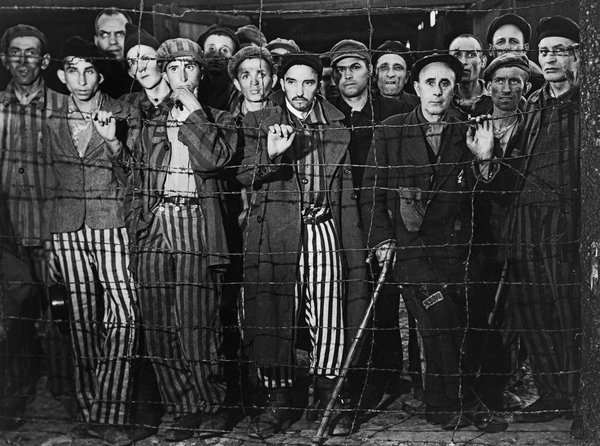
Yes, you have read correctly, Britain’s concentration camps for gay men did exist.

Auschwitz Concentration Camp
Historian and author Simon Webb writes about the gay men who were kept in concentration camps in the UK.
We are most of us aware that gay men were routinely sent to the concentration camps of the Third Reich for no other reason than that their sexuality was unacceptable to the Nazis. A special section of the Gestapo, the Reich Central Office for the Combating of Homosexuality and Abortion was set up by Heinrich Himmler in 1936, with the avowed intention of rooting out homosexuality wherever it was to be found in Germany.
In Britain during the 1930s and 1940s, gay men were certainly imprisoned for what was then classified as criminal behaviour, but few people know that there were also concentration camps operating in this country between 1940 and 1946, to which one special category of gay men was sent.
In 1940, following the fall of France, an estimated 30,000 Polish soldiers arrived in Britain; men who had fought alongside the French army to stave off the invading Germans.
They were led by a former Prime Minister of Poland, General Wladyslaw Sikorski. Fearing that this country was itself about to be invaded, these troops were rushed to Scotland to defend the east coast against possible landings of German troops launched from Norway. Britain was thus indebted to the new Polish government-in-exile, which was led by Sikorski. Without the Polish troops, Scotland would have been all but undefended against the German attack.
General Sikorski was not universally popular with his fellow countrymen and opposition groups emerged which threatened his position as leader of the Polish government and commanding officer of the tens of thousands of Polish soldiers. The solution, at least as far as Sikorski was concerned, was simple. These enemies would have to be neutralised.

General Sikorski – the man responsible for the concentration camps in Scotland
On 18 July 1940, General Sikorski told the Polish National Council in London: “There is no Polish judiciary. Those who conspire will be sent to a concentration camp.”
Since he and the others were likely to be in Britain for the foreseeable future, it was plain that the concentration camp of which he talked, would be set up in this country.
General Marian Kukiel, appointed Commander of Camps and Army Units in Scotland by Sikorski, received a secret order relating to what was described as, ‘an unallocated grouping of officers’, who were to be held in a special camp.

Life inside the concentration camps of Scotland – The Jewish Post
Not only did Sikorski wish to see senior officers and political rivals who might challenge his authority tucked out of the way, but he also wished to purge the Polish army of what he termed, ‘Person of improper moral level’ (homosexuals, Jews etc).
General Sikorski was an austere and autocratic leader and had very strong ideas on what constituted acceptable behaviour.
He loathed drunks, gamblers, the sexually promiscuous and especially homosexuals.
So it was that along with all the men he feared might interfere with his leadership of the Polish government-in-exile, generals and senior politicians from pre-war Poland, Sikorski decided to lock up many other men of whose conduct he happened to disapprove. The site chosen for this, the first concentration camp to be established in Britain, was the Isle of Bute.
The inmates of the new camp were at first housed in tents. Not all were military men. Among the first to be imprisoned, there were men such as Michael GrazynskI, President of the Polish Scouting Association. Another important prisoner was Marian Zyndram-Kosciakowlski; who was Prime Minister of Poland from 1935-1939. The atmosphere in the camp on the Isle of Bute was toxic.
The senior officers, no fewer than twenty generals were held captive there at various times, refused to have anything to do with what was known as the ‘pathological cases’; I.e. the drunks and homosexuals.
This led to the development of a sub-culture of gay prisoners, who tended to stick together; a situation which represented something of a scandal to those running the camp and it was decided that the ‘pathological’ types should be separated from the political prisoners.
A new and harsher camp was set up on the Scottish mainland at Tighnabruich and the gay prisoners transferred there. This village voted in 2002 ‘the prettiest village in Argyll, Lomand and Stirlingshire’, is on the coast, facing the Isle of Bute. The commandant of the new camp was Colonel Wladyslaw Spalek. How was it possible that the Polish government-in-exile was allowed to operate concentration camps in this way, without any objections from the British government? After the evacuation of Dunkirk in 1940, the British needed all the help they could get to defend their country against a German invasion. The Allied Forces Act was accordingly passed that same year. This gave the governments-in-exile of Poland, Norway, The Netherlands, Belgium and Czechoslovakia the legal right to raise their own independent forces from among citizens of their countries resident in Britain. Their army camps and military bases were to be regarded as the sovereign territory of the various countries concerned and, as such, immune from interference by the British police or any other authorities.
How this worked in practice was that if General Sikorski took a dislike to any Polish person living in this country, he was able to draft that person into his army and then have him arrested by the military police and taken off into captivity as either a deserter or mutineer. This neat little trick meant that any Polish man whose behaviour, sexual or otherwise, did not meet with Sikorski’s approval was apt to find himself being shipped off to Scotland and held behind barbed wire. In another grim echo of the situation in Nazi Germany, not only were gay men marked down for imprisonment in the camps; communists and Jews were also likely to fall foul of the Polish government in London.
One of the most famous prisoners on the Isle of Bute was the writer, journalist and biographer of Stalin; Isaac Deutscher. Although born in Poland, Deutscher, a Jew, had emigrated to Britain where he made a life for himself before the outbreak of war in 1939. In 1940, following Dunkirk and the Fall of France, he travelled to Scotland to volunteer for the Polish army which was now based there. No sooner had he joined up, than Deutscher found himself arrested and sent to the camp at Rothesay. Being both a Jew and also a communist, he was regarded as a dangerous subversive by senior figures in General Sikorski’s administration. Rumours began to circulate among MPs in London that something unsavoury was going on in Scotland.
Names began to emerge of Polish citizens being held for no apparent reason in secret installations. In all cases, the men being detained seemed to be Jews.
On February 19 1941, for example, Samuel Silverman, MP for Nelson and Colne, raised the question in the House of Commons of two Jewish brothers called Benjamin and Jack Ajzenberg. These men had been picked up by Polish soldiers in London and taken to a camp in Scotland. The following year, Adam McKinley, MP for Dumbartonshire in Scotland, asked in the House what was happening on the Isle of Bute. The government, which had no wish to upset a valuable ally, refused to provide any information.
Under the terms of the Allied Forces Act, the British had, in any case, no legal right to interfere in what was happening at camps and army bases being operated by the Polish Government in Exile.
Having found that they were apparently able to operate concentration camps on British soil with complete impunity, the Polish leadership opened new facilities for holding political prisoners and others at Kingledoors, Auchetarder and Inverkeithing. The last-named of these was located just eight miles from Edinburgh.
These were dreadful places that looked like the traditional idea of a concentration camp; barbed wire fences, primitive accommodation and watchtowers containing armed guards. Those living nearby heard rumours of maltreatment, starvation, beatings and even the death of inmates. In several cases, the reports of deaths by shooting turned out to be quite true. On 29 October 1940, for instance, a Jewish prisoner called Edward Jakubowsky was shot dead in the camp in Kingledoors, for allegedly insulting a guard.
The Polish camps were to operate for another six years. Increasing unease on the part of British MPs and others led to questions being asked in the House about what precisely was going on in Scotland. Matters came to a head, on the 14th June 1945. Robert McIntyre, the Member for the Scottish constituency of Motherwell, stood up in the House and asked the following question:
“Will the government make provision for the inspection, at any time, by representatives of the various districts of Scotland of any penal settlements, concentration camps, detention barracks, prisons, etc. within their area, whether these institutions are under the control of the British, American, French or Polish governments or any other authority; and for the issuing of a public report by those representatives?”
This caused something of a sensation; the suggestion that there were concentration camps in Scotland.
That same day, Moscow Radion made the same accusation, citing the detention of a Jewish academic called Dr Jan Jagodzinski in a camp at Inverkeithing.
This provoked widespread interest and the world’s press began to ask what was happening in these Polish camps.
 In an attempt to defuse the anger being felt, the Polish government-in-exile agreed to allow journalists to visit the camp at Inverkeithing. This action did little to reassure anybody. The first prisoner to whom reporters spoke turned out to be yet another Jew, by the name of Josef Dobosiewicz. He alleged that a prisoner had recently been shot dead in the camp. The commandant conceded that this was true, but claimed that the dead man had been trying to escape.
Once again, the local police had been powerless to act, under the terms of the Allied Forces Act.
A year after the Second World war had come to an end, the camps were still in existence and still seemingly holding Jews.
On 16 April 1946, the MP for Fife West, William Gallacher, asked the Secretary of State for War to look into the case of two more Jews being held in a camp in Scotland; David Glicenstein and Shimon Getreudhendler.
It is impossible at this late stage to know precisely what was happening in these camps. That they were in fact concentration camps is undeniable; that after all is what general Sikorski had announced that he would be setting up. We have no idea at all how many gay men were sent to the camps, nor how long they were held there. The same is true for the statistics relating to communists and Jews.
What is beyond dispute is that from 1940 onwards, men in this country were being arrested and taken to concentration camps for no other reason than that they were gay.
Simon Webb is the author of ‘British Concentration Camps: A Brief History from 1900 – 1975′.
Links: