ACOMSDave

Community Journalist

  • Home
  • Community Journalist
  • Events
  • Media Page and Press Kit
    • Projects and Work
  • Resources & Documents
    • LGBTQ+ Support Groups and Documents
  • NIGRA
  • Archives
  • Contact

Jeffrey Dudgeon – MP in Waiting

14/01/2015 By David McFarlane Leave a Comment

Jeff is the current Treasurer of NIGRA, a councillor for the Balmoral ward within the Belfast Council, an established author (Roger Casement: The Black Diaries – With a Study of His Background, Sexuality and Irish Political Life), was awarded the MBE services to Lesbian, Gay, Bisexual and Transgender Community in Northern Ireland.

He is mainly known for Dudgeon v United Kingdom, the case which led to the legalisation decriminilising homosexuality in Northern Ireland.

Jeff is an active politician, and the result of the South Belfast Ulster Unionist Association vote for a Westminster candidate on Wednesday 7 January 2014 was declared.

Michael McGimpsey MLA withdrew the day before the selection vote to concentrate on the Assembly.

(And two of Jeff’s supporters, Roberta Flack and George Fleming, were hospitalised earlier in the week!)

‘All present gave me a preference! A bit humbling.’ Jeff stated after the vote.

Party officers will now choose between the top two names after an interview.

Obviously a deal with the DUP standing down in South Belfast and the UUP doing the same in East Belfast is vital, along with Fermanagh South Tyrone and North Belfast being so arranged.
Unionism could regain three seats on a very good day


Further reading:

  • Belfast Telegraph: Unionist gay rights man Jeffrey Dudgeon eyeing seat as MP
  • Belfast Telegraph: UUP’s Jeffrey Dudgeon: ‘Police once raided my home and quizzed me for being gay’

Filed Under: History Tagged With: Belfast Council, general election, jeffrey dudgeon, selection, UUP

Mass gay wedding in Toronto for 115 couples

13/01/2015 By David McFarlane Leave a Comment

Queerspace, Belfast  are excited to be screening a very special short documentary giving a unique & facinating insight into one of the largest same sex marriage events ever held. 115 couples, individuals from all over the world committed to each other in the magnificant grounds of Casa Coma Toronto on 26 June 2014, it was the start of World Pride in Toronto & Sam was there with his camera up close & personal capturing it’s message of hope & equality in its simplest form… That everyone should have the right to marry a person that they love.

Sam is showing his documentary in Belfast LGBT centre on Saturday 17 Jan, 5.15 pm

Map Link:

Filed Under: History Tagged With: canada, gay wedding, mass wedding, toronto

Top 10 Gay Icon Dames

12/01/2015 By David McFarlane Leave a Comment

By The Gay UK, Dec 31 2014 12:01PM
THERE IS NOTHING LIKE A DAME.
(and we don’t mean the Pantomime ones)
We are fast approaching the NEW YEARS HONOURS LIST when HM The Queen will make a few more illustrious women who have made significant contributions to society a DAME (of the British Empire to be exact). It’s a very select ‘club’ and includes some of very favorite ladies who have enriched all our lives one way or another. So to honour them, here’s THE GAY UK‘S TOP TEN DAMES
1) DAME JUDI DENCH: if you can win an OSCAR for a performance that lasts no longer than 8 minutes (‘Shakespeare in Love’) then you really are a Star in every sense of the word.
DAME JUDI DENCH
2) DAME MAGGIE SMITH: two-time OSCAR winner and the cutting queen of the perfect put-down with her scary withered looks, we’d watch this grand Dame if she was just reading the phone directory out loud.
Dame_Maggie_Smith
3) DAME HELEN MIRREN: whom we actually call Deputy Queen after she stole our hearts and her first OSCAR for playing H.M. with such dignity and style.
Dame Helen Mirren
4) DAME SHIRLEY BASSEY: the brassy girl from Tiger Bay who has belting out hits for years and sued for belting her staff too. We love her regardless.
Dame Shirley Bassey
5) DAME KIRI TE KANAWA: we fell for this operatic diva from New Zealand when we saw her recording ‘West Side Story’ with Leonard Bernstein (later parodied by French and Saunders who both should be made Dames too)
DAME KIRI TE KANAWA
6) DAME JOAN PLOWRIGHT (Baroness Olivier): if you had ever had the good fortune to see this sublime actress on stage you’d appreciate that she was every bit as good as her famous late husband.
DAME JOAN PLOWRIGHT
7) DAME EILEEN ATKINS: celebrated actress & writer (she co-created Upstairs Downstairs) with a lengthy stunning resume, but in our eyes she will always be the wonderful snobby Miss Deborah (and big sister to Dame Judi as Miss Matty) in ‘Cranford‘ TV series
DAME EILEEN ATKINS
8) DAME DIANE RIGG: a multi-awarding winning ‘serious’ actress and one of the first to ‘bare all’ on a West End stage, she is still however best known for her sexy leather clad Emma Peel in the hit TV series ‘The Avengers ‘in the 1960’s
DAME DIANE RIGG
9) BARONESS BAKEWELL D.B.E.: one of very first female TV presenters on the heavyweight current affairs programmes to be taken seriously. Never afraid to be forthright and frank with her views she was dubbed ‘the thinking man’s crumpet’.
We couldn’t decide on 10th place so we are awarding this spot to two great Dames
BARONESS BAKEWELL
10) DAME JULIE ANDREWS: probably one of the most ‘English’ of our list even though she left our shores many years ago to climb every mountain and fly over chimney pots.
LOS ANGELES, CA - APRIL 27: Actress Julie Andrews attends the 13th annual Los Angeles Times Festival of Books at UCLA on April 27, 2008 in Los Angeles, California. (Photo by David Livingston/Getty Images)

LOS ANGELES, CA – APRIL 27: Actress Julie Andrews attends the 13th annual Los Angeles Times Festival of Books at UCLA on April 27, 2008 in Los Angeles, California. (Photo by David Livingston/Getty Images)

10) DAME EVELYN GLENNIE: profoundly deaf since 12 years old this Scottish virtuoso percussionist not only doe she make such incredible music, Dame Evelyn has a seemingly limitless capacity to inspire all of us.
DAME EVELYN GLENNIE
Compiled by Roger Walker-Dack

Filed Under: History Tagged With: dames, gay icons, top 10

UK armed forces recruits to be asked if they are gay

12/01/2015 By David McFarlane Leave a Comment

Move introduced in bid to foster greater tolerance within the military, but recruits will be allowed to ‘prefer not to say’

  • Press Association
  • The Guardian, Sunday 11 January 2015 08.28 GMT
British troops
The British armed forces only allowed gay soldiers to openly serve in 2000. Photograph: Ben Birchall/PA Archive/Press Association Ima
Recruits to the British armed forces will be asked whether they are gay in a move to improve diversity in the military.
Details of the service personnel’s sexual preference will be stored, and recruits will have the option to “prefer not to say”. The measure has been introduced in a bid to foster greater tolerance within the armed forces, which have allowed gay soldiers to openly serve since 2000.
Recruits will also be invited to provide additional information on how open they feel they can be regarding their sexual orientation. The information will not be visible on individual personal records or to chain of command or managers, and will be anonymised before being collated to ensure no one can be identified by their personal diversity information.
A Ministry of Defence (MoD) spokesman said: “The MoD proudly encourages diversity at all levels. Service personnel are now encouraged to declare their sexual orientation. Although this is not mandatory, collecting this data will give us a better understanding of the composition of our armed forces and help ensure our policies and practices fully support our personnel.”
This move to encourage recruits to declare their sexual orientation was introduced last November. The armed forces said it believed the new policy would shed new light on its workforce and help create a more inclusive organisation.

Filed Under: History Tagged With: armed forces, gay, recruits, UK

Y-fronts celebrate 80th birthday

11/01/2015 By David McFarlane Leave a Comment

Undated handout photo issued by Jockey International of a model wearing Y-fronts

Undated handout photo issued by Jockey International of a model wearing Y-fronts

BY PRESS ASSOCIATION, 3 JANUARY 2015 10.09AM. UPDATED: 5 JANUARY 2015 10:56PM.

The Y-front is set to celebrate its 80-year history which has seen it go from a hurriedly-removed window display in a Chicago department store to underwear staple for men the world over.

Arthur Kneibler’s Jockey briefs first went on sale on January 19, 1935 at the Marshall Field & Co department store, placed on show in the window during one of the worst blizzards of the winter.
The store’s managers promptly demanded the display be removed, thinking it ridiculous to flaunt such a skimpy design in the middle of winter – but not before customers had snapped up 600 pairs.
Some 30,000 pairs were sold in the next three months alone.
Mr Kneibler, the vice president of marketing at a company called Coopers, was inspired by a picture of a man in a sleek, supportive swimsuit, going on to encourage his design team to create a new kind of underwear called “the brief”.
The only successor to the long john had been the boxer short, a cotton version of trunks worn by boxers.
They did not sell well with customers due to their lack of support, but the “jock strap”, mostly worn by the jockeys or messengers who rode penny farthings, did.
Mr Kneibler named his new creation the Jockey brief, and Coopers is now known as Jockey International.
They went on sale in Britain in 1938, at Simpsons in Piccadilly, where they sold at a rate of 3,000 a week.
In 1948 every male athlete in the British Olympic team was given a free pair of Y-fronts.
To date, it has been banned for being too skimpy, survived the recession to outsell its more glamorous cousin the boxer short and has become a Christmas staple across the world for men of all ages.
According to Debenhams, sales of Y-fronts increased by 35% in 2009 and outsold boxer shorts in March of that year for the first time since the early 1990s – the last time Britain was in recession.
Three years earlier, a pair of 37-year-old Y-fronts were sold in the UK on eBay for £127.
A second pair sold for £90 to a buyer in Hong Kong.
Jockey marketing manager Ruth Stevens said: ” Although competition from the boxer is fierce, time and time again the Y-front has been used in ultra-masculine ads and films, such as From Russia With Love when they appeared on the ultimate man’s man James Bond in 1963, all the way up to 2012 where Zac Efron spent much of his time in them in the film The Paperboy.
“This positioning of the Y-front as masculine yet practical ensures its popularity remains high.
“Underwear trends seem to be coming full circle as we head back towards the classics. Y-fronts are cool.”

Filed Under: History Tagged With: history, underwear, y-fronts

The Controversial Cartoons that are Said to Have Inspired the Terrorist Attack Against Charlie Hebdo

09/01/2015 By David McFarlane Leave a Comment

Freedom to speak ‘within the law’ is a fundamental right for all civilised people.  It is not that long ago that Mary Whitehouse seeked to prevent plays, TV programmes and publications that reflected our LGBT society.  Our own government has been equally two faced in the past when it comes to LGBT rights, including initiating surveillance on individuals and organisations, including trade unions, who did (do) not meet with its agenda.

We as individuals and as part of the wider society, owe it to ourselves and our future to be vigilant and fight and secure our rights and our liberties.

CharlieHebdo010815

Yesterday was an extreme case of horror, but it’s not Charlie Hebdo’s first experience with violence. The newspaper’s history of taboo-challenging content is as old as the magazine itself.

Published: January 8, 2015 | Authors: Jessica Goldstein | ThinkProgress | News Investigation
At least 12 people were killed in a shooting at the offices of French satirical magazine Charlie Hebdo Wednesday morning. Multiple masked gunmen entered the building, opened fire on the writers, and escaped in a getaway car. The shooters reportedly yelled “Allahu Akhbar” (“God is greatest”) during the assault and “We have avenged the prophet” as they sped out of the office. Among the confirmed dead are two police officers and Stephane Charbonnier, a journalist and editorial director. French President Francois Hollande has called the shooting “a terrorist attack.” The gunmen and driver are still at large.
The French Muslim community has condemned the attack. Dalil Boubakeur, rector of the Great Mosque of Paris, announced on behalf of French Muslims, “I want to denounce the horror and the unspeakable and show our compassion. We condemn what just [happened] in the name of all Muslims. This is an act of war in the middle of Paris. “
Chances are, if you’ve heard of Charlie Hebdo before, it has been because their satire has inspired the ire of Islamic extremists; the target of the magazine’s humor is frequently religious, political and social mores.
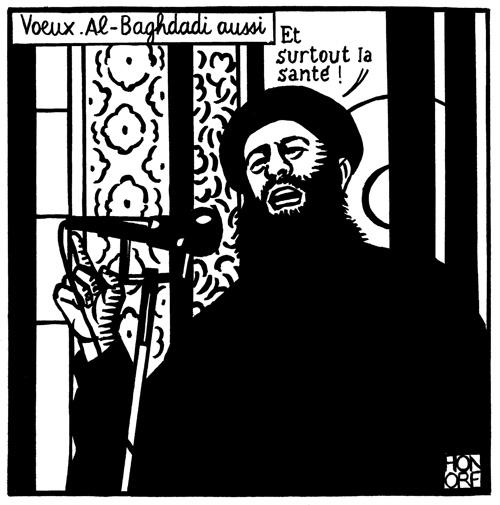
The Guardian‘s Anne Penketh reported from Paris that the magazine’s latest cover (featured in the most recent tweet from @Charlie_Hebdo_) took aim at Islam:

The weekly’s latest jibe, published on Twitter moments before the terrorist attack, was a cartoon wishing a Happy New Year ‘and particularly good health’ to Abu Bakr Al-Baghdadi, the leader of the Islamic militant group Islamic State (Isis).
The magazine describes itself on the social network as the ‘irresponsible newspaper’. Its cover this week features the provocative new novel by Michel Houellebecq, Submission, which satirises France under a Muslim president.
Charlie Hebdo’s editor, Stéphane Charbonnier, has received death threats and lives under police protection. He has always insisted that the cartoons depicting the Prophet were harmless fun, although he is well aware that Islam does not allow public images of Muhammad, which are believed by Muslims to be sacrilegious.
View image on Twitter

Today is an extreme case of horror, but it’s not Charlie Hebdo’s first experience with violence.
The offices were firebombed in late 2011, after running a spoof issue “guest edited” by the Prophet Muhammad honoring an Islamist party’s victory in Tunisian elections. The special issue, in a winking reference to “Shariah law,” was named “Charia Hebdo,” and showed a cartoon of Muhammad along with the line, “100 lashes if you don’t die of laughter.” At the time, editor Stephane Charbonnier described the post-attack wreckage of the office: “We can’t put out the magazine under these conditions. The stocks are burned, smoke is everywhere, the paste-up board is unusable, everything is melted, there’s no more electricity.” The website was also hacked, and members of the staff received death threats.
Charlie-Hebdo
Less than a week later, the magazine’s front page read “L’Amour plus fort que la haine” (Love is stronger than hate) and showed a male Charlie Hebdo cartoonist and a bearded Muslim man engaged in a kiss, the still-smoking magazine Charlie Hebdo offices burning in the background.
In 2012, the magazine included multiple caricatures of the Prophet Mohammad in which he appeared naked; one was called “Mohammad: a star is born,” and showed a man bent over so his beard was the only thing covering the lower half of his body. The cover depicted Mohammad in a wheelchair being pushed by an Orthodox Jew.

rsz_charlie-hedbo-18-sept-2012

The French government implored the magazine not to publish the issue — at the time, protests over a prophet-mocking video produced in the U.S., “The Innocence of Muslims,” were raging across South Asia and the Middle East — but Charlie Hebdo persisted; the government shut down schools, consulates, cultural centers and embassies in 20 counties as a precautionary measure. Riot police were also stationed at the Charlie Hebdo offices for protection.
The then-editor-in-chief, Gérard Biard, did not back down from the magazine’s call to publish the issue. “We’re a newspaper that respects French law. Now, if there’s a law that is different in Kabul or Riyadh, we’re not going to bother ourselves with respecting it. What are we supposed to do when there’s news like this?” Biard went on to describe the magazine as “atheist,” “democratic,” and a supporter of “laïcité,” France’s secularity.
Charlie Hebdo republished cartoons of Mohammad in 2006 that had originally appeared in a Danish newspaper; the images sparked protests throughout the Muslim community.
Charlie Hebdo’s history of taboo-challenging content is as old as the magazine itself. Its earlier form, Hara-Kiri Hebdo, was banned in 1970 for spoofing what they saw as the too-deferential coverage of former president Charles de Gaulle’s death by the French media. Editors picked Charlie Hebdo as a new name to get around the ban; the new title jokingly referenced both de Gaulle and a monthly comic book, Charlie Mensuel, which got its name from Charlie Brown.
The magazine, which comes out every Wednesday, came on the scene in 1969; it folded in 1981 due to poor sales but was revived 11 years later. Charbonnier, one of today’s victims, had held his post as editor in chief since 2012. This is reportedly his last cartoon:
View image on Twitter
Former French President Nicolas Sarkozy issued a statement, reported in Le Monde, expressing outrage at the violence and affirming the importance of French free speech: “This attack is a national tragedy. This is a direct, savage attack on one of our most cherished republican principles: freedom of expression. Our democracy has been attacked. We must defend it without any weakness. Absolute resoluteness is the only possible response. Our nation is in mourning, struck in the heart, the Republic must gather assemble together. I call on all French people to reject the temptation of stereotyping.”

Filed Under: Book Reviews, History Tagged With: cartoons, charlie hebdo, satire

Summer Friends – Vintage Male Photography

25/12/2014 By David McFarlane Leave a Comment

For those who didn’t spot this article, or who have missed the wonderful video slide shows produced by Wayne Brighton.
 

It seems that everyone loves vintage photography, including us!  This is the latest video by Wayne Brighton who has put together some pretty incredible videos of vintage guys on his YouTube channel and we love every single one of them.  We aren’t sure where he gets the images as they seem to be actual photos, but the videos are very well done and we hope that he continues to make them!
Advertisement
In the age of digital photography it is easy to forget that people actually took and developed pictures.  We used to love taking pictures and having them developed because you really never know how something is going to turn out.  Now a days it is so easy to snap and delete or snap and post or snap and send that images, especially selfies are everywhere.  For us photos that like the ones featured in this video are more “real” for lack of a better word.  These are photos that were shot and kept by someone, they capture a moment in time that has past and offer glimpses of a world that was different.  Even the images themselves are different now with filters and everything else giving a distorted reality.
Perhaps this is just us being nostalgic or looking too much into things and someone will feel the same way about the images we are taking now in 50 years but things just seem simpler in these images which may or may not be the case.  When people used to take photos it was typically for themselves or immediate family and friends whereas now a days thousands may instantly see an image.  That immediate exposure means you have to present yourself in a certain way to meet an image or expectation for social media but these images seem to lack that pretense which is nice.  Also it is fun to see how trends change – from body types to hairstyles and fashion.
We love taking a look back in time!
Enjoy!
http://youtu.be/A2_0RtVhbb0

Filed Under: History Tagged With: male, photography, summer, vintage, wayne brighton, YouTube

Merry Christmas

25/12/2014 By David McFarlane Leave a Comment

[layerslider id=”3″]NIGRA wishes everyone a peaceful and happy Christmas –
 
Christmas Christmas Christmas-2

Filed Under: History Tagged With: Christmas, merry, peaceful

Gay marriage law comes into effect in Scotland

19/12/2014 By David McFarlane Leave a Comment

Douglas Pretsell, from Edinburgh, and Peter Gloster, from Melbourne, formalised their marriage in SydneyDouglas Pretsell and Peter Gloster formalised their marriage in Sydney

Scotland’s new law on same-sex marriages has come into effect.

Existing civil partnerships can now be converted to a marriage and other same-sex couples can give notice of their intention to wed.
The new legislation was used for the first time shortly after midnight when one couple upgraded their civil partnership at the British consulate in Sydney.
The first gay weddings in Scotland will take place on Hogmanay.
Because Australia is 11 hours ahead, Douglas Pretsell, from Edinburgh, and Peter Gloster, from Melbourne, completed the paperwork to formalise their marriage hours before registrars open for business in Scotland.
The couple have been together for seven years and had their civil partnership in August 2010 at Fenton Tower in North Berwick, East Lothian.
‘It’s official’
Mr Pretsell told BBC Radio’s Good Morning Scotland programme: “It was kind of coincidental. we weren’t originally intending to be the first at all.
“We sent an email to the consulate asking how long after the weddings came in that we would be able to change our certificate.
“We got an email back from them, asking if we would be able to come in at 11am on the 16th and saying we would probably be one of the first in the world.”

Leanne and Marie Banks signing the documentsLeanne and Marie Banks were one of the first gay couples in Scotland to become married

The couple earlier said: “We always considered our civil partnership to be our marriage, but in the eyes of the law and society it wasn’t held in the same regard.
“Prior to today, same-sex couples were deliberately treated as though our relationships were inferior and not worthy of the same recognition or respect.
“Well, from today it’s official, we are married and we have the certificate to prove it.”
‘Day of celebration’
One of the first gay couples to become married in Scotland were Leanne and Marie Banks.
They were at Dundee Registrars’ office at 08:45 to sign the documents.
A number of other Scots couples, already in civil partnerships, are also planning to make the conversion.
Others wishing to become married must give the normal 15-day notice period, meaning the first weddings can take place on 31 December.
Tom French, from the Equality Network, which ran the campaign for equal marriage in Scotland, said: “Today is both a day of celebration and a hugely important step forward for LGBTI rights in Scotland, both in terms of equality in the law and the way in which same-sex relationships are viewed in society.
“In recent years Scotland has become a leading light on LGBTI equality, with one of the most progressive equal marriage laws in the world, helping to create the fair and equal society we all want to see.”

Holding handsThe first gay weddings in Scotland will take place on 31 December

Colin Macfarlane, director of Stonewall Scotland, said: “Many of the couples celebrating today and in the weeks and months ahead have been together for decades and in a civil partnership since they were introduced in 2005.
“While there is still lots to do before the lived day-to-day experience of many lesbian, gay, bisexual and transgender people is truly equal in Scotland, this is a day of celebration and we know these ceremonies will be a wonderful early Christmas present for many couples, their friends and families.’
The law on same-sex marriages has already changed in England and Wales.
The change in Scotland comes as a survey revealed a huge rise in support for same-sex marriage over the past 12 years.
More than two-thirds of people (68%) agreed that gay couples should have the right to marry, according to the figures from the Social Attitudes Survey, which tracks public opinions on a range of subjects.
The figure compares with just two-fifths of the public (41%) in 2002.
The 2014 survey suggested fewer than a fifth (17%) of Scots were against same-sex marriage, compared to 29% in 2002.
Younger people were more likely to believe gay couples should be allowed to wed than older Scots, with 83% of 18 to 24-year-olds in favour compared to 44% of those aged 65 and above.
MSPs approved the Marriage and Civil Partnership Act at Holyrood earlier this year.
The Scottish government said the move was the right thing to do, but Scotland’s two main churches – the Catholic Church and Church of Scotland – are opposed.
The legislation will see religious and belief bodies opting in to perform same-sex marriages, and ministers have stressed that no part of the religious community would be forced to hold such ceremonies in churches
 
http://www.bbc.co.uk/news/uk-scotland-scotland-politics-30486804

Filed Under: History Tagged With: gay marriage, law, scotland

Gay W. Virginia high school soccer player comes out by dancing with homecoming king

19/12/2014 By David McFarlane Leave a Comment

By Michael S Martin on Dec 16 2014, 8:34a 27

Michael Martin, left, with Jem at Jem’s homecoming dance. – Andrew Martin photo

Michael Martin, an all-state goalie, slow danced with the guy who gave him the courage to be himself. Inspired by Robbie Rogers, Martin now hopes to inspire others.

It was something I thought I’d never do — dance a slow dance with the homecoming king at his high school.

I am an 18-year-old senior all-state high school soccer goalie for Musselman High School in West Virginia. I also have been on the school’s football, tennis and swim teams. And I am openly gay. Growing up in rural West Virginia, it’s not the easiest place to be a gay teenager and it took me a long time to come out to myself and others.

Yet there we were, Jem and I, on an October night this fall, slow dancing with each other. We attend schools in different counties and met through friends and I was thrilled that he asked me to his dance so we could be together. He was wearing his gray vest and pink bow tie while I had on my black shirt with a gold tie. We danced to “Love Story” by Taylor Swift, which was a perfect song for my first dance with a guy.

We both started the dance with our female friends who were our “dates.” The final song came on and Jem and I danced for a brief time. It was my first school event where I was with another guy, even though we came to the dance separately. I held his hand when we went to get refreshments and when we took breaks from dancing. It was a weird feeling for me, since I had just barely started coming out. I was nervous yet excited. After the dance we went to his house. That is where I asked him to be my boyfriend. I posed the question by writing it on the dry erase board on his wall. He quickly said yes.

My homecoming dance at Musselman — two weeks after the dance at Jem’s school — was the big moment I revealed being gay to my school. Jem was the date of girl at Musselman and her outside guest for the dance, while I went “alone.” The girl knew Jem and I were together. I was on the homecoming court, which was a big honor and something I never thought would happen. Only some people knew about me before the homecoming, so it was a shocker for some seeing me dance with another guy.

Jem and I danced all night to the most popular pop songs. But it was the slow dance that I most remember that night at the school cafeteria — “Remember When” by Alan Jackson. It was the best night ever. Jem and I got asked a lot if we were together and we said yes. “That is so cute!” some girls said. It made us felt accepted.

Word quickly spread and the following week I sensed that some guys were looking at me differently. My friends even told me people were talking about me in a negative way in different classes. “He is a faggot now,” I was told some people said. My friends courageously stood up for me and I am so proud to call them my friends.

MikeMartin2Michael Martin won All-State honors this year. (Photo by Andrew Martin).

Dancing with another guy in front of my fellow students would have seemed like the last thing I would ever do when I started high school. When I was a freshman I knew I was not like other guys on the Musselman High varsity soccer team. They were always talking about their girlfriends and I always felt that I could never say anything about my sexuality. I was just a freshman, and I was scared of being mocked by my teammates when I was just trying to fit in. The team threw around the words “gay” and “faggot” a lot. I felt I would never be safe if I did come out.

Musselman High School is located in Inwood, W. Va. The school is named for the Musselman applesauce company and we are called the Applemen. Inwood is only about two hours from Washington, DC, and Baltimore but culturally is far from city life. Inwood is a pretty conservative town. The students, however, are very diverse in their culture and beliefs; the range runs from rednecks to foreign exchange students. I live in isolated mountain area, so I didn’t have any kids to hang around with when I was younger. I was alone but even at a young age I knew I didn’t like girls and found boys attractive instead. I could never tell anyone since my family is really conservative and religious.

MikePortrait(Photo by Jeremiah Carver)

I was silent about my sexuality until my junior year when I told my best friend, Ben, who was a senior at the time and on the soccer team. I waited until after the soccer season so I wouldn’t have to worry about him telling any of my teammates.

The cold winter air and the campfire at Ben’s house that night made it the perfect environment in which to tell him my news. I was scared to death, but summoned up the courage and was direct: “I hope this doesn’t change our friendship but I am gay.” His response was simple but it meant the world to me: “There is nothing that can change our friendship.” Thankfully, Ben accepted me (he said he had suspected) and promised to not tell anyone until I was ready.

My junior year was a strange time for me. I played football and soccer in the fall (in West Virginia they are in the same season). I punted for the football team, but never felt comfortable. I was always scared about my sexuality on the team, surrounded by a bunch of country boys and jocks who would definitely make fun of me if they knew I was gay. I felt useless, which is why I dropped the sport in the senior year and focused solely on soccer.

Things were better in my favorite sport. My coach for my traveling soccer team laid down the law that there was not going to be any racism or discrimination based on sexuality, which made me feel safe. I still did not have the guts to tell anyone I was gay. My travel coach never knew that I was gay nor did I tell him but he was determined to create a safe environment on the team. We were a very diverse team that played well together and were a state finalist three years in a row.

The experience of coming out was very rough for me to do but it really took off this fall. When I started to talk with Jem I was comfortable with myself and wasn’t ashamed like I was in years past. For me to be happy, though, I needed to come out. I didn’t want to hide how I really was any more. I didn’t want to live every day with a secret hanging over my head. I told my team before my own parents. My family was not accepting at first but is starting to come around and support me. I just had to keep telling them that I can’t change who I am and that I am the same teenager that I was before.

I came out to my soccer team one step at a time. Since I was dating Jem, I decided to become truthful with everyone. I never held a team meeting. Instead, I told some players and then they told others and these people asked me for confirmation. They couldn’t believe that I was gay, because they said “I always acted so straight.”

Teammates were curious and I got a lot of questions. I also got teased by my teammates closest to me making jokes or saying sexual things, but I know they were just kidding. Actually, their joking told me they were OK with things. I also knew that even if someone did say something negative that a lot of my teammates would have my back. Recently I was named captain for the Musselman swim team. They all know about my sexuality and gratefully are accepting.

Despite my fears, I feel very safe at my school when comes to LGBT issues; we even have a Gay Straight Alliance Club. I have made a lot new friends and my previous friends who are girls love me more and we have become better friends. I still get told that girls have crushes on me, before someone then breaks the news to them that I am gay.

As I am graduating next spring, I have been talking to several college coaches about playing soccer at their schools. That will be a whole new level, a whole new school, group of friends, and new teammates. But I won’t be afraid of being myself since I am proud to play as an athlete who happens to be gay.

Mike MartinsaveMichael Martin was inspired to come out by Robbie Rogers (Photo by Andrew Martin).

I try to prove myself in sports not just for myself but for other gay athletes. I want to show everyone that I am just as good as anyone else in my sport. Being a two-time goalkeeper of the year for my conference, making the All-State team and being two-time M.V.P for Musselman and defender of the year makes me proud.

I remember a playoff game with the varsity when I was only a freshman. We were playing our rivals and lost 1-0 on a goal with 10 minutes left. The goal was on a perfect shot in the upper corner, but it was so depressing for me. I felt like I let the team down but I kept my head up. It motivated me to become a better player the next three years.

One athletic highlight for me and one that showed I could play on a high level came when I had a tryout for the West Virginia’s Olympic development soccer team. I was very nervous during the tryout and I felt like did well. My training paid off and I made the team. It was a great exposure to quality soccer for me and it feels good to say that I was a part of that team.

My soccer hero and the man who inspired me to come out is Robbie Rogers of the Los Angeles Galaxy. I loved how he announced he was gay and did not quit playing soccer. He gave me hope and confidence to be true to myself. Once he came out I started to contemplate doing the same myself and being proud of who I am. He recently published a book, “Coming Out to Play,” which my friend Ben got me for my birthday. I can tell you that after reading the book, Robbie should be every soccer player’s idol, gay or straight. I am so proud that he recently won a MLS Cup with the Galaxy.

I have learned that being gay does not mean you are a lesser of a human being. If I can come out in a small town in West Virginia and be accepted, and dance with the homecoming king, it shows things are changing. I hope my performances and story help inspire other gay teens to show their true colors and not be afraid to play the sport they love.

Michael Martin, 18, is a senior at Musselman High School in Inwood, West Virginia, and is goalie for his school’s soccer team; he was named All-State this season. His hobbies include photography and the outdoors. His career dreams include owning historic hotels or producing sustainable foods. He can be reached via email at soccer4h96@gmail.com or on Twitter @martinofcompany. You can also check out his photography on Instagram (@wvnatureboy).

Story editor: Jim Buzinski

Filed Under: Anti-Bullying & Homophobia, History Tagged With: high school, prom dance, soccer

  • « Previous Page
  • 1
  • …
  • 20
  • 21
  • 22
  • 23
  • 24
  • …
  • 35
  • Next Page »

Categories

Copyright ACOMSDave.com © 2026