ACOMSDave

Community Journalist

  • Home
  • Community Journalist
  • Events
  • Media Page and Press Kit
    • Projects and Work
  • Resources & Documents
    • LGBTQ+ Support Groups and Documents
  • NIGRA
  • Archives
  • Contact

THE NUMBERS GAME

24/01/2014 By David McFarlane Leave a Comment

Edited out-take
Gay Star
Issue No. 16
Summer 1985
THE NUMBERS GAME
An article by Joseph Dalton
Since roughly the time of the Korean War (World War 21/2) in the late 1940s and early ’50s, the international Gay movement has drawn its inspiration and much of its intellectual armoury from the United States of America. This has entailed the use of a great deal of ‘scientific’ evidence to counter the old notion of homosexuality as a sinful, or ‘animal’ or diseased condition.
This was very wise on the part the movement in all of its manifestations from the courageous but inevitably ultra-closeted founding Mothers and Fathers (so to speak) of the Daughters of Bilitis and the Mattachine Society to the street-wise generation of Stonewall and beyond.  We appeared to be the rational, logical level-headed element in disputes with our opponents.  It justified the moral anger of the GLF (Gay Liberation Front).
Did we not rest our case on solid, scientific, empirical evidence?  Why were we waiting … for equality in law, at work, in housing?  Our arguments emboldened ourselves as individuals, and as a self-conscious factor in society, convinced or neutralised the general public, and embarrassed our opponents.  They were reduced to quoting irrelevant bits of an irrelevant Book, to smear tactics – or to silence.  Our arguments were based, in the main, on the Kinsey Report.
One In Twenty
This (‘Kinsey”) seemed to indicate that a very substantial proportion of the population was specifically homosexual.  This proportion was One in Twenty, to quote the title of Brian Magee’s condescending little volume published in 1966.  These figures have never been challenged and up until quite recently it would have been madness for Gay people to have done such questioning.  We were fighting for a place in the scheme of things.  We did not want to be thought mad, bad or dangerous to know.  Arguing about the niceties of Kinsey’s figures would have been grotesquely inappropriate.
But now the Gay movement has succeeded; this statement will be greeted with gasps of anger and astonishment; but it is undoubtedly accurate.  It may be many long years before we are fully integrated into society (and thereby change it beyond recognition) but the days of lobotomies, ice-baths and “aversion therapy”, to name some of the instruments used in “civilised” countries, are gone forever.
Classic Faults
So we can cast a cold eye on the Kinsey Report.  And note that there is a lot wrong with it.  It is, in many ways, a classic piece of American ‘social science’, with the classic faults.  These include the fact that the investigators did not go off-Campus – to test the general public.  Admittedly the general public would probably have been less forthcoming about their sexual preferences — especially if they had been out of kilter with those that were socially acceptable in the Truman (and McCarthy) years.
This means that the people surveyed by Kinsey and his assistants were, in effect, self-selected.  This alone skews the resulting figures in a number of ways.  Kinsey was known to be open-minded on sexual matters (this certainly was not the case with the majority of psychologists, psychiatrists or the medical profession in general).  Because of Kinsey’s ‘stance’ Gay people – lesbians, gay men, bisexuals and other sexual minorities were prepared to be more up-front with him, than with other investigators.  It left the investigators open to those who were not telling the truth — or were telling the investigators what they (the subjects) thought they wanted to hear.
Exaggeration
Commonsense and experience of the ‘political wing’ of the Gay movement, of the telephone helplines, the gay social groups and Centres – the ‘community’.  And of the pubs, clubs, discos, saunas – the ‘scene’, including the cottages where gay men, anyway, all meet on an equal basis, impelled the ‘the agony in the crotch’ tell us that he Kinsey figures are an exaggeration.
Homosexual people do not constitute anything even remotely like five per cent of the over-all population.  Half of that figure might be accurate and it is more than defensible to quote a figure of one per cent — or less. This figure covers homosex-ually-oriented people (largely men.  It seems accurate to say that there are fewer specifically homosexual women, possibly because in our culture women are allowed more leeway in expressing themselves physically, thus dispersing a build up of homoerotic feeling.  There has been lately the phenomenon of “political lesb-ianism”.  Women’s sexuality appears to be a more elastic thing than that of men) rather than Gay people.  GLF used “Gay” to mean anyone who was not 110% heterosexual.
One In One Hundred
This more reasonable figure gives a more realistic perspective on the position of Gay people in society.  It gives a more reasonable perspective on homosexual people as people.  If you think there are roughly three million homosexuals in the UK you must also believe that hundreds of thousands if not several million are utterly without backbone.  This is self-evidently inaccurate.  People have ‘come out’ with courage, fortitude and flair in the most difficult and painful circumstances.
Accepting that the true figure is something like six hundred thousand or fewer, spread over all age groups from early adolescence to extreme old age, it becomes obvious that most of these people have surfaced and are part of the Gay sub-culture.  This again, ranges from a yearly phone call to the local Switchboard to being … President of NIGRA  [the Northern Ireland Gay Right Association – upstart 2013].  We are, largely, aware of each other’s existence.
This assessment gives a more accurate picture of the burgeoning Gay comm-unity.  “Out” Gays are not the tip of an iceberg vanguard of a huge timorous majority, the “mere” ten thousand or so that turn out for Gay Pride marches in various parts of these islands are a substantial percentage of the overall gay population.
Creative
Instead of a ragbag of committed people all apparently going in different direct-ions, we are generally-speaking a disciplined sub-culture tending in one direction – towards genuine civil liberty and equality, and at a very fast pace.  Our apparent diffuseness irritates the tidy minded, nevertheless we are approaching emancipat-ion faster than the Catholics or the Jews did in the previous century, and faster than non-European immigrants at present.
The above may appear over-sanguine to the committed or the alienated.  It must be emphasised that building a community while exhausting is deeply satisfying.  Whether it is a few hours a week in a pub backroom that is achieved, or a full-scale Gay community centre.
The future for Gay people is bright, even if we suffer momentary setbacks.  We must be realistic, our effect on society at large, is predicated on our being in a morally strong position, where the largely indifferent majority are not prepared to oppress us, or stand over the oppression of an inoffensive minority.  And one were our enemies are reduced to living in a nostalgic dream world.  This is how the ’67 Act was achieved from ‘within the closet’.
Nobody today could listen to a Sir Cyril Osbourne clone claiming that there were no homosexuals in the House of Commons (even if a number had not come out) with a straight face.
Self-reliance
We will achieve legal equality and a rationalised age of consent, we can also achieve job protection and legal recognition and protection of longstanding relationships.  Where we may come a cropper, is demanding more out of society and / or the state than we are entitled to in terms of head count.  ‘Probable’ Gays can’t be counted as the ‘real thing’ just for the sake of bamboozling the rest of society.
Gay people have played a great part in sexualising our culture, but there’s little chance of homosexualising it.  Society will not even become ‘bi-sexual’ so much as omnisexual.  This will be the best of all settings for homosexual people and all other sexual minorities.  This will not come about by wishful thinking nor probably in a short period of time but by self-discipline and self-reliance, rising from the “bottom” to the “top”.  We are, happily, in a position where traditional notions of leaders and led simply will not function.
 
Further reading:

  • About.com – The Gay Population

Filed Under: Anti-Bullying & Homophobia, History Tagged With: kinsey, LGBT, numbers game, one in twenty

DO THE GAY ACTIVISTS ALLIANCE SUPPORT IAN PAISLEY ???

24/01/2014 By David McFarlane Leave a Comment

Out-take from Gay Star No. 2
July / August 1980
DO THE GAY ACTIVISTS ALLIANCE SUPPORT IAN PAISLEY ???
During the recent Gay Pride Week in London, members of the Northern Ireland Gay Rights Association were attacked at a meeting organised by the Gay Activists Alliance by supporters of the Troops Out Movement who argued that we should not be making any demands for a change in the law.  They said that the Government, which could make those changes, the Westminster Government, is a foreign Government which has no business legislating for Northern Ireland. By demand-ing changes in the law we are recognising the right of this foreign Government to rule over us.
It’s funny how one always has to go to London to hear arguments like that.  No one here has ever suggested that we put our interests into cold storage until the great day when Mr. Haughey becomes our Prime Minister.  Whether we want to see a united Ireland or maintain the union with Great Britain, the argument is stupid and only English people – or people who have been living a long time in England – could have thought of it.
THE CONSTITUTIONAL QUESTION
NIGRA is solely concerned with improving the lot of homosexuals in Northern Ireland.  It contains members with nationalist sympathies and members with unionist sympathies.  NIGRA as such will continue to work for gay people whatever government is in power.  We don’t argue that our interests are necessarily more important than the Constitutional question, but we leave it to members who feel strongly on either side of that question to join whatever other political bodies they like, without their decision prejudicing their membership of NIGRA.
At present, Northern Ireland exists as a region governed by Westminster and separate from the Republic.  There is no point in us asking favours from Mr Haughey who – in the unlikely event of his wanting to – can do nothing for us.  Westminster is the government with which we have to deal.  If that situation changes, we will change with it.
But perhaps our interests are affected by such ‘political’ considerations.  One thing we can probably all agree is that we don’t want to be governed by Dr Paisley who has been very active in opposition to us.  Paisley is very popular in Northern Ireland not because of his campaign against us, but because he has represented himself as the most hard line opponent of a united Ireland.  And, rightly or wrongly, most of the people living here are strongly opposed to a united Ireland.
PAISLEY IN POWER?
Because of Paisley’s popularity, any devolved government in Northern Ireland – whether it is relatively powerless thing proposed by Humphrey Atkins [the then Secretary of State – upstart 2013] or a full-blown independent Parliament – is likely to be headed by Paisley.  That is not a prospect that can fill us with delight.  So we are not enthusiastic about the idea of having a devolved government in Northern Ireland.
Furthermore, although the law in the rest of the United Kingdom is far from satisfactory, it is still better than the law here and in the Republic (where, in both places, the pre-1967 laws are still in force).
We are therefore pressing for the same laws to apply throughout the UK.  And in that general principle we have – according to a recent opinion poll – the support of over 90% of both Protestants and Catholics.  For most people, homosexuality is a marginal issue and, in what they would see as the main issues, we have always had much the same legislation as the rest of the UK, since Stormont used to pursue a ‘step by step’ policy of keeping in line with Westminster.  For example, we have the welfare legislation Labour introduced after the war [WW2 – upstart 2013] despite the fact that our largely Tory devolved government disliked it.  Since there is no great desire for legislation that is very different from that passed at Westminster, it seems that, so long as we remain in the UK, there is no need for us to have any sort of devolved Parliament.
REMOVAL OF THE TROOPS
But the Troops Out supporters aren’t interested in such a modest, ‘reformist’ approach.  They think that we should throw our interests as homosexuals to the winds, and lend all our support to efforts to get rid of the army (i. e. that we should join the Provisionals.  Or possibly the Irish Independence Party [the ‘double-I’ P, now defunct. It, like the People’s Democracy, ‘kept the seats warm’ for Sinn Féin – upstart 2013] who are the only people who are calling immediate withdrawal of the troops).  The likely result of the immediate withdrawal of the troops (after a period of open and vicious warfare) would be the establishment of an independent Ulster – with Paisley on top.  If there were to be a united Ireland, the troops would have to enforce it.  Is this what these people want?  Is it what they think we should want?
No.  We are not prepared to campaign for the removal of the troops.  And we are even prepared to oppose the removal of the troops unless there is some guarantee that it won’t result in a (possibly smaller) Paisleyite state.  And as long as we are in the UK, we want (at least) the same laws as far as homosexuals are concerned as prevail in the rest of the UK.  In making this demand, we expect the support of everyone throughout the UK who is involved in gay politics.  And we support them in their search for further changes.  AS far as those of us who want to see a united Ireland are concerned, that no more compromises their principles than demanding better pay and conditions would compromise the principles of a trade unionist who wanted to see a united Ireland.
The only possible effect of the policy proposed by the Gay Activists Alliance would be to split us into a Republican Gay Rights Movement and a Loyalist Gay Rights Movement, both of them subjecting their particular interests as gays to the greater interest of their respective ’causes’.  We are not prepared to oblige them.
Semi-editorial written, probably by Peter Brooke, then – 1980 – GS Editor.

Filed Under: Campaigns Tagged With: gay pride week, gay rights, ian paisley, London, Ulster

The English Defence League (EDL) – London, East — and the Mosque

24/01/2014 By David McFarlane Leave a Comment

London, East — and the Mosque
The EDL (English Defence League) decided to march through Whitechapel, east London, on Saturday, 7th September (2013).  No special reason was given for this, especially as the EDL is not a London phenomenon. It is a Luton one, arising out of a thrusting Muslim community in a town on the skids.  Luton was a car-producing town until the late 1970s.  It is victim of government policy over forty years but some people have decided to blame ‘Muslims’ for the situation they find themselves in.
The EDL seems to have an obsession with the mosque on Mile End Road, near Aldgate, despite the fact that it serves people of Bengali origin, a smaller one deeper inside Bethnal Green is Somali-oriented. A cultural matter of no ideological / theological significance. The Imam of that mosque spoke, very cogently on social solidarity, to the crowd at Atab Ali Park, (named after a murdered Muslim youth) on the afternoon of September the 7th.
Somalis and Bengalis have not been prominent in ‘Islamist’ violence, so why this area is picked-on is problematical.  (Presumably Somali ‘piracy’ in the Indian Ocean is not one of the EDL’s complaints).  It was difficult to tell how many there were at the anti-EDL demo as there was a fair amount of coming and going.  (The speeches were pretty grim, if I hear the phrase ‘they shall not pass’ again I may assault the speaker.  The weather was not grim but was coldish and overcast).  There seemed to be few of the teen boys who let off steam at the previous stand-off, but there were large numbers of Muslim women there.  Towards the end of our stay in the park we were told that the EDL were returning home by way of Tower Bridge.  This was via i-Pad, I don’t know if it was tuned into a police camera or one used by a member of East End United (the group that organised the opposition to the EDL).
The EDL turnout was half of that last time (about 1,000 – still a thousand bigots too many).  This may be the end for the EDL in London.  Last time the weather was warm and sunny – this time it was damp and dank.  And on both occasions it was, surely, boring and humiliating being boxed-in; in this case into a dead end street.  The police were probably reacting to motorists’ fury about the way traffic at Aldgate was snarled up for most of a Saturday afternoon on the EDL’s previous outing in the area.

Filed Under: History

Picket outside church event on 'converting gays'

24/01/2014 By David McFarlane Leave a Comment

Gay Conversion therapy doesn't work

Gay Conversion therapy doesn’t work


On Saturday 18th January 2014, the Ballynahinch Baptist Church hosted the ‘Setting Love In Order’ conference organised by the Core Issues Trust.  The Trust was arguing for ‘freedom for gay people to approach psychiatrists and counsellors about their homosexuality’; this was a thinly disguised message about converting gays, or in other words ‘conversion therapy’.
 
One of the discussions was entitled: Don’t want to be gay any more?  Sorry we’re not allowed to help you! Is that ethical?’  This is a thinly disguised approach to gay conversion therapy, which Robert Spizer in 2001 was promoting, Spitzer renounced and retracted his own study in 2012, stating “I was quite wrong in the conclusions that I made from this study. The study does not provide evidence, really, that gays can change. And that’s quite an admission on my part.”.  He also apologized to the gay community for making unproven claims of the efficacy of reparative therapy, calling it his only professional regret. Spitzer has requested that all “ex-gay” therapy organizations such as NARTH, PFOX, American College of Pediatricians, and Focus on the Family stop citing his study as evidence for conversion therapy.
 
Pro-gay protestors outside the church were there to give the message that therapy has been discredited, it doesn’t work.  And also to give out a positive message that being LGBT is not wrong, it is not bad, and it is not broken so it doesn’t need ‘fixed’.
 
Further reading:

  1. Wikipedia-Conversion Therapy
  2. Belfast Telegraph – Protestors picket church event on ‘converting’ gays
  3. Belfast Telegraph – Row over ‘gay conversion’ conference to be held at church

Filed Under: Anti-Bullying & Homophobia Tagged With: Belfast, conversion therapy, converting gays, LGBT

J F Kennedy and his 'gay' friend were attractive men

16/01/2014 By David McFarlane Leave a Comment

JFK had a close 'gay' friend

JFK had a close ‘gay’ friend


jfk-and-lem-snow-2 jfk-and-lem-snow-3 jfk-and-lem-snow-4 jfk-and-lem-snow-5 jfk-and-lem-snow-6
 
A recently published book has highlighted a close relationship between President John F. Kennedy (known as ‘JFK’ or ‘Jack’), who was assassinated in Dallas on November 22, 1963, had a gay best friend named Lem Billings,
The book has been reviewed on the Daily Grind here :  [button_icon icon=”blogs” url=”http://www.thegailygrind.com/2013/11/23/john-f-kennedy-gay-best-friend-even-room-white-house/” blank=”true” colour=”red”]Daily Grind Review[/button_icon]
[Photo Credit: Greg In Hollywood]
A review from upstart publishing will be forthcoming soon.


Filed Under: Book Reviews Tagged With: book review, friend, gay, JFK, President

DIY Funerals – all the rage from 'Soaps' to Co. Down

16/01/2014 By David McFarlane Leave a Comment

Reprinted from The Irish Times dated January 15, 2014
 
Written by:  Richard O’Leary
 
Viewers of Coronation Street have been intrigued by Roy Cropper’s plans for a “DIY” funeral for his terminally ill wife Hayley. Roy was seen searching on the internet for “do it yourself” funerals, and Hayley suggested they wouldn’t even need an undertaker. In the fictional world of Corrie, anything is possible, but is a DIY funeral a realistic option?
Last year I had to ask myself this same question. During the summer my partner of 25 years, Mervyn Kingston, was told he was terminally ill with bone cancer and had only weeks to live. Unlike Coronation Street’s Roy, who was initially reluctant to discuss funeral planning with his wife Hayley, I was fortunate that Mervyn openly discussed the subject with me. He told me of his wish for a DIY funeral, or as we preferred to call it, a “direct-it-yourself” funeral.
We both liked the idea of a simple, “not-for-profit” funeral consistent with our non-consumerist values. We were attracted by the possibility of increasing the contribution of our close friends and family to one of life’s main events, while minimising the involvement of strangers and professional funeral service providers. Furthermore, I retained a memory of my grandmother’s funeral in Co Cork. Granny was laid out at home by a neighbour who had known her for decades. She was waked in her own home. Those who knew her well transported her to the church for a simple funeral service.
Mervyn dictated instructions to me from his bed, as I typed up a list of all the tasks we could envisage being part of the funeral. We were fortunate that Mervyn had been a Church of Ireland clergyman until his retirement in 2007, meaning that he was well aware of the tasks involved. However, even without this experience, most people would be capable of drawing up the to-do list. I then contacted likely volunteers among our close friends and family, inviting them to carry out post-death tasks – transport, pall-bearing, flowers, catering.
Registering a death

First I familiarised myself with the legal requirement to register a death. There is no cost in Northern Ireland or the Republic of Ireland for registering a death. The only cost is for copies of death certificates (information on registration can be found atgroireland.ie or nidirect.gov.uk). Then we both prepared the draft death notice for later submission to The Irish Times. Even in the age of the internet, a newspaper death notice is an indispensable way of informing the wider community, especially older contacts, of a death.
Hayley in Coronation Street said, “I don’t want to waste good money on oak caskets and brass handles”. However, the alternative isn’t necessarily Roy’s self-assembly cardboard coffin. We sourced a sturdy and attractive wooden coffin for £420 (about €510) from a local undertaker in Co Down.
Although we had been told that some undertakers might be reluctant to sell a coffin on its own as part of an “a la carte” service without the full funeral package, that was not our experience. Our local undertaker was friendly and accommodating, advising us that this coffin from their brochure could be purchased with a simple phone call when required.
We knew we would need help when it came to preparing the body, and it appears that the days when this skill was available in the local community are gone. We made inquiries among district nurses, care workers and clergy as to who might be able to prepare the corpse. All our inquiries drew a blank. Fortunately, in advance of the death we agreed with the undertaking firm that sold us the coffin that it would prepare the corpse as well. We did not request embalming. The charge for the basic preparation was £75.
We had a preference for a church service for the funeral, so we advised in advance the relevant clergy of the expected death. I typed the service sheet in advance – including the hymns – ready to be photocopied once the date of death was inserted. We also had a preference for burial rather than cremation. We already had a family grave in a graveyard. I contacted the gravedigger.
Best-made plans 

“No man knoweth the day or the hour” (Matthew 24:36). Even the best-made plans for an impending death will need to be altered. Here is how it panned out for us.
Mervyn died peacefully at home with me by his side on Friday, August 2nd, at 6.20pm. We kept his body at home that night at a cool temperature. The following morning I phoned the funeral service to complete the purchase of the coffin and requested that the funeral service collect the corpse to prepare it before it was returned to our home.
I contacted the church and the clergyman to agree the date and time of the church service. I informed the gravedigger to ensure his availability on the same day. Normally an undertaker would attend to these tasks. Once these details were confirmed, the finalised death notice was emailed to The Irish Times and I alerted my list of volunteers that they should begin their tasks – providing the vehicles, flowers, photocopying of service sheets and catering.
The day before the funeral, a volunteer collected the death certificate from the GP’s surgery and registered the death at the registrar’s office. This must be done before the funeral can take place. We waked Mervyn at home that evening. We made one room in our house available for viewing of the coffin. Fortunately we remembered to choose a room into which a 6ft coffin could easily be carried. It felt right that mourners could say goodbyes to Mervyn and offer support to me in our own home.
On the morning of the funeral, instead of a black hearse, Mervyn’s close friend Percy used his estate car to transport the coffin to the church. A beautiful spray of flowers prepared by a friend from Mervyn’s favourite garden adorned the coffin. Six pre-arranged friends acted as pall-bearers. Instead of the unfamiliarity of a chauffeur-driven black limousine, I was driven by a close friend in his saloon car. After the church service, instead of going to a hotel, home-made refreshments were prepared and served by volunteers in the adjacent church hall.
 
Transported by friends
A smaller group of mourners drove to the graveyard. As I sat in the saloon car following the estate car containing Mervyn’s coffin, my sister remarked to me “how comforting it is that a dear friend of Mervyn’s is bearing his body to the graveyard”. At the cemetery one of the volunteers brought straps to assist the pall-bearers to lower the coffin into the open grave. This highlights the number of small tasks and items that can easily be forgotten and need to be included on the to-do list for your DIY funeral.
DIY funerals are not for everyone. There are many tasks to be undertaken at an emotional time in a short period. An anticipated death makes it easier, and detailed planning is essential. It requires the availability of reliable volunteers. Nevertheless, as our experience shows, a DIY funeral is achievable.
It is certainly more economical – a basic cost €600 (coffin plus preparation of corpse) compared with the typical funeral service’s basic package of €2,500. This difference is mainly accounted for by the saving on administration, personnel time and transport costs, which in our case were borne by volunteers.
Typically, there are additional expenses such as costs of newspaper death notices and the grave – the latter can sometimes be considerable.
We donated our savings from our DIY funeral to our favoured charity. However, as important as the economic advantage is, the personal satisfaction of directing it yourself is immeasurable. It felt more like my granny’s traditional funeral.
The contribution of family members and close friends, instead of strangers, transformed a very sad occasion into an unexpectedly positive experience.
 
Further reading (Inclusion is not a recommendation of any particular organisation or company):

  1. Natural Death Centre
  2. Funeral Inspirations
  3. The Funeral Helper

Filed Under: History Tagged With: death, DIY funerals, family, funerals, gay, LGBT, rememberance

European election: launch of ILGA-Europe’s Come Out European 2014 Elections Campaign

16/01/2014 By David McFarlane Leave a Comment

ILGA
On Tuesday 14 January, the ILGA-Europe launched their European election campaign in Strasbourg. Within 24 hours, 31 candidates have given their support by signing up to their 10 points Come Out 2014 Election Pledge. By signing the Pledge, candidates commit to fully use the European Parliament’s powers to deliver LGBTI equality between 2014-2019. The ILGA-Europe’s objective is to reach the highest possible number of support among MEP candidates and elected MEPs.
To participate in their Come Out Campaign and support your own election campaign initiatives, we have developed a campaign section on their website. The section consists of three parts:

  • For MEP candidates: This part is targeting candidates for the European elections in May, and consists of the Election Pledge, a simple sign up form and an overview on who has signed so far. Check it out here.
  • For Individuals and organisations: This section makes available resources for  to be involved in the campaign – the section provides tools for you to approach national candidates for the European elections. Check out the section here. Note that there is a “hidden” sub-section for Members only, which requires a username and password (username: EP2014, password: ep2014. Please do not share this information outside your organisation.) This “hidden” section contains documents on good ways on approaching candidates.
  • About European Elections: This section’s aim is to provide with general information on the European elections. Check it out here.

If you in the meantime have any questions about the campaign, then do not hesitate tthe ILGA-Europe [button_icon icon=”information” url=”http://www.ilga-europe.org/home/about_us/contact_us” blank=”true” colour=”green”]Contact the ILGA-Europe Here[/button_icon]

Filed Under: History Tagged With: campaign, Elections, European, gay, ILGA, MEPs, vote

Washington Post: Parents Pressure Gay Son To Change

13/01/2014 By David McFarlane Leave a Comment

“Readers of The Sun know and speak and write words like poof and poofter. What is good enough for them is good enough for us,” Sun editorial, May 1990.
 
Twenty-three plus years later, in the USA we have a parent who is rejecting her son because he is gay (see below).  IN July 2012 the BBC political reporter, Brian Wheeler, wrote an article entitled ‘Gay Politicians and the Tabloid Press’  which was a review of the book Sex, Lies and Politics: Gay Politicians in the Press, and also a commentary on whether the press has moved forward from its bigotry.

The conclusion is that we in Britain, and obviously in the USA, still have a long way to go in accepting and embracing all of the LGBT Society

By Amy Dickinson, Published: November 18

DEAR AMY: I recently discovered that my son, who is 17, is a homosexual. We are part of a church group and I fear that if people in that group find out they will make fun of me for having a gay child.
 
He won’t listen to reason, and he will not stop being gay. I feel as if he is doing this just to get back at me for forgetting his birthday for the past three years — I have a busy work schedule.
Please help him make the right choice in life by not being gay. He won’t listen to me, so maybe he will listen to you. — Feeling Betrayed
DEAR BETRAYED: You could teach your son an important lesson by changing your own sexuality to show him how easy it is. Try it for the next year or so: Stop being a heterosexual to demonstrate to your son that a person’s sexuality is a matter of choice — to be dictated by one’s parents, the parents’ church and social pressure.
I assume that my suggestion will evoke a reaction that your sexuality is at the core of who you are. The same is true for your son. He has a right to be accepted by his parents for being exactly who he is.
When you “forget” a child’s birthday, you are basically negating him as a person. It is as if you are saying that you have forgotten his presence in the world. How very sad for him.
Pressuring your son to change his sexuality is wrong. If you cannot learn to accept him as he is, it might be safest for him to live elsewhere.
A group that could help you and your family figure out how to navigate this is Pflag.org. This organization is founded for parents, families, friends and allies of LGBT people, and has helped countless families through this challenge. Please research and connect with a local chapter.


Further reading:

  • Gay Politicians and the Tabloid Press
  • Washing Post – Ask Amy


Filed Under: Anti-Bullying & Homophobia Tagged With: gay, gay son, politicians, prejudice, son

Tel Aviv's Gay Holocaust Victims Memorial Unveiled

12/01/2014 By David McFarlane Leave a Comment

By ARON HELLER 01/10/14 11:49 AM ET EST AP
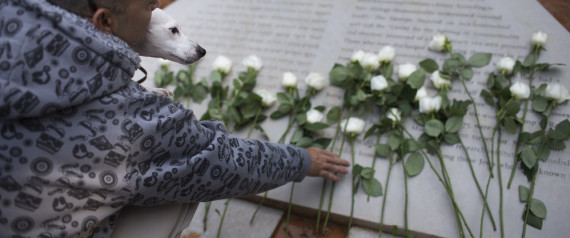
tel aviv gay holocaust memorial

TEL AVIV, Israel (AP) — Israel’s cultural and financial capital unveiled a memorial Friday honoring gays and lesbians persecuted by the Nazis, the first specific recognition in Israel for non-Jewish victims of the Holocaust.
Tucked away in a Tel Aviv park, a concrete, triangle-shaped plaque details the plight of lesbian, gay, bisexual and transgender people under Adolf Hitler’s Third Reich. It resembles the pink triangles Nazis forced gays to wear in concentration camps during World War II and states in English, Hebrew and German: “In memory of those persecuted by the Nazi regime for their sexual orientation and gender identity.”
The landmark joins similar memorials in Amsterdam, Berlin, San Francisco and Sydney dedicated to gay victims of the Holocaust. While Israel has scores of monuments for the genocide, the Tel Aviv memorial is the first that deals universally with Jewish and non-Jewish victims alike and highlights the Jewish state’s rise as one of the world’s most progressive countries for gay rights.
“I think in Israel today it is very important to show that a human being is a human being is a human being,” Mayor Ron Huldai said at the dedication ceremony, where a rainbow flag waved alongside Israel’s blue-and-white flag. “It shows that we are not only caring for ourselves but for everybody who suffered. These are our values — to see everyone as a human being.”
Israel was born out of the Holocaust and its 6 million Jewish victims remains seared in the country’s psyche. Israel holds an annual memorial day where sirens stop traffic across the nation, it sends soldiers and youth on trips to concentration camp sites and often cites the Holocaust as justification for an independent Jewish state so Jews will “never again” be defenseless.
But after 70 years, Tel Aviv councilman Eran Lev thought it was time to add a universal element to the commemoration. Lev is one of many gays elected to public office in Tel Aviv, a city with a vibrant gay scene that has emerged as a top international destination for gay tourism.
“The significance here is that we are recognizing that there were other victims of the Holocaust, not just Jews,” said Lev, who initiated the project during his brief term in office.
As part of their persecution of gays, the Nazis kept files on 100,000 people, mostly men. About 15,000 were sent to camps and at least half were killed. Other Nazi targets included communists, Slavs, gypsies and Jehovah’s Witnesses.
Unlike their persecution of Jews, however, there was no grand Nazi plan to exterminate gays. Nazis viewed being gay as a “public health problem” since those German men did not produce children, said Deborah Dwork, director of the Strassler Family Center for Holocaust and Genocide Studies at Clark University in Worcester, Mass.

“The idea was to change their behavior, not to eradicate them, not to murder them,” Dwork said.
The policy was far from sweeping — as evidenced by the rampant homosexuality among the ranks of the Nazi Party’s SA paramilitary wing, which helped pave Hitler’s path to power. The most famous gay Nazi was Ernst Röhm, one of the most powerful men in the party before Hitler had him executed in 1934.
Later, the Nazis outlawed homosexuality and the Gestapo set up a special unit targeting homosexuality. In the Buchenwald concentration camp, the Nazis carried out experiments to try and “cure” homosexuality. Those sent to the camps were forced to wear pink triangles, compared to the yellow stars that Jews bore on their clothing. Gay Jews wore an emblem that combined the two colors.
Today, Israel is one of the world’s most progressive countries in terms of gay rights. Gays serve openly in Israel’s military and parliament. The Supreme Court grants a variety of family rights such as inheritance and survivors’ benefits. Gays, lesbians and a transsexual are among the country’s most popular musicians and actors.
Moshe Zimmermann, a professor from the Hebrew University of Jerusalem and the memorial project’s historical adviser, said the Tel Aviv monument marked a big step in Israel by ridding itself from what he called a monopoly of victim hood.
“We are finally shedding the load of being the lone and ultimate victim,” he said. “We can learn from this that by recognizing the victimhood of others, it does not diminish the uniqueness of your own victim hood.”
 
Further reading:
 

  1. Original Article – Huffington Post
  2. BBC News Article
  3. BN&S Commentary
  4. The Gay Holocaust Lagers

Filed Under: Anti-Bullying & Homophobia, History Tagged With: Adolf Hitler, Anti-Gay Discrimination, civil rights, Gay Discrimination, Gay Holocaust Victims, gay rights, Gay Voices News, Genocide, Israel Gay Holocaust Monument, Nazi Germany, Tel Aviv, Tel Aviv Gay Holocaust Monument, The Holocaust

History Recalled – the Letter that OUT did not print about Peter Mandelson coming to Ulster

12/01/2014 By David McFarlane Leave a Comment

(Out-take from upstart November 2000)
 
HISTORY RECALLED  – The Letter That OUT did NOT print
 
OUT Letters
Prince Street Station
PO Box 630
New York NY 1001
 
Dear Editor,
 

‘MANDY’ MANDELSON & NORTHERN IRELAND

 
In your January 2000 edition (issue 74) you carried an item about Peter Mandelson — the former Cabinet Minister, and Tony Blair favourite — being given the job of Secretary of State for Northern Ireland.  It was strongly implied that we quaintly reactionary Ulster-folk would be horrified at having a ‘Sodomite’ sent amongst us, a notion gleaned from the self-consciously fashionable (and stupid) Gay publications produced in London.  A city which is 55 minutes away from Belfast by plane, but several light years psychologically – think Manhattan and Juneau.
The response to Mandelson in Northern Ireland has been pretty muted, apart from the odd mildly satirical article about his spending the Christmas holiday with his Brazilian ‘friend’, with a local television personality who is also famously (and rather futilely) closeted.  Gayness is simply not pass-remarkable in this part of the world anymore, partly due to the work of this organisation over nearly thirty years.
Other groups have of course played their part: the major one being Cara-Friend the befriending and welfare wing of the over-all Gay movement, which has helped tens of thousands of lesbians, gay men, bisexual, transsexual, transgender and transvestite people to come to terms with themselves, over the past quarter of a century. The Pride committees have also done a great deal to make the community come forward.  2000 will be Belfast’s Tenth LGBT Pride and all the stops will be pulled out to make it a memorable festival.
That might be difficult, because in 1999, Pride enjoyed talks from Bishop Pat Buckley on the ‘ethical’ aspect of being Gay, while Jeff Dudgeon (about whose struggle against the UK government at the European Court of Human Rights, BBC Radio 4 UK broadcast a dramatisation in November 1999) gave a workshop on Roger Casement’s wide and deep connections with Belfast.  There was a Civic Reception in City Hall addressed by the Deputy Mayor Ms Marie Moore, and a half-hour programme shown on prime time television.  There were many other events and workshops, a poetry -reading and an art exhibition among other things.
NIGRA since 1993 has organised solidarity actions with ILGO (the Irish Lesbian & Gay Organisation of New York) in its struggle against the bigotry of the AOHA (Ancient Order of Hibernians in America).

Yours faithfully,

Seán McGOURAN

Secretary,

NI Gay Rights Association

[The above letter was sent in January 2000, by ‘snail-mail’, we think.  The date ‘November 2000’ had to do with the erratic production of upstart, a private concern that depended on whether or not the people producing it were employed and in funds.]

Filed Under: Anti-Bullying & Homophobia Tagged With: history, London, OUT, peter mandelson, Ulster

  • « Previous Page
  • 1
  • …
  • 21
  • 22
  • 23
  • 24
  • 25
  • …
  • 41
  • Next Page »

Categories

Copyright ACOMSDave.com © 2026