LGBTQ Equality & Northern Ireland’s Political Parties 2015
An independent survey on party policies and active records in supporting lesbian, gay, bisexual, trans* and queer rights.
Community Journalist

An independent survey on party policies and active records in supporting lesbian, gay, bisexual, trans* and queer rights.
 Reported by Marie :
Sometimes I get tired of being angry and frustrated (sigh) – the new online Mental Health Services Finder tool was launched today and the good news is that sexual orientation is on the list – the bad news is that there are no LGBT organisations mentioned under this heading (more sighs). 3 community based counselling providers plus the Samaritans are listed under the sexual orientation heading.
I tried also to access LGBT services under the search for an organisation and drew a blank (even more sighs).
Check for yourself and if, like me, you can’t find the services our community provides please mention it to any canvassers who come to your door; but also write to NI Direct.
As Editor I have sent the following message from the NI Direct site:
 Editor of NIGRA News:
The finder tool was set up by DHSSPS and the HSCB
 Find a mental health organisation
Breaking the Gay code in the movies shows how, before obviously gay characters were allowed on the big screen, subtle (and not so subtle) indicators were used. Here are our favourite 12.

Jo (Barbara Stanwyck), Walk on the Wild Side, 1966
Even the ferociously closeted actress Barbara Stanwyck admitted that her character, the madam of the bordello, Jo Courtney, is a lesbian. And in the spooky way that only Hollywood can create, the love interest/prostitute is Capucine, one of the most beautiful but icily sexless women to have graced the silver screen. Stanwyck smacks Capucine around some, which is the equivalent at the time of hot lesbian sex, at least in the male film creator’s eyes. Don’t miss the very hot Jane Fonda as a baby whore and Anne Baxter as a Mexican. — C.H.
Dill Harris (John Megna) and Scout (Mary Badham), To Kill a Mockingbird, 1962
I would love to have been on the set of this film when the director, Robert Mulligan, told John Megna, the actor playing Dill, to swish it up somewhat. Megna actually nails it without a lot of fuss. Dill Harris is based on Truman Capote, author Harper Lee’s childhood friend. Lee later helped Truman with his work on In Cold Blood. That the Harper character is named Scout and has a haircut that looks as it was done with an egg beater is sophisticated gender role-play for the time.— C.H.
Brandon (John Dall) and Phillip (Farley Granger) Rope, 1948
Alfred Hitchcock was fascinated by gay and lesbian characters, and there are sly and not so sly references in many of his films. Rope is fairly overt. The movie is based on a play, which was based on the the true story of Nathan Leopold and Richard Loeb, who murdered 14-year-old Bobby Franks in Chicago in 1924. This time bi actor Farley Granger gets to be smacked around some for being hysterical and nelly, which is definitely code for gay. But the biggest whiff of lavender is that two young well-dressed male roommates are throwing an odd dinner–cocktail party hybrid. Who does that? James Stewart’s Rupert Cadell may or may not be gay in intention, but if the original casting choice of Ray Milland had played the role we would have been much more likely to see him as gay. — C.H.
Phillip Vandamm (James Mason) and Leonard (Martin Landau), North by Northwest, 1959
In another gay-inclusive Hitchcock classic, suave villain Phillip Vandamm has a thing going with Eve Kendall (Eva Marie Saint), who’s actually an American spy trying to find out how he’s exporting secrets to our Cold War–era enemies. He also may have a thing going with his devoted “right hand,” Leonard, or at least Leonard would like that to be the case. Leonard is suspicious of Eve, leading Vandamm to say, “I think you’re jealous.” “Call it my woman’s intuition,” Leonard responds. He’s undoubtedly jealous but he’s also on to her, and he ends up pursuing Eve and the film’s reluctant hero, Roger Thornhill (Cary Grant), in a climactic chase over Mount Rushmore. —T.R.
Joel Cairo (Peter Lorre), The Maltese Falcon, 1941
The effete, curly-haired, heavily perfumed Joel Cairo is among the shady characters seeking the priceless title statuette; detective Sam Spade (Humphrey Bogart) goes along with the quest in order to find out who killed his business partner. Cairo was clearly gay in the 1930 Dashiell Hammett novel on which the film is based; movies of the era couldn’t be quite so overt, but Lorre’s Cairo is so effeminate that he fits a certain stereotype of a gay man. Also, as The Peter Lorre Companion notes, he suggestively fondles an umbrella handle and gets his hand on Spade’s posterior briefly. Film experts have also observed that Kasper Gutman (Sydney Greenstreet) and his “gunsel,” Wilmer (Elisha Cook Jr.), seem to be a couple. — T.R.
Mrs. Danvers (Judith Anderson), Rebecca, 1940
In Hitchcock’s first U.S. release, soon after British aristocrat Maxim de Winter (Laurence Olivier) brings his new bride (Joan Fontaine) home to his great estate Manderley, we learn that Mrs. Danvers, the housekeeper, “adored Rebecca,” Maxim’s now-deceased first wife. That point is driven home as “Danny” fondles Rebecca’s lingerie — “Did you ever see anything so delicate?” she tells Fontaine’s character. “Look, you can see my hand through it!” She resents the presence of the second Mrs. De Winter (“Even in the same dress you couldn’t compare”) and does all she can to get rid of the new wife, and she also fondly remembers brushing Rebecca’s hair and laughing with her at the idea that Rebecca could ever love any man. Every housekeeper is that devoted, right? — T.R.
Bruno (Robert Walker), Strangers on a Train, 1951
In this Hitchcock film about a plot to trade murders , Farley Granger plays the hot straight guy that the unctuous Bruno, played by Robert Walker, inveigles into his lurid plan. Bruno’s nelliness would have been enough — plus he practically drools on Farley’s extra-wide lapels — but Hitchcock wants no ambiguity, so two-tone spectator shoes and flashy dressing gowns are used for the less-than-perceptive. — C.H.
Addison DeWitt (George Sanders), All About Eve, 1950
One of the greatest pleasures in a film with many is Sanders’s performance as drama critic Addison DeWitt, with his pitch-perfect delivery of Joseph L. Mankiewicz’s sardonic dialogue: “To those of you who do not read, attend the theater, listen to unsponsored radio programs, or know anything of the world in which you live, it is perhaps necessary to introduce myself,” he says in a voice-over as the movie begins. Addison is the ultimate condescending snob, described by one character as a “venomous fishwife”; in a less censored time, that would be “bitchy queen.” Along with his high-toned manner of speaking, his impeccable clothing and cigarette holder signal gayness, and he seems interested in women only to make them stars. “That I should want you at all suddenly strikes me as the height of improbability,” he says to the titular Eve (Anne Baxter). Addison is said to have been based on one of two acerbic New York critics of the 20th century, George Jean Nathan (apparently straight) or Alexander Woollcott, who was gay. Woollcott inspired other film portrayals as well; read on. — T.R.
Waldo Lydecker (Clifton Webb), Laura, 1944
Another character based on Woollcott, Waldo Lydecker is just as bitchy as Addison DeWitt and a lot more queeny. A powerful columnist and radio commentator, he’s helped the film’s title character to rise in the advertising business and he’s obsessed with her, but there are several indicators that his obsession isn’t of a sexual nature — those interests lie elsewhere. Key signs: the elaborately decorated apartment (“It’s lavish, but I call it home”), the walking stick, the perfection in dress and diction, and the fact that he answers questions from a hunky detective while in the bathtub. Played unforgettably by gay actor Clifton Webb, Waldo is the most fascinating character in the film, and he’d agree with that assessment. “In my case, self-absorption is completely justified,” he says at one point. “I have never discovered any other subject quite so worthy of my attention.” — T.R.
Sheridan Whiteside (Monty Woolley), The Man Who Came to Dinner, 1942
Is it a sign of our culture’s dumbing-down or just its fragmentation that we can’t think of any contemporary figure who’d inspire three fictional portrayals? Yet another character based on Woollcott is famed critic Sheridan Whiteside, a sophisticated New Yorker who gets stuck at a bourgeois Ohio couple’s home when he slips on the ice and breaks his leg while visiting. In this film adaptation of the George S. Kaufman–Moss Hart play, “Sherry” (played by gay actor Monty Woolley, a pal of Cole Porter’s) make lifes miserable for the couple, his nurse, and his secretary, and encourages his hosts’ son and daughter to rebel. Like Addison DeWitt and Waldo Lydecker, he does not lack for ego; “Is there a man in the world who suffers as I do from the gross inadequacies of the human race?” he wonders. Also like them, he has an effete manner and acid tongue that mark him as a certain type of gay man. And when a local journalist asks him how he thinks Ohio women stack up, he responds, “I’ve never gone in for stacking women up, so I really can’t say.” Whiteside entertains some showbiz visitors during his convalescence. They include playwright Beverly Carlton, who talks about seducing South Seas maidens but, as played by Reginald Gardiner, reads as pretty gay, and after all, the character is based on Noël Coward. Then there’s comedian Banjo (Jimmy Durante), inspired by Harpo Marx, with whom Woollcott was in love. Whether Harpo reciprocated is subject to debate. — T.R.


Six in ten Sunday People readers back the change in the law allowing gay and lesbian couples to marry.
The latest results from the People’s Panel, which is letting you have your say on key issues every week in the run-up to the May 7 polls , also reveal 33% of you strongly support the move.
It was most popular among women with 69% in favour compared with 50% of men.
UKIP voters were alone among the major parties in having more readers opposing the change than backing it – a vindication for David Cameron, who stuck his neck out to give same-sex couples the same rights as heterosexual ones.

One reader said: “There are more important things for the Government to deal with than gay and lesbian marriages.”
Another added: “Everyone should have a chance of happiness.”
As the People’s Panel focused on equality this week, it also emerged that more than three in five readers believe 16 should remain the age of consent – although 14% said it should be raised to 18, as in Turkey.

More than six in ten want to keep the voting age at 18 and only 7% thought it should be lowered to 17, and 1% to 15. Some 18% favour 16, as proposed by Ed Miliband.
The Labour leader was persuaded to press for a change by the high turnout of 16-year-olds in last year’s Scottish referendum.
He felt that having been given the right to vote once, 16 and 17-year-olds should not be denied it in future. The voting age was lowered to 16 for local elections in the Isle of Man, and Channel Islands Jersey and Guernsey.
In the US, 19 states allow 17-year-olds to vote in primary elections as long as they will be 18 on polling day.
In Japan the voting age is 20 and in Italy it is 25 for Senate elections.

More than half of the People’s Panel did not feel governments have gone far enough in closing the gender pay gap. That rose to 65% among women voters.
A third of the 18-54 group, compared with 15% of the 55-plus, felt changes needed to bring about equality have been made.
One reader told us: “Women should be paid the same as men – but nurses should be paid more.”
Regarding childcare provision, only one in ten thought it should fall to mothers alone
Nearly one in three felt it should be shared equally with nine per cent more men holding that view than women. But more than half said divvying up childcare should depend on the circumstances of the parents..


This video documentary sets out to examine Gay life in Ireland, and gives most of its 26 minutes to Irish lesbians and gay men in New York. These include Anne Maguire of the ILGO (Irish Lesbian and Gay Organisation) taking being arrested and hassled by Noo Yoicks Finest (the polis) calmly in her stride, Billy Quinn a Dublin-born artist and Tariach MacNaillais.
Tariach came to Gay politics by way of the Hunger Strikes agitation and says he was told than an out Gay man was not going to be employed in his field of Youth and Community Work. The other person from Northern Ireland who spoke, Cherry Smyth, lives in London (England, UK). She is of middle-class, liberal Protestant origin. Her parents had she makes clear, no insuperable problems with her sexuality. She also said things about “being Irish” which I found difficult to grasp. You don’t have to be Catholic and Gaelic to be Irish. Who said you did? Why does “being Irish” matter?
Billy Quinn is a working class Dubliner who was sexually abused in his childhood and has worked in bars from a very yong age. Where he acquired his rather plummy accent is a mystery. He compared Molly Bloom unfavourably with Jane Austen’s heroines. The latter were prissy and repressed but James Joyce’s Molly was a great sexual Earth-Mother. This proves he hasn’t read either Joyce or Austen. Compared, for example, with Chaucer’s Wife of Bath, Molly is positively south. Jane Austen, a great comic writer, is central to English, even British culture. Joyce is not central to modern Irish culture. Billy Quinn’s paintings, founded, so far as one could see, in a culture of “wee holy pictures” and fold Catholicism seems far more relevant to what one could almost call a post-Catholic Republic than Joyce, the middle-European intellectual.
Quinn says that many of his friends found the news that Ireland had abandoned practically all of the laws criminalising Gay sexuality almost impossible to believe. Kieran Rose explained why it was not impossible in the rather short amount of time he was allowed. Mike Quinlan said that ten years ago a Pride demo “ran down Grafton Street”, implying that this was nervousness on the part of the marchers – rather than the fact that a decision was taken to hurry us up with fantastic disco tracks. In 1992, GLEN (the Gay and Lesbian Equality Network) decided on a Pride for Dublin: the fact that Galway was organising its third and Belfast its second Pride[s] was neither here nor there of course … not.
The video looks very good. You can’t really miss with the New York skyline and the Irish scenery, and the excitement of a big public ceremony, namely St Patrick’s Day parade. A flash of wit was a group of red-necks carrying an AOH banner marked ‘Orange County’. There was a flash of Belfat Pride with a bible-0thumper given more time to talk than the locals. There was a cut to Catholic objectors to Dublin Pride, which appeared to be saying that one was as bad as the other. But the Paisleyites put up a bigger (if not a better) show.
The Sin Fein banner was shown at the Dublin Pride demo (it was the one which came days after the change in the law). Why, one wonders? There were a dozen – at least – ‘straight’ political groups there, including Democratic Left and its leader De Rossa. There was also the Socialist Workers Movement, which has been assiduous in it support of Gay groups – to the point of being irritating. Why were they not shown?
There did seem to be a rather simple-minded (straight) political agenda behind these images or lack of the, including the non-appearance of people who actually live in Northern Ireland (not to mention the rest of the island).
This sort of thing is not inherently a bad thing artistically – it can give a certain flavour to a work. But the special flavour of the place (Ireland-in-general and Northern Ireland in particular) leached away, mainly because most of the people talking had lived outside of the island for the greater part of their short lives.
There were really two videos fighting to get out of this one. Maybe Paula Crickard, the director, should re-splice the material and produce one on New York and one (possibly even two) on Ireland – there are plenty of tales worth the telling.
Reviewer; Sean McGouran Reprinted from upstart print edition
Should the YouTube copy of this documentary stop working, then it can also be viewed at the Northern Visions Archive

Pacemaker Press 6/11/2014 Daniel and Amy McArthur with their Baby Girl Elia, Daniel from Ashers Baking Company refused to bake a cake with a pro-gay marriage slogan. The Equality Commission are now going to take civil action against a Christian-owned bakery firm. Pic Colm Lenaghan/Pacemaker
The commission has brought a civil case against Ashers Baking Company after it refused to bake a cake with a pro-gay marriage slogan. The two-day hearing is due in the High Court later this week.
The DUP leader said: “When you consider that they have set aside the potential of spending £33,000 on this court case where they are seeking damages of £500 against Ashers, there is a better use that could be put to that money, particularly in the tight fiscal situation the Executive faces.” Ashers is facing the action after it refused to supply a pro-gay marriage cake on grounds of the owners’ religious views.
A new poll released yesterday found that more than 70% of people believe it is wrong for a Christian bakery to be taken to court over its refusal to make a cake supporting gay marriage. As the case approaches, the debate has intensifed between Christian-based groups, including church leaders, and pro-gay groups.
Professor Steven Greer has suggested that busin esses can print a disclaimer on invoices, websites, and other business documents, to say that compliance with statutory requirements does not constitute approval of the activities in question. In a commentary piece, the Bristol University professor argues that the courts need to strike a balance between competing rights and interests.
Mr Greer believes that a ‘conscience clause’ bill proposed to the Assembly by the DUP’s Paul Givan has little chance of ever being introduced as it would be repealed by Westminster and legally challenged in Strasbourg.
He suggests: “Those providing goods and services in Northern Ireland who do not approve of gay relationships, could and should simply issue a disclaimer on their invoices, websites, and other business documents to the effect that compliance with relevant statutory requirements does not necessarily constitute approval of the activities in question.”
Churches across Northern Ireland have been encouraged by the Christian Institute to highlight a support meeting to their members tonight at Belfast’s Waterfront Hall while pro-gay rights rallies have been held in various towns.
There could be a way round the difficulties thrown up by the Ashers case, writes Prof Steven Greer:
This Thursday, the District Judges Court in Belfast will begin hearing a case, brought by the Equality Commission for Northern Ireland on behalf of gay activist Mr Gareth Lee, against Ashers Baking Company for alleged breach of statutory duty not to discriminate on the grounds of sexual orientation in the provision of goods or services.
There seems little doubt that Ashers will lose the litigation, and that Mr Lee will be modestly compensated, because the legislation in question, the Equality Act (Sexual Orientation) Regulations (Northern Ireland) 2006, does not provide an exemption on any ground, including religious faith.
Possibly anticipating this outcome, DUP Assembly member, Paul Givan, is seeking to provide one by way of a Private Members Bill supported by his party and the Catholic Church amongst others. Mr Givan’s amendment would not legalise all refusals to supply goods and services to gays in Northern Ireland.
It would, instead, provide a ‘conscience clause’ permitting those with strongly held religious views to avoid ‘endorsing, promoting or facilitating behaviour or beliefs’ which conflict with these convictions. Some have claimed that the current position in Northern Ireland is ‘Christianophobic’ — intolerant of and discriminatory towards Christians. And, according to First Minister Peter Robinson, the Equality Commission’s case amounts simply to ‘bullying’.
For these and others, the proposed amendment would, merely provide an appropriate, measured solution to a genuine conflict between the right to freedom of thought, conscience and religion, on the one hand, and the right not to be discriminated against due to sexual preference on the other. By contrast, others regard it as an attempt to legalise homophobia.
The right not to be discriminated against on the basis of sexual preference is clear in international human rights law with, for example, the decriminalization of private, consensual, adult, gay sex mandatory throughout the 47-member Council of Europe, no matter how strong national or regional opposition. And for good reason.
Gay, lesbian, bisexual and transgender people have long suffered, not just discrimination, but often savage mistreatment merely for claiming identities or engaging in private, consensual, adult sexual activities, of which others disapprove. The scope of the right to freedom of thought, conscience and religion is, however, less clear.
Since it unquestionably includes the right not to be compelled to believe against conscience, religious conservatives are well within their rights to regard gay sex as inherently wrong because God forbids it.
But the permissibility of the expression of religious belief, in commercial and other spheres, hinges fundamentally upon its consequences, including and especially how others are affected.
Were Mr Givan’s amendment to be passed, same-sex couples in Northern Ireland could, for example, be lawfully denied a table at a restaurant, a room in a hotel, or a mortgage, on the grounds that this would otherwise endorse or facilitate same-sex unions.
But, apart from a sense of discomfort, distaste or outrage, it is not at all clear what loss or damage is suffered by those who feel that being required to provide gays with customised goods and services compels them to act contrary to their core religious beliefs.
Such a ‘loss’, if a loss it is at all, pales into insignificance compared with the tangible and potentially substantial damage which could be sustained by gay couples in such circumstances.
There is, in any case, a simpler solution to these difficulties. Instead of an exemption from the 2006 regulations, those providing goods and services in Northern Ireland who do not approve of gay relationships, could and should simply issue a disclaimer on their invoices, websites, and other business documents to the effect that compliance with relevant statutory requirements does not necessarily constitute approval of the activities in question.
Steven Greer was born and raised in Belfast and is currently Professor of Human Rights at the University of Bristol Law School
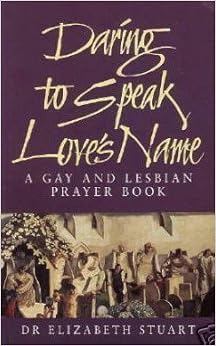
(A Gay and Lesbian Prayer Book)
Dr Elizabeth Stuart
Publisher: Hamish Hamilton
Reprinted from ‘upstart’ April 1993
First of all I understand the need for a book of this type but I personally can see it having only a limited use.
One of the main problems that I can see in the book is that it revolves too much around the main established churches and the Bible, and for the life of me I can’t understand why. We have all at one time or another felth the pain that the Church can cause either directly or indirectly. What would have been more useful and indeed thought provoking would have been people’s own words rather than the words of the Bible.
The title is also misleading: it should read A Christian Gay and Lesbian Prayer Book. What about the other faiths that make up the Gay communnity – Jew, Hundi, Muslim, Buddhist, and so on, or are we to believe that Christians have a monopoly?
I’m sorry I personally would have no need for this book, it is just to restricted in its outlook
Peter G Simms

Reprinted from so so GAY 20 FEB 2015
Justin Fashanu was a football player who made history both in his personal and professional life. When Nottingham Forrest bought Fashanu from Norwich City in 1981, he became the first black footballer to break the £1 million transfer fee. It wasn’t until 1990 that Fashanu came out publicly. He was the first footballer to ever come out. However, it all ended tragically in 1998 when he committed suicide following accusations of sexually assaulting a 17-year-old male.
Former Aston Villa and West Ham midfielder Thomas Hitzlsperger came out at the start of 2014, five months after retiring from football. The 31-year-old, who won 52 caps for Germany, said: ‘I’m coming out about my homosexuality because I want to move the discussion about homosexuality among professional sportspeople forwards.’
Two years ago, in a post on his own blog, Robbie Rogers wrote, ‘Try convincing yourself that your creator has the most wonderful purpose for you even though you were taught differently.
‘I always thought I could hide this secret. Football was my escape, my purpose, my identity. Football hid my secret, gave me more joy than I could have ever imagined… I will always be thankful for my career.’
Rogers posted this after initially retiring from the game due to injury but soon after he signed for LA Galaxy, coming out of retirement to become the highest profile openly gay footballer in the world.
Amelie Mauresmo is a Grand Slam winning former tennis player who came out early on in her career, at just 19. Mauresmo went on to become the number one ranked player and win Wimbledon and the French Open. Mauresmo is now Andy Murray’s coach making him the highest profile male player with a female coach.
Gareth Thomas was a fixture of the Welsh Rugby side’s starting lineup for over a decade, representing his country 100 times. In 2009 he came out in a national newspaper whilst still playing for the Cardiff Blues making him the first openly gay professional rugby player.
Thomas announced his retirement after a short spell playing Rugby League in the Super League.
Fallon Fox became the first transgender athlete in MMA history and has won five of her six matches. After coming out Fox faced fierce criticism with some, not least UFC commentator Joe Rogan who attacked Fox in a rant on his podcast.
Rogan said ‘She calls herself a woman but… I tend to disagree. And, uh, she, um… she used to be a man but now she has had, she’s a transgender which is (the) official term that means you’ve gone through it, right? And she wants to be able to fight women in MMA. I say no f***ing way.
‘I say if you had a dick at one point in time, you also have all the bone structure that comes with having a dick. You have bigger hands, you have bigger shoulder joints. You’re a f***ing man. That’s a man, OK? You can’t have… that’s… I don’t care if you don’t have a dick any more…’
Greg Louganis was one of the most famous divers in the world. He was the Tom Daley of his era; talented, tanned and a sight for sore eyes in a pair of Speedos. He dominated in both the 3m springboard and 10m platform event for several years and he still holds the record for being the only male diver to win gold in both events at two consecutive Olympic Games. Louganis came out in 1994, six years after his last Olympics.
Matthew Mitcham, on the other hand, came out at the start of his career. In 2008, in an interview prior to the Beijing games, Mitcham mentioned in an interview with the Sydney Morning Herald that he was gay. Mitcham would go on to win gold at the Beijing games, denying the Chinese divers a clean sweep of the medals.
Tom Daley was the poster boy of the London 2012 Olympics. His good looks, tanned skin and perfect smile had the gays and the girls up and down the country transfixed as he fought his way to a bronze medal. 18 months later Daley posted a video on YouTube where he came out saying ‘Of course I still fancy girls, but right now I’m dating a guy and I couldn’t be happier. I just feel safe. And it just really does feel right.’ Five months later Daley said ‘I am a gay man now’.