
 History for the LGBT community has largely remained hidden, due to the persecution and homophobia enacted by society in the main, and in particular by those in power, whether it be government, police, the judiciary etc.
As the LGBT community has slowly fought and achieved its rights, so the need for its history to be written down and incorporated into mainstream history has become a necessity. There is still a resistance within corridors of power, and indeed the history books still do not reflect LGBT characters and their contribution to the development of society, or the fight against tyranny,
Stonewall in the USA, has recognised the lack of visibility and acceptance of LGBT history, and that is why a broad coalition of elected officials, community members, advocates and Stonewall witnesses are urging President Obama to designate a national monument at the Stonewall site before the end of his term.
The article can be read here: Stonewall Site to Honor LGBT History, America’s Struggle for Equality.
I also believe that our history should be written down now, before those who have been involved in the past leave us and take their memories and knowledge with them.
I urge the LGBT community in Northern Ireland, and indeed in Ireland to consider forming an online repository for our history.
Why not let us know what you think about this idea?
Jewish-LGBT history exhibition launched

A Leeds shul has hosted the launch of the Rainbow Jews exhibition, which documents and showcases Jewish-LGBT history in the UK.
Sinai Reform Synagogue held a shabbat weekend, which included a service on Friday night and Saturday morning, before the display was launched.
The services were led by Sinai’s assistant rabbi, Esther Hugenholtz, with Friday’s service followed by a supper at the shul.
Surat Shaan Rathgeber Knan, founder and manager of Rainbow Jews and of his latest project Twilight People, spoke about his journey coming to terms with the relationship between his sexuality and his Judaism.

The Saturday shabbat service included alternative texts and liturgy which embraced LGBT issues, which event organiser Nicolle Levine called “thoughtful, spiritual, sensitive and inclusive”. She added: “this is exactly what we were aiming for in bringing the exhibition to Sinai.” 
The service was attended by members of the Jewish and non-Jewish LGBT community from across Yorkshire.
The launch of the exhibition took place after the Shabbat service, and saw speaking guests including Leeds’ Lord Mayor and Sinai member Judith Chapman, Leeds North East MP Fabian Hamilton and Pudsey Horsforth and Aireborough MP Stuart Andrew.
The exhibition is run by Rainbow Jews, which is a lottery funded oral history project that records and showcases Jewish LGBT history in the UK from 1950-present.
An oral history selection can be heard on the Rainbow Jews website: www.rainbowjews.com
Sinai’s Senior Rabbi, Rabbi Morris also spoke about the Jerusalem Pride attack.
On Sunday morning, Nicolle Levine and Sinai member Matt Thornfield were guests on Radio Leeds talking about the event. They spoke about significant parts of the exhibition, including a testimony of a Jewish woman who aged 90, came out as lesbian.
For more information, contact sanctuary@sinaisynagogue.org.uk.
The event took place between 31 July and 2 August.
Old Shoebox Gives Glimpses Into A Gay Man's Life In 1940s-'60s Vancouver
Huffpost Gay Voices – Kevin Dale McKeown – Posted:
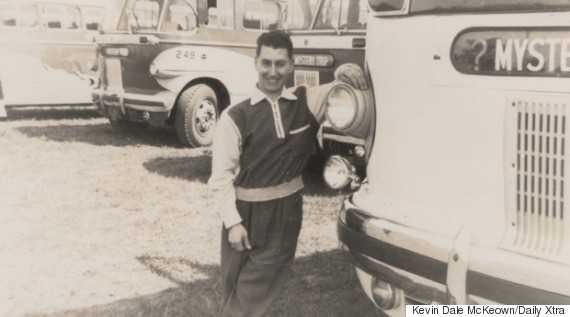
I have a new guy in my life. His name is Joseph, but his friends and family called him Joe so I will too.
I met Joe a few months ago through Don Stewart, the proprietor of MacLeod’s Books where I was in browsing one Saturday morning when Don suggested I take a look at a shoebox full of papers and photos that he thought might interest me.
The contents of the box proved to be memorabilia of the life of one Joseph R. Selsey, late of Vancouver’s West End. The reason that Don thought I might want to see these discards, retrieved by a savvy binner from where they’d been dropped next to a dumpster, was that several pieces of this collection indicated that Joe was a gay man living in our neighbourhood in the 1940s, ’50s, and ’60s; decades for which we have few records of our community’s existence.
Don’s first clue might have been the paperback copy of Richard Amory’s Song of the Loon, an interracial and intergenerational gay love story from the early ’60s, before either of those loaded terms had been coined.
Or the flyers from Trojan Book Service offering such titles as America’s Homosexual Underground by Antony James (quote: “The good-looking boy with lily-white skin was husky but the man sensed a kind of effeminacy as he watched the boy leaning against the stair steps with his crotch bulging.”).
Or the handbill from International Nudist Sun, boasting “frontal nude photographs” of hunky young “body builders.”
Certainly the Tom of Finland-style greeting card with three studs, naked except for toques and scarves and boots, carolling in the snow, was a clear giveaway.
Yeah, Joe was a friend of Dorothy’s, and I quickly scooped up the remains of his days for a closer look, and perhaps some clues to the lives of that generation of gay men who lived their youth in the years before Stonewall.
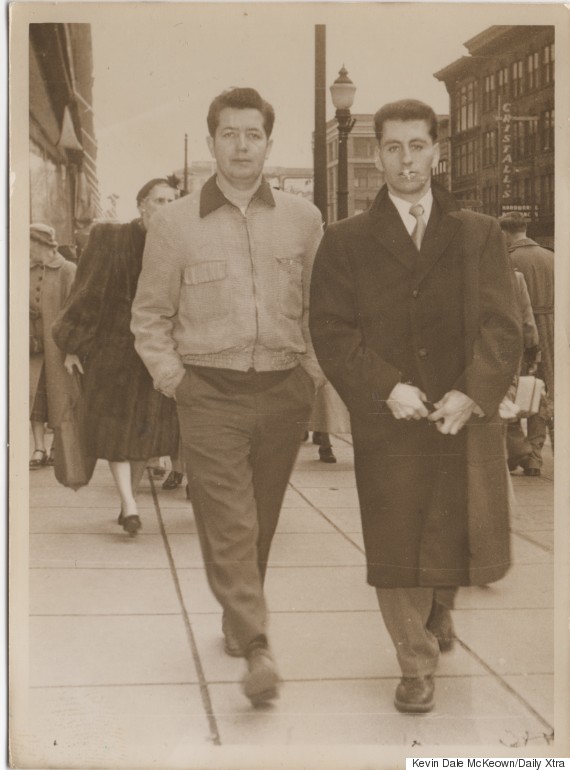
I have spent many pleasant hours with this material, wondering what kind of life we might imagine for Joe from these crumbs.
Much of it was lived at 1031 Harwood St., according to the handsome leather baggage tag with Joe’s name and address.
A well-dressed, happy, busy life with good friends, if the many photos of Joe and pals are any indication. And a life not entirely in the closet, hints a card signed “Merry Xmas to Joe from Kitty & Bob. PS: And a gay New Year!” Nor a life of rejection by family, according to several notes and photos inscribed “To Uncle Joe” from various wholesome looking children.
Joe’s wallet revealed that he had been born on March 19, 1927 in Saint Norbert, Manitoba, and that during his Vancouver years he was a joiner. He held membership cards to several establishments and organizations, most intriguingly to something called The Happytime Social Club, at 1022 Davie St. If that address sounds familiar, it might be because you gave it to the cab driver the last time you were dropped off atCelebrities.
I wonder what was going on in the Happytime Social Club in 1956? Was this a gay club after its turn as The Embassy Ballroom and before it became the notorious ’60s rock palace, The Retinal Circus?
Joe also had quite a number of passes to a Palm Springs Health Spa at 2405 West Broadway, which in the late ’50s offered, for a $2-surcharge, the “Complete Guest Treatment.”
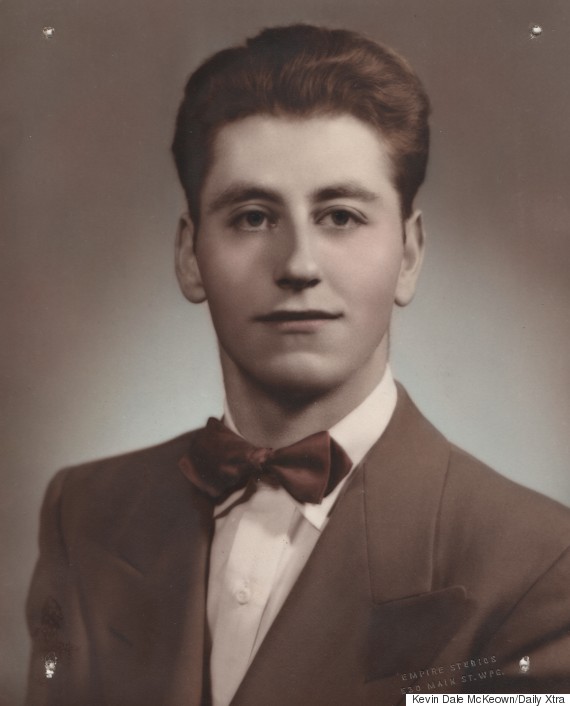
This time capsule also held a tiny key on a string (but nothing to open with it), a miniature silver keychain charm toaster, and a ratty rabbit’s foot. Does the collection of little sewing kits gathered from various hotel rooms suggest that our Joe might have been good with a needle?
Would the bolo tie with the bull and matador woggle indicate a butch streak, or does the baby blue cord of the tie suggest otherwise?
The stick of dried-out Wrigley’s chewing gum hints at less than fastidious housekeeping (really Joe!) and the little bundle of Irish Sweepstakes tell us that Joe liked a flutter on the ponies.
Most poignant among the scraps was a simple black and white, business-card sized piece, with a psychedelic pattern enclosing the words “You Are Not Alone.”
I admit to having qualms about outing Joe, even several years after his demise, until I found his Vancouver Sun obituary online. Noting his death at Vancouver General Hospital on April 26, 2007, aged 80, the obit proudly stated that Joe was “survived by his loving companion of 27 years, Ralph Gotell.”
Having weathered the challenges of life as a gay man in the 1940s and ’50s and ’60s, Joe was lovingly partnered and proudly out at the end. I don’t think he’d mind our spinning this little tale around these bits and bobs his life.
So far my digging has turned up no further records of the lives of either Joe or Ralph.
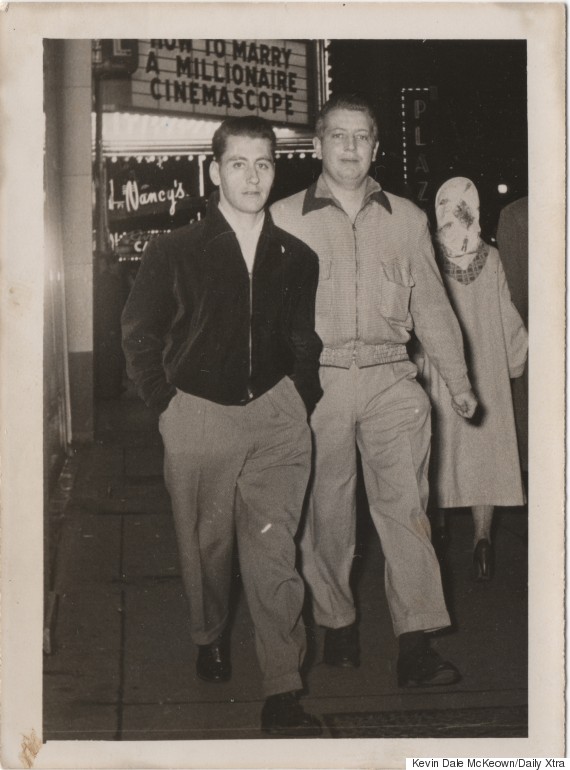
I share these random musings about Joe Selsey and how he might have lived his life as a gay man in the Vancouver of his day for two reasons: To help us realize that there is at least two generations worth of local, verifiably gay history that is slipping beyond our grasp; and to ask you, gentle reader, to share this story and these photos with any friends you may have of Joe’s generation.
Ask if they knew him, and if they recall the Happytime Social Club, and can tell us just how happy those times were?
Even if they didn’t know Joe or Ralph, perhaps something of these notes will jog a memory and stir up a story that we should add to our rich history. Before it’s too late.
If you have such friends, and they’re willing to chat, coffee’s on me!
You can contact the writer at stillqq@dailyxtra.com.
(This column first appeared on Daily Xtra.)
Closet Queens by MIchael Bloch
Reprinted from The Guardian
Michael Bloch
Saturday 16 May 2015 08.00 BST Last modified on Monday 18 May 2015 11.43 BST
Double lives – a history of sex and secrecy at Westminster
There are now 32 openly gay MPs, but for much of the 20th century many politicians were forced to lead complex, clandestine sexual lives. Michael Bloch tells their stories and salutes their powers of subterfuge
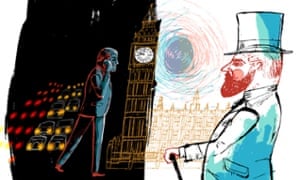
Westminster’s ‘closet queens’ were past masters when it came to keeping secrets, and taking calculated risks Illustration: Robin Heighway-Bury@goodillustration.com
Westminster’s ‘closet queens’ were past masters when it came to keeping secrets, and taking calculated risks.
From 1885, when the Labouchere amendment created the new offence of gross indecency, until 1967, when the recommendations of the Wolfenden committee were enacted, all homosexual behaviour was illegal in Britain. It continued to attract intense social disapproval for long after that: as late as 1993, according to the annual British Social Attitudes survey, most people still considered it to be “always wrong”. In this cruel and illiberal atmosphere, politicians with gay inclinations had to keep them secret from the public at large, and ran enormous risks. They were obliged either to repress their sexual feelings and lead celibate lives, or else to lead double lives, indulging their tastes clandestinely while outwardly conducting conventional, heterosexual existences, often married with children.
Yet paradoxically, “closet queens” (to use an expression that came into vogue in the 1960s) often made effective politicians. They were past masters when it came to keeping secrets, and taking calculated risks; they were also actors on life’s stage, with a strong sense of showmanship, and a flair for intrigue and subterfuge. And there was probably a far higher proportion of homosexuals in politics than in most other walks of life, partly because, as actors and risk-takers, they were drawn to the profession, and also because 20th-century British politicians were often educated at all-male boarding schools, which fostered intense (often sexual) friendships among their pupils, and provided unintentional training in the art of breaking the rules and getting away with it.
The quiet revolution: why Britain has more gay MPs than anywhere else
Read more
I became aware of this aspect of British political life when I wrote the biography (published after his death last year) of Jeremy Thorpe, the charismatic Old Etonian who led the Liberal party from 1967 to 1976. Always gallant with “the ladies”, Thorpe married twice, and fathered a son; but he led a hair-raising promiscuous gay life behind the scenes. When it came to both sex and politics he was a master of intrigue, exhibited outstanding seductive qualities and got a kick out of his risk-taking. He was eventually obliged to resign as Liberal leader when a former male model revealed that they had conducted an affair many years earlier, when it was still illegal; and he was subsequently tried at the Old Bailey for having allegedly conspired to have the man in question murdered – though he was acquitted, the revelations of his sex life and his efforts down the years to cover it up left him a discredited figure.

Jeremy Thorpe in 1977. Facebook Twitter Pinterest Jeremy Thorpe in 1977. Photograph: PA/PA wire ***
Many years earlier, two other Old Etonian Liberal politicians had found their careers ruined when they were hounded by men who claimed to have proof of their homosexual activities – the 5th Earl of Rosebery, prime minister in the 1890s, and the 7th Earl Beauchamp, a government minister from 1905 to 1915, subsequently Liberal leader in the House of Lords. They were cousins, who partly owed their early success to handsome looks; both were offered high positions in their 20s and joined the cabinet in their 30s. Both married fabulously rich heiresses – Rosebery, Hannah de Rothschild; Beauchamp, the sister of the 2nd Duke of Westminster. Rosebery’s marriage produced four children, Beauchamp’s no fewer than seven – but both were drawn emotionally to their own sex. (Both seem to have been infatuated by their handsome younger sons, by whose early deaths they were devastated.)
Rosebery had a liking for personable private secretaries. One of these was Francis, Viscount Drumlanrig, heir to the 9th Marquess of Queensberry, by whose qualities Rosebery was so taken that he arranged for him to be made a junior member of the government at the age of 26. This incensed “the mad marquess”, who was convinced that Rosebery was having an affair with his eldest son, just as he believed that Oscar Wilde was conducting one with his youngest son, Lord Alfred “Bosie” Douglas. Queensberry’s accusations were at first regarded as the ravings of a madman, but received some credence when in the autumn of 1894 – Rosebery having meanwhile become prime minister – Drumlanrig shot himself. Soon afterwards Rosebery suffered a breakdown and went into a state of seclusion: he was said to be terrified that his name would be raised in the libel case that Wilde brought against Queensberry. In 1895, less than a month after Wilde had been sentenced to two years’ hard labour for gross indecency, Rosebery tendered the resignation of his government (though it still commanded a parliamentary majority and no election was due).

Lord Rosebery speaking at the Foreign Office, c1900. Photograph: Hulton Archive/Getty Images
Whereas Rosebery had a (possibly platonic) taste for secretaries, Beauchamp’s (by no means platonic) penchant was for footmen and grooms. He continued these escapades for decades without being exposed, and might have done so indefinitely but for a vendetta by the Duke of Westminster, who was resentful that Beauchamp had, through his marriage to Westminster’s sister, produced three sons, while Westminster’s sole male heir had died aged four. In 1930, Westminster’s agents obtained statements from former servants of what he termed his “bugger-in-law”, testifying to his peccadilloes; confronted with this evidence, Beauchamp resigned and fled into exile. His story provided the background for Evelyn Waugh’s novel Brideshead Revisited: Lord Marchmain, the distinguished peer obliged to live abroad, is based on Beauchamp, while his son, the beautiful but wayward Sebastian, is based on Beauchamp’s adored younger son Hughie, with whom Waugh had been intimate at Oxford.
***
As a young cavalry officer, the Old Harrovian Winston Churchill was accused of having “participated in acts of gross immorality of the Oscar Wilde type” with fellow cadets at Sandhurst; but he successfully sued his accuser for libel, and there is no evidence that, as an adult, he engaged in physical homosexual relationships. Yet he was far from being straightforwardly heterosexual. Although he worshipped his beautiful American mother, he showed a lifelong aversion to women. (In Churchill’s only novel Savrola, the obviously autobiographical hero has a purely chaste relationship with the heroine, obviously based on Churchill’s mother.) He seems to have had a low sex drive, and married rather cold-bloodedly, aged 33, for social and dynastic reasons, just after being appointed to Asquith’s cabinet. Though he came to depend on his “Clemmie” in many ways, she was often exasperated by his emotional unresponsiveness and treatment of her as a child-bearer and housekeeper, and more than once considered leaving him.

Winston Churchill c1900. Photograph: Everett/Rex Shutterstock
While he never showed much interest in women other than his wife, Churchill’s life was marked by a series of close platonic relationships with attractive young men. Prominent among these were Eddie Marsh, a civil servant who served devotedly for 25 years as his private secretary, whom Churchill described as “a friend I shall cherish and hold on to all my life”; Archie Sinclair, a cavalry officer, whom he chose as his second in command on the western front in 1916, as his personal assistant as war secretary and colonial secretary in 1919-22, and finally (after Sinclair had become leader of the Liberal party) as air minister in 1940; Bob Boothby, the youngest and handsomest MP, whom Churchill, as chancellor of the exchequer in the 1920s, appointed his PPS despite the bumptious Boothby having criticised his policies; and Brendan Bracken, a young man on the make whom Churchill (to the horror of his family) effectively adopted in the 1920s and who served as his right-hand man during the 1930s, finally becoming information minister during the second world war. (Of these four, Marsh, who developed crushes on young writers and actors, and Boothby, who had a taste for “rough trade” from the criminal underworld, were certainly predominantly homosexual, and Bracken, though he cloaked his private life in impenetrable secrecy, probably, too.) Like Rosebery and Beauchamp, Churchill seems to have had feelings towards his son, Randolph, that verged on the amorous (another factor that estranged him from his wife, who disliked the boy from birth) – though these feelings cooled as Randolph lost his looks owing to excessive drinking, and became a coarse womaniser. Arguably, the intensely narcissistic and exhibitionistic Churchill was romantically drawn to men rather than women, even if his relations with them stopped short of the physical.
Advertisement
***
The long parliament of 1935-45 contained a clandestine fraternity of homosexual and bisexual politicians who knew each other well, were aware of each other’s tastes and often met socially. Boothby featured prominently in this circle, as did his friend the leftwing MP Tom Driberg, who was addicted to having sex with strangers in lavatories (including those of the House of Commons). Another friend of Boothby was the National Labour MP and wartime minister Harold Nicolson; Nicolson was an active homosexual married to a lesbian, as was the Conservative MP Viscount “Hinch” Hinchingbrooke. Nicolson had two sons by his wife, the writer Vita Sackville-West, while Hinch’s artist wife Rosemary bore him seven children before leaving him to live with a female companion. Also in the circle were two Conservative MPs and close friends, the American-born Henry “Chips” Channon and the Churchill protege Alan Lennox-Boyd, who married sisters, Guinness heiresses, but enjoyed riotous homosexual adventures behind the scenes. Lennox-Boyd had a distinguished ministerial career in several governments, while Channon achieved posthumous fame with his racy diaries (from which any hint of his gay sex life was expunged when they were published in the 1960s). Other MPs in the coterie included the outrageously camp millionaire aesthete Sir Philip Sassoon, who as undersecretary for air befriended young airmen and seems to have had a close relationship with at least one of them; the rich and handsome Sir Paul Latham, who in 1941 became the only serving MP of modern times to go to prison for homosexuality, after attempting to seduce his batman; and Malcolm Bullock, a balletomane and former guards officer on close terms with the royal family. All these men undoubtedly enjoyed the sensation of belonging to a secret society, as well as the thrill of danger that their illegal sex-lives involved (though this should not blind us to the fears, disappointments and lack of self-fulfilment suffered by most gay men, including politicians, until recent times).

Bob Boothby, photographed for the Picture Post in 1949. Photograph: Haywood Magee/Getty Images
Boothby is an interesting case, for while continuing relationships with young men he also pursued a long affair, which was common knowledge at Westminster, with Lady Dorothy Macmillan, wife of a fellow Conservative MP, the future prime minister Harold Macmillan; it was she who seduced Boothby and made the running throughout the affair. (When asked what he saw in her, Boothby replied that she reminded him of a caddie he had once met on the links at St Andrews.) The affair, and the impression it gave that Boothby was “a ladies’ man”, provided a smokescreen for his homosexual activities, and also proved helpful when, in 1953, he pressed the home secretary, Sir David Maxwell Fyfe, to set up a body to reconsider the law relating to homosexuality. Maxwell Fyfe was a vicious homophobe, then organising the unprecedented national persecution of homosexuals; and it is curious that he went out of his way to get the cabinet (which was far from keen on the idea) to appoint a committee to examine the matter, chaired by the former public school headmaster John Wolfenden.
When, in 1957, Wolfenden reported in favour of decriminalising homosexual acts performed between adult males in private, Maxwell Fyfe, now Viscount Kilmuir and lord chancellor, declared that he was “not going down in history as the man who made sodomy legal”. The Conservative government, now led by Macmillan, shared his view, refusing to lay the Wolfenden proposals before parliament; and a long campaign began to get them enacted – which they finally were in 1967, thanks to several courageous parliamentarians who sponsored the necessary legislation, notably the charismatic bisexual Welsh Labour MP Leo Abse. The Labour government that then held office was no keener to be associated with the reform than its Conservative predecessor – though time was allowed for a private member’s bill thanks to the efforts of two ministers who, though they had become thoroughly heterosexual, had enjoyed homosexual adventures as Oxford undergraduates: the home secretary, Roy Jenkins, who had been in love with his future cabinet colleague Tony Crosland; and the leader of the House of Commons, Richard Crossman, who had had an affair with the poet WH Auden.
***
It is ironic that the Macmillan cabinet that resisted implementing Wolfenden seems to have contained more “closet queens” than any other of the century. During the years 1959-60, for example, it contained the following homosexual or bisexual members: the chancellor of the exchequer, Derick Heathcoat-Amory, who narrowly avoided scandal after engaging in frolics with “teddy boys” at Margate; the foreign secretary, Selwyn Lloyd, who was in love with his handsome godson and personal assistant Jonathan Aitken; and the colonial secretary, Alan Lennox-Boyd, who though married with three sons conducted a longstanding relationship with a major in the Coldstream Guards.
The cabinet also included the health secretary, Enoch Powell, who as a classics professor in Australia before the war had written to his parents about his infatuation with his male students; and the minister of labour, the unmarried and misogynistic Edward Heath.
Three junior members of the government were obliged to resign owing to homosexual scandal: the Foreign Office minister Ian Harvey, who in 1958 was caught with a guardsman in St James’s Park; the Home Office minister Charles Fletcher-Cooke, who in 1961 was found to be living with a former borstal boy; and the science minister Denzil Freeth, whom Lord Denning, during his inquiry into the Profumo affair in 1963, discovered to have “attended a party of a homosexual character and there engaged in homosexual conduct”. It was even rumoured that Macmillan himself had been expelled for homosexuality from Eton (where his elder brother Daniel certainly had a “reputation”; his lovers including the future economist John Maynard Keynes) – though his latest biographer believes it more likely that he was “removed” from the school by his parents when they discovered that he was being “used” by older boys.

Edward Heath after his election victory in 1970. Photograph: Peter Kemp/AP
Heath, who became Conservative leader and prime minister, seems to have repressed his sexual nature totally in order to realise his political ambitions. He came from modest social origins, which he never tried to conceal: he was not close to his father, a former carpenter who ran a small building firm, but he worshipped his mother, who had a certain refinement, having worked as a lady’s maid in a country house. She adored her “Teddie”, and pressed him to achieve great things. Inspired by her, Heath was the star of his grammar school and won a scholarship to Balliol College, Oxford, where he became president of both the Union and the Conservative Association. Unlike his Oxford contemporary and future rival, Harold Wilson, Heath was not brilliant, but an intelligent and dedicated plodder. Following distinguished war service, in which he rose to be a colonel in the artillery, he was elected to parliament in 1950 and spent the ensuing decade as a whip, a role to which his personality – upright, thorough, affable but aloof – was ideally suited. That as government chief whip he managed to keep the party together after the Suez debacle of 1956 was a considerable achievement.
The Conservatives elected Heath as their leader in 1965 believing he would help them shed their elitist image, but he was an odd choice, awkward in his behaviour and lacking “the common touch”. It caused surprise when he defeated the charismatic Wilson to become prime minister in 1970. In 1975, after his administration been brought down by union militancy, he was replaced as leader by Margaret Thatcher, whom he regarded with an intense loathing that he never tried to conceal. (“When I look at him and he looks at me,” she once remarked, “it doesn’t feel like a man looking at a woman, more like a woman looking at another woman.”) Heath (like his hero, Churchill) was notoriously averse to women, and barely managed to be polite even to the wives of colleagues, but he does not seem to have been close to any men either, and was a self-absorbed, friendless figure.
Apart from Arthur Balfour, Conservative prime minister from 1902 to 1905 (who, though a narcissistic dandy, was in fact heterosexual and enjoyed sado-masochistic relationships with sophisticated women), Heath is modern Britain’s only bachelor premier, and his unmarried state gave rise to widespread rumour to the effect that he was actively gay – though no reliable evidence has emerged to suggest that he ever had a sexual or even a platonic relationship with anyone. Only in old age did he unbend to the extent of developing flirtatious friendships with some younger gay Tory MPs such as Alan Duncan and Matthew Parris, as well as with the gay couple who decorated his house in Salisbury. During his later years he also supported the lowering of the age of consent for homosexuality from 21 to 18 and then 16, whereas during his active political career he had studiously avoided showing interest in homosexual law reform.
***

Norman St John Stevas in 1950. Photograph: Personalities/AP / TopFoto
Clandestine homosexuality also flourished in the Labour party; here two contradictory influences were at work. A strain in the party’s development (epitomised by the Fabian Society, and Edward Carpenter’s philosophy of “the dear love of comrades”) preached sexual toleration and the rejection of bourgeois morals; but the party was also deeply rooted in the fierce evangelical Christianity that spearheaded the crackdown on homosexuality during the Victorian era. The Old Etonian Hugh Dalton, a leading figure in the Labour movement and a senior cabinet minister throughout the 1940s, was in love with Rupert Brooke as a Cambridge undergraduate, and later became intimate with several younger Labour politicians whose careers he helped, notably the bisexual Hugh Gaitskell and Tony Crosland. There were also some Labour-supporting peers who, while continuing to “live like lords”, shocked their families by flaunting both their socialism and their homosexuality, such as Oliver Baldwin, son of the Conservative statesman Stanley Baldwin and successor to his earldom, who, appointed a colonial governor by Attlee, barely concealed his “married” relationship with another man; and Gavin Henderson, 2nd Baron Faringdon, who had a penchant for firemen, and turned Buscot, his country house in Oxfordshire, into a venue for party meetings. These men were relaxed about their sexuality; but it was quite otherwise with a man of working-class origins such as the Welsh Labour politician George Thomas, speaker of the House of Commons from 1976 to 1983 (in which role he succeeded another “closet queen”, Selwyn Lloyd), who lived in terror of the exposure of his guilty secret. His homosexuality was revealed after his death by his friend and fellow MP Leo Abse, who had on several occasions helped extricate him from blackmail situations involving young men.
***
At the end of the 20th century, two of the most colourful figures in British public life, whose ambiguous sexual natures had recently been made public, were the Conservative Michael Portillo and Labour’s Peter Mandelson (“Polly” and “Mandy”). Despite their political differences, there were some remarkable similarities in their backgrounds. Both were born in 1953, the youngest in families of boys; both had strong-willed mothers, who had married husbands with foreign ancestries of whom their families disapproved. (Portillo’s mother, daughter of a Scottish linen tycoon, married an eminent Spanish refugee professor; Mandelson’s mother, daughter of the Labour statesman Herbert Morrison, married the descendant of Russian revolutionaries who had sought sanctuary in Australia.) Both had suburban London upbringings, became prefects at their excellent local grammar schools, and took part in amateur theatricals. Portillo went to Peterhouse, Cambridge, where he fell under the influence of the rightwing historian Maurice Cowling, while Mandelson went to St Catherine’s College, Oxford, becoming a protege of the leftwing historian Alan Bullock. Portillo, recommended by Cowling, began his career in the Conservative Research Department, while Mandelson, recommended by Bullock, started as a researcher at the TUC. Both subsequently had a spell working in television – in the early 1980s, Portillo was a researcher on Channel 4’s The Week in Politics, Mandelson a producer on LWT’s Weekend World.
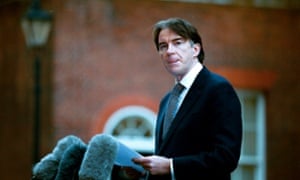
Peter Mandelson announcing one of his resignations, in 2001. Photograph: David Sillitoe
Their careers then diverged in two respects. Portillo, whose party was in power throughout the years 1979-97, became a cabinet minister in his late 30s, just after Mandelson had entered parliament as a backbench MP. And whereas Portillo was famously the most swaggery politician of his generation (especially after John Major had appointed him defence secretary in 1995), Mandelson was the ultimate scheming “backroom boy”, whose achievement was to engineer Tony Blair’s succession as Labour leader and steer the “New Labour” brand to its great electoral triumph in 1997. (Mandelson worshipped Blair much as Portillo had worshipped Thatcher.) Both performed great services for their parties while becoming widely unpopular: Portillo’s loss of his supposedly safe London seat was the great shock of the 1997 election, while Mandelson, regarded by many as “a prince of darkness”, was twice made to resign from the cabinet during Blair’s first term of office owing to minor transgressions. Both made comebacks: Portillo (having experienced a Damascene conversion and become a “compassionate Conservative”) returned to parliament in 1999 and was appointed shadow chancellor by William Hague, whom he was widely expected to succeed as Conservative leader; while Mandelson, having become an EU commissioner in 2004, was recalled to the cabinet with a peerage by Gordon Brown in 2008, showing brilliance as a strategist during Labour’s last two years of office. (Though effectively retired from frontline politics, both made their voices heard during and after the recent election campaign.)
Both Portillo and Mandelson enjoyed the company of women. In his late 20s, Portillo married the girlfriend of his teenage years, Carolyn Eadie; Mandelson shared a flat with Neil Kinnock’s press secretary, Julie Hall. However, it was widely known that Portillo, though enjoying relationships with women, had homosexual interests, while Mandelson was frankly gay. Portillo was attached during his 20s to two institutions in which homosexuality flourished, Peterhouse and the Conservative Research Department, and he did not hold himself entirely aloof from the opportunities offered. Mandelson had two longstanding close relationships, first with a fellow researcher at the TUC, later with the Brazilian Reinaldo da Silva, who was some years younger than himself. Within the space of a year, both their private lives were made public in a spectacular fashion. In 1998, Mandelson, not yet in the cabinet but wielding great (and, in the view of some, sinister) influence behind the scenes as the eminence grise of the Blair government, was inadvertently “outed” on the BBC’s Newsnight by the journalist and former MP Matthew Parris. And in 1999, Portillo, about to stand for re-election to Parliament, admitted in an interview with the Times that he had had “some homosexual experiences as a young person” – whereupon a businessman named Nigel Hart declared in the Mail on Sunday that they had had an affair lasting eight years. Although these revelations do not seem to have harmed Portillo’s standing with the public, concern among fellow Conservative MPs about possible further embarrassing disclosures undoubtedly contributed to his narrow failure to win the party leadership when Hague stood down after the Tory defeat in the 2001 general election.
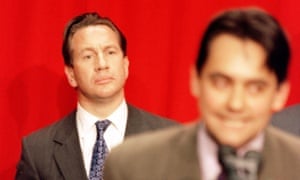
Michael Portillo listens to Stephen Twigg’s victory speech in Enfield Southgate in the 1997 general election. Photograph: Kevin Lamarque/Reuters
The climate for gay politicians showed some dramatic swings during the last quarter of the 20th century. Despite her Methodist upbringing and strait-laced image, Margaret Thatcher, who became prime minister in 1979, was quite tolerant of homosexuality: she was one of the few Tories consistently to support Wolfenden, chose many gay men to serve her, and appointed the flamboyant Norman St John Stevas as one of her leading ministers (though she became irritatated by his love of gossip and sacked him after less than two years). However, the espousal of gay rights by some elements of the left, and the Aids epidemic, resulted in much public disquiet about homosexuality during the 1980s. In the Bermondsey byelection of 1983, the openly gay Peter Tatchell managed to lose the supposedly safe Labour seat to the Liberal Simon Hughes (who later admitted to having gay relationships). In this atmosphere, no MP felt able to “come out” – with the brave exception of Chris Smith, Labour MP for Islington South and Finsbury. In 1988, Section 28 of the Local Government Act provided that a local authority “shall not intentionally promote homosexuality or publish material with the intention of promoting homosexuality”. Though heterosexual, John Major, who succeeded Thatcher in 1990, was favourable to the cause of gay equality. He lifted the ban on homosexuals in “high security positions”, and in 1994 the age of consent was reduced from 21 to 18. However, the great terror for gay MPs in the 1990s was of being “outed” by the press, something which would scarcely have been imaginable in previous decades. The decision of the Murdoch press to launch a “morality crusade” against the Major administration led to the resignation of several gay Tory MPs from minor government positions, and reinforced the impression that the regime was mired in “sleaze”. Meanwhile the militant gay organisation Outrage! targeted MPs it believed to be gay who failed to support gay equality, one of whom, the Ulster Unionist Sir James Kilfedder, died of a heart attack after learning of his “outing”.
New Labour, elected in 1997, promised a new era of “diversity” and “inclusiveness”. Labour candidates who triumphed in former Tory strongholds included two openly gay men, Stephen Twigg in Enfield Southgate (where he unseated Michael Portillo) and Ben Bradshaw in Exeter (where he won a large majority in the face of a homophobic Conservative campaign). Chris Smith became culture secretary and the first openly gay cabinet minister, his male partner being included in such official occasions as Buckingham Palace garden parties. Great strides were made in reforming the law. The ban on homosexuals in the armed forces was lifted; the age of consent was reduced to 16; Section 28 was repealed; civil partnerships were introduced, giving gay couples the same legal privileges as married couples; and a series of measures made it illegal to discriminate against people, or “incite hatred” against them, on the grounds of their sexual orientation.

Chris Smith at the Tate Modern in 2000. Photograph: Martin Argles for the Guardian
Yet in 1998 the Blair government witnessed one of the most bizarre gay scandals of the century, when Ron Davies, secretary of state for Wales, resigned after what he termed “a moment of madness” on Clapham Common, which had led to his being robbed at knifepoint and relieved of his wallet, phone, car and Commons pass. And the Conservative-Liberal Democrat coalition that took office in 2010, which was equally committed to the cause of gay equality and legislated for “gay marriage”, similarly suffered the loss of a cabinet minister when the Lib Dem David Laws resigned as chief secretary to the Treasury after the Daily Telegraph revealed that he had claimed parliamentary expenses for London accommodation belonging to his “long-term partner and secret lover”, a situation disallowed by the expenses rules; he explained that he had wished to keep his sexuality secret out of respect for the feelings of his mother. It seems the age of the political closet queen may not be quite dead yet.
***
Is a study of this subject historically or politically relevant? I believe it is, because until recently many politicians (possibly more than one might imagine, for the men in question usually did their utmost to ensure that no details of this aspect of their lives emerged) were obliged to keep secret something important about themselves. And this inevitably affected the way they operated as politicians: apart from inculcating quick wits and sharp antennae, it tended to foster skills in several areas – tact and discretion; acting and showmanship; the “dark arts” of presentation and manipulation; awareness and management of risk. Following the election, Westminster now boasts 32 openly gay MPs and while one must be thankful that, in Britain, official homophobia is a thing of the past, and that gay men and women, in politics as elsewhere, can now be honest about their sexuality, the necessity for homosexuals in public life to hide their nature, though in itself deplorable, did not, perhaps, exercise an entirely negative influence on the 20th-century political scene.
• Michael Bloch’s Closet Queens is published by Little, Brown this month.
Be careful where you wash your hands
Editorial: Cottaging is a British gay slang term referring to anonymous sex between homosexual men in a public lavatory (a “cottage”, “tea-room” or “beat“), or cruising for sexual partners with the intention of having sex elsewhere. The term has its roots in self-contained English toilet blocks resembling small cottages in their appearance; in the English cant language of Polari this became a double entendre by gay men referring to sexual encounters.
According to Roger Casement’s diaries, from 1903 to 1911, the gay cruising areas in Belfast were at the Albert Clock (probably also around the Customs House toilet), Botanic Gardens, Ormeau Park, and the Giants Ring. Cottaging went on in Victoria Square in an elegant wrought iron edifice (which was still operating in the 1960s and may be in the Ulster Folk Museum) and at the Gasworks.
Cottaging is not something that is recommended as the police will take action, and in the past this had led to prosecution and unfortunately to individuals feeling so threatened by this that they have committed suicide.
The Rainbow Project offers a free Safer Sex Packs delivered direct to your address in Northern Ireland. To receive these please fill in the form on their website. You are eligible to receive our free Safer Sex Packs if you identify as the following:
-
A Gay, Bisexual or Man who has Sex with Men (MSM) living in Northern Ireland
Want to find out more about where to get condoms?
You can get free condoms from:
-
Brook NI if under 25 – www.brook.org.uk
-
Rainbow Project Belfast and Foyle Offices
-
Partner Bars and Clubs
-
GUM Clinics and Community Pharmacies
0-0-0-0-0-0-0-0
Pensioner who groped burly trucker after mistaking lay-by for gay hook-up spot guilty of sex assault

The Mirror : 15:39, 11 April 2015 By Nick Towle
The horrified victim thought Dennis Cockerill, 82, was asking for directions before he began touching his legs and crotch
Guilty: Cockerill said he wanted to “verify” rumours the lay-by was a gay sex hotspot
A randy pensioner who groped a trucker after he mistook a lay-by for a gay hook-up spot has been convicted of sex assault.
Dennis Cockerill, 82, stopped at the Skipbridge lay-by in Hammerton Green, near Harrogate, looking for “a bit of fun”, a court heard.
He approached the victim, a burly lorry driver in his 40s, believing he was also a sex cruiser, York Crown Court was told.
But Cockerill was misinformed, and the Yorkshire trucker had stopped in the lay-by to load some pig feed onto another wagon.
Prosecutor Paul Newcombe told a jury how Cockerill got up on the step at the side of the victim’s cab and began chatting him up, before reaching through an open window and touching him on the arm, his knee and then his crotch.
The horrified trucker nudged the lustful pensioner away and called the police, who turned up and arrested Cockerill.
Cockerill, from Kent, told officers he’d heard a rumour that the lay-by was used as a meeting placed for gay men and he wanted to “verify” this.
Read more at: http://www.mirror.co.uk/news/uk-news/pensioner-who-groped-burly-trucker-5499825
Book Review: The Official History of the Campaign for Homosexual Equality and its times; Volume 1: A Space to Breathe, 1954–1973

CHE of course did not arise from nothing. Scott-Presland begins with a short review of the “homophile” movements in Germany and the Netherlands and the United States, as well as the early British sex-reformers such as Edward Carpenter. Many early figures from the 1950s also played their roles in the early reforming development of the movement: Peter Wildeblood, Rupert Croft-Cooke, and the setting-up of the Wolfenden Committee which in 1957 recommended the decriminalisation of sex between consenting men over 21 in private, which was to become law in 1967. Hence the overriding focus of the early history of the gay movement was upon law reform, public education, and counselling; the vaguer concept of “equality” and an end to “discrimination” were still inchoate concepts in the 1950s and 1960s.
The two great figures of this early history are Allan Horsfall and Antony Grey. The two men typify the split that was to bedevil the gay movement: the North West Homosexual Law Reform Committee in Manchester, run by Horsfall, and the Homosexual Law Reform Society in London (run by Grey). It was essentially a class divide: working-class Northerners versus middle-class Southerners. The HLRS in particular was obsessed by “respectability” and was constrained by the feeling that it should not advocate anything that would be perceived to be too radical by the honorary members listed on its letterhead. This often meant that it could not focus specifically upon homosexuality, but had to be inclusive of all sexualities. The force behind all this was the Albany Trust, run by Antony Grey, with prominent heterosexual sexologists on its board. The Trust had to maintain the fiction that it was broadly concerned with all sexualities in order to receive funding from institutional donors and prominent individuals, even though in fact it was almost exclusively directed towards gays. One might say that Antony Grey was rather canny in thus achieving the main purpose, but the fact that “Antony Grey” never used his real name – Edgar Wright – in the public forum is symbolic of his “behind the scenes” approach to reform. Allan Horsfall, in contrast, was a working-class son of a publican and a prospective Labour Party candidate, and always used his real name and even published his home address. Nevertheless, the membership of the NWHLRC was also predominantly heterosexual at the beginning.
Both organisations, early on, were especially focused on counselling, dealing with the problems of self-loathing homosexuals in the closet, who had no way to meet others. This lack of meeting places – especially social and not just sexual sites – was a central concern for the gay movement for many years.
This is a history of people rather than a history of ideas. Although Scott-Presland gives individual spotlight biographies to all the major players in the movement – including Leo Abse, Glenys Parry, Griffith Vaughan-Williams, Peter Norman, Ray Gosley – it is difficult not to form the view that this early history consists of the working out of the tensions between just two men, Horsfall and Grey, as they struggle for the control or independence of their two organisations. At times the documentation of this early history consists simply of incestuous letters between Horsfall and Grey congratulating themselves on how many letters they have written to the press and on how many speaking engagements they had performed, and swapping newspaper cuttings documenting their achievements. There is hardly any sense that other people were involved in their campaigns. Horsfall was sometimes naively idealistic but a powerehouse for action, while Grey was more politically astute but over-cautious. The early campaigning efforts were regularly dampened by people like Antony Grey and Leo Abse (the MP who had pushed the 1976 Sexual Offences Act through Parliament) urging Allan Horsfall not to rock the boat. Even while the heterosexual membership of the Homosexual Law Reform Society dwindled and it became a modern gay campaigning group, nevertheless it became just the Sexual Law Reform Society in 1970, with a solitary secretary: Antony Grey.
Ironically it was the passing of the law in 1967 that led to organisational chaos in both the NWHLRC and the HLRS (and Albany Trust), for neither knew quite what to aim for once the law reform had been achieved. A “gay space” became a major focus, and many years would be spent in trying – and failing – to set up CHE-owned social clubs as a more healthy alternative to the commercial gay pub and club scene. These were to be called Esquire Clubs, and to be organised along the lines of the COQ clubs in Denmark, but CHE never quite succeeded in getting a brewery on board, and never raised enough money to fund physical premises. There was also the problem that Leo Abse and the Home Office specifically objected to the emergence of gay social clubs, which they felt would be an unwanted result of legalisation – the ideal result in their view would be for homsoexuals to lead discreet private lives rather than be publicly visible and associating with others. This, they felt, would result in separation rather than integration. Antony Grey, who always felt that VIPs and leaders of Society were necessary for the success of any campaign, came down opposed to social clubs; as a result the NWHLRC severed its relations with the Albany Trust, and the power and influence of the Albany Trust gradually declined.
By 1969 the NWHLRC had become CHE – the Committee for Homosexual Equality – a significant change from “law reform” to the wider issue of “equality”. (Though it wasn’t until 1971 that “Committee” was changed to “Campaign”.) The great mover behind this phase was Paul Temperton, whose social political background was typical of early CHE members: he worked for the British Humanist Association, the Manchester Non-Violent Action Group, the National Council for Civil Liberties, and the Anti-Apartheid movement. Social activism came to the fore while the counselling focus of the old school receded. For this period from 1968 to 1973 Scott-Presland gives a very detailed study of press campaigns, newspaper advertisements for membership, complaints to the Press Council, and meetings with local councils and institutions.
The proliferation of local CHE organisations becomes almost overwhelming. Each regional group is given its proper focus, because each region was autonomous, and there were always very weak links between the regional groups and the national CHE executive. This was perhaps its main failure as a campaigning organisation, but also its strength at encouraging social solidarity. The origins of each group are carefully documented; they were almost always started by an individual person who became the convenor (or a pair of lovers who became joint convenors) and who worked to get together a critical mass of about twenty members. While there were very formal links between each region and the national executive, there were virtually no links at all between one local group and another local group. Every would-be member of a group was vetted by a representative appointed by national headquarters – usually the talented journalist Roger Baker. Liverpool and Manchester remained strong regional powerhouses, but gradually the working-class membership was superseded by a middle-class membership, for reasons not fully explained, perhaps not even explainable. Advertising in newspapers and journals reached mainly a middle-class audience, hence recruited more middle-class members, and as CHE became more professional, it also became more middle-class. Also, women’s issues did not much occupy CHE, and it increasingly lost its lesbian membership.
A lengthy chapter on London systematically goes through each of its thirteen groups, often with extracts from interviews with its first convenors – notably Roger Baker, Brian Sewell, Peter Robins, Peter Norman, and Jackie Forster. Because of geographical concentration, the London groups all associated with one another (unlike groups scattered across the country outside London), and from April 1971 all the London groups held “mass meetings” at which larger goals and strategies were proposed, and work towards shared aims was distributed among groups. However, everything was still highly bureaucratic and hence cumbersome. Rules of debate dissipated too much energy.
One important product of these pan-London activities was the formation of the counselling group FRIEND. Individual convenors had lacked the professional skill and funds necessary for really effective counselling, hence the use of formally trained volunteers was a great advance. Money was raised for training and for staffing a telephone service, and maintaining offices. By the end of 1972 they had 50 befrienders, plus 12 professional therapists, a Centre in London, with branches in Manchester, Liverpool, and several other cities. During all of FRIEND’s activities, there was the inevitable power struggle between Antony Grey and the leaders of FRIEND regarding the future of homosexual counselling services. The Albany Trust refused to accept the structure proposed by FRIEND and stopped supporting it financially. FRIEND became independent and grew, while the Albany Trust became marginalised. (However, FRIEND would formally split from CHE in 1975–6 in order to obtain charitable status and government money, which was not possible while it remained allied with a campaigning organisation – a problem the Albany Trust had faced earlier.)
CHE continued essentially as a social support provider rather than a campaigning organisation. Each group was in effect a discussion group rather than a campaign group; a number of speakers regularly went around the circuit giving their talks, e.g. Roger Baker talking on drag (on which he had written a book). In addition to the regular Discussion meetings, there were regular Winter Fairs, Winter Talks, Jumble Sales, Summer Balls, coach trips, Christmas parties, bingo and lotteries, and a host of events very similar to those organised by the ladies of the Women’s Institutes. As the London groups expanded, some became special interest groups for those interested in music, writing, film, sports, rambling, bird-watching, and so on. These were hardly political action groups. The long-lived London Monday Group met at the Chepstow Arms in Notting Hill for over 15 years, with a regular programme of well-known speakers and lively disccussions, followed by drinks and socilising. Many long-term friendships were formed there, but it might be hard to document any specific “social change” it might have achieved. Scott-Presland argues (not very convincingly in my view) that these special interest groups were an important factor in the development of gay identity, specifically the notion of “being gay” while engaged in non-gay activities. By mid-1973 London CHE had some 20 local groups plus 15 special groups, with 1,000 members; CHE across the country had a total of some 70 local groups with 3,500 members.
So by late 1973, although the Campaign for Homosexual Equality did not create a coherent national campaigning movement with a coherent ideology, it nevertheless had succeeded in its main objective: the creation of “a gay space” in which people with a shared sexual orientation could come together in a broadly social space rather than a narrow subculture whose main aim was sex. This is not to say that sex was not important to the development of the friendship networks formed within CHE, but the real aim was a modus vivendi, a way of life, for homosexuals within society rather than a separate twilight world on the margins of society. The community it had helped forge was an astonishing achievement and deserves the full and careful treatment it receives here. The development of an effective campaigning organisation after 1973 will be the subject of the next volume in this projected three-volume official history.


Check out the amazing cakes baked by these school kids for LGBT History Month
The cakes were produced during the grand final of the ‘Ed-u-bake and Cel-a-cake’ Great Rainbow Bake Off: a UK-wide competition for students to help tackle LGBT prejudice

Scott Nunn
The live final of the inaugural Great Rainbow Bake-off competition took place at Stoke Newington School yesterday (6 February). The nationwide competition was launched for school children last year during the UK’s annual anti-bullying week.
Students were invited to bake a rainbow-themed cake or cupcakes and to send photos of the resulting treats to competition organizers, Educate & Celebrate.
From the submitted photos, ten finalists were selected. They were invited to the grand final yesterday, which was officially started by Elly Barnes, CEO and founder of Educate & Celebrate:
‘We welcome the 10 finalists, parents, teachers and families to our first live Great Rainbow Bake-off final. The standard was set in the heats and now we are ready for some top quality rainbow baking to celebrate ten years of LGBT History Month.’

Also on hand was Scott Nunn, Director of Gay Star News and one of the judges of the competition. The other judge was professional chef, Allegra McEvedy [pictured right]. The children were asked to bake a cake celebrating the theme of ‘LGBT History’.
Among the amazing entries produced on the day was one creation decorated with rainbow colored icing to mark ‘100 year LGBT milestones’, including ‘gender reassignment surgery’ and ‘same sex adoption’ as historical highlights.
Durham’s Hamsterley Primary School’s entry was a team effort by three students to produce ‘gender-bread’ men and LGBTI cupcakes on a journey to LGBTI inclusion. The concept was explained by the head teacher of the school, Damian Hassan:
‘This is about children working together to produce a coherent whole. Our school has been 100% behind the bake-off and everyone in the community has also been supportive.’
Prizes included a meal for four at Allegra McEvedy’s restaurant Blackfoot at Exmouth Market in London as well as two signed books by teen fiction author Hayley Long. All the children received ‘Educate & Celebrate’ aprons made by Zitta Lomax, a teacher supporting the event, and GayStarNews tote bags with cookery goodies.

Teachers at the school also got involved and brought their cakes in to be judged. The winner, Anna Gluckstein, produced a cake in memory of Alan Turing:
‘Celebrating LGBT History Month is part of the culture at Stoke Newington School and this bake-off has been a way of bringing staff and students together in a really positive way.’
All the judges agreed that the standard of entries was very high, with all the students demonstrating impressive skills.
At the end of the day Elly Barnes who was one of the judges said:
‘All the finalists produced thoughtful and inspiring cakes representing LGBT History,’ said Elly Barnes. ‘It was virtually impossible to choose a winner, however we all agreed that the cake which fulfilled all the criteria was the pink triangle cake by Jude from Stoke Newington School, which won on theme, style and taste!
‘It was a successful day and we are already looking forward to next years entries for anti-bullying week November 2015.’
Jude Costley’s cake was a bold and delicious design featuring multi-colored hundreds and thousands and bright pink triangles. Runners up were fellow Stoke Newington School pupil, Liam Charles, and Sadie Soverall, from London’s Emmanuel School in Battersea Rise.
‘It was an amazing and fun day,’ said Scott Nunn. ‘Congratulations to everyone who took part.’

The winning ‘Pink Triangle’ cake (above) by Jude Costley

Students were invited to bake a rainbow-themed cake or cupcakes and to send photos of the resulting treats to competition organizers, Educate & Celebrate.
From the submitted photos, ten finalists were selected. They were invited to the grand final yesterday, which was officially started by Elly Barnes, CEO and founder of Educate & Celebrate:
‘We welcome the 10 finalists, parents, teachers and families to our first live Great Rainbow Bake-off final. The standard was set in the heats and now we are ready for some top quality rainbow baking to celebrate ten years of LGBT History Month.’
Also on hand was Scott Nunn, Director of Gay Star News and one of the judges of the competition. The other judge was professional chef, Allegra McEvedy [pictured right]. The children were asked to bake a cake celebrating the theme of ‘LGBT History’.
Among the amazing entries produced on the day was one creation decorated with rainbow colored icing to mark ‘100 year LGBT milestones’, including ‘gender reassignment surgery’ and ‘same sex adoption’ as historical highlights.
Durham’s Hamsterley Primary School’s entry was a team effort by three students to produce ‘gender-bread’ men and LGBTI cupcakes on a journey to LGBTI inclusion. The concept was explained by the head teacher of the school, Damian Hassan:
‘This is about children working together to produce a coherent whole. Our school has been 100% behind the bake-off and everyone in the community has also been supportive.’
Prizes included a meal for four at Allegra McEvedy’s restaurant Blackfoot at Exmouth Market in London as well as two signed books by teen fiction author Hayley Long. All the children received ‘Educate & Celebrate’ aprons made by Zitta Lomax, a teacher supporting the event, and GayStarNews tote bags with cookery goodies.
Teachers at the school also got involved and brought their cakes in to be judged. The winner, Anna Gluckstein, produced a cake in memory of Alan Turing:
‘Celebrating LGBT History Month is part of the culture at Stoke Newington School and this bake-off has been a way of bringing staff and students together in a really positive way.’
All the judges agreed that the standard of entries was very high, with all the students demonstrating impressive skills.
At the end of the day Elly Barnes who was one of the judges said:
‘All the finalists produced thoughtful and inspiring cakes representing LGBT History,’ said Elly Barnes. ‘It was virtually impossible to choose a winner, however we all agreed that the cake which fulfilled all the criteria was the pink triangle cake by Jude from Stoke Newington School, which won on theme, style and taste!
‘It was a successful day and we are already looking forward to next years entries for anti-bullying week November 2015.’
Jude Costley’s cake was a bold and delicious design featuring multi-colored hundreds and thousands and bright pink triangles. Runners up were fellow Stoke Newington School pupil, Liam Charles, and Sadie Soverall, from London’s Emmanuel School in Battersea Rise.
‘It was an amazing and fun day,’ said Scott Nunn. ‘Congratulations to everyone who took part.’
The winning ‘Pink Triangle’ cake (above) by Jude Costley
Sadie Soverall
An entrant with her ‘Lesbians Do Exist’ cake

Liam Charles and his runners-up entry

A cake inspired by artist Frida Kahlo

Sadie Soverall with her colorful runners-up entry

‘Genderbread people’!

Scott Nunn, Allegra McEvedy and Elly Barnes judge the cakes

The finalists and their finished entries

Photos by Samantha Hayhurst and Scott Nunn
– See more at: http://www.gaystarnews.com/article/check-out-amazing-cakes-baked-these-school-kids-lgbt-history-month070215#sthash.MdsHYgTs.dpuf
Floral Hall – Belfast
On Wednesday 21, 2015 Linda Stewart wrote in the Belfast Telegraph about the Floral Hall at Bellvue and the campaign to try and save it and restore it to its past glory. Having read the article, and looked at the Facebook campaign page, with its photos, I got to wondering how many of you remember going to any of the events at the Floral Hall, was there a ‘scene’ , albeit hidden, at the Floral Hall.
Why not write an let us know your memories, and with your permission we will print them
The Floral Hall, was built in the 1930s and was used as a dance hall for many years.
Located within the grounds of the zoo is a 1930s art deco ballroom, the Floral Hall. The Hall was popular venue in its time and during the war the Hall had blackouts fitted to the windows so that dances could continue. In the 1960s, the hall was visited by musical artists such as Pink Floyd and Small Faces. The Floral Hall closed to the public on 2 April 1972 and has remained derelict since the outbreak of the Troubles in the 1970s.
During the 1990s the Floral Hall had been given Listed Building Status.
In December 2011 saw the creation of a Facebook page based around sharing old photos of the Floral Hall including interior shots of the hall today, the following year an online petition, addressed to the City Council was created to help raise awareness and to progress with the restoration project of the hall.
With such an iconic building, and the fact that it was a venue for so many different kind of events, I wonder how many of the LGBT community in Ireland, or anywhere for that matter, can remember going to any kind of event. If you do why not write to us letting us know your memories.
University Supports LGBT History Month
 The question that this article raises, is will either of our universities in Northern Ireland take up the challenge and support LGBT History Month this year and in the future years. Queen’s University and the Ulster University talk about doing things, but isn’t it about time that they actually did something that stands out in support of our LGBT community?
| Published: 26th January 2015 11:28 |
LGBT History Month takes place every year in February. It celebrates the lives, achievements and promotes awareness of the LGBT community.
As part of the celebrations the University and Portsmouth, supported by the LGBT Staff Forum, is supporting a range of events through the month open to all staff and students:
- Tuesday 3-Thursday 26 February. In partnership with Portsmouth Film Society, the University will be hosting the ‘Pride LGBT Film Festival’. One of the highlights will the opening night screening on Tuesday 3 February of the recent film release Pride, a historical comedy-drama film about UK gay activists work to help miners during their lengthy strike in the Summer of 1984. Mike Jackson, the original chairperson of ‘Lesbians and Gays Support the Miners’ and one of the main characters portrayed in the film, with be attending and taking a Q&A after the screening. This in one of seven films being shown throughout the month.
- Wednesday 11 February. A public lecture by Peter Tatchell, political campaigner best known for his work with LGBT social movements – despite great progress on LGBTI rights in the UK, there are still injustices. Same-sex marriage is separate and unequal to marriage. Equality laws have exemptions for religious organisations. Hundreds of thousands of people are victims of homophobic hate crime and bullying in schools. Many geniune LGBTI refugees are detained and refused asylum. HIV and sex and relationship education mostly ignores LGBTI pupils. Much more needs to be done to secure LGBTI acceptance, equality and inclusion.
- Wednesday 18 February. Hosted by the University and Portsmouth City Council, an evening panel event at John Pounds Community Centre, on LGBT equality and prize-winning film screening. Chaired by Dr Páraic Finnerty, speakers include: Dr Soozi Mead, ‘Historians on LGBT History’; Dr Sue Bruley , ‘Uppity women: Lesbians in the Women’s Liberation Movement in 1970s Britain’; Dr Paul Flenley, ‘Gay Rights in Russia: the cultural and political context’; Dr Deborah Shaw, ‘A whistle-stop tour of lesbians on screen’. Film: Sweat (15mins, Dir: John Lochland).
Full details of all events and booking arrangements can be found at http://www.port.ac.uk/departments/services/equalityanddiversity/staffforums/lgbtstaffforum/
Further Reading:
Y-fronts celebrate 80th birthday
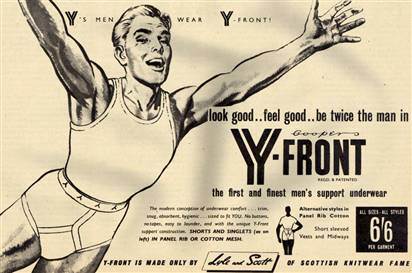

Undated handout photo issued by Jockey International of a model wearing Y-fronts
The Y-front is set to celebrate its 80-year history which has seen it go from a hurriedly-removed window display in a Chicago department store to underwear staple for men the world over.
Arthur Kneibler’s Jockey briefs first went on sale on January 19, 1935 at the Marshall Field & Co department store, placed on show in the window during one of the worst blizzards of the winter.
The store’s managers promptly demanded the display be removed, thinking it ridiculous to flaunt such a skimpy design in the middle of winter – but not before customers had snapped up 600 pairs.
Some 30,000 pairs were sold in the next three months alone.
Mr Kneibler, the vice president of marketing at a company called Coopers, was inspired by a picture of a man in a sleek, supportive swimsuit, going on to encourage his design team to create a new kind of underwear called “the brief”.
The only successor to the long john had been the boxer short, a cotton version of trunks worn by boxers.
They did not sell well with customers due to their lack of support, but the “jock strap”, mostly worn by the jockeys or messengers who rode penny farthings, did.
Mr Kneibler named his new creation the Jockey brief, and Coopers is now known as Jockey International.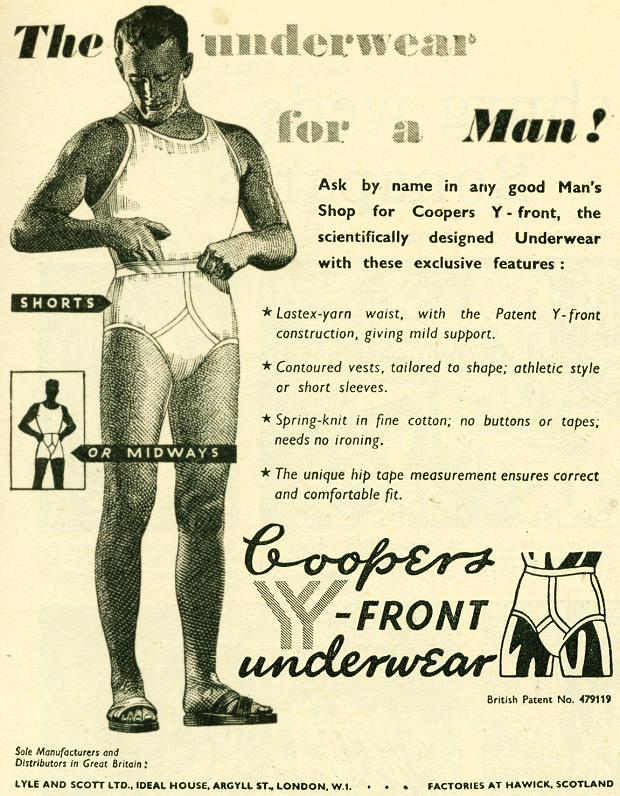
They went on sale in Britain in 1938, at Simpsons in Piccadilly, where they sold at a rate of 3,000 a week.
In 1948 every male athlete in the British Olympic team was given a free pair of Y-fronts.
To date, it has been banned for being too skimpy, survived the recession to outsell its more glamorous cousin the boxer short and has become a Christmas staple across the world for men of all ages.
According to Debenhams, sales of Y-fronts increased by 35% in 2009 and outsold boxer shorts in March of that year for the first time since the early 1990s – the last time Britain was in recession.
Three years earlier, a pair of 37-year-old Y-fronts were sold in the UK on eBay for £127.
A second pair sold for £90 to a buyer in Hong Kong.
Jockey marketing manager Ruth Stevens said: ” Although competition from the boxer is fierce, time and time again the Y-front has been used in ultra-masculine ads and films, such as From Russia With Love when they appeared on the ultimate man’s man James Bond in 1963, all the way up to 2012 where Zac Efron spent much of his time in them in the film The Paperboy.
 “This positioning of the Y-front as masculine yet practical ensures its popularity remains high.
“Underwear trends seem to be coming full circle as we head back towards the classics. Y-fronts are cool.”