ACOMSDave

Community Journalist

  • Home
  • Community Journalist
  • Events
  • Media Page and Press Kit
    • Projects and Work
  • Resources & Documents
    • LGBTQ+ Support Groups and Documents
  • NIGRA
  • Archives
  • Contact

Loving Comrades by Paul Salveson

23/06/2015 By ACOMSDave Leave a Comment


Publisher: P.Salveson (Aug. 1984)

Lancashire’s Links to Walt Whitman

This book sets out to investigate the history of socialism in Bolton, and of some of the famous people who were involved in the movement, or adopted by it, in it’s early years.
I came to this fifteen page book with a fresh mind and no preconceived ideas or knowledge.  I found it to be well linked together, with the test interspersed carefully chosen b&w photographs.  But, it is unfortunate that a book of such wide interest should be faulted by spelling mistakes and word omission.  These are not sufficient to affect the readability of the book, but do lower the standard of an obviously well researched and written book.
For the gay community, the book is well worth a delve for it’s comments and outlook on Edward Carpenter and the rest of the literacy group that was part of the movement.
I think ‘Loving Comrades’ is worthwhile reading; and it has been thought provoking enough to leave me wanting to know more about all the people referred to, and their writing also.


Filed Under: Book Reviews Tagged With: Bolton, Loving Comrades, Paul Salveson, Socialism

Out of the Winter Gardens

23/06/2015 By ACOMSDave Leave a Comment


Publisher: Verulam Publishing Ltd; paperback / softback edition (Sept. 1984)
By David Rees
This book, Out of the Winter Gardens,  is up to the normal David Rees standard, well written and constructed, however, I do feel that the ‘gay’ content is limited and publicised beyond it’s actual content.
You feel sympathy for Mike during his investigative adolescence; despair for his father Jo who appears to be lacking in a deep-rooted characters and some loathing for Adrian the harpist.
If you enjoy a well-written book, and don’t look for real characters, this book is for you.


Filed Under: Book Reviews Tagged With: David Rees, Out of the Winter Gardens, The Olive Press, Verulam Publishing Ltd

Book Review: Sticky White Label by Paul Culshaw

23/06/2015 By ACOMSDave Leave a Comment

Now former Liverpool drag queen Paul Culshaw has written a book to help others beat the labels – Sticky White Label

Paul Culshaw who has written a book about gay bullying
Paul Culshaw’s life has been filled with extremes. As a young child, lonely and tormented for being different; as a teenager struggling to come to terms with being gay, subjected to a primitive exorcism to drive out the ‘demons’ of homosexuality.
He went on to become Liverpool’s most reluctant drag queen DJ, never quite fitting the extravagant persona he created.
“I went from this isolated little boy to born again Christian, then child soap actor to being Whitney Wide-On,” he smiles. “So when I thought about it, there was quite a lot of scope and stories to tell.”
Now 31, Paul sat down to write down a collection of his experiences, anticipating a mix of anecdotes and fun recollections.
“It was only when I wrote them all down, these emotions started to come out and I began to recognise quite a sad troubled character,” he explains. “That was when I tapped into the bullying and low self-esteem, and how that still affects me on a daily basis as an adult and what I was writing became part autobiography and part self-help book.”
The result, Sticky White Label, is, he says: “raw, painfully honest and finishes on a very positive, uplifting note that we can defeat the bullies and we can live with and overcome our mental health issues. And it challenges gay slurs and labels which can be hard to shake off, hence the title.”

A quote from Paul Culshaw’s book Sticky White Label
Sticky White Label traces Paul’s life from infant and primary school years spent struggling to be accepted.
Brought up by a single mum in Crosby, she would often take him to the park to play. “I always wanted to connect with other children because I was an only child, and I was very polite, but when I asked to join in the games they’d always say ‘no, you talk like a girl.’
“So I was aware, even at five or six, that there was something different about me, even though I didn’t understand what it was. I’d spend every lunchtime at school walking round doing laps of the playground, just looking at the clock because it felt like the break went on forever.”
When he won an assisted place at Merchant Taylor’s Boys School he begged his mum not to send him.
“I knew what it would be like because boys didn’t like me, but with hindsight I’m grateful that I went there because I got a wonderful education and I think I probably would have had a tough time whatever school I’d gone to.”
The bullying and rejection was constant, he says. “And the name calling. I remember being on the bus and the word faggot used to terrify me because that was the word that meant I was going to get beaten up.”
Landing a role in C4 soap Springhill only served to draw more unwanted attention, but it wasn’t until he was 14 that he finally found the courage to come out as gay.
“I was a born again Christian and I remember going to one of the girls and asking her to pray with me because I’d been having thoughts about boys and I was attracted to them,” he recalls. “It must have taken me about half an hour to get the sentence out, I was so terrified.”
The girl he chose to confide in was supportive, but his experience within the church wasn’t always so positive.

Paul Culshaw’s take on self-esteem from Sticky White Label
“I was ostracised by some of the group for confessing my gay feelings, and they had a private exorcism. I didn’t realise what it was at the time, I thought it was just a prayer meeting, but looking back it was like a bad Hollywood horror movie. There were people praying and commanding the demon of homosexuality to leave my body in Jesus’ name.
“I think they were trying to help a troubled soul in the best way they could, and some of those people are still very good friends of mine, but the experience was traumatic and it stayed with me.”
Paul’s life took a positive turn when he found friendship with his mum’s hairdresser who was also gay. “He was a confident, successful person and a great example of someone who was happy in themselves so it gave me hope,” he explains.
Since leaving school to pursue a career as an actor/DJ and writer, Paul has continued struggle with panic attacks and low self-esteem.
“They are daily challenges I’ve learned to live with and manage,” he says. “And so much stems from the bullying and being made to feel ashamed when I was younger.

Paul as drag queen DJ Whitney Wide-On
“Even when I was Whitney Wide-On, working at G-Bar for six years, I realised that a lot of those one-liners and the sharp witty comebacks came from learning to defend myself. They were from a negative place, that’s why I was never truly happy doing it. The other drag queens were very comfortable in their job, in the sequins and the glamour, and I was envious of that but it was just a character to me and I couldn’t wait to be Paul again.”
Whitney features in Sticky White Label, but for now at least her lipstick and Lily Savage wig are consigned to Paul’s past.
As for the future, he hopes that the book can help anyone going through bullying or suffering chronic anxiety and go some way to dispelling the lingering harm of labels.
“We all get labelled don’t we?” he says. “Not just for being gay, for being different in any way, but the book isn’t all doom and gloom, it does have a happy empowering ending. I’d just love to think people relate to my experiences and they could help someone else. I might not be famous or in the public eye, I’m not Cheryl Fernandez-Versini, but that doesn’t mean my life is any less valid!”
* Sticky White Label is available on amazon.co.uk. £3 from each book sale goes to PACE (LGBT mental health), Ditch The Label, (anti-bullying) and The British Heart Foundation.

Filed Under: Book Reviews Tagged With: Paul Culshaw, Sticky White Label

New Book Releases: June 2015.

23/06/2015 By ACOMSDave Leave a Comment

GAY YA

LGBTQIA+ CHARACTERS IN YOUNG ADULT LITERATURE

New book releases June 1st (USA)
Love Spell by Mia Kerick — (G,Q)

Love Spell (Cool Dudes Publishing, 2015)

Love Spell (Cool Dudes Publishing, 2015)

Goodreads Summary: “Strutting his stuff on the catwalk in black patent leather pumps and a snug orange tuxedo as this year’s Miss (ter) Harvest Moon feels so very right to Chance César, and yet he knows it should feel so very wrong.
As far back as he can remember, Chance has been “caught between genders.” (It’s quite a touchy subject; so don’t ask him about it.) However, he does not question his sexual orientation. Chance has no doubt about his gayness—he is very much out of the closet at his rural New Hampshire high school, where the other students avoid the kid they refer to as “girl-boy.”
But at the local Harvest Moon Festival, when Chance, the Pumpkin Pageant Queen, meets Jasper Donahue, the Pumpkin Carving King, sparks fly. So Chance sets out, with the help of his BFF, Emily, to make “Jazz” Donahue his man.
An article in an online women’s magazine, Ten Scientifically Proven Ways to Make a Man Fall in Love with You (with a bonus love spell thrown in for good measure), becomes the basis of their strategy to capture Jazz’s heart.
Quirky, comical, definitely flamboyant, and with an inner core of poignancy, Love Spell celebrates the diversity of a gender-fluid teen.”
Cool Dudes Publishing / Amazon
June 2nd (USA)
*GAY YA’S BOOK CLUB PICK FOR JUNE!*
More Happy Than Not by Adam Silvera — (G)

More Happy Than Not (Soho Teen, 2015)

More Happy Than Not (Soho Teen, 2015)

Goodreads Summary: “Part Eternal Sunshine of the Spotless Mind, part Aristotle and Dante Discover the Secrets of the Universe,Adam Silvera’s extraordinary debut novel offers a unique confrontation of race, class and sexuality during one charged near-future summer in the Bronx.
When it first gets announced, the Leteo Institute’s memory-alteration procedure seems too good to be true to Aaron Soto—miracle cure-alls don’t tend to pop up in the Bronx projects. Aaron can’t forget how he’s grown up poor, how his friends all seem to shrug him off, and how his father committed suicide in their one bedroom apartment. He has the support of his patient girlfriend, if not necessarily his distant brother and overworked mother, but it’s not enough.
Then Thomas shows up. He doesn’t mind Aaron’s obsession over the Scorpius Hawthorne books and has a sweet movie set-up on his roof. There are nicknames. Aaron’s not only able to be himself, but happiness feels easy with Thomas. The love Aaron discovers may cost him what’s left of his life, but since Aaron can’t suddenly stop being gay Leteo may be the only way out.”
Amazon / Book Depository / Indie Bound
June 2nd (USA)

Skyscraping (Philomel Books, 2015)

Skyscraping (Philomel Books, 2015)

Skyscraping by Cordelia Jensen — (Gay parent)
Goodreads Summary: “A heartrending, bold novel in verse about family, identity, and forgiveness.
Mira is just beginning her senior year of high school when she discovers her father with his male lover. Her world–and everything she thought she knew about her family–is shattered instantly. Unable to comprehend the lies, betrayal, and secrets that–unbeknownst to Mira–have come to define and keep intact her family’s existence, Mira distances herself from her sister and closest friends as a means of coping. But her father’s sexual orientation isn’t all he’s kept hidden. A shocking health scare brings to light his battle with HIV. As Mira struggles to make sense of the many fractures in her family’s fabric and redefine her wavering sense of self, she must find a way to reconnect with her dad–while there is still time.
Told in raw, exposed free verse, Skyscraping reminds us that there is no one way to be a family.
Amazon / Book Depository / Barnes & Noble
June 4th (USA)
The Geek and His Artist by Hope Ryan — (G)

The Geek and His Artist (Harmony Ink, 2015)

The Geek and His Artist (Harmony Ink, 2015)

Goodreads Summary: “Simon Williams spends his lunch periods drawing his geek and trying not to think about the terrors waiting for him at home. He needs to get away from his abusive father before he suffers the same grisly fate as his mother. Because he’s learned the hard way running away doesn’t work, he’s counting the days until his eighteenth birthday.
Jimmy Bennet should be spending his lunch studying so his senior GPA is good enough to get him into college, but he can’t seem to focus thanks to his distracting artist. When he’s given the opportunity to tutor Simon in Trig and discovers Simon’s home-life nightmare, he wants nothing more than to get Simon out of danger. This need becomes more urgent when Simon comes to school the Monday after their first date with bruises, but it takes a broken leg before Jimmy can convince his boyfriend the Bennets really want him.
But the danger Simon thought was past shows up at the most unexpected time, and he must stand up to the fears he’s held so long to protect not only himself, but the man he wants to spend his life with.”
Harmony Ink Press / Amazon
June 5th (UK)

Starring Kitty (Catnip Publishing, 2015)

Starring Kitty (Catnip Publishing, 2015)

Starring Kitty by Keris Stainton (Middle Grade – L)
Goodreads Summary: “Sometimes the greatest love stories happen behind the scenes…
Kitty’s keeping secrets. Like how she’s struggling to cope with her mum’s illness. And how she’s falling for the girl with the purpley-red hair… A fun film competition with her friends Sunny and Hannah seems like the perfect distraction. But then Dylan wants to be more than Kitty’s secret. Is Kitty ready to let her two worlds meet or will she risk losing Dylan forever?
Starring Kitty is the first in a new series about first love and friendship by much-loved teen author Keris Stainton.”
Book Depository
 
June 9th (USA)
The Rules of Ever After by Killian B. Brewer — (G)

The Rules of Ever After (Duet, 2015)

The Rules of Ever After (Duet, 2015)

Goodreads Summary: “The rules of royal life have governed the kingdoms of Clarameer for thousands of years, but Prince Phillip and Prince Daniel know that these rules don’t provide for the happily ever after they seek. A fateful, sleepless night on top of a pea set under twenty mattresses brings the two young men together and sends them on a quest out into the kingdoms.
On their travels, they encounter meddlesome fairies, an ambitious stepmother, disgruntled princesses and vengeful kings as they learn about life, love, friendship, and family. Most of all, the two young men must learn to know themselves and how to write their own rules of ever after.
The Rules of Ever After is the debut novel from Duet Books, an imprint for Young Adult LGBTQ fiction from Interlude Press.”
Amazon / Book Depository / Barnes & Noble
June 11th (USA)

The History of Us (Harmony Ink, 2015)

The History of Us (Harmony Ink, 2015)

The History of Us by Nyrae Dawn — (G)
Goodreads Summary: “Sometimes it’s not about coming out, it’s about settling in.
Eighteen-year-old Bradley Collins came out a year ago and hasn’t looked back since. Who cares if he doesn’t know any other gay people? Bradley has friends and basketball—that’s all he needs. Even if that means always sitting on the sidelines when the guys go out looking for girls.
When cute film-boy TJ tries to flirt with Bradley while his friends are doing their thing, he freaks. Yeah, he’s gay, but he’s never had the opportunity to go out with a boy before. He’s never had to worry about how his friends will react to seeing him with a guy.
Bradley accompanies TJ on a road trip to film TJ’s senior project documentary. In each city they visit, they meet with people from different walks of life, and Bradley learns there’s a whole lot more to being honest about himself than just coming out. He still has to figure out who he really is, and learn to be okay with what he discovers.”
Harmony Ink Press / Amazon
June 16th (USA)
Glittering Shadows (Dark Metropolis #2) by Jaclyn Dolamore — (book#1 featured L and A characters)

Glittering Shadows (Disney Hyperion, 2015)

Glittering Shadows (Disney Hyperion, 2015)

Goodreads Summary: “The revolution is here.
Bodies line the streets of Urobrun; a great pyre burns in Republic Square. The rebels grow anxious behind closed doors while Marlis watches as the politicians search for answers—and excuses—inside the Chancellery.
Thea, Freddy, Nan, and Sigi are caught in the crossfire, taking refuge with a vibrant, young revolutionary and a mysterious healer from Irminau. As the battle lines are drawn, a greater threat casts a dark shadow over the land. Magic might be lost—forever.
This action-packed sequel to Dark Metropolis weaves political intrigue, haunting magic, and heartbreaking romance into an unforgettable narrative. Dolamore’s lyrical writing and masterfully crafted plot deliver a powerful conclusion.”
Amazon / Barnes & Noble / Indie Bound
June 23th (USA)

The Rise and Fall of a Theater Geek (Random House Books for Young Readers, 2015)

The Rise and Fall of a Theater Geek (Random House Books for Young Readers, 2015)

The Rise and Fall of a Theater Geek by Seth Rudetsky — (G)
Goodreads Summary: “Broadway, New York. The shows, the neon lights . . . the cute chorus boys! It’s where Justin has always wanted to be–and now, with a winter internship for a famous actor, he finally has his chance to shine. If only he could ditch his kind, virtuous, upright, and–dare he say it?—uptightboyfriend, Spencer. But once the internship begins, Justin has more to worry about than a cramped single-guy-in-the-city style. Instead of having his moment in the spotlight, he’s a not-so-glorified errand boy. Plus, Spencer is hanging out with a celebra-hottie, Justin’s best friend Becky isn’t speaking to him, and his famous actor boss seems headed for flopdom. Justin’s tap-dancing as fast as he can, but all his wit and sass might not be enough to switch his time in New York from nightmare-terrible to dream-come-true terrific.
Seth Rudetsky’s second YA novel is endearingly human, laugh-out-loud funny, and for any kid who’s ever aspired to Broadway but can only sneak in through the stage door. ”
Amazon / Barnes & Noble / Indie Bound
June 30th (USA)
Under the Lights by Dahlia Adler — (B, L)

Under the Lights (Spencer Hill Contemporary, 2015)

Under the Lights (Spencer Hill Contemporary, 2015)

Goodreads Summary: “Josh Chester loves being a Hollywood bad boy, coasting on his good looks, his parties, his parents’ wealth, and the occasional modeling gig. But his laid-back lifestyle is about to change. To help out his best friend, Liam, he joins his hit teen TV show, Daylight Falls…opposite Vanessa Park, the one actor immune to his charms. (Not that he’s trying to charm her, of course.) Meanwhile, his drama-queen mother blackmails him into a new family reality TV show, with Josh in the starring role. Now that he’s in the spotlight—on everyone’s terms but his own—Josh has to decide whether a life as a superstar is the one he really wants.
Vanessa Park has always been certain about her path as an actor, despite her parents’ disapproval. But with all her relationships currently in upheaval, she’s painfully uncertain about everything else. When she meets her new career handler, Brianna, Van is relieved to have found someone she can rely on, now that her BFF, Ally, is at college across the country. But as feelings unexpectedly evolve beyond friendship, Van’s life reaches a whole new level of confusing. And she’ll have to choose between the one thing she’s always loved…and the person she never imagined she could.”

Filed Under: Book Reviews

LGBTQ YA by the Numbers: Gender and Genre

23/06/2015 By ACOMSDave Leave a Comment


After seeing an ask about speculative fiction with LGBTQ+ protagonists on the Gay YA tumblr a few weeks ago, I got curious, so I did what I often do in circumstances like these: I went through the masterlist to figure out just how much LGBTQ+ speculative fiction was on it. Thinking about speculative fiction numbers got me thinking about other numbers, so I thought it might be interesting to do a gender breakdown as well. This turned into a slightly more involved project (“more involved” meaning “I had to count more books”, basically). These numbers are based on the list as it stood on 21 April, 2015; they would look (slightly) different if recalculated today.
Totals
I’m going to go down the list from most books to least books.
Gay: 315 books

  • male author: 174.5 (55.4%)
  • female author: 130.5 (41.4%)
  • non-binary author: 0 (0%)
  • multi-author anthology: 7 (2.2%)
  • anonymous: 1 (0.3%)
  • I couldn’t find out: 3 (1.0%) (two books by M.C. Lee and one by R.J. Seeley)

While a majority of books about gay male characters are written by men, a significant portion of them are written by women (a far, far greater percentage than the numbers for books about lesbians written by men, as we’ll see in a moment).
That said, my initial perception that the majority of the books in the Gay section of the masterlist were written by women was, obviously, very wrong — it’s clear I fell victim to the 17%/33% fallacy (if you’re reading this, are a man, and haven’t heard about this, I’d highly recommend reading the article; it really opened my eyes to the limitations of my perception and is the reason that in contexts like this my approach is to actually count so I have accurate numbers instead).
I’d be very interested to hear from authors about why they chose to write the stories they wrote (as opposed to writing stories about non-straight female characters).
Lesbian: 203 books

  • male author: 13 (6.4%)
  • female author: 172 (84.7%)
  • non-binary author: 1 (0.5%) (S.J. Adams)
  • multi-author anthology: 15 (7.4%)
  • I couldn’t find out: 2 (1.0%) (two books by Ari Bach)

These percentages become even starker if you exclude the anthologies: over 90% of the non-anthologies were written by women.
Bisexual: 81 books

  • male author: 21.5 (26.5%)
  • female author: 58.5 (72.2%)
  • non-binary author: 0 (0%)
  • multi-author anthology: 1 (1.2%)

A further breakdown of the bi books by the gender of the bi character (and character gender vs. author gender) would be very interesting, but that will have to wait for another time.
Transgender: 38 books

  • male author: 6.5 (17.1%)
  • female author: 26.5 (70.0%)
  • non-binary author: 2 (5.3%) (one book by Sassafras Lowry and one by Rae Spoon)
  • multi-author anthology: 3 (7.9%)

The same note as for the bi books applies here, as well.
Asexual/Aromantic: 19 books

  • male author: 2 (11%)
  • female author: 17 (89%)
  • non-binary author: 0 (0%)
  • multi-author anthology: 0 (0%)

Caveat: the ace/aro section of the masterlist includes non-YA books, in deference to the rarity of ace/aro representation in YA, so take these numbers with a grain of salt.
Intersex: 6 books

  • male author: 0 (0%)
  • female author: 6 (100%)
  • non-binary author: 0 (0%)
  • multi-author anthology: 0 (0%)

There are so few books with intersex characters. Hopefully that will change in future.
Genre
I’ve included a gender breakdown here, as well. For the purposes of this list, I counted all forms of speculative fiction: high fantasy, urban fantasy, paranormal stuff, science fiction, postapocalyptic and/or dystopian books, magical realism, etc. Not included are things like thrillers, historical fiction, sports books, and the like. Again, I’m going to go through by number of books.
Gay: 76 (24.1% of total)

  • male author: 39 (51.3% of genre)
  • female author: 33 (43.4% of genre)
  • multi-author anthology: 2 (2.6% of genre)
  • I couldn’t find out: 2 (2.6% of genre) (two books by M.C. Lee)

Lesbian: 58 books (28.6% of total)

  • male author: 3 (5.2% of genre)
  • female author: 48 (82.8% of genre)
  • multi-author anthology: 5 (8.6% of genre)
  • I couldn’t find out: 2 (3.4% of genre) (two books by Ari Bach)

Bisexual: 40 (49.4% of total)

  • male author: 5 (12.5% of genre)
  • female author: 35 (87.5% of genre)

Asexual/Aromantic: 17 books (89% of total)

  • male author: 1 (6% of genre)
  • female author: 16 (94% of genre)

As above, these statistics are perhaps a bit dubious considering that the masterlist includes non-YA books with ace/aro characters.
Transgender: 9 books (23.7% of total)

  • male author: 2 (22% of genre)
  • female author: 7 (78% of genre)

Intersex: 2 books (33% of total)

  • female author: 2 (100% of genre)

There are so few of these that these statistics mean nothing, basically.
Comments
Excluding asexual/aromantic and intersex on the grounds that there are too few of them to make any real judgments, the percentage of genre fiction is pretty consistently around 25% for gay, lesbian, and trans books.
So what’s up with the bi books? I mean, that’s awesome if you’re looking for speculative fiction about bi characters (and really, is anyone not?), but still: almost 50% of the books on the masterlist about bi characters are speculative.
This raises two questions that are two sides of the same coin: first, why is it that we can more easily imagine bi characters in speculative contexts than in the real world? And, relatedly: why is it that gay, lesbian, and trans characters are limited (relatively speaking) to realistic (or at least grounded in the real world) fiction?
I think the answers to those questions are related in much the same way the questions are:

  • the dominant narrative about LGBTQ+ youth is the coming out story, prototypically about gay men, lesbians to a lesser extent, and more recently trans people (cf. Casey Plett’s excellent commentary on the “Rise of the Gender Novel“). Bi young people don’t fit as neatly into this narrative, so fewer versions of it are written.
  • by the same token, the dominant narrative about LGBTQ+ youth is the coming out story about gay men, lesbians, and trans people. Speculative fiction plots don’t tend to leave as much room for this as realistic fiction does, so less speculative fiction about these groups is written because it’s harder to fit that dominant narrative into speculative stories.

The (relative) overrepresentation of bisexuality in speculative fiction worries me: it’s already easy enough for realistic media to refuse to say the word “bisexual”. Moving to a fantasy world where contemporary labels for sexuality aren’t used or don’t apply can be liberating, but it can also be an uncomfortably convenient way to not engage with real-world questions about identity.
The (relative) underrepresentation of gay, lesbian, and trans characters in speculative fiction has been extensively discussed elsewhere, and I don’t have much to add that hasn’t been said elsewhere, better, before. Speculative fiction allows members of marginalized groups to imagine possibilities for themselves beyond what the dominant group(s) acknowledge, and that’s incredibly important (N.K. Jemisin has an amazing essay on representation that you should go read immediately).
This is not at all to say that realistic fiction isn’t important, because it is. If we take one thing away from this post, let it be that there just isn’t enough LGBTQ+ YA being published. The Gay YA Masterlist is not a complete list, by any means, but it’s fairly comprehensive, and it’s also short enough that it’s not unreasonable for me to sit down and count every book on it. Malinda Lo estimated in 2013 that only “1.9% to 2.4% of YA books published in 2013 include LGBT main characters or are about LGBT issues”.
Realistically, there just aren’t enough LGBTQ+ YA books being published for any of these numbers to be more than vaguely suggestive of questions or trends. How meaningful is it to say more books about bi characters in speculative contexts are being published when only a handful of books about bi characters are released every year? Or that there are “too many” coming out stories when major publishers released only 24 LGBTQ+ YA books total in 2014?
We desperately need more stories. In N.K. Jemisin’s words (seriously, read the essay I linked to above):

We all have futures. We all have pasts. We all have stories. And we all, every single one of us, no matter who we are and no matter what’s been taken from us or what poison we’ve internalized or how hard we’ve had to work to expel it —
 
 
— we all get to dream.
Nathaniel | May 28, 2015 at 6:00 am | Categories: Guest Blogs, Updates and Announcements | URL:http://wp.me/p1tHav-Bv

Filed Under: Anti-Bullying & Homophobia, Book Reviews Tagged With: LGBTQ books

Give Your Characters an Online Presenc

23/06/2015 By ACOMSDave Leave a Comment

There was a time when you could be all alone even when surrounded by dozens, even hundreds, of people. I’m talking about high school and the time before the Internet and smart phones.
Everyone feels isolated now and then, but true isolation, being ignored while the rest of the world goes about its day, is something teenagers face. Especially LGBT teens. We’re the outsiders, after all. Different. Sometimes special, but very different. Where we look we see a world that was built for heterosexuals and cisgendered people. Seeing a film, watching a commercial, noticing a sign that features two boys holding hands or two girls kissing or androgyny–we remember this as the exception to the norm. Our being different is reinforced every day, sometimes every hour.
When I was an adolescent, the isolation was terrible and terrifying. I know that for many kids that is still the case, but I lacked the technology that could soothe my loneliness. I was closeted. There was no option of a gay-straight alliance. I did not know a single other gay kid except the effeminate boy who surrounded himself with a flotilla of girls. I could not relate to him. I could not tell anyone my secret. Being a nerd did not help matters–nerds talk a lot about science-fiction and fantasy back then, but invariably the conversation would turn to talk about lusting after girls. And I became hushed and alone even among the few friends I found.
As a writer, I think about how life as a LGBT teen has changed because of technology. The Internet brings people together. When you’re LGBT, often you need to construct an artificial family because of issues (real or perceived) with you biological family members. I say artificial but I do not mean to suggest that this constructed kin and kith are less valuable. We want our family to shelter us and nurture us. And a family constructed from people from around the world, who we speak to online, can be incredibly caring and encouraging.
An example: I recently watched the film Romeos (which I give two thumbs-up and recommend). The lead is a young transgender man in the midst of transitioning. The emotional toll is devastating but the lead goes online and records his own progress, checks in with others through Skype, and watches videos of those who are both ahead and behind him in the transition process. I’m in my 40s now. I had no idea that this vibrant community of transgender folk (I am sure it’s not just teens) existed and that they did so to help others dealing with gender issues. Sometimes the pain expressed in the videos was almost too much to bear, but then there were moments of joy for the lead, as he could see the aftereffects of surgery.
Back to books and why I am writing this blog: when I was a teen, there was no etheric community I could join–likely anonymously to begin with, then identifying myself as my confidence was reinforced. Gay teens of my generation had to either wait until graduation (cars! college! clubs!) or run away to major cities and find the gayborhoods. If you are writing gayYA and it’s set before the Internet, you cannot avoid the issue of isolation. Except for the boys who were flamboyant and hid behind drama and female best friends, few boys would dare come out of the closet.
But now…now, in contemporary YA fiction, there exists an entire realm of friends and acquaintances that can comfort.
I’m certainly not going to suggest that LGBT teens today no longer have to deal with loneliness or being outcasts. An enormous number of runaway teens are queer. But you cannot ignore the role of the Internet in the everyday life of any adolescent. Tumblr. Instagram. Even those hoary old sites like Facebook. Social networking means that a gay kid can find someone to talk to someplace in the world 24/7. The characters in your novel need to have an online presence. Whether they live in a rural state that is highly conservative and religious and they are afraid to come out or they are fortunate to be in a liberal neighborhood and have parents who love them for who they are, that teen will be socializing online. And not just socializing. How do LGBT kids learn about being…well, queer? Straight kids have the heteronormative world that instructs them how to dress, how to speak, how to ask a boy or girl out, how to make out, how to navigate adolescence. Now some of this is patterned off of media like television and movies and has terrible elements (like misogyny) but they have role models to follow. Gay kids have fewer examples to follow and so they need the Internet more than their straight counterparts. Watching a gay short on Vimeo…following a popular blogger…asking dating advice from friends that they have never even met in person. This is a very real and strange (and wondrous) life for so many LGBT teens.
It may seem silly in a blog post to champion the role of the Internet in your fiction. But take a step back and realize why this blog exists. How are queer kids discovering that books they can relate to have been written? Not every baby dyke’s mom is going to be handing her the latest Malinda Lo book. Not every gay boy is brave enough to ask the school librarian if they have anything by David Levithan. And a teen questioning gender? Likely their first investigations will be made online before they can seek professional and clinical help with the decision to transition.
Your queer kids in the book may be loners, may be introverts, but they will also be using the Internet as a lifeline. Don’t deny them that.
—
Steve Berman is a writer of queer speculative fiction for teens and adults, and an editor. Visit him online or follow him on Twitter.

Filed Under: Book Reviews Tagged With: gay teen authors, LGBT teen authors, online presence, Romeos

Wayne Hoffman Reads from His New Novel ‘An Older Man’

18/06/2015 By Dave McFarlane Leave a Comment

by Andy Towle
June 17, 2015 | 2:36pm

Wayne Hoffman


This week’s TowleREAD comes from author Wayne Hoffman from his new novel An Older Man, a follow-up to his debut novel Hard.
Hoffman spoke with Towleroad about the excerpt he selected to read:
Moe Pearlman was the main character in my debut novel, Hard, where he was a horny, daddy-chasing, twenty-something cub in late ’90s New York City, fighting for sexual freedom in the midst of a crackdown on adult businesses and the ongoing AIDS crisis.
In my new novel, An Older Man(Bear Bones Books), Moe is back, but now he’s over forty, overweight, and going gray. For someone used to being the adorable younger guy chasing after older men, that’s not particularly easy. But Moe’s whole conception of himself is challenged when he spends Bear Week in Provincetown.
Still singular in his focus and sexual appetites, Moe hopes he’ll find a hot older guy — at tea dance, walking down Commercial Street, or cruising the Dick Dock — and have an intense summer fling. But things aren’t going exactly as planned. Joining him on vacation is Moe’s ex-lover Gene and Gene’s new boyfriend Carlos, so Moe has no reason to feel lonely, but when the older objects of Moe’s affection start looking right past him in favor of younger rivals, Moe is shaken to the core. One thing is certain: When Moe gets on the ferry to go home after a week in Provincetown, he won’t be the same man he was when he arrived.
In this excerpt from the first chapter, Moe has just arrived in Provincetown, and he’s headed to the Dick Dock on a bear hunt.
For those of you who are going to be in Provincetown for Bear Week,Hoffman will be reading from both Hard and An Older Man and signing books at the Marc Jacobs Reading Room at the Provincetown Public Library on Thursday, July 16 at 7 pm.
As part of its sponsorship of TowleREAD, Audible is offering a free download of Hoffman’s novel Sweet Like Sugar at Audible.com with a 30-Day Trial membership for Towleroad readers.
Listen, below (warning: graphic):

Wayne Hoffman is the author of three novels: An Older Man, Hard, andSweet Like Sugar, which won the Stonewall Book Award. His short stories and essays have also appeared in such collections as Best Gay Stories 2010, Mama’s Boy, Fresh Men 2, Boy Meets Boy, and others. A longtime journalist, he has written for the Washington Post, Village Voice, Out, The Forward, Billboard, and elsewhere; he is currently executive editor for Tablet magazine. He lives in New York City and the Catskills.

Filed Under: Book Reviews Tagged With: An Older Man, Wayne Hoffman

LGBT Books in the wider Community

15/06/2015 By Dave McFarlane Leave a Comment

Editorial:  I was sent the information on this LGBT archive for interest, and to also allow our readers who travel to Indianapolis to schedule time to visit such a wonderful resource.  

For me what is interesting is that the population of Indianapolis was calculated to be 852,866 (2013), whilst the population of 333,871 at the 2015 census.  From my research in the local libraries, I would hazard a guess that we proably have less than 50 items which be classified as LGBT; and indeed some 4 or 5 years ago I was at a Pride event held by UNISON about the dearth of material in our school libraries – at that time there was one, yes one, gay book in school libraries in Northern Ireland.

I would also hazard a guess that things will not have improved, indeed the indications are that our school libraries are being mothballed, and our Northern Ireland library service is under pressure to cut back again!

Indianapolis’ Chris Gonzalez Library and Archives

by Paul
 
Indianapolis’s Chris Gonzalez Library and Archives is the unofficial home of the city’s rich and relatively unknown LGBT history. with a collection of almost 10,000 items which have mostly been collected by Michael Bohr, pictured.
15070
Michael Bohr | Timothy Bella | 15070

Back in the ’60s, when I first started collecting gay books, it was very hard to find this stuff. You’d find two or three titles maybe in six months. It didn’t matter how good it was. You picked it up because that’s all there was.

The collection is named after Chris Gonzalez, whose  family threw out photos of the 1970s local LGBT scene that he had taken after he died. “His family just trashed all of it,” Bohr says.
The collection includes mementos of the Celebration on the Circle event in 1990, which was a turning point for Indianapolis’ gay community.
This is the poster from the first pride celebration on [Monument] Circle. Doing pride on the Circle was a way of stating that the gay community was here and that we had a presence in the city. Before it was done on the Circle, pride celebrations were small banquet affairs done out of the public eye.
At one time, after dark the only people on the Circle were hustlers. There was a police presence trying to drive people off the Circle. The pride celebrations were a way of taking back the Circle as a public space for everybody. You could be on the Circle and be gay without being harassed by the police. Monument Circle is the big circle of Indianapolis. Doing something on Monument Circle is saying, “Hey, pay attention to us. We’re here, and we’re a presence. We’re not going away.”
15071
Timothy Bella | 15071

Filed Under: Anti-Bullying & Homophobia, Book Reviews Tagged With: Irish politics, LGBT books, NI Libraries, school libraries

Why GLBT Books Are Important

15/06/2015 By Dave McFarlane Leave a Comment

Editorial:  Over the last week The Crescent Arts Centre has held its 5th annual Belfast Book Festival.  We in NIGRA have been extremely pleased to support this festival and to be involved in two of its events:

  • photo of BBF15: Forrest Reid - Andrew Doyle In Conversation With Stephen ConnollyFORREST REID – ANDREW DOYLE IN CONVERSATION WITH STEPHEN CONNOLLY held on Friday 12th June

and

  • photo of BBF15: Thomas HitzlspergerTHOMAS HITZLSPERGER – who became the most high-profile footballer to come out as gay following his retirement from football, and his international career.

Both events highlighted just how important role models are to all of our community, but in particular to thos who are coming to terms with being gay.  In today’s society positive role models are rarely provided, and books and good movies are a natural provider of these.

However, with budget cuts, and with book providers not looking outside the norm for their sales, and also with gay magazines being prohibitively expensive and not freely accessible in libraries etc. todays LGBT youth has been and is being short changed.

I am reprinting an article from GLBT News on The Importance of GLBT Book Month written by Peter Coyl to support my comments:

The Importance of GLBT Book Month

As a teenager, I was such an avid library user I got a job shelving books at the library in the Children’s section. On my breaks, I would roam the stacks of the second floor adult fiction area looking for something new to read. One day, a book caught my eye, and I started flipping through it. It was about gay people. Young and scared, I put the book away and quickly checked to see if someone had seen me looking at this book. I then went back to work, my brain reeling.
A week or so later, I realized that if I accidentally found a book with gay people in it, maybe I could “on purpose” find one. So I looked in the library catalog and voila: we had some. In fact, we had a book in the Young Adult section that had gay characters in it.
So at age 15, that is how I came to read Entries from a Hot Pink Notebook by Todd Brown. This was the first book to show me that I was normal. That yes, other teenagers felt like I did. Despite it being on the shelf and being accessible, I was scared to read it and scared others would find out I was reading it.
This is why GLBT Book Month is important.
GLBT Book Month is important because it gives readers exposure to the works of authors and topics they may not have known existed.
The GLBTRT Executive Board often is contacted (collectively and individually) by library staff or librarians about problems at their library relating to GLBT materials: books cataloged so kids can’t find them, displays that are not allowed to be put up, programs that are cancelled, and the numerous other issues that come up when librarians try to provide equitable service.
This past week, a library an 75 miles away from me made headlines because of a cancelled author appearance (the author has written a book about coming out as a Christian) and the removal of a PFLAG display that had been constructed to coincide with the visit. In the end, the appearance was reinstatedand the display put back up. Things like this shouldn’t happen. But they will continue to happen as long as we do not speak up and promote what we do.
I am not encouraging civil disobedience or actions that would put employment in peril. I am encouraging promoting of GLBT Book Month in whatever way you can in your institution. We have a book month, let’s use it.
That being said, though, it’s time GLBT books, especially those in libraries, came out of the closet.
Libraries and librarians need to stop being afraid of what is on their shelves. It’s been said that a good library should have something in it to offend everyone. Let that be the case.
GLBT Book Month is for everyone. It isn’t just about highlighting books for the GLBT community, it’s about exposing every reader to a new idea, a new story, a new author. In the same way National Poetry Month isn’t just for the poets, GLBT Book Month isn’t just for “the gays.”
So dust off those display ideas you’ve had squirreled way. Order a poster and bookmarks from ALA Graphics. Cut out those rainbow letters. Tack up a flag in the corner. Put out some books from theStonewall Book Awards, Rainbow Book List or Over the Rainbow Book list. Let your community know that you are proud to serve everyone. And if you have a copy of Entries from a Hot Pink Notebook in your collection, maybe you can put it in your display for the kid who shelves your children’s books to see. He may need it.

Filed Under: Anti-Bullying & Homophobia, Book Reviews Tagged With: FORREST REID, GLBT books, role models, Stephen Connolly, Thomas Hitzlsperger

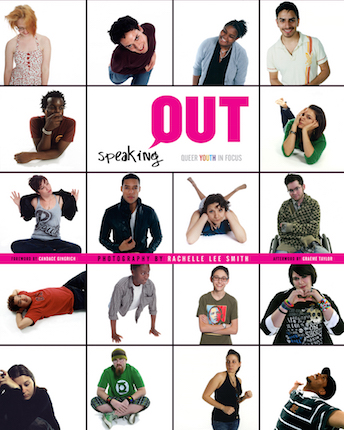
Book Review: Speaking Out – Queer Youth in Focus photography by Rachelle Lee Smith

12/06/2015 By Dave McFarlane Leave a Comment


Posted on: Sunday 4 January 2015 By Antony
speaking-out-book-cover-rachelle-lee-smith Speaking Out is a collection of photographic portraits of LBGT young people (aged 14-24 years old). 65+ young people, mostly from the USA are photographed. On each portrait young people have shared their thoughts, feelings or an experience. The young people have been honest in sharing their joys and tribulations of being an LGBT youth in a heterosexual world.In Speaking Out photographer Rachelle Lee Smith took the portraits, handed young people a sharpie pen and left them to write what they wanted. Among other topics, young people wrote about: stereotypes, identity, homophobia, self-love and romantic love. Young people identify as gay, lesbian, bisexual and transgendered. It was great to see transgendered young people represented, however the vast majority of the young people identified as lesbian.

Years later, some young people reconsidered their portrait. They wrote about how their lives had changed and what they would write now. It was enjoyable to read these reflections from young people and the book would have benefited from having more of these. Several pages of the book felt wasted as they contained quotes that either praised the photographer or the book its self. Never was there any praise for the young people who were actually brave enough to share their stories.
Speaking Out is presented well, it’s a large book with 127 glossy pages in full colour. There is the odd page where a young person’s hand writing makes it difficult to read what they’ve written, but at no point is it unreadable.
Speaking Out is an enlightening book that shows how we are all the same, rather than how we are different. It should be available in every school, college, library and youth club.

What do you think of the book – let us know by writing in our comments.

Filed Under: Book Reviews Tagged With: Kindle book, Rachelle Lee Smith, Speaking OUt

  • « Previous Page
  • 1
  • …
  • 8
  • 9
  • 10
  • 11
  • 12
  • …
  • 19
  • Next Page »

Categories

Copyright ACOMSDave.com © 2026