ACOMSDave

Community Journalist

  • Home
  • Community Journalist
  • Events
  • Media Page and Press Kit
    • Projects and Work
  • Resources & Documents
    • LGBTQ+ Support Groups and Documents
  • NIGRA
  • Archives
  • Contact

Malcolm by Bruce Perry

19/07/2015 By ACOMSDave Leave a Comment

Malcolm by Bruce Perry

Malcolm: The Life of a Man Who Changed Black America

by Bruce Perry
Publisher: Station Hill Press; 1st Edition edition (26 Sept. 1991)
This huge book has 380 pages of text, 25 of introduction contents, and pictures of Malcolm X at the beginning and the end of his ministry as a Muslim minister, 128 pages of notes, eleven pages of bibliography, nine of people interviewed, two of acknowledgements, another 11 of index, a page of photographic acknowledgements, another pic of Malcolm reading, and lastly, eight glossy plates with 13 photographs.
An exhaustive biography you might think, but while we get the chronology of his life, Malcolm X, (born ‘Little’) is still an indistinct figure at the end.  This is possibly because he became a great speaker, but Perry reproduces rather little of his speeches, sermons, or debates.  Malcolm seems to have been the man who made the NOI (Nation of Islam), which was just another wacky American sect before he converted.  It was confined to the Chicago area until he took the East Coast in hand.
Malcom X Quote
The East Coast meant New York, with its enormous Black population centred on Harlem, but he opened mosques (called ‘temples’ by NOI) from New England down to Atlanta, Georgia.  He was also in charge of the temple in Los Angeles, on the West Coast.  Malcolm’s work made the leadership of NOI fabulously rich, especially ‘the Messenger, Elijah Muhammed’, and his family.  Malcolm helped set up the journal Muhammed Speaks, another money-spinner.
When he could no longer ignore the financial (and sexual) chicanery, Malcolm denounced it (he was straining against NOI’s political absence from the Civil Rights struggle).  The journal was used to traduce him, and openly called for his assassination.  This came on Sunday, February 21st, 1966 – the killers being acknowledged members of the Nation of Islam.
This book is of interest to the general reader, but, in Bruce Perry’s bibliography is found “Socarides, Charles W Homosexuality, J Aronson Inc, 1978 – yes Malcom ws ‘family’.  From his very early teens until his thirties, he engaged in homosex: at two different schools he got a name as a “sissy”, and also had, in effect, a ‘camp name’, Madame Harpy”.
In his teens and twenties he swung wildly from sissified unatheicism to extremes of violent physical endeavour: football, basketball, boxing.  In prison, even after his conversion, he liked to hang out with the athletes and bodybuilders.
Perry, quoting Socarides, gives us the old absent father and dominant mother business.  He does not mention hi slove of guns and big cars, in his criminal day, the Freudian, phallic implications are ignored.  So is his appalling attitude to women.  As a crook, he lived off them, and enjoyed screwing white women, and having them seen on his arm.  HIs wife, Betty Shabazz (a professional, before converting to the Nation of Islam) was treated distantly, even cruelly.  Admittedly, Malcolm’s attitudes began to change after he broke with Elijah Muhammed, and the NOI, and wasn’t much different from other men’s in the 1940s to ’60s period.
If Ravel can be recruited into the ‘family’ on the strength of one song, Malcolm surely can be on the strength of many years of dedicated homosexuality.
 

Filed Under: Book Reviews Tagged With: Bruce Perry, Crime, homosexuality, Malcolm X, Station Hill Press

MIchael Stokes does our service men proud

19/07/2015 By ACOMSDave Leave a Comment

The campaign made $50,000 in an hour.

The campaign made $50,000 in an hour.

People Are Shouting ‘Shut Up And Take My Money’ To This Amputee Veteran Kickstarter

by joseph lamour 7/10/2015One look look at a Michael Stokes’ photographs and you’ll understand why his Kickstarter has been such a success. The campaign, which is for Stokes’ art books “Exhibition” and “Always Loyal,” reached its $48,250 goal in an hour and change. Now think about how much you made in an hour at work today.
It’s not unusual for a Kickstarter to be funded quickly, but for one to make $50,000 this quickly isjust so very impressive. The campaign, which has only been up for two days, has reached over $134K, well ahead of its $48K goal. And there are still 18 days left on the campaign, so who knows how many books he’ll sell.

Stokes’ images (which get potentially NSFW down there) have power. And so do his subjects. One of the two books, “Always Loyal,” features amputee veterans in semi or completely nude photographs that not only show how fit they are, but the sacrifices they made for their country.

11f526958d507697cb85005279df52f3_original

Michael Stokes
Men’s Health Names Double Amputee Vet The ‘Ultimate’ Guy

Michael wasn’t even looking to make a book featuring wounded veterans. “I photographed a wounded veteran named Richard Rocco, who had no visible injuries — that was the first veteran that I photographed,” he told MTV News. “And from that, I start to get a following from people who follow wounded veterans. … Then one of my fans suggested Alex Minsky. He wasn’t really known.”

AlexMinsky-1436556517

After Michael posted the results of his shoot with Minsky, they went viral. Since then Minsky has had a lucrative modeling career, appearing in underwear ads and making appearances on “The View,” “Good Morning America” and late night talk shows.

Michael Stokes

It’s possible the same thing could happen for one these veterans who appear in the book. And, if you’re wondering whether any of the veterans felt self-conscious or anxious, the answer is no.

TJ Adams Of ‘Got Your 6′ Breaks Down Myths About Veterans

“Some people will say to me ’Oh, this is really helpful to their self-esteem,’ or, ’You’re making them feel like men again,’” Stokes said. “And I hear all these types of commentMs and the response I have to that is that these guys have come to me very healed and ready to take the world on. I’m not giving them back their confidence. They already have it.”

Michael Stokes’ Kickstarter runs until July 29, 2015.
 
http://www.mtv.com/news/2209944/amputee-veteran-book-kickstarter-michael-stokes/

Filed Under: Anti-Bullying & Homophobia, Book Reviews Tagged With: Michael Stokes, Servicemen amputees

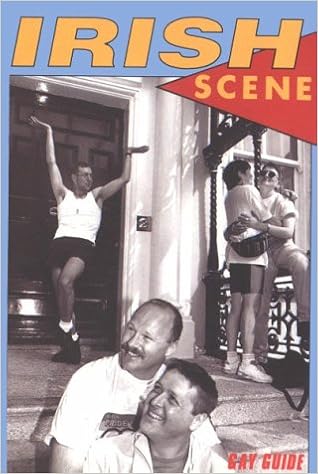
The Irish Scene: Gay Guide to Ireland by Mike Parker (Part 2)

14/07/2015 By ACOMSDave Leave a Comment

The second part of Sean McGouran’s review of MIke Parker’s book, ‘The Irish Scene: Gay Guide to Ireland”

Irish Scene by Mike ParkerSTROKE

 
Derry’s being denied the second university in the mid-1960s was of the first insults the city refused to take lying down.  (The only other place that could convincingly have been given the new university was Armagh [now a ‘city’ again, due to a piece of paper signed by Bessie Windsor], on the grounds of its historical importance and relatively central location.  But Derry had Magee College, ironically, a state-funded Presbyterian foundation set up in the Anglican-Ascendancy city of Derry, in the 1820s to get trainee Ministes away from radical Belfast.  Injury was added to insult when the O’Neill government  gave the university to Coleraine, which patently did not want it, and is now complacently watching most of the degree courses being moved to the Maiden City.  If o’Neill, the only genuine bigot to rule Northern Ireland, had given the city the university we may not have had to put up with twenty-five years of war).
Limerick’s acquisition of a university was less tortured, a section of the National INstitute for Higher Education (rather more similar to a ‘Poly’ in the UK then the IHE’s) about twenty years ago and it became a university about 1992 – it is a very handsome set of buildings in a big park – too good for mere students  [Paul Calf lives!].

GHOST TOWN

As hinted above, Mike Parker has distinct quirks, and he clearly doesn’t like Belfast.  This might make for entertaining reading, but I suspect that Mike hasn’t bothered to visit the place.  He obviously drove around the Mournes (which he describes as “bucolic”), and along the Antrim Coast road, and seems to have been impress by the Giant’s Causeway (I’ve never been).  Anyway, about Belfast, the industrial revolution sort of happened (this is the usual reason why Brits dislike Belfast – it looks like an industrial city – a handsomer version of Oldham).  There’s no mention of the United Irish-persons (Wolfe Tone is mentioned on page 13) or of the 1798 Uprising.  Odly enough, the Gay law appears to have changed of its own accord, no local agency or agent is noted.  Paisley gets abused, and the DUP is called “tiny”; which it is, in UK terms, but it is a major part in local, or even Irish [geographical expression] terms.  Mike also describes our newspapers, “The staunchly Unionist News Letter (including some stomach-churning attitudes to progressive social ideas) sits against the Republican Irish News.  Straddling the two is the responsible Belfast Telegraph”.
I’d have thought, being a journalist, Mike Parker might have taken an interest in the oldest newspaper in the world (it has been regularly published since 1737).  During the 1790s, when Belfast was the revolutionary foco for the whole of these isles, it was somewhat less revolutionary that the Northern Star, which was the organ if the Society of United Irishmen.  As for “stomach-churning attitudes to progressive social ideas”, he doesn’t quote anything; could it be an attack on our (unselected) rulers in Stormont Castle closing down a bit of another hospital?  Is this ethnic solidarity on MIke’s part?  Would the Irish News relish the description of itself as “Republican”?  The Bellylaugh is taken by most people in Northern Ireland – for the advertisements for houses, cars and jobs.  Its editorial policy was smugly suimmed-up about ten years ago as dealing with the “real-life Unionist/Nationalist conflict” (ie no class politics, please, we’re the Ulster bourgeoisie).  As readers know, our community has had more hassle off the BT than the Irish News or the News Letter (which has given Gay ~ er ~ leaders, column-space, in its time).  You’d also have thought that a journalist might have noticed the growth of small, and not so small, publishing houses in the Six Counties, a walk around any bookshop would have done the trick.

COULDN’T BE ARSED?

Mike clearly does not like Prods; Bushmills is described as a “tight-arsed little Protestant town” – as opposed to slack-arsed little Papist towns, undoubtedly.
MIke rather sells the tourist short, practically nothing is written of County Londonderry, Tyrone, Armagh – or Fermanagh.  No Belleek, no Marble Arch caves, no Bo Island, no mention of the Lakes.  Enniskillen is described as a “nationalist town” –  the good people of Skin Town must have been keeping the rest of us in the dark all of these years.  Even in County Down (or “Downshire” is you are an aspirant West Briton) thee is no mention of Mount Stewart, or say, Hillsborough – the list could go on, and there’s plenty of info as the Tourist Office.
If Mike’s little book goes to a second edition, a sub-editor should cast a cold eye on it.  The “history” is rubbish (the Ulster Plantation led to Partition apart from anything else, this is the One Big Boat theory of the Plantation.  It was not a complex series of events spread over more than a century involving from south west Scotland, as well as State-run Plantations in west Ulster, the Hugenots, the Moravians, the Quakers as well as a fair number of villains).  The attitude to the majority of people who live on this geographical expression, is p[atronising (Mike Parker may well be outraged at this assertion, but it is) and to the Ulster Prods is pretty racist.
All of the above may seem like taking a sledgehammer to the proverbial … but there is no reason why GMP should be allowed to add to the gigantic pile of nonsense written by English sentimentalists about, “Ah-land” or the BBC’s “Eye-land”.
Mike Parker isn’t a good enough writer to make the prejudices witty or sardonically memorable.
 

Editorial – this review was written by Sean McGouran in our paper magazine ‘upstart’


Filed Under: Book Reviews Tagged With: gay men's press, Mike Parker, The Irish Scene

The state of publishing in Britain

11/07/2015 By ACOMSDave Leave a Comment

The Bookseller – Published July 10, 2015. By Kerry Hudson
we-need-diverse-books
 
In an extract of an article by novelist Kerry Hudson, commissioned by Writers’ Centre Norwich for The National Conversation, the Scottish author explores the state of the literary ecology
Imagine four writers. They are talented, they have written brilliant, sales-worthy books. They are respectively BAME, LGBT, working- class, disabled. They go in search of publication. Feedback comes in: “The writing is good but it didn’t speak to me. I don’t know how I’d sell this.” Of course, to love a book it must resonate, represent a society we recognise, have relatable characters. However, the agents and editors who will decide if our writers will be published may not “connect” with these stories.
In Spread the Word’s recent Writing the Future: Black and Asian Writing in the UK report, just 11% of publishers that responded had ties with non-Oxbridge universities or had developed educational programmes for state schools. Additionally, publishers are overwhelmingly London-based, with entry into the profession largely gained through unpaid internships. This is not a system which fosters diversity.
Three of our authors gain representation, but not the BAME writer who—like 53% of BAME writers surveyed in Writing the Future—remains unagented. While our authors sell their books there are commercial concerns: the LGBT writer is asked to “straighten” a few characters; the BAME writer’s editorial notes urge “authenticity”, by which they seem to mean more “urban/African/ethnic” . . . though the writer is sure that the semi-autobiographical novel is “authentically” about them. The disabled and working-class writers are asked to talk about difficult personal experiences during book promotion. One welcomes the opportunity, the other doesn’t wish to be defined by this single trait; publicity column inches will reflect this.
Now our writers are authors, there should be second novels. Unfortunately, our BAME author remains unagentedDiverse Voices and is unable to place his next novel. Our disabled writer suffered from her lack of press coverage. The working-class writer couldn’t sustain the added unpredictability of a tiny income and took a “real” job. The LGBT writer was nominated for two LGBT awards and, though the advance reduced, was able to write without concern that she might alienate the presumed “mainstream” reader.
Four writers. One stays in print. The others, their future stories, are lost. The consequence? Other emerging writers will look, and fail, to find voices like their own, and young people from non-Oxbridge institutions will have no idea that they might contribute to our literary culture. It is stories lost, voices unheard, a book-buying public that has no idea how much spectrum of choice it is being denied.
Without making changes, we risk turning our proud literary legacy into a factory producing monocultural “safe-ish bets” based on previous successes, where books are viewed as “units” to be shifted. Naturally so, this is a business. The bottom line is important.
So consider an industry that could benefit from the potential disposable income of £300bn for the BAME community and approximately £80bn for both the Pink Pound and those with disabilities. Even as we publish more books than ever in the UK, and our market becomes saturated, the fact that we have a such a spectrum of diversity in this country should make our potential to perform well in the area of foreign rights much stronger, because a variety of books about people of different backgrounds will be more attractive globally.
Books are not just a business, they are a fundamental element of evolved society. Writers are often the first to be persecuted by oppressive regimes specifically because words have immense power to influence. We must not relinquish that power by reducing it merely to profit and loss calculations. Let’s make sure a career in publishing is seen as a viable option for people of all backgrounds. If we portray the true multiplicity of society in books, young people will grow up immersed in a British cultural life which fosters a creative environment with inclusivity, innovation and collaboration at its heart. Let’s harness the enormous potential of our diversity, not only to meet our current financial objectives but to fulfil our responsibilities for generations to come.
I don’t believe anyone in publishing is unconcerned by its lack of diversity. But agreeing isn’t enough. Each of us must ask: “What can I do to change this?”
 
Join the discussion using #NatConv or at www.writerscentrenorwich.org.uk
 

Editorial:  Previously I have written about how dire the state of LGBT publishing is in the UK, indeed I cannot find any details currently of books that are written by LGBT authors, or for LGBT readers in the UK.  An article published in September 2011 on the Malinda Lo – I have the numbers! site gives us some statistics for the period 1969-2011 which makes interesting reading. Please have a look at it, but I am quickly going to produce some of the statistics in picture form here:

 
lgbtyawhopublishes1 lgbtya2000-11publisher1 lgbtya1969-2011a

Filed Under: Book Reviews Tagged With: diversity, LGBT publishing, UK publishers

The Irish Scene: Gay Guide to Ireland by Mike Parker (Part I)

09/07/2015 By ACOMSDave Leave a Comment

First published in our paper magazine – upstart
 
Publisher: Gay Men’s Press (29 May 1996)
Mike Parker compiled the (English) Northern Scene in this series, which I praised in a previous upstart. Yes: I didn’t much like this book.  MIke, who was so efficient shoving a quart (almost a gallon) quantity into a pint pot in his last outing seems to be one of those people who was lyrical when theyh come across the word “celtic” or even just “Irish”.  He also decides that history loms large here, so he gives us some of it.  “Daniel O’Connell, a brilliant young Kerry man…won the County Clare constituency in the 1828 election.  As a Catholic, however, he was barred from taking his seat.  British Prime Minister William Pitt… scrapped the ban”.

In 1828, O’Connell was in his fifties, PItt the Younger had been dead for a quarter of a century.  The Elder Pitt (Lord Chatsworth) had snuffed it in the 1780s.  Mike also appears to be saying the Irish Labour Party only just got into power recently.  Labour has held Cabinet seats since the 1940s, and has been a constant in government for fifteen years (it is being described these days as “the-even the– Party of government”).  There is also some very odd stuff abut the Celtic Twilight/Literary Renaissance (one would have thought that someone visiting Ireland, whether the political entity or the geographical expression, over the past twenty years might have noticed that we have become less provincial and embarrassed about our contribution to ‘art’ (painting and sculpture) and ‘classical’ music, there is a booming industry in art-books and a quite large discography of the latter).  The ‘folk’ and pop/rock end of things hardly needs mentioning.
Mike Parker admits that he has spent his holidays in Ireland in a Guinness-induced haze, which is fair enough – so do I – in fact, I spend my non-hols in a Guinness-induced haze, if I can manage it.  He also says that the outer rim of Ireland is more interesting that the centre, that’s his business, though I quite like the Irish midlands and south east, which he rather gives short drift.  I think Wexford, town and country are very interesting, but I’m not the author.
The problem here, is that Mike has to write more ‘touristy’ stuff than in his English book, as the “scene”, as such, is not really very big (the whole population of the island is less than Greater Manchester, or Merseyside, or the West Midlands).  He deals with the scene very well.
He compares Limerick with Derry (no ‘Londonderrys’ here – not even for the sake of a bit of alliteration), and rather approves of them, but he does not investigate what effect having a university has had on the town(s) and their scene(s).  Mike appears to believe that Limerick is still brooding on KIng Billy’s government reneging on the Treaty of 1691 – I doubt it.  Limerick was the Holy City of Irish Catholicism for over a century.  This came to a climax during De Valera’s period (if the word “climax” is permissible in the same sentence as “De Valera”).  Dev represented County Clare, just down the road from Limerick City, and his long supremacy is characterised in this book as ‘insular’.

The Pope’s Divisions

Catholic Ireland at that time quite often spoke of itself in the same breath as Communist Russia, and was not in the least fazed by the huge disparity in population and power.  Ireland, (which had not been Catholic in the days of Gaeldom), became, not more Catholic than the Pope – but just as Catholic as the pope wanted.  Missionaries spread out from Ireland through Latin America, the British Empire (and most of the other colonial empires) and the Orient, proselytising with a vigour the Bolshevik might have (and probably did) envy.  All of this was cultural vandalism of the first ordr – but to give the Blackcoats their due, they destroyed pagan, Gaelic Ireland’s immemorial culture before they set out.  Whtever this was – it was decidedly not smug insularity….
Part Two to follow


Filed Under: Book Reviews Tagged With: gay men's press, Mike Parker, The Irish Scene

Five LGBT Comic Books Out Now

08/07/2015 By ACOMSDave Leave a Comment

 – alliterator

Five LGBT Comic Books Out Now

This week has been somewhat of a weird week for LGBT characters in comic books. First, there was the fact that the Midnighter’s comic is actually really, really good. But then we got acontroversy about James Robsinson’s Airboy and its use of a derogatory word for transgender. (My take on that: Robinson was deliberately writing those characters as assholes. Unfortunately, those characters are fictional versions of him and the artist and he went a bit too far, making the whole thing seem weird, out of place, and in bad taste. Edit: Robinson has written a full apology.)

But the current crop of comics does have a lot of good LGBT characters, especially independent comics. Here are five you really need to start reading:

Five LGBT Comic Books Out Now

8house: Arclight, written by Brandon Graham and art by Marian Churchland

Hey, do you want to read about genderqueer knights in a weird fantasy land involving alien monsters, blood magic, and a goose?

I had you at “genderqueer knights,” didn’t I?

8house: Arclight is a fantastic comic that just came out (only one issue) about Sir Arclight (one of the aforementioned genderqueer knights) and her Lady, who has been magically trapped in an alien root-body. Now they have to protect their world from blood magic and find out what happened to her original body and who is using it. (Seriously, it’s weird and awesome.)


Five LGBT Comic Books Out Now

The Spire, written by Simon Spurrier, pencils by Jeff Stokely, colors by Andre May

The Spire is another brand new comic (also one issue) that takes place in a strange fantasy land. Only this fantasy land is the Spire, “a mountain of metal and stone that rises from the toxic nowherelands; a city of twisting tunnels, grinding elevators, ancient machinery, and over one million human and non-human residents.”

The main character is Shå, the Commander of the City Watch (and lesbian who has white tendrils that come out of her back), who polices the Spire. However, now that the old Baron is dead, the new Baroness has some problems with her.

Si Spurrior is an awesome writer and Jeff Stokely is an awesome artist. Their previous collaboration, Six-Gun Gorilla, was mind-blowingly good.


Kaptara, written by Chip Zdarsky and art by Kagan McLeod

So, okay, this book is kind of hard to explain. It’s about a group of astronauts that accidentally crash land into the planet of Kaptara.

Except it’s not really about that. It’s really only about one astronaut, Keith Kanga, who is super lazy (and also gay) and when he finds himself away from the other astronauts in this cool fantasy land (similar to, say, He-Man’s Eternia), he doesn’t want to leave. Not when he hated it back on Earth.

Of course, that’s presupposing that there will be an Earth to go back to, since maybe there won’t be?

Chip Zdarksy is hilarious and Kagan McLeod draws some excellent cat tanks. (Seriously, cat tanks. It’s super weird and awesome.)


Five LGBT Comic Books Out Now

Infinite Loop, written by Pierrick Colinet and art by Elsa Charretier

So if fantasy lands aren’t your thing, how about time travel? Because Infinite Loop is an awesome, time travel romance epic.

Teddy (the redhead on the cover) and her coworker Ulysses have one job to do: find time anomalies and eradicate them. If left alone, these anomalies will build up and eventually result in the end of the world. Teddy is really good at her job, too…until she meets a human anomaly (later named Ano) and falls head over heels for her.

Much time travel and nudity ensues. Seriously, lots of nudity (this is not a book to read on the bus). But there’s also awesome action and art and romance. Oh, and a really neat thing where decisions are mapped out in decision trees. Seriously, get it.


Five LGBT Comic Books Out Now

The Wicked + The Divine, written by Kieron Gillen and art by Jamie McKelvie

Here’s one that you may have heard of — in fact, it’s the only one on this list that has been going on for more than a year and has just completed it’s second storyarc.

But it bears repeating that this comic isawesome. The Wicked + The Divine is about creativity and imagination; it’s about fans and fandoms and how we try to be closer to the creators we love; and it’s about magic and gods. These gods just happen to have a ticking clock: two years of being loved and hated and then they die. Some can deal with the pressure. Others can’t.

It also bears repeating that the cast is filledwith LGBT characters, including Cassandra, a trans woman. Two books are out now, Vol 1: The Faust Act and Vol 2: Fandemonium.

What other LGBT characters are you guys excited out in comics now?

Filed Under: Book Reviews Tagged With: comics, LGBT characters

Camp as Knickers by BA Finnegan

07/07/2015 By ACOMSDave Leave a Comment

Reprinted from out paper magazine upstart
Publisher: Mercier Press (1 Jun. 1996)
The subtitle is ‘How to camp it up and have an absolutely fabulous life’.  “Camp”  here, means being conscientiously ‘fem’, drunk, obsessed with certain television progs (AbFab for example), and the usual list of Hollywood stars.  Bette Davis, Joan Crawford, Judy (yawn) Garland.  The notion of ‘camp’ as a form of social and cultural subversion does not enter into it: John (christened “Marion”) Wayne with his limp wrist, golf-ball-between-the-arse-cheeks mincing walk, made La Davis look like Mr America.
Reading this short (95 pages) book, is a bit like watching a small, cute, dumb, animal being relentlessly bludgeoned to death.  There one, very slight joke, simply does not stand up to the cold scrutiny demanded by printed ink on paper.  This sort of thing is (probably) a gas if you are in the right frame of mind, (ten G&Ts, etc).  Honestly, asking seven quid for what amounts to one over-extended joke is a bit much.
Especially as it tends to demonstrate the fact that camp and/or ‘scene’ queens are as funny as a dose of the skitters, and that being able to lip-sync whole scenes from Whatever Happened to Baby Jane? is not an audacious off-centre ‘take’ on modern popular culture.  It’, just as sad, really, as being a “Trekkie”.  Specially if you are still at it after the age of, say, eighteen and a wee bit.

Filed Under: Book Reviews Tagged With: BA Finnegan, Camp as Knickers, Mercier Press

Out of Order by Casey Lawrence

06/07/2015 By ACOMSDave Leave a Comment

My Big Gay Sequel

by Casey Lawrence
This past May my first book, Out of Order, was published through Dreamspinner Press’s YA branch Harmony Ink. My first foray into queer YA has been, on the one hand, a whirlwind of excitement, and on the other, a huge let down. My book will never be a New York Times Bestseller, and I’ve made my peace with that. It will never win awards, sit on Indigo shelves, be translated into a dozen languages. This isn’t because my main character is a biracial, bisexual teenaged girl or because my writing style is still growing, still changing from day to day. I think, ultimately, it’s because I didn’t think big enough.
My main character, Corey Nguyen, is a bisexual WOC in small town USA. Her experiences are not like my own, but I still drew on my high school memories to write her story; her high school had a GSA only because she pushed for it. It was small, inadequate, and none of its members supported or relied on each other. The book only has two central LGBT characters, Corey and Kate, and neither of them have any experience being queer. They’re still figuring things out, just like I was in high school.

Out of Order by Casey Lawrence (Harmony Ink, 2015)

Out of Order by Casey Lawrence (Harmony Ink, 2015)

So I’ll admit it: with Out of Order, I fell into certain stereotypes. I didn’t even know that some of them were stereotypes, like that f/f romances in YA never have happy endings. But I fell into the traps that have been set up for people like me by years of precedence: Confused Bisexuals. Ambiguously Bi. The One Exception. Turned Gay. All of these things are tropes I didn’t know I was using, clichés drawn on for lack of a bigger understanding.
I’m working on doing better now, but this is something I will always struggle with as an author of queer YA; how far is too far? How can I make this as diverse as possible without alienating a huge segment of potential readers?
Writing a sequel to a book you’re not entirely happy with anymore is incredibly difficult. In my case, I’ve been struggling with it for longer than it took me to write the first one. But there are some things I feel I’m obligated to fix now. Corey deserves a second shot at this, a second chance to break down the barriers that have been placed around her as a bisexual YA character. I want to address the issues that she and I both face every day, but I have to do it without making my book an Afterschool Special. With YA, you have so little space to work with to do all of the big things you want to accomplish.
I’ve changed so much since I graduated high school. I’ve realised that in the real world, when you’ve not grown up with the same group of kids for years and years, queer people flock together. Pride groups and GSAs exist but so do gay bars, LGBT bookstores, online communities. There are good things out there, and bad things too. Bisexual erasure, biphobia, mental health stigma. The events of my first novel have left my protagonist in a unique position; university won’t be a fresh start for her to explore this new world. She has so much baggage to drag along with her, baggage I never had to carry, which is what’s making my Big Gay Sequel so hard to write.
My cast of characters has multiplied and diversified. My fictional world has grown wider and deeper. And yet I don’t feel satisfied. No matter how many gay, lesbian, bi, and trans characters I add, I feel like I should be doing more. That my work should be making some grand statement. That I’m not doing enough.
And so my Big Gay Sequel is slowly becoming my Little Bisexual Follow-Up instead. The thing about sequels is that they need to be able to stand alone, to be just as entertaining and authentic as the first story, and to add something new and fresh. I’m probably never going to win any of the big awards or be a household name. But that’s okay as long as I like what I’m writing and I am satisfied that I’m doing the best I can.
It doesn’t have to be big. It just has to be right.

Filed Under: Book Reviews Tagged With: Casey Lawrence, Harmony INk, Out of Order

Yank Mags – ‘Men’s Style’ and ‘Out’

06/07/2015 By ACOMSDave 1 Comment

Reprinted and edited (adjusted)  from upstart in the distant past…
 
Comag Magazine Marketing sent NIGRA two mags to look at and comment on; they were Men’s Style and Out.

Pat Robertson Christian Coalition

Pat Robertson Christian Coalition


Of the two, Out, is the most substantial (most US Gay magazines take ‘The Advocate’ as a template), it has the usual showbiz gossip, some political news from around the States, and internationally, a big interview, and in this particular edition, an investigation into the enormous wealth of Pat Robertson.  He is one of the main figures in the Christian Coalition (currently, and successfully, ‘entering’ the Republican Party, with the ardour of born-again Trotskyites).  He is also head of a quite enormous media empire founded on a television network, which, because it is ‘religious’ and ‘charitable’ is not liable to tax.  Surely Jefferson’s Constitution forbids the endowment of any religion?
Out is easy to read and get around, though it was difficult to pin down how old it was – it’s was in it’s second year when we did this review.  It is not as US-bound as many other American publications.  It also does not have the fascinating (and rather frightening) Personal Ads with the strange hieroglyphs – yet.
This particular edition had a piece about the composer Pauline Oliveros, and her ‘life-partner’, Ione.  It reads like a full sclae interview that has been cut down (somewhat) to fit one page.  There is also a full-page picture of Oliveros and Ione, two women in their sixties at that time, facing the page of text.  Presumably, Out is making it clear that it is not going to be as youth and sex-obsessed as such glossies tend to be.  Out was to be produced ten times a year, with a cover price of £2.95 at that time.
Men’s Style also cost £2.95, and was bi-monthly.  There is an interview in the edition to hand with a very American celeb – he doesn’t even appear on out telly between 2 and 2 am (yep, he was that obscure – but obviously “mega” in American).  The rest was basically pictures of pretty, handsome and beautiful young men wearing seriously naff threads.  Three quid is a bit much to pay to gander at men with clothes on, especially as there was a lot of opposition – FHM, GQ, half a dozen others come to mind.  (There’s was also loads of footie, and other sports magazine with the likes of Ryan Giggs, David Ginola and various Brazilian and Portuguese boy-babes…um…sportsmen, wearing short shorts, and often very little else at that time.
 

Also posted juxaposed to this article was a picture in B&W of Dani de Cruz Cavallo – I have tried to find the picture online and cannot, so I have used another and will print the comment from our previous paper edition:

Dani Da Cruz Carvalho Magazine Cutting Full Page Photo Ref J (I don't know the photographer for this picture).The comely youth is Dani de Cruz Caravallo, he was a footballer on West Ham’s first team.  He was a middle class Portuguese, and according to an interview (with Just 17 – yes, we hadn’t realised it was a footie-mag either) he can “look after myself – I can cook” (a Latin boy?) and “I have a number of friends who are girls”.  He seems to have walked off the plane and into a modelling contract.  The mind doesn’t quite boggle – it just throbs a wee bit.


Filed Under: Book Reviews Tagged With: Comag Magazine, Dani da Cruz Carvalho, Men's Styles, OUT

The Riders by Tim Winton

05/07/2015 By ACOMSDave Leave a Comment

Publisher: Picador; Reprints edition

The Riders by Tim Winton

The Riders by Tim Winton


This book was short-listed for the Booker Prize in 1995, and has been praised by many critics.  I found it irritating and inconclusive.  It starts brilliantly, but the … Fred Scully, the main character, leaves his home in Australia, to make a new home in Ireland.  His wife and child are to follow.  The shack he has bought, has to be rebuilt, which he proceeds to do, with the help of workmen.  This is November, when the weather is shocking!
He goes to Shannon to meet his wife and daughter, but the child turns up alone, and is so confused that she is unable to tell him anything.  A telegram arrives saying all will be explained, but there are no developments.
He doesn’t report his wife missing, or check at Heathrow – a child of seven and a half would have had to be put in the charge of a stewardess if travelling alone, for any reason.  As he and his wife had lied for some time in the Greek Islands, he decides to go there, but no one has seen her.
Has she gone off with another man?
 
 
He travels through Italy, where they also spent some time, hoping he will find a reason for her behaviour.  One woman he meets, to whom he shows his wife’s photograph, says she has seen her in a hotel in Amsterdam.  He heads there.
By this time, the child is coherent, but he never questions her.  Why Not?  He receives a telegram to met his wife in the Tuileries Gardens, in Paris.  He goes there at the appointed time, but she does not turn up.  How did she know where he was?  Why did he not trace the origin of the telegram?
He eventually goes back to Ireland with his daughter, wondering did he ever really know his wife.  He still doesn’t contact the police, or try an official way to find her.
Tim Winton writes well, but this story leaves too many questions unanswered.

Filed Under: Book Reviews Tagged With: Ajustralia, Amsterdam, Ireland, The Riders, Tim Winton

  • « Previous Page
  • 1
  • …
  • 6
  • 7
  • 8
  • 9
  • 10
  • …
  • 19
  • Next Page »

Categories

Copyright ACOMSDave.com © 2026