
 Today I was talking to the owner of Belfast Books (www.belfastbooks.co.uk ), a used/new book shop at 112 York Road, who asked if I knew of anyone or any groups that had any LGBT-themed books they would sell or donate. He is interested, due to familial connections to the LGBT community and through social conscience, in selling these amongst his varied collections. He is interested in books across multiple genres – topical, fiction, auto-/biographicals, academic and pop culture etc, and would ideally like to have enough to fill a bookshelf or two.
As I’m sure you can appreciate, it’s not easy finding these when you’re not sure what you’re looking for.
If anyone is interested in helping out, please contact John using the below details:
email: enquiries@belfastbooks.co.uk
Tel: 028 9075 1466
Many thanks
Liam
Morning Ireland and the Referendum
 The Chairman of the Referendum Commission, Mr Justice Kevin Cross, answers listeners questions ahead of the two ballots on Friday
LGBT Walking Group
This might be of interest to you. Our Dublin walking group have been busy!
We’re walking in the Mournes with our Dublin counterparts on Sunday. I hope we’ll have Marriage Equality cake for celebrations. If any of you want to come, let me know: you’ll need the usual walking gear and a pair of walking boots- lovely walks planned with upwards of 30 people expected.
Op-ed: Remembering LGBT History Didn’t Begin With Stonewall
 BY SIMON COPLAND MAY 19 2015 8:30 AM ET
The long arc of gay history means there will be wins — like the story of Victorian-era cross-dressers Fanny and Stella — and losses, like Russia’s growing intolerance.

Fanny and Stella (Frederick Park and Ernest Boulton) in 1868
Maybe you’ve heard of the pioneering trans* activists Fanny and Stella, who were charged for indecency in Victorian Britain 25 years before Oscar Wilde. Maybe you haven’t? Up until the announcement of a new play based on their lives by writer Glenn Chandler — appropriately named Fanny & Stella — I certainly had not. Yet, reading about them, it has become clear how important they were, and how tragic it is that most of us probably don’t know who they are.
Chandler’s play is now being performed in London. It follows the story of cross-dressing gays Frederick Park and Ernest Boulton, a.k.a. Fanny and Stella, who were arrested in 1870 for wearing women’s clothes to a play and charged with “conspiring to incite others to commit unnatural offences.” After a trial that attracted huge publicity, the two were acquitted — partly because doctors who inspected the men couldn’t prove they had anal sex. Both Fanny and Stella, who performed throughout London in men’s and women’s clothing, hoped their success in court would be a catalyst for change in the antigay laws of the time (sadly, it wasn’t).
The play is exciting. The retelling of queer history is important. Yet at the same time I cannot help but be disappointed at my lack of knowledge of these two pioneers as well as many others of their time. I suspect I am not the only one. When it comes to remembering queer history we’re pretty bad at it.
I’m not talking here about our modern history. The stories of the past 40 years, from the Stonewall Riots to Harvey Milk to the AIDS crisis to the growth of the marriage equality movement, are largely imprinted on our collective memory. Yet that seems to be the limit of it. Queer history is often written as if it started June 28, 1969, the date of Stonewall.
Yet, our story goes much deeper than that. A quick look and you can find some amazing things. What about Oscar Wilde, who was not as lucky as Fanny and Stella, and was sentenced to hard labor for “gross indecency”? Or how about Magnus Hirschfeld, a gay, Jewish, left-wing occasional transvestite, who developed the Berlin Institute of Sexual Research in 1919? Hirschfeld had to flee Germany in the 1930s, watching as his entire library was set alight.
These sorts of stories run throughout our history. Stories of pioneers and campaigners, and of movements that changed our society for the better. Our history is far deeper and more varied than just what’s happened in the last 40 years.
This is really important. Through pointing to the heroes and heroines of our past we can draw greater connections to our modern struggle. Just as Joan of Arc and the women of the suffragist movement have become important modern feminist icons, so should Fanny and Stella, Wilde and Hirschfeld (among many others!) become icons of the queer movement.
More than that, understanding this history is essential to ensuring the continued progression of LGBTIQ rights. In recent years we have begun to talk as though the march of queer liberation is “inevitable.” But what if it wasn’t as simple as that?
It is a little-known story that the Soviet Union — now one of the most homophobic nations on earth — was at the forefront of gay rights in the early 20th century. In the aftermath of the Russian Revolution, all offenses related to homosexuality were removed from the criminal code (well before this happened in much of the Western world). In fact, if you look even further into Russian history you will see a very tolerant approach to homosexuality. This is a very different picture from the one we see in Russia now. After a decade of sweeping changes for LGBT rights in developed nations, Russia turned quickly against queer people. Suddenly all the progress was lost.
Here is the true importance of understanding our history. If we see history only through the lens of the past 40 years in the U.S., it is easy to paint a picture of constant progress. It is why so many are bewildered by the actions of Russia — how could a country turn on gays like this in the 21st century?
But if you take a longer view you realize our story is more complex. It is one of constant struggle — a story of progress being followed by setbacks, only to be met with resistance once again. This is not to make us depressed about the gains we’ve made but to ensure we collectively protect ourselves from returning to this fate. If we understand our history better, we don’t let ourselves lose the progress we’ve made.
Speaking about Fanny and Stella, playwright Glenn Chandler stated, “The sad thing is that they really thought their case would change things, they thought a change in the law was coming, but then in two decades we have the Oscar Wilde trial and it takes another two centuries for change to come.”
Chandler points out that Victorian society actually became more conservative in the years following their trial. If Fanny and Stella’s case was held in the era of Oscar Wilde, there is every chance they could have ended up behind bars. The progress they hoped for vanished before their eyes. We are making great progress, but the past shows us this can be reversed in a hearbeat. Knowing our history can help us stop that from happening.
Southern Rites: A Reminder of the Parallels of Prejudice
Editorial: Yesterday a judge decided that a bakery had shown prejudice against a gay man by taking his order and payment for a cake, and then calling him back some days later to state that they couldn’t fulfil his order because it was against their Christian principles to promote ‘gay marriage equality’. The gay man did not seek to have this action in the courts, at no time as has been stated, did he seek to ‘set-up’ the bakery (Loose Women/Janet Street-Porter).
It is obvious from the comments made by our politicians following the judgement, that they cannot separate church from state. The links between church and state in the UK are, nowadays, mostly a formality and the governance of the UK is relatively secular, although the Lords Spiritual have a significant influence when they vote as a bloc on certain issues, notably abortion and euthanasia.
As Slugger O’Toole penned, “…When it comes to separating Church from State I believe that many of our Unionist politicians are out of step with the views of the majority of Unionist voters….”
The following article on prejudice in the Southern States of the USA, show how legislation and political statements don’t remove prejudice, only a concerted action by all involved with a recognition of everyone’s equal rights will enable a balanced, forwarding looking society.
0-0-0-0-0-0-0-0-0-0
MAY 18 2015 6:00 AM ET
A new documentary about racial tensions in rural Georgia reminds us what all types of bigotry have in common.

Sha’von Patterson holds a photo of himself and his older brother, Justin, as children. The new documentary Southern Rites addresses Justin’s violent death and its consequences.
Sha’von Patterson holds a photo of himself and his older brother, Justin, as children. The new documentary Southern Rites addresses Justin’s violent death and its consequences.
Over the past year, events in Baltimore, New York, and Ferguson, Mo., have provided ample evidence that America’s racial problems are far from solved. A new HBO documentary drives the point home as well — and its director is quick to note parallels between racism and anti-LGBT bigotry.
“It’s all about discrimination and civil rights — it’s all connected,” says Gillian Laub, whose directorial debut,Southern Rites, premieres tonight on the cable channel. And all prejudice, she notes, is about fear of the unknown.
Laub has spent most of her career as a photographer; one of her earlier projects was a multimedia piece called “Becoming Nikki,” about a 10-year-old transgender girl, commissioned by Peoplemagazine in 2013. Another project was documenting the racially segregated proms at Montgomery County High School in rural Georgia, and that’s what gave rise to Southern Rites.
Laub, who is based in New York City, had been photographing the separate proms for several years, and in 2009, The New York Times Magazine published her photo essay on the subject. National outrage led the school to finally have an integrated prom for all students. Laub continued to travel to Montgomery County; “I thought I was going back to kind of show the prom in transition,” she says. But she found far more than that, exposing continued racial tensions.
Norman Neesmith, a white resident of neighboring Toombs County, was arrested in January 2011 for shooting and killing Justin Patterson, a 22-year-old black man Laub had photographed at a prom years earlier. Neesmith’s 18-year-old great-niece, Danielle, whom he had raised after her mother abandoned her, and a friend of hers had invited Patterson and his brother Sha’von to the Neesmith home, apparently for sexual encounters. Neesmith was sleeping when the young men arrived, but he woke up, confronted them, and a fight ensued, ending in Justin’s death.
While Neesmith was facing trial in 2012, Calvin Burns, the well-respected police chief of Mount Vernon, the Montgomery County seat, was seeking election as county sheriff, hoping to become the first African-American to hold the post. Juxtaposing these two stories, Southern Rites explores the role of race in the region, making it clear that bigotry against black residents has not been erased.
It also makes clear that the situation is complicated; as much as Norman Neesmith may incite viewers to anger, it would be an oversimplification to say he’s a hopelessly racist villain. For one thing, Danielle, whom he says he loves deeply, is part African-American. “I think he’s a complicated and flawed human being, like most of us,” Laub says of Neesmith. “He’s very nuanced.”
Laub, a straight woman who is a passionate LGBT ally, notes that she’s met some Montgomery County residents who are facing homophobia along with racism. The prom king at one year’s black prom, she says, came out to her and asked what he should do with his life, as he felt there was no place for him as a black gay man in rural Georgia. But he’s still there and actually doing well, she says.
A recurring theme in her work, she says, is “trying to bring out people’s truth,” whether it’s the story of the “incredibly brave” transgender girl Nikki or race relations in the Deep South. Her next project will take her back to transgender issues; it’s a film about trans people in the military, who still face discharge if their status becomes known. Laub adds that she can’t provide any details just yet.
Meanwhile, as Southern Rites premieres, a companion photo and video exhibit has just opened at New York City’s Benrubi Gallery, where it runs through June 27. There is also a companion photo book, and Laub will give a lecture before a special screening of the film at Dartmouth College May 26.
Laub stresses that while the film, which has John Legend as an executive producer and features a song by him, deals with serious and pressing issues, it’s not all downbeat. For instance, several scenes show teens of all races having fun together and saying how ridiculous they found the idea of segregated proms. “I do want to note the progress there has been and that there is hope,” she says.
Southern Rites premieres tonight at 9 Eastern on HBO; check your local listings. For more information about the film, the exhibit, and related events, go to SouthernRitesProject.com.Watch a trailer for the film below.
Asher’s Gay Cake Judgement Reaction
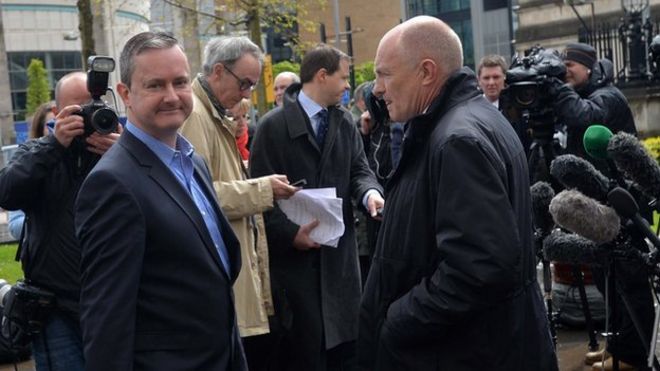
Gareth Lee outside Laganside Court after a judge found Ashers Baking Company guilty of discrimination
The following reactions were noted from the BBC News website following the judgement given by a judge on the ‘Gay Cake’ case:

First Minister Peter Robinson
“I’m not terribly surprised. In many ways, that’s why we were preparing a legislating alternative.
“I think the term ‘reasonable accommodation’ is now what we would like to frame some legislation around, recognising that there are rights on both sides.”
Deputy First Minister Martin McGuinness, on Twitter
“Ashers bakery judgement a good result for equality. Gay people have for far too long been discriminated against. We and the law on their side.”
David McIlveen DUP, on Twitter
“Utterly sickened that a Christian-owned business has been hauled over the coals for refusing to promote something that is not legal in Northern Ireland.”
SDLP MLA Colum Eastwood, on Twitter
“Today’s judgment is a welcome and refortifying of our hard-won equality laws.”
Sinn Féin MLA Catriona Ruane
“It is a good day for equality and a good day for everyone in our society.”
John O’Doherty, The Rainbow Project
“The judge clearly articulated that this is direct discrimination for which there can be no justification.”
The Green Party NI, on Twitter
“Let us now move forward to rebuild relationships with the LGBQT community.”
DUP MLA Paul Givan
“What we cannot have is a hierarchy of rights, and today there’s a clear hierarchy being established that gay rights are more important than the rights of people to hold religious beliefs.”
Jim Allister TUV
“It is a dark day for justice and religious freedom in Northern Ireland.”
Peter Lynas, director of Evangelical Alliance
“This judgment will cause great concern for all those in business. It turns out the customer is always right and businesses have no discretion in deciding which goods and services to produce. The law rightly protects people from discrimination, but it has now extended that protection to ideas.”
Editorial: The judgement has been made and it recognises that the law had been broken. We will now have to follow carefully to ensure that our politicians do not decide that they can change the law to suit their bias. The Human Rights Act is one of the cornerstones of the Good Friday Agreement, but with Westminster talking about withdrawing from it, we could see Stormont deciding to then repeal all the rights that the LGBT community have gained in Northern Ireland.
Live updates gay cake row: Ashers bakery guilty of discrimination against gay man – £500 damages awarded
Updates from court as verdict delivered on high-profile legal action on a baker’s refusal to make a cake bearing a pro-gay marriage slogan
 – BY CLAIRE WILLIAMSON AND DEBORAH MCALEESE – 19 MAY 2015

Daniel McArthur (General manager at Ashers Bakery) arrives at Laganside Court in Belfast with his familly
A Christian-run bakery which refused to make a cake bearing a pro-gay marriage slogan has been found guilty of discrimination after a landmark legal action at Belfast County Court.
Ashers Bakery, run by the McArthur family, was accused of discrimination after declining to produce a cake with an image of Sesame Street puppets Bert and Ernie below the motto Support Gay Marriage.
It had been ordered by gay rights activist Gareth Lee for a private function marking International Day Against Homophobia last May.
The Northern Ireland Equality Commission – which monitors compliance with the region’s anti-discrimination laws – brought the case on behalf of Mr Lee, a volunteer member of the LGBT advocacy group Queer Space.
Making the ruling the Judge said: “The defendants have unlawfully discriminated against the plaintiff on grounds of sexual discrimination.
“This is direct discrimination for which there is no justification.”
Evidence in the landmark ruling was heard over three days in March.
Judge Brownlie said the McArthur family held “genuine deeply held religious beliefs” but said that they must have been aware that Mr Lee was gay and were aware of the ongoing same sex marriage debate.
She said: “The defendants are not a religious organisation. They conduct a business for profit. I believe the defendants did have the knowledge that the plaintiff was gay.
“As much as I acknowledge their religious beliefs this is a business to provide service to all. The law says they must do that.
advertisement
“The defendants are not a religious organisation. They are a business for profit. There are no exceptions available.
“The defendants have unlawfully discriminated on the grounds of sexual orientation.”
Among the Christian supporters in the courtroom was former Northern Ireland health minister Edwin Poots and DUP Lagan Valley MLA Paul Givan.
The judge said there were “competing human rights” in the case.
Both parties have agreed that £500 of damages are to be awarded to Mr Lee.
The lawyers have seven days to raise any issues with the Ashers judgement.
Here is the latest from our reporter Deborah McAleese @DeborahMcAleese in court:
- Both parties agree to £500 damages be paid to Mr Lee
- “I give in favour of the plaintiff” £500 damages requested
- “The defendants are entitled to hold and manifest their religious beliefs but in accordance with the law”
- She said to do otherwise “would be to allow religious belief dictate what the law is”
- Judge says the extent of 2006 regulations and 1998 order “limit the manifestation of the defendants’ religious beliefs”
- “The law on NI prohibits the defendants from acting as they did” judge tells court
- Sexual orientation is a highly protected right under ECHR as is religion” #Ashers
- Judge says a secular judge must be very wary of crossing the divide between the Church and state
- Judge says there are competing human rights in this case #AshersBakery
- “Whilst defendants have right to religious beliefs they are limited as to how they manifest them” judge says
- Considering ECHR Article 9 Judge says the defendants “have a Christian belief that’s sincerely held”
- Judge says even if persuaded Ashers were unaware of Mr Lee’s political beliefs she still would’ve found they treated him less favourably
- Judge says Ashers directly discriminated against Gareth Lee on political or religious grounds
- Judge says the defendant must have known the plaintiff (Gareth Lee) supported gay marriage
- Judge now considering if Ashers discriminated on grounds of political opinion or religious beliefs
- Judge says Gareth Lee was discriminated against on grounds of sexual orientation #Ashers
- This is direct discrimination for which there is no justification” #Ashers
- The defendants have unlawfully discriminated on the grounds of sexual orientation
- “The defendants are not a religious organisation. They are a business for profit. There are no exceptions available”
- “As much as I acknowledge their religious beliefs this is a business to provide service to all. The law says they must do that”
- “I believe the defendants did have the knowledge that the plaintiff was gay”
- “The defendants are not a religious organisation. They conduct a business for profit”
- Government regulations “protect people from having their sexual orientation used for having their business turned down”
- Judge says McArthurs “hold genuine deeply held religious beliefs”
- Judge tells court McArthurs said because of their Christian beliefs they could not promote same sex marriage
- “The defendants are Christians & regular church goers. They said they seek to live at all times in accordance with the doctrines of Bible”
- Gareth Lee claims he has been discriminated against contrary to Equality Act & Fair Employment, judge says
- Judge says the defendants deny they have discriminated unlawfully & say they are entitled to refuse an order on grounds of religious belief
- Gay rights activist Gareth Lee has arrived in the courtroom #Ashers
- “We have been sustained throughout by the knowledge God is faithful and in control”
- “We have always served everyone we cannot promote a cause that goes against what the bible says about marriage”
- “Because of the Equality Commission’s decision we have endured many anxious months”
- “We have tried to be guided in our actions by our Christian beliefs” Daniel McArthur tells the media outside Laganside Courthouse
- “We will not promote a cause against what the bible says about marriage” Daniel McArthur
- Daniel McArthur says his family have been “sustained by the knowledge God is faithful”
- The McArthur family, who employ 80 staff across nine branches and deliver across the UK and Ireland, have been supported by the Christian Institute, which has paid their legal fees.
Giving evidence, Mr Lee claimed he was left feeling like a lesser person when his order, which was paid in full, was turned down two days after being initially accepted.
Karen McArthur, a founder and company director at Ashers, told the court she had accepted the request to avoid embarrassment or confrontation but, as a born-again Christian, knew she could not fulfil it.
The high-profile case has divided public opinion in Belfast and beyond.
Same-sex marriage remains a contentious issue in Northern Ireland and attempts to have it legalised have been rejected four times by the devolved Assembly at Stormont.
The cake row has prompted a proposal to include a so-called “conscience clause” in equality legislation – a move Sinn Fein has vowed to veto.
Reggie Yates talks LGBT life in Russia for BBC show Gay & Under Attack

Reggie Yates talks LGBT life in Russia for BBC show Gay & Under Attack
“It started to become incredibly difficult to listen…”
Russia is currently home to nearly 150 million people, ranking it one of the top 10 countries in the world based on population size.
Vladimir Putin, now into his third term as President, is facing growing sanctions from the West following his outspoken and controversial laws and views on self-expression.
A year after the introduction of the controversial anti-propaganda law, presenter Reggie Yates heads to Russia to discuss their many differing views on homosexuality, their support or objections to the LGBT community and the harsh reality facing young gay people living in the country.
Ahead of the show airing on BBC Three tonight, we caught up with the presenter to discuss the difficult world of 2015 Russia…
What was it about this show that appealed to you so much?
For me, I’m really passionate about finding areas where young people are living in tough parts of the world, and learning about those lives. Plus, I wanted to show people in the UK how different their lives are and just how fortunate they really are. And if someone can learn something off the back of it, then I’ve done a good job.
So why Russia and why now?
I think it’s down to timing. There’s a lot happening in Russia related to this, so it was a great time to act now, and that’s why this series is so poignant in this moment. It’s stripping it back and looking at the country and what’s happening to its young people. It’s about young people and the reality of their lives and to maybe even give people an idea, and possibly their parents too, as to what lives are really like there.
Before heading to Russia for the series – what were your ideas on the levels of homophobia in the country beforehand?
I was aware there was levels of homophobia in Russia before, but I had no idea the real extent. But I was shocked! I wasn’t expecting it to be as hard for young people. I didn’t think they’d be quite so far behind us here in the UK.
Do the levels of homophobia in the country cover the majority or minority or its citizens?
I’d hate to make a massively sweeping judgement based on my time there, as I didn’t speak to everyone. But, what I can say is that not everybody has the beliefs based on the homophobic people that we spoke to. This programme is called Extreme Russia for a reason, as these really are people with extreme views and I’m certain they don’t represent everybody. Their views are scary and it does make you wonder just exactly how extreme these views are.
So who did you meet?
Without giving too much away before the show goes live, I met people that have been attacked, victimised and also people that are doing everything in their power to change the situation by educating, but also by running events.
But on the other side to that, we did also meet the people who are the homophobes and the people that do have ridiculously shocking attitudes towards the LGBT community – and my priority was to show both sides of the coin and not go in judging anybody, as I wanted to try and understand both sides where possible. I wanted to know why these men and women felt the way that they did.
One of the people you met during your time was Dayra. Give us a preview of her story…
What happened to her was just awful. She was stabbed for being gay. She wasn’t helped or aided by the police and was essentially treated disgustingly by everyone. She was really made to feel like an outcast and that was just disgusting what had happened to her. But for me, it was important to reflect her story and get it out there. If you’re in the LGBT community in Russia, you’re in a dangerous position if you live your life out in the open.
It’s an unbelievable thing really in 2015, with people not able to be who they want to be in public because of fear of their own safety. That was the thing that scared me most.
You also met a young male couple that are together yet one pretends to have a girlfriend….
Yes I did. Their fear came from them being open and their world crumbling around them if it became public knowledge. Their business may be taken away from them from this anti-propaganda law and their family may disown them because of their religious beliefs as well. These guys are an amazing young couple, with a local business and doing brilliant things, yet they have to operate under this cloud of secrecy.
Once this story is broadcast tonight – do either couple have a fear of officials in Russia hearing their story now they’ve spoken out?
Everybody involved is aware that this show may end up online and people may see it in Russia, but that wasn’t the important thing for many. They wanted people on the other side of the world to see their story and know about it, and see just how tough things are in their world. That was their important message.
In one part of the show, you also ended up in a sauna…
Yeah, that was bizarre. There was a traditionalist that I met who ended up actually beating me with a stick. It was a pretty crazy thing to end up happening but you can see why on the show.
And finally, you also met with pressure group God’s Will – whose message is to stone members of the LGBT community to death. Couldn’t have been an easy chat?
No – not at all! With me, I like to let people from both sides put their message across so it’s fair and almost hang their own selves with the message they’re portraying. But, this message was just so offensive with the words being said that I couldn’t listen to it for that long. Eventually, I ended up just walking away from the conversation. It started to become incredibly difficult to listen to that message.
Reggie Yates’ Extreme Russia: Gay & Under Attack airs on BBC Three tonight – 20 April – at 9pm.
More information can be found here.
French Twist (GAZON MAUDIT)

Entertaining French Film
Released as ‘French Twist’, (2005), is a cult comedy written and directed by Josaine Balasko, who also stars alongside Victoria Abril and Alain Chabat. In French with subtitles.
Gazon MauditIn this very modern ménage à trois, Laurent (Chabat) is a serial philanderer who assumes his dutiful wife Loli (Abril) is blissfully ignorant of his cheating. However, when a broken-down campervan brings stranger Marijo (Balasko) into their lives, Loli starts a less conventional extramarital romance of her own.
It’s a saucy, daring comedy in which sex becomes an ever-shifting game of musical chairs.
https://www.youtube.com/watch?v=Qd_88LUuHGU
Upset the American Bible Belt
This film upset the American Bible Belt because of the suggestion that a wife could leave her husband, even a complete womanising jerk, for a woman. Not even one eyebrow was even slightly raised in disgust in Europe.
See the film at the Cinema Museum

If in London, on Sunday afternoon, May 31st, see the film at the remarkable Cinema Museum, near the Elephant and Castle. Tickets.
Not only do you get the film, but a selection of clips from other French comedy films in very relaxed surroundings. You can a drink or snack – including quiche and pizza. Really lovely venue.

The building used to be the Master’s House of the Lambeth Poor House, where Charlie Chaplin’s spent some time before he made his way to America.
LA CAGE AUX FOLLES (1979) French film

One of the funniest films ever made. The story is of a gay couple, Renato, (played by Ugo Tognazzi) and Albin, (Michel Serrault), who runs the Riveria’s most outrageous nightclub, in which Serrault is the leading drag act.
There is a complication as Renato’s son, Laurent, the result of his only straight one night stand, is bringing home his fiance and her very straight, religious parents, with their own dark secret.

Renato and Albin attempt the impossible to try and hide their decadent lifestyle to impress the parents and the whole situation descends into a complete French farce – which just gets more and more complicated and funnier and funnier.

Why the French version is so much better than the American ‘The Gold Cage’ is the acting. The couple have genuine affection for each other and work together to try and help Lauren achieve happiness.

One of my favourite scenes where Renato tries to teach Albin to behave in a manly manner.
Good discussion of the film.
- « Previous Page
- 1
- …
- 90
- 91
- 92
- 93
- 94
- …
- 108
- Next Page »