ACOMSDave

Community Journalist

  • Home
  • Community Journalist
  • Events
  • Media Page and Press Kit
    • Projects and Work
  • Resources & Documents
    • LGBTQ+ Support Groups and Documents
  • NIGRA
  • Archives
  • Contact

Did This LGBT Study Actually Do More Harm?

24/05/2015 By ACOMSDave Leave a Comment

  BY BRENDEN SHUCART MAY 20 2015 4:00 AM ET

Did this study on free public transportation’s effects on LGBT homeless youth get in its own way — and prevent good policy?

Above: Sylvia’s Place, a homless shelter for LGBT youth in New York.
There is a crisis facing the LGBT communities, as pressing as teen suicide, as complicated as substance abuse, and as critical to our collective futures as the fight to end HIV, and it is intrinsically bound up in all three. Homelessness among LGBT youth has become endemic in the United States, and if we don’t act soon the ramifications will haunt queer communities for generations.
The number of LGBT youth living on the streets is staggering. The Williams Institute put out a report several years ago that estimated a full 40% of all homeless youth are LGBT. This figure is widely agreed upon, but as Mark Erwin, director of community development at the Ruth Ellis Center, near Detroit, says, “…no one truly knows how many LGBTQ youth are experiencing homelessness for two important reasons: Youth may not identify as homeless, or want you to know, even if they qualify under HUD’s definitions, or youth may not disclose their sexual orientation or gender identity.”
But the exact number is almost irrelevant. LGBT individuals make up somewhere between 4% and 10% of the national population; even if only 20% of homeless youth were queer, the number would still be hugely disproportional to the general population.
We have a moral obligation to rescue our queer siblings from this dangerous situation, coupled with the practical consideration that the longer these kids are on the streets, the more likely they will have been exposed to drugs, crime, and HIV.
So when I came across an article in the Edmonton Journal with the nerdishly intriguing title “Giving Homeless Youths Transit Passes Brings Stability to Their Lives, Study Finds,” my interest was piqued. And while “Routes to Homes,” the study cited, did shed some light on the interplay between homelessness and access to transportation, it wasn’t as rigorous or elegant as it could have been — and its usefulness suffers as a result.
The study sought to assess the impact of public-transit assistance on the lives of homeless youth. It took 40 young people (ages 15 to 22) without stable or consistent housing situations and randomly assigned them into one of two groups, with the first receiving monthly bus passes and the second an allotment of bus tickets.
At the beginning and the conclusion of the study, participants answered questionnaires detailing demographic information as well as “questions on previous housing and services, and involvement with transit and city police; and, completed a short exploratory survey” dealing with the participants’ perception of their own support systems, support seeking, community belonging, and safety. In addition, those participants who completed the study participated in group interviews that focused on the intervention’s perceived impact, participant satisfaction, and recommended changes to the program.
The study’s authors conclude that the impact of free access to mass transit on these youth was “overwhelmingly positive” and that the results “indicate that transportation is a critical component of an integrated program to move street youth towards homes and employment.”
But how critical a component? How much benefit did the participants gain from the training program? How much good would the passes have done by themselves? The study indicates that receiving counseling, etiquette training, and free access to public transit improved the lives of several homeless kids living in Canada, but not a lot beyond that. Its structure robs us of the ability to make any kind of serious cost-benefit analysis beyond noting that monthly passes are marginally better for homeless kids than bus tickets.
The authors of “Routes to Homes” freely admit that their study faced a number of limitations, most notably that it was a small study with limited funds and retention — 40% of the initial participants didn’t complete the final survey or attend the group exit interview despite the $20 awaiting them upon completion.
A control group composed of individuals randomly selected to receive neither transit assistance nor public transportation skills and etiquette training would have benefited the study by giving a baseline of success to measure the other two groups against, without significantly increasing the cost of the program. And less involvement from the Community Advisory Committee would probably have benefited the study’s general applicability as well.
But for all its shortcomings, “Routes to Homes” presents a tantalizing possibility; a more rigorously designed study, properly focused, and adequately funded — could go a long way toward ending the shameful epidemic of homelessness facing the most vulnerable members of our communities.

Filed Under: Anti-Bullying & Homophobia Tagged With: LGBT homelessness, LGBT study, USA

Young Gay Film Maker Needs Help To Get To Cannes

18/04/2015 By ACOMSDave Leave a Comment

By The Gay UK, Apr 17 2015 08:20AM
The ultimate high for every established filmmaker is to have your work accepted by the prestigious Cannes Film Festival, so you can imagine what a remarkable achievement this is when you are still a student and this is your very first film. This is exactly what happened to Robert Doobay a student at the University of Central Florida
Earlier this year in January he created a film with the help of his two best friends Gordon and Andrew for Campus Movie Fest 2015, and when it came to awards time they took home the Top Four and Best Directing Awards. They then got an offer of a screening in Hollywood this coming July, but then in early April, he received an email with news that their short film had been selected to play at Cannes.
Attending Cannes will open up huge doors for anyone who attends, as they will be able to network with industry professionals, attend production workshops, buy and sell rights to production companies, and, of course, watch great films. The problem, a huge one for a student, is that it costs money to get there, so Robert has opened an appeal for help raise this on gofundme.com
We are happy to lend our support and we think you will too after you watch his wee film which will hit a chord with anyone who has ever had a Grindr encounter.
Click on the link to the film, and then you can click on the link to donate. Every little bit will help send this talented young man on his way to fulfill his dream (and maybe encourage him to even get back on line again).
Click here to go directly to the GoFundMe page
by @RogerWalkerDack

Filed Under: Campaigns, Movie Reviews Tagged With: Florida, gay film maker, MovieNews, movies, news, RogerWalkerDack, USA, world, young

Gay Sex Rings

12/04/2015 By ACOMSDave Leave a Comment

Editorial:  Gay Sex Rings have for various reasons been in the news in Northern Ireland.  Obviously when you read the article from GayStarNews you will be shocked and if you have family travelling abroad you will have worries.  You are right to be worried, however you cannot prevent every harm that is out there, all you can do is prepare your love ones, and friends, by making certain they are aware to be careful and to setup regular check-in times so that you can raise alarms when appropriate.

0-0-0-0-0-0-0-0-0

Hungarian man faces 155 years’ jail for running gay sex slave ring in Miami

He kept three young gay men locked up in a house as ‘sex slaves’ and forced them to prostitute themselves for up to 20 hours a day
Reprinted from GayStarNews:  11 APRIL 2015 | BY SYLVIA TAN
Andras Vass

Andras Vass

 
A 25-year-old Hungarian man is facing 155 years in prison after 12 jurors found him guilty of human trafficking and racketeering on Thursday.
Andras Vass and two other men, Gabor Acs and Viktor Berki were arrested last October for running a company called Never Sleep Inc which forced three young men to prostitute themselves for up to 20 hours a day.
The Miami Herald reported that according to the arrest warrant, the company in 2012 flew the three men aged 20-22 to New York City, where they lived in a cramped one-bedroom apartment and were forced to have sex with customers or with each other on webcam.
Up to eight men lived and worked in the apartment.
In August 2012, the group moved their operation to Miami-Dade.
The court heard that the ringleaders kept their passports, and threatened them and their families back in Hungary if they refused to work.
According to the authorities, the ringleaders met two victims in Hungary through a website called GayRomeo.com while another was ‘living with gypsies’ as a male prostitute in Hungary when he met one company representative through Facebook, the Miami Herald reported.
The victims were promised they would make US$3,500 to US$5,000 a month for legal escort work.
Vass faces a minimum of 21 years and up to 155 years in prison. He will be sentenced June 2.
Acs and Berki, a former policeman in Hungary, are still awaiting trial.

Filed Under: History Tagged With: gay sex rings, hungarian, Miami-Dade Corrections, USA

Gay marriage to be recognized by largest Presbyterian Group

09/04/2015 By David McFarlane Leave a Comment

 Largest USAPresbyterian Church approves changing the definition of marriage to include gay couples
PAYTON GUION

NEW YORK

The Independent – Wednesday 18 March 2015

In a monumental move by one of the largest Protestant denominations in the US, the Presbyterian Church has changed the definition of marriage in the church’s constitution to includegay marriage.
The change was approved by a majority of the church’s regional bodies – called presbyteries – on Tuesday following the recommendation of the Presbyterian General Assembly last year.
“With the positive vote on (the marriage amendment), our denomination steps forward into a new chapter – one that values our past journeys of faith, respects the importance of pastoral discretion in congregational matters, and yet offers to the world a compelling witness about how God’s grace is active in loving, mutual relationships,” the Rev. Randy Bush, pastor of East Liberty Presbyterian Church in Pittsburgh, Pennsylvania, said in a statement.
Tuesday’s vote changes the definition of marriage in the church’s constitution from “a man and a woman” to “two people, traditionally a man and a woman.”
This will allow gay couples to be married in congregations under the jurisdiction of the Presbyterian Church, though the change was clear to leave the decision to marry couples to the discretion of the officiant.
The Presbyterian Church has about 1.8 million members in 10,000 congregations and is among the largest Protestant denominations in the US.
The constitutional change comes as gay marriage has picked up unprecedented momentum in the US. Currently, 37 states allow gay marriage and 13 have banned it.
 

Filed Under: Anti-Bullying & Homophobia, History Tagged With: gay miarriage, presbyterian, protestant, USA

Controversy Over That Gay Teen Kiss

09/03/2015 By David McFarlane Leave a Comment

There’s Controversy Over That Gay Teen Kiss On ‘The Fosters’

The Huffington Post  |  By Cavan Sieczkowski
Posted: 03/05/2015 1:15 pm EST Updated: 03/05/2015 10:59 pm EST
GAY KISS

ABC Family made history when two 13-year-old characters shared a same-sex kiss on the show “The Fosters.” However, with broken ground came angry tweets from those who disapproved of the scene.
“The Fosters,” which is currently in its second season, focuses on the story of a lesbian couple and their family of biological and fostered children. Last week, friends Jude (Hayden Byerly, 14) and Connor (Gavin MacIntosh, 15) kissed after a build-up around their blossoming relationship. It was the youngest gay kiss in TV history. While some were thrilled with the progressive and powerful message, others took to Twitter and bashed the show, calling it a “sin” and “cultural suicide.”
Show co-creators Peter Paige and Bradley Bredeweg defended the scene while speaking with TheWrap.

“When people question the scene my response has been: ‘Everyone has a first kiss and you remember it. How old were you?’ Ninety percent of people who have an answer come back and say, ‘I was 12, 13 and 14 years old,’ and I say, ‘Exactly. It was time to see this, time to put this up for the world,'” Bredeweg said. “Then people understand, they’re able to wrap their heads around it.”
“I would say its very easy to balk at or sensationalize the headline, but its hard to deny the truth or the integrity of the whole story,” Paige added. “We are here to tell the true stories of what it is to grow up and these are true stories of what it is to grow up as a young, potentially gay person. It’s the truth and that’s all.”
Although he admitted his hesitation as a straight male, Byerly told the Daily Beast he came to terms with filming the gay kiss because of the impact it could have for viewers of the show, particularly for the LGBT community.
“It was very important to portray a character that is going through a struggle that so many people go through,” he said. “I want people to watch the show and see the struggle that Jude goes though and feel more comfortable about themselves; to feel like it doesn’t matter whether you are gay or straight or bisexual or transgender or whatever you are, that you are happy with who you are, and that you are accepting of yourself. My hope is that people watch the scene and they are happy to see something on television that represents them.”
Watch the scene from “The Fosters” below.

http://youtu.be/XEIacwmjMqE
http://youtu.be/350q-dATkbU
http://youtu.be/uVflpLWFCtA

Filed Under: Anti-Bullying & Homophobia, TV programme reviews Tagged With: ABC Family, gay, kiss, teen, USA

History -Surviving the Nazis, Only to Be Jailed by America

17/02/2015 By David McFarlane Leave a Comment

Surviving the Nazis, Only to Be Jailed by America 


Eric Lichtblau
February 7, 2015
New York Times – Sunday Review
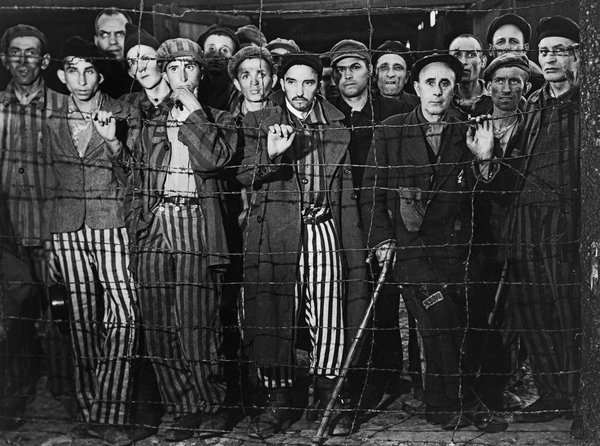
Today the U.S. government treats immigrants from Latin America the way liberated Jews were treated after World War II. Then a presidential aid reported: “we appear to be treating the Jews as the Nazis treated them except that we do not exterminate them. They are in concentration camps in large numbers under our military guard instead of S.S.

Prisoners at the Buchenwald concentration camp, near Weimar, Germany, as it was liberated by American forces in April 1945., Margaret Bourke-White/Time & Life Pictures – Getty Images // The New York Times,
World leaders gathered at Auschwitz last month to mark the liberation 70 years earlier of the Nazis’ most infamous concentration camp. More ceremonies will follow in coming months to remember the Allied forces’ discovery, in rapid succession, of other Nazi concentration camps at places like Bergen-Belsen that winter and spring of 1945.
Largely lost to history, however, is the cruel reality of what “liberation” actually meant for hundreds of thousands of Holocaust survivors discovered barely alive in the Nazi camps.
Even after the victorious American and Allied forces took control of the camps, the survivors – mainly Jews, but also small numbers of gays, Roma, Communists, Jehovah’s Witnesses and others – remained for months behind barbed wire and under armed guard in what became known euphemistically as displaced persons, or D.P., camps. Many Jews were left wearing the same notorious striped pajamas that the Nazis first gave them.
With the American forces overwhelmed by the sheer numbers of refugees under their control, underfed survivors lived for months in decrepit camps in Germany and Austria – a number of them on the same grounds as the concentration camps. Even after conditions improved, thousands of former prisoners remained inside and in limbo for as long as five years because the United States and most other nations refused to let them in.
In the early months after the war, thousands of survivors died from disease and malnutrition. Food was so scarce that rioting broke out at some camps, as Allied commanders refused to give extra food rations to Jewish survivors because they did not want to be seen as giving them preferential treatment over German P.O.W.s and other prisoners.
Faced with complaints by outside Jewish groups about conditions of “abject misery,” President Harry S. Truman sent a former immigration official, Earl Harrison, to Europe to inspect the camps. His findings were blistering. The survivors “have been `liberated’ more in a military sense than actually,” Harrison wrote Truman in the summer of 1945.
“As matters now stand,” he wrote, “we appear to be treating the Jews as the Nazis treated them except that we do not exterminate them. They are in concentration camps in large numbers under our military guard instead of S.S. troops.”
I ran across Harrison’s report a few years ago while researching a book on the flight of Nazis to the United States after the war. As I examined the path the Nazis took out of Europe, I struggled to understand how so many of them had made it to America so easily while so many Holocaust survivors were left behind.
One answer came in a copy of Gen. George S. Patton’s handwritten journal. In one entry from 1945, Patton, who oversaw the D.P. operations for the United States, seethed after reading Harrison’s findings, which he saw – quite accurately – as an attack on his own command.
“Harrison and his ilk believe that the Displaced Person is a human being, which he is not, and this applies particularly to the Jews who are lower than animals,” Patton wrote. He complained of how the Jews in one camp, with “no sense of human relationships,” would defecate on the floors and live in filth like lazy “locusts,” and he told of taking his commander, Gen. Dwight D. Eisenhower, to tour a makeshift synagogue set up to commemorate the holy day of Yom Kippur.
“We entered the synagogue, which was packed with the greatest stinking mass of humanity I have ever seen,” Patton wrote. “Of course, I have seen them since the beginning and marveled that beings alleged to be made in the form of God can look the way they do or act the way they act.”
Other evidence emerged revealing not only Patton’s disdain for the Jews in the camps, but an odd admiration for the Nazi prisoners of war under his watch.
Under Patton, Nazis prisoners were not only bunked at times with Jewish survivors, but were even allowed to hold positions of authority, despite orders from Eisenhower to “de-Nazify” the camps. “Listen,” Patton told one of his officers of the Nazis, “if you need these men, keep them and don’t worry about anything else.”
Following Harrison’s scathing report to Truman, conditions in the camps slowly became more livable, with schools, synagogues and markets sprouting up and fewer restrictions. But malaise set in, as survivors realized they had no place to go.
Hundreds of thousands of war refugees from Eastern Europe – including many top Nazi collaborators – gained entry to the United States in the first few years after the war, but visas were scarce for those left in the camps. Some Washington policy makers were actively opposed to the idea of taking in Holocaust survivors because of lingering anti-Semitism.
At Bergen-Belsen, as many as 12,000 Jewish survivors at a time remained there until the camp was closed in 1951. Menachem Z. Rosensaft was born at the camp in 1948 to two Holocaust survivors. He said in an interview that he believed that the survivors’ hardships after the war had often been overlooked because “it doesn’t neatly fit the story line that we won the war and liberated the camps.”
Mr. Rosensaft, the editor of a new book by Holocaust descendants called “God, Faith and Identity from the Ashes,” added: “Nobody wanted them. They became an inconvenience to the world.”
Joe Sachs, an 88-year-old Holocaust survivor who now lives outside Miami, said his three and a half years in a displaced person camp were tolerable. He met his wife there, learned a trade as a dental technician, and, on most days at least, there was enough food for everyone to get a piece of bread or meat.
Compared with the Nazi camps, “it was heaven,” he said. “But of course we felt abandoned,” Mr. Sachs added. “We were treated not quite as human beings. In a camp like that with a few thousand people, the only thing you feel is abnormal.”
The State Department finally approved visas for Mr. Sachs and his wife and their 18-month-old daughter in 1949, just as Holocaust survivors were finally being allowed into the country in large numbers, and they left for New York City.
That, he said, was truly liberating.
[Eric Lichtblau is a Washington correspondent for The New York Times and the author of “The Nazis Next Door: How America Became a Safe Haven for Hitler’s Men.”]

Filed Under: Anti-Bullying & Homophobia, History Tagged With: bigotry, concentration camps, homophobia, Nazi, nazis, oppression, USA

Just in time for Thanksgiving, here's the new short film Black Friday: A Gay Love Story

28/11/2014 By David McFarlane Leave a Comment

Dennis Hensley and Tom Goss experience consumerism, long lines and most especially, gay drama

26 NOVEMBER 2014 | BY GREG HERNANDEZ – Gay Star News

Photo courtesy of Tom Goss
Black Friday, the big post-Thanksgiving shopping day in US, is the setting for high gay drama in a fun new short film by Tom Goss and Dennis Hensley.
Goss tells Gay Star News that he and Hensley came up with the idea while chatting over coffee and pie about the ridiculousness of relationships and Black Friday consumerism.
The short tells the story of Chad (Hensley) and Claudio (Goss) who meet while waiting in line for Black Friday doorbuster deals.
Lust, love and heartbreak quickly – very quickly – ensue.

– See more at: http://www.gaystarnews.com/article/just-time-thanksgiving-heres-new-short-film-black-friday-gay-love-story261114#sthash.9HgGVqI1.dpuf

Filed Under: Movie Reviews Tagged With: Black Friday, movie, USA

The Unfair Criminalization of Gay and Transgender Youth

09/08/2013 By David McFarlane Leave a Comment

An Overview of the Experiences of LGBT Youth in the Juvenile Justice System of the USA


SOURCE: AP/Paul Sancya
Two boys hold hands at the Ruth Ellis Center, a drop-in shelter for LGBT – lesbian, gay, bisexual or transgender youth in Detroit, Michigan.
By Jerome Hunt and Aisha C. Moodie-Mills | June 29, 2012
Download this brief (pdf)
Gay, transgender, and gender nonconforming youth are significantly over-represented in the juvenile justice system—approximately 300,000 gay and transgender youth are arrested and/or detained each year, of which more than 60 percent are black or Latino. Though gay and transgender youth represent just 5 percent to 7 percent of the nation’s overall youth population, they compose 13 percent to 15 percent of those currently in the juvenile justice system.
These high rates of involvement in the juvenile justice system are a result of gay and transgender youth abandonment by their families and communities, and victimization in their schools—sad realities that place this group of young people at a heightened risk of entering the school-to-prison pipeline.
Despite the disproportionately high rates of gay and transgender youth entering the juvenile justice system, our nation’s schools, law enforcement officers, district attorneys, judges, and juvenile defenders are not equipped to manage the unique experiences and challenges that these young people face. As a consequence, the system often does more harm by unfairly criminalizing these youth—imposing harsh school sanctions, labeling them as sex offenders, or detaining them for minor offenses—in addition to subjecting them to discriminatory and harmful treatment that deprives them of their basic civil rights.
Angela Irvine of the National Council on Crime and Delinquency in conjunction with the Equity Project, which works to ensure gay and transgender youth in the juvenile justice system are treated with fairness and respect, have both generated groundbreaking research on the experiences of these youth in the system over the past few years. This issue brief offers a high-level summary of some of their findings, as well as others, to explain the disproportionate pipelining of gay and transgender youth into the juvenile justice system, the bias and discrimination they face once within the system, and the steps that the federal government and state and local juvenile courts can take to ensure that gay and transgender youth are treated with dignity and respect.

Why gay and transgender youth end up in the juvenile justice system

Family rejection, homelessness, and failed safety nets

Research shows that gay and transgender youth entering into the juvenile justice system are twice as likely to have experienced family conflict, child abuse, and homelessness as other youth. This trend is partly due to the fact that youth today “come out” at younger ages, often to families that may not accept gay and transgender people. Since these youth still depend on their families to meet their material needs, family rejection can leave them emotionally and physically vulnerable, particularly if they find themselves cast onto the streets with nowhere to turn for support.
Many gay and transgender youth leave their homes of their own accord to escape the conflict and emotional or physical abuse that can ensue—26 percent report leaving their homes at some point—but more often, they are pushed out and into the juvenile justice system by their own families.
Interfamily conflicts stemming from parents’ refusal to accept a child’s sexual orientation or gender identity often result in the first contact these young people have with the justice system. According to the Equity Project, prosecutors frequently file charges against these youth for being “incorrigible” or beyond the control of their parents or guardians, based largely on the parent’s objections to their sexual orientation. This practice unfairly criminalizes gay and transgender youth because of their identity rather than because of their behavior.
Further, family discord that casts these youth from their homes can send them cascading through social safety nets not adequately equipped to support them. Programs designed to keep children and youth off the streets, such as foster care, health centers, and other youth-serving institutions, are often ill-prepared or unsafe for gay and transgender youth due to institutional prejudice, lack of provider and foster-parent training, and discrimination against gay and transgender youth by adults and peers.As a result, many youth run away from these placements, actions that could also land them in the custody of the juvenile justice system.
Gay and transgender youth who flee hostility and abuse at home and in temporary placements are most likely to end up homeless, which is the greatest predictor of involvement with the juvenile justice system. Gay and transgender youth represent up to 40 percent of the homeless youth population even though they only compose 5 percent to 7 percent of the youth population overall, and 39 percent of homeless gay and transgender youth report being involved in the juvenile justice system at some level.
Out of despair and a need for survival, homeless gay and transgender youth are more likely to resort to criminal behaviors, such as drug sales, theft, or “survival sex,” which put them at risk of arrest and detainment. These youth are also at an increased risk of detainment for committing crimes related to homelessness, such as violating youth curfew laws and sleeping in public spaces.
Family rejection, which sets off a tragic chain of events for many gay and transgender youth, is at the core of these issues. Caitlin Ryan of the Family Acceptance Project at San Francisco State University, whose research has brought to light the negative impacts that family rejection can have on gay and transgender youth, emphasizes the need to provide opportunities to help support and strengthen families in order to promote nurturing environments for gay and transgender children. Early intervention can help families and caregivers reduce the risk of these youth entering the juvenile justice system. It is important that law enforcement officials, district attorneys, judges, and juvenile defenders seek ways to keep gay and transgender youth and their families together, rather than pushing for incarceration.

Biased school discipline policies

Unfortunately, schools do not always provide a reprieve for youth experiencing family rejection. According to the Gay Lesbian and Straight Education Network’s School Climate Survey, 84 percent of gay and transgender students report being verbally harassed, 40 percent physically harassed, and 19 percent physically assaulted.
What’s more, gay and transgender students report astonishingly low levels of confidence in their school administrators and often do not report incidents because they expect the situation will not improve or fear it might even become worse. This is not surprising considering that one-third of bullied gay and transgender students who reported bullying to school officials said the administrators did nothing to address the issue.
In fact, school officials in many ways exacerbate these problems and place further stress and burden on gay and transgender youth by disproportionately doling out harsh school sanctions against them for minor disciplinary infractions. The school and juvenile justice systems have become inextricably linked in recent years with schools relying heavily on law enforcement to manage what in the past were school discipline issues. The consequence of this conflated discipline system is that it unduly criminalizes youth of color and gay and transgender youth.
School discipline policies across the United States are under heightened scrutiny because of the disparate impact they have on youth of color, particularly black boys. Data released this spring from the U.S. Department of Education’s Office of Civil Rights show that harsh school sanctions—such as zero-tolerance policies, which lead to suspensions and expulsions of students for even the most minor offenses—perpetuate a school-to-prison pipeline that disproportionately criminalizes youth of color.
Hidden among these school discipline data are thousands of gay and transgender youth who bear a double burden of disparate impact. A groundbreaking study published in 2010 in the medical journal Pediatrics revealed that gay and transgender youth, particularly gender nonconforming girls, are up to three times more likely to experience harsh disciplinary treatment by school administrators than their heterosexual counterparts.
As with the racial disparities in school suspensions and expulsions, these higher rates of punishment do not correlate to higher rates of misbehavior among gay and transgender youth. What the research suggests is that gay and transgender youth actually face harsher sanctions by school administrators even when committing similar offenses.
Surely bias and discrimination among teachers, staff, and administrators contributes to the unfair treatment of gay and transgender youth in schools. Adults in schools often draw assumptions of guilt based on a student’s physical characteristics, demeanor, dress, or mannerisms, deeming those deviating from an accepted gender norm to be agitators. Such assumptions are not only misguided, but biased against gay and transgender students who do not fall within rigid stereotypes of expression.
Moreover, studies reveal that gay and transgender youth are often the victims, rather than the aggressors in school conflicts, which stem from bullying and harassment. Consider, for example, a gender nonconforming girl exhibiting masculine traits, who is disciplined for fighting but may be defending herself from peers’ taunts. Yet more often than not, school administrators will consider her the aggressor based solely on her physical demeanor and will suspend or expel her despite the defensive nature of her actions.
For many students, suspension and expulsion are the first steps toward time behind bars. This is equally true for gay and transgender youth. Black boys and gender nonconforming girls similarly experience disproportionately harsh punishments and juvenile justice system referrals in schools, but the latter are rendered all but invisible because sexual orientation and gender identity are not included in the federal school discipline data cited earlier in this report. A first step in addressing the unfair punishment of gay and transgender youth in schools is to expand the research and collection of school discipline data to include gay and transgender youth, which will help policymakers and practitioners alike better understand the problem and formulate more supportive school discipline policies.

Unfair criminalization by the system

Once in the juvenile justice system, gay and transgender youth are too often denied basic civil rights, wrongly categorized as sexually deviant simply because of their sexual orientation, gender identity, or gender nonconformity, and even labeled as sex offenders. They are also subjected to the biases and discrimination of law enforcement agents, judges, and other justice system officials that leave them vulnerable to abuse and neglect.

Classification as sex offenders

Gay and transgender youth who end up in the justice system are at-risk of being labeled as sex offenders, regardless of whether they have actually committed a sexual crime. Gay and transgender youth “are more likely to be prosecuted for age-appropriate consensual sexual activity” than their heterosexual counterparts—a lopsided application of the law, which has devastating consequences for gay and transgender youth who would be required to register as a sex offenders in 29 states if convicted. The stigma of being a registered sex offender could haunt them for the rest of their lives, negatively impacting their future employment and life opportunities and causing significant psychological distress.
Many gay and transgender youth charged with nonsexual offenses are also unfairly treated as sex offenders and ordered by the court to undergo sex offender treatment programs or sex offense risk assessments simply because of their sexual orientation or gender identity. This misguided categorization by the courts has led gay and transgender youth, innocent of violent crimes or sex offenses, to be placed in restrictive punitive settings for high-risk youth and to be given longer stays in out-of-home placements.
These restrictive settings not only hinder rehabilitation efforts, they perpetuate the stigma that being gay or transgender is wrong. Additionally, extended stays in out-of-home placements prevent gay and transgender youth from reconnecting with their families, a critical step proven to stabilize their lives and reduce their risk of returning to the system. These unfair practices make gay and transgender youth susceptible to discrimination and harmful treatment while in the system.

Detention as a default

In most incidences juveniles who have been arrested or detained will only be released from custody under the supervision of a parent or guardian. Without someone to claim them, youth can be left to languish in detention centers with youth convicted of crimes, even if they have not been. Gay and transgender youth are most at-risk of detainment by default by the juvenile justice system as they are more likely to be estranged from their families and lack parental support, which leaves them to fend for themselves. As a consequence, these youth are subjected to criminal incarceration while they await foster or group home placements.

Discriminatory and harmful treatment

Segregation and isolation of gay and transgender youth

From the moment gay and transgender youth enter a detention facility they are at risk of being inappropriately classified and housed. Transgender youth, for example, are often placed according to their birth sex rather than by their gender identity in an effort to force transgender youth to conform to societal norms. Doing so can be psychologically devastating and leave them vulnerable to physical and sexual abuse. Additionally, youth facility staff often view them as threatening or sexually predatory, harmful stereotypes that taint placement decisions and influence the treatment of transgender youth.
Some facilities will automatically segregate gay and transgender youth or place them in solitary confinement for their “own safety,” but this isolation perpetuates the stigmatization of gay and transgender youth, casts them as sexually deviant, and signals that they might be of threat to other youth.
According to the American Psychiatric Association, isolation “is a form of punishment and is likely to produce lasting psychiatric symptoms.” Unwarranted segregation deprives gay and transgender youth of educational, recreational, and programming opportunities that they are otherwise entitled to receive, punishing them unfairly and at a particularly vulnerable time in their adolescent development.

Physical, sexual, and emotional abuse

A 2007 study funded by the California Department of Corrections and Rehabilitation found an astounding 67 percent of gay or transgender men have been sexually assaulted by another inmate—a rate 15 times higher than the overall inmate population. Another study found that sexual assaults that occur are not just isolated events, but that 30 percent of all inmates have endured six or more sexual assaults.
Gay and transgender youth are particularly at risk for physical, sexual, and emotional abuse while in detention, by both staff and other youth. Eighty percent of those surveyed by the Equity Project believed a lack of safety in dentition was a serious problem. Some reports suggest that staff have turned a blind eye to incidents of rape and abuse against gay and transgender youth, confusing gay and transgender identity as an invitation for sex. Gay and transgender youth are not only subjected to abuse by their peers but by staff as well, particularly in the facilities that lack training and policies that promote inclusiveness and rely on biases rather than on best practices in treatment and placement decisions. This type of environment allows physical, sexual, and emotional abuse toward gay and transgender youth to happen without so much as a second thought and leaves them with nowhere to turn for help.

Unsafe reparative or conversion therapy

Gay and transgender youth have been subjected to reparative or conversion therapy to change their sexual orientation by both social workers and the courts, even though so-called reparative or conversion therapy has been condemned by every major health organization, including the American Medical Association, American Psychological Association, and the American Academy of Child and Adolescent Psychiatry.
Sadly, the juvenile justice system is rife with examples of misguided interventions. One judge hospitalized a gay youth to stop his same-sex attraction, while another judge with the parent’s approval, had a young lesbian who was caught in a sexual act with another girl placed in a private hospital to be “treated and diagnosed for this behavior.” These examples may be the extreme, but instances such as a 15-year-old boy being given a women’s lingerie catalogue with the purpose of teaching him “appropriate” sexual desires and a male-to-female transgender youth, who was detained in a boy’s facility, being placed on “treatment plan” to “help with gender confusion and appropriate gender identity,” are more common examples of unsafe reparative therapy.
The inclination to change a youth’s sexual orientation or gender identity or force him or her to conform to “social norms” hinders general mental health and causes severe psychological distress. This type of “counseling and other services are virtually worthless [for gay and transgender youth] because they either ignore or criminalize the youth’s sexuality.”

Conclusion and recommendations

Gay and transgender youth are pipelined into the juvenile justice system at disproportionate rates, often stripped of their basic dignity and civil rights, and treated in a harmful and discriminatory manner once in the system. The current policies and practices of schools and the juvenile justice system overlook gay and transgender youth and perpetuate stigma and bias that can lead to their unwarranted criminalization and unfair treatment.
Some of the issues discussed in this report stem from the lack of cultural competency on the part of school officials, law enforcement officers, district attorneys, judges, and juvenile defenders. The individuals who interface directly with these youth must be better equipped to provide respectful, culturally appropriate interventions in order to reduce the number of gay and transgender youth unfairly and unnecessarily pipelined into the juvenile justice system and to improve conditions for them once in the system. A first step toward improving the system will be to institute training standards across the board for all agents of the court.
Moreover, institutional bias is at the heart of the mistreatment of gay and transgender youth by schools and the juvenile justice system, and we recommend broad policy suggestions to address them. The following recommendations are adopted in part from the National Juvenile Justice and Delinquency Prevention Council and the Equity Project. These recommendations are by no means the only recommendations for improvement, but instead offer a start to address the serious issue of the criminalization of gay and transgender youth.

Practical recommendations

  • Promotion of family center interventions

Family rejection drives many gay and transgender youth from their homes and perpetuates negative coping behaviors and unlawful activities, heightening risk of entering the juvenile justice system. Gay and transgender youth who feel a sense of family acceptance report better physical, mental, and educational outcomes all around. Yet families have largely been left out of the equation on reform. Interventions that reconnect youth with their families will reduce their susceptibility to involvement with the juvenile justice system. Moreover, schools and juvenile detention systems should engage in more supportive behaviors that reduce risk and promote the positive development of gay and transgender youth in custodial care.

  • Gay and transgender inclusive training for all juvenile justice professionals

“Juvenile justice professionals must receive training and resources regarding the unique societal, familial, and developmental challenges confronting [gay and transgender] youth … [T]rainings must be designed to address the specific professional responsibilities of the audience (i.e., judges, defense attorneys, prosecutors, probation officers, and detention staff).” Furthermore, these professionals must ensure that they and others treat gay and transgender youth with dignity, respect, and fairness and avoid ridiculing or attempting to change their sexual orientation or gender identity.

  • Development of gay and transgender inclusive policies, procedures, and programs

All agencies involved with juvenile justice and all officers of the juvenile court should develop, adopt, and enforce polices that prohibit discrimination and mistreatment of any youth on the basis of their actual or perceived sexual orientation or gender identity at all stages of the process. Juvenile justice professionals should develop appropriate responses to the behavior of each gay and transgender youth that are tailored to address specific needs and to promote individual well-being by allowing gay and transgender youth to express themselves freely. This would include giving them the choice of name, clothing, hairstyle, or any other means by which they feel comfortable expressing themselves.

  • Gay and transgender inclusive data collection by the Office of Juvenile Justice and Delinquency Prevention

Many states and localities are unable to achieve meaningful changes to their juvenile justice systems because the lack adequate data. Therefore, the U.S. Department of Justice’s Office of Juvenile Justice and Delinquency Prevention should prioritize data collection that is disaggregated not only by race, ethnicity, and gender, but also by sexual orientation and gender identity. Through this type of robust data collection, communities will be better able to develop services that are culturally and linguistically appropriate for youth and their families, especially for gay and transgender youth.

Policy recommendations

  • Dismantle the school-to-prison pipeline for all youth and for gay and transgender youth in particular

As previously noted, gay and transgender youth are disproportionately pipelined into the juvenile justice system by their schools. Yet little data are available to quantify the problem and address it effectively. We can address this by including sexual orientation and gender identity questions in the Department of Education’s school discipline data collection efforts. In addition, it is important that the Supportive School Discipline Initiative, a joint effort between the Department of Education and the Department of Justice aiming to dismantle the school-to-prison pipeline and currently focusing on race, provide guidance to school systems that bridges the gap for all youth, including those who are gay or transgender.

  • Pass the Safe Schools Improvement Act and the Student Nondiscrimination Act

The federal Student Nondiscrimination Act would prohibit discrimination on the basis of gender identity and sexual orientation against any student in a public school that receives federal funding and would allow individuals to take legal action and be awarded compensatory damages and reimbursement of court costs if judgment is found in their favor under the bill’s provisions. The Safe Schools Improvement Act would require kindergarten-through-12th-grade public schools that receive federal funding to implement policies prohibiting harassment and bullying based on gender identity and sexual orientation. The bill would also require states to report harassment and bullying data to the U.S. Department of Education. Passage of these two pieces of legislation by Congress would help ensure that gay and transgender students do not end up in the juvenile justice system for protecting themselves against discrimination they face on a daily basis at school.

  • Gay and transgender cultural competence in Safe Schools/Healthy Students

The Department of Education’s Safe Schools/Healthy Students program is widely recognized as a model of “effective collaboration across public education, local mental health, and juvenile justice.” Therefore the evaluations of the Safe Schools/Healthy Students program should be inclusive of gay and transgender students needs, including cultural competency training for those who work in the juvenile justice system. Increased training focused on the needs of gay and transgender youth will help decrease arrest rates and referrals of these youth to the juvenile justice system. Currently, law enforcement is 50 percent more likely to stop gay youth than other youth, according to a recent study in the medical journal Pediatrics. Additionally, “girls who identified themselves as lesbians or bisexual reported twice as many arrests and convictions as other girls who had engaged in similar behavior.” Gay and transgender youth in general experience high rates of school violence, which not only interferes with their ability to learn but also can affect their involvement with the juvenile justice system.

  • Amend the Sex Offender Registration and Notification Act

Congress should amend the Sex Offender Registration and Notification Act, or SORNA, to exclude youth who are convicted of certain sex-based offenses from mandatory sex offender registration. The way the U.S. Department of Justice’s SORNA program is currently set up can disrupt families because both the youth who has to register is stigmatized and the entire family. More importantly, SORNA can have lasting effects on a youth’s identification and treatment. A parent, for example, may delay getting his or her child needed treatment and even go as far as hiding the child’s problem after discovering that the child may have to register as a sex offender for life. Thus, amending this law can help to alleviate the criminalization that is part and parcel of a gay or transgender youth being labeled as a sex offender.

  • Reauthorization of the Juvenile Justice and Delinquency Prevention Act

The Juvenile Justice and Delinquency Prevention Act has not been reauthorized since 2002 and is in need of substantive changes to ensure that youth are put on a better path and that our communities are kept safe. In particular, the act should be reauthorized to include three key items that will help gay and transgender youth in the system. The first is to strengthen the Disproportionate Minority Contact core protections “by requiring states to take concrete steps to reduce racial and ethnic disparities in the juvenile justice system,” rather than just issuing vague requirements with no clear guidance on how to reduce these disparities.
Second, the partnership between states and the Office of Juvenile Justice and Delinquency Prevention should expand training, technical assistance, and research and evaluation to include of gay and transgender needs and issues.
Third, incentives for the juvenile justice system to ensure that all policies, practices, and programs recognize the unique needs of gay and transgender youth, including accountability measures, expertise on the Juvenile Justice and Delinquency Prevention Act advisory groups, and increased research and information dissemination should be created.

  • Passage of federal legislation prohibiting gay and transgender discrimination in the juvenile justice system

As this brief has shown, the juvenile justice system holds a disproportionally large number of gay and transgender youth, who experience high rates of discrimination and violence. Passage of federal protections that would ensure equality and the end of discrimination against gay and transgender youth is universal and should not be legislated on a state-by-state basis. Therefore, “Congress should pass federal protections against discrimination in all settings based on actual or perceived sexual orientation or gender identity and create incentives for States to appropriately and effectively respond to [gay and transgender] youth involved in the justice system.”
Jerome Hunt is a Research Associate for LGBT Progress at American Progress and Aisha C. Moodie-Mills is the Advisor for LGBT Policy & Racial Justice at American Progress.

Filed Under: Anti-Bullying & Homophobia Tagged With: criminalization, gay, justice system, LGBT youth, transgender, USA, youth

  • « Previous Page
  • 1
  • 2

Categories

Copyright ACOMSDave.com © 2026