
ACOMSDave

Community Journalist

  • Home
  • Community Journalist
  • Events
  • Media Page and Press Kit
    • Projects and Work
  • Resources & Documents
    • LGBTQ+ Support Groups and Documents
  • NIGRA
  • Archives
  • Contact

Straight dads with gay sons

22/02/2015 By David McFarlane Leave a Comment

Reprinted from Gay Star News:

Watch: Straight dads with gay sons read from book titled I Think I’m a Poof

This video will give you all the feels
20 FEBRUARY 2015 | BY DARREN WEE
Gay author Samuel Leighton-Dore.

Photo courtesy of Samuel Leighton-Dore
This video of straight Aussie dads reading from an adorable new book and talking about their gay sons will give you all the feels.
I Am a Poof is a new adult-children’s book and one dads in the video is the father of the author, Samuel Leighton-Dore.
‘One of the fathers is my own, and the others are those of friends,’ he told Gay Star News.
‘It was really touching to watch them all open up and discuss something so personal.’
In the video, Leighton-Dore’s father says of his son’s coming out: ‘It was so significant for him, but what’s remarkable is how insignificant an announcement it was for me.’
The book itself is a tongue-in-cheek story about a young boy coming out to his father and the unusually progressive advice his father gives in response.
‘Traditionally fairytales typecast heroes and villains, so I mindfully followed that more conventional structure; making the bullies our villains, and the young gay man our hero,’ the author said.
Leighton-Dore is a self-proclaimed ‘poof on mission’ but why did he use a word that many find offensive?
‘My choice of language wasn’t to provoke or polarize, but rather to deflate these everyday insults of their crushing power on children,’ he said.
The part-time relationship columnist said the book is a work of satire – but with a beating heart of its own. And a percentage of all profits will be donated to local LGBTI charities.
‘It’s so important that there are a range of characters and protagonists for young people to identify and relate to,’ he said.
‘Adults will take something from it, as will those approaching their teenage years. The main thing is to open up a positive dialogue.’
Watch the video below:

– See more at: http://www.gaystarnews.com/article/watch-straight-dads-gay-sons-read-book-titled-i-think-im-poof200215#sthash.CMZyiwI3.dpuf

Filed Under: Book Reviews Tagged With: gay sons, straight dads

Book review: Only Heaven Knows by Alex Harding

18/02/2015 By David McFarlane Leave a Comment

reprinted from Gay Star Spring 1991.

Our resident dramturge (I think that’s the word) rather looked down his nose at this wee book.  I quite liked it.  The musical is set mostly in Sydney 1944, the early summer.  It is a sentinmental story of young (gay) love and of experience, in the form of a couple of middle-aged sissies.  That is about all there is to the whole thing – bot on the stage the whole thing has life and energy.
I’d recommend it to any group of gay people who might be thinking of putting on a show celebrating our lives – if you think this is a broad hint you might just be right
1990 Old Nick production of Alex Harding’s Musical “Only Heaven Know’s”


Filed Under: Book Reviews Tagged With: alex harding, gay love story, musical, only heaven knows

Book Review: Foreign Parts by Ivor C Treby

18/02/2015 By David McFarlane Leave a Comment

Reprinted from Gay Star Spring 1991. Reviewer Sean McGouran


Ivor C. is very clever writer, in fact he sometimes verges on the clever-clever – which may be one of the reasons why I have always like his stuff.  If you’re a smart Alec you may as well be Smart Alecky with style.
This wee book is in three parts (not unlike Caesar’s Gaul) the middle section is Foreign Parts, the poems being often quasi-experimental.  Lisboa for example, being written over two pages to give an impression of the great earthquake which ruined Lisbon of the classical era.
On the train to Leipzig, written when East Germany (the Deomcratic Republic) still existed, is written in very good standard verse; it scans and it rhymes.  This section involveds visits to other parts of the erstwhile Soviet boc, including Romania, but Treby does not fall into the trap of jibing at “the sytem”.  I was very struck by An Embalmed Revolutionary, about George Dimitrov, who defied the Nazi in their own People’s Courts:
 
“When young
and full of fire
did he expect this state,
the marble tomb, and all his trips
re,pved?”
 
Lost bright waters is about travelling to and through Australia and New Zealand.  The poems are a sort of crescendo and diminuendo up to and away from transmitted in the blood,  at least that’s how it appears to one reader.
Mr. ICT has a certain amount of Carollian fun at the expense of the kakapo, the ground parrot in lost bright waters.  In fact there is a Carrollian air about ICT’ use of language – it is precise but off-centre, not deliberately eccentric but the product of a way of looking at the world which is inborn.
 

Filed Under: Book Reviews Tagged With: De Blackland Press, foreign part, ivor c treby, poetry

Book Review – John by Ron Schreiber

18/02/2015 By David McFarlane Leave a Comment

Originally published in Gay Star in Spring 1991,

This book consists of what read like a series of entries into a journal or diary.  They do not rhyme and the rhythm is that of everyday, if not banal speech, cut up and set down on paper like traditional verse.
It isn’t verse and it isn’t poetry.  It does not have the vigour, the precision or the power of poetry.  It only springs into life when Schreiber turns for the situation of his lover John McDonald, to describe animals.  This is very striking in midsummer’s day, 1986 and in canaries, which ends in a tension-relieving joke.  There is also in protocols (4-16-86) an image of “hope”.
 
“…wriggling
“it’s wormy body into a
kind of life”
 
Although Ron Schreiber discusses katharsis (his spelling) the terror and pity of the drama of life and death, he does not achieve it here.  the book as a whole achieves a sort of power – the simple exposition of someone dying with dignity could nto help but be moving, but the railing against McDonald’s family rather mars this dignity and power.  this is not to say that they do not deserve the criticism, they seem to be standard=issue fundamentalists who took their son away to “save” him from Ron Schreiber – and the Devil.
What Mr. Schreiber seems to me to have written, possibly inadvertently, is the synopsis for a television mini-series.  Spread over three nights and with realistic dialogue, this story could do a great deal of good, in the world, especially now that it has been purged from the system of Ron Schreiber and John McDonald’s other friends and companions
 

Filed Under: Book Reviews Tagged With: book review, Poems, ron schreiber

Book Review: Stealing Time

18/02/2015 By David McFarlane Leave a Comment

Originally published in Gay Star Spring 1991. Review written by RB


The blurb on the back says: “A lesbian feminist novel that brings today’s vicious politics to their illogical conclusion while offering a rascally hope for the future.”
The novel is set in the future where hard cash has been abolished and legal transactions are done via direct transfers between computerised bank accounts  Controlling which organisations get these accounts is one way the establishment suppresses subversive activity.  Also, each citizen has a Social Credit status which affects what kind of privileges, such as the quality of education or health care, they can get from the state.
As a dig at the New Right the novel does not really work.  The New Right is certainly not in my experience interested in class and social status.  Rather it is more interested in material things such as hard cash.  A free market in health care and education it may well be capable of providing an ideological justification for.  It would shun any kind of system based on an abstract concept of Social Credit.
As a story it is not exactly gripping.  The highest level of suspense for me was whether Alison, the adolescent computer hacker, was going to have grommets put into her ear by the end of the story.  Physical action peaked when the police were around though I found the police scenes in Tom Sharpe’s Wilt more exciting.
If you are going to have computer hacking or some other technical pursuit as a fore-ground activity in a novel it needs to be convincing and in this book it sadly is not.  Computers are not as easy to hack through down telephone lines as she implies – a lot more can be done to protect against unauthorised access than just having static passwords.  For example, a protection system where the central computer had to telephone the user’s terminal back would have flummoxed our heroines as the authorities would known exactly which telephone numbers had been used for accessing their computer.
The book does not make lesbian squats sound very attractive.  Too much tension.  Marlene, Kerry and Ruth would probably have been much happier if they had beaten each other up occasionally
If you are looking for a book to inspire your children/sprogs/weens.  I would not recommend Stealing Time as the highest level of action is Bobbies raiding a squat and the technical detail is very thin.
Better, but not perhaps so ideologically sound from Onlywomen’s Press’ perspective, is Robert Heinleins’s Podkayne of Mars and Have Space Suit Will Travel.


Filed Under: Book Reviews Tagged With: computer hacking, lesbian fiction

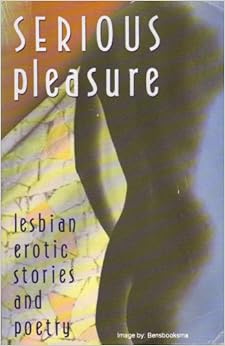
Book Review: Serious Pleasure

18/02/2015 By David McFarlane Leave a Comment

This review was published Spring 1991 in Gay Star and was written by Stella Mahon


It a ‘serious pleasure‘ to find lesbian sex and sexuality celebrated by those to whom they belong.  But there are problems on several levels with this book.
The Sheba Collection are only too aware of some of these and assure us in their well-considered introduction, that they discussed them at great length.  For example, one of  the things they invite us to ponder is the thinness of the differential line ‘between erotica and pornography’.  How do we cope with the fact that there are some men ‘out there’ who will inevitably use the book as a  turn-on, written as the stories and poems often are, with frank and uncompromising abandon.  Sheba obviously feel that there is a further general – and important – debate, around lesbians taking ownership of how we are represented.  And I believe that they feel that they have taken a step within that debate, challenging us to rise towards finding ‘the fine balance between political correctness and personal experience’.
And there, of course lies another possible problem, colouring how individuals are likely to react to this volume.  It is, I would guess, improbable that every lesbian will identify with all the fantasies and romps through its pages.  It is also conceivable that there might be those who fail to identify with any of it and that not merely because personal experience precludes identification but also because personal politics, which, of necessity, have a collective focus and significance, will raise too many questions.
That larger debate aside, though never forgotten, there is one further problem to be addressed in reviewing the book: are the stories and poems a good read?  Disappointment will not be yours if all you want to do is absorb and react to many and varied visions of lesbian sex in full flow.  On that level, the stories are indeed a good read.  Some are headily passionate, others questing and sometimes finding.  Yet others are sheer fun, one, in particular Parting Gift by MIndy Meleyal with punchline which almost takes the breath away.
But is it wrong to want more than that level of expectation grants?  Does writing erotica have to mean, as it sometimes does here, that quality – of language, of story construction, of character creation – has to go by the board?  The essence of many of the stories is most definitely ‘grunt and thrust’, and that occasionally quite aggressively so.  (I am thinking on particular of the poem by Storme Webber, Like a Train).  There were occasions when I felt that what mattered was not the characters, but how quickly they could be got into bed or under the shower, so as not to lost space for exhaustively describing them at it.  As if the only vital thing is the fantasy.  Perhaps it is in erotica and I am looking at this book from a completely wrong premise.
But then, you see, not all of the book is like that.  Cherry Smith’s Crazy about Mary Kelly is a case in point.  Not that it is devoid of what I have called ‘grunt and thrust’.  But the presence of sexual desire and its fulfilment serves Cherry’s characters, helping to make them and their angers, fears and needs recognisable.  How they are together physically mirror their individual emotions and reactions to each other – and for a brief while we have the tensions of whether they will be able to grow past these to respond to each other as they need to  The story has a wholeness which some of the other lack.
And there are others which, while giving themselves over quite fully to fantasy, also carry something of universal about them.  In Ambivalance  by Tina Bays, we see before us something which most, if not all of us have expereinced – that electric insecurity of wanting and needing, which one is wary of voicing in case the other is not feeling the same way.
All in all, though I suppose I did feel rather overshelmed by the experience of reading this book.  I think I felt rather like the speaker in the last piece in the book – a poem of Cheryl Clarke (whose work as represented in Serious Pleasure is worth the folling up and I intend to).  I’m almost convinced that Sheba Collective, aware of the possibility of many shell-shocked readers, deliberately put this poem last, in a moment of wry humour, to slow things down, and bring other perspectives to bear.
Here it
is:

Sexual Preference by Cheryl Clarke

I’m a queer lesbian

Please don’t go down on me down yet

I do not prefer cunnilingus

(There’s room for me in the movement.)

Your tongue does not have to prove its prowness

there

to me

now

or

even on the first night

Your mouth all over my body

then there

Filed Under: Book Reviews Tagged With: lesbian, lesbian fiction, lesbian poetry, poetry, serious pleasure, sheba, stella mahon

Stonewall Book Awards 2015

08/02/2015 By David McFarlane Leave a Comment

Three Honor Books for Children and Young Adults were selected:

    • “Beyond Magenta: Transgender Teens Speak Out,” by Susan Kuklin, photographed by Susan Kuklin.
    • “I’ll give you the sun,” written by Jandy Nelson, published by Dial Books, an imprint of Penguin Group (USA) LLC.
    • “Morris Micklewhite and the Tangerine Dress,” written by Christine Baldacchio, pictures by Isabelle Malenfant, published by Groundwood Books / House of Anansi Press.


The Stonewall Book Awards – Barbara Gitting Literature Award was presented to “Prelude to Bruise” by Saeed Jones  and published by Coffee House Press.

Four Honor Books in Literature were selected:
  • “Frog Music” written by Emma Donoghue and published by Little, Brown and Company.
  • “Bitter Eden” written by Tatamkhulu Afrika and published by Picador.
  • “The Two Hotels Francforts” written by David Leavitt and published by Bloomsbury.
  • “My Real Children” written by Jo Walton and published by Tor Books.


The Stonewall Book Awards – Israel Fishman Non-Fiction Award was presented to “Living Out Islam: Voices of Gay, Lesbian and Transgender Muslims” written by Scott Siraj al-Haqq Kugle and published by New York University Press.

Four Honor Books in Non-Fiction were selected:
  • “Redefining Realness: My Path to Womanhood, Identity, Love and So Much More” written by Janet Mock and published by Atria Books.
  • “Gay Berlin: Birthplace of a Modern Identity” written by Robert Beachy and published by Knopf.
  • “Hold Tight Gently: Michael Callen, Essex Hemphill, and the Battlefield of AIDS” written  by Martin Duberman and published by The New Press.
  • “Charity and Sylvia: A Same-Sex Marriage in Early America” written by Rachel Hope Cleves and published by Oxford University Press.

Filed Under: Book Reviews Tagged With: awards, book, stonewall

Book Review: The Journey Home

08/02/2015 By David McFarlane Leave a Comment

The Journey Home
 
By Dermot Bolger
Penguin


The Journey Home by Dermot Bolger is an exceptional novel from one of Ireland’s leading contemporary writers.  The author, with the release of this title, has been recently nominated for the Irish literature prize in the Irish Times/Aer Lingus awards.
One can immediately see why.
Mr Bolger, to coin a phrase, is a master of modern-day grotesquery in that he portrays a horribly vivid picture of Dublin life as seen through the eyes of his principal characters: Hano, Shay and Katie.
The former enjoys too much lavish drunken debauchery with is soulmate Shay; whilst the latter has a sordid past of solvent abuse and robbery.
Briefly, Hano meets Shay whilst working in an electoral office; the two begin drinking heavily together and become best friends. Hano gradually places Shay on a pedestal. The latter moves to the continent, returns, and is eventually murdered by Hano’s ex-boss: the shady (homosexual) Patrick Plunkett (extortionist extraordinaire).  In revenge, Hano murders Plunkett and goes on the run with the outcast and social victim Katie.
Behind all this marvellous maundering is a background of drug abuse, homelessness, prostitution, alcoholism, corruption rape, destruction of innocence, death, and street-fighting (PHEW!).  The whole structure of the novel would make Dickens envious.
Bolger is incontrovertibly a craftsman. Structurally The Journey Home is a delight to behold; for the author incorporates flashback/memory with the present; and manages to restrict the story’s time-span to four days (Sunday to Wednesday).  Further to this his seemingly “out-of-place” passages (in italics) give his work a strong cinematic quality.
Moreover, the characters portrayed in the book are extremely lifelike.  It seems that very few authors around today could mould such moral deviants; such villainous, putrescent scum; as does Dermot Bolger.  I actually sat down after reading this little gem of skulduggery and imagined what type of life, and what kind of people the writer in question has had the misfortune to have known.  The Plunkett brothers are nasty pieces of work.  Patrick is a high-powered sexual deviant; Pascal is a corruptible junior minister. The two, in my opinion, would have battled well against the Kray twins.
The whole tone of the book is one of no hope as the narrator (Hano) struggles with his guilt.  Indeed, this novel could be very easily compared to Jean-Paul Sartre.  It has an essentially existentialist outlook and moves often from one morose setting to the next:
…”But always the fun was jolted out of the night by the interruption of the journey.  We’d sit on the floor around an electric fire, opening six-packs and trying to get back into the happy ambience of the pub.  But slowly the conversation froze back into the endless dissection of work and promotion, character assassination and grudges”…
The book carries on in this vein incessantly.  It can make reading somewhat arduous at times; sometimes strangely interesting at others.
One essential point to note about the Journey Home is that it can shock quite easily.  I issue this very serious warning:  DO NOT UNDER ANY CIRCUMSTANCES PURCHASE THIS NOVEL IF YOU ARE EASILY OFFENDED.  For within this work there are numerous passages of gratuitous violence; bad language; and explicit sex scenes (including a homosexual rape scene).  On the other hand, if you are open-minded these passages are a riveting read:  for they practically drip realism onto the page.  They are also arguably essential to the plot in that they aid the reader to visualise the harsh realities that the author is trying to convey.  Indeed, the author attains his goals in this respect with consummate ease.
The Journey Home, surprisingly, is a refreshing, rather than a depressing work.  It can serve as a lesson to us all on how to avoid the evils of modern society.  The book’s greatest attribute is it’s commentary on the destruction of innocence, and collapse of society (Hano’s family being the prime example of this).
One really wonders if the author leaves us with any hope of salvation from the sordid state that Dublin, and, more importantly, the characters within this novel have got themselves into.  Is It is really their fault thought?……we can only speculate.
Overall, this is a book that will no doubt have you completely enthralled from the moment you pick it up until you put it down.  I strongly recommend its purchase, despite the fact that I previously thought that I disliked this genre.
The Journey Home is worthwhile: not only is it thoroughly entertaining, but it will no doubt stand the test of time as a social commentary.  Just like Orwell’s The Road to Wigan Pier it is vastly ahead of its time.  The novel has something in it for everyone; and the discerning reader will find it hard not to see it for it’s true worth.
Granted, I didn’t come away from reading it with a sense of catharsis – but I was pleased to discover that my initial perceptions of the book were wholly unfounded.
At its current price it is at least worth considerable consideration.
 
JOURNEY INTO its PAGES IF YOU DARE TO STARE REALITY IN THE FACE.
Me? …..well, I’m going to buy another one of Bolger’s books!
 
Mark McCormack

Filed Under: Book Reviews Tagged With: bolger, book review, dermot, dublin, home, journey

Book and Movie – LOVE AND DEATH ON LONG ISLAND

02/02/2015 By David McFarlane Leave a Comment


LOVE AND DEATH ON LONG ISLAND
by Gilbert Adair
138 pages
Published by Minerva
This novel might be described as a gay Lolita, or more properly a modern Death in Venice. The tile seems to hint at this connection, and while the main character does finally meet and speak to the object of his desire, the same fruitless ending follows.
Giles is a middle-aged writer who lives in near seclusion. On impulse he goes to the cinema complex to see a film of a Forster novel. He goes to the wrong cinema and sees instead Hotpants College II, and falles hopelessly in love with Ronnie Bostock, one of the stars.
Giles embarks on a search for details of his beloved. He discovers Teen Dream Boat and other fan magazines. He even enters the world of video rental. Then he finds himself pushed to buy Toy Boy and superimpose the head of Ronnie on the nakes bodies from the flesh mag. When he reads that Ronnie is to wed, he goes in desperation to the States to meet him. This he finally manages, and flatters Ronnie with an intellectual analysis of the crap films he stars in. When he does finally declare himself to Ronnie, he is rebuffed.
The novel is told in beautiful spare prose, and (contrary to what this brief outline might indicate) it is funny and amusing. Adair, who is an accomplished film commentator and author of Hollywood’s Vietnam, manages to filter the world of cinema through innocent eyes, and this shed new light on it.
the obsessive nature of love is superbly captured, and this (Gile’s declaration to Ronnie) captures the style:
I found myself clinging to his wrist, to his hand, holding him back to then, in a fierce whisper, forcing frommyself the inevitable,: irreplaceable words, hackneyed and sacre d’I love you!’
When Ronnie has left, he wonders:
Dear God, I said to myelf, what have I done?
This short book says more in its space than many an overweight ‘page-turner’. It will appeal for its fine handling of a gay theme with poise and humour, while not flinching from the pathos that lies at the heart of so much love.
AH

Filed Under: Book Reviews, Movie Reviews Tagged With: death, gilbert adair, long island, love, Minerva

BOOK REVIEW: Barbra: An Actress Who Sings

02/02/2015 By David McFarlane Leave a Comment


Barbra: An Actress Who Sings
An unauthorised biography by James Kimbrell, published by Branden Publishing Company, Boston
Filmography, Discography, bibliography are all words that spring to mind when trying to describe this book. Volume I (of presumably a 2-volume set) gives us Ms Streisand the Acress and Singer, but precious little about Streisand the Woman. Certainly we learn of her affair with Jon Peters; but this is probably one of the too-few instances when we hear about her private life.
Streisand the Actress seems to be an entirely different person from the plitical and social-awareness campaigner, as th singer is totally different fromthe aforementioned two. Her temper is legendary, and she does not sufer fools gladly- but she has also alienated many co-stars, directors, producers, camera-men etc. Mr Kimbrell is obviously a fan of Ms Streisand, but he is not afraid to pull any punches when describing her behaviour on and off the set.
The gorgeous voice (we learn) is a little unsure of itself, which accounts for her giving only four (I was surprised to learn) publich performances in her entire career. Her singing career is very well covered in this volume – but Please! no more underlining of titles, dates, names etc. It is so infuriating and distracting.
Streisand is not afraind to tackel political issues as well. Money form her own pocket was used to fund a campaign to unseat Senator Jesse Helms. All that can be said is Good Luck on this one, Barbra!
Certainly a book for all Streisand fans; but I think I will wait a while, as this is definetly not the Definitive Biography.
Peter G Simms

Filed Under: Book Reviews Tagged With: barbra, branden publishing, james kimbrell, peter g simms, streisand

  • « Previous Page
  • 1
  • …
  • 12
  • 13
  • 14
  • 15
  • 16
  • …
  • 19
  • Next Page »

Categories

Copyright ACOMSDave.com © 2026