
ACOMSDave

Community Journalist

  • Home
  • Community Journalist
  • Events
  • Media Page and Press Kit
    • Projects and Work
  • Resources & Documents
    • LGBTQ+ Support Groups and Documents
  • NIGRA
  • Archives
  • Contact

Northern Ireland gay marriage ban faces judicial review

27/06/2015 By ACOMSDave Leave a Comment


Henry McDonald Ireland correspondent
Friday 26 June 2015 12.39 BST Last modified on Saturday 27 June 2015 00.01 BST
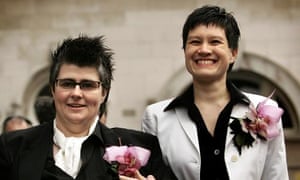
Grainne Close and Shannon Sickles

Grainne Close and Shannon Sickles became the first gay couple in the UK to enter a civil partnership at Belfast city hall in 2005. Photograph: Peter Macdiarmid/Getty Images


First couples in UK to enter civil partnerships delighted with result of legal battle, saying religious views should not affect public policy
The first two couples to become civil partners in the UK have won the right to have the same-sex marriage ban in Northern Ireland subjected to judicial review.
A Belfast high court judge ruled on Friday that Grainne Close and Shannon Sickles, and Charles and Henry Flanagan-Kane, should be granted the review, which is set for the autumn.
Both couples’ civil partnership ceremonies were held at Belfast city hall, just a short distance from the high court, 10 years ago.
The review is likely to be held in November, alongside several other legal challenges taken by gay couples in the region, and who are backed by the Rainbow Project, an LGBT rights organisation.
Neither couple was in court for Friday’s ruling but their barrister and senior counsel representing the Northern Ireland regional government were present to hear Mr Justice Treacy say that he had read the case papers and had already satisfied himself that the matter should proceed to judicial review. “The applicant has an arguable case,” he said.
Members of the Rainbow Project and Amnesty International were also in court. Others supporting the legal challenge included the former CEO of the Marie Stopes clinic in Belfast Dawn Purvis and the actor Nuala McKeever.
Outside court, solicitor Mark O’Connor issued a statement on behalf of both couples: “We are delighted that we have been able to get over the first hurdle in relation to the judicial process and that the judge today has granted leave for us to bring this judicial review.
“We are thankful that the judge has made that decision today. We believe that religious policy and religious views shouldn’t be affecting public policy. Thankfully today the judge appears to have accepted that there is an arguable case to answer … and hopefully we will have success in the future in relation to this matter.”
Advertisement
Prior to the hearing Grainne Close had said: “This is not a religious issue, it is a human rights issue. That is why we are going to court.”
Close said she and her US partner had been inspired by Ireland’s overwhelming vote in favour of gay marriage last month and the joyous scenes that greeted the result of the referendum at Dublin castle.
The Rainbow Project’s director, John O’Doherty, welcomed Treacy’s ruling. “We are pleased that this case is progressing and that it will likely be heard alongside our client’s case challenging the failure of the Northern Ireland government to recognise their lawful marriage.
“The current illogical patchwork of marriage laws created by the Westminster government is placing LGBT people in Northern Ireland at an inexcusable disadvantage and we hope that the courts will agree and find that there must be a harmonisation of marriage laws across the UK.”
A Sinn Féin motion on marriage equality was defeated in April, with 47 Northern Ireland assembly members voting in support, but 49 unionists against. Even if there had been a small majority in favour, the Democratic Unionist party would have exercised a special veto drawn up under devolution.
The petition of concern rule allows any party to veto legislation if it can argue the law would not have sufficient cross-community or Protestant/Catholic support.
Earlier this month, 20,000 trade unionists staged a rally in Belfast city centre to support gay marriage in Northern Ireland, the only part of the UK where LGBT couples cannot be married.
Amnesty International said the ban has turned Northern Ireland into a “discriminatory backwater for the gay and lesbian community”.

Filed Under: Anti-Bullying & Homophobia, History Tagged With: Camden and Islington LGBT, civil partnerships, gay marriage, Irish politics, marriage equality, Northern Ireland election debate

Being arrested: your rights

25/06/2015 By ACOMSDave Leave a Comment

Being arrested: your rights

  1. When you’re arrested

  2. How long you can be held in custody

  3. Giving fingerprints, photographs and samples

  1. Legal advice at the police station

  2. Complaining about your treatment by the police

  3. When you’re arrested

If you’re arrested, you’ll usually be taken to a police station, held in custody in a cell and then questioned.
After you’ve been taken to a police station, you may be released or charged with a crime.
Your rights in custody
The custody officer at the police station must explain your rights. You have the right to:

  • get free legal advice
  • tell someone where you are
  • have medical help if you’re feeling ill
  • see the rules the police must follow (‘Codes of Practice’)
  • see a written notice telling you about your rights, eg regular breaks for food and to use the toilet (you can ask for a notice in your language) or an interpreter to explain the notice

1.   You’ll be searched and your possessions will be kept by the police custody officer while you’re in the cell.
Young people under 18 and vulnerable adults
The police must try to contact your parent, guardian or carer if you’re under 18 or a vulnerable adult.
They must also find an ‘appropriate adult’ to come to the station to help you and be present during questioning and searching. An appropriate adult can be:

  • your parent, guardian or carer
  • a social worker
  • another family member or friend aged 18 or over
  • a volunteer aged 18 or over

The National Appropriate Adult Network provides appropriate adult services in England and Wales.
Your rights when being questioned
The police may question you about the crime you’re suspected of – this will be recorded. You don’t have to answer the questions but there could be consequences if you don’t. The police must explain this to you by reading you the police caution:
“You do not have to say anything. But, it may harm your defence if you do not mention when questioned something which you later rely on in court. Anything you do say may be given in evidence.”

  1. How long you can be held in custody

The police can hold you for up to 24 hours before they have to charge you with a crime or release you.
They can apply to hold you for up to 36 or 96 hours if you’re suspected of a serious crime, eg murder.
You can be held without charge for up to 14 days If you’re arrested under the Terrorism Act.
When you can be released on bail
The police can release you on police bail if there’s not enough evidence to charge you. You don’t have to pay to be released on police bail, but you’ll have to return to the station for further questioning when asked.
You can be released on conditional bail if the police charge you and think that you may:

  • commit another offence
  • fail to turn up at court
  • intimidate other witnesses
  • obstruct the course of justice

This means your freedom will be restricted in some way, eg they can impose a curfew on you if your offence was committed at night

  1. Giving fingerprints, photographs and samples

The police have the right to take photographs of you. They can also take fingerprints and a DNA sample (eg from a mouth swab or head hair root) from you as well as swab the skin surface of your hands and arms. They don’t need your permission to do this.
The police need both your permission and the authority of a senior police officer to take samples like blood or urine, or to take dental impressions.
This doesn’t apply when they take a blood or urine sample in connection with drink or drug driving.
Information from fingerprints and samples is stored in a police database.
You can find out if your information is stored on the police database bygetting a copy of your police records from your local police station.
You have to write to your local police (England, Wales and Northern Ireland) or local police (Scotland) to have your personal information removed from the police database.
They’ll only do this if an offence no longer exists or if anything in the police process (eg how you were arrested or detained) was unlawful.

  1. Legal advice at the police station

Your right to free legal advice
You have the right to free legal advice (legal aid) if you’re questioned at a police station. You can change your mind later if you turn it down.
How you can get free legal advice
You must be told about your right to free legal advice after you’re arrested and before you’re questioned at a police station. You can:

  • ask for the police station’s ‘duty solicitor’ – they’re available 24 hours a day and independent of the police
  • tell the police you would like legal advice – the police will contact the Defence Solicitor Call Centre (DSCC)
  • ask the police to contact a solicitor, eg your own one

You may be offered legal advice over the phone instead of a duty solicitor if you’ve committed a less serious offence, eg being disorderly. The advice is free and independent of the police.
Being questioned without legal advice
Once you’ve asked for legal advice, the police can’t question you until you’ve got it – with some exceptions.
The police can make you wait for legal advice in serious cases, but only if a senior officer agrees.
The longest you can be made to wait before getting legal advice is 36 hours after arriving at the police station (or 48 hours for suspected terrorism).
You have the right to free legal advice if you are questioned by the police.

  1. Complaining about your treatment by the police

Contact the police force you want to complain about if you’re unhappy about how the police have treated you.
Police forces must refer certain types of complaints to the Independent Police Complaints Commission (IPCC.)
 
https://www.gov.uk/arrested-your-rights


Filed Under: Anti-Bullying & Homophobia, History Tagged With: being arrested, gov.uk, your rights

Britain’s Got Totally starkers: Winners strip naked for racy gay magazine shoot

25/06/2015 By ACOMSDave Leave a Comment

BRITAIN’S Got Talent winners Collabro discuss their body hang-ups as they bare all for Attitude magazine.

WARNING ADULT IMAGES

By Adam Mohamed / Published 24th June 2015
The five singers shot to fame when they emerged triumphant on the ITV talent show in 2014 and were immediately signed by Simon Cowell’s Syco label.Since then, Michael Auger, Richard Hadfield, Jamie Lambert, Matthew Pagan and Thomas J Redgrave have had two hit albums and are touring the world.
But stripping to their birthday suits for an outrageous shoot has got to be their boldest move yet.
The pop-opera superstars have stripped off and let it all hang out for the cameras.
“We’re five normal young lads. We all go to the gym but we’re not obsessed with having a beautiful body. We just try to stay healthy,” said Jamie.
Clearly none of the lads are ashamed of their bodies, but despite being chart-topping pop stars with thousand of adoring fans, some of the boys reveal that they have suffered from serious body image issues.
Collabro naked photo shoot LOVES HIMSELF: Collabro naked photo shoot [ATTITUDE]
Richard said: “When I was at school I was teased about being heavy and I have to admit it did upset me.“Then I realised I had a body built for rugby so did that.
“When my rugby career was over, I lost a lot of weight dropping from 18st to 15st.
“Then in Collabro I put the weight back on and when we did the Royal Variety performance people said, ‘Oh he’s gotten fatter since BGT’.
“I made a conscious effort to get healthy again.
“Not for vain reasons, if you’re on stage every night, you just don’t want to eat crap, otherwise you’ll end up getting run down.
“If you are confident in yourself, and you accept what you were born with, then that makes you sexy.”
Collabro naked photo shootFROM FAT TO FIT: Richard from Collabro opens up [ATTITUDE]
The raunchy shoot is for the first national British gay magazine Attitude, and openly gay band member Jamie reveals that he didn’t even feel confident enough in his own body to start dating when he started university.He said: “I have to admit I had body dysmorphia when I was at uni.
“I was big as a teenager and I would look in the mirror and not see what was looking back at me. I felt very alone and was very self-conscious and my self-esteem collapsed.
“All I would eat was lettuce and runner beans. I ate just enough to live off but it wasn’t healthy.
Collabro naked photo shootCOMFORTABLE: The boys are clearly at ease with eachother’s bodys [ATTITUDE]
“At one point I weighed 10st which — bearing in mind I’m over 6 foot — is tiny. I can’t pinpoint why it happened, but I was never happy with the way I looked and I suffered from anxiety.”It was only when I changed universities that things seemed to get better. My diet improved and my self-esteem got better.
“I joined lots of LGBT societies and began to meet more gay people and even felt comfortable enough in myself to start a relationship.”
The group’s debut album Stars hit the top spot and the follow-up, Act Two hit No.2.
Collabro have been shot for the Attitude Awards issue available to download now and in shops on Wednesday, June 24

Filed Under: Book Reviews Tagged With: Attitude, Collabro, naked

Beckenham playwright Chris Woodley’s Next Lesson tackles Thatcher’s controversial Section 28 anti-gay law

25/06/2015 By ACOMSDave Leave a Comment

News Shopperby Jim Palmer, leisure editor Last updated 13:04 Wednesday 24 June 2015
 

News Shopper: Photograph of the Author by Jim Palmer, leisure editor
A Beckenham dramatist has won rave reviews for his play about controversial legislation which banned the promotion of homosexuality in schools.
Chris Woodley’s Next Lesson looks at the affects of Thatcher’s notorious Section 28, which came into force in 1988 and was not repealed until 2003.
It is a portrait of a south London secondary school and focuses on Michael, a gay student, from his first day in 1988 through to becoming a teacher at the school.
When it debuted at The Pleasance Theatre in April, Gay Times gave Next Lesson a five star review.
The topic was an important one for Chris to write about.
The 33-year-old said: “Section 28 has had a huge effect on many LGBT young people at that time who simply couldn’t talk about who they were and what they felt in school. It’s heart breaking.
“The repeal of Section 28 came incredibly late and I feel it left a really confused feeling in our education system about what could and could not be discussed in schools.
“Even today the way in which we deliver Sex and Relationship Education in this country needs to be addressed; without open and honest conversations about SRE we are at risk of failing LGBT young people.”
The play’s subject is one that Chris knows well: before he turned to theatre full time hewas a drama teacher for six years.
He said: “When I was teenager I was very badly bullied during the time this legislation was in power.
“So as an adult in my twenties it was quite a moment to return to Bromley as an out gay teacher and see what had and hadn’t changed in the education system.”
He added: “People often think that the central figure in the play Michael is based on me, when in fact the smaller stories around Michael’s journey are loosely based on personal events.
“Nearly every scene has a character or a plot line that is taken from my life as a student or teacher.
“Aspects of the story have to be changed to protect the innocent. The scene that’s most personal is the scene in particular where a Head of Drama is challenged by a parent about directing a play with gay characters in it.”
Chris grew up in Beckenham and attended Marian Vian Primary School then Langley Park School for Boys.
He said: “Langley wasn’t the best place for a gay teenager growing up in the nineties so I left Langley after my GCSEs and went to The BRIT School.
“The BRIT School was and still is the most outstanding school for anyone that wants to get into a creative industry.
“It brought me back to life after quite a tough time at school. On the opening night of the show my first drama teacher from Marian Vian attended and the Principal of BRIT School, it was lovely to have such incredible support.”
Perhaps it’s unsurprising given his strong links to the area, but Chris made sure Next Lesson was firmly rooted in the borough.
He said: “I really wanted the play to have a strong geographical identity so Next Lesson has lots of references to Bromley.
“There are references that include Beckenham War Memorial, The Churchill Theatre even News Shopper gets a mention.”
Hyphen Theatre Company present Next Lesson written by Chris Woodley on at The Pleasance Islington in October 2015. Go to hyphentheatre.com

Filed Under: Anti-Bullying & Homophobia, Theatre Reviews Tagged With: Beckenham, Chris Woodley, Margaret Thatcher, Section 28

Allah Made Me Muslim; Allah Made Me Queer

25/06/2015 By ACOMSDave Leave a Comment


Posted: 06/22/2015 8:56 pm EDT
Wazina Zondon
Co-founder of ‘Coming Out Muslim’
 
 
PATRICK MULCAHY PHOTOGRAPHY
 
Co-authored by Terna and Andrew Stehlik

“I didn’t know there was such a thing as a queer Muslim.”

Even among the most progressive, well-educated and best-intentioned individuals, this is a comment which is heard far too often. People who have no trouble understanding that lesbians, gay men, bisexuals and transgendered people have existed throughout history, in every nation, culture, religion and ethnicity, still have trouble accepting someone can be both queer and a faithful believer in Islam.
Admittedly, some confusion is understandable, as the Muslim record for tolerance is not commendable. On the contrary, Sharia, which is the most orthodox form of Islamic law, can be evoked to issue a death penalty for practicing homosexuals in Muslim countries such as Iran, Nigeria and Saudi Arabia. And, in 2011, when the Human Rights Council of the United Nations passed its first-ever resolution recognizing LGBTQ rights, it gained full support from the Americas and Europe, but was almost unanimously voted against by countries with a Muslim majority.
Nonetheless, there are queer Muslims, and they are making themselves known in growing numbers. The annual celebration of Ramadan (which began on June 17) coincides with Gay Pride Month this year, providing a unique opportunity to consider the current state of LGBTQ Muslims, as well as their likely future.
Why is this? Because Ramadan, which according to Islamic tradition, honors the first revelation of the Quran to the Prophet Muhammad, is not only commemorated through fasting from dawn to sunset, but is also a time known for great acts of kindness towards the neediest. Charity is very important to Islam year-round, but it is believed that good deeds performed during Ramadan are looked upon by Allah (God) with special favor.
While it takes discipline to keep one’s mouth shut and forgo all food and drink for many hours a day, it also requires bravery to open one’s mouth wide and speak up with compassion and charity for the rights of all human beings to be whole. This is what we’re attempting to do with “Coming Out Muslim: Radical Acts of Love,” a storytelling performance which has been shared on stages across the United States, and will appear at Rutgers Presbyterian Church in New York City on Wednesday, June 24.
The show’s title is deliberately ambiguous. It suggests both the self-revelation which occurs in publicly declaring one’s queer sexuality, as well as the challenges of being open about one’s faith in Islam in a post-9/11 America, where fears and suspicions linger that all Muslims are terrorists. As recently reported in The New Yorker magazine, statistics from the F.B.I. show that hate crimes against Muslims are five times as common as they were before 2001. Given this environment, it is exponentially more dangerous to proclaim, “Allah made me Muslim; Allah made me queer.”
In making such a courageous assertion, LGBTQ Muslims are becoming more visible at the intersection of faith and sexuality, joining conversations which have been underway for quite some time within Christianity and Judaism. What these three faiths have in common, of course, is not only an Abrahamic tradition, but a homophobia based in large part on a single scriptural story, that of Sodom and Gomorrah.
More modern Muslim scholars, along with freer-thinking Jewish and Christian theologians, advocate interpretations indicating that the true offense shown in the story of Lot is a threat of male rape, and a violent failure to show hospitality to strangers. New attention is being paid as well to verses in the Quran which non-judgmentally describe the existence of men who have no desire for women. And, some historians now point out that in earlier Islamic societies, same-sex relationships were celebrated in love poems written by Persian, Urdu and Sufi poets.
As for those contemporary Muslims who now choose to find a rationale for the death penalty against homosexuality in the hadith, or non-Quranic stories that are attributed to Prophet Muhammad, it must be remembered there is also a hadith where the Prophet says, if anything you have heard about me makes you turn away from me, it is not from me. Violence against sexual and gender minorities is not aligned with the Prophet’s example of love and tolerance in community.
Most Americans, many Muslims, and a lot of LGBTQ people do not know that Islam has room for all of us. And, there may be quite a few who, even after hearing so, will respond, “Well, all this is unique to queer Muslims, what does this have to do with me?”
Our answer is, a lot. Because we believe that the more specific a story is, the more universal.
“Coming Out Muslim” speaks to the universal wish to be recognized as multi-layered individuals, who are parts of families and communities, who struggle and strive for wholeness. Time and time again, people come up to us after performances — men, women, heterosexuals, gays and lesbians, Christians and atheists — and tell us exactly this.
Coming out, then, is really about letting the world know who you are. So, yes, there are queer Muslims!
By taking pride in this, change can occur and love can grow.

2015-06-22-1435009273-6271717-COMINGOUTMUSLIMTerna.jpg
Terna, photographed by Patrick Mulcahy Photography

Filed Under: Anti-Bullying & Homophobia, History Tagged With: LGBT Muslim, Muslim, queer

Manchester’s LGBT history to be celebrated on new digital platform OUT!

25/06/2015 By ACOMSDave Leave a Comment


BY BETH ASHTON

OUT! will bring together the heritage trail and digital histories to provide a central place for all of Manchester’s rich LGBT history

Manchester Pride has been awarded funding by the Heritage Lottery Fund to create a digital platform that will explore the history of LGBT life in Manchester.
OUT! will bring together the heritage trail and digital histories to provide a central place for all of Manchester’s LGBT past.
Visitors to the website will also be able to create their own personalised trails based on where they are in Manchester, a theme or a time period, giving them the ability to discover and explore without the need of a tour guide.
The trails will use the rainbow tiles, which mark historic occurrences around the city centre, that were installed as part of Europride and OUT! will bring together a variety of projects championed by organisations including Gaydio, LGBT Foundation, Archives+ and the LGBT Youth North West.

The platform will also allow users to contribute to the research, with opportunities for crowdsourcing and digital games that enable the public to engage with and contribute to the ever-growing resource.
Mark Fletcher, Chief Executive of Manchester Pride comments; “Two of the main aims of Manchester Pride are to celebrate LGBT life in our city and to create opportunities for engagement. With ‘Out!’ we aim to commemorate and unite the rich and vibrant past by providing a factual and insightful legacy resource in one single location.”
“Our vision is to enable communities, historians and researchers, tourists and locals to learn about these histories and encourage them to contribute to the content and engage more fully with and to understand this important part of Manchester’s past.”

Manchester Pride is currently recruiting a number of volunteer research pioneers for this project who will collate information from both the LGBT community and other sources. The funding will provide training for the research pioneers who will visit community groups, researchers and local history societies to introduce the digital tool, ’OUT!’, and gather content including videos, photography and stories.
Daniel Jessop, Project Manager on the OUT! Digital Histories project said, “It’s great to join the team and make sure that stories in the LGBT community are shared. The Heritage Lottery funded project will empower volunteers through training, collecting oral histories and encouraging people to question the past and find out more. ‘OUT!’ celebrates LGBT heritage and if anyone is interested in being part of this please do get in touch.”
Alongside the creation of the digital platform, ‘OUT!’, the funding will also provide:
The training of 40 volunteers to visit community groups, researchers, local history societies etc to introduce ‘OUT!’.
Training of local historians to investigate archives to examine them for LGBT content.
A stand at the Expo Stand at the Big Weekend 2015 to explain the project and demonstrate the digital tool.
A panel discussion during Manchester Histories Festival 2016 to help the wider community to understand the heritage of the LGBT Community in Greater Manchester.
32 individuals will be trainees in oral histories and interviewing skills throughout the life of the project. 18 will initially be trained at the start of the project (12 community volunteers, 6 Gaydio interns) to conduct interviews for the theatre piece, digital booths and during the Big Weekend from the Expo Stand. A further 14 will be trained as a part of LGBT History Month in January 2016 in order to collect stories to add to the resource.
A digital exhibition at Archives + during the Manchester Pride Festival 2015 creating a new strand to their “Radical Histories” unit.
A live performance based piece in conjunction with Hope Theatre in the Gay Village that utilises oral histories and heritage on the digital tool.
A digital game run through Twitter and based around the digital tool to encourage engagement and usage.
To get involved in the project or find out more email Daniel Jessop on daniel@manchesterpride.com .

Filed Under: Anti-Bullying & Homophobia, History Tagged With: digital archive, lgbt history, manchester, OUT

Couples challenge Northern Ireland’s gay marriage ban in court

25/06/2015 By ACOMSDave Leave a Comment

Shannon Sickles and Grainne Close, and Chris and Henry Flanagan-Kane, the first UK couples in civil partnerships, pursue legal battle over full marriage equality

A rally calling for same-sex marriage to be made legal, in Belfast.
A rally calling for same-sex marriage to be made legal, in Belfast, earlier this month. Sinn Fein has called for a referendum on the issue in the province. Photograph: Charles McQuillan/Getty Images

Henry McDonald Ireland Correspondent

Wednesday 24 June 2015 14.42 BSTLast modified on Wednesday 24 June 201515.21 BST

An American woman and her partner, who were the first couple in the UK to have a civil partnership ceremony, are to challenge Northern Ireland’s ban on gay marriages.
Shannon Sickles, a US citizen, and Grainne Close made history a decade ago when they were the first gay couple to have a civil partnership in Britain, sealing their union at a ceremony at Belfast city hall.
Now the couple are taking part in a legal case to overturn the bar on LGBT couples getting married in Northern Ireland. They will launch their legal case on Friday morning.

Shannon Sickles, left, and Grainne Close
Shannon Sickles (l), and Grainne Close at Belfast city hall in 2005. Theirs was one of the first gay civil partnerships in the UK. Photograph: Paul Faith/Press Association

Northern Ireland remains the only part of the UK where there is no gay marriage equality. The deputy first minister, Martin McGuinness, has suggested a regional referendum – similar to the one that passed in the Irish Republic last month – on gay marriage.
Sinn Féin and other parties have made repeated attempts to legislate for gay marriage equality in the Northern Ireland assembly, but their proposals have been voted down by unionists. The evangelical Christian wing of the Democratic Unionist party has mounted fierce opposition to introducing gay marriage equality in the province.
Close and Sickles will be joined by a male couple, Chris and Henry Flanagan-Kane (previously Christopher Flanagan and Henry Kane) in seeking a judicial review of the ban.
On her Facebook page, Close posted on Wednesday: “This year, December 19th, 2015 Shannon and I, along with Chris and Henry Flanagan-Kane, will celebrate 10 years of our civil partnerships.
“Northern Ireland was the first place in the UK to recognise civil partnership legislation and is now the last place in the UK and Ireland to recognise equal marriage.
“On June 26th, 10am in the high court, the four of us are bringing a legal challenge for a judicial review of the legislative prohibition preventing us from entering into civil marriage.”
“Our barrister, Laura McMahon, will argue that to bar equal marriage is a fundamental discrimination of our rights under the European convention on human rights, which is without justification.”

Henry Kane (R) and Christopher Flanagan had a civil ceremony on the same day in 2005 in Belfast. They are also fighting the ban on gay marriage in the region.

FacebookTwitterPinterest
Henry Kane (R) and Christopher Flanagan had a civil ceremony on the same day in 2005 in Belfast. They are also fighting the ban on gay marriage in the region. Photograph: Peter Macdiarmid/Getty Images

She added: “You will hear the arguments from DUP and other religious groups (all the same that have been played out in the Irish referendum) that we have civil partnership, so why marriage?
“The fact that we have to stand in a different queue from opposite-sex peers when it comes to having our relationship recognised by the state is itself indicative that we are treated differently.”
The Rainbow Project, one of the main gay rights organisations in Northern Ireland, said it will attend the hearing in Belfast this Friday, in solidarity with the couples.
“Anything that tests the legal basis of Northern Ireland’s ban on civil marriage is a positive step,” said John O’Doherty, the Rainbow Project’s director. The organisation has been planning to launch its own legal challenge, based on human rights legislation, this autumn.
Earlier this month, thousands attended a rally in Belfast organised by the trade union movement and Amnesty International, calling for gay marriage equality in Northern Ireland.
The Irish Congress of Trade Unions has backed the campaign to lift the ban, claiming that it not only violates European human rights law but also equality legislation contained within the 1998 Good Friday Agreement.

Filed Under: Anti-Bullying & Homophobia, History Tagged With: gay marriage, Irish politics, marriage equality, same sex marriage

Loving Comrades by Paul Salveson

23/06/2015 By ACOMSDave Leave a Comment


Publisher: P.Salveson (Aug. 1984)

Lancashire’s Links to Walt Whitman

This book sets out to investigate the history of socialism in Bolton, and of some of the famous people who were involved in the movement, or adopted by it, in it’s early years.
I came to this fifteen page book with a fresh mind and no preconceived ideas or knowledge.  I found it to be well linked together, with the test interspersed carefully chosen b&w photographs.  But, it is unfortunate that a book of such wide interest should be faulted by spelling mistakes and word omission.  These are not sufficient to affect the readability of the book, but do lower the standard of an obviously well researched and written book.
For the gay community, the book is well worth a delve for it’s comments and outlook on Edward Carpenter and the rest of the literacy group that was part of the movement.
I think ‘Loving Comrades’ is worthwhile reading; and it has been thought provoking enough to leave me wanting to know more about all the people referred to, and their writing also.


Filed Under: Book Reviews Tagged With: Bolton, Loving Comrades, Paul Salveson, Socialism

Out of the Winter Gardens

23/06/2015 By ACOMSDave Leave a Comment


Publisher: Verulam Publishing Ltd; paperback / softback edition (Sept. 1984)
By David Rees
This book, Out of the Winter Gardens,  is up to the normal David Rees standard, well written and constructed, however, I do feel that the ‘gay’ content is limited and publicised beyond it’s actual content.
You feel sympathy for Mike during his investigative adolescence; despair for his father Jo who appears to be lacking in a deep-rooted characters and some loathing for Adrian the harpist.
If you enjoy a well-written book, and don’t look for real characters, this book is for you.


Filed Under: Book Reviews Tagged With: David Rees, Out of the Winter Gardens, The Olive Press, Verulam Publishing Ltd

Book Review: Sticky White Label by Paul Culshaw

23/06/2015 By ACOMSDave Leave a Comment

Now former Liverpool drag queen Paul Culshaw has written a book to help others beat the labels – Sticky White Label

Paul Culshaw who has written a book about gay bullying
Paul Culshaw’s life has been filled with extremes. As a young child, lonely and tormented for being different; as a teenager struggling to come to terms with being gay, subjected to a primitive exorcism to drive out the ‘demons’ of homosexuality.
He went on to become Liverpool’s most reluctant drag queen DJ, never quite fitting the extravagant persona he created.
“I went from this isolated little boy to born again Christian, then child soap actor to being Whitney Wide-On,” he smiles. “So when I thought about it, there was quite a lot of scope and stories to tell.”
Now 31, Paul sat down to write down a collection of his experiences, anticipating a mix of anecdotes and fun recollections.
“It was only when I wrote them all down, these emotions started to come out and I began to recognise quite a sad troubled character,” he explains. “That was when I tapped into the bullying and low self-esteem, and how that still affects me on a daily basis as an adult and what I was writing became part autobiography and part self-help book.”
The result, Sticky White Label, is, he says: “raw, painfully honest and finishes on a very positive, uplifting note that we can defeat the bullies and we can live with and overcome our mental health issues. And it challenges gay slurs and labels which can be hard to shake off, hence the title.”

A quote from Paul Culshaw’s book Sticky White Label
Sticky White Label traces Paul’s life from infant and primary school years spent struggling to be accepted.
Brought up by a single mum in Crosby, she would often take him to the park to play. “I always wanted to connect with other children because I was an only child, and I was very polite, but when I asked to join in the games they’d always say ‘no, you talk like a girl.’
“So I was aware, even at five or six, that there was something different about me, even though I didn’t understand what it was. I’d spend every lunchtime at school walking round doing laps of the playground, just looking at the clock because it felt like the break went on forever.”
When he won an assisted place at Merchant Taylor’s Boys School he begged his mum not to send him.
“I knew what it would be like because boys didn’t like me, but with hindsight I’m grateful that I went there because I got a wonderful education and I think I probably would have had a tough time whatever school I’d gone to.”
The bullying and rejection was constant, he says. “And the name calling. I remember being on the bus and the word faggot used to terrify me because that was the word that meant I was going to get beaten up.”
Landing a role in C4 soap Springhill only served to draw more unwanted attention, but it wasn’t until he was 14 that he finally found the courage to come out as gay.
“I was a born again Christian and I remember going to one of the girls and asking her to pray with me because I’d been having thoughts about boys and I was attracted to them,” he recalls. “It must have taken me about half an hour to get the sentence out, I was so terrified.”
The girl he chose to confide in was supportive, but his experience within the church wasn’t always so positive.

Paul Culshaw’s take on self-esteem from Sticky White Label
“I was ostracised by some of the group for confessing my gay feelings, and they had a private exorcism. I didn’t realise what it was at the time, I thought it was just a prayer meeting, but looking back it was like a bad Hollywood horror movie. There were people praying and commanding the demon of homosexuality to leave my body in Jesus’ name.
“I think they were trying to help a troubled soul in the best way they could, and some of those people are still very good friends of mine, but the experience was traumatic and it stayed with me.”
Paul’s life took a positive turn when he found friendship with his mum’s hairdresser who was also gay. “He was a confident, successful person and a great example of someone who was happy in themselves so it gave me hope,” he explains.
Since leaving school to pursue a career as an actor/DJ and writer, Paul has continued struggle with panic attacks and low self-esteem.
“They are daily challenges I’ve learned to live with and manage,” he says. “And so much stems from the bullying and being made to feel ashamed when I was younger.

Paul as drag queen DJ Whitney Wide-On
“Even when I was Whitney Wide-On, working at G-Bar for six years, I realised that a lot of those one-liners and the sharp witty comebacks came from learning to defend myself. They were from a negative place, that’s why I was never truly happy doing it. The other drag queens were very comfortable in their job, in the sequins and the glamour, and I was envious of that but it was just a character to me and I couldn’t wait to be Paul again.”
Whitney features in Sticky White Label, but for now at least her lipstick and Lily Savage wig are consigned to Paul’s past.
As for the future, he hopes that the book can help anyone going through bullying or suffering chronic anxiety and go some way to dispelling the lingering harm of labels.
“We all get labelled don’t we?” he says. “Not just for being gay, for being different in any way, but the book isn’t all doom and gloom, it does have a happy empowering ending. I’d just love to think people relate to my experiences and they could help someone else. I might not be famous or in the public eye, I’m not Cheryl Fernandez-Versini, but that doesn’t mean my life is any less valid!”
* Sticky White Label is available on amazon.co.uk. £3 from each book sale goes to PACE (LGBT mental health), Ditch The Label, (anti-bullying) and The British Heart Foundation.

Filed Under: Book Reviews Tagged With: Paul Culshaw, Sticky White Label

  • « Previous Page
  • 1
  • …
  • 86
  • 87
  • 88
  • 89
  • 90
  • …
  • 108
  • Next Page »

Categories

Copyright ACOMSDave.com © 2026