
This review reprinted from our Spring 1985 magazine
Written By: Edmund White
Publisher: Picador (14 Mar. 1986)
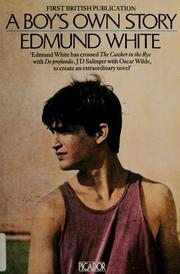


After coming to term with the author’s rather ornate writing style, the main problem for the reader is trying to work out whether the tale is being told in hindsight, or are the current thoughts of a rather precocious youth. A pity because apart from this, possibly deliberate, ambiguity the characters are very well imagined.
White can actually tell a story, there is a very long paragraph towards the end where he rounds up the subplots in a very sharp and funny way, the humour is quite zany in this part.
Plough through this book, you will enjoy it for the incidental charms, the central character is just a piece too precious for local tastes. And the writing is too overripe for a genuine masterpiece.
More Tales of the City by Armistead Maupin
Reprinted from our Spring 1985 magazine
by Armistead Mauplin
Publisher: Transworld Digital; New Ed edition (13 Mar. 2012)
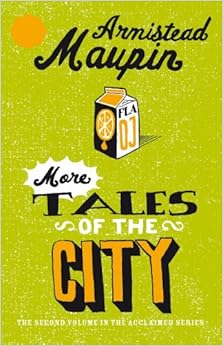 The city referred to is San Francisco, and this book does have an awful lot of Bay City chic about it. The first third is a series of short stories; some sections are very short. So many characters are introduced that is difficult to keep track.
But the author shows his art, as in guile, by pulling these zany yarns into a ‘whodunnit’ with ghoulish undertones, that keeps the reader interested for the greater part of the novel. The sub-plots go off in the near foreground, like a particularly colourful fireworks display.
The ending is over-neat though there are a number of loose ends, possibly deliberate to hand a sequel on. This is the liveliest boot I have read for a very long time, and I’d recommend.
Amazon LInk to buy
Legislation enacting Irish gay marriage vote delayed
 Reuters
-

View PhotoReuters/Reuters – A couple walks hand in hand from the count centre in Dublin in this May 23, 2015 file photo. REUTERS/Cathal McNaughton
DUBLIN (Reuters) – Legislation allowing same-sex couples to marry in Ireland will be delayed until later this year following a legal challenge against last month’s gay marriage referendum, a government minister was quoted as saying on Tuesday.
The government had planned to enact the required laws before parliament goes into recess at the end of July.
However two men who unsuccessfully sought to challenge the result in the High Court will have their case heard by Ireland’s Court of Appeal on July 30, local media reported. According to one of the them, the outcome had been unfairly influenced by government parties that had not been impartial in campaigning for a ‘Yes’ vote.
“If the courts are going to hear a case, we can’t proceed with legislation until that case is decided,” Health Minister Leo Varadkar was quotes as saying in the Irish Times newspaper.
“It is disappointing but we have to respect the division of powers and separation of powers that exists between the courts and the government.”
Results of referendums in Ireland are often challenged in the courts, causing delays in the formality of passing the relevant legislation but not threatening the result.
Same-sex marriage was backed by 62 percent of voters in one of the largest turnouts ever in a referendum in Ireland, marking a dramatic shift in a traditionally Catholic country that only decriminalised homosexuality two decades ago.
“We are most concerned that these appeals are frustrating the overwhelming will of the people as expressed in the referendum,” Kieran Rose, chairman of Ireland’s Gay and Lesbian Equality Network, said in a statement.
(Reporting by Padraic Halpin; Editing by Robin Pomeroy)
Digital Campaign Launches To Remind Gay Men To Test For HIV Regularly
By The Gay UK, Jun 30 2015 09:58AM
A new digital campaign was launched yesterday by the Terrence Higgins Trust to remind gay men and MSM (men who have sex with men) to get tested for HIV regularly.

(C) Terrence Higgins Trust
A feel-good video has been launched by THT as part of the charity’s mission to get more gay men and MSMs to test for HIV more regularly.
The launch is part of its continuing efforts with the It Starts With Me campaign. Figures show that gay and bisexual men are still the most affected by HIV in England.
There is an estimated 43,500 gay and bisexual men living with HIV in the UK, one in six of whom don’t know they are positive, so could pass it on without knowing.
The summery video features a male couple who get together at a BBQ.
Cary James, Head of Programmes at Terrence Higgins Trust said:
“The fight against HIV will not only be won by large organisations or governments, but by the actions of individuals in the most personal and intimate moments of their lives.
“At this time of the year when the LGBT community comes together to celebrate Pride, we hope this video will inspire all of us to play a part in stopping HIV by regular testing and protecting each other by using condoms.“
The #TogetherSummer video and social media activity will direct people to the It Starts With Me website which offers a tool to find the nearest testing clinic, a the perfect condom, and a tool to tell you whether or not you need a HIV test.
HIV Prevention England’s It Starts with Me campaign launched in April 2013, and is co-ordinated by Terrence Higgins Trust, funded by Public Health England.
The campaign speaks directly to gay and bisexual men, chiefly about the importance of HIV testing and using condoms.
LGBT: Bletchley Park included on interactive map dedicated to buildings with LGBT histories
LGBT: Bletchley Park included on interactive map dedicated to buildings with LGBT histories
| Posted: June 30, 2015

Bletchley Park included on interactive map dedicated to buildings with LGBT histories

The former Crown Inn in Shenley Brook End, where Alan Turing lodged whilst working at Bletchley Park has also been.. Read more: http://www.mkweb.co.uk/LGBT-Bletchley-Park-included-interactive-map/story-26806016-detail/story.html#ixzz3ecTr1yA3 Follow us: @YourMKWeb on Twitter | mymkweb on Facebook
LGBT-Bletchley-Park-included-interactive-map showing over 200 buildings and locations across the country deemed to have ‘untold lesbian, gay, bisexual and transgender (LGBT) histories.’
Led by historians at Leeds Beckett University’s Centre for Culture and the Arts and experts from Historic England, the ‘Pride of Place’ project aims to chart the untold LGBT histories of buildings across the country and to encourage the public to help further map
 the heritage of the LGBT community.
Alongside Bletchley Park, where Alan Turing broke the Enigma code during the Second World War before he was persecuted for his homosexuality in 1952, the map includes a Manchester temperance hall whose infamous cross-dressing ball was raided by the police in 1880 and a 14th-century bisexual prostitute’s lodgings.
The project covers sites from Roman Britain to the present day, including the homes of prominent members of the LGBT community, pubs, cultural spots and activist sites.
The former Crown Inn in Shenley Brook End, where Alan Turing lodged whilst working at Bletchley Park has also been outlined on the map.
A spokesperson from Bletchley Park said: “Alan Turing was one of the pre-eminent Bletchley Park Codebreakers, a visionary mathematician whose work contributed enormously both to the outcome of World War Two and the computer age.
“In the exhibition The Life and Works of Alan Turing, which features a signed copy of
the 2009 apology from the then Prime Minister, Gordon Brown, The Bletchley Park Trust celebrates Turing’s short but brilliant life and achievements, many of which are more relevant today than they were during his lifetime.”Professor Alison Oram, lead researcher at Leeds Beckett University, said: “It’s really significant that LGBTQ history is being recognised and promoted by our national heritage body, Historic England, and I am delighted to be developing this project with them. It means that people all over England will have the opportunity to contribute to and learn about the LGBTQ heritage that exists in the streets and buildings all around us.”
You can plot your own LGBTQ heritage places on Historic England’s interactive
map and see what buildings and landscapes others are remembering here.The news follows this year’s LGBT pride parade in London that took place last Saturday (June 27.)
The theme of this year’s event was Pride Heroes and Alan Turing was one of many LGBT figures celebrated.
Family members
including his great niece Clare Dowling joined tens of thousands on the streets of London to represent the legacy of the revolutionary computer scientist at the parade
Read more: http://www.mkweb.co.uk/LGBT-Bletchley-Park-included-interactive-map/story-26806016-detail/story.html#ixzz3ecTCEMX7
Follow us: @YourMKWeb on Twitter | mymkweb on Facebook
Boris Dittrich: Gay City workers let down by UK business culture’s attittude to LGBT issues
ibtimes.co.uk
By Bauke Schram

Boris Dittrich, the ‘founding father’ of gay marriage in Europe, with former PM of the Netherlands Jan-Peter Balkenende(Getty)
After the US Supreme Court ruled that same sex marriages should be legal across the nation, many companies drenched their logos in the colours of the rainbow. Although the UK’s equal marriage act passed in 2013, leading LGBT advocate Boris Dittrich says that the UK is behind in terms of equality and acceptance in its business life.
Dittrich, who is often dubbed the ‘founding father of gay marriage’ because of his work in the Dutch parliament, which made the Netherlands one of the leading countries in terms of protecting gay rights and equality, told IBTimes UK that many gay City workers still decide against coming out because of their career prospects.
He said: “I personally feel that this is a conversation that has just kicked off in London, whereas in the US, in New York, the conversation has developed a lot more.”
Dittrich found that, in London specifically, ambition sometimes prevents LGBT workers from being open about their identity. “They still feel like coming out as LGBT does not give them any advantages and might even limit their career options. This why it is so important for big directors and executives to come out and act as a role model in a sense.”
In the UK, the most prominent example of an openly gay executive was Lord Browne, who, after decades of business success and hiding his sexuality, stood down as CEO of oil giant BP when the Mail on Sunday found out about his former partner.
“When he was still CEO of BP, he was in the closet and was therefore tense and made decisions based on his fear people would find out about his sexuality and made decisions in his position that were not good for him and possibly even the company,” Dittrich said.
Browne is now travelling the world, approaching business leaders about sexuality and diversity. He has written a book called Glass Closet, which tells the story of his double life.
Dittrich also mentioned António Simões, the Portuguese chief executive UK of HSBC, who is openly gay and lives with his husband and their adopted children. Examples of successful business people like Simões are vital to show young City workers that members of the LGBT community can still be very successful.
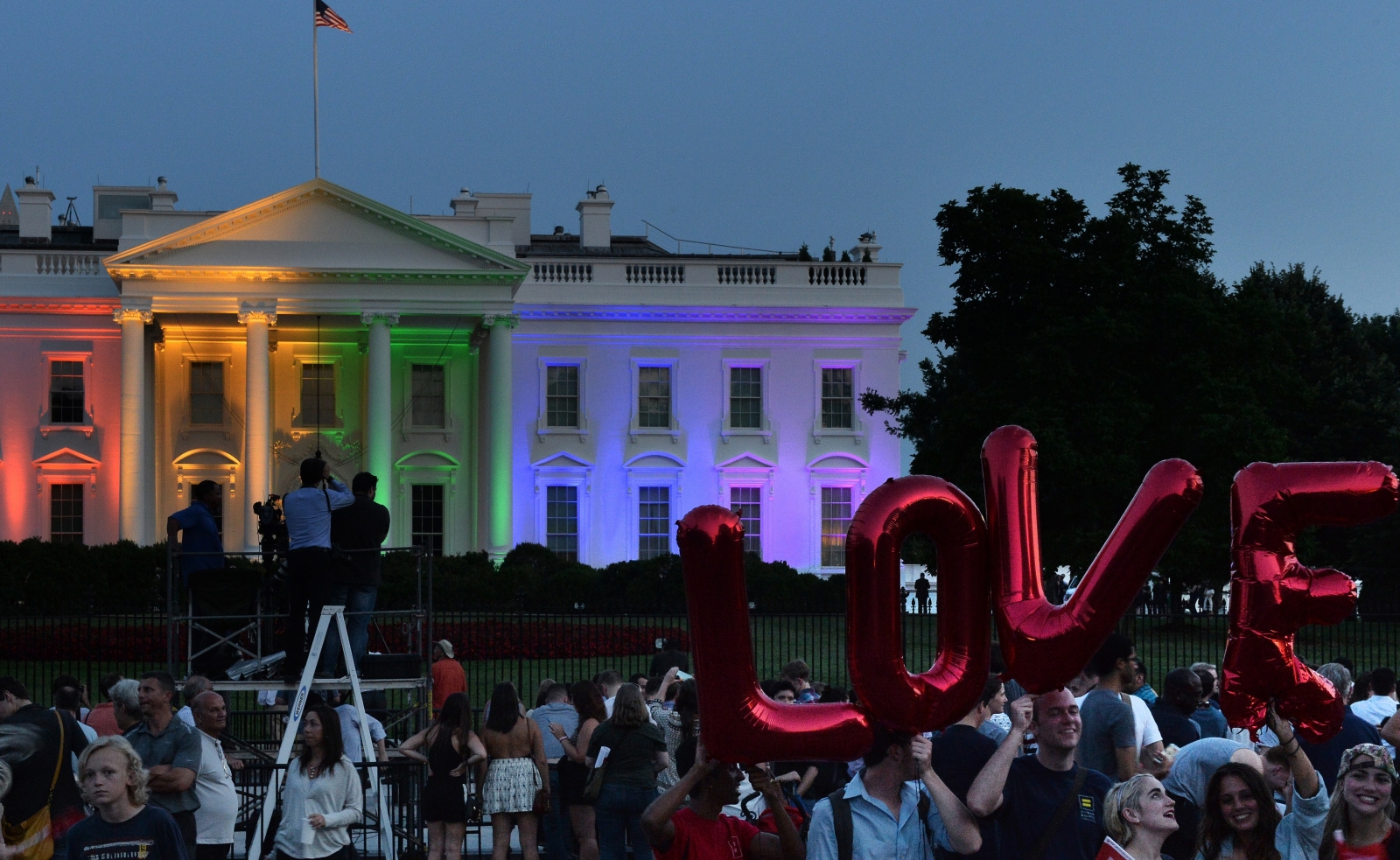
For the US, the ruling of the Supreme Court will help propagate the ideas of acceptance and the importance of equality and diversity for big companies. “Images like the White House covered in rainbow colours are images people just remember, which eases the process of acceptance for the whole population. It makes it easier for sons or daughters to tell their parents ‘I am like that as well’,” Dittrich said.
Turkish Police Ends Gay Pride Parade


Riot police in Turkey interrupted a gay pride parade in Istanbul on Sunday with rubber bullets, tear gas, and water cannons. It’s still not clear why the police decided to break it up but they cleared it out quickly and left the people celebrating upset.
The annual gay pride celebration, which has been held in the city for years now, was packed and it is not immediately clear why police wanted to break up the celebration, Reuters reported.
Rumors say that the conservative Muslim officials had a problem with the celebration being around the same time as Ramadan. Homosexuality isn’t illegal in the country, but many are not ok with them and they have no laws that protect them from discrimination in employment, education, housing, health care, public accommodations or credit. The EU Commission on Enlargement released a report a few years ago saying, “There have been several cases of discrimination at the workplace, where LGBT employees have been fired because of their sexual orientation. Provisions of the Turkish Criminal Code on ‘public exhibitionism’ and ‘offences against public morality’ are sometimes used to discriminate against LGBT people. The Law on Misdemeanors is often used to impose fines against transgender persons”.
The country does not recognize same-sex marriage.
The Event
The gay pride event was held in Istanbul’s Taksim Square, a place that is known for its protests against the government. The AFP reported that police targeted the crowd after hearing slogans accusing President Recep Tayyip Erdogan of engaging in “fascism.”
The event has been going on since 2003, and now occurs each year on either the last Sunday of June or the first Sunday of July, to mark the end of Istanbul pride week. In the first year of the celebrations, only 30 people attended but the numbers have drastically increased with time. Estimates say that in 2010, 5,000 people attended and in 2011 the number doubled with 10,000, making Gay Pride Istanbul the biggest march of its kind in Eastern Europe. Three years ago the parade attracted around 10,000-30,000 people and in 2013, almost 100,000. The European Union has praised the country in the past for hosting the parades without any disruptions, but not this time.
See Also Report from the METRO – LINK Here
London Parade
On Saturday, thousands of people took the streets to celebrate the annual Pride parade just a day after gay marriage was ruled to be legal across the U.S.
To celebrate the historic decision, the U.S flag joined those of Ireland and Mozambique at the front of the celebration, all three have recognized gay rights recently. More than 250 groups showed up at the event with extra security alert for any irregularities after the attacks on Kuwait, France and Tunisia.
Ruth Hunt, chief executive of Stonewall, said Pride was “a wonderful event that celebrates LGBT equality and how far we’ve come”, adding: “However, we must not lose sight of how much is left to do.
“The number of reported LGBT hate crimes is on the rise across the UK, our government must address trans-law reform, LGBT people are still being bullied in school and isolated at work, and overseas, many Prides either take place under armed guard or not at all. In fact, it’s illegal to be gay in 75 countries and punishable by death in 10.”
Other people protested against Northern Ireland, which does not allow same-sex marriage. Campaigner Peter Tatchell held a sign which said: “Northern Ireland! End the same-sex marriage ban. Equal Marriage.”
Pride of Place: Historians map out untold LGBT histories of locations throughout UK


Now the “Pride of Place” project is to be widened to the whole country, with the launch of an interactive map of 200 buildings and locations and a call to the public to help further map the heritage of the lesbian, gay, bisexual and transgender (LGBT) community.
The map includes an extraordinary range of sites: a Manchester temperance hall whose infamous cross-dressing ball was raided by the police in 1880, a 14th-century bisexual prostitute’s lodgings, and Bletchley Park, where Alan Turing broke the Enigma code during the Second World War before he was persecuted for his homosexuality.
It also includes the story of French soldier Chevalier d’Eon, who fenced in women’s clothing in 1787 at Carlton House, the London residence of the Prince Regent.

Rosie Sherrington, a social inclusion and diversity adviser at project organisers Historic England, said: “The project is looking at national recognition of LGBT heritage. I think it’s really important, largely because it hasn’t been formally recognised before. There aren’t any buildings listed entirely due to their lesbian and gay relevance.
“I think people will be surprised… there are some really rural sites that have been important for lesbian and gay people in this country. We want to show how important LGBT people have been in influencing the environment around us.” 
The Chevalier d’Eon, the androgynous 18th-century spy
Ms Sherrington hopes the project may lead to more buildings being protected. “This comes at a time when buildings and places with LGBT associations are coming under increasing pressure.
“Many are disappearing as LGBT culture becomes more integrated into wider society, while others – often in urban areas – are closing to make way for redevelopment.”
The project is led by historians at Leeds Beckett University’s Centre for Culture and the Arts, who have researched important places and will moderate the suggestions from the public.
Other important LGBT sites include Shibden Hall in Halifax, home of the lesbian diarist Anne Lister, and Millthorpe in Derbyshire, home of Edward Carpenter, the founding father of gay rights in Britain.
Reading Gaol, where Oscar Wilde was imprisoned for “gross indecency” in 1895, is among the sites under the “crime” category, as is the Old Bailey, where James Pratt and John Smith were convicted, and became the last men in Britain to be executed for sodomy in 1835. The project began in London in May and Historic England plans to have the project completed by autumn 2016.
Ronald Wright, a gay magazine illustrator, artist’s model and author who was a prominent member of the gay scene in London from the early 1950s, said the project was a “marvellous idea”.
“So many of our traditions are disappearing. If it wasn’t for something like this jotting it down, the nation would be poorer in years to come.”
Now 87 years old, Mr Wright said: “So much had to be hidden in the old days. I’ve seen some remarkable changes and the biggest change was gay marriage. I wish I had been born 20 years ago so I was young enough to enjoy the things young gay people can enjoy these days.”
He suggested a series of prominent gay pubs, many of which have closed, for the map. These included the Coronation Club, The Standard and The City of Quebec in London’s West End. “It was a tremendously close community,” he said.
Links:
Nick Herbert: Parliamentary group on global LGBT rights will help tackle ‘discrimination and abuses’

Tory MP Nick Herbert has said that a new cross-party Parliamentary group on LGBT rights will work with NGOs to help tackle “breaches of LGBT rights” around the world.
Members of Parliament and peers for the first time this month formed a new All-Party Parliamentary Group on global LGBT rights – to tackle rights issues around the world.
APPGs are informal cross-party groups, which have no official status within Parliament – but dedicate their time to working on specific issues across party lines.
The new APPG, which includes politicians from the Conservative, Labour, Lib Dem, Scottish National and Green parties from across the Commons and the Lords – will work to push issues in Parliament relating to LGBT people around the world.
Tory MP Nick Herbert said: “I am delighted to have been elected Chair of the APPG on Global LGBT Rights and I look forward to working closely with my fellow parliamentarians on these issues.
“While the advance of LGBT rights in many countries has been remarkable, as the decision of the Supreme Court in the US testifies, elsewhere in the world we are seeing discrimination and abuses which are of real concern.
“The power of this group is that is cross-party and will work closely with interested NGOs. I hope that it will help to ensure that, when breaches of LGBT rights occur around the world, UK parliamentarians respond in the most coordinated and effective manner possible.
“I would also like to put on record my gratitude to Crispin Blunt and the Kaleidoscope Trust for providing the foundations for this group, and I look forward to continuing their good work.”
The group’s vice chairs include Lord Cashman, Labour’s Envoy on LGBT Rights, SNP MP Stewart McDonald, Lib Dem peer Baroness Barker, and Green MP Caroline Lucas. Labour’s Lord Collins of Highbury was elected Treasurer, and Tory MP Ben Howlett MP as Secretary.
Caroline Lucas MP said: “There is a tremendous amount of work to be done in advancing LGBT rights across the world, and it’s good to see parliamentarians coming together on such a crucial issue.
“I hope that this all party group can hold the Government to account where necessary to ensure that British foreign policy, and our rules on immigration, promote the wellbeing of LGBT people across the world.”
Lord Cashman, who was one of the co-founders of Stonewall, said: “The APPG will give us a unique opportunity to share our skills to ensure that LGBT people both in the United Kingdom and internationally enjoy the same rights wherever they are born and wherever they live.
“Working with local activists in other countries and in the UK we can ensure that the universality of human rights becomes a reality.”
Baroness Barker said: “The APPG is uniquely placed to bring together governments, civil society and businesses to build strong, safe communities in which all citizens, including those who are LGBTI, prosper. Let’s get started.”
Stewart McDonald added: “I am very pleased to have been elected as vice chair of the APPG on Global LGBT Rights. This group has been founded at a crucial time.
“Although in the UK LGBT rights have advanced rapidly in recent years, the opposite is true in many other countries around the world.
“I look forward to working with colleagues across the House to put our commitment to promote LGBT rights internationally into practice.”
There is already a long-standing APPG on HIV and AIDS – which Tory MP Mike Freer was recently elected to chair.
Parliament introduced a Women and Equalities Select Committee for the first time last month, and former equalities minister Maria Millerwas elected as chair. Select Committees provide scrutiny of the government’s equality work, and are distinct from APPGs
26 Million People Change Profile Pictures With Facebook’s Rainbow Pride Filter


Photos from Facebook/Leonardo DiCaprio, Anne Hathaway, Elizabeth Warren, Elizabeth Banks, Mark Zuckerberg, Arianna Huffington, Arnold Schwarzenegger
As anyone with a Facebook account can attest to, this weekend saw rainbows sweep across the social media site. In honor of Pride, and in anticipation of the Supreme Court’s marriage equality decision, Facebook developed a program to allow users to quickly and easily add a rainbow filter to their profile images. Originally created by two interns, the company saw the concept’s promise and streamlined the process.
The reaction was nothing short of viral, with more than 26 million people across the world turning their profiles into visible statements of LGBT pride and support. So far the photos received more than half a billion likes and comments, and the momentum shows no sign of slowing down.
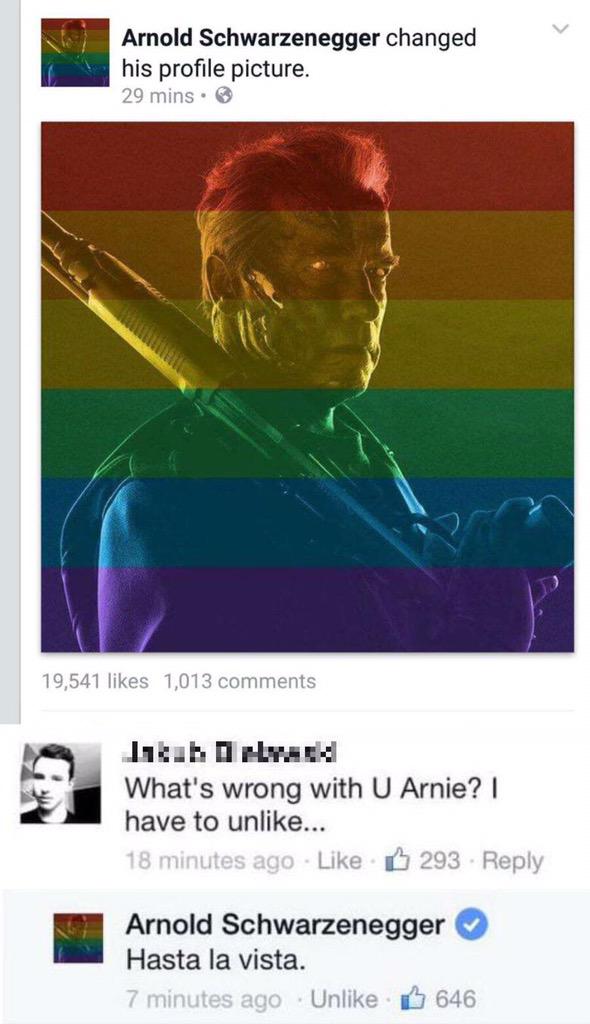
Among the millions were a number of familiar faces, with stars like Leonardo DiCaprio, Elizabeth Banks, and Arianna Huffington taking part. Arnold Schwarzenegger had a particulalry memorable encounter with an anti-gay fan:
- « Previous Page
- 1
- …
- 83
- 84
- 85
- 86
- 87
- …
- 108
- Next Page »