ACOMSDave

Community Journalist

  • Home
  • Community Journalist
  • Events
  • Media Page and Press Kit
    • Projects and Work
  • Resources & Documents
    • LGBTQ+ Support Groups and Documents
  • NIGRA
  • Archives
  • Contact

The Boys on the Rock by John Fox – a gay book review by DTerry McFarlane

22/08/2021 By ACOMSDave Leave a Comment

The Boys on the Rock by John FoxThough our copy of the Boys on the Rock by John Fox is a proof copy,  I could find very little that was in need of correction; except for the basis of the story.

The story is one of these: Boy has girlfriend, but fantasies about his best mate in his mind – finally he meets his first gay and gives his girlfriend up, with little compassion on his side – then he goes to college where he falls in love with this ‘ good looker’ who turns out to be gay and they become lovers.  However, his lover is fickle and goes his own way, leaving Billy to look after his crippled friend!

As you will see, the story is not very original and shows it!  Many books come to mind which cover the same themes in a vastly superior way – indeed even some of the pulp magazines carry stories that have considerably more literary merit.

In conclusion, therefore, if you enjoy reading a rehash of other people’s work, and the rehash is not put together work, then I recommend ‘the Boys on the Rock by John Fox’ – otherwise pick up your local newspaper. 


Product details

  • Publisher ‏ : ‎ SMP Paperback; New edition (15 Jan. 1994)
  • Language ‏ : ‎ English
  • Paperback ‏ : ‎ 156 pages
  • ISBN-10 ‏ : ‎ 0312104332
  • ISBN-13 ‏ : ‎ 978-0312104337

Links:

  • Amazon – The Boys ON The Rock (1984)
  • Amazon – the Boys On The Rock P (1994)
  • Firestorm by Gerald Wening

Originally published in Gay Star Issue No 16 – currently held in Linenhall Library

Filed Under: Book Reviews, Reviews

Firestorm by Gerald Wening – a gay book review by DTerry McFarlane

22/08/2021 By ACOMSDave Leave a Comment

Firestorm by Gerald WeningFirestorm by Gerald Wening is a book that follows a standard format, including that of the homophobic minister, and “we can save you” doctor.  As I don’t wish to destroy your reading enjoyment, let me say that the book provides a quick, ‘light’, read (all 170 pages in total).

The cover of the book is quite attractive, and the print quality is good.

Wening,  has produced a “normal” fictional gay book – but how I do wish authors would attempt to write about characters with depth and feeling, and not just superficial characteristics!


Product details

  • Publisher ‏ : ‎ Alyson Publications Inc; First Edition, First Printing (1 Jan. 1985)
  • Language ‏ : ‎ English
  • Paperback ‏ : ‎ 177 pages
  • ISBN-10 ‏ : ‎ 093287052X
  • ISBN-13 ‏ : ‎ 978-0932870520

Links:

  • Fellow Travellers by T C Worsley
  • Amazon – Firestorm by Gerald Wening

Filed Under: Book Reviews, Reviews Tagged With: gay book review, Gerald Wening, lgbtq+ gay book review

Fellow Travellers by T C Worsley – a gay book review by Vincent Geoehegan

13/08/2021 By ACOMSDave Leave a Comment

Fellow Travellers by T C Worsley


Fellow Travellers by T C Worsley explores the impact of the political upheavals of the 1930s on five characters:  Harry, a working-class ex-guardsman; Gavin, a feckless undergraduate; Pugh, a young and exuberant ex-public schoolboy; Martin, a priggish poet; and Lady Nellie, a somewhat naive left-wing aristocrat.  The first three are gay; Martin, as they say, swings both ways; while Lady Nellie doesn’t.  Against the intrusive backdrop of world Stalinism and fascism, and in particular the great moral drama of the Spanish Civil War, these individuals have a complex series of sexual, emotional, and political inter-relationships.

Worsley uses a clever formal device to present his material.  An anonymous narrator, who acts as the guiding thread throughout the book, reveals documents he has accumulated for an unwritten novel.  These documents are eyewitness accounts by our five characters – accounts of their dealings with the world and with each other.  This enables Worsley to portray effectively the complicated personalities of his subjects and to show how they differ in their perceptions of the same political;  and personal events.

The price to be paid for this formal novelty is that the characters remain as fragments, disembodied subjects, and objects, never really coming alive, and consequently one feels rather uninterested in their fate.  Only at the end, in war-torn Spain does the book’s method really pay off, as the immense tragedy, impossible to capture ‘objectively’, is graphically revealed through the very different eyes of the five.

The book is a novel with gay characters, rather than a gay novel.  Gayness is neither the theme nor an agnosied issue, but provides rather the texture of the work.  It is, in this respect, a welcome addition to the literature.


Product details

  • Publisher ‏ : ‎ London Magazine Editions; First Edition (1 Jun. 1971)
  • Language ‏ : ‎ English
  • Hardcover ‏ : ‎ 249 pages

Links:

  • Amazon – Fellow Travellers by T C Worsley
  • Homophobia and Terrorism are not limited to Muslims.

Originally published in Gay Star No 16 held in the Linenhall Library, Belfast


Filed Under: Book Reviews, Reviews Tagged With: Fellow Travellers, gay book review, LGBTQ+ Book Review, Linenhall Library, T C Worsley

Parallel Lives by Peter Burton – a gay book review

10/08/2021 By ACOMSDave Leave a Comment

Parallel Lives by Peter BurtonParallel Lives by Peter Burton, is a  memoir that falls into three unequal parts:  the first section sees PB (Peter Burton) coming to terms with his adolescent self.  this is very gracefully written as is the very end of the book describing the last few years.

The rest is a carnival of name-droppings and descriptions of unpleasant people getting unpleasingly blotto and/or pilled.

Peter Burton has no time for the ‘Gay’ movement because it is dominated by middle-class types who look down on working-class people like himself.  He also exalts the commercial scene over the efforts of the ‘politicals’, and glossy mags over the likes of … GAY STAR(?), THE PREDECESSOR OF ACOMSDave (the Blog).

This class (ill-) feeling without any impetus towards change is a very English thing – mysterious to a simple Irish queen like myself.  And the inability to spot the symbiotic relationship between the ‘scene’ and the ‘community is very London-village.

Despite these rather sharp criticisms, I look forward to a real autobiography from Peter Burton.  Towards the end of this volume, he edges towards real self-analysis.  He has a good brain, a sharp eye and commonsense, an assessment of himself and the sub-culture and also the general community could be a masterpiece.


Product details for Parallel Lives by Peter Burton

  • Publisher ‏ : ‎ Gay Men’s Press (18 April 1985)
  • Language ‏ : ‎ English
  • Paperback ‏ : ‎ 128 pages


First published in Gay Star No 16, paper copy held at The Linenhall Library, Belfast


Links:

  • Amazon – Parallel Lives by Peter Burton
  • The Glass Boat by Alison Ward


Filed Under: Book Reviews, Reviews Tagged With: Alison Ward, gay book review, gay star, LGBT+ book review, LGBTQ+ Book Review, Linenhall Library, Peter Burton, The Glass Boat

Olympic Medals and Population

09/08/2021 By ACOMSDave Leave a Comment

So the Tokyo Olympics are over and the medals are coming home, and yes there will be disappointments, but it is a big but, every one of those athletes went and represented their country to the very best of their ability.  And yes, if we just look at medals, as one newscaster did when he stated that the United Kingdom had done as well as in Rio or London (a  statement now proven to be at least half incorrect).   The United Kingdom has achieved more than London and only slightly less than Rio – an absolutely brilliant result when considering the pandemic’s impact and comparing Olympic medals against the population.

It is very easy to forget that the United Kingdom is fifth in population size in the top ten medal winners, which means that for every 1m people in the population our Olympians achieved a medal.  This is absolutely stupendous when you compare that again People’s Republic of China (1 med per 16.4m), the USA (1 medal per 2.9m) or the ROC (1 medal per 2m).

It is estimated that at least 182 ‘out athletes’ from about 30 countries attended the Tokyo Games. 

…At least 55 of those athletes, who competed in 35 different sports, won medals — five nabbed gold for Team USA women’s basketball alone. In fact, if the LGBTQ Olympians competed as their own country — affectionately labeled “Team LGBTQ” by Outsports — they would rank 11th in the total medal count (right behind France and before Canada), with 32 team and individual medals: 11 gold, 12 silver and nine bronze…NBC News

Our Olympians are marvellous. and wouldn’t it be wonderful if the media realised this for more than just the two weeks of the Olympic Games!


Olympic Medals and Population


  Top 10 Countires Olympic Medals 2021 with Population  
Rank Team/NOC Gold Silver Bronze Total Rank by Total Population Total  
1 United States of America 39 41 33 113 1 332.9 million  
2 People’s Republic of China 38 32 18 88 2 1444.2 million  
3 Japan 27 14 17 58 5 126 million  
4 Great Britain 22 21 22 65 4 68.2 million  
5 ROC (Russian Olympic Committee) 20 28 23 71 3 144.2 million  
6 Australia 17 7 22 46 6 25.8 million  
7 Netherlands 10 12 14 36 9 17.1 million  
8 France 10 12 11 33 10 65.4 million  
9 Germany 10 11 16 37 8 83.9 million  
10 Italy 10 10 20 40 7 60.3 million  


Links:

  • World Population Review
  • Olympic Medal Count
  • ‘Team LGBTQ’ earns 32 medals at Tokyo Olympics
  • TOKYO OLYMPICS: 10 INSPIRING GAY AND BI MALE ATHLETES TO LOOK OUT FOR
  • The Conversion Therapy Saga

Filed Under: Community Journalist Tagged With: Bronze, conversion therapy, Gold, LGBTQ, Olympians, Olympic Medals, olympics, population, Silver, Tokyo Olympics, world population

The Secret a gay short film review

08/08/2021 By ACOMSDave Leave a Comment

The SecretThe Secret is a short gay film about hidden love.  Julian is in a dilemma. He loves the person, he is in a relationship with, less than his best friend.  It is a story of a journey, of coming to terms with who you love and not what society and other pressures say who you should love.  Both the main actors are very handsome, and their acting is really good considering their young age. The film is only 3.37 mins long, but it successfully gets its message across.  Do make an effort to watch it, and I would love to have your comments. 
 
 
Director: Kim Anderson
Writer: Kim Anderson
Country: Germany
Language: Germany
Duration: 4 min
Stars: 
Björn Helge Jochum – Julian
Jan-Nicklas LeRoi  –  Alexander
Thea Valder  –  Jana
Kim Anderson –   Regie
 
 
Links:
  • YouTube – The Secret
  • GTM – The Secret
  • Chicken
 

Filed Under: Movie Reviews, Reviews Tagged With: Bjorn Helge Jochum, gay movie review, Jan-Nicklas LeRoi, Kim Anderson. German, LGBTQ+ move review, LGBTQ+ short gay movie review, short gay movie review, Thea Valder

Men in Frocks by Kris Kirk and Ed Heath – a gay book review by Stella Mahon

06/08/2021 By ACOMSDave Leave a Comment


Men in FrocksThe title says it all, really,  Men in Frocks.  A frock, as any woman will tell you, is quite different from a dress.  Drags of any kind wear frocks, the women of the western world, for the most part, wear dresses if they wear dresses at all.

The authors of this book are aware of this distinction.  When talking of two male-to-female transexuals they freely admit that Roz and Tish ‘do not sit comfortably in a book with (this) title’.  But they are included in a brief chapter on TV/TS, where I read something which was the exact opposite to my own feelings. 

…’TSs also are often accused of perpetuating fantasy female stereotypes and some people see them as Fifth Columnists who seek to undermine the struggle of women to right the imbalance of power between sexes.’ …

I had to check it – did the authors write TSs or TVs at the beginning of that sentence?  For they were actually saying something I had always felt about transvestites (AND most drag artists).  There were the men who projecting the image of women as sexual objects, who wanted to pass for women, be whistled at.  Who negated in a way that your ordinary straightforward hetman did not, the whole challenge that women have been flinging in society’s face for years.  In a way that challenge which I offer to a society which would put me in a particular niche (comfortable for it), and which I offer with my mind and lifestyle, a transexual is offering with his or her body also.

But the debate about TV/TS forms only part of this book.  Much of it, indeed most of it, is a history of the drag scene, whether on stage or off, complete with photos of this one and that one doing his drag thing.  As such it occasionally bored me a little bit. but as it moved away from the post-war years and the big drag shows, through individuals and into more modern times my interest picked up.  The chapter on ‘The Red Drag Queen’ is a case in point.  Back in 1970, when their story began as it were, I knew nothing of any gay scene, was still married and only vaguely aware of my own sexual make-up, slightly more aware of me as a woman.  So the history of that period – albeit from a ‘drag ‘ angle – caught my attention more than any other with the notion that many men – gay men, for the most part, if not the whole part – used drag as a political statement.  With their dress, used on particular occasions, not simply as a fun activity, they were ‘showing solidarity with women by ridiculing the idea of beauty objects.  It e3xpanded to a political statement on their own behalf, within GLF in London when they as well as the women members felt intimidated by the men who did most of the talking – gay men, who, ‘although prepared to pay lip-service to anti-sexism, were as dominating and aggressive as the archetypal heterosexual men’.  They became the Radical Feminists – Rad Fems for short – of GLF, would you believe.  Some had come to realise that ‘women were right about drag.  They never put down drag per se, but they put down the men who got into low cut dresses (Frocks, surely?) false books, the fantasy Hollywood stereotype’.  But we began to realise that there were ways of using drag … it’s a way of giving up the male power role … Oh yes, Kirk and Heath are correct in assuming as they do in this chapter, that such activity would today be criticized for ridiculing women,  You want to reject male power, give up that role?  So what’s the best way of doing that?  Live it in your life?  Preach it?  Oh no, as the outward sign of self-denial, you, as a man, take on the trappings of the one group of people who are universally at the receiving end of male power.  Instead of standing up and hitting out in your own right you tacitly acknowledge, by using a female image, the position of women, using the image of the so-called ‘weaker sex’ to say ‘up yours’ to the ones who parade the power.  If that is not perpetuating the rolebase of our lives, I don’t know what is.  Still, Kirk and Heath do say that ‘the Rad Fems’, like many others from GLF have come out of the experience older and wiser.

It has begun to change, hasn’t it?  I have no doubt that drag in all its old-fashioned (in more ways than one) sense continues.  Danny La Rue is still inexplicably, popular and that mostly with women.  but, as the book points ut Boy George is doing in the eighties what David Bowie did in the seventies – clothing himself how he pleases, and that becomes his dress.  Not male, not female, ut indivual.  It is also what women have been doing for quite a time, women of feminist persuasion.  We don’t, as some of the press hacks would have it (and haven’t they had a field day with the garb of the women at Greenham) insist on ‘wearing the trousers’, for it is only to them that trousers whether of cord, denim, or worsted, are a sexual symbol of power.

The book is OK.  You’ll enjoy reading it.  but keep your political eyes open while you do so.


Reviewer -Stella Mahone

Original review held in Gay Start  No 16 lodged in the Linenhall Library


Product details

  • Publisher ‏ : ‎ GMP Publishers Ltd; First Edition (31 Oct. 1984)
  • Language ‏ : ‎ English
  • Paperback ‏ : ‎ 160 pages

Links:

  • Amazon – Men in Frocks
  • The Glass Boat
  • Gays in the 80s – Men in Frocks
  • Yvonne Sinclair – the story of TV/TS Group – Men in Frocks

Filed Under: Book Reviews, Reviews Tagged With: Boy George, Danny La Rue, David Bowie, drag queens, Ed Heath, Feminists, gay book review, Gay LIberation Front, gay men's press, GLF, GMP, Kris Kirk, LGBTQ+ Book Review, press hacks, Rad Fems, stella mahon, TSs, TVs

The Glass Boat by Alison Ward – a gay book review

03/08/2021 By ACOMSDave Leave a Comment

The Glass BoatThe Glass Boat is a fairy story.  No, not the way you think I mean.  It’s the story of people who might exist, of events that could happen.  It is, in short, somewhat magical.

An old wharf building is to be pulled down and the site re-developed.  to the man who wants to do this it is only bricks and mortar, bo the woman to whom he entrusts the design work for his new edifice soon finds out otherwise.  It is a magic place, a place that brings her into contact with people who inhabit the same world as herself but not in the same way as she does.  they do it in a way that makes the wharf their world, using only bits and pieces of her world as and when they need them.  Dealing with the so-called real world is a problem for them, in that it intrudes on what they really want to do.


This is a magical book, with a magical story, written in the 1980s.  It entices you in, and you have to decide to continue with the journey or jump off.  Take a leap of faith and stay with the story – hopefully yo will be surprised as I was1

The Glass Boat


Information:

  • Publisher ‏ : ‎ Brilliance Books Ltd (26 Nov. 1983)
  • Language ‏ : ‎ English
  • Paperback ‏ : ‎ 96 pages


First published in Gay Star Issue No 16 held by the Linenhall Library

Links:

  • Books by Alison Ward
  • Amazon Link:  The Glass Boat
  • Make IT Happy Make IT Safe: What Sex is All About

Filed Under: Book Reviews, Reviews Tagged With: Alison Ward, amazon, book review, gay book review, gay star, Linenhall Library

Make IT Happy Make IT Safe: What Sex is All About by Jane Cousins-Mills – Book Review by Geraldine Johnston

02/08/2021 By ACOMSDave Leave a Comment

You would be forgiven for thinking that a homosexual magazine (Gay Star) is an unlikely place to find a review of a sex education text, namely ‘Make IT Happy Make IT Safe: What Sex is All About’.  After all, these stirling manuals are usually crammed with information on how men and women do  “it”, how often, and how to negate the consequences.

Make IT Happy Make IT Safe: What Sex is All AboutHomosexuals have, for centuries, known the secret of fool-proof contraception – we’re just waiting for the rest of the world to catch on.  However, ‘Make It Happy’, despite its innocuous title, is of some interest to the gay community.  The author, Jane Cousins, regards homosexuality in a very positive light, and, as the book is intended primarily for young people, it’s good to see someone putting across such attitudes in a matter-of-fact, common-sense way.

Chapters on sexual development, masturbation, orgasms, sexually transmitted diseases, hygiene, and the law are of interest to all of us – male, female, hetero, homo.  One of the refreshing things about ‘Make It Happy’ is that Jane Cousins writes for young people in their own language, and she doesn’t assume that they are familiar with technical terms.  Hence in the narrative and index, you’ll find ‘penis’ and ‘tool’, ‘vagina’ and ‘twat’.  Having taught in various Belfast schools, I’ve come across sex education texts in which the basic assumption is that sex is something that happens between a husband and a wife, presumably only in bed with the lights off – anything else is either not quite nice or a mortal sin.

Thankfully attitudes are changing, and Jane Cousins’ book is both a reflection of this and an attempt to meet the demand for hard facts unseasoned with moral overtones.  Unfortunately, the Church and State school authorities either haven’t wakened to or choose to ignore the need for a direct, no-nonsense approach to sex education.  Therefore, I can’t see this book being used in schools, at least in Northern Ireland, for some time yet.

In the appendix of ‘Make It Happy’, there is a list of useful addresses, including major gay organizations.  My feeling is that the sooner such information is made widely available, the better for us all.


‘Make It Happy’ was of course available in the NIGRA library, now held by the Rainbow Project, along with a range of other books of interest to gay men and lesbians.  Some of these are not generally available elsewhere.


written by Geraldine Johnston in Gay Star No 3 Sep/Oct 1980 – the full magazine can be read in the Linenhall Library

Information:

  • Publisher ‏ : ‎ Penguin (30 Jun. 1988)
  • Language ‏ : ‎ English
  • Paperback ‏ : ‎ 224 pages

Links:

  • Amazon – Make IT Happy Make IT Safe: What Sex is All About
  • Coming to Power by Samois: Writings and Graphics on Lesbian S/M
  • UK Government – Relationships education (Primary)
  • Dept of Education (NI) – Relationships and sexuality education


Filed Under: Book Reviews, Reviews Tagged With: gay book review, Geraldine Johnston, Jane Cousins-Mills, LGBT+ book review, NIGRA, Rainbow project, sex education

Belfast Pride and Economics

01/08/2021 By ACOMSDave Leave a Comment

PEYE__Belfasty_Gay__702897s PEYE__Belfasty_Gay__702943s Image-3 Image-6 Pride-Belfast-civic-dinner-Brian-Gilmore-and-Jeff-Dudgeon-right-2004 City-Hall-Pride-dinner-2004 Belfast-Pride-August-2008-Shanes-front-tattoo

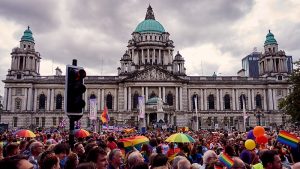
Belfast Pride and Economics!  Originally, we had Pride Day with a march to show people that we are part of their community and that we had a right to exist.  At this point we were fighting for our lives;  abuse, both physical and mental, was normal, and murder occurred and was usually brushed under the legal table as justified due to overtures or something similar. (Portsmouth Defence)

And again, marches started in large cities like New York and London, and like a spider’s web slowly the marches spread into other cities and links were formed.

In the background to these marches were the fights in court to get us legal recognition and protection (e.g., Jeffrey Dudgeon, MBE).


…’Try to will yourself into – or out of – loving someone,  try to will someone into loving you, and you collide with the fundamental fact that we do not choose whom we love.’  …James Baldwin on Love, the illusion of Choice and the Paradox of Freedom


Time has passed and so the Pride March has become Pride Month, with a lot of regions or cities now holding the Pride Parade which is almost like a Lord Mayor’s Float Parade!

With a parade comes flamboyance, but why?  To quote i-d-vice.com  in their article the significance of men’s fashion at pride’: 


…Queer men have always worn outlandish clothing within the safety of their own spaces but Pride is different; it’s an occasion which allows you to dress however you want, in broad daylight, in the centre of the city. Fashion at Pride is a way of being defiantly visible, satirising the straight world, and experimenting with gender….


However, this last year during the covid lockdown we have all seen how shallow the acceptance has been, with an increase in LGBTQ+ attacks, with the homeless of LGBTQ+ increasing and with some countries even reversing (or seeking to reverse) the laws which were fought for to give the LGBTQ+ community acceptance and protection.

I love Belfast Pride, having been one of those few souls who marched on the very first one in 1991 (all 200 of us), and walked past the various vociferous groups protesting us being there and alive.

That first Pride in Belfast was a small affair, but so significant as it allowed the Belfast population going about their normal daily tasks, to see that we were just like them from one end of the spectrum to another, with very flamboyant characters to extremely conservative ones – and that just as other groups have marched for centuries in the belief of their right to exist, so were we.

Today, as I have mentioned above, the Pride Day Parade is a large affair in Belfast, with conservative numbers for those taking part being (55000) and with watchers at least double that.   We have support groups from Trade Unions, the PSNI, local councils, student groups to name but a few.  The detractors have gone down in number, and indeed the local papers generally write in a positive way about the parade.

I welcome this change, but again I caution everyone to remember our roots, there are still those who would seek to have us put back in the closet.

The one thing that is not often mentioned about Gay Pride Parades is the economic benefit that regions, towns, or cities get from them.  I come from a background of finance, and I am also a local community journalist for our community, so I was extremely interested to see if anyone knew what economic benefits were brought into Belfast specifically and for Northern Ireland in general.

There is little available documentation regarding this area, but one that I have read with interest is the Greater London Authority Mayoral Decision for funding for Pride in London for the period 2018-2022.  I would like to share an extract from it: –

…During the past five years, Pride in London has continued to see growth and improved community engagement.  It is the UK’s largest lesbian, gay, bisexual and transgender (LGBT+) event and parade that typically attracts an annual attendance of up to a million people into central London.  Independent audience survey research in 2016 (the most recent data set) showed that additional spend in the local economy from people attending Pride was approximately £26.3m…

Now obviously Belfast figures as I have stated above are nowhere near 1 million (55000 approx.), however, if you conservatively look at the projected spend figures then I would suggest that Belfast economically benefits to the tune of


  Attendance Figures Additional Spend Spend per Head Estimated Policing Cost Estimated Cleaning Up Costs Estimated Net Benefit
             
London 1000000 £26.3m £26.30 £1m £1m £24.3m
             
 Brighton 400000 £20.5m  £51.25 £420k* £200k* £19.8
             
             
Belfast 55000 £.825m £15.00 £55k £45k £725k
  55000 £.550m £10.00 £55k £45k £450K
Northern Ireland            


Now the statistics for Northern Ireland are a lot more obscure as the Northern Ireland Tourist Board does not seem to track increased  figures for the period of Pride Month, and in particular Belfast Pride (FOI Request reply to 3 questions on Belfast Pride and in general N Ireland Pride Festivals dated 25 Jun 2018), but I believe that economically, the events help attract tourist income, stimulate employment, encourage spending, and contribute to public infrastructure development; and in so doing events prove the opportunity to revitalise communities and foster economic development. 

Also, the rural pride events can help members of the LGBTQ+ community to feel supported and accepted by creating visibility about different sexual orientations.

In the last week, we have seen reference to 1991 A Belfast Pride to be remembered!  It is important to realise that Belfast Pride is both a celebration of life and who we are, but also a political statement to show we are here, that we will not be going back and that we will continue to fight for our rights in society.


Belfast Pride and Economics


Links:

  • Wikipedia – LGBT stereotypes
  • Fermanagh Herald – ‘Pride festival game-changer, but keep politics out’
  • scene magazine – THE COST OF KEEPING PRIDE SAFE FOR EVERYONE
  • University of Minnesota – Community festivals—Big benefits, but risks, too
  • University of Massachusetts Amherst – Together we will go our way: The development of
  • Belfast Pride


Filed Under: Community Journalist, Editor to ACOMSDave, Government & Politics, History

  • « Previous Page
  • 1
  • …
  • 16
  • 17
  • 18
  • 19
  • 20
  • …
  • 108
  • Next Page »

Categories

Copyright ACOMSDave.com © 2026