ACOMSDave

Community Journalist

  • Home
  • Community Journalist
  • Events
  • Media Page and Press Kit
    • Projects and Work
  • Resources & Documents
    • LGBTQ+ Support Groups and Documents
  • NIGRA
  • Archives
  • Contact

Archives for May 2015

Zac Efron gets steamy in We Are Your Friends trailer

24/05/2015 By ACOMSDave Leave a Comment


Zac Efron gets steamy in We Are Your Friends trailer

The perfect start to the summer…

Film hunk Zac Efron has released the trailer for his latest film We Are Your Friends.

His upcoming movie features him as a struggling 23-year-old electronic DJ trying to make it big on the Hollywood dance scene with dreams of becoming a major record producer.
Alongside taking his shirt off – or at least being in a tight t-shrt throughout – we aren’t really sure what else happens in the 3 minute 15 second trailer. Let’s say we were preoccupied.
The film is released in the US on 28 August before moving across to British shores later in the year.
The perfect start to summer – here’s Zac’s trailer for We Are Your Friends….

Words William J Connolly, @wjconnolly

Filed Under: Movie Reviews Tagged With: We Are Your Friends, Zac Efron

‘Sextarianism’ is drawing new battle lines in Northern Ireland

24/05/2015 By ACOMSDave Leave a Comment

The Conversation 22 May 2015, 1.09pm BST


Livid. EPA/Paul McErlane
If you grew up in Northern Ireland during the 1970s and 1980s, sectarianism pervaded every aspect of your everyday life. In fact, such is the pervasiveness of sectarianism that it’s almost been normalised. These days, it’s sometimes not even recognised or regarded as a problem.
In simple terms, sectarianism is the dislike, hatred, and distrust of another religious faction, a bundle of ideas, beliefs and practices including verbal and physical intimidation and violence as well as political, economic and institutional discrimination.
The intent is to reinforce social stereotypes, perpetuate cultural differences and, ultimately to uphold the political and economic inequality between Northern Ireland’s Protestants and Catholics. Put another way, it’s all about securing and exercising political, economic, social and cultural power.

Simmering down?

In symbolic terms, the signing of the 1998 Good Friday Agreement and the Belfast Agreement marked the beginning of the end of sectarian violence by mainstream republican and loyalist paramilitaries.
And while sectarianism still looms large in Northern Ireland, statistics from the Police Service of Northern Ireland show an overall downward trend in sectarian incidents and crimes. Meanwhile, recent research by Paula Devine shows that the majority of both Catholics (71%) and Protestants (70%) would prefer to live in a mixed-religion neighbourhood.
Although there is still a long way to go in terms of eradicating sectarianism, these statistics offer a sign of optimism and improvement. But sectarianism’s sideways move on the political agenda has only made space for other social issues in the same hateful part of the spectrum.
Two issues in particular have caught the attention of NI Assembly members and local councillors, especially those from the Democratic Unionist Party (DUP), in recent years. On the one hand, sexual citizenship – gay rights, abortion and reproductive rights – and on the other, sexual commerce: the sale and consumption of adult goods and sexual services.
The attitudes of individual politicians and political parties, and, more importantly, the policy responses to issues of sexual citizenship and sexual commerce have taken on a deeply conservative and fervently activist bent. Northern Ireland has become a hotbed for what we might term “sextarianism” – a politicised dislike of those whose sexual identities, beliefs and practices are non-heteronormative, “deviant”, or commercialised.

Minorities targeted

Sextarianism revolves around religious and patriarchal ideas, beliefs, practices and policies that stigmatise, physically harm, and criminalise members of sexual minority groups, and deny them their human and labour rights.
Whereas civil and political sectarianism is about various religious and nationalist/republican and unionist/loyalist factions fighting one another, sextarianism sees civil society and politicians from both sides of the old sectarian divide coming together to fight common “enemies”.
An indication of the extent and scale of violent sextarianism can be gleaned from data on “hate motivated” incidents and crimes: year-on-year, the number of recorded homophobic incidents increased by 20% in 2013/14.
And in terms of political sextarianism, there has been considerable controversy, about a local bakery refusing to make a gay-themed cake for an LGBTQ customer. The case over the bakery’s refusal ended up in the High Court.
And while the bakery ultimately lost, related battles are being fought on other fronts.

War of words

Political sextarianism has seen Northern Ireland consumed by a range of sexual rights issues, among them gay adoption, gay marriage and gay blood donation. On these issues, there has been particularly strong opposition from the DUP.
The nationalist political parties, SDLP and Sinn Fein, have expressed some measure of support for gay marriage – but in the recent NI Assembly vote on it, a number of SDLP members “missed” the vote, and as such, the motion failed.
The undercurrent of hostility that greets gay rights periodically comes to the surface. Recent homophobic comments by the then minister for health Jim Wells, who claimed that children were more likely to be abused within same-sex households, resulted in him stepping down.

Sex shops are another bone of contention. Belfast City Council recently ruled that the number of sex shops in the Gresham Street area, where one of the first two sex shops in Northern Ireland opened in the early 1980s, should be zero. The argument was that “the presence of such premises would have an adverse impact upon the current and envisaged character of the area.” This resolution was moved by Tim Attwood, a councillor from the SDLP, a nationalist political party, but seconded by Alderman Guy Spence from the DUP.
Protests by religious groups, mainly the Free Presbyterian Church, were a common feature outside Belfast’s one and only lap dance club, the Movie Star Café, back in the early 2000s. This adult entertainment venue was also vehemently opposed by Belfast City Council, which sought to refuse a renewal of the club’s licence. The lap dance club closed within about a year of opening. There have been no clubs since.
More recently, Marie Stopes, which opened its first abortion advice centre and clinic in Belfast in late 2012, has been the subject of regular protests from both Protestant and Catholic religious groups as well as some women’s groups. The founder of one of the most vociferous pro-life organisations, Bernadette Smyth from Precious Life, was issued with a five-year banfrom approaching the Marie Stopes offices after being found guilty of harassing its recently departed director, Dawn Purvis.

Come together

But one of the starkest incidents of political sextarianism was the saga of the Human Trafficking and Exploitation (Further Provisions and Support for Victims) Bill by the NI Assembly in late October 2014.
The Bill, due to become law on June 1 2015, will introduce a version of the so-called “Nordic Model”, which criminalises the purchase of sexual services but not the sale of them. It was supported by 81 out of 91 NI Assembly members, spanning the ethno-sectarian divide.
As part of its “research” on different ways to regulate sex work, the NI Justice Committee visited Finland and Sweden to examine their much-ballyhooed models close up. This fact-finding fly-by does not represent a considered inquiry; it was clear at the committee’s hearings that many members had made up their minds in favour of the so-called Nordic model before all the evidence had been tendered.
If the committee were sincere in gathering as much evidence as possible about how best to regulate sex work and ensure the safety and well-being of sex workers, it would have bothered to look beyond the Nordic countries, and would have engaged properly with sex workers and sex worker organisations in Northern Ireland, the Republic of Ireland, and the rest of the UK.
The suspicion and harsh questioning that greeted the one and only current sex worker, sex work support organisations and academics researching sex work showed that there was little if any interest in being genuinely analytical of the Nordic model. Conversely, the Catholic and women’s organisations from the Republic of Ireland who gave oral evidence were welcomed with open arms, strange given Unionist politicians’ longstanding distrust of all things Irish.
This shows the sheer power of sextarianism. This sort of political alliance between Protestants and Catholics would have been virtually unimaginable about ten years ago. But since both Catholic and Protestant politicians have both long laid claim to the moral high ground on sex and sexuality, the human trafficking bill created the perfect conditions for a sextarian marriage of convenience – another sign of how nothing heals old wounds like a new enemy.

Filed Under: Anti-Bullying & Homophobia Tagged With: Irish politics, LGBT rights, sextarianism

Northern Ireland is now the odd one out on same-sex marriage

24/05/2015 By ACOMSDave Leave a Comment

PinkNews

  • 23rd May 2015, 7:58 PM
  • LAST UPDATED AT 9:07 PM
  • Nick Duffy

Following the victory of same-sex marriage in the Republic of Ireland, Northern Ireland has grown increasingly isolated on the issue.

The Republic of Ireland yesterday held a referendum on a proposal to introduce civil same-sex marriage.

Despite fears that a strong turnout among older, religious voters could sway the referendum against equality, it was announced today that the vote passed by 62.1% to 37.9%.
However, in Northern Ireland the Democratic Unionist Party government continues to block all LGBT rights legislation including same-sex marriage – with the measure rejected by Stormont for a fourth time last month despite popular support.
The DUP has dismissed calls to follow the Republic of Ireland in holding a referendum – but Northern Ireland is now very much isolated in Northern Europe on the issue.
In Europe, same-sex marriage is now legal in Belgium, Denmark, Finland, France, Iceland, Ireland, Luxembourg, the Netherlands, Norway, Portugal, Spain and Sweden – as well as Scotland, England and Wales inside the United Kingdom.
The Crown Dependencies of Jersey, Guernsey and the Isle of Man are also still to introduce equality – but have a much smaller population than Northern Ireland’s 1.8 million.
Sinn Féin’s Martin McGuinness has previously called for a referendum in Northern Ireland following roadblocks in Stormont, saying: “What would be very interesting for me, would be to gauge whether or not on the issue of equality, in regard to the rights of people in LGBT community, the assembly actually is representative of people here in the north and I think it would be very interesting if we had a referendum.
“In fact I would advocate that we should have a referendum.
“This is a matter of whether or not we want to live in a modern progressive society that respects minorities, and as far as I’m concerned the LGBT community for far too long have been discriminated against and I believe that they are entitled to be treated as equals and treated with respect.”

Filed Under: Anti-Bullying & Homophobia Tagged With: gay marriage, Irish politics, marriage equality, same sex marriage

Irish gay marriage referendum: Pressure to build on Northern Ireland’s politicians to allow vote on gay marriage

24/05/2015 By ACOMSDave 5 Comments

Belfast Telegraph

BY ED CARTY – 23 MAY 2015

Charles McQuillan/Getty Images

Charles McQuillan/Getty Images

Pressure is set to build on Northern Ireland’s politicians to allow a popular vote on gay marriage after the resounding victory in the Republic.

Sinn Fein said the equality rights for same-sex couples must be shared by citizens in the north and it will continue to campaign for the reform.
Caitriona Ruane, the party’s Stormont Assembly Member for South Down, said the referendum shows change is possible and inevitable when people fully engage in politics.
“The marriage equality rights that will be enjoyed by Irish citizens in the south must be shared by citizens in the north,” she said.
“Sinn Fein will continue to campaign for marriage equality for all in the North and to end the discrimination against our LGBTI community.”
Northern Ireland is the only part of the UK which does not have gay marriage.
Northern Ireland’s Deputy First Minister Martin McGuinness welcomed the emerging success of the marriage equality vote.
Mr McGuinness said: “Today we can all rightfully be proud to be Irish and part of an increasingly tolerant, pluralist and outward-looking Ireland.
“Politicians, particularly in the north need to reflect on this progress.
“The world is moving on and Ireland is taking the lead. Pride in Ireland has taken on a whole new meaning.”
Unionists earlier this year rejected a proposal from Deputy First Minister Martin McGuinness to hold a referendum on the issue similar to Republic.

Sinn Fein also said the influx of emigrants returning home to vote in the day before polling yesterday highlights the need to tackle the issue of voting rights for the Irish diaspora and for Irish citizens in Northern Ireland.

“I’m delighted the people have voted overwhelmingly in favour of marriage equality for all,” she said.

“This referendum was all about equality, inclusion and respect for our LGBTI brothers and sisters.

“The campaign energised and engaged a whole new generation of young people in the democratic process.

“This result shows when people fully participate in the political process that change is not only possible but inevitable.”

Filed Under: Anti-Bullying & Homophobia Tagged With: gay marriage, Irish politics, marriage equality

Belfast Books

24/05/2015 By ACOMSDave Leave a Comment

Today I was talking to the owner of Belfast Books (www.belfastbooks.co.uk ), a used/new book shop at 112 York Road, who asked if I knew of anyone or any groups that had any LGBT-themed books they would sell or donate. He is interested, due to familial connections to the LGBT community and through social conscience, in selling these amongst his varied collections. He is interested in books across multiple genres –  topical, fiction, auto-/biographicals, academic and pop culture etc, and would ideally like to have enough to fill a bookshelf or two.
As I’m sure you can appreciate, it’s not easy finding these when you’re not sure what you’re looking for.
If anyone is interested in helping out, please contact John using the below details:
email: enquiries@belfastbooks.co.uk
Tel: 028 9075 1466
Many thanks
Liam

Filed Under: Book Reviews Tagged With: Belfast Books, LGBT

Morning Ireland and the Referendum

21/05/2015 By ACOMSDave Leave a Comment

The Chairman of the Referendum Commission, Mr Justice Kevin Cross, answers listeners questions ahead of the two ballots on Friday

Filed Under: Anti-Bullying & Homophobia Tagged With: Justice Kevin Cross, marriage equality, Morning Ireland, referendum

LGBT Walking Group

21/05/2015 By ACOMSDave Leave a Comment

This might be of interest to you. Our Dublin walking group have been busy!

We’re walking in the Mournes with our Dublin counterparts on Sunday. I hope we’ll have Marriage Equality cake for celebrations. If any of you want to come, let me know: you’ll need the usual walking gear and a pair of walking boots- lovely walks planned with upwards of 30 people expected.
http://nigra.org.uk/wp-content/uploads/2015/05/Out-About-Hiking-fundraiser-for-Yes-Equality-campaign-HD.mp4

Filed Under: Anti-Bullying & Homophobia Tagged With: lgbt walking group, marriage equality, same sex marriage

Op-ed: Remembering LGBT History Didn’t Begin With Stonewall

20/05/2015 By ACOMSDave Leave a Comment

 BY SIMON COPLAND MAY 19 2015 8:30 AM ET

The long arc of gay history means there will be wins — like the story of Victorian-era cross-dressers Fanny and Stella — and losses, like Russia’s growing intolerance.

Fanny and Stella (Frederick Park and Ernest Boulton) in 1868

Fanny and Stella (Frederick Park and Ernest Boulton) in 1868

Maybe you’ve heard of the pioneering trans* activists Fanny and Stella, who were charged for indecency in Victorian Britain 25 years before Oscar Wilde. Maybe you haven’t? Up until the announcement of a new play based on their lives by writer Glenn Chandler — appropriately named Fanny & Stella — I certainly had not. Yet, reading about them, it has become clear how important they were, and how tragic it is that most of us probably don’t know who they are.

Chandler’s play is now being performed in London. It follows the story of cross-dressing gays Frederick Park and Ernest Boulton, a.k.a. Fanny and Stella, who were arrested in 1870 for wearing women’s clothes to a play and charged with “conspiring to incite others to commit unnatural offences.” After a trial that attracted huge publicity, the two were acquitted — partly because doctors who inspected the men couldn’t prove they had anal sex. Both Fanny and Stella, who performed throughout London in men’s and women’s clothing, hoped their success in court would be a catalyst for change in the antigay laws of the time (sadly, it wasn’t).

The play is exciting. The retelling of queer history is important. Yet at the same time I cannot help but be disappointed at my lack of knowledge of these two pioneers as well as many others of their time. I suspect I am not the only one. When it comes to remembering queer history we’re pretty bad at it.
I’m not talking here about our modern history. The stories of the past 40 years, from the Stonewall Riots to Harvey Milk to the AIDS crisis to the growth of the marriage equality movement, are largely imprinted on our collective memory. Yet that seems to be the limit of it. Queer history is often written as if it started June 28, 1969, the date of Stonewall.
Yet, our story goes much deeper than that. A quick look and you can find some amazing things. What about Oscar Wilde, who was not as lucky as Fanny and Stella, and was sentenced to hard labor for “gross indecency”? Or how about Magnus Hirschfeld, a gay, Jewish, left-wing occasional transvestite, who developed the Berlin Institute of Sexual Research in 1919? Hirschfeld had to flee Germany in the 1930s, watching as his entire library was set alight.
These sorts of stories run throughout our history. Stories of pioneers and campaigners, and of movements that changed our society for the better. Our history is far deeper and more varied than just what’s happened in the last 40 years.
This is really important. Through pointing to the heroes and heroines of our past we can draw greater connections to our modern struggle. Just as Joan of Arc and the women of the suffragist movement have become important modern feminist icons, so should Fanny and Stella, Wilde and Hirschfeld (among many others!) become icons of the queer movement.
More than that, understanding this history is essential to ensuring the continued progression of LGBTIQ rights. In recent years we have begun to talk as though the march of queer liberation is “inevitable.” But what if it wasn’t as simple as that?
It is a little-known story that the Soviet Union — now one of the most homophobic nations on earth — was at the forefront of gay rights in the early 20th century. In the aftermath of the Russian Revolution, all offenses related to homosexuality were removed from the criminal code (well before this happened in much of the Western world). In fact, if you look even further into Russian history you will see a very tolerant approach to homosexuality. This is a very different picture from the one we see in Russia now. After a decade of sweeping changes for LGBT rights in developed nations, Russia turned quickly against queer people. Suddenly all the progress was lost.
Here is the true importance of understanding our history. If we see history only through the lens of the past 40 years in the U.S., it is easy to paint a picture of constant progress. It is why so many are bewildered by the actions of Russia — how could a country turn on gays like this in the 21st century?
But if you take a longer view you realize our story is more complex. It is one of constant struggle — a story of progress being followed by setbacks, only to be met with resistance once again. This is not to make us depressed about the gains we’ve made but to ensure we collectively protect ourselves from returning to this fate. If we understand our history better, we don’t let ourselves lose the progress we’ve made.
Speaking about Fanny and Stella, playwright Glenn Chandler stated, “The sad thing is that they really thought their case would change things, they thought a change in the law was coming, but then in two decades we have the Oscar Wilde trial and it takes another two centuries for change to come.”
Chandler points out that Victorian society actually became more conservative in the years following their trial. If Fanny and Stella’s case was held in the era of Oscar Wilde, there is every chance they could have ended up behind bars. The progress they hoped for vanished before their eyes. We are making great progress, but the past shows us this can be reversed in a hearbeat. Knowing our history can help us stop that from happening.

Filed Under: Anti-Bullying & Homophobia Tagged With: lgbt history, politics

Southern Rites: A Reminder of the Parallels of Prejudice

20/05/2015 By ACOMSDave Leave a Comment

Editorial:  Yesterday a judge decided that a bakery had shown prejudice against a gay man by taking his order and payment for a cake, and then calling him back some days later to state that they couldn’t fulfil his order because it was against their Christian principles to promote ‘gay marriage equality’.  The gay man did not seek to have this action in the courts, at no time as has been stated, did he seek to ‘set-up’ the bakery (Loose Women/Janet Street-Porter).

It is obvious from the comments made by our politicians following the judgement, that they cannot separate church from state.  The links between church and state in the UK are, nowadays, mostly a formality and the governance of the UK is relatively secular, although the Lords Spiritual have a significant influence when they vote as a bloc on certain issues, notably abortion and euthanasia.

As Slugger O’Toole penned, “…When it comes to separating Church from State I believe that many of our Unionist politicians are out of step with the views of the majority of Unionist voters….”

The following article on prejudice in the Southern States of the USA, show how legislation and political statements don’t remove prejudice, only a concerted action by all involved with a recognition of everyone’s equal rights will enable a balanced, forwarding looking society.

0-0-0-0-0-0-0-0-0-0

republished from the The Advocate – BY TRUDY RING  –  MAY 18 2015 6:00 AM ET

A new documentary about racial tensions in rural Georgia reminds us what all types of bigotry have in common.

Sha'von Patterson holds a photo of himself and his older brother, Justin, as children. The new documentary Southern Rites addresses Justin's violent death and its consequences.

Sha’von Patterson holds a photo of himself and his older brother, Justin, as children. The new documentary Southern Rites addresses Justin’s violent death and its consequences.

Sha’von Patterson holds a photo of himself and his older brother, Justin, as children. The new documentary Southern Rites addresses Justin’s violent death and its consequences.

Over the past year, events in Baltimore, New York, and Ferguson, Mo., have provided ample evidence that America’s racial problems are far from solved. A new HBO documentary drives the point home as well — and its director is quick to note parallels between racism and anti-LGBT bigotry.
“It’s all about discrimination and civil rights — it’s all connected,” says Gillian Laub, whose directorial debut,Southern Rites, premieres tonight on the cable channel. And all prejudice, she notes, is about fear of the unknown.
Laub has spent most of her career as a photographer; one of her earlier projects was a multimedia piece called “Becoming Nikki,” about a 10-year-old transgender girl, commissioned by Peoplemagazine in 2013. Another project was documenting the racially segregated proms at Montgomery County High School in rural Georgia, and that’s what gave rise to Southern Rites.
Laub, who is based in New York City, had been photographing the separate proms for several years, and in 2009, The New York Times Magazine published her photo essay on the subject. National outrage led the school to finally have an integrated prom for all students. Laub continued to travel to Montgomery County; “I thought I was going back to kind of show the prom in transition,” she says. But she found far more than that, exposing continued racial tensions.
Norman Neesmith, a white resident of neighboring Toombs County, was arrested in January 2011 for shooting and killing Justin Patterson, a 22-year-old black man Laub had photographed at a prom years earlier. Neesmith’s 18-year-old great-niece, Danielle, whom he had raised after her mother abandoned her, and a friend of hers had invited Patterson and his brother Sha’von to the Neesmith home, apparently for sexual encounters. Neesmith was sleeping when the young men arrived, but he woke up, confronted them, and a fight ensued, ending in Justin’s death.
While Neesmith was facing trial in 2012, Calvin Burns, the well-respected police chief of Mount Vernon, the Montgomery County seat, was seeking election as county sheriff, hoping to become the first African-American to hold the post. Juxtaposing these two stories, Southern Rites explores the role of race in the region, making it clear that bigotry against black residents has not been erased.
It also makes clear that the situation is complicated; as much as Norman Neesmith may incite viewers to anger, it would be an oversimplification to say he’s a hopelessly racist villain. For one thing, Danielle, whom he says he loves deeply, is part African-American. “I think he’s a complicated and flawed human being, like most of us,” Laub says of Neesmith. “He’s very nuanced.”
Laub, a straight woman who is a passionate LGBT ally, notes that she’s met some Montgomery County residents who are facing homophobia along with racism. The prom king at one year’s black prom, she says, came out to her and asked what he should do with his life, as he felt there was no place for him as a black gay man in rural Georgia. But he’s still there and actually doing well, she says.
A recurring theme in her work, she says, is “trying to bring out people’s truth,” whether it’s the story of the “incredibly brave” transgender girl Nikki or race relations in the Deep South. Her next project will take her back to transgender issues; it’s a film about trans people in the military, who still face discharge if their status becomes known. Laub adds that she can’t provide any details just yet.
Meanwhile, as Southern Rites premieres, a companion photo and video exhibit has just opened at New York City’s Benrubi Gallery, where it runs through June 27. There is also a companion photo book, and Laub will give a lecture before a special screening of the film at Dartmouth College May 26.
Laub stresses that while the film, which has John Legend as an executive producer and features a song by him, deals with serious and pressing issues, it’s not all downbeat. For instance, several scenes show teens of all races having fun together and saying how ridiculous they found the idea of segregated proms. “I do want to note the progress there has been and that there is hope,” she says.
Southern Rites premieres tonight at 9 Eastern on HBO; check your local listings. For more information about the film, the exhibit, and related events, go to SouthernRitesProject.com.Watch a trailer for the film below.

Filed Under: Anti-Bullying & Homophobia Tagged With: A Reminder of the Parallels of Prejudice, Irish politics, movie, politics, prejudice

Asher’s Gay Cake Judgement Reaction

19/05/2015 By ACOMSDave Leave a Comment

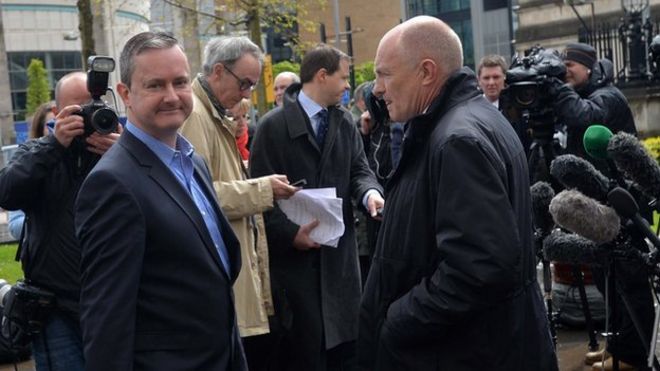
Gareth Lee outside Laganside Court, Belfast

Gareth Lee outside Laganside Court after a judge found Ashers Baking Company guilty of discrimination


The following reactions were noted from the BBC News website following the judgement given by a judge on the ‘Gay Cake’ case:

line

First Minister Peter Robinson
“I’m not terribly surprised. In many ways, that’s why we were preparing a legislating alternative.
“I think the term ‘reasonable accommodation’ is now what we would like to frame some legislation around, recognising that there are rights on both sides.”

line

Deputy First Minister Martin McGuinness, on Twitter
“Ashers bakery judgement a good result for equality. Gay people have for far too long been discriminated against. We and the law on their side.”

line

David McIlveen DUP, on Twitter
“Utterly sickened that a Christian-owned business has been hauled over the coals for refusing to promote something that is not legal in Northern Ireland.”

line

SDLP MLA Colum Eastwood, on Twitter
“Today’s judgment is a welcome and refortifying of our hard-won equality laws.”

line

Sinn Féin MLA Catriona Ruane
“It is a good day for equality and a good day for everyone in our society.”

line

John O’Doherty, The Rainbow Project
“The judge clearly articulated that this is direct discrimination for which there can be no justification.”

line

The Green Party NI, on Twitter
“Let us now move forward to rebuild relationships with the LGBQT community.”

line

DUP MLA Paul Givan
“What we cannot have is a hierarchy of rights, and today there’s a clear hierarchy being established that gay rights are more important than the rights of people to hold religious beliefs.”

line

Jim Allister TUV
“It is a dark day for justice and religious freedom in Northern Ireland.”

line

Peter Lynas, director of Evangelical Alliance
“This judgment will cause great concern for all those in business. It turns out the customer is always right and businesses have no discretion in deciding which goods and services to produce. The law rightly protects people from discrimination, but it has now extended that protection to ideas.”
 
line

Editorial:  The judgement has been made and it recognises that the law had been broken.  We will now have to follow carefully to ensure that our politicians do not decide that they can change the law to suit their bias.  The Human Rights Act is one of the cornerstones of the Good Friday Agreement, but with Westminster talking about withdrawing from it, we could see Stormont deciding to then repeal all the rights that the LGBT community have gained in Northern Ireland.


Filed Under: Anti-Bullying & Homophobia Tagged With: Ashers, editorial, gay cake, Irish politics, LGBT rights

  • « Previous Page
  • 1
  • 2
  • 3
  • 4
  • 5
  • 6
  • …
  • 12
  • Next Page »

Categories

Copyright ACOMSDave.com © 2026