ACOMSDave

Community Journalist

  • Home
  • Community Journalist
  • Events
  • Media Page and Press Kit
    • Projects and Work
  • Resources & Documents
    • LGBTQ+ Support Groups and Documents
  • NIGRA
  • Archives
  • Contact

London: Ken Livingstone and Partnership Ceremonies

21/06/2015 By Dave McFarlane Leave a Comment

Gay History

by Paul
Couples on the London Partnerships Register celebrate

BC – Ken Livingstone joined the couples’ celebrations


In 2001 London Mayor Ken Livingstone introduced a partnership registration service for same sex couples. The registrations recognised the partnership of the individuals but did not confer any legal rights. The new register was called the London Partnerships Register. The register was open to heterosexual as well as gay couples.
The first couple to take advantage of the scheme, which pre-dated Civil Partnerships and demonstrated the need and desirability of giving same sex couples rights, were Ian Burford and Alexander Cannell, who had been together already for 38 years.
They had a five-minute ceremony conducted by Rob Coward, a specially-trained officer with Greater London Authority.
Couples taking part in the ceremony received a certificate but the register was not made available to the public for confidentiality reasons. The register was designed to be self-financing, charging couples £85 to register their details.
The Greater London Authority was the first public body in the United Kingdom to recognise same-sex relationships as being on a par with heterosexual partnerships.
http://news.bbc.co.uk/1/hi/uk/1525205.stm

Filed Under: Anti-Bullying & Homophobia, History Tagged With: civil partnership, lgbt history, same-sex partnerships

Out From The History Books – Celebrating Our Past

01/06/2015 By Dave McFarlane Leave a Comment

The Second National Festival of LGBT History – February 2016

Following the success of the First National Festival of LGBT History in Manchester earlier this year, plans are under-way to make the next festival in February 2016 even bigger and even better.  And this time it will be truly nationwide.
As well as the academic conference being held again in Manchester, an additional four ‘hubs’ are being developed to celebrate the contribution of British LGB and T people throughout history. These will be in Shrewsbury,York, London and Bristol. Each hub will be liaising with a member of the Schools OUT UK steering committee to enable their popular event to remain in keeping with the ethos of LGBT History Month. The theme for History Month 2016 will be Religion, Belief and Philosophy.
Schools OUT’s Academic Director Jeff Evans is inviting individuals and groups to put forward their ideas for popular events showcasing the histories of LGBT groups, events and individuals in their local area. The formal announcement of the full programmes of events will be this autumn.
This year’s festival included talks and exhibitions relating to queer histories in the north of England and Manchester, including: “We were born in the 1980’s: History of the Joyce Layland Centre (Manchester)”, “Anne Lister: A Life”, “Press for Change & Trans History”, and “21 years and more: BiPhoria and Bisexuality in Manchester”.
The first National Festival of LGBT History this year attracted speakers of calibre: Stuart Milk, LGBT activist and nephew of assassinated pioneer Harvey Milk, veteran campaigner Peter Tatchell, Linda Bellos and history Professor Charles Upchurch, who flew in from Florida especially for the event.  The highlight of the weekend was the three-part immersive theatre production A Very Victorian Scandal, which dramatised the events of Britain’s own Stonewall event, which happened in Hulme in 1880.
The closing date for festival submissions is 30th June 2015.
We are also delighted to announce the call for papers for the ‘What is & How to Do LGBT History: Methods, Subjects and Approaches’ academic conference and we are expecting submissions as last year from round the world.
For more information contact Jeff Evans:  academics@schools-out.org.uk
To submit presentations, the online form is here:http://lgbthistorymonth.org.uk/call-for-presentations/

Filed Under: Anti-Bullying & Homophobia Tagged With: lgbt history, schools-out.org

Old Shoebox Gives Glimpses Into A Gay Man's Life In 1940s-'60s Vancouver

29/05/2015 By Dave McFarlane Leave a Comment

Huffpost Gay Voices – Kevin Dale McKeown – Posted: 05/28/2015 6:07 pm EDT
 
joe selsey vancouver
I have a new guy in my life. His name is Joseph, but his friends and family called him Joe so I will too.
I met Joe a few months ago through Don Stewart, the proprietor of MacLeod’s Books where I was in browsing one Saturday morning when Don suggested I take a look at a shoebox full of papers and photos that he thought might interest me.
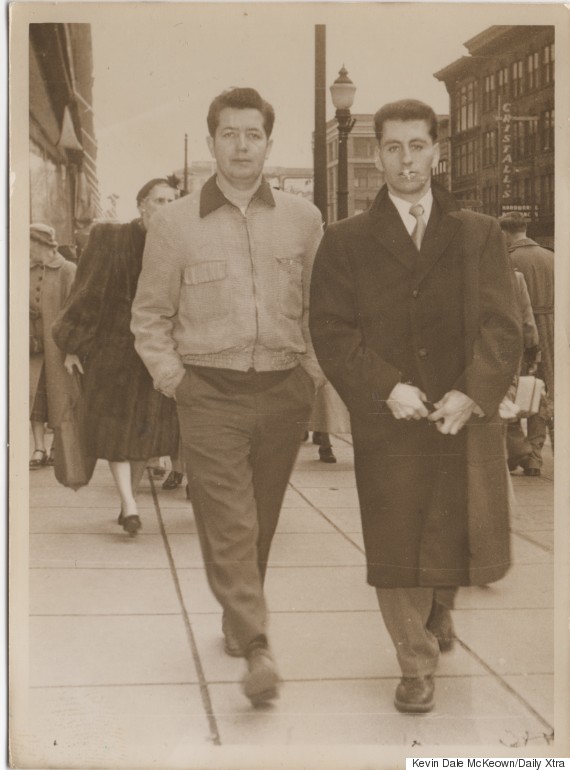
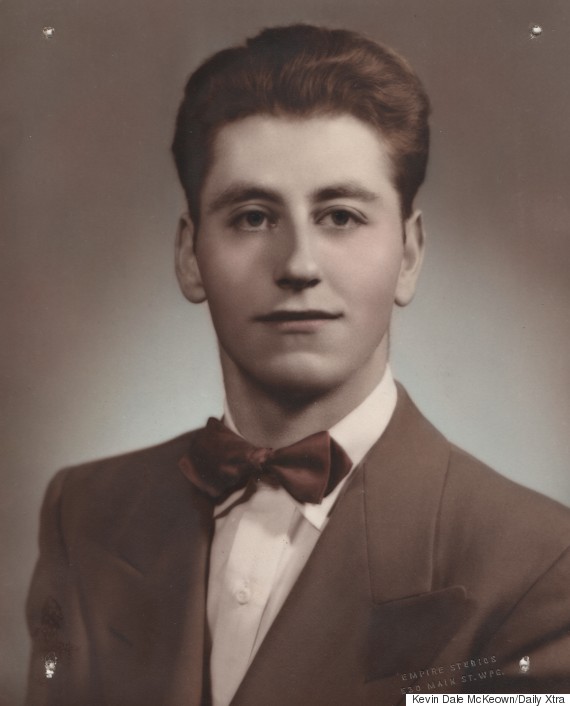
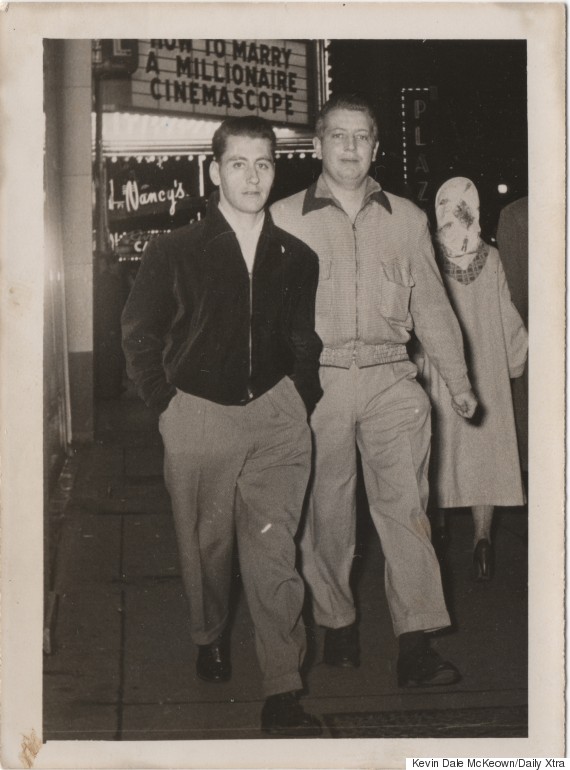
The contents of the box proved to be memorabilia of the life of one Joseph R. Selsey, late of Vancouver’s West End. The reason that Don thought I might want to see these discards, retrieved by a savvy binner from where they’d been dropped next to a dumpster, was that several pieces of this collection indicated that Joe was a gay man living in our neighbourhood in the 1940s, ’50s, and ’60s; decades for which we have few records of our community’s existence.
Don’s first clue might have been the paperback copy of Richard Amory’s Song of the Loon, an interracial and intergenerational gay love story from the early ’60s, before either of those loaded terms had been coined.
Or the flyers from Trojan Book Service offering such titles as America’s Homosexual Underground by Antony James (quote: “The good-looking boy with lily-white skin was husky but the man sensed a kind of effeminacy as he watched the boy leaning against the stair steps with his crotch bulging.”).
Or the handbill from International Nudist Sun, boasting “frontal nude photographs” of hunky young “body builders.”
Certainly the Tom of Finland-style greeting card with three studs, naked except for toques and scarves and boots, carolling in the snow, was a clear giveaway.
Yeah, Joe was a friend of Dorothy’s, and I quickly scooped up the remains of his days for a closer look, and perhaps some clues to the lives of that generation of gay men who lived their youth in the years before Stonewall.
joe selsey vancouver
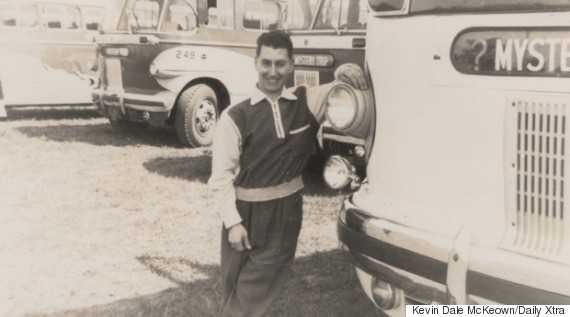
I have spent many pleasant hours with this material, wondering what kind of life we might imagine for Joe from these crumbs.
Much of it was lived at 1031 Harwood St., according to the handsome leather baggage tag with Joe’s name and address.
A well-dressed, happy, busy life with good friends, if the many photos of Joe and pals are any indication. And a life not entirely in the closet, hints a card signed “Merry Xmas to Joe from Kitty & Bob. PS: And a gay New Year!” Nor a life of rejection by family, according to several notes and photos inscribed “To Uncle Joe” from various wholesome looking children.
Joe’s wallet revealed that he had been born on March 19, 1927 in Saint Norbert, Manitoba, and that during his Vancouver years he was a joiner. He held membership cards to several establishments and organizations, most intriguingly to something called The Happytime Social Club, at 1022 Davie St. If that address sounds familiar, it might be because you gave it to the cab driver the last time you were dropped off atCelebrities.
I wonder what was going on in the Happytime Social Club in 1956? Was this a gay club after its turn as The Embassy Ballroom and before it became the notorious ’60s rock palace, The Retinal Circus?
Joe also had quite a number of passes to a Palm Springs Health Spa at 2405 West Broadway, which in the late ’50s offered, for a $2-surcharge, the “Complete Guest Treatment.”
joe selsey vancouver
This time capsule also held a tiny key on a string (but nothing to open with it), a miniature silver keychain charm toaster, and a ratty rabbit’s foot. Does the collection of little sewing kits gathered from various hotel rooms suggest that our Joe might have been good with a needle?
Would the bolo tie with the bull and matador woggle indicate a butch streak, or does the baby blue cord of the tie suggest otherwise?
The stick of dried-out Wrigley’s chewing gum hints at less than fastidious housekeeping (really Joe!) and the little bundle of Irish Sweepstakes tell us that Joe liked a flutter on the ponies.
Most poignant among the scraps was a simple black and white, business-card sized piece, with a psychedelic pattern enclosing the words “You Are Not Alone.”
I admit to having qualms about outing Joe, even several years after his demise, until I found his Vancouver Sun obituary online. Noting his death at Vancouver General Hospital on April 26, 2007, aged 80, the obit proudly stated that Joe was “survived by his loving companion of 27 years, Ralph Gotell.”
Having weathered the challenges of life as a gay man in the 1940s and ’50s and ’60s, Joe was lovingly partnered and proudly out at the end. I don’t think he’d mind our spinning this little tale around these bits and bobs his life.
So far my digging has turned up no further records of the lives of either Joe or Ralph.
joe selsey vancouver
I share these random musings about Joe Selsey and how he might have lived his life as a gay man in the Vancouver of his day for two reasons: To help us realize that there is at least two generations worth of local, verifiably gay history that is slipping beyond our grasp; and to ask you, gentle reader, to share this story and these photos with any friends you may have of Joe’s generation.
Ask if they knew him, and if they recall the Happytime Social Club, and can tell us just how happy those times were?
Even if they didn’t know Joe or Ralph, perhaps something of these notes will jog a memory and stir up a story that we should add to our rich history. Before it’s too late.
If you have such friends, and they’re willing to chat, coffee’s on me!
You can contact the writer at stillqq@dailyxtra.com.
(This column first appeared on Daily Xtra.)

Filed Under: Anti-Bullying & Homophobia, History Tagged With: 1940s, history, lgbt history, shoebox

Op-ed: Remembering LGBT History Didn’t Begin With Stonewall

20/05/2015 By ACOMSDave Leave a Comment

 BY SIMON COPLAND MAY 19 2015 8:30 AM ET

The long arc of gay history means there will be wins — like the story of Victorian-era cross-dressers Fanny and Stella — and losses, like Russia’s growing intolerance.

Fanny and Stella (Frederick Park and Ernest Boulton) in 1868

Fanny and Stella (Frederick Park and Ernest Boulton) in 1868

Maybe you’ve heard of the pioneering trans* activists Fanny and Stella, who were charged for indecency in Victorian Britain 25 years before Oscar Wilde. Maybe you haven’t? Up until the announcement of a new play based on their lives by writer Glenn Chandler — appropriately named Fanny & Stella — I certainly had not. Yet, reading about them, it has become clear how important they were, and how tragic it is that most of us probably don’t know who they are.

Chandler’s play is now being performed in London. It follows the story of cross-dressing gays Frederick Park and Ernest Boulton, a.k.a. Fanny and Stella, who were arrested in 1870 for wearing women’s clothes to a play and charged with “conspiring to incite others to commit unnatural offences.” After a trial that attracted huge publicity, the two were acquitted — partly because doctors who inspected the men couldn’t prove they had anal sex. Both Fanny and Stella, who performed throughout London in men’s and women’s clothing, hoped their success in court would be a catalyst for change in the antigay laws of the time (sadly, it wasn’t).

The play is exciting. The retelling of queer history is important. Yet at the same time I cannot help but be disappointed at my lack of knowledge of these two pioneers as well as many others of their time. I suspect I am not the only one. When it comes to remembering queer history we’re pretty bad at it.
I’m not talking here about our modern history. The stories of the past 40 years, from the Stonewall Riots to Harvey Milk to the AIDS crisis to the growth of the marriage equality movement, are largely imprinted on our collective memory. Yet that seems to be the limit of it. Queer history is often written as if it started June 28, 1969, the date of Stonewall.
Yet, our story goes much deeper than that. A quick look and you can find some amazing things. What about Oscar Wilde, who was not as lucky as Fanny and Stella, and was sentenced to hard labor for “gross indecency”? Or how about Magnus Hirschfeld, a gay, Jewish, left-wing occasional transvestite, who developed the Berlin Institute of Sexual Research in 1919? Hirschfeld had to flee Germany in the 1930s, watching as his entire library was set alight.
These sorts of stories run throughout our history. Stories of pioneers and campaigners, and of movements that changed our society for the better. Our history is far deeper and more varied than just what’s happened in the last 40 years.
This is really important. Through pointing to the heroes and heroines of our past we can draw greater connections to our modern struggle. Just as Joan of Arc and the women of the suffragist movement have become important modern feminist icons, so should Fanny and Stella, Wilde and Hirschfeld (among many others!) become icons of the queer movement.
More than that, understanding this history is essential to ensuring the continued progression of LGBTIQ rights. In recent years we have begun to talk as though the march of queer liberation is “inevitable.” But what if it wasn’t as simple as that?
It is a little-known story that the Soviet Union — now one of the most homophobic nations on earth — was at the forefront of gay rights in the early 20th century. In the aftermath of the Russian Revolution, all offenses related to homosexuality were removed from the criminal code (well before this happened in much of the Western world). In fact, if you look even further into Russian history you will see a very tolerant approach to homosexuality. This is a very different picture from the one we see in Russia now. After a decade of sweeping changes for LGBT rights in developed nations, Russia turned quickly against queer people. Suddenly all the progress was lost.
Here is the true importance of understanding our history. If we see history only through the lens of the past 40 years in the U.S., it is easy to paint a picture of constant progress. It is why so many are bewildered by the actions of Russia — how could a country turn on gays like this in the 21st century?
But if you take a longer view you realize our story is more complex. It is one of constant struggle — a story of progress being followed by setbacks, only to be met with resistance once again. This is not to make us depressed about the gains we’ve made but to ensure we collectively protect ourselves from returning to this fate. If we understand our history better, we don’t let ourselves lose the progress we’ve made.
Speaking about Fanny and Stella, playwright Glenn Chandler stated, “The sad thing is that they really thought their case would change things, they thought a change in the law was coming, but then in two decades we have the Oscar Wilde trial and it takes another two centuries for change to come.”
Chandler points out that Victorian society actually became more conservative in the years following their trial. If Fanny and Stella’s case was held in the era of Oscar Wilde, there is every chance they could have ended up behind bars. The progress they hoped for vanished before their eyes. We are making great progress, but the past shows us this can be reversed in a hearbeat. Knowing our history can help us stop that from happening.

Filed Under: Anti-Bullying & Homophobia Tagged With: lgbt history, politics

Pratt and Smith – The last men hanged for sodomy 

28/03/2015 By David McFarlane Leave a Comment

Father Frank Ryan casts new doubt on the 1835 convictions

 
The wrongful conviction and execution of James Pratt and John Smith for ‘buggery’ in 1835
by Father Frank Ryan

The last Saturday of August 1835 was a beautiful hot day. James Pratt (30) left his wife and two young daughters in Deptford, searching for work – promising to return by 6pm. He was a labourer and needed a better job.
Pratt first visited his aunt in Holborn, before heading to Blackfriars. His aunt thought he’d had too much to drink and needed a rest, but he pressed on. In an ale house he met John Smith, a labourer aged 40, and William Bonill (sometimes spelled Bonell), aged 68. Neither could offer him a job to improve his financial situation but their company was hospitable. Bonill invited Pratt and Smith back to his rented flat and they accepted.
Little did they know as they made their way to his premises in nearby George Street, that this encounter would result in their execution – and that Bonill would be  banished to the penal colony of Australia –  all within a mere three months.
The landlords of 45 George Street, Southwark, Jane and George (also known as John) Berkshire, were determined to curtail the activities of their tenant, William Bonill, who they regarded as an “old villain.” He had been bringing male “couples” back to his flat on a regular basis; sometimes two a day. George was determined to put a stop to this practice and get rid of what he regarded as a disagreeable and troublesome lodger.
Shortly after the three men arrived, the suspicious, antagonistic George spied into Bonill’s room through a nearby window. A little later, over tea, he told his wife that he saw Pratt sitting on Bonill’s knees and then on Smith’s. There was much laughing and conversation, he said. Jane slipped upstairs and peeped through Bonhill’s keyhole. After a brief look, she returned to tell her husband that she had witnessed sexual acts. He became enraged, went upstairs and also looked through the keyhole. He then burst into the room to confront Pratt and Smith, who were in a compromising position, according to George Berkshire.
At this point, Bonill, who had gone out for a drink, returned and entered the room. An effort to calm down Berkshire was unsuccessful. George went off to seek the police.
Pratt, Smith and Bonill were soon arrested and taken into custody. Pratt and Smith were charged with ‘buggery’ (anal sex) and Bonill as an accessory. They went on trial for their lives before Judge Baron Gurney at the Old Bailey on 21 September 1835.
The arresting police officer had no material evidence to support the charge. The account that Jane Berkshire told the jury is improbable. She said she watched for less minute but claimed to have witnessed the alleged sex acts, from the men undressing to laying on the floor and the “appearance” of anal penetration. She said she saw the men’s private parts but did not answer when asked whether either man had an erection. It seems doubtful that the keyhole could have provided the range of vision needed to see what she claimed.
The testimony of George was very similar to Jane’s. It had a whiff of coordination. His evidence supported the charge that buggery had taken place. However, he failed to testify if the men had an erection or if he had seen actual penetration; though he claimed to have sighted their genitals and their bodies in motion.
The anatomical description of intimacy described by George Berkshire would have been very difficult to witness. As in the case with Jane’s testimony, the keyhole probably could not have provided a sufficient angle of sight to provide the evidence he imparted to the jury.
Neither James Pratt nor John Smith were allowed to give evidence at their trial. Both pleaded “not guilty” to the charge. Nevertheless, the jury returned a guilty verdict.
The law against ‘buggery’ (not repealed until 2003) was based on an interpretation of the Bible that regarded homosexual acts as an abomination and worthy of death; a particularly evil sin that must be severely punished and eradicated. It was a capital crime.
The judge had no hesitation in sentencing James Pratt and John Smith to death. He warned them their chances on appeal were hopeless and they could expect no reprieve. They had to prepare, he said, to receive God’s judgement upon departing this life. Both men left the dock in tears.
William Bonill was sentenced to 14 years transportation to Australia. He died in Tasmania in 1841.
As well as Pratt and Smith, there were many death sentences for different crimes handed down during the autumn 1835. The process of petitioning for clemency and commutation began.
While being held in Newgate Prison, Pratt and Smith were visited by Charles Dickens who wrote they “had nothing to expect from the mercy of the crown, their doom was sealed.” The turnkey whispered to Dickens that they were “dead men.”
John Smith, it seems, had no friends. But the friends of James Pratt commenced a vigorous campaign to save him. They gathered a substantial petition which included the trial prosecutor, former employers, neighbours and even George and Jane Berkshire, their accusers.
All the documents were prepared for a Privy Council meeting with the King, William IV, to be held in Brighton.
On 24 November, 12 men sentenced to death were reprieved by the King’s mercy. Pratt and Smith were not among them. Judge Baron Gurney’s warning had prevailed.  In their case, the law was to be allowed to take its course.
News of the pending execution spread around London, confirmed by the erection of the scaffold outside Newgate Prison.
On Friday 27 November, the two prisoners were taken from their cells and brought to the place of execution, still protesting their innocence. Pratt was weak and had to be helped up the scaffold. The crowd began to hiss, possibly in disagreement with the execution. These were probably the last sounds the men heard. The hangman pulled the bolt and after a short struggle on the rope Pratt and Smith were dead.
They are buried in a common grave, with others executed at Newgate, in the City Cemetery, Manor Park, London E12.
In 2014, I petitioned the Secretary of State for Justice, Chris Grayling MP, to grant a posthumous pardon to James Pratt and John Smith on the grounds that even by the standards of those days their convictions were unsafe. Further, the ‘buggery’ law itself was unjust. Consenting adult homosexuality should have not been a crime.
In reply, the Justice Ministry regretted the men’s execution, acknowledging that it should never have happened, but said the conditions for granting a pardon had not been met. However, since the pardoning of Alan Turing for same-sex relations has established a legal precedent, hopefully the Justice Minister will, with further pressure, re-examine the case and grant a long overdue pardon to Pratt and Smith.
The full story of Pratt and Smith is retold in the book, ‘The law to take its course – Redeeming the past, securing our  future’. It is available as a self- printed manuscript from the author, Father Frank Ryan, for the cost of printing (about £14): fmryan33@hotmail.com
The book and this article are based on Ryan’s original research at the National Archives, British Library and London Metropolitan Archives, plus newspapers reports.
This article was written by Frank Ryan, with the assistance of Peter Tatchell.

Further information:

  • Rictor Norton (Ed.), Homosexuality in Eighteenth-Century England: A Sourcebook. Updated 28 March 2015
  • Trial at the Old Baily –  Full Transcript
  • Website Executed Today – 1835: John Smith and James Pratt, the last hanged for sodomy in Great Britain

Filed Under: Anti-Bullying & Homophobia, History Tagged With: British History, James Pratt, John Smith, Judge Baron Gurney, lgbt history, Old Bailey, Sodomny

Book Review: DAYS OF LOVE

12/03/2015 By David McFarlane Leave a Comment

Celebrates LGBT History One Love Story at a Time.


Days of Love: Celebrating LGBT History One Story at a Time


Paperback – 1 Jul 2014

by Elisa Rolle


There are sweeping changes being made across the world in respect of equality and with the increasing recognition of same sex marriage. Prolific LGBT writer and editor, Elisa Rolle, has brought together the personal stories of over 700 LGBT couples and celebrates these couples’ life-long relationships by telling their stories. Many of the contemporary couples, who share their stories talk about how they met, fell in love and share photographs from their wedding or of the families that they have started together.
Spanning 2,000 years of history, the book includes a number of interesting pieces of trivia, such as the fact that Sir Isaac Newton, who laid the foundation for modern physics, may have had a relationship with a Swiss mathematician, Nicolas Fatio de Duillier and that the author of 2001: A Space Odyssey
; Arthur C. Clarke; had a 23-year partnership with a Sri Lankan man, and that they are buried together?
The book also reminds us that in these times when equality is moving forward, there were a number of people who came before us, paving the way for LGBT rights to be crystallised, and the book also acts as an alternative cultural history of LGBT people. Elisa Rolle explains in the introduction to Days of Love why she decided to compile this book, “I have always liked love stories, and to me, even if you only spent one day in blissful happiness, then it was a love story. I see the following pages like a family photo album, the enlarged LGBT family sharing their memories: you will read about couples who managed to stay together for more than 70 years, but also those who were able to have only some days of happiness.”
Day of Love by Elisa Rolle is available to buy now from bookstores including www.amazon.co.uk:
 

Filed Under: Book Reviews Tagged With: CreateSpace Independent Publishing Platform, lgbt history

LGBT History Archive – Open Meeting

11/11/2013 By David McFarlane Leave a Comment

Outburst is showing A CENTURY LATER: LGBT – A HIDDEN HISTORY on Sat. 16th Nov 3.30pm in the Black Box- Green Room and its FREE (Northern Visions Dur: 40 Min).
history
Immediately following the screening will be an informal round table discussion, led by the LGBT History Archive Working Group in Belfast, around building an online public archive that shares the stories, memorabilia and key events that shaped, and continue to shape, our LGBT histories in Northern Ireland.

Please come along and let us know your views, and even better get involved with the project


FOR YOUR COMMUNITY BY YOUR COMMUNITY

Filed Under: History Tagged With: Archive, history, LGBT, lgbt history, LGBT History Archive

  • « Previous Page
  • 1
  • 2

Categories

Copyright ACOMSDave.com © 2026