
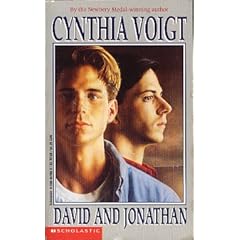
Auth: Cynthia Voight
Pub: Harper Collins
This is an intriguing book covering the relationships of three people – all male. The story shifts from the present to the past in a series of flashbacks, showing the relationship of the two surviving characters, and their interdependence on each other.
The central figures are Jonathan and Henry, friends in a small American town growing up, sharing experiences, yet separated by the divide of their different religious backgrounds and physical and mental abilities and aptitudes.
Into this relationship is thrown a wild boomerang. A person who is so different that he completely upsets the natural order of Jonathan’s family, and thus Henry’s relationship to it. Jonathan and Henry grow apart – or are forced apart by David the interloper. Yet no-one can see or will admit that David really needs outside help. Ultimately David is lost, but Jonathan and Henry cannot seem to put him away – he always seems to be there, an intrusion into their present and future.
The time span is from post Second World War to Vietnam. It does not try to tackle either of these two issues, except to say that the trauma that affects David, his sense of not belonging could just as easily be applied to the returning troops of the Vietnam action.
The book is well written and captures the period in question and its ambiguities. Anyone growing up during this time span will readily understand the story, its characters and the sense of prevailing loss that still exists.
[Terry McFarlane
Work In Progress: Episodes From The History Of Irish Women's Trade Unionism by Theresa Moriarty

Auth: Theresa Moriarty
Pub: ILHS/Unison
The subtitle is Episodes from the History of Women’s Trade Unionism. This is a glossy A3 foldover of 24 (A4) pages, in all. Twenty-one (numbered) pages contain Ms Moriarty’s text. There is also a short, unsigned Introduction. This includes the odd phrase, “… the understated hostility of men towards women workers.” In context, this must mean trade unionist men. It’s odd, because, any woman trade unionist will tell you, the hostility is anything but “understated”. Stella Mahon, (a former President of NIGRA), one of a dozen members of NALGO in NI (as a clerical worker with the Open University) was called “a stupid f**king cow”, and worse, at union conferences. NALGO (the National Association of Local Government Officers) was, allegedly, terminally “PC” – politically correct.
It’s doubly odd, because one William Walker, who levied 3d (1.25p) on members of the Amalgamated Society of Carpenters and Joiners, raising “about 2,000” (these highly-skilled workers with a six-year apprenticeship behind them would have earned between 2 and 3 per week – and absolutely nothing in slack periods) to help unionise women workers, especially in the textile industry, is given more space than any individual woman except Mary Galway. She was a major figure in the Irish Textile Operatives Society, and addressed every [Irish Trade union] Congress between 1901 and 1913, except 1906. In 1906 there was a great strike in Belfast’s linen mills.
There is a mass of fascinating information in this mercifully short pamphlet, it has many quotations from contemporary sources printed in the large page-margins in green on white. There is a wonderfully pompous one from the Dundalk Democrat for January 13, 1912, on the unladylike conduct of striking workers. Green, white and purple, the Suffragette colours, prevail in the design, making some of the people in the fine selection of photographs look slightly bilious. This latter is not a criticism, more an aside. This is a beautifully produced and very well written bit of Labour “herstory”.
GA Y USA
Gay USA
By: Andrew Collins
Pub: Fodor
This chunky, but portable, book covers forty different venues in the States, ranging from cities like New Orleans to resorts like Fire Island, NY, and Russian River in northern California. The only way to review such a book is to read about the bits of the country one knows: New York (all of a fortnight), Philadelphia (about eight to ten hours!).
The piece on New York (actually, on Manhattan: there are some places in Brooklyn mentioned, but none in the other Boroughs – you’d have thought Queens would have had at least one place, just to take the bad look off it). There is information on every conceivable sort of venue, entertainment and cultural establishment from the Rawhide bar to the St Patrick’s Cathedral, by way of the Guggenheim Museum.in this, and all of the other city sections, there are reasonably charitable run-downs of the size and type of bares) and clientele (and, in some cases, their staff). There are also very lengthy and useful lists of accommodation, ranging from the pricey to the dirt-cheap. There are good guides to eating places, again with a range of prices – and directions as to where it is the done thing to be seen. There are also directions as to where to go for good food, not just venues but cities too. The book points out that while New York has 12,000 options “it’s pretty easy to strike out” (the Big Apple is the last refuge of the Anglo-Saxon soggy salad). But New Orleans and San Francisco are good for grub.
There is also information about getting around, which is mostly pretty easy, as the large cities have very good public transport systems, and the Gay venues are mostly in central areas. Philadelphia is a bit of an exception proving this rule, as a good part of its scene is in New Hope on the outskirts of the town.
An interesting aspect of all of this is that Philadelphia, Baltimore and even Boston, though all larger than Belfast, have rather modest social scenes, though they all have their local publication (sometimes more than one) and their LGB Centres.
Our review copy is an uncorrected proof bound in gray paper and with lots of spaces for city maps; but the book in the shops has a sturdy glossy cover and crisply printed city maps, sometimes more than one per city (or holiday venue).
There are a number of small criticisms to be made of this book. For one thing, it’s more-ish: I wanted to go to Baltimore one day and New Orleans the next (there is a fair amount of easily digested history in the write-up). Backpackers, and the seriously skint, aren’t really catered for, there’s no info on Youth Hostel or campus accommodation.
But it is an excellent book for the real (and the armchair) traveller, and is genuinely cheap at the price.
Lavender and Pink Images
I have just bought Raymond Murray’s compendium ‘Images in the Dark’: An Encyclopaedia of Gay and Lesbian Film and Video, and I am thoroughly enjoying page after glorious page of it. (Some nice pics too!)
This weighty tome is a sort of Lesbian & Gay Halliwell containing (according to the cover) “More than 3,000 films and videos, over 400 photos, fully indexed and cross-referenced by titles, directors, stars and themes.” It lives up to all these claims.
The extensive cross-references include a 7-page index headed “ThemeSeand Countries”. Under the heading “Ireland” you will find a single word – “Pigs”.
Before you fly off the handle, assuming Murray is doing a Princess Margaret on us inhabitants of the Emerald Isle, you should check the main listings, where you will learn that PIGS is, in fact, a 79-minute film produced in 1984 by Cathal Black in Ireland, about a group of outcasts squatting in an abandoned mansion in inner-city Dublin. Jimmy Brennan, who wrote the screenplay, plays the “sweetly hopeless” gay man who is the main organiser in making this dump a “home” for all the other exotic characters.
At the back, it has 6 pages of titles available from TLA Video, Philadelphia, the vast majority of which I have never yet seen – but would certainly love to. What say we set up a Lesbian & Gay Video Club, to give regular screenings of videos and films of lesbian and gay interest? If you think this is a good idea ( and especially if you would be prepared to support a venture), please let us know through the blog.
The only disappointment for me with the book was that it had no nice revealing photos of my old heart-throb, Tab Hunter!
[P A Mag Lochlainn
CONSENTING ADULT
 Auth: Laura Z Hobson
Pub: Warner Books, 1975
Consenting Adult is ‘a warm-hearted mother-and-son novel with a significant difference: this is about a mother and a homosexual son’ (John Barkham review).
The novel is written to cover the 1960s: that period of the homosexual revolutionary explosion, both in terms of the fight for rights and (more importantly) the medical fraternity’s acceptance that being homosexual is (and was) not a ‘medical problem.’
Though I did not read this book until the 1980s, its importance to me, a child (now a man) who grew up in that time frame cannot be expressed. This book brought home to me the problems I had had while growing up and allied to this the horrors of growing up without having access to information about being gay – the repression that 1 had as a personality, and its effect on my whole development.
It may well be that people will ask what relevance this book has, in these times of enlightenment and information. I believe it is of vital importance, as the government has denied access to information in schools for gays, and in other ways. Also, the local campaign by some factions to stop counselling centres from opening, shows that bigots still abound, and ignorance on homosexual matters persists.
This book should be on the shelves of every school and local library, and also on the shelf of every reputable counsellor!
I also recommend it without reservation to every homosexual, whether in or out: it is a riveting read.
Links:
Different Friends
by: Rhodri Jones
This book is obviously written for an adolescent audience, with a below average reading age!
It is set in a multi-cultural Town. The main characters living at home or just ‘moving’ away, and coming to terms with being out in the big bad real world. We have a hodgepodge of mixed problems – parents, being gay, drugs, you name it and it seems to get hit; but it doesn’t seem to be dealt with in depth.
The main character, Jeff, is just out of sorts with his parents and with life. He is not gay, but his best friend Azhar, with whom he loses touch, is.
I don’t want to write much more about this book, except to say, that anyone with average reading skills, will not find it challenging, or really exciting.
Prince Eddy and the Homosexual Underworld
By:Eddy Aronson
Pub: John Murray Pubs Ltd (June 1995)
This hardback book has 246 pages, including indexes. In the ‘prologue’ it refers to a 1970 article which suggests that ‘Jack the Ripper’ was almost certainly Queen Victoria’s grandson, Prince Albert Victor, Duke of Clarence and Avondale. Allied to this is the author’s conjecture that the Prince was also heavily involved in the ‘Cleveland Street Scandal’ (a notorious homosexual brothel case of the day), [Edward Samuel Wesley de Cobain, MP for Belfast, East, was involved in the affair].
That is the background for the book, however, having read it twice, I have to say with honesty that the author in my mind has filed to prove either supposition. Indeed the fabric around the Jack the Riper case and the Prince only deserves mention on approximately 26 pages, and the Cleveland Street case hardly at all! The author concentrates on Lord Arthur Somerset, his part in the latter case, his escape, who helped him and what happened to him afterwards – to my mind he has not proved that the Prince was involved at all.
This is a book that reads like a thesis for a University course. It is dry, un-intriguing, full of conjecture, and all in all not one that I can recommend. The only possible redeeming factors are the photos of the Prince, who was extremely handsome man; and also the line drawings of the other characters in the two stories.
The publishers make reference to Aronson’s previous ‘wonderful’ biographies (The King in Love – King Edward VII’s Mistresses, Napoleon and Josephine and Heart of a Queen – Queen Victoria’s Attachments) – I have not read any of these, and if this book is representative of his tyle, I will not be doing so.
[Terry McFarlane]
GAY'S THE WORD
Columnists in the metropolitan glossy magazines aimed at metrosexuals (as opposed to mere homosexuals, or bisexuals) have been, for some time, chewing the fat about the use of the word ‘gay’. Apparently it is, (or was), all the rage in school playgrounds. And other places where young persons gather. ‘Gay’ is used to describe anything limp, or second rate, or just plain bad. What is worse, middle class kids are using the word in this manner. This is a dreadful insult to us… queers. ..And there lies upstart’s problem. We, non-heterosexuals, have ‘reclaimed’ the formerly, in the ‘Anglosphere’ anyway, most grosSeand insulting word used to describe us. Why is it illicit for young people who have probably never heard the word ‘queer’ used in the old, coarse manner, and are not benders themselves, to reclaim the word ‘gay’?. The English language is flexible mainly because it is something of a shotgun marriage between two disparate tongues. English as she is spoke in
The twee phrase ‘gated community’ is a poIitism for a kind of ghetto, a place where the very rich gather for their own protection (and that of their goodSeand gains -well-gotten, or otherwise). It is also the reason why boys (and some girls, mostly complete innocents) who should be running Scout and Guide troops are being shot and killed on a regular basis. An element of racism, real and inverted, has been introduced into this because most of these children have been ‘West Indian’, as even third generation Londoners are described by the media. Anyone with eyes to see and ears to hear knows quite well that this cohort of ‘immigrants’ have become not’ British’ but specifically English. They are responding to the same stimuli as the men who got obscene ‘bonuses’ in The City [the ‘square mile of
That may sound an oddly pompous way to describe such people, just remember that generations of sound chaps (George Orwell’s father, for example) administered the trade in opium between the proudly-entitled ‘British India’ and
It’s true to say that the cohort who use ‘gay’ as ‘not good’ have been joined by the likes of Chris Moyles (seen on the telly being ‘interviewed’ by CharIotte Church and behaving like a dirty old man whose wa*k’ fantasy has just come true). That’Sean extremely coarse image – but we are not ashamed of using it – he iSean element of the coarsening of English, or metropolitan, culture made flesh. (Lots of it.) The metrosexual glossies are also affected by this style. Their columnists bemoan the use of ‘gay’ as a put-down, but the word ‘c*nt’ is scattered throughout them like confetti. And it is used as a much more crude ‘adult’ form of put-down, than kids using gay’.
We are ‘right to be worried by this trend to use a word with which we chose to describe ourselves (apart from having sexual connotations since it entered the language in Plantagenet times, it usefully contained the acrostic Good As You’) being used aSean insult. But we clearly have the odd mote in our collective eye. This is not (more’s the pity) a Gay Liberationist call to the barricades but if we cleaned up our own act it might encourage others to clean up theirs.
The Youngest Director
Auth: Martyn Goff
Pub: Brillance Books Written in the 1950’Seand first published in 1961, this, Goff’s second novel with a Gay theme, is the story of a successful Company Director whose rise to the top is thwarted by the Chairman’s discovering that he Leonard, the youngest Director is Gay, due to betrayal by another Gay man in whom Leonard confided. He refuses to conceal his private life and thus loses his position. The theme of the novel is the conflict between private desire and enforced public practice, between the social and cultural traditions of the British Establishment and the sub-culture hidden within it. The power of public morality is demonstrated by the fact that although the youngest Director rejects the heterosexual, set-up his own life is a mirror image of his fellow Directors. I would recommend this book to Gays who think we live in a “liberated” age. We have come a long way since 1961 – but we have still got a long way to go.
Death Trick
[
Author: Richard Stevenson
Pub: Alyson Pub Inc
Very, very good – best of its kind – according to the people who read it. But nobody’s produced a review]