ACOMSDave

Community Journalist

  • Home
  • Community Journalist
  • Events
  • Media Page and Press Kit
    • Projects and Work
  • Resources & Documents
    • LGBTQ+ Support Groups and Documents
  • NIGRA
  • Archives
  • Contact

Who Gets Fucked? And Why?

13/12/2008 By David McFarlane Leave a Comment

STALLION

Yaoi PressK sen & (Others)
Stallion (Yaoi Press)I bought this booklet / magazine (in Gay’s The Word) because I could not find a gift calendar for a friend with images of (preferably unclothed) East Asian chaps. A Manga comic would be just the ticket – and one that specified that it was Yaoi was even better – a legend on the back of this booklet announces Yaoi = Boys Loving Boys. I don’t know about “loving” but there’s a lot of fucking going on. The Stallion storyboard, while very sexy, is a bit non-specific about the three central characters’ sexual equipment. Probably to ward off the attention of censors.The three are the Native American Savage Stallion (referred to simply as The Pretty in an enclosed sticker, not that the other two boys are plug ugly). There is also The Bad Bill Tempest, a Bad Pill, who is described as a sadist in the text. He also fucks (uninvited) Savage Stallion ‘ the lovely non-WASP ‘ who is shorter than the two honkies. The third person (The Good) is Josey Blackwell, who needs to avenge himself on Bill Tempest. Mainly because Bill Tempest is ” well ” a Bad Pill. Bill Tempest gets his just desserts; more’s the pity, really. He’s exceptionally pretty. His ‘sadism’ is indicated by the fact that he has hair on his chin. And he fucks females (not too vigorously. He fucks Master Blackwell, (again, unasked) in preference to a female floozy in the hotel / saloon / brothel he is staying in.) Savage Stallion and Josey Blackwell have a serious fuck at the end of the story and – it is implied – live happily ever after.Despite the sweaty action all the boy-men in this story are ridiculously pretty (and implicitly well-hung) they spend a good deal of the action naked – especially the Josey Blackwell character. Savage Stallion, being a Redskin, (um! ” ‘Native American’) is barely clothed. Savage Stallion (an exceptionally pretty ‘girl’-boy) is fucked by both the honkies. He is shown as desperately wanting to be fucked by The Good (and lovely) Josey Blackwell. After the climactic fuck the two boys ride off into the future (represented as a desert).Which set me thinking: Who Gets Fucked? In this charming story the ‘Native American’ (‘Redskin’) gets fucked, cruelly by The Bad, and triumphantly (and just as vigorously) by The Good. If such happened in ‘real life’ would the ‘Red’ boy being fucked by either White boy be entirely certain about his response? In A Very British Sex Scandal the WASP Peter Wildeblood, was pictured fucking the Scottish-Irish, working class, Catholic, conscript soldier Edward McNally (Sam Heughan). Is that an entirely accurate image of their relationship? Or is there in the Noughties (Stallion is dated: First printing July 2006), still a notion about that being fucked is to be in a lesser, receptive, – passive – role? The above echo David Rees’s 1987 novel, The Hunger, (GMP – now Millivres) in which the short, slender, credulous / superstitious, – passive – ‘native’ Irish boy is fucked / protected by an older English (not even Anglo-Irish) soldier. This is in the course of ?ün G rta M r, the Great Hunger of the 1840s, so-described to distinguish it from the comparatively minor annual hungers from the 1690s to the 1890s. It is not too gross to infer that this is something of an image of the relations between the two countries. Not unlike the relations between France and Morocco as exemplified in books by metropolitan French ‘?”sthetes’ in which they drool over fucking very young Arab and Berber boys.I hope the above is not too heavy-duty a thesis to lay on the reader, but it is striking that Savage Stallion does not get to screw anybody. He is definitely and definably an ‘outcast’ – like the Irish boy in The Hunger, – and like him is something of a girl-boy. As is, to an extent, the husky Private McNally (Sam Heughan) in the ‘drama-doc’, A Very British ”.It is quite odd, in that this wee book carries the legend For Women Readers, and the editors, authors, and in particular, artists, are all women. It bears a US dollar price, ($12.95) and was printed in the USA. But K?öSEN is described as the “Famed Spanish Studio”. Which means that there is a women’s international dedicated to making images of beautiful boys fucking each other’s brains out. There are also representations of male on male oral sex. (It was accepted decades ago that women liked the thought of, and looking at images of, cute men snogging or in sexual foreplay. But these Yaoi Press comics brings this interest into a different dimension.) What does that say about Gay Liberation? Or about feminism?It casts Germaine Greer’s recent book about beautiful boys (meaning boys) in an interesting light. The second story in this publication is Eien (Japanese for ‘eternity’) “Story and Art by K?öSEN” it involves vampirism and little is left to the imagination. The third, and last, Cancellation of Darkness “[a]rt by Amelia Woo, Story by Laila Reimoz”. It has a ‘beautiful haunted boy’ theme, and strays very close to p?”dophilia. Yet another legend claims: “All characters depicted in sexual situations are aged 18 or older.” Kai (the haunted boy) is pictured as very young, and he is fucked by Bradley the (admittedly, just about) adult psychic (presumably) investigator. Though there iSean ambiguity in the last panel. Has Bradley defeated Kai’s internal monster – or morphed into him? (There’s no question; the monster is quite definitely a ‘him’).The art work is very interesting as the boys’ have virtually no bulges at the crotch. But the incidence of pistols, rifles, knives, swords, axes, violin bows, pogo-sticks, a huge pair of scissorSeand very penile trees [!] ensue that only holy innocents will remain unaware of what is going on. That is quite apart from seven fuck scenes, as many images of oral Gay male sex, and the fact that Savage Stallion and Josey Blackwell spend an unconscionable (and entertaining) amount of time in the buff.Se n McGouran

Filed Under: Book Reviews

A Class Apart

13/12/2008 By David McFarlane Leave a Comment

A Class Apart: Private Pictures of Montague Glover (Paperback)

Book cover for A Class Apart


Pub: Serpent’s Tail


ISBN: 1852427280


This book is a wonderful pictorial history of a period in Britain when though the laws were very harsh in relation to homosexuality, there seemed to be a freedom which we currently don’t have.

James Gardiner has successfully put together photographSeand letters taken and written by Montague Glover spanning a period of 32 years. A period in which people seemed to accept individualSeand their foibles, when time seemed to have stopped, and also when life seemed simpler.

Montague Glover waSean architect, and army officer with a distinguished service record from the First World War, and also a homosexual. The photographs in the book illustrate the three great obsessions of his life:

London’s rough trade

Men in uniform

And

Ralph Hall, his “loverMontague Glover's lover“

Highly recommended.

Filed Under: Book Reviews

Hooked On Books?

13/12/2008 By David McFarlane Leave a Comment

Write A Book Review For Your Target Audience
If you are burned out with writing how-to articles to promote your business then consider writing a book review. I recommend you write a review about a book you enjoyed that is related to your products or services. Your review, of course, will be capped off with your 5-6 line byline that includes your contact information and web site URL. Many of the article directories, e-zineSeand web sites that normally accept articles will accept book reviews too. In addition, you can find and submit to the many sites featuring book reviews.
To begin a review, I start with the format required by Midwest Book Review. I then adapt the format and word count to what is required by each submission site. Midwest Book Review recommends the following format (examples of paragraphs are enclosed in parenthesis):
Book Title:
Author:
Publisher:
Publisher Address:
ISBN:
Price: Publication Date: Page Count:
Reviewer Contact Information:
Name: Address: E-mail:
First Paragraph: Include information about the format of the book. A nice touch is to comment on the cover design, table of contents structure and/or glossary at the back of the book.
(Sample: This beautifully laid out trade paperback has a gorgeouSeand practical design both inside and out. I recommend you read this book with a highlighter and a pen, ready to take copious notes in the blank pages thoughtfully provided between chapters.)
Second Paragraph: Detail the recommended audience and note why they should read the book.
(Sample: Manners That Sell: Adding The Polish That Builds Profits should be required reading for high school and college studentSeand for anyone already in the business environment. Once upon a time, good manners were taught in school and at home, but that time has long since passed. This book provides the perfect refresher course for those of us who learned manners but no longer remember the finer points of etiquette.)
Third Paragraph: Write about the book structure and layout, number of chapterSeand topics covered.
(Sample: While reading this book, I discovered that the author, Lydia Ramsey, covered every conceivable point of etiquette including many that I’d never been taught. Each of the twelve chapters covers one main topic broken down into digestible bite sized chunks of ruleSeand guidelines to enhance credibility and professionalism. Topics include first impressions, greetingSeand introductions, the art of conversation, dressing for business, telephone courtesy, electronic etiquette, correspondence in business, etiquette in the office, gift-giving in business, etiquette out of the office, dining for profit and doing business internationally.)
Fourth Paragraph: Give a brief biography of the author including their name, name of their business (if applicable), business or personal expertise and if available, include titles of their other books.
(Sample: The author of this delightful book, Lydia Ramsey, is a business etiquette expert with over thirty years of experience working with non-profits, corporations, collegeSeand universities. She is a frequently published author who presents workshops, seminarSeand keynotes on all aspects of business etiquette.)
Fifth Paragraph: Recommend the book and offer some ideas of its practical use by individuals or groups. If applicable, mention that it would make a good gift book and wrap up the review with a positive summary of the book.
(Sample: I recommend businesses buy this book in bulk and present one to every employee from the frontline up to the top management. In this ever-changing world of so many consumer choices, the bottom line is often affected by the simple courtesies that can and should be afforded to customers. You need this book if you want your employees to succeed and your business to thrive.)
Add your copyright statement and byline to the bottom of the review and, as usual, have the review proofread by an editor before you begin submission. Your book reviews can be very effective marketing tools that will generate considerable exposure for you.
Bonnie Jo Davis iSean experienced writer and publications coordinator with over ten years of experience submitting articles online and in print. Visit http://www.ArticleSubmissionSites.com today to gain access to her submission list, e-book, newsletter and more!
(c) 2005. Davis Virtual Assistance. All rights reserved. Permission to publish online or in print granted provided the article and byline are printed intact with live links.

Filed Under: Book Reviews

H. Montgomery Hyde, the Ulster Unionist MP (Part 2)

13/12/2008 By David McFarlane Leave a Comment


He was called to the Bar in 1934 working in London and the North East circuit. His first salaried employment was with the 7th Marquess of Londonderry whose wife Edith was a famous London political hostesSeand whose influence on Ramsay MacDonald was held by some to be suspect. From 1935-9, Hyde was librarian and Private Secretary to the Marquess [1] in his appeasement’ period, hired specifically to research the family paperSeand write its history. His works on the family included Londonderry House and its pictures (1937), The Rise of Lord Castlereagh [i] a book which remains very highly regarded, and The Londonderrys: A Family Portrait.

Lord Londonderry had been a Northern Ireland Education Minister in the 1920s, famous for trying to integrate schooling. He was later Air Minister in the MacDonald and Baldwin cabinets, and who, against the progressive or parsimonious view, heightened the RAF’s budget and encouraged the early development of radar and the Spitfire. He built the airport in Newtownards near his family seat. Hyde always defended Londonderry whose entertainment of Ribbentrop [2] at Mount Stewart and his meeting with Hitler haunted him politically until his death.

In 1939, Hyde married Dorothy Mabel Crofts from Cheshire, an artist and linguist, later a vendeuse running a fashion shop in London. The Dublin raconteur and Senator, Oliver St John Gogarty proposed the toast at the London wedding.

Lt. Col. Hyde, as he became, and was so addressed throughout most of his parliamentary career, had a good war, mostly in intelligence but he continued writing and publishing. He first served aSean Assistant Censor in Gibraltar in 1940, was then commissioned in the intelligence corpSeand engaged in counter-espionage work in the United States under Sir William Stephenson, Director of British Security Co-ordination in the Western Hemisphere. [ii] He was also Military Liaison and Security Officer, Bermuda from 1940 to 1941 and Assistant Passport Control Officer in New York from 1941 to 1942. He was with British Army Staff, USA from 1942 to 1944, attached to the Supreme HQ Allied Expeditionary Force in 1944, and then seconded to the Allied Commission for Austria until 1945. After the war, he became assistant Editor of the Law Reports until 1947 and was legal adviser to the British Lion Film Corporation, then managed by Alexander Korda, up to 1949. And in 1948 he published The Trials of Oscar Wilde, a precursor of three more Wilde books. [3]

The background to Hyde’s political career in Northern Ireland is that Ulster Unionist MPs took the Conservative whip at Westminster, tended to be aristocratic, officer class or barristers, and were largely left to their own devices. Prior to the 1972 reform, key power and patronage was at local government level, particularly Belfast Corporation and not at Stormont. The Unionist Party was a Protestant all-class alliance, more of a movement than a party. It had started as something of a broad church but was ossifying by the 1950Seand was no longer representative, although it remained hyper-democratic in structure.

The British Labour Party had declined to take members in Northern Ireland or organise there since 1918 so the Ulster Unionist Labour Association and the Communist Party seized the Labour franchise, leaving no outlet for genuine progressiveSeand trade unionists, Protestants in particular, to this day. And no purpose in politics except sectarianism.

Hyde had planned a parliamentary career since the 1930Seand actively scouted for seats however the war intervened, postponing an election until 1945. He then applied for the South Belfast Unionist candidature and was unfortunate enough to miss the nomination by one vote. Five years later, North Belfast was to select him. [iii] He could have expected to hold his seat for a quarter of a century or more. In the event, he represented the constituency for just nine years. His maiden speech was on the uncontentious subject of the unenforceability of Northern Ireland maintenance orders [4] in Great Britain, and the consequent problem of border hopping husbands.

He was a UK Delegate to the Council of Europe Consultative Assembly in Strasbourg from 1952 to 1955, majoring on simplifying European visa and border controls. He was also an incessant traveller, a visit in 1958 to East Germany and Czechoslovakia getting him into difficulty with political exiles when he lamely defended himself saying, there are terrible things going on. Cultural matters are a safe subject in common.

In 1954, as the foremost author on the subject, he presided over the unveiling of a London County Council plaque to Oscar Wilde at his home in Tite Street in Chelsea. In 1956 he argued successfully for the preservation in legislation of Trinity College Dublin’s copyright library status. During the 1950s, he wrote a regular column in the Empire News and Sunday Chronicle newspapers, and much other journalism. [iv]

Contrary to concerns expressed at home, he did involve himself in Northern Ireland affairs, despite properly realising he was sent to Westminster, to be a United Kingdom MP. In the economy debate on the Queen’s speech on 12 November 1957, Hyde managed a rare break in the convention that the province’s internal affairs were not discussed in the House of Commons, which ban was due to the existence of a parliament at Stormont in Belfast.

In the section on productivity, he drew attention to Ulster industry’s difficulties, which he said were not least due to the credit squeeze and the fact that overdraft rates are still higher in Northern Ireland than they are across the border in the Republic of Eire. This waSean issue remarkably similar to the current debate on corporation tax rate differentials, north and south. He also blamed a combination of civic disturbance and general economic problems, this being the second year of the IRA’s 1956-62 campaign pointing out there have been more than 200 incidents caused by illegal organisations resulting in damage in excess of 600,000. He alluded to the high number of unemployed in Northern Ireland amounting more than 29,000 people or 6.2% of the total number of insured employees.

His earliest gay-related parliamentary intervention was a question tabled on police agent provocateurs after the acquittal in 1954 of Weng Kee Sam, a young Singaporean. He and another man, Frederick Beauchamp, who committed suicide before the trial, had been charged with gross indecency at Gloucester Road tube station. Weng Kee Sam later successfully sued the British Transport Police for 1,600 for malicious prosecution. [5] The Home Office strenuously denied Hyde’s suggestion of provocateurism when police carried out such distasteful duties said to be essential to the preservation of public order and decency. [v]

He first debated the question of Casement’s diaries in the Commons on 3 May 1956 when the junior Minister, William (now Lord) Deedes declined to depart from the (government’s) policy of silence, [vi] and again on 2 May 1957 when the Home Secretary, R.A. Butler only admitted that certain confidential documents of Casement’s existed. Butler was still not prepared to explain their nature and declined even to say if any diaries existed. This debate led to Hyde starting an extensive, 20-year correspondence with all the proponentSeand opponents of the diaries’ authenticity, their letters duly responded to, typed and neatly filed. He also wrote two substantive pieces in the Sunday Times in April 1957 on the Casement controversy, which made the MP’s interest in the subject of homosexuality plainer in Belfast.

In July 1959, the Home Secretary was asked again about the Casement diaries when Hyde called for the Home Office both to admit they existed and to allow the public to see them. As Singleton-Gates’s book, replicating some of them, had just been published, limited access to view them was then granted. [6] The fact that there were five, not three, diaries then first emerged. The erotic fifth diary was only published in my Casement book in 2002, as publication had previously been threatened with an obscenity prosecution.

After Wolfenden’s publication, the House of Lords on 4 December 1957 was the first to debate the report on a motion proposed in its favour by Lord Pakenham (later the Earl of Longford). It was not taken to a vote.

On 21 May 1958, Hyde came second in a Commons ballot for notices of motion and announced he would call attention to the Wolfenden Report in three weeks. The day before that debate, and backed by Hyde, the Desmond Donnelly [vii] (who with Bob Boothby [7] in 1953 had called for a Royal Commission “to investigate the law relating to the medical treatment of homosexuality”) pressed the government to allow enough time. The Home Secretary prevaricated, so on 13 June, Hyde was required to propose that the House took note of the report of the Departmental Committee on Homosexual OffenceSeand Prostitution.

Hyde stood up, and said he begged to move. He only managed 37 words: I regret that there is not more time to develop the subject. I hope that in the minute that is left to me I can express the opinion that this is a most valuable social document and ‘. The Speaker then cut him off.

The next day the remarkably modern looking, Daily Mirror headline was ONE MINUTE’. The accompanying, supportive article read, It is nine months since the Wolfenden Committee made their recommendations. The Committee took three years to collect their evidence ”and one minute [was] given to the subject yesterday. And so the matter disappeared off parliament’s timetable for a further six months. This courageous moment was to be Hyde’s political undoing.

In November 1958, when the government relented and allowed a debate, Hyde contributed a half-hour speech which was wide-ranging and thoughtful, and covered both aspects of the report. He concluded by demanding equality for the homosexual and the prostitute. Earlier he quoted a letter from a consenting adult who had been gaoled and released, only to be informed on again, losing his new job. He pointed out three popular fallacies that have been exposed by the Report; that male homosexuality always involves sodomy; that homosexuals are necessarily effeminate and that most relevant court cases are of practising male homosexuals in private. Only one hundred men a year, he said, were convicted of sex in private with consenting adults.

These ideas, novel to the wider public in 1958, can be directly traced back to the 1890s works of Havelock ElliSeand J.A. Symonds. The final government speaker David Renton, who died last month as Lord Renton, concluded definitively, unlike Butler, saying, we believe it is the instinct of most members of the public and most members of both Houses of Parliament to decline the Wolfenden proposal. Decriminalisation was now shelved for a decade.

Reports of Hyde’s speech at home were not extensive. The Belfast News Letter did title its story as Montgomery Hyde in Wolfenden debate’, but reported his remarks after the comments of R.A. Butler and Labour’s front bench spokesman Anthony Greenwood who said there is no justification to impose legislation on homosexuals. Hyde’s reading of a letter from a homosexual was quoted, as was his warning against dropping the legal requirement to prove annoyance by prostitutes before conviction.

Ironically on 26 November 1958, the day of the Commons debate, Ian Harvey, the Conservative MP for East Harrow, resigned both as a junior Foreign Office Minister and an MP, being gazetted as Steward of the Manor of Northstead. [viii] On 11 December, he was in court charged with an offence in St James’s Park against public decency and was fined 5 as was his partner of the night, Coldstream Guardsman Anthony Plant. Hyde had been asked in 1950 by David Ogilvy, a colleague from MI6, to make contact with my old fag from Fettes days, now an MP for Harrow and another admirer of yours. Name is Ian Harvey.” [8] He was later to become a vice-President of the Campaign for Homosexual Equality (CHE). [xi]

But such seriously liberal views had already begun to pull Hyde down along with the traditional complaint that he did not visit the constituency sufficiently often. He was also a convinced abolitionist on capital punishment and was a co-sponsor with Sidney Silverman in 1956 of a bill to abolish hanging. It passed in the House of Commons only to be defeated in the Lords. [9] Tribune picked him out as one of four key players in that first success. Indeed he was drifting toward Labour, as he had presciently begun to doubt the wisdom or efficacy of the Unionist Party’s rigid alliance with the Conservative Party. Ironically Hyde also successfully moved an amendment to which Silverman agreed, excluding Northern Ireland because of its devolved status (presumably also to try to stop antagonistic Ulster MPs voting). He pointed out however that in the previous twelve years there had been no executions in the province. And only eleven since partition.

The Belfast newspapers reported extensively on Hyde’s considerable attempts in early 1959, the general election year, to stem opposition to his reselection, On 6 January, he addressed the Shankill branch’s AGM. Questioned for two hours on the death penalty and the Wolfenden report, he said, I believe I have the support of the Shankill. I have threshed capital punishment out with my constituents before and they know my views. On 8 January, he was noted in the Belfast Telegraph as a Suez rebel, apparently the only time he voted against the whip. Next day he averred, I must plead guilty to being the best known of the Ulster MPs. Although accepting he was a Suez rebel, Hyde said he thought subsequent events had proved him right, adding, My primary interest is the prevention of crime and the treatment of offenders.

Henry Holmes, the Shankill’s Stormont MP, defended him saying, although he has sponsored one or two unpopular causes I do not believe these are sufficient grounds for discarding him. His opposition to the death penalty, and his support of the Wolfenden recommendations on homosexuality and prostitution were all declared to be non-party matters.

Hyde was heavily backed in the English liberal press, with favourable editorials in The Guardian and The Sunday Times. There was however little or no controversy in the letters columns of the Belfast papers about his progressive views. Licensing law was then the biggest controversy not gay law reform. However, Robin Bailie, later a Stormont MP, in a rare letter of 11 December 1958 did call on the church to stick to preaching morality and leave law making (including that on homosexuality) to men. There was no apparent response.

A few weeks after Hyde’s speech in the Commons, and in the absence of any hope of law reform, Northern Ireland’s police and prosecutors accelerated their work of rooting out and imprisoning gay men for on 18 December 1958, nineteen Lurgan men were charged with gross indecency and other charges involving indecency.

Their cases were heard before Lord Justice Curran [x] at Belfast Winter Assizes. Before sentencing seven of them to terms of imprisonment, he remarked, Cries of repentance after an act had been committed was no new thing in his experience.

You seem to have been a cancer in the society of Lurgan, said Curran when sentencing William Wells aged 64 who was not professionally represented to three years in prison. Of the remainder, six were gaoled for a year: Thomas Burton 30, lorry driver, George Haddock 43, optical lens maker, George Hunter 27, engineer, now living in London, Edward Stevenson 38, unemployed, James Walker 30, packer, and Thomas Kerr 52, labourer. Of those bound over, James Robinson 32, a grocer was defended by E.W. Jones MP (later Attorney General) with a plea that he was liable to mental illness. This was accepted by the judge who said he was treating Robinson as a special case, declaring, you have had a week in prison and you know what it is like. I hope it will make some impression on your mind.

The other ten [10] were given recorded sentenceSeand also bound over. Thomas Jenkinson 23, linesman, denied the offence, pleaded not guilty and was acquitted. He said he had only made a statement to keep police from approaching his girl friend and family. The crimes were not described except in his case, where he had initially stated an incident took place at the entrance to some garages. The police claimed to have three witnesses to prove it. The judge commended the police officer concerned, Detective Constable Ernest Drew, saying, I think you have done a very useful piece of work in cleaning up this mess in Lurgan.

What seemed unusual in this trial was the sheer number charged and the severity of the sentences. However not much has changed in relation to such small town round-ups, exemplified by the 2006 Coleraine events, when a dozen men were convicted and publicly shamed (with their houseSeand cars duly attacked) for trivial cottaging offences. Such trials studded the English newspapers in the 1950s, but extensive group arrestSeand prosecutions [xi] continue to be an Ulster peculiarity, perhaps indicative of an institutionalised homophobia in the police, prosecution and judicial system.

Under the radar, opposition was building to Hyde’s Wolfenden and Casement activities which unfortunately only muddied already troubled waters so far as his constituency association was concerned. In the event, he faced a challenge for the parliamentary nomination from Air Marshall Sir George Beamish, once an Irish rugby international.

The MP went to the Unionist Party selection committee meeting on 12 January 1959 armed with a letter of endorsement from Edward Carson’s widow (which looked and read suspiciously as if he had written it himself). The vote was 70 for Hyde, 60 for Beamish and 12 for David Carlisle. After his elimination, it was 77 to 72, a five vote win for Hyde, a result greeted with prolonged applause. Reselection with nearly 150 voting was a remarkable achievement given the worrying publicity. This defeat knocked Sir George out of the running. Hyde’s enemies however fought on.

The ratification meeting, normally a formality was on 13 February 1959, but Hyde was in the West Indies on what was described aSean industrial parliamentary West Indies committee tour of the Caribbean to promote trade and business contacts. A local news story ominously read, in the event of the association rejecting Hyde against whom there is some feeling in the constituency the matter will be considered again.

Unwisely, Hyde chose not to cut short his trip and thus missed the full North Belfast Imperial Association ratification meeting in the Belfast YMCA. Despite pleas from his wife and certain Belfast friends, he chose instead to appeal to the chairman, Mr David McClelland, for a postponement.

That plea was in vain as McClelland was already hostile. He simply replied, Wire received. Regret you cannot attend meeting. Must go on. Management Committee decision. Writing letters, from a hotel in Kingston Jamaica, to his number one enemy in wintry Belfast, the association secretary Mrs Noble who thought him a bad man [11] was also bordering on the politically insane.

In a much bigger turnout, and by 171 votes to 152, Hyde’s reselection failed to be ratified. By 19 votes, the Unionist Party lost its one respected voice at Westminster and abroad, and the only MP who ever advised his people of changing times, while attempting to modernise and moderate Unionist opinion. Unionism’s failure to send a consistently liberal voice to Westminster since remains a dangerous deficiency that has done it considerable damage, not least with Labour governments.

The Belfast Telegraph reported, Mr Hyde’s rejection is a result of criticism amongst constituents over his attitude over certain problems particularly the Wolfenden report, capital punishment and the return of the Lane pictures to Ireland; further there was a feeling he did not visit the division sufficiently. One view expressed was that as the vote was so close he might have carried the day, had he been present.

Two days later, now in Belize city, Hyde complained that it was a rank discourtesy holding the meeting without him, especially as there were 3,000 members in the constituency. His wife in London the next day said, I shall advise him to cut out the rest of his tour if that is possible and deal with the matter on the spot. She had however written earlier to him in Jamaica: SO THAT’S THAT. I’m sorry darling perhaps it’s for the best. No more politics. No more Belfast politics. Oh bliss. He did make efforts to have the decision overturned by Unionist Party headquarters on procedural grounds but he had no high-level political support.

Although he had made little secret of his progressive views during his the capital punishment debates, the campaign for access to the Casement diarieSeand his writings on Oscar Wilde, Hyde’s political undoing was his parliamentary interventionSeand outspoken views on the decriminalisation of homosexuality. [xii]

Ironically, if he had managed to effect the Wolfenden report recommendations at Westminster, the reform would not have applied in Ulster. In the event, the 1967 England and Wales Sexual Offences Act was not extended to Northern Ireland until October 1982, by a vote of 168 to 21 in the House of Commons. This was only after my 7-year European Court of Human Rights case succeeded 12 months earlier, vindicating Hyde’s efforts of 25 years before.

With Stormont back up and running, the no change; no reform’ policy is likely to prevail again in relation to implementing proposed sexual offences reform, adoption and other gay anti-discrimination measures, due in particular to having the Rev Ian Paisley, leader of the 1977 Save Ulster from Sodomy campaign, as First Minister.

Hyde vacated his seat at the election in October 1959, not standing aSean independent as had been mooted, and despite having received many letters of support from within North Belfast including a number from his Hebrew constituents, as he put it, and beyond. There was (and is) a folk view that the North Belfast Unionist Association at that time was conducted out of the Synagogue, explaining to a degree its apparently liberal approach, although no such aspect to the dispute surfaced in the press. The one (anonymous) antagonistic letter in the Public Record Office of Northern Ireland (PRONI) fileSeand postmarked Worthing, stated Ulster has no time for an advocate for homosexuality. It also accused him of gallivanting in the sunshine.” [12]


[1] Lady Mairi Bury, daughter of the 7th Marquess of Londonderry, who still resides in Mount Stewart, has recollections of Hyde.


[2] Count Joachim von Ribbentrop, later German Foreign Minister was then Ambassador in London. In 1935, he negotiated the Anglo-German Naval Agreement. He was hanged in 1946 in Nuremberg for war crimes.


[3] The four books were Oscar Wilde (1975); Oscar Wilde: the Aftermath (1963); Lord Alfred Douglas (1984) plus the aforementioned Trials of Oscar Wilde (1948).


[4] Hyde’s maiden speech was on the Maintenance Orders Bill.


[5] News of the World, 5 February 1956. ThiSeand many other relevant cuttings were provided by the Lesbian and Gay Newsmedia Archive (LAGNA) at Middlesex University. My thanks go to Robert Thompson (r.e.thompson@mdx.ac.uk) and the Hall Carpenter Archives for supplying them: see http://hallcarpenter.tripod.com/lagna/cuttings.htm


[6] The Casement author, Roger Sawyer, recalled to the author (in 2007) Herbert Mackey, the doyen of the diary forgery theorists, telling him preposterously that Hyde was having an affair with R.A. Butler, which explained the decision to release the diaries.


[7] Bob, later Lord Boothby, was the long-time lover of the, then Prime Minister Harold Macmillan’s wife Dorothy, and was himself reputedly gay. Like Liberace, he was none the less successful in winning libel damages of 40,000 from Mirror Newspapers in 1964 over an accurate accusation in relation to his association with the Kray twins.


[8] PRONI D.3084/A/7


[9] The reverse happened with the Earl of Arran’s 1965 Sexual Offences Bill which passed first in the House of Lords. Humphry Berkeley’s Bill which succeeded in getting a 2nd reading in the Commons fell due to the calling of the 1966 general election when he lost his Lancaster seat to Labour. He blamed his defeat on the Bill although the overall swing was against the Conservatives. Abse then took up the torch.


[10] The other ten, very ordinary martyrs bound over were George Wilson, 44, clerk; William Sharpe 55, TA watchman; Howard Thompson 44, fitter; David McKinley 44, hotel employee; George Fleming 48, packer; John McCappin 58, clerk; Thomas Neill, 52, weaver; William Magill 65, old age pensioner; William Taylor 44, power loom tenter; and William Dowds 32, unemployed. They were indeed martyred, as in the words of the Earl of Arran, on 21 July 1967 when his Bill finally became law: My Lords, Mr Wilde was right: the road has been long and the martyrdoms many, monstrouSeand bloody. Today, please God! sees the end of that road. (Quoted in The Other Love p. 268).


[11] Recollection of former Belfast Councillor John Harcourt, in conversation with the author in 2007.

[12] PRONI D/3084/I/A/2


[1] Lord Castlereagh, Robert Stewart, the 2nd Marquess of Londonderry, b. 1769, was Foreign Secretary from 1812 until he committed suicide in 1822, due to depression. It was suggested he was being accused or blackmailed for homosexuality, as he put it himself, the crime of the Bishop of Clogher’. Percy Jocelyn, a son of the 1st Earl of Roden was charged after being caught in a compromising position with a guardsman, John Moverley, at the White Hart public house in Westminster on 19 July 1822 and deposed as Bishop in October, after fleeing to Scotland. Hyde also wrote The Strange Death of Lord Castlereagh.


[ii] Sir William Stephenson’s biography was written by Hyde and published in 1962 as The Quiet Canadian.


[iii] His nearest rival for the North Belfast candidature was Brian McConnell, later a Stormont MP and life peer from 1995 until 2000. Hyde feared that his earlier listing of King William III, Prince of Orange, as a homosexual might come back to hurt him at this selection meeting. It did, but later. His somewhat unconvincing and unused crib, in 1950 was that he was only quoting another author. See also an Irish Times letter of 5 June 2007 from James McGivern about Ian Paisley’s son’s attack on homosexuals: Should we not judge Ian Paisley jnr by his actions rather than his words? Surely every July 12th, he, and indeed his dad, dress in gaily coloured clotheSeand regalia and honour that great homosexual – King Billy. Is this not definitive proof that Mr Paisley can hate this sin but still do his duty as Northern Executive minister and love the sinner


[iv] There is little Hyde broadcast material extant. BBC NI has, at Cultra (tel. 028 90395127), an arts programme on Oscar Wilde, broadcast in September 1976, in which Hyde participated, while BBC Motion Gallery (motiongallery@bbc.co.uk) has a networked 1972 Self Portrait programme featuring him. Its script is in PRONI; D.3084/A/5B.


[v] The Other Love, p. 210-11


[vi] Hansard, Commons Debates. Vol. 552, cols. 749-60. Deedes argued that verification of the diaries existence and granting access would be unfair as Casement, due to his execution, was now unable to answer the allegations!


[vii] Desmond Donnelly, the independent-minded MP for Pembrokeshire, was later a rebel against Harold Wilson’s steel nationalisation planSeand ultimately joined the Conservative Party. He committed suicide in 1974.


[viii] A device appointing someone to an office of profit under the crown thus compelling an MP to vacate his seat.


[ix] CHE, one of Britain‘s first gay organisations flowered in the 1970s.


[x] Ironically, Lord Justice Curran’s daughter Patricia had been murdered in November 1952 in a case where there were rumours of a homosexual connection between her brother and the young airman later convicted. He was known to have gay contacts in Belfast and Co. Antrim.


[xi] Ironically in 1893 the first prominent person convicted of gross indecency under the 1885 Act, preceding Oscar Wilde, was a fellow Belfast MP and Orangeman, Edward de Cobain. He was sentenced to 12 months’ imprisonment with hard labour (see The Other Love p 137-8).


[xii] In an Irish Times interview of 5 January 1985, Hyde stated, In fact Lord Boothby and I really initiated the whole thing and started the Wolfenden committee – the [Unionist Party] caucus said we cannot have our member condoning unnatural vice’. That was it. That really finished me.


[1] Lord Castlereagh, Robert Stewart, the 2nd Marquess of Londonderry, b. 1769, was Foreign Secretary from 1812 until he committed suicide in 1822, due to depression. It was suggested he was being accused or blackmailed for homosexuality, as he put it himself, the crime of the Bishop of Clogher’. Percy Jocelyn, a son of the 1st Earl of Roden was charged after being caught in a compromising position with a guardsman, John Moverley, at the White Hart public house in Westminster on 19 July 1822 and deposed as Bishop in October, after fleeing to Scotland. Hyde also wrote The Strange Death of Lord Castlereagh
[1] Sir William Stephenson’s biography was written by Hyde and published in 1962 as The Quiet Canadian.
[1] His nearest rival for the North Belfast candidature was Brian McConnell, later a Stormont MP and life peer from 1995 until 2000. Hyde feared that his earlier listing of King William III, Prince of Orange, as a homosexual might come back to hurt him at this selection meeting. It did, but later. His somewhat unconvincing and unused crib, in 1950 was that he was only quoting another author. See also an Irish Times letter of 5 June 2007 from James McGivern about Ian Paisley’s son’s attack on homosexuals: Should we not judge Ian Paisley jnr by his actions rather than his words? Surely every July 12th, he, and indeed his dad, dress in gaily coloured clotheSeand regalia and honour that great homosexual – King Billy. Is this not definitive proof that Mr Paisley can hate this sin but still do his duty as Northern Executive minister and love the sinner
[1] There is little Hyde broadcast material extant. BBC NI has, at Cultra (tel. 028 90395127), an arts programme on Oscar Wilde, broadcast in September 1976, in which Hyde participated, while BBC Motion Gallery (motiongallery@bbc.co.uk) has a networked 1972 Self Portrait programme featuring him. Its script is in PRONI; D.3084/A/5B.

[1] The Other Love, p. 210-11

[1] Hansard, Commons Debates. Vol. 552, cols. 749-60. Deedes argued that verification of the diaries existence and granting access would be unfair as Casement, due to his execution, was now unable to answer the allegations!

[1] Desmond Donnelly, the independent-minded MP for Pembrokeshire, was later a rebel against Harold Wilson’s steel nationalisation planSeand ultimately joined the Conservative Party. He committed suicide in 1974.

[1] A device appointing someone to an office of profit under the crown thus compelling an MP to vacate his seat.

[1] CHE, one of Britain‘s first gay organisations flowered in the 1970s.

[1] Ironically, Lord Justice Curran’s daughter Patricia had been murdered in November 1952 in a case where there were rumours of a homosexual connection between her brother and the young airman later convicted. He was known to have gay contacts in Belfast and Co. Antrim.

[1] Ironically in 1893 the first prominent person convicted of gross indecency under the 1885 Act, preceding Oscar Wilde, was a fellow Belfast MP and Orangeman, Edward de Cobain. He was sentenced to 12 months imprisonment with hard labour (see The Other Love p 137-8).

[1] In an Irish Times interview of 5 January 1985, Hyde stated, In fact Lord Boothby and I really initiated the whole thing and started the Wolfenden committee – the [Unionist Party] caucus said we cannot have our member condoning unnatural vice. That was it. That really finished me.Ø

Filed Under: Book Reviews, History

H. Montgomery Hyde, the Ulster Unionist MP (Part I)

13/12/2008 By David McFarlane Leave a Comment

H. Montgomery Hyde, the Ulster Unionist MP (and author of The Other Love) who led the 1950s Westminster campaign for homosexual law reform and his struggle for political survival [i]

It will be surprising to many, and perhaps distressing to some, that the Member of Parliament who led the campaign to have the House of Commons debate the Wolfenden report – let alone implement it – waSean Ulster Unionist MP, Harford Montgomery Hyde. He was to pay a heavy political price for his bravery.

The debt owed to him has gone largely unremarked, although he would be recognised by many as the author of that, still fresh, history of homosexuality in Great Britain and Ireland, The Other Love [ii], perhaps his most memorable and long lasting work. With its rich and detailed narratives, fusing legal knowledge with illustrative anecdotage, [iii] it is still the best book on the subject, if phrased in the somewhat polite style of the time. Interestingly, Antony Grey, [iv] secretary of the Homosexual Law Reform Society (HLRS) provided case historieSeand cuttings from the Albany Trust files for its contemporary section.

Hyde was to be the author of nearly fifty books. [v] Although he wrote rapidly he was a consistently thorough and accurate historian. Some of his biographies were written to order but it was those works on a spying or sexual topic to which he devoted most attention and effort. His publications on intelligence and defence matters however nearly outnumber those with gay themes. He also wrote innumerable articleSeand reviews.

There iSeanother anniversary to be celebrated this year, related to the Wolfenden report, and that is the 25th anniversary of the passing of the Northern Ireland Order in Council in 1982 which brought the Ulster law into line with the then 15-year-old England and Wales reform of 1967.

I must be one of a now, small number of people who actually attended some of the parliamentary debates at Westminster from 1965 to 1967, actually in 1966, in the House of Lords, when I waSean eager 20-year-old wishing to meet other gays, not knowing where to find them, and very afraid to ask. This was despite being happy in my homosexuality. I have ruefully gathered since that supporters of the HLRS were also present in the public gallery but I had not conceptualised the Trust was manned by other gay men, nor did I notice them.

This year, 2007, is also the so far unmarked, centenary of Hyde’s birth. Born on 14 August 1907, his background was Belfast merchant class while his secondary schooling was in England [vi]. His father James Hyde was a Unionist Councillor [vii] although his mother [viii] came from a more liberal, home rule, Protestant background. He attended Queen’s University, Belfast where he gained a first class history degree, and then Magdalen College Oxford and a second class law degree. So why did Hyde take up this deeply unpopular struggle? Did he have a political death wish? Indeed who was he and what happened to him?

Married three times, he was on the surface an unlikely champion of homosexual law reform so why the exceptional interest in the matter? And how was it that what is now reported [ix] to be the most homophobic place in the western world, and was then certainly, highly conservative, produce, elect and tolerate such a public representative?

The further question in most minds must be: Did he have gay relationships? His own words on that subject were, My feelings were always distinctly heterosexual. [i] He certainly knew gay people, particularly at Oxford, as he recorded, although he was older than most of his fellow students. There he occupied Oscar Wilde’s rooms which apparently concerned his father who feared he might follow in his footsteps. He later even shared a room in MI5 with Guy Burgess, the Soviet spy and defector, whom he described as a thorough going homosexual and hard drinker with a distinct dislike of washing. Antony Grey believes the notion of any gay affair highly unlikely but describes him as a highly-sexed man and interested in all aspects of the subject.

When first in London, Hyde had a regular Belfast correspondent, Ronnie [ii], who had been at Queen’s University with him. His letters reveal something of their lifestyle, love affairSeand modern outlook. For example, Ronnie wrote in May 1930 of a girl he had frightened, with talk notably of sapphism and v.d. of which she knew enough to be mortally scared. On 27 March 1931, he asked archly of (I presume) condoms: If you want some more merchandise let me know. The last lot must have done yeoman service by this time or else your laundry is very kind to the washable variety. I hope they never starch them by mistake.

As to religion, Hyde wrote, For a time, I admit I was greatly attracted to the Roman church, especially the ritual, so much more appealing to my aesthetic sense than the dull Protestant services. But already at Queen’s I was beginning to have doubts about all religious beliefs.” [iii] This lack of religious belief enabled Hyde to break from many related conformities. In the House of Commons, he always affirmed, instead of taking the oath but this, he said, was never noticed back home.


He looks like a matinee idol in his 1930s studio photographs, yet earlier, at his graduation, more of a young fogy [iv]. He was 5′ 7″ tall and appears to be a classic 1920s person; somewhat louche, having lost his virginity to a prostitute in Italy, according to his own memoir. He seems to have been influenced and shaped politically by his upbringing in that brief decade of prosperity and freedom between the wars.
[end of Part I]


[i] None the less, all the classic markers of gayness were there; an interest in history, archives, genealogy and spying (he was nicknamed Monty the Mole’), an affection for aristocracy, the ownership of two ginger marmalade catSeand a tendency toward Rome. Only church music was absent.


[ii] PRONI D.3084/B/B/2/1. Ronnie wrote to Hyde from a house named Royton in Marlborough Park North, Belfast. His surname is not given in the letters.


[iii] PRONI D.3084/A/5B


[iv] PRONI D.3084/A/3 and D.3084/B/A/2


[i] Confusingly, Montgomery‘ was his second Christian name (and mother’s maiden name). Increasingly people took it to be his primary Christian name although it seems designed aSean ersatz, double-barrelled surname. In the manner of the times, Hyde only used H’, his first initial, on publications, not Harford’ which was the name his family and friends called him.


[ii] The Other Love: A Historical and Contemporary Survey of Homosexuality in Britain, Heinemann, London 1970. It was published in the U.S. under the title The Love that Dared not Speak its Name. Another, far less substantial work by Hyde on some of the same themes is A Tangled Web: Sex Scandals in British PoliticSeand Society, 1987.


[iii] Dictionary of National Biography (DNB) entry.


[iv] Antony Grey is the pseudonym of A.E.G. Wright, b. 1927. The Albany Trust was a charity set up alongside the Homosexual Law Reform Society to promote psychological health in men through research, education and social action.


[v] Other books in the Hyde oeuvre include those on T.E. Lawrence, entitled Solitary in the Ranks; Edward Carson (thought by Dr Ian Paisley to be the best of the three Carson biographies); British air policy between the wars; Bloody’ Judge Jeffreys; Strong for Service (on Lord Nathan, Attlee’s Aviation minister); and Rufus Isaacs, 1st Marquess of Reading, Viceroy of India, and the Lord Chief Justice who presided at Roger Casement’s trial.


[vi] Hyde won a scholarship to Sedbergh College in Yorkshire having earlier attended Mourne Grange preparatory school in Kilkeel, Co. Down.


[vii] James Hyde, an auctioneer and linen merchant, was a councillor for Belfast Corporation’s Cromac Ward.


[viii] Mrs Isobel Hyde died in 1966.


[ix] Love Thy Neighbour: How Much Bigotry Is There In Western Countries? Vani K Borooah, University of Ulster and John Mangan, University of Queensland; January 2007. Northern Ireland has the highest proportion of bigoted people in the western world ”Homophobia was by far the main source of bigotry in most western countries: over 80% of bigoted persons in Northern Ireland and Canada and 75% of bigots in Austria, the USA, Great Britain, Ireland and Italy would not want homosexuals as neighbours. The dubious nature of this poll’s results is exemplified by the fact that Canada equalled Northern Ireland in the level of homophobia of its bigoted people. Perhaps the respondents here and there are just more honest.


[x] None the less, all the classic markers of gayness were there; an interest in history, archives, genealogy and spying (he was nicknamed Monty the Mole’), an affection for aristocracy, the ownership of two ginger marmalade catSeand a tendency toward Rome. Only church music was absent.


[xi] PRONI D.3084/B/B/2/1. Ronnie wrote to Hyde from a house named Royton in Marlborough Park North, Belfast. His surname is not given in the letters.


[xii] PRONI D.3084/A/5B


[xiii] PRONI D.3084/A/3 and D.3084/B/A/2


[xiv] Lady Mairi Bury, daughter of the 7th Marquess of Londonderry, who still resides in Mount Stewart, has recollections of Hyde.


[xv] Lord Castlereagh, Robert Stewart, the 2nd Marquess of Londonderry, b. 1769, was Foreign Secretary from 1812 until he committed suicide in 1822, due to depression. It was suggested he was being accused or blackmailed for homosexuality, as he put it himself, the crime of the Bishop of Clogher’. Percy Jocelyn, a son of the 1st Earl of Roden was charged after being caught in a compromising position with a guardsman, John Moverley, at the White Hart public house in Westminster on 19 July 1822 and deposed as Bishop in October, after fleeing to Scotland. Hyde also wrote The Strange Death of Lord Castlereagh.


[xvi] Count Joachim von Ribbentrop, later German Foreign Minister was then Ambassador in London. In 1935, he negotiated the Anglo-German Naval Agreement. He was hanged in 1946 in Nuremberg for war crimes.


[xvii] Sir William Stephenson’s biography was written by Hyde and published in 1962 as The Quiet Canadian.

[xviii] The four books were Oscar Wilde (1975); Oscar Wilde: the Aftermath (1963); Lord Alfred Douglas (1984) plus the aforementioned Trials of Oscar Wilde (1948).


[i] An abridged version of this paper was given at the Wolfenden50 conference (28-30 June), King’s College London, on 30 June 2007.

Filed Under: Book Reviews, History

The Faber Book of Gay Short Fiction

13/12/2008 By David McFarlane Leave a Comment

Ed: Edmund White
The Faber Book of Gay Short Fiction
This big fat book is not for wee Gay people but is a collection of not-very short stories. The editor, Edmund White’s own writing style is ornate, and most of the stories, from America anyway, are over-written. White does not realise that “fine writing” gets in the way of narrative.
In his ‘Introduction’ he mentions the fact that an informal group of Gay (he uses the word to mean simply homosexual males) writers met in New York in th early 1980s. By 1990 most of them were dead or dying, these were men in their twentieSeand thirties in 1980.
Surely this should come across with the force of an explosion? Here, it all passes the reader by: style is everything.
The ornate language of most of the stories from America, not to mention the fact that all of the characters appear to live on air, saps one’s interest. Most of them aren’t especially interesting as stories.
Gore Vidal iSean exception to this, and William Burrough’s The Wild Boys carries the reader along, even though it is nonsense. The wonderfully name Armistead Maupin (who has written Tales of the City, a series of comic novels about San Francisco – yes, AIDSeand all) turns in a good lively story, as is to be expected.
This side of the Atlantic is different, structure is all: E M Forsters Dr Woolacott is beautifully thought-out, and well-written. It is also dead as mutton. The best piece in the book – and by far the shortest! – is Tom Wakefield’s likable slice of life Darts.
This is something of a literary person’s stroke-book and for it’s price you can get three or four honest stroke-books. It’s a book to be requested for the public library shelves, as different individuals will like and respond to different stories. But nobody could possibly like or respond to them all.

Filed Under: Book Reviews

QUEENS

13/12/2008 By David McFarlane Leave a Comment

Queens
Auth: ‘Pickles’

Pub: Penguin

This book consists of 274 pages of text, some with relatively few words. There are fifteen pages of drawings ironically called ‘Plates’, (in the manner of a text-book) presumably also the work of ‘Pickles’.
I read this book in two sittings (and would probably have read it in one if I hadn’t been interrupted), ‘Pickles’ can certainly carry the reader along. I had assumed that it was going to be something good natured like Kate Charlesworth’s Exotic Species or the locally-produced Superdyke. Good-natured Queens is not.
In a Preface to the 1986 edition (it was first published in 1984) ‘Pickles’ writes “… gladness [is not] compulsory …”. Fair enough; but what is to be made of the following (P. 98): “An incestuous relationship with Uncle Brian probably made them what they are, along with a little love from mummy, and too much time spent playing with their sisters’ toySeand friends”? It could be ironic. But irony is something! to be used sparingly, like vinegar. Like vinegar, it should stimulate the taste and appetite – not kill both stone dead.
gain, on page 110, “It is reasonable enough to expect a masculine figure to behave like a man – but watch it walk”. That “it” is alienating: ‘Pickles’ is saying that he is not one of these people. This quotation and the one above comes from a description of Heaven (the London disco). This is where his gallery of queens ends up, after he has paraded them. They are all true-to-life, but ‘Pickles’, who in his 1984 Preface praises the “great queens” “colourful and sensational” challenge to drabness, clearly loaths his characters.
A reviewer, quoted on the back of the book uses the word “dis- relish”, but there is more to it than that. Genuine [self-]hatred is in there too, and so is sentimentalism. “Ben’s diary”, a thread through the whole book, ends in something like fulfillment for young Ben. Two elderly queens in the last few pages regret the past and criticise the present, in particular “rubbing people’s noses in it”. (Queers not being themselves “people”).
This book reads as if it had been written by Quentin Crisp’s reactionary alter-ego run riot. ‘Pickles’ (the vinegary pseudonym is well-chosen) can write brilliantly, but the repeated one-note jars, and is counter-productive. There’s plenty wrong with the commercial gay scene and Gay life in general, but this scab-tearing is futile. There is no sense of people being trapped on the treadmill of commerce, or even just human solidarity: these people are on the same level as the creatures which scuttle about when a stone is turned over.
The cover has a detail from St Mark on the Throne with Saints, …by Titian, or more likely, one of his apprentices. The detail is a picture of St Sebastian. The arrow is clearly sticking out of a rib, the Ilegs are a job-lot, which do not connect with the trunk. The exquisitely handsome face is the image of a semi-hippy boy I used to drool over in the early seventies … but I digress. This book is vile.
[Richard Lyttle]

Filed Under: Book Reviews

MARY RENAULT – A Biography

13/12/2008 By David McFarlane Leave a Comment

Mary Renault: A Biography (Harvest Book)Auth:David Sweetman
Pub: Harvest Books
The blurb on the [paper]back of this book claims it is "well-written . In the sense that all the facts are in their proper order and it isn’t actually ill-written, this is accurate. But it’s quite pedestrian, especially compared with RenauIt’s own writing, which Sweetman analyses in terms of “deviant sexuality”. .
Despite the fact that he uses words like “gay” (even though on one of its first appearances it is in inverted commas); this being an incident during Mary’s second visit to Greece, in 1962, when, wearying of a search for the distinguished musician Mikis Theodorakis, she insisted on going to a club her (male, straight) hosts considered …notoriouSeand hardly the place for a woman. It was a gay club. It is typical of Sweetman’s approach, on this as on other occasions in his biography he mentions the incident in passing. He is not interested in how, or why a woman in her late fifties, who lived at the other end of a different continent, acquired the knowledge of such an establishment.
This would be quite acceptable if he had not offered the reader interminable information about Mary’s shabby-genteel upbringing. Her mother, Clementine Challans (the name is Huguenot in origin) comes in for a great deal of criticism, but the poor woman only had normal, ordinary, human, faults. A snob, having married a doctor, she had the odd experience of sliding down the social scale. Her husband was not wealthy and could not buy a ‘smart’ practice so they spent most of their married life on the border of London’s East End.
Mrs Challans found the tom-boyish Mary hard to control, and turned to her other child, the more amenable Joyce. The Challans’s refused to divorce, though they argued incessantly. Sweetman places, the responsibility for this at the wife’s door, but Dr Challans’ aloofness (it seems to me) would have vexed Job. Clementine lived to a great age and Joyce nursed her in her last illness.
Mary Renault (she pronouned it Ren-olt: it was taken from a character in a Jacobean play), loved the theatre, but was spectacularly bad at acting, after a number of false starts, simply walked off the street in Oxford, and into the Radcliffe infirmary, saying she wanted to be a nurse. She was 28. She met her lover Julie Mullard, in her first place of work, and remained a professional nurse until taking up residence in South Africa in 1948.
Renault’s literary life is divided by the latter event, she wrote five books before and during the war. Her first was well-received but war-weariness soured the response to the later ones. She dealt with lesbianism in some of them, which, along with the (male) homosexuality dealt with in The Charioteer of 1953 almost put paid to her chances of publication in America.
Her New York publisher, Morrow, were scared by the anti-Gay hysteria raised by Senator Joe McCarthy, and his help-meet, the odious faggot Roy Cohn. Her first "Greek" novel The Last of the Wine was published in 1956 by Parthenon, a smaller imprint than she imagined (she remained over here, with Longmans, until she found she’d been sold to Allan Lane [Penguin] with the rest of their chattels in 1972. She then moved to John Murray). Sweetman implies that it was Parthenon’s marketing that made the Americans take Renault Sun more seriously than the British. The idea that the Yanks might be more perceptive than the Brits doesn’t seem to have crossed his mind.
But it is clear that they were more perceptive and welcoming of a major talent – so was America’s Gay scene, which was purchasing (in great numbers) Mary’s books on the most exulted form of male homosexual love well before Gay Liberation came along.
Sweetman does not ask why a lesbian, brought up in a repressed age (she was nine when the Great War broke out in 1914) should have exaulted (and she did!) in male beauty. There are, from her private letters, lyrical descriptions: of a Xhosa youth, of surfers on the beach near her Cape Province home, and of rioting (!) Zulus. It was the men who attracted her to ballet. There are interesting, but not strong, women in her "hospital novels, but only one genuine central character is female: Eurydike, Alexander the Great’s sister in law, in Funeral Games, her last novel. She is a destructive Kali-like figure.
This is a straightforward chronicle of Renault’s life, her battles, victories … and defeats. He is good on the war-weariness afflicting Europe, during and immediately after, WWII. It and an award of a large amount of money from MGM – drove Mary and Julie Mullard to South Africa. Mary became involved in the anti-Apartheid “Black Sash” movement in the ’50s/’60s, but was accused of being a reactionary in the 70s/80s. This was due to her insistence on the PEN (the international association of writers) Centres in Cape Town – of which she was Honorary President – and Johannesburg not lowering their entrance requirements.
Renault’s imagination dwelt in ancient Hellas (many scholars deemed her the greatest of their company), her dealings with contemporary politics are of little real consequence. Peter Elstob, sent to the RSA by PEN’s International Centre, in London, had been shocked by Renault’s attitude when he met her at the very start of his tour. He wasn’t so sure that he had all the answers by the end of it. The Xhosa and Zulu loathed each other, Black and Cape Coloured had problems relating, the two White tribes were at odds. Renault realised, after a while, that many Anglos in “Black Sash” were motivated by distaste (or worse) for the Boers, rather than a commitment to liberal values. She was quite right in refusing to patronise Black and Coloured writers by allowing PEN to lower its’ standards in South Africa.
[Sean McGouran]

Filed Under: Book Reviews

ALTERNATIVE LOVES

13/12/2008 By David McFarlane Leave a Comment

Edited by David MARCUS

Pub: Martello Press
This collection of stories, edited by a man who surely haSean encyclopaedic knowledge of the modem Irish short story, proves rather conclusively (I fear) that alternative sexualities were not a major concern of Iish authors.
I found the first item, Sean O Faolain’s How to Write a Short Story rather unpleasant, indeed anti-Gay, and rather awkwardly written. William Trevor’s Torridge iSean oddity in this setting. All of the characters are of the English public-school type. The story is well constructed, but hardly life-enhancing. (I realise that this collection is not liberationist agitation, but surely the fact that most
of the stories are down-beat is relevant to a review of the first such collection?) .
I will deal with the “well-made” traditional stories fIrst. They are all well written. Ita Daly’s Such Good Friends, Ray Lynott’s: April, Val Mulkrn’s Memory and Desire, and John Jordan’s He Lay: Down on Me, all end in rejection or despair, or both. Ray Lynott’s’ story being the best-written and most subtle, Jordan’s being quite crude and unpleasant.
Of the others, Edna O’Brien’s The Mouth of the Cave barely exists, while Padraig Rooney’s Tabernacles is too ornate for its own good. Colum McCann’s Breakfast for Enrique is a trifle dour, but: well-written and heartening. It reads like the precis of a novel, rather than a ‘real’ short story. It deals with full-blown AIDS. Terry Prone also deals with HIV/AIDS, in a tremendously spirited and invigorat ing way, in Blood Brothers, Soul Sisters.
Three of the stories are meant to be funny, or at least amusing. Julia O Faolain’s The Widow’s Boy – a well-trodden path, but very well done. Frank Rowan’s Ringsend is a very funny yarn about a prissy Dublin queen who faces the ultimate horror… no, My Lips Are Sealed – read it yourself.
I enjoyed Patrick Boyle’s Shaybo, even though it is positively raucous. He is the only person from The (Wee Black) North represented in this collection.
I also found Emma Donoghue’s story Going Back very enjoyable and, thankfully, upbeat. But while it involved two Gay-identified young Irish people (of different sexes, having what reads remarkably.like a sexual relationship), they are in London.
Irish writers seem to fmd alternative loves rather exotic, as witnessed by the settings – France, San Francisco, London (it’s exotic if you’re queer in Kiltimagh). We also have the Stage, the Gaeltacht (in Ray Lynott’s April the unrequited love of a young priest for a beautiful brown-skinned ferryman) and in Desmond Hogan’s A Poet, and an Englishman the English poet is discovered by his complaisant wife in the arms of a teenage Traveller. You don’t get much more exotic than that.
Like all anthologies, this is uneven, but one hopes that the next such effort is full of the likes of Emma Donoghue and Colum McCann, and isn’t padded out with stuff from old hands like William Trevor, whose story here is from a British and specifically English tradition. It is not really about love: it is about wild justice.
Brian Finnegan’s cover is a bit odd (it shows two fully-dressed’ men being intimate), given that the book is sub-titled Irish Gay and: Lesbian Stories, and that half the contributors are women.
[S. McGouran]

Filed Under: Book Reviews

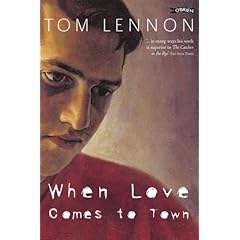
WHEN LOVE COMES TO TOWN by Tom Lennon – Book Review

13/12/2008 By David McFarlane Leave a Comment

Auth: Tom LENNON
Pub: The O’Brien PressWhen Love Comes to Town
The central figure (hero, if you like) of this story (When Love Comes To town)  is 17-year-old Neil Byrne. He is a sportsman and a good scholar. He is implicitly middle-class (his parents incessantly gripe about money, that’s how one knows). His response to the trauma of coming out, or being outed by circumstances, simply does not ring true.

Neil responds to an ad in what’s Hot Press, but aborts actual contact because the other man (the advertiser) is not as appealing as he claimed. Surely, an intelligent youth would have noticed ads for Tel-a-Friend, or articles on various Gay campaigns. He makes Sean intervene on a radio phone-in programme, but doesn’t hang around for the phone number (or numbers) which usually follow such broadcasts. 

There wouldn’t have been much of a story then, admittedly, but one got the distinct impression, reading this, that we were not dealing with the 1990s (it was first published in 1993) but with the 70s, even ’60s. Master Byrne is just going to experience certain emotions and prejudices, whether these ring true or not.

The other characters in ‘When Love Comes to Town’  are rather shadowy, and authorial prejudices show:- sissies (including married transvestites!) are sound; bisexuals-are abused as what people in Belfast called “bendy-tries. “. The blurb claims Neil is “a new type of hero” in Irish fiction, but there are stock characters. The Mother is loving, suffering and forgiving (but, naturally, uncomprehending). The Da’s a bastard – as are nearly all of the heterosexual men, Neil’s fellow students for example. The treatment of the women is a bit off-hand, even slightly misogynistic. Neil’s lover is a grumpy Belfast man called Shane who loves him and leaves him (but not before introducing him to the joys of classical music)!

Tom Lennon (it’s a nom-de-plume [de guerre?]) has his cake of a happy ending, while giving us the full tragic-suicide finale (this happens inside Neil’s head: he is a bit of a Drama-Queen on the quiet). It is a well-made, entertaining naturalist/realist novel. But one is left rather wishing for something a bit more substantial and a bit more real.

Not everything in this island is rosy for Gay people – young, old, women or men – but l7-year-olds knew in 1993 (and know today) that there iSean infrastructure, built by Gay people, of telephone helplines, campaigning and social groups, as well a sporting and religious ones, bookshops, bars, bistros, saunaSean safer-sex projects. There’s a social group in deepest Fermanagh! Since law reform in the Republic, GCN’s listings have grown to include six of the smaller towns.
All of this suggests a dramatic change, which is surely worth writing about.

[Sean McGOURAN]


Links:

  • Catflap – Book Review
  • Amazon – When Love Comes to Town

Filed Under: Book Reviews Tagged With: 1990s Ireland, authorial prejudices, Bisexuality, classical music, coming out, family dynamics, gay culture, gay fiction, Irish fiction, LGBTQ, love and loss, middle-class, Neil Byrne, queer literature, realistic portrayal, societal challenges, sportsman, teenage drama, tragedy, young adult literature

  • « Previous Page
  • 1
  • …
  • 15
  • 16
  • 17
  • 18
  • 19
  • Next Page »

Categories

Copyright ACOMSDave.com © 2026