ACOMSDave

Community Journalist

  • Home
  • Community Journalist
  • Events
  • Media Page and Press Kit
    • Projects and Work
  • Resources & Documents
    • LGBTQ+ Support Groups and Documents
  • NIGRA
  • Archives
  • Contact

How hard is it to come out as a gay sportsman / sportswomen / person?

28/01/2014 By David McFarlane Leave a Comment

With a small amount of research I have discovered that since 1900, one hundred and fourteen years in total, there have only been 24 (twenty-four) sports people in the British Isles who have been our or come out as gay.
Document:    Sports people who have come out in the British Isles
So why don’t sportsmen and sportswomen ‘come out’ if they are gay?  Of course there is no reason why someone has to announce they are gay, there is no law, no contract (indeed there may even be contracts preventing it); but, with so few sportsmen and sportswomen visible who are gay, then those growing up don’t have positive role models to aspire to.  It also enables the continuing stigmatisation of the LGBT community.
John Amaechi, the British basketballer said ‘…people have a misconception that time will automatically bring progress and that homophobia is in the decline … if you’re associated with a word that has so many pejorative connotations – ‘gay’ regularly used to mean bad, weak, wrong, sinful – it’s going to affect you’
History has shown that gay women in sports are more routinely accepted than men; but even they have been the target of bullying on and off the field, in society and in the media.
Gay men in sports are stigmatised more because being a sportsman means you are rough, tough and a ladiesman.  If you are gay you can’t be a great sportsman.
Secondly, all spo0rtsmen and sportswomen depend on sponsorship, and the sponsors have not necessarily bee supportive of equality and freedom for LGBT athletes.
 
As I referred to at the start of this article, there are 24 noted sportsmen and sportswomen:

  • 4 in the 1990s
  • 5 in the 2000s

And

  • 6 so far in the 2010s

Hopefully the tide is turning and society is more accepting, also the establishment which controls the laws and the purse strings of so much sponsorship.
What will be even more interesting is to watch and review the Winter Games in Sochi, Russia during and after the event in relationship to both the athletes who are LGBT and who go there and perform, and also for the local LGBT groups and individuals who are suffering persecution through the new laws and trumped charges and arrests.
Premier Putin’s homophobia has been shown up repeatedly, and the Mayor of Sochi (Anatoly Pakhomov) would seem to be equally homophobic ( or is he just securing his political position?) – his latest speech stating that there are no gays living in Sochi only further highlight’s Russia’s perilous states for LGBT people.

Filed Under: Anti-Bullying & Homophobia Tagged With: gay, homophobia, LGBT, Putin, Russia, Soichi, sportsman, sportsperson, sportswoman

Criminal Records – Should they haunt you for life?

27/01/2014 By David McFarlane Leave a Comment

On November 8th, last year (2013) the Belfast Telegraph ran an article from Bob Ashford on ‘Wipe the slate clean for minors’.

Does one mistake haunt you for life!


He ruminating on how one event, when he was 13, has prevented him from applying for the role of Police and Crime Commissioner for Avon and Somerset.  After 40 years working as a social worker, and becoming director of strategy at the Youth Justice Board, his one misdemeanor which resulted in a fine in 1966, has prevented him from taking up a role he is obviously eminently qualified for.
This article then led me to wonder what does a criminal record prevent you from doing?  In most formal circumstances, offenders are legally obliged to declare a conviction when asked, until it becomes “spent”: currently this takes seven years for sentences of up to six months and a decade for sentences of up to 2.5 years. Sentences longer than that are never spent. This may entail disclosing a conviction to employers, insurers, landlords, financial services providers, education institutions, visa and adoption agencies and others.
On top of this, employers can request a standard criminal record check—where convictions show up for life—for certain jobs within the health, financial, security and legal sectors. This also includes cautions, which are given without trial when the offender accepts responsibility for a minor offence such as writing graffiti. Jobs involving working with children or vulnerable adults require an enhanced criminal record check, which includes all convictions, cautions and any other information held by police forces that is considered “relevant,” including, potentially, crimes of which a person has been a victim and occasions when officers have visited an individual’s address.
In some cases, a criminal record is an absolute bar to an application. Those convicted of certain sexual offences are blocked completely from adopting, and some violent or sexual offenders are prevented from working with children and vulnerable adults—the government’s Disclosure and Barring Service operates a list of people banned from these positions. In other professions, regulatory bodies have their own rules, which means that anyone who has received a custodial or suspended sentence can generally not become a doctor, lawyer or accountant, among other things.
Even in unregulated professions finding work can be difficult with a conviction. Employers and others are legally entitled to discriminate against an applicant on the grounds of an unspent conviction, regardless of its relevance to the position.
The Poverty Site has given the following statistics:
 

  • 74,000 children aged 10 to 17 were found guilty of, or cautioned for, indictable offences in 2010.  Numbers have fallen sharply in each year since 2007, when the number was 126,000.  The net result is that the number in 2010 is lower than at any time since the data first became available in the mid-1990s.
  • Both the fall in the latest three years and the rises in the years immediately before that are largely accounted for by changes in the number of cautions, with the numbers found guilty having remained stable throughout.
  • Almost half of the 74,000 offences were committed by children aged 15 or under.
  • The peak rate for offending is at ages 17 to 20, with rates being much lower from age 21 onwards and below the age of 16.
  • Nearly half of all the offences committed in 2010 by children involved theft, with drug offences and violence against the person being the other two big groups.
  • Four times as many boys are found guilty of, or cautioned for, indictable offences as girls.  Among girls, theft is by far the most likely crime to be committed, accounting for two-thirds of all crimes committed by girls.  By contrast, although still the largest single category, theft accounts for just a third of the crimes committed is estimated that by boys.

KIds do wrong things, and often do not think of the consequences for future life.  That in itself is bad enough, but when a crime which is not a crime, i.e. you are gay and experiment about being gay,  has led to a criminal record why should it hang over you for the rest of your life?
In May 2012 The Protection of Freedoms Act received Royal Assent which will enable men to wipe the records of thousands of convictions for consensual gay sex under now-repealed laws,  It estimated that 16000 convictions could now be eligible for removal from police records.
Men may now apply to the Secretary of State to disregard convictions, however essentially in large part this Act does not seem to apply in Northern Ireland.  NIGRA has written to Department of Justice for clarification and will advise of their reply as soon as possible.

Filed Under: Anti-Bullying & Homophobia, History Tagged With: Act of Parliament, criminal records, reprieve

A Kiss To Far – Gay Kiss on Television

26/01/2014 By David McFarlane Leave a Comment

Colin and Barry. Their gay relationship was one of the more controversial storylines in 1987.


Rob McNeil wrote in the Belfast Telegraph of his hopes for Ulster’s future and made reference to the first interracial kiss on television between Captain James T Kirk and Lieutenant Uhura on November 22, 1968.  His  ( McNeil’s) dream encompassed a shared future, studying a space science qualification, which would help an evolving Ulster economy towards space ‘that final frontier’.
For out community, the first gay kiss on television occurred on East Enders in January 1989, twenty-one (21) years later.!
Today interracial kissing doesn’t get a mention or complaint, but two gay men kissing still results in complaints.  Darran Little, the write of the episode, has said that ‘no progress’ in peoples’ attitudes towards gay people has been made.  Approximately 10 years before this episode, a storyline in Coronation Street with Todd kissing Nick also resulted in complaints.
Society is not adjusting fast enough to the fact that the LGBT are real, honest, people who deserve to live the full active lives just as heterosexuals do!


Filed Under: Anti-Bullying & Homophobia Tagged With: coronation street, eastenders, gay kiss, interracial kiss, star trek

THE NUMBERS GAME

24/01/2014 By David McFarlane Leave a Comment

Edited out-take
Gay Star
Issue No. 16
Summer 1985
THE NUMBERS GAME
An article by Joseph Dalton
Since roughly the time of the Korean War (World War 21/2) in the late 1940s and early ’50s, the international Gay movement has drawn its inspiration and much of its intellectual armoury from the United States of America. This has entailed the use of a great deal of ‘scientific’ evidence to counter the old notion of homosexuality as a sinful, or ‘animal’ or diseased condition.
This was very wise on the part the movement in all of its manifestations from the courageous but inevitably ultra-closeted founding Mothers and Fathers (so to speak) of the Daughters of Bilitis and the Mattachine Society to the street-wise generation of Stonewall and beyond.  We appeared to be the rational, logical level-headed element in disputes with our opponents.  It justified the moral anger of the GLF (Gay Liberation Front).
Did we not rest our case on solid, scientific, empirical evidence?  Why were we waiting … for equality in law, at work, in housing?  Our arguments emboldened ourselves as individuals, and as a self-conscious factor in society, convinced or neutralised the general public, and embarrassed our opponents.  They were reduced to quoting irrelevant bits of an irrelevant Book, to smear tactics – or to silence.  Our arguments were based, in the main, on the Kinsey Report.
One In Twenty
This (‘Kinsey”) seemed to indicate that a very substantial proportion of the population was specifically homosexual.  This proportion was One in Twenty, to quote the title of Brian Magee’s condescending little volume published in 1966.  These figures have never been challenged and up until quite recently it would have been madness for Gay people to have done such questioning.  We were fighting for a place in the scheme of things.  We did not want to be thought mad, bad or dangerous to know.  Arguing about the niceties of Kinsey’s figures would have been grotesquely inappropriate.
But now the Gay movement has succeeded; this statement will be greeted with gasps of anger and astonishment; but it is undoubtedly accurate.  It may be many long years before we are fully integrated into society (and thereby change it beyond recognition) but the days of lobotomies, ice-baths and “aversion therapy”, to name some of the instruments used in “civilised” countries, are gone forever.
Classic Faults
So we can cast a cold eye on the Kinsey Report.  And note that there is a lot wrong with it.  It is, in many ways, a classic piece of American ‘social science’, with the classic faults.  These include the fact that the investigators did not go off-Campus – to test the general public.  Admittedly the general public would probably have been less forthcoming about their sexual preferences — especially if they had been out of kilter with those that were socially acceptable in the Truman (and McCarthy) years.
This means that the people surveyed by Kinsey and his assistants were, in effect, self-selected.  This alone skews the resulting figures in a number of ways.  Kinsey was known to be open-minded on sexual matters (this certainly was not the case with the majority of psychologists, psychiatrists or the medical profession in general).  Because of Kinsey’s ‘stance’ Gay people – lesbians, gay men, bisexuals and other sexual minorities were prepared to be more up-front with him, than with other investigators.  It left the investigators open to those who were not telling the truth — or were telling the investigators what they (the subjects) thought they wanted to hear.
Exaggeration
Commonsense and experience of the ‘political wing’ of the Gay movement, of the telephone helplines, the gay social groups and Centres – the ‘community’.  And of the pubs, clubs, discos, saunas – the ‘scene’, including the cottages where gay men, anyway, all meet on an equal basis, impelled the ‘the agony in the crotch’ tell us that he Kinsey figures are an exaggeration.
Homosexual people do not constitute anything even remotely like five per cent of the over-all population.  Half of that figure might be accurate and it is more than defensible to quote a figure of one per cent — or less. This figure covers homosex-ually-oriented people (largely men.  It seems accurate to say that there are fewer specifically homosexual women, possibly because in our culture women are allowed more leeway in expressing themselves physically, thus dispersing a build up of homoerotic feeling.  There has been lately the phenomenon of “political lesb-ianism”.  Women’s sexuality appears to be a more elastic thing than that of men) rather than Gay people.  GLF used “Gay” to mean anyone who was not 110% heterosexual.
One In One Hundred
This more reasonable figure gives a more realistic perspective on the position of Gay people in society.  It gives a more reasonable perspective on homosexual people as people.  If you think there are roughly three million homosexuals in the UK you must also believe that hundreds of thousands if not several million are utterly without backbone.  This is self-evidently inaccurate.  People have ‘come out’ with courage, fortitude and flair in the most difficult and painful circumstances.
Accepting that the true figure is something like six hundred thousand or fewer, spread over all age groups from early adolescence to extreme old age, it becomes obvious that most of these people have surfaced and are part of the Gay sub-culture.  This again, ranges from a yearly phone call to the local Switchboard to being … President of NIGRA  [the Northern Ireland Gay Right Association – upstart 2013].  We are, largely, aware of each other’s existence.
This assessment gives a more accurate picture of the burgeoning Gay comm-unity.  “Out” Gays are not the tip of an iceberg vanguard of a huge timorous majority, the “mere” ten thousand or so that turn out for Gay Pride marches in various parts of these islands are a substantial percentage of the overall gay population.
Creative
Instead of a ragbag of committed people all apparently going in different direct-ions, we are generally-speaking a disciplined sub-culture tending in one direction – towards genuine civil liberty and equality, and at a very fast pace.  Our apparent diffuseness irritates the tidy minded, nevertheless we are approaching emancipat-ion faster than the Catholics or the Jews did in the previous century, and faster than non-European immigrants at present.
The above may appear over-sanguine to the committed or the alienated.  It must be emphasised that building a community while exhausting is deeply satisfying.  Whether it is a few hours a week in a pub backroom that is achieved, or a full-scale Gay community centre.
The future for Gay people is bright, even if we suffer momentary setbacks.  We must be realistic, our effect on society at large, is predicated on our being in a morally strong position, where the largely indifferent majority are not prepared to oppress us, or stand over the oppression of an inoffensive minority.  And one were our enemies are reduced to living in a nostalgic dream world.  This is how the ’67 Act was achieved from ‘within the closet’.
Nobody today could listen to a Sir Cyril Osbourne clone claiming that there were no homosexuals in the House of Commons (even if a number had not come out) with a straight face.
Self-reliance
We will achieve legal equality and a rationalised age of consent, we can also achieve job protection and legal recognition and protection of longstanding relationships.  Where we may come a cropper, is demanding more out of society and / or the state than we are entitled to in terms of head count.  ‘Probable’ Gays can’t be counted as the ‘real thing’ just for the sake of bamboozling the rest of society.
Gay people have played a great part in sexualising our culture, but there’s little chance of homosexualising it.  Society will not even become ‘bi-sexual’ so much as omnisexual.  This will be the best of all settings for homosexual people and all other sexual minorities.  This will not come about by wishful thinking nor probably in a short period of time but by self-discipline and self-reliance, rising from the “bottom” to the “top”.  We are, happily, in a position where traditional notions of leaders and led simply will not function.
 
Further reading:

  • About.com – The Gay Population

Filed Under: Anti-Bullying & Homophobia, History Tagged With: kinsey, LGBT, numbers game, one in twenty

Picket outside church event on 'converting gays'

24/01/2014 By David McFarlane Leave a Comment

Gay Conversion therapy doesn't work

Gay Conversion therapy doesn’t work


On Saturday 18th January 2014, the Ballynahinch Baptist Church hosted the ‘Setting Love In Order’ conference organised by the Core Issues Trust.  The Trust was arguing for ‘freedom for gay people to approach psychiatrists and counsellors about their homosexuality’; this was a thinly disguised message about converting gays, or in other words ‘conversion therapy’.
 
One of the discussions was entitled: Don’t want to be gay any more?  Sorry we’re not allowed to help you! Is that ethical?’  This is a thinly disguised approach to gay conversion therapy, which Robert Spizer in 2001 was promoting, Spitzer renounced and retracted his own study in 2012, stating “I was quite wrong in the conclusions that I made from this study. The study does not provide evidence, really, that gays can change. And that’s quite an admission on my part.”.  He also apologized to the gay community for making unproven claims of the efficacy of reparative therapy, calling it his only professional regret. Spitzer has requested that all “ex-gay” therapy organizations such as NARTH, PFOX, American College of Pediatricians, and Focus on the Family stop citing his study as evidence for conversion therapy.
 
Pro-gay protestors outside the church were there to give the message that therapy has been discredited, it doesn’t work.  And also to give out a positive message that being LGBT is not wrong, it is not bad, and it is not broken so it doesn’t need ‘fixed’.
 
Further reading:

  1. Wikipedia-Conversion Therapy
  2. Belfast Telegraph – Protestors picket church event on ‘converting’ gays
  3. Belfast Telegraph – Row over ‘gay conversion’ conference to be held at church

Filed Under: Anti-Bullying & Homophobia Tagged With: Belfast, conversion therapy, converting gays, LGBT

Washington Post: Parents Pressure Gay Son To Change

13/01/2014 By David McFarlane Leave a Comment

“Readers of The Sun know and speak and write words like poof and poofter. What is good enough for them is good enough for us,” Sun editorial, May 1990.
 
Twenty-three plus years later, in the USA we have a parent who is rejecting her son because he is gay (see below).  IN July 2012 the BBC political reporter, Brian Wheeler, wrote an article entitled ‘Gay Politicians and the Tabloid Press’  which was a review of the book Sex, Lies and Politics: Gay Politicians in the Press, and also a commentary on whether the press has moved forward from its bigotry.

The conclusion is that we in Britain, and obviously in the USA, still have a long way to go in accepting and embracing all of the LGBT Society

By Amy Dickinson, Published: November 18

DEAR AMY: I recently discovered that my son, who is 17, is a homosexual. We are part of a church group and I fear that if people in that group find out they will make fun of me for having a gay child.
 
He won’t listen to reason, and he will not stop being gay. I feel as if he is doing this just to get back at me for forgetting his birthday for the past three years — I have a busy work schedule.
Please help him make the right choice in life by not being gay. He won’t listen to me, so maybe he will listen to you. — Feeling Betrayed
DEAR BETRAYED: You could teach your son an important lesson by changing your own sexuality to show him how easy it is. Try it for the next year or so: Stop being a heterosexual to demonstrate to your son that a person’s sexuality is a matter of choice — to be dictated by one’s parents, the parents’ church and social pressure.
I assume that my suggestion will evoke a reaction that your sexuality is at the core of who you are. The same is true for your son. He has a right to be accepted by his parents for being exactly who he is.
When you “forget” a child’s birthday, you are basically negating him as a person. It is as if you are saying that you have forgotten his presence in the world. How very sad for him.
Pressuring your son to change his sexuality is wrong. If you cannot learn to accept him as he is, it might be safest for him to live elsewhere.
A group that could help you and your family figure out how to navigate this is Pflag.org. This organization is founded for parents, families, friends and allies of LGBT people, and has helped countless families through this challenge. Please research and connect with a local chapter.


Further reading:

  • Gay Politicians and the Tabloid Press
  • Washing Post – Ask Amy


Filed Under: Anti-Bullying & Homophobia Tagged With: gay, gay son, politicians, prejudice, son

Tel Aviv's Gay Holocaust Victims Memorial Unveiled

12/01/2014 By David McFarlane Leave a Comment

By ARON HELLER 01/10/14 11:49 AM ET EST AP
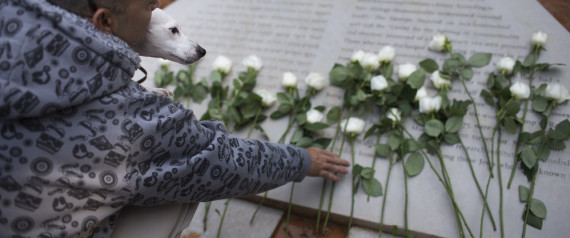
tel aviv gay holocaust memorial

TEL AVIV, Israel (AP) — Israel’s cultural and financial capital unveiled a memorial Friday honoring gays and lesbians persecuted by the Nazis, the first specific recognition in Israel for non-Jewish victims of the Holocaust.
Tucked away in a Tel Aviv park, a concrete, triangle-shaped plaque details the plight of lesbian, gay, bisexual and transgender people under Adolf Hitler’s Third Reich. It resembles the pink triangles Nazis forced gays to wear in concentration camps during World War II and states in English, Hebrew and German: “In memory of those persecuted by the Nazi regime for their sexual orientation and gender identity.”
The landmark joins similar memorials in Amsterdam, Berlin, San Francisco and Sydney dedicated to gay victims of the Holocaust. While Israel has scores of monuments for the genocide, the Tel Aviv memorial is the first that deals universally with Jewish and non-Jewish victims alike and highlights the Jewish state’s rise as one of the world’s most progressive countries for gay rights.
“I think in Israel today it is very important to show that a human being is a human being is a human being,” Mayor Ron Huldai said at the dedication ceremony, where a rainbow flag waved alongside Israel’s blue-and-white flag. “It shows that we are not only caring for ourselves but for everybody who suffered. These are our values — to see everyone as a human being.”
Israel was born out of the Holocaust and its 6 million Jewish victims remains seared in the country’s psyche. Israel holds an annual memorial day where sirens stop traffic across the nation, it sends soldiers and youth on trips to concentration camp sites and often cites the Holocaust as justification for an independent Jewish state so Jews will “never again” be defenseless.
But after 70 years, Tel Aviv councilman Eran Lev thought it was time to add a universal element to the commemoration. Lev is one of many gays elected to public office in Tel Aviv, a city with a vibrant gay scene that has emerged as a top international destination for gay tourism.
“The significance here is that we are recognizing that there were other victims of the Holocaust, not just Jews,” said Lev, who initiated the project during his brief term in office.
As part of their persecution of gays, the Nazis kept files on 100,000 people, mostly men. About 15,000 were sent to camps and at least half were killed. Other Nazi targets included communists, Slavs, gypsies and Jehovah’s Witnesses.
Unlike their persecution of Jews, however, there was no grand Nazi plan to exterminate gays. Nazis viewed being gay as a “public health problem” since those German men did not produce children, said Deborah Dwork, director of the Strassler Family Center for Holocaust and Genocide Studies at Clark University in Worcester, Mass.

“The idea was to change their behavior, not to eradicate them, not to murder them,” Dwork said.
The policy was far from sweeping — as evidenced by the rampant homosexuality among the ranks of the Nazi Party’s SA paramilitary wing, which helped pave Hitler’s path to power. The most famous gay Nazi was Ernst Röhm, one of the most powerful men in the party before Hitler had him executed in 1934.
Later, the Nazis outlawed homosexuality and the Gestapo set up a special unit targeting homosexuality. In the Buchenwald concentration camp, the Nazis carried out experiments to try and “cure” homosexuality. Those sent to the camps were forced to wear pink triangles, compared to the yellow stars that Jews bore on their clothing. Gay Jews wore an emblem that combined the two colors.
Today, Israel is one of the world’s most progressive countries in terms of gay rights. Gays serve openly in Israel’s military and parliament. The Supreme Court grants a variety of family rights such as inheritance and survivors’ benefits. Gays, lesbians and a transsexual are among the country’s most popular musicians and actors.
Moshe Zimmermann, a professor from the Hebrew University of Jerusalem and the memorial project’s historical adviser, said the Tel Aviv monument marked a big step in Israel by ridding itself from what he called a monopoly of victim hood.
“We are finally shedding the load of being the lone and ultimate victim,” he said. “We can learn from this that by recognizing the victimhood of others, it does not diminish the uniqueness of your own victim hood.”
 
Further reading:
 

  1. Original Article – Huffington Post
  2. BBC News Article
  3. BN&S Commentary
  4. The Gay Holocaust Lagers

Filed Under: Anti-Bullying & Homophobia, History Tagged With: Adolf Hitler, Anti-Gay Discrimination, civil rights, Gay Discrimination, Gay Holocaust Victims, gay rights, Gay Voices News, Genocide, Israel Gay Holocaust Monument, Nazi Germany, Tel Aviv, Tel Aviv Gay Holocaust Monument, The Holocaust

History Recalled – the Letter that OUT did not print about Peter Mandelson coming to Ulster

12/01/2014 By David McFarlane Leave a Comment

(Out-take from upstart November 2000)
 
HISTORY RECALLED  – The Letter That OUT did NOT print
 
OUT Letters
Prince Street Station
PO Box 630
New York NY 1001
 
Dear Editor,
 

‘MANDY’ MANDELSON & NORTHERN IRELAND

 
In your January 2000 edition (issue 74) you carried an item about Peter Mandelson — the former Cabinet Minister, and Tony Blair favourite — being given the job of Secretary of State for Northern Ireland.  It was strongly implied that we quaintly reactionary Ulster-folk would be horrified at having a ‘Sodomite’ sent amongst us, a notion gleaned from the self-consciously fashionable (and stupid) Gay publications produced in London.  A city which is 55 minutes away from Belfast by plane, but several light years psychologically – think Manhattan and Juneau.
The response to Mandelson in Northern Ireland has been pretty muted, apart from the odd mildly satirical article about his spending the Christmas holiday with his Brazilian ‘friend’, with a local television personality who is also famously (and rather futilely) closeted.  Gayness is simply not pass-remarkable in this part of the world anymore, partly due to the work of this organisation over nearly thirty years.
Other groups have of course played their part: the major one being Cara-Friend the befriending and welfare wing of the over-all Gay movement, which has helped tens of thousands of lesbians, gay men, bisexual, transsexual, transgender and transvestite people to come to terms with themselves, over the past quarter of a century. The Pride committees have also done a great deal to make the community come forward.  2000 will be Belfast’s Tenth LGBT Pride and all the stops will be pulled out to make it a memorable festival.
That might be difficult, because in 1999, Pride enjoyed talks from Bishop Pat Buckley on the ‘ethical’ aspect of being Gay, while Jeff Dudgeon (about whose struggle against the UK government at the European Court of Human Rights, BBC Radio 4 UK broadcast a dramatisation in November 1999) gave a workshop on Roger Casement’s wide and deep connections with Belfast.  There was a Civic Reception in City Hall addressed by the Deputy Mayor Ms Marie Moore, and a half-hour programme shown on prime time television.  There were many other events and workshops, a poetry -reading and an art exhibition among other things.
NIGRA since 1993 has organised solidarity actions with ILGO (the Irish Lesbian & Gay Organisation of New York) in its struggle against the bigotry of the AOHA (Ancient Order of Hibernians in America).

Yours faithfully,

Seán McGOURAN

Secretary,

NI Gay Rights Association

[The above letter was sent in January 2000, by ‘snail-mail’, we think.  The date ‘November 2000’ had to do with the erratic production of upstart, a private concern that depended on whether or not the people producing it were employed and in funds.]

Filed Under: Anti-Bullying & Homophobia Tagged With: history, London, OUT, peter mandelson, Ulster

Brave Tom Daley

06/01/2014 By David McFarlane Leave a Comment

On Dec 8 Donald MacLeod, a columnist in the Sunday Post,  made comment about Tom Daley and his decision to come out – and how brave he had been.
It was nice of him to congratulate Tom, but his other comments were to a degree not supportive. Tom, like many other young people in today’ society, has had to find his own route through the maze of sexual hangups that our society places in front of us. It shouldn’t be a shock, it shouldn’t even need commented on, but that fact that it has been shows how far society still needs to go to accept LGBT people
 

Well Done Tome


Well done Tom –
.

Filed Under: Anti-Bullying & Homophobia Tagged With: brave, coming out, sports, Tom Daley

USI PINK TRAINING – Gay Rights

29/11/2013 By David McFarlane Leave a Comment

USI PINK TRAINING
QUB Peter Froggatt centre
Friday 22 November 2013, 7pm
 
OPENING SPEECH BY JEFFREY DUDGEON MBE
My thanks go to the Union of Students in Ireland for inviting me to open their Pink Training Event tonight and to Laura Harmon (and Ben Archibald) for organising it.
Your numbers here tonight, in the hundreds, (c. 300) and your enthusiasm are seriously impressive.
Pink Training has been happening almost as long as Belfast Gay Pride which is quite something for the student world, where corporate memory is necessarily brief.
My student days in Dublin were gay enough but not in organisational terms. I was at the university of life, with too many evenings spent in the famous, indeed unequalled, Dublin gay bar, Bartley Dunne’s, in the late 1960s.
It was only after gay liberation that our anger and indeed rage was channelled into groups and meetings, by which time I was back living in Belfast. QUB was very much in the vanguard having hosted a Gay Liberation Society from about 1972. One of the founders was the theatre director Andy Hinds from Derry. It was a curious mixture of town and gown that worked. relationships were intense too.
Indeed GLS, by 1975, had a grant and offices in an unused building round the corner in 4 University Street. Best of all we organised and ran discos in the Queen’s Students Union which became famous in the worst of times in this city, for fun and dancing. We were so popular gays were in danger of being outnumbered by straights.
Then we knuckled down to thirty years of equality campaigning not least by means of my successful Strasbourg case, funded in part by those very same discos.
The Northern Ireland Gay Rights Association (NIGRA) was born, and Cara-Friend (CF), the befriending and information organisation. Both exist to this day.
Our twilight existence where we were getting funding and support – despite being criminals, indeed part of a conspiracy, came to an abrupt end in the great police round-up of 1976. All male NIGRA and CF committee members were arrested although none – after months of waiting – were ever charged.
The consequent case at the European Court of Human Rights in Strasbourg took six long grinding years before we won in 1981. A year later the government was forced to decriminalise in a law put through the House of Commons late at night against the wishes of all NI political parties (and shamefully even gay Unionist MPs I later discovered).
This was a European first and laid the groundwork for a host of later successes at the Court, not least in the south of Ireland where we eased the path for David Norris and for Alexander Modinos in Cyprus. And it was even quoted in the recent US Supreme Court Texas sodomy case.
My lawyer antagonists at the Court prospered. The UK’s lead barrister against me, in time, became the President of the Strasbourg Court, while Sir Brian Kerr was to become the NI Lord Chief Justice and now sits on the UK Supreme Court.
But we won. We beat them. A successful group effort in Belfast and beyond made the difference.
It remains unquestionable and remarkable – and maybe it tells you something – that the two best-known, and most written about, gay characters in the last 100 years were both Irish, and both went to jail, although only one to the scaffold.
Roger Casement, whose biography I have written, was brought up partly in Antrim, going to school in Ballymena. He became an Irish separatist and helped found and arm the Irish Volunteers (Óglaigh na hÉireann), the forerunner of the IRA, exactly a century ago. His landing of arms from Germany in 1916 led to a charge of treason and the death penalty exacted by an inevitably anti-gay government.
It matters that Casement was gay, not least because it is unlikely, otherwise, he would have been such a rebel. (I reprinted those diaries in my book, including the never-before-or-since published 1911 diary which is the most seriously sexual.)
One of the complaints of those argue that the Casement Black Diaries are forged – and there are still a number who say so – is that homosexuals are trying to turn Casement into a gay icon.
This assertion infers that gay men are, as a class, historically minded, which has more than a grain of truth. The notion however that Casement has a cult following like James Dean or Marilyn Monroe is laughable.
He is no gay icon, as he did not address the matter in his career but he lived the life extensively, wrote it up more so and that is interesting. He did however become something of a religious icon because of his saintly looks.
Up close, everyone is human so it is unwise to admire too much – Oscar Wilde, WH Auden, Christopher Isherwood, James Baldwin, Harvey Milk, Peter Tatchell might be or become gay icons. But they are, or were, like us all, flawed, and sometimes less than attractive.
My personal icon would be the 1950s law reformer and Ulster Unionist MP, Harford Montgomery Hyde. He was also author of The Other Love, a History of Homosexuality in Britain and Ireland, which is still a book to consult although overtaken, where Ireland is concerned, by Brian Lacey’s 2008 work Terrible Queer Creatures – Homosexuality in Irish History.
Montgomery Hyde did more for us than most, and paid the price in career terms by being deselected for his North Belfast seat in 1959. This was as a result of being the most prominent MP in the House of Commons pressing for decriminalisation.
One of his opponents then was a young preacher, Ian Paisley, who came to prominence as leader of the Save Ulster From Sodomy campaign in the 1970s. His sidekick was Peter Robinson now our First Minister. We had our work cut out dealing with their disturbing and at times intimidating and extensive operation.
Being anti-gay or trying to keep us criminal rarely blighted political and legal careers. But we won. They didn’t. It is they who have changed, if grudgingly.
One becomes history after two generations, even if still alive. I know. I am just that. History.
But I still have a life in politics to a large degree, and to a smaller degree now in gay matters particularly in relation to policing and law reform. Others, in a range of organisations, do the bulk of the work.
We have continued to achieve significant victories around equality. One example is the election to councils of the first out lesbians and gays. These are people selected as candidates by their parties in full knowledge of their sexuality and then voted in by the electorate.
And one of those councillors, Andrew Muir, is currently the Mayor of North Down. He is from the Alliance Party, interestingly elected in part by his DUP colleagues.
And unnoticed, indeed unremarked, a gay member of the Ulster Unionist Party is one of its two representatives at the talks chaired by Dr Richard Haass and Professor Meghan O’Sullivan of the New York Council on Foreign Relations.
I – for it is me – have just come from two meetings and four hours with the American pair, tasked to try and find a way forward, with the five executive political parties, on the dividing issues of Flags, Parades and The Past. Hence my photo-opportunity suit and imperial purple tie.
To be an active Unionist does not mean you are an ex-gay, something some seem to believe.
Finally, coming up to date on campaigning, what are the current issues being addressed by local activists?
In truth, we are heading towards becoming a protected species and need fear little or no hostility from officialdom. This may not hold for ever, I would caution.
However the perennial issue of violence against LGBT people remains, as can be seen from the recent trial of the murderers of Andrew Lorimer in Lurgan and of Shaun Fitzpatrick in Dungannon. In Andrew’s case the sentences were pitiful and it is to be hoped that they are reviewed by the PPS. Indeed it would be of assistance if you were to consider writing to Barra McGrory (the head of the Public Prosecution Service) accordingly.
The fact remains that über-violence is meted out in these horrendous attacks. That will take decades to reduce as it involves one of the baser instincts in many males – fear of women. And of homosexuals – homophobia in the strictest sense of the word against gay men and lesbians. And Transphobia especially so, a greater treason, as can be seen from their casualty count world-wide.
Otherwise gay or equal marriage, the blood donation ban and changing of the adoption laws are the issues of today.
Each of these reforms can and will be advanced in the courts. Our local Assembly for complicated reasons can’t or won’t do the needful. It came into being and is, to a degree, supported by those who want to avoid changing such laws.
So be it. We can get round them but it is producing the same anger and rage as we felt in the 1970s. And the same productive resistance.
So far the Minster of Health has lost cases on adoption and blood donation. How he proceeds, if he does at all, remains a matter of concern.
Gay marriage which will soon be uniquely absent in these islands is a harder nut to crack. Reform will be a matter of trench warfare in the local courts while ultimate victory, in a successful Strasbourg case, may be a decade away.
So welcome to Belfast. Do enjoy your days and nights here, and the pleasures of the city, take care in relation to illegal pills being peddled which have caused ten deaths here in recent months, and thank you for your kind reception.
To conclude, I open this USI weekend of Pink Training.
 
Jeff Dudgeon (NIGRA Treasurer)

Filed Under: Anti-Bullying & Homophobia Tagged With: gay rights, Jeff Dudgeon, NIGRA, Northern Ireland Gay Rights Association, Pink Training, USI

  • « Previous Page
  • 1
  • …
  • 65
  • 66
  • 67
  • 68
  • 69
  • …
  • 72
  • Next Page »

Categories

Copyright ACOMSDave.com © 2026