
ACOMSDave

Community Journalist

  • Home
  • Community Journalist
  • Events
  • Media Page and Press Kit
    • Projects and Work
  • Resources & Documents
    • LGBTQ+ Support Groups and Documents
  • NIGRA
  • Archives
  • Contact

Padraig Reidy: The “gay cake” case bedevils Northern Ireland

04/04/2015 By David McFarlane Leave a Comment

Editorial:  We have already reported that this case is currently in court and awaiting judgement; however the reason why I have picked this article up is because members of the Free Presbyterian Church decided to protest outside  Windsor Park before the Finland in a European Championship qualifier which was to be played for the first time on a Sunday.  

As I have stated before, I believe that everyone has a right to hold a ‘peaceful’ protest, however what is disheartening is when you also read that Conservative faith leaders have made religious liberty a rallying cry as gay marriage has spread throughout the states.  

It would appear that religious freedom must be granted no matter whose freedom gets trampled in the meantime.

Please let us know your thoughts?

Gay Cake Controversy

Religious right wants to constrict your freedom


By Padraig Reidy / 2 April, 2015
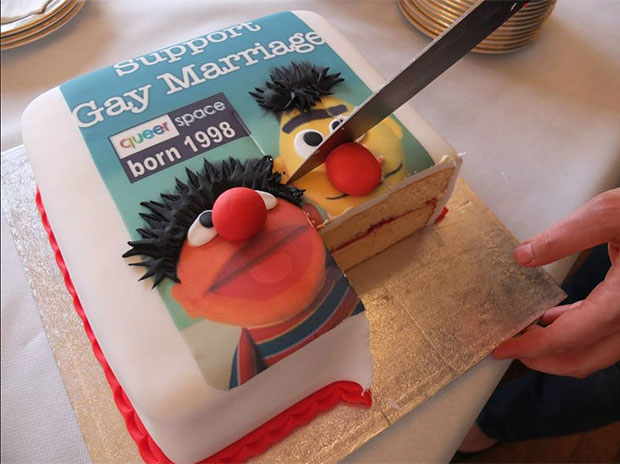
QueerSpace Belfast / Facebook
Last Sunday, as Northern Ireland’s footballers prepared to play Finland in a European Championship qualifier, protesters gathered outside Windsor Park, the team’s Belfast home.
The assembled were members of the Free Presbyterian Church. They were angered by the fact that Northern Ireland were playing on a Sunday  – the Sabbath  – for the first time ever.
Reverend Raymond Robinson told the Press Association: “Our opposition is to the breaking of observance of the Lord’s day.
“We believe in the Sabbath being kept holy. It seems more and more that the football agenda is being driven by the television companies and not what God says, or what public opinion is.”
Commentator Newton Emerson was, like many, blase about the protest, tweeting “I think these people are harmless enough now to just count towards our wonderful diversity.”
Be that as it may, Christian fundamentalism still plays a huge role in public life in Northern Ireland. While the old demands for Biblical propriety may seem archaic, a new struggle has emerged over what many religious people in the country see as threats to their religious freedom and way of life. And a cake has become the latest flashpoint.
Asher’s bakery is a business run by a family known for its Christian beliefs. It is named after one of the Biblical Twelve Tribes of Israel. Last summer, the bakery was asked to provide a cake by Gareth Lee, a volunteer for LGBT group QueerSpace.
Lee had requested a cake decorated with a picture of Sesame Street’s Bert and Ernie and the slogan “Support Gay Marriage”.
The bakery initially accepted the order, before then informing Lee that it could not fulfil the deal. The case went to Northern Ireland’s Equality Commission, and, between the jigs and reels, is now in the hands of district judge Isobel Brownie, who will rule on Monday whether the Christian bakers engaged in unlawful discrimination by not delivering the pro-same sex marriage cake.
Meanwhile, the “gay cake” case has raised the spectre of a “conscience clause” in equality legislation in Northern Ireland.
The whole situation is, quite frankly, pitiful. One can preach it, validly, both ways: fundamentalist bigots out of touch with the modern world, and inflicting their bigotry on others, or God-fearing, humble folk sticking by their beliefs in the face of an onslaught they didn’t invite.
I can’t help feel sympathetic towards the McArthurs, the family who own the bakery. Karen McArthur told the court that she had initially accepted the order to avoid embarrassment. Colin McArthur said “On that day I didn’t make a clinical decision. I was examining my heart. I was wrestling it over in my heart and in my mind.” He was, apparently, “deeply troubled”. “We discussed how we could stand before God and bake a cake like this promoting a case like this…”
On the other hand, Gareth Lee said he was left feeling like a lesser person after he was told his order would not be fulfilled.
This shouldn’t be down to who was more upset or offended, but then, on what criteria can we judge it? I don’t think it’s necessarily true to say that Lee is entitled to have any message he wants put on any cake by any person. The prosecution, correctly, pointed out that the message was rejected because of the word “gay”. The defence lawyers suggested that a ruling against the McArthurs could lead to a situation where devout Muslims were legally obliged to decorate cakes with images of Muhammad. While “you wouldn’t say that about the Muslims” is a tedious argument, and one deployed increasingly often by Christians, it’s not, in this case, an entirely unreasonable position.
Hardline Christians see homosexuality as a (wrong) choice people make, or a psychological disorder. I recall watching the Reverend Willie McRea, an MP, once, being asked what support he would offer to a constituent who was a victim of homophobia. McRea replied that he would advise the young man not go down that route: basically, the best way to prevent homophobia is to stop being gay.
Meanwhile, Iris Robinson, wife of Democratic Unionist Party leader Peter Robinson, firmly believes that one can be counselled away from homosexuality.
These people are odd, certainly, but they are not fringe characters who can be dismissed as irrelevant to mainstream society in Northern Ireland.
And even if these views were not mainstream, that would not make the fundamentals of the case any different. But it does seem as if the Equality Commission is trying to drag a segment of Northern Irish society kicking and screaming into the secular world.
So who’s right? Who should win? Reader, I am about to break the columnist’s solemn covenant and admit: I don’t fully know. This is not as clear cut a case of discrimination as, say, barring a gay couple from a Bed and Breakfast: if the McArthurs had simply refused to sell a cake to Lee, that would be clear cut. But the cake was loaded, so to speak. Should this tricky case lead to a “conscience clause” in equality legislation, then one can imagine legitimisation of genuinely discriminatory practices.
At the same time, the McArthurs, are wrong, and one’s initial inclination is to side with the gay rights activist against the religious fundamentalists. But that’s the problem with defending freedom of conscience, (and its expression in freedom of speech). Everyone’s conscience is different.
Northern Ireland beat Finland 2-1, by the way. God’s clearly not very troubled by Sunday football.
This column was posted at indexoncensorship.org on April 2, 2015
 
Further reading:

  • Religious freedom fight over gay marriage will persist

  • Girls’ Brigade taught homosexuality is a sin – equal to murder, stealing and adultery

Filed Under: Anti-Bullying & Homophobia Tagged With: Ashers bakery, Free Presbyterian Church, gay cake, Girls' Brigade, homosexuality, LGBT rights, personal freedom, religious freedom

Dublin priest comes out as gay at church, receives standing ovation

31/03/2015 By David McFarlane Leave a Comment

 Reprinted from GayStar News: http://www.gaystarnews.com/article/dublin-priest-comes-out-gay-church-receives-standing-ovation090115
Now that’s something worth praising
09 JANUARY 2015 | BY JOE MORGAN
Father Martin Dolan came out to his parish at Mass.

Photo via Twitter.
A Dublin priest decided to risk everything by choosing to come out in front of his congregation in order to fight for same-sex marriage.
But it was worth taking, for he received a standing ovation from his parishioners.
Father Martin Dolan, a priest at Church of St Nicholas of Myra in Dublin’s city center, led Mass last weekend by calling on his flock to support same-sex marriage in the upcoming Irish referendum.
‘I’m gay myself,’ he revealed.
At first there was a smattering of applause, and then his ‘proud’ parishioners stood up to clap at the bravery of his statement.
Liz O’Connor, a community youth worker, told the Irish Sun: ‘We are all very proud of Martin. Because he has admitted that he is gay doesn’t change the person that he was before he said it.’
But not everyone was pleased by Dolan’s coming out, with some suggesting he should be fired or moved from the church he has been at for 15 years.
‘I wouldn’t like to see him being moved for the statement he made. That would be horrendous,’ O’Connor added.
‘He should be supported. He has done nothing wrong. If he’s moved, there would be uproar in this parish. He’s still the same man today.
‘Martin has always been an advocate of people’s rights, and even spoke about the child abuse in the Church.
‘There’s not many [priests] that would come out because they’re afraid of the bishops and that, but Martin is his own man. That’s what he believes in.’
The Dublin Archdiocese declined to comment until they had spoken directly to Dolan.
In the polls leading up to May’s referendum, they show over 70% of Irish people support gay marriage.

– See more at: http://www.gaystarnews.com/article/dublin-priest-comes-out-gay-church-receives-standing-ovation090115#sthash.jrCtGKsF.dpuf

Filed Under: Anti-Bullying & Homophobia Tagged With: church, gay, priest

Crack Down On Camps

30/03/2015 By David McFarlane Leave a Comment

Editorial:  In the past we have written and republished articles about movements who state that they can change your homosexual tendencies.  Indeed the current First Minister’s had said that “homosexuality was an abomination and that gay people could be turned around “with help”, and offering to recommend homosexuals to psychiatric counselling with Dr. Paul Miller, who is still practising today in Holywood.

The reason I raise this again, is because the ‘Controversial Cake’ case is going through the courts, and in Stormont  the DUP propose a change in the law, which would provide for a “conscience clause” in equality legislation, effectively giving businesses the right to refuse service based on religious grounds.

So why should I highlight this now; well it is because of the following article on camps were ‘troubled’ LGBTI youths are sent by parents.  Could this happen in Northern Ireland, well unless we are very careful it could.  What do you think?


Reprinted from Gay Star News:Effort launched to crack down on camps where ‘troubled’ LGBTI kids are sent by parents

Says one survivor: ‘They blanketed their abusive practices under the guise of Christianity’
28 MARCH 2015 | BY GREG HERNANDEZ
David_Wernsman

Thousands of youth have been abused and hundreds have died while in residential programs that claim to help ‘troubled’ youth, including those who are lesbian, gay, bisexual or transgender.
The Los Angeles LGBT Center announced at a news conference Friday that it has joined forces with Survivors of Institutional Abuse (SIA) to launch a national campaign to regulate these programs on a federal level.
David Garcia, the center’s director of public policy, points out that neighborhood nail salons are more regulated than the industry of residential schools, camps and wilderness programs that are entrusted with the lives of these LGBT kids and other youth.
‘We’ve heard from survivors forced to endure torture techniques that include food and water deprivation, physical abuse, and electric shocks,’ Garcia said. ‘We’ve also spoken to devastated parents whose children died in these programs.’
David Wernsman (pictured above), a young gay survivor of a program for so-called ‘troubled teens,’ had his story of abuse told in the 2014 documentary Kidnapped for Christ and was present at the news conference where he shared some of the harrowing details of his ordeal.
‘When I was 17, two large men woke me up before dawn, tied a belt around my waist and forced me out of my home,’ Wernsman recalled.
‘I was taken to a dumping ground – guarded by men with guns – for kids whose families didn’t know how to solve their child’s issue. In my case, it was the fact that I’m gay. The program was an endless nightmare of torture including public beatings and humiliation, hard labor, and sometimes solitary confinement in a windowless cell where we relieved ourselves in a bucket. They blanketed their abusive practices under the guise of Christianity.’

Garcia and Wernsman were joined at the news conference by SIA Executive Director Jodi Hobbs and California State Senator Ricardo Lara who announced the introduction of his Protecting Youth from Institutional Abuse Act (SB 524).
The bill is co-sponsored by the LA LGBT Center and SIA to regulate the troubled teen industry and calls for no exemption for religious-based groups.
‘Tragically many young people have experienced horrendous abuse, neglect, and even death at some unregulated youth facilities,’ said Lara.
He explained that the bill would define private alternative youth treatment and education institutions and require them to obtain a license from the Department of Social Services and ensure youth’s rights are protected.
SIA reports the deaths of more than 300 people who are linked to these programs.
Since it is common for these programs to re-open in another state under a different name after they are forced to close, federal legislation is considered essential.
US Congressman Adam Schiff, a staunch LGBT ally, is working to introduce legislation that will hold all residential treatment programs accountable for instances of child abuse.
‘The measure will also increase the transparency of these programs so that parents can make informed and safer choices for their children,’ he stated. ‘Families that turn to these treatment programs for help, often as a last resort, must know that their children are safe and in the care of professionals.
‘We cannot ignore reports that far too many young people have died and suffered abuse at the hands of those who run and work at residential treatment programs under the guise of providing critical therapy and rehabilitation services.
The LA LGBT Center has launched the website www.PYIA.org to share information about its “Protect Youth from Institutional Abuse” campaign with an online petition to members of the US Congress and the California legislature.


Filed Under: Anti-Bullying & Homophobia Tagged With: cake controversy, camps for change, Dr Paul Miller, iris robinson, LGBTI, peter robinson

Mirror Website: Majority back gay marriage laws

29/03/2015 By David McFarlane Leave a Comment

Majority back gay marriage laws – except for those who support UKIP

  • 23:18, 28 March 2015
  • By Nigel Nelson
The latest People’s Panel poll in the lead-up to the General Election reveals that a majority of all other party supporters backed the change in the lawSix in ten Sunday People readers back the change in the law allowing gay and lesbian couples to marry

Cameron vindicated: Majority back the change in the law allowing gay and lesbian couples to marry

Six in ten Sunday People readers back the change in the law ­allowing gay and lesbian couples to marry.
The latest results from the People’s Panel, which is letting you have your say on key issues every week in the run-up to the May 7 polls , also reveal 33% of you strongly support the move.
It was most popular among ­women with 69% in favour ­compared with 50% of men.
UKIP voters were alone among the major parties in having more readers opposing the change than backing it – a vindication for David Cameron, who stuck his neck out to give same-sex couples the same rights as heterosexual ones.

People's Panel. Pictured - To what extend do you support or oppose the law change allowing gay and lesbian couples to marry?
People’s Panel. Pictured – To what extend do you support or oppose the law change allowing gay and lesbian couples to marry?

One reader said: “There are more important things for the Government to deal with than gay and lesbian marriages.”
Another added: “Everyone should have a chance of happiness.”
As the People’s Panel focused on equality this week, it also emerged that more than three in five readers believe 16 should ­remain the age of consent – ­although 14% said it should be raised to 18, as in Turkey.

People's Panel. Pictured - What should the UK age for consent for sex be?
People’s Panel. Pictured – What should the UK age for consent for sex be?

More than six in ten want to keep the voting age at 18 and only 7% thought it should be lowered to 17, and 1% to 15. Some 18% favour 16, as ­proposed by Ed Miliband.
The Labour leader was ­persuaded to press for a change by the high turnout of 16-year-olds in last year’s Scottish referendum.

38 days 22 hours 27 minutes 37 seconds

He felt that having been given the right to vote once, 16 and 17-year-olds should not be denied it in future. The voting age was lowered to 16 for local elections in the Isle of Man, and Channel Islands Jersey and Guernsey.
In the US, 19 states allow 17-year-olds to vote in primary elections as long as they will be 18 on polling day.
In Japan the voting age is 20 and in Italy it is 25 for Senate elections.

People's Panel. Pictured - What should be the minimum voting age for general elections?
People’s Panel. Pictured – What should be the minimum voting age for general elections?

More than half of the People’s Panel did not feel governments have gone far enough in closing the gender pay gap. That rose to 65% among women voters.
A third of the 18-54 group, ­compared with 15% of the 55-plus, felt changes needed to bring about equality have been made.
One reader told us: “Women should be paid the same as men – but nurses should be paid more.”
Regarding childcare provision, only one in ten thought it should fall to mothers alone
Nearly one in three felt it should be shared equally with nine per cent more men holding that view than women. But more than half said divvying up childcare should depend on the circumstances of the parents..

People's Panel. Pictured - How should childcare be divvied up between fathers and mothers?
People’s Panel. Pictured – How should childcare be divvied up between fathers and mothers?
Equality polls. Pictured - Have governments done enough in the past 10 years to secure genre pay equality

Filed Under: Anti-Bullying & Homophobia Tagged With: age of consent, age to vote, child care, Elections, gay marriage, gender pay equality, LGBT

Pratt and Smith – The last men hanged for sodomy 

28/03/2015 By David McFarlane Leave a Comment

Father Frank Ryan casts new doubt on the 1835 convictions

 
The wrongful conviction and execution of James Pratt and John Smith for ‘buggery’ in 1835
by Father Frank Ryan

The last Saturday of August 1835 was a beautiful hot day. James Pratt (30) left his wife and two young daughters in Deptford, searching for work – promising to return by 6pm. He was a labourer and needed a better job.
Pratt first visited his aunt in Holborn, before heading to Blackfriars. His aunt thought he’d had too much to drink and needed a rest, but he pressed on. In an ale house he met John Smith, a labourer aged 40, and William Bonill (sometimes spelled Bonell), aged 68. Neither could offer him a job to improve his financial situation but their company was hospitable. Bonill invited Pratt and Smith back to his rented flat and they accepted.
Little did they know as they made their way to his premises in nearby George Street, that this encounter would result in their execution – and that Bonill would be  banished to the penal colony of Australia –  all within a mere three months.
The landlords of 45 George Street, Southwark, Jane and George (also known as John) Berkshire, were determined to curtail the activities of their tenant, William Bonill, who they regarded as an “old villain.” He had been bringing male “couples” back to his flat on a regular basis; sometimes two a day. George was determined to put a stop to this practice and get rid of what he regarded as a disagreeable and troublesome lodger.
Shortly after the three men arrived, the suspicious, antagonistic George spied into Bonill’s room through a nearby window. A little later, over tea, he told his wife that he saw Pratt sitting on Bonill’s knees and then on Smith’s. There was much laughing and conversation, he said. Jane slipped upstairs and peeped through Bonhill’s keyhole. After a brief look, she returned to tell her husband that she had witnessed sexual acts. He became enraged, went upstairs and also looked through the keyhole. He then burst into the room to confront Pratt and Smith, who were in a compromising position, according to George Berkshire.
At this point, Bonill, who had gone out for a drink, returned and entered the room. An effort to calm down Berkshire was unsuccessful. George went off to seek the police.
Pratt, Smith and Bonill were soon arrested and taken into custody. Pratt and Smith were charged with ‘buggery’ (anal sex) and Bonill as an accessory. They went on trial for their lives before Judge Baron Gurney at the Old Bailey on 21 September 1835.
The arresting police officer had no material evidence to support the charge. The account that Jane Berkshire told the jury is improbable. She said she watched for less minute but claimed to have witnessed the alleged sex acts, from the men undressing to laying on the floor and the “appearance” of anal penetration. She said she saw the men’s private parts but did not answer when asked whether either man had an erection. It seems doubtful that the keyhole could have provided the range of vision needed to see what she claimed.
The testimony of George was very similar to Jane’s. It had a whiff of coordination. His evidence supported the charge that buggery had taken place. However, he failed to testify if the men had an erection or if he had seen actual penetration; though he claimed to have sighted their genitals and their bodies in motion.
The anatomical description of intimacy described by George Berkshire would have been very difficult to witness. As in the case with Jane’s testimony, the keyhole probably could not have provided a sufficient angle of sight to provide the evidence he imparted to the jury.
Neither James Pratt nor John Smith were allowed to give evidence at their trial. Both pleaded “not guilty” to the charge. Nevertheless, the jury returned a guilty verdict.
The law against ‘buggery’ (not repealed until 2003) was based on an interpretation of the Bible that regarded homosexual acts as an abomination and worthy of death; a particularly evil sin that must be severely punished and eradicated. It was a capital crime.
The judge had no hesitation in sentencing James Pratt and John Smith to death. He warned them their chances on appeal were hopeless and they could expect no reprieve. They had to prepare, he said, to receive God’s judgement upon departing this life. Both men left the dock in tears.
William Bonill was sentenced to 14 years transportation to Australia. He died in Tasmania in 1841.
As well as Pratt and Smith, there were many death sentences for different crimes handed down during the autumn 1835. The process of petitioning for clemency and commutation began.
While being held in Newgate Prison, Pratt and Smith were visited by Charles Dickens who wrote they “had nothing to expect from the mercy of the crown, their doom was sealed.” The turnkey whispered to Dickens that they were “dead men.”
John Smith, it seems, had no friends. But the friends of James Pratt commenced a vigorous campaign to save him. They gathered a substantial petition which included the trial prosecutor, former employers, neighbours and even George and Jane Berkshire, their accusers.
All the documents were prepared for a Privy Council meeting with the King, William IV, to be held in Brighton.
On 24 November, 12 men sentenced to death were reprieved by the King’s mercy. Pratt and Smith were not among them. Judge Baron Gurney’s warning had prevailed.  In their case, the law was to be allowed to take its course.
News of the pending execution spread around London, confirmed by the erection of the scaffold outside Newgate Prison.
On Friday 27 November, the two prisoners were taken from their cells and brought to the place of execution, still protesting their innocence. Pratt was weak and had to be helped up the scaffold. The crowd began to hiss, possibly in disagreement with the execution. These were probably the last sounds the men heard. The hangman pulled the bolt and after a short struggle on the rope Pratt and Smith were dead.
They are buried in a common grave, with others executed at Newgate, in the City Cemetery, Manor Park, London E12.
In 2014, I petitioned the Secretary of State for Justice, Chris Grayling MP, to grant a posthumous pardon to James Pratt and John Smith on the grounds that even by the standards of those days their convictions were unsafe. Further, the ‘buggery’ law itself was unjust. Consenting adult homosexuality should have not been a crime.
In reply, the Justice Ministry regretted the men’s execution, acknowledging that it should never have happened, but said the conditions for granting a pardon had not been met. However, since the pardoning of Alan Turing for same-sex relations has established a legal precedent, hopefully the Justice Minister will, with further pressure, re-examine the case and grant a long overdue pardon to Pratt and Smith.
The full story of Pratt and Smith is retold in the book, ‘The law to take its course – Redeeming the past, securing our  future’. It is available as a self- printed manuscript from the author, Father Frank Ryan, for the cost of printing (about £14): fmryan33@hotmail.com
The book and this article are based on Ryan’s original research at the National Archives, British Library and London Metropolitan Archives, plus newspapers reports.
This article was written by Frank Ryan, with the assistance of Peter Tatchell.

Further information:

  • Rictor Norton (Ed.), Homosexuality in Eighteenth-Century England: A Sourcebook. Updated 28 March 2015
  • Trial at the Old Baily –  Full Transcript
  • Website Executed Today – 1835: John Smith and James Pratt, the last hanged for sodomy in Great Britain

Filed Under: Anti-Bullying & Homophobia, History Tagged With: British History, James Pratt, John Smith, Judge Baron Gurney, lgbt history, Old Bailey, Sodomny

In 'Time' Video, Steve Grand Cozies Up To Model Daniel Williams, But It's Far From A Perfect Love

28/03/2015 By David McFarlane Leave a Comment

The Huffington Post  |  By Curtis M. Wong
Posted: 03/27/2015 2:17 pm EDT Updated: 03/27/2015 2:59 pm EDT

 
Singer-songwriter Steve Grand finds — and loses — love in snowy Chicago in his latest video, “Time.”
The out star, 25, gets cozy with hunky model Daniel Williams in the clip for the piano-driven pop ballad, which is a cut from his debut album, “All-American Boy,” released March 23.
The video explores the entire course of a relationship — from the couple’s first meeting on an empty train station platform to a fiery breakup, with a playful snowball fight in between — in just over five minutes. Still, there’s a surprise twist at the end.
“My lyric style is definitely very story-driven,” Grand, who has cited Billy Joel, Lady Gaga and Bruce Springsteen as musical influences, told HuffPost Live earlier this year. “I try to tell stories from my life, whether it’s one single moment in time or something that’s been recurring in my life.”
The album, he said, “is an arc, and every song is a plot point on that arc.”

Filed Under: Anti-Bullying & Homophobia Tagged With: daniel williams, gay love, love, railway station, steve grand, time

In ‘Time’ Video, Steve Grand Cozies Up To Model Daniel Williams, But It’s Far From A Perfect Love

28/03/2015 By ACOMSDave Leave a Comment

The Huffington Post  |  By Curtis M. Wong
Posted: 03/27/2015 2:17 pm EDT Updated: 03/27/2015 2:59 pm EDT

 
Singer-songwriter Steve Grand finds — and loses — love in snowy Chicago in his latest video, “Time.”
The out star, 25, gets cozy with hunky model Daniel Williams in the clip for the piano-driven pop ballad, which is a cut from his debut album, “All-American Boy,” released March 23.
The video explores the entire course of a relationship — from the couple’s first meeting on an empty train station platform to a fiery breakup, with a playful snowball fight in between — in just over five minutes. Still, there’s a surprise twist at the end.
“My lyric style is definitely very story-driven,” Grand, who has cited Billy Joel, Lady Gaga and Bruce Springsteen as musical influences, told HuffPost Live earlier this year. “I try to tell stories from my life, whether it’s one single moment in time or something that’s been recurring in my life.”
The album, he said, “is an arc, and every song is a plot point on that arc.”

Filed Under: Anti-Bullying & Homophobia Tagged With: daniel williams, gay love, love, railway station, steve grand, time

My boyfriend killed himself because his family couldn’t accept that he was gay

25/03/2015 By David McFarlane Leave a Comment

Nazim Mahmood jumped to his death from a balcony seven months ago after coming out to his parents. His partner of 13 years, Matthew Ogston, talks to Sarfraz Manzoor
Matthew Ogston Nazeem Mahmood
Nazim Mahmood and Matthew Ogston in Iceland in 2008.
Sarfraz Manzoor
Saturday 21 March 2015 05.59 GMT Last modified on Monday 23 March 2015 15.32 GMT
In the spring of last year, Matthew Ogston and Nazim Mahmood moved into their dream home. The apartment, on the top floor of a mansion block in north-west London, offered stunning panoramic views of London. Nazim was a doctor who ran three London clinics, Matthew a web designer.
The life Nazim enjoyed seemed a world away from the working-class traditional Muslim community in which he had been raised. It was that world – conservative and closed – that he had left behind for a new life. In their first week in the flat, the two men stood on the balcony as London glittered in front of them. Matthew looked at Nazim and said, “Darling, I think we’ve finally made it.” They both smiled. Four months later, Nazim jumped off the edge of that same balcony to his death. He was 34.
Nazim was 21 when he met Matthew in November 2001. Matthew was at a gay nightclub in Birmingham, when Nazim approached with the words, “Excuse me, may I sit here?” Something about Nazim’s shy demeanour appealed to Matthew. They started talking. “There was an instant connection,” he recalls.
We are in the living room of the apartment. It is more than seven months since Nazim’s death but the condolence cards are still on display. This is the first time Matthew has agreed to talk openly, and during the hours we talk, words tumble and tears flow. It was only minutes after first meeting him that Nazim had said to Matthew: “I’m a Muslim, is that going to be a problem?”
Matthew Ogston
Matthew Ogston Facebook Twitter Pinterest
Matthew and Nazim with their dog Charlie in 2007.
The two were soon inseparable. Matthew was working as a web designer and Nazim was a medical student. Their families did not know they were gay. After a year they bought a house. It had two bedrooms so their families might assume they were just housemates. “We used to have to keep the window blinds in our front room closed so no one would see us,” says Matthew. “When we walked down the street we made sure there was some distance between us just in case a family member of his spotted us together.”
They grew tired of looking over their shoulders and wanted to stop hiding, so when Nazim was offered a job at a London hospital in 2004 they seized the opportunity to move to the capital. They would be far from their families, in a city where they knew no one and could fashion a new life together. “In London we felt free,” Matthew says. “We didn’t have to worry about bumping into our parents.”
They made friends and created a social world that reflected the people they were. Of necessity, this new life was founded on sadness and deceptions. Nazim was leading a double life: his family had barely met Matthew and thought he was merely an investor in their son’s flat. On the rare occasions they visited London, Matthew had to spend the night in a bed and breakfast. “We had to ‘de-gay’ the house,” says Matthew. “That meant putting pictures of Kylie into the cupboard, Cher too – and any photo or memento that suggested a relationship had to go.”
Nazim didn’t like to talk about his family. He had left Birmingham and felt that to talk about pain or sadness or guilt would have infected the new life they had created in London – he was resigned to playing the dutiful Muslim boy to his family in Birmingham when, in fact, he was a happily gay man in London.
To celebrate the 10th anniversary of their first meeting, Matthew and Nazim threw a party at a London club. Nazim was now a GP as well as running his own business – three London clinics that offered Botox treatments – and Matthew was doing well working for a software company. During the party, Matthew asked the DJ to lower the music. He led Nazim into the DJ booth, got down on one knee and proposed. “He looked at me and his face was just lit up,” says Matthew.
The following year, Matthew came out to his parents, who were loving and accepting of both of them, but for Nazim, whose family were culturally conservative Muslims, the only strategy was to keep the solid borderlines between the old life in Birmingham and the new life in London.
On the last Saturday of July 2014, Nazim and Matthew drove north to Birmingham. It was a strange time: a close friend had died and they had to be back in London on the Monday for his memorial service. It was also the weekend of Eid, the Muslim festival.
When he arrived, Nazim’s family were annoyed that he was late for the Eid celebrations and planned to leave early for the memorial. Things were said – Matthew does not know what, exactly – that left Nazim distraught. “I am a good person,” Nazim said, weeping. “Why can’t people accept me for who I am?”
“Is it because you like men?” his mother had asked him, out of the blue. And Nazim, who had spent years hiding and pretending, to protect his relationship with Matthew, did something he had never expected to do: on the spur of the moment, he told them everything.
Matthew Ogston
Matthew and Nazim at a friend’s wedding in 2005.
Nazim was in a state of shock as he drove back to London. It emerged at the inquest in December 2014 that he had told his mother he was gay and had been in a relationship with a man for 13 years, and planned to marry him. Her response was to tell Nazim to consult a psychiatrist with a view to being “cured”.
The coroner, Mary Hassell, ruled that Nazeem killed himself. She said: “It seems incredible that a young man with so much going for him could have taken his own life. But what I’ve heard is that he had one great sadness which was the difficulty his family had in accepting his sexuality.”
Nazim had never planned to reveal his sexuality and found it hard to process his mother’s extreme reaction.
The couple went to the service for their dead friend that evening and a second ceremony the following day, but Matthew recalls Nazim being distant, but trying to put on a brave face. On Tuesday evening, Nazim helped with paperwork for the new job Matthew would start the following morning and then they retired to bed.
In the office next day, Matthew got a text from his sister, saying simply “call me now”. It was early evening on Wednesday 30 July. He rang her and was told to go home immediately; she would not say why. It couldn’t be Nazim – they had talked at lunchtime and Nazim had called again at just after 3pm and then twice after 5pm, but it was Matthew’s first day in a new office and he had been too busy in meetings to take the calls, though he had tried to call Nazim back. Had there been a bomb scare at the flat?
As he left West Hampstead station Matthew began to run. “It was like I was running for my life,” he recalls.
As he speaks, he is clutching himself tightly, right hand gripping his biceps. “I was pushing people out of the way and as I came round the corner I saw flashing blue lights and police cordon tape, then I saw this red blanket on the floor covering something up.”
He began to scream. He was bundled into a police car as friends started to show up, faces grey with shock.

A TV interview with Matthew about the problems faced by many Asian men in coming out to their families.
Matthew arrived at Handsworth cemetery early on the day of Nazim’s funeral. In the aftermath of the death, Matthew had met Nazim’s family but the encounters were tense and uncomfortable. It appears that they did not want to have to deal with what they considered the shame of having had a gay son, and a gay son with a non-Muslim lover. Out of respect for Nazim’s mother’s plea not to make a scene at Nazim’s burial, Matthew agreed not to ask for a major role at the funeral, which was due to take place at 3.30pm.
With less than half an hour to go, nobody else had arrived and Matthew began to worry. In the distance he could see a burial taking place. “I went over and asked one of the officials where Nazim was being buried,” he said. “She said, ‘I’m really sorry – they have already buried him.’”
He ran out and saw Nazim’s family pouring dirt on to the coffin. “I was so angry,” Matthew tells me, tears streaming down his face, “I could not move. My arms and legs were just clenched. I felt completely betrayed.”
Nazim’s family had apparently given him the wrong time for the funeral.
He returned to London feeling desperately low. “I wanted to end it all,” he says quietly. “Follow Naz and leap off the balcony.”
His friends ensured he always had at least three people with him round the clock. “Every time I tried to get to the edge of the balcony, my friends would stop me. I couldn’t find a reason to stay alive.”
Then, in his distress, Matthew recalls: “I heard Naz’s voice.”
He is convinced that Nazim spoke to him, telling him to set up a foundation to help other young gay men and women driven to depression because of religious homophobia. He had a reason to go on at last.
The Naz and Matt Foundation was announced at a special service held in London for Nazim, two weeks after his funeral. The service featured contributions from a gay Muslim, gay Hindu, a gay vicar, a trainee Rabbi and a lesbian interfaith minister. Matthew has been seeing a psychotherapist but he doubts any counsellor can help to liberate him from the questions that haunt him. “I don’t have answers to the questions I have and I can’t find peace of mind because there are no answers.”
Who does Matthew blame for Nazim’s death? “I blame a community that is so closed minded to allow these bigoted views that make families believe that their honour is more important than loving their children,” he says. “The respect and honour of the family is more important than the happiness of the children they gave birth to. How sick is that?”
The purpose of the Naz and Matt Foundation is to confront and challenge these views. Matthew says the foundation has given him a reason to stay alive but he is still finding it hard to come to terms with Nazim’s death. “I am on medication for sleep and anxiety,” he says. “I can’t face going to sleep because I know I will have to wake up and face more sadness, because he’s not there.”
Nazim is gone but in the home they shared he is everywhere. A large painting of him rests against one wall, photographs arranged around the room. The condolence cards read “With deepest sympathy”, and “So sorry for your loss” and so on.
We have talked for more than five hours and Matthew looks emotionally exhausted as I prepare to leave. A digital picture frame has settled on an image from the party where Matthew proposed to Nazim. They were engaged for three years but didn’t marry. “I have applied to have my name changed by deed poll to the name I would have adopted when we got married,” he says.
Why didn’t they get married? “Naz said it would not feel right to marry without being able to invite his mother,” says Matthew. “He wanted the unconditional love of his mum – that was all he had ever wanted: love and acceptance.”
nazandmattfoundation.org
@sarfrazmanzoor
Samaritans: 08457 909090 (24-hour national helpline)
 
Read more: http://www.theguardian.com/lifeandstyle/2015/mar/21/my-boyfriend-killed-himself-because-his-family-couldnt-accept-that-he-was-gay

Filed Under: Anti-Bullying & Homophobia Tagged With: Bereavement, Birmingham, Death and dying, Doctors, family, gay marriage, homophobia, Islam, LGBT rights, Parents and parenting

£2 Million Awards Announced From Homophobic Bullying Fund

25/03/2015 By David McFarlane Leave a Comment

Image result for political dogma cartoons northern irelandHomophobic bullying is still happening throughout society, and in particular in our schools.  None of us condone it, but very few of us actually do anything concrete to stop it, and in particular families of LGBT kids are often to quiet in challenging schools/colleges/universities when they are aware of what has happened to their child or to someone they know.

In our previous comment on the Ashers Bakery case, we noted that the Office of the First MInister along with the Deputy First Minister funds the Equality Commission, this means they are responsible for ensuring equality in our schools but why is it that our legislative bodies seem to be dragging their feet over ensuring that our children our safe from any kind of bullying in our schools?

Is political dogma getting in the why of natural rights?  I will let you decide when you next speak to your MLA/MP and at the ballot box.

£2 Million Awards Announced From Homophobic Bullying Fund

By The Gay UK, Mar 24 2015 03:43PM

Funds awarded to projects to train school staff and provide support for pupils affected by homophobic, biphobic and transphobic bullying.

◉ Stonewall awarded nearly half million pounds of the £2million total.
◉ Minister for Women and Equalities Jo Swinson, said, “It’s good news that schools are making progress on homophobic bullying
Classroom (C) Thomas Favre-Bulle via Flickr

Classroom (C) Thomas Favre-Bulle via Flickr
Today eight organisations will be told they are to get a share of £2 million to help prevent and eradicate homophobic, biphobic and transphobic (HBT) bullying. The funding was announced by Jo Swinson, Minister for Women and Equalities, and Secretary of State for Education, Nicky Morgan, in October 2014.
Homophobic bullying in schools is decreasing: 55 per cent of lesbian, gay and bisexual young people surveyed for Stonewall’s 2012 School Report said they had experienced homophobic bullying, down from 65 per cent in 2009.
However further action is still needed. Metro’s Youth Chances Survey 2014 found that more than half of gay young people had experienced either discrimination or harassment. In a report from Stonewall last year 86 per cent of secondary school teachers and 45 per cent of primary school teachers said pupils at their school had experienced homophobic bullying. Most (89 per cent for secondary schools and 70 per cent for primary) had heard homophobic language used. Teachers say they lack the knowledge and confidence to tackle HBT bullying effectively. These projects will help to build that confidence by providing training and resources for school staff.
Minister for Women and Equalities, Jo Swinson, said, “It’s good news that schools are making progress on homophobic bullying, but it must be eradicated entirely. The trauma of being bullied at school can stay with you for life, and it is absolutely unacceptable that those who may be gay, lesbian, bisexual and transgender are being targeted. Teachers need specialist support and training to help them stamp out homophobic bullying, which is why we have funded these excellent projects which are designed to tackle this issue head on.”
The organisations awarded funding are:
Anne Frank Trust (£104,894) – to run workshops and educate young people about prejudice and the impact of the Holocaust on lesbian, gay and bisexual people.
Barnardo’s (£263,218) – to provide face-to-face support for victims of HBT bullying and training for staff with a focus on cultural issues in schools in Leeds and Wakefield.
Diversity Role Models with Brook (£277,722) – to develop and deliver training on tackling HBT bullying to 10,000 teachers and staff in 400 schools.
EACH (£189,304) – to deliver a training and resource programme in schools across Avon and Somerset.
Educate and Celebrate (£214,048) – to train staff in 60 schools, giving them confidence and strategies to address HBT language and bullying and promote inclusiveness throughout the school environment and the curriculum.
National Children’s Bureau (£128,754)– to train 1,500 teachers on tackling homophobia, biphobia and transphobia through PSHE.
Show Racism the Red Card (£119,557)– to hold workshops with 2,000 young people at football clubs around England, train 200 teachers and run a film competition for young people on tackling HBT bullying.
Stonewall (£465,594) – to extend and share its ‘train the trainer’ course with 60 partner organisations, enabling them to run the programme with schools in their local communities and giving them the skills to tackle HBT bullying.
ALSO READ:1 in ten calls to Samartians are worried about their sexualityMarcel Varney, Assistant Director for Barnardo’s, said, “At Barnardo’s, we hear about HBT bullying from the young people we work with across the organisation. We know that the bullying of a young person because of their sexuality can be incredibly damaging and can impact dramatically on a young person’s ability to succeed at school.
“This commitment from the government will enable us to reach hundreds of young people to alert them to the impact of HBT bullying. It‘s a big step towards stamping out HBT bullying. We aim to improve the visibility of LGBT lives in the school environment and ensure that young people are supported regardless of culture or religion.”

Filed Under: Anti-Bullying & Homophobia Tagged With: bullying, homophobia, news, politics, UK

Peter Robinson hits out at cost of Ashers Bakery court case

25/03/2015 By David McFarlane Leave a Comment


As with all reporting, a balance must be sought between both sides of a dispute.  When a legal case was not sought or indeed envisaged by the person who placed the ordr for the cake, nor I am certain were Asher’s wishing to be in the limelight for an equality case, the fact is that they both are now tangent to what is happening.  The Equality Commission, established in 1998, has duties which derive from a number of statutes which have been enacted over the last decades, providing protection against discrimination on the grounds of age, disability, race, religion and political opinion, sex and sexual orientation. They also have responsibilities arising from the Northern Ireland Act 1998 in respect of the statutory equality and good relations duties which apply to public authorities. However, importantly, they are sponsoring Department is the Office of the First and deputy First Minister which carries responsibilities for equality policy and legislation in the Northern Ireland Executive.
With these facts in mind, it is obvious that the Equality Commission is fulfilling its mission within the statues.  What is not so obvious is why the Office of the First Minister in the person of Rt Hon Peter D Robinson MLA would seem to be at odds with the body that it provides funding for.  However, politics does make strange bedfellows, as can be seen in the Belfast Telegraph report below.
But before you make your mind up on this case, please remember that all legal cases have an impact on our future; and that if we allow politicians to ram down our throats that we are second class citizens for any reason, what next in our rights will be eroded away?
I will also note that most of the newspapers have carefully put a photograph of the Asher family to the front, with the inference being that here is the ‘perfect, normal’ family which the DUP and its supporters rave about!
Pacemaker Press 6/11/2014<br /><br /><br /><br />
Daniel  and Amy McArthur with their Baby Girl Elia,  Daniel from Ashers Baking Company refused to bake a cake with a pro-gay marriage slogan.  The Equality Commission are now going  to take  civil action against a Christian-owned bakery firm.<br /><br /><br /><br />
Pic Colm Lenaghan/Pacemaker

Pacemaker Press 6/11/2014 Daniel and Amy McArthur with their Baby Girl Elia, Daniel from Ashers Baking Company refused to bake a cake with a pro-gay marriage slogan. The Equality Commission are now going to take civil action against a Christian-owned bakery firm. Pic Colm Lenaghan/Pacemaker

BY JOANNE SWEENEY – 24 MARCH 2015

First Minister Peter Robinson has accused the Equality Commission of spending up to £33,000 to seek court damages worth £500 from a Christian-owned bakery.

The commission has brought a civil case against Ashers Baking Company after it refused to bake a cake with a pro-gay marriage slogan. The two-day hearing is due in the High Court later this week.
The DUP leader said: “When you consider that they have set aside the potential of spending £33,000 on this court case where they are seeking damages of £500 against Ashers, there is a better use that could be put to that money, particularly in the tight fiscal situation the Executive faces.” Ashers is facing the action after it refused to supply a pro-gay marriage cake on grounds of the owners’ religious views.
A new poll released yesterday found that more than 70% of people believe it is wrong for a Christian bakery to be taken to court over its refusal to make a cake supporting gay marriage. As the case approaches, the debate has intensifed between Christian-based groups, including church leaders, and pro-gay groups.

 A human rights academic has claimed that businesses owned by Christians have a legal way of providing services while not approving of gay relationships.

Professor Steven Greer has suggested that busin esses can print a disclaimer on invoices, websites, and other business documents, to say that compliance with statutory requirements does not constitute approval of the activities in question. In a commentary piece, the Bristol University professor argues that the courts need to strike a balance between competing rights and interests.
Mr Greer believes that a ‘conscience clause’ bill proposed to the Assembly by the DUP’s Paul Givan has little chance of ever being introduced as it would be repealed by Westminster and legally challenged in Strasbourg.
He suggests: “Those providing goods and services in Northern Ireland who do not approve of gay relationships, could and should simply issue a disclaimer on their invoices, websites, and other business documents to the effect that compliance with relevant statutory requirements does not necessarily constitute approval of the activities in question.”

Churches across Northern Ireland have been encouraged by the Christian Institute to highlight a support meeting to their members tonight at Belfast’s Waterfront Hall while pro-gay rights rallies have been held in various towns.

‘How simple disclaimer could be solution to the rights versus conscience deadlock’

There could be a way round the difficulties thrown up by the Ashers case, writes Prof Steven Greer:

This Thursday, the District Judges Court in Belfast will begin hearing a case, brought by the Equality Commission for Northern Ireland on behalf of gay activist Mr Gareth Lee, against Ashers Baking Company for alleged breach of statutory duty not to discriminate on the grounds of sexual orientation in the provision of goods or services.

On the basis of strongly held Christian beliefs, the bakery declined an order from Mr Lee for a cake decorated with Sesame Street characters Bert and Ernie in a friendly but not intimate embrace, the logo of the campaign group ‘QueerSpace’, and the slogan ‘Support Gay Marriage’.

There seems little doubt that Ashers will lose the litigation, and that Mr Lee will be modestly compensated, because the legislation in question, the Equality Act (Sexual Orientation) Regulations (Northern Ireland) 2006, does not provide an exemption on any ground, including religious faith.

Possibly anticipating this outcome, DUP Assembly member, Paul Givan, is seeking to provide one by way of a Private Members Bill supported by his party and the Catholic Church amongst others. Mr Givan’s amendment would not legalise all refusals to supply goods and services to gays in Northern Ireland.

It would, instead, provide a ‘conscience clause’ permitting those with strongly held religious views to avoid ‘endorsing, promoting or facilitating behaviour or beliefs’ which conflict with these convictions. Some have claimed that the current position in Northern Ireland is ‘Christianophobic’ — intolerant of and discriminatory towards Christians. And, according to First Minister Peter Robinson, the Equality Commission’s case amounts simply to ‘bullying’.

For these and others, the proposed amendment would, merely provide an appropriate, measured solution to a genuine conflict between the right to freedom of thought, conscience and religion, on the one hand, and the right not to be discriminated against due to sexual preference on the other. By contrast, others regard it as an attempt to legalise homophobia.

The right not to be discriminated against on the basis of sexual preference is clear in international human rights law with, for example, the decriminalization of private, consensual, adult, gay sex mandatory throughout the 47-member Council of Europe, no matter how strong national or regional opposition. And for good reason.

Gay, lesbian, bisexual and transgender people have long suffered, not just discrimination, but often savage mistreatment merely for claiming identities or engaging in private, consensual, adult sexual activities, of which others disapprove. The scope of the right to freedom of thought, conscience and religion is, however, less clear.

Since it unquestionably includes the right not to be compelled to believe against conscience, religious conservatives are well within their rights to regard gay sex as inherently wrong because God forbids it.

But the permissibility of the expression of religious belief, in commercial and other spheres, hinges fundamentally upon its consequences, including and especially how others are affected.

Were Mr Givan’s amendment to be passed, same-sex couples in Northern Ireland could, for example, be lawfully denied a table at a restaurant, a room in a hotel, or a mortgage, on the grounds that this would otherwise endorse or facilitate same-sex unions.

But, apart from a sense of discomfort, distaste or outrage, it is not at all clear what loss or damage is suffered by those who feel that being required to provide gays with customised goods and services compels them to act contrary to their core religious beliefs.

Such a ‘loss’, if a loss it is at all, pales into insignificance compared with the tangible and potentially substantial damage which could be sustained by gay couples in such circumstances.

There is, in any case, a simpler solution to these difficulties. Instead of an exemption from the 2006 regulations, those providing goods and services in Northern Ireland who do not approve of gay relationships, could and should simply issue a disclaimer on their invoices, websites, and other business documents to the effect that compliance with relevant statutory requirements does not necessarily constitute approval of the activities in question.

Steven Greer was born and raised in Belfast and is currently Professor of Human Rights at the University of Bristol Law School

Filed Under: Anti-Bullying & Homophobia, History Tagged With: Ashers bakery, equality commission, Jeff Dudgeon, law in northern ireland, LGBT, peter robinson MLA, william crawley

  • « Previous Page
  • 1
  • …
  • 53
  • 54
  • 55
  • 56
  • 57
  • …
  • 72
  • Next Page »

Categories

Copyright ACOMSDave.com © 2026