ACOMSDave

Community Journalist

  • Home
  • Community Journalist
  • Events
  • Media Page and Press Kit
    • Projects and Work
  • Resources & Documents
    • LGBTQ+ Support Groups and Documents
  • NIGRA
  • Archives
  • Contact

Conversion Therapy Is Fraud, N.J. Court Rules

27/06/2015 By ACOMSDave Leave a Comment

BY SUNNIVIE BRYDUM
JUNE 25 2015 3:18 PM ET

Ex-Gay Therapy

Telling gay people they can be turned straight is fraud under New Jersey law, a jury determined. The Jewish group must now pay $72,400 in damages to its former clients.

Benjamin Unger and Chaim Levin, two of the plaintiffs in the suit

Benjamin Unger and Chaim Levin, two of the plaintiffs in the suit

After just three hours of deliberation, a New Jersey jury has delivered a unanimous verdict that a Jewish group peddling so-called conversion therapy violated the state’s consumer fraud protection laws in claiming it could “cure” clients of being LGBT.

The verdict concludes that New Jersey–based nonprofit Jews Offering New Alternatives for Healing, or JONAH, violated the state’s Consumer Fraud Protection Act by marketing “conversion therapy” that has been denounced by every major medical and mental health organization in the country, notes the Southern Poverty Law Center.

The Jewish group has been ordered to pay $72,400 to the plaintiffs, which represents three times the cost of JONAH’s “therapy,” in addition to the cost of subsequent legitimate therapy one plaintiff sought to overcome the damage done by JONAH’s efforts.

The lawsuit was filed by the SPLC on behalf of three young men and two mothers subjected to the discredited therapy that tries to change a person’s sexual orientation or gender identity. It was filed in 2012, before New Jersey became the second U.S. state to ban the unscientific practice when used by licensed therapists on minors. Republican Gov. Chris Christie signed the ban on ex-gay therapy into law in August 2013.

“This verdict is a monumental moment in the movement to ensure the rights and acceptance of LGBT people in America,” said a statement from David Dinielli, deputy legal director for the SPLC and lead attorney in the case. “Conversion therapy and homophobia are based on the same central lie — that gay people are broken and need to be fixed. Conversion therapists, including the defendants in this case, sell fake cures that don’t work and can seriously harm the unsuspecting people who fall into this trap.”

Testimony in the trial, which was presided over by Hudson Superior Court Judge Peter D. Barsio, Jr., demonstrated that JONAH counselors used abusive, discredited tactics to shame and defraud their clients, according to SPLC:

“According to testimony at the trial, the defendants’ counselors or their associates instructed young men to undress and stand naked in a circle with them; encouraged clients to undress in front of a mirror and touch their genitals while a counselor was present in a closed-door session; and organized group activities for clients to reenact past abuse and take part in violent role-play exercises. Male counselors also engaged and advocated ‘healthy touch’ with young men, including cuddling sessions lasting nearly an hour.”

In addition to the $72,400 in damages paid to the plaintiffs, JONAH has been ordered to pay “reasonable attorney’s fees”  incurred by the plaintiffs, SPLC reports. The judge has yet to rule on SPLC’s additional requests that JONAH’s business license be cancelled, or that the group pay additional financial penalties.

Plaintiff Chaim Levin, 26, whose mother, Bella, was also a plaintiff, said he was relieved by today’s verdict in a statement from SPLC:

“Seven years ago, I was subjected to abusive, harmful practices by JONAH that I thought would remain secret and unnoticed despite how destructive they were — in part because they thrived on this secrecy in their so-called therapy practice. Now the world knows about their destructive, refuted practices. I took part in this lawsuit to take a stand. I don’t want another person to endure the anguish and harm JONAH put my loved ones and me through.”

Benjamin Unger, a 27-year-old plaintiff who now lives in Brooklyn, added:

“I am so grateful that the jury has decided conversion therapy organizations do not have the right to lie to and deceive people. It is a victory not just for me but for other victims of this harmful therapy.”

The first-of-its-kind case has been closely watched by advocates hoping to end the practice of conversion therapy in the U.S. In February, Hudson Superior Court Judge Peter D. Barsio Jr., ruled that JONAH could not legally present homosexuality as a “disorder” but did not determine whether JONAH had actually made that claim to its clients.

That February ruling from Barsio determined that JONAH would be in violation of the Consumer Fraud Act if it offered specific success statistics for its services when “client outcomes are not tracked and no records of client outcomes are maintained” because “there is no factual basis for calculating such statistics.” SPLC lawyers said they are confident that evidence at the trial, set for June 1, will show that JONAH has indeed engaged in such misrepresentation.

Barsio had previously ruled that several proponents of “ex-gay” therapy will not be allowed to testify as expert witnesses at the trial. They included Joseph Nicolosi, a psychologist who founded the National Association for Research and Therapy of Homosexuality, as well as other prominent voices in the movement, such as Christopher Doyle, James Phelan, and John Diggs. The judge held that their opinions are based on the false premise that homosexuality is a disorder, writing that “the theory that homosexuality is a disorder is not novel but — like the notion that the earth is flat and the sun revolves around it — instead is outdated and refuted.”

Today’s ruling affirms that JONAH did defraud its clients by telling them not only that homosexuality was wrong, but that it could be cured, despite overwhelming scientific evidence that shows such attempts at “reparative therapy” are ineffective and harmful to those subjected to it. The practice has already been condemned by the White House and top Obama administration officials, and is currently illegal to employ on minors in California, New Jersey,Washington, D.C., and Oregon.

“This jury has affirmed what victims of conversion therapy heartbreakingly already know — charlatans’ attempts to change someone’s sexual orientation or gender identity amount to nothing more than fraud,” said Human Rights Campaign legal director Sarah Warbelow in a statement. “Today’s decision is an extremely important legal victory in our march towards fairness, equality, and justice for LGBT people.”

Filed Under: Anti-Bullying & Homophobia, History Tagged With: conversion therapy, ex-gay therapy, fraud, illegal

Tom Daley ‘still thinks twice’ before discussing his sexuality 18 months after coming out as gay

27/06/2015 By ACOMSDave Leave a Comment

The Independent The Independent

>HEATHER SAUL Author Biography

The Olympic diver said talking about having a boyfriend still feels ‘weird’


Tom Daley has admitted he still “thinks twice” before discussing his sexuality more than a year after he came out as gay.
The Olympic diver’s revelation in a YouTube video that he was dating a man in July 2013 sparked a media frenzy, with Daley suddenly propelled to the front pages of tabloids across the UK.
Subsequent news that his partner was Dustin Lance Black – the US script writer behind the Oscar-winning Harvey Milk biopicMilk – only served to intensify the furore surrounding his sexuality.
Daley said he still hesitates before talking about being gay eighteen months after coming out, telling Newsbeat it still feels “weird” .
“As the months have gone on I’ve felt more and more comfortable saying it and give me another year and I’ll probably feel at my most comfortable but it’s still weird,” he said.
Daley, who is now an ambassador for the LGBT helpline Switchboard, is preparing to compete in the Olympic Games in Rio next year. The 21 year-old said he has not experienced homophobia, despite many stories of discrimination emerging from various sports.
“I don’t think there should be any reason for there to be any discrimination or homophobia or anything like that in sport because sport is the one place where you’re judged on performance and nothing else,” he added.
“More and more, especially in diving, that’s the only sport I really have experience in, there’s no homophobia whatsoever.”
 

Filed Under: Anti-Bullying & Homophobia, History Tagged With: comin gout, Lance Black, sexuality, Tom Daley

Channel 4 and Russian Olympics Video

27/06/2015 By ACOMSDave Leave a Comment


Back in February Channel 4  released a music video called Gay Mountain in support of gay olympians heading to Russia, as well as turning their brand rainbow.
Gay Mountain - Channel 4

Gay Mountain – Channel 4

Channel 4 have been a long time supporter of equal rights and diversity so with all the current homophobia being presented in Russia currently  at the moment, and with its role as host to the Winter Olympics it seems an opportunity not to miss to send a message of love and support. The music video Gay Mountain was featured on Friday 7th February, but you can watch the full video now here

Channel 4 Born Risky

Channel 4 Born Risky

Filed Under: Anti-Bullying & Homophobia, Music Reviews Tagged With: Channel 4, Mountain video, Olympics video, Winter Olympics

Supreme Court rules gay marriage law of the land

27/06/2015 By ACOMSDave Leave a Comment

In a historic ruling, the Supreme Court extended gay marriage rights to couples in all 50 states.

Christian Science MonitorBy Cristina Maza | Christian Science Monitor – 17 hours ago

Same sex marriage is now legal in every state in the United States after a historic Supreme Court ruling declared that the right to marriage equality is enshrined under the equal protection clause of the 14th Amendment.

In what marriage equality advocates have called the most important civil rights case in a generation, 5 out of 9 court justices ruled in favor of same-sex marriage. This means the remaining 14 states that did not recognize same-sex marriage, most of which are in the South and Midwest, will no longer be able to enforce bans on the marriages of gay couples.
The results of this historic case, known as Obergefell v. Hodges after an Ohio man who sued the state to get his name listed on his late husband’s death certificate, mark a long-sought victory for LGBT rights activists who have campaigned for decades in favor of marriage equality.
“No union is more profound than marriage, for it embodies the highest ideals of love, fidelity, devotion, sacrifice, and family. It would misunderstand these men and women to say they disrespect the idea of marriage. Their plea is that they do respect it, respect it so deeply that they seek to find its fulfillment for themselves,” Justice Anthony Kennedy said in his closing opinion.
“Their hope is not to be condemned to live in loneliness, excluded from one of civilization’s oldest institutions. They ask for equal dignity in the eyes of the law. The Constitution grants them that right. The judgment of the Court of Appeals for the Sixth Circuit is reversed.”
Each of the four opposing justices issued separate dissenting opinions. “This court is not a legislature. Whether same-sex marriage is a good idea should be of no concern to us,” wrote Cheif Justice John Roberts.
“If you are among the many Americans — of whatever sexual orientation — who favor expanding same-sex marriage, by all means celebrate today’s decision,” Roberts said, reading his opinion from the bench. “But do not celebrate the Constitution. It had nothing to do with it.”
The Obama administration supports same-sex marriage, and many high-profile politicians such asPresident Obama and Democratic presidential nominee Hillary Clinton took to their Twitter accounts to celebrate the Supreme Court’s decision.
Today is a big step in our march toward equality. Gay and lesbian couples now have the right to marry, just like anyone else. #LoveWins— President Obama (@POTUS) June 26, 2015
Proud to celebrate a historic victory for marriage equality—& the courage & determination of LGBT Americans who made it possible. -H— Hillary Clinton (@HillaryClinton) June 26, 2015
The ruling will not take effect immediately because the court gives the losing side around 3 weeks to ask for the decision to be reconsidered.

According to UCLA’s Williams Institute, which tracks the demographics of gay and lesbian Americans, there are an estimated 390,000 married same-sex couples in the United States.  Another 70,000 couples living in states that do not currently permit them to get married are expected to hear to the alter over the the next three years, the institute says.  Roughly 1 million same-sex couples, married and unmarried, live together in the United States.

Filed Under: Anti-Bullying & Homophobia, History Tagged With: gay marriage, marriage equality, USA

Northern Ireland gay marriage ban faces judicial review

27/06/2015 By ACOMSDave Leave a Comment


Henry McDonald Ireland correspondent
Friday 26 June 2015 12.39 BST Last modified on Saturday 27 June 2015 00.01 BST

Grainne Close and Shannon Sickles

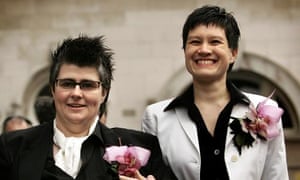
Grainne Close and Shannon Sickles became the first gay couple in the UK to enter a civil partnership at Belfast city hall in 2005. Photograph: Peter Macdiarmid/Getty Images


First couples in UK to enter civil partnerships delighted with result of legal battle, saying religious views should not affect public policy
The first two couples to become civil partners in the UK have won the right to have the same-sex marriage ban in Northern Ireland subjected to judicial review.
A Belfast high court judge ruled on Friday that Grainne Close and Shannon Sickles, and Charles and Henry Flanagan-Kane, should be granted the review, which is set for the autumn.
Both couples’ civil partnership ceremonies were held at Belfast city hall, just a short distance from the high court, 10 years ago.
The review is likely to be held in November, alongside several other legal challenges taken by gay couples in the region, and who are backed by the Rainbow Project, an LGBT rights organisation.
Neither couple was in court for Friday’s ruling but their barrister and senior counsel representing the Northern Ireland regional government were present to hear Mr Justice Treacy say that he had read the case papers and had already satisfied himself that the matter should proceed to judicial review. “The applicant has an arguable case,” he said.
Members of the Rainbow Project and Amnesty International were also in court. Others supporting the legal challenge included the former CEO of the Marie Stopes clinic in Belfast Dawn Purvis and the actor Nuala McKeever.
Outside court, solicitor Mark O’Connor issued a statement on behalf of both couples: “We are delighted that we have been able to get over the first hurdle in relation to the judicial process and that the judge today has granted leave for us to bring this judicial review.
“We are thankful that the judge has made that decision today. We believe that religious policy and religious views shouldn’t be affecting public policy. Thankfully today the judge appears to have accepted that there is an arguable case to answer … and hopefully we will have success in the future in relation to this matter.”
Advertisement
Prior to the hearing Grainne Close had said: “This is not a religious issue, it is a human rights issue. That is why we are going to court.”
Close said she and her US partner had been inspired by Ireland’s overwhelming vote in favour of gay marriage last month and the joyous scenes that greeted the result of the referendum at Dublin castle.
The Rainbow Project’s director, John O’Doherty, welcomed Treacy’s ruling. “We are pleased that this case is progressing and that it will likely be heard alongside our client’s case challenging the failure of the Northern Ireland government to recognise their lawful marriage.
“The current illogical patchwork of marriage laws created by the Westminster government is placing LGBT people in Northern Ireland at an inexcusable disadvantage and we hope that the courts will agree and find that there must be a harmonisation of marriage laws across the UK.”
A Sinn Féin motion on marriage equality was defeated in April, with 47 Northern Ireland assembly members voting in support, but 49 unionists against. Even if there had been a small majority in favour, the Democratic Unionist party would have exercised a special veto drawn up under devolution.
The petition of concern rule allows any party to veto legislation if it can argue the law would not have sufficient cross-community or Protestant/Catholic support.
Earlier this month, 20,000 trade unionists staged a rally in Belfast city centre to support gay marriage in Northern Ireland, the only part of the UK where LGBT couples cannot be married.
Amnesty International said the ban has turned Northern Ireland into a “discriminatory backwater for the gay and lesbian community”.

Filed Under: Anti-Bullying & Homophobia, History Tagged With: Camden and Islington LGBT, civil partnerships, gay marriage, Irish politics, marriage equality, Northern Ireland election debate

Being arrested: your rights

25/06/2015 By ACOMSDave Leave a Comment

Being arrested: your rights

  1. When you’re arrested

  2. How long you can be held in custody

  3. Giving fingerprints, photographs and samples

  1. Legal advice at the police station

  2. Complaining about your treatment by the police

  3. When you’re arrested

If you’re arrested, you’ll usually be taken to a police station, held in custody in a cell and then questioned.
After you’ve been taken to a police station, you may be released or charged with a crime.
Your rights in custody
The custody officer at the police station must explain your rights. You have the right to:

  • get free legal advice
  • tell someone where you are
  • have medical help if you’re feeling ill
  • see the rules the police must follow (‘Codes of Practice’)
  • see a written notice telling you about your rights, eg regular breaks for food and to use the toilet (you can ask for a notice in your language) or an interpreter to explain the notice

1.   You’ll be searched and your possessions will be kept by the police custody officer while you’re in the cell.
Young people under 18 and vulnerable adults
The police must try to contact your parent, guardian or carer if you’re under 18 or a vulnerable adult.
They must also find an ‘appropriate adult’ to come to the station to help you and be present during questioning and searching. An appropriate adult can be:

  • your parent, guardian or carer
  • a social worker
  • another family member or friend aged 18 or over
  • a volunteer aged 18 or over

The National Appropriate Adult Network provides appropriate adult services in England and Wales.
Your rights when being questioned
The police may question you about the crime you’re suspected of – this will be recorded. You don’t have to answer the questions but there could be consequences if you don’t. The police must explain this to you by reading you the police caution:
“You do not have to say anything. But, it may harm your defence if you do not mention when questioned something which you later rely on in court. Anything you do say may be given in evidence.”

  1. How long you can be held in custody

The police can hold you for up to 24 hours before they have to charge you with a crime or release you.
They can apply to hold you for up to 36 or 96 hours if you’re suspected of a serious crime, eg murder.
You can be held without charge for up to 14 days If you’re arrested under the Terrorism Act.
When you can be released on bail
The police can release you on police bail if there’s not enough evidence to charge you. You don’t have to pay to be released on police bail, but you’ll have to return to the station for further questioning when asked.
You can be released on conditional bail if the police charge you and think that you may:

  • commit another offence
  • fail to turn up at court
  • intimidate other witnesses
  • obstruct the course of justice

This means your freedom will be restricted in some way, eg they can impose a curfew on you if your offence was committed at night

  1. Giving fingerprints, photographs and samples

The police have the right to take photographs of you. They can also take fingerprints and a DNA sample (eg from a mouth swab or head hair root) from you as well as swab the skin surface of your hands and arms. They don’t need your permission to do this.
The police need both your permission and the authority of a senior police officer to take samples like blood or urine, or to take dental impressions.
This doesn’t apply when they take a blood or urine sample in connection with drink or drug driving.
Information from fingerprints and samples is stored in a police database.
You can find out if your information is stored on the police database bygetting a copy of your police records from your local police station.
You have to write to your local police (England, Wales and Northern Ireland) or local police (Scotland) to have your personal information removed from the police database.
They’ll only do this if an offence no longer exists or if anything in the police process (eg how you were arrested or detained) was unlawful.

  1. Legal advice at the police station

Your right to free legal advice
You have the right to free legal advice (legal aid) if you’re questioned at a police station. You can change your mind later if you turn it down.
How you can get free legal advice
You must be told about your right to free legal advice after you’re arrested and before you’re questioned at a police station. You can:

  • ask for the police station’s ‘duty solicitor’ – they’re available 24 hours a day and independent of the police
  • tell the police you would like legal advice – the police will contact the Defence Solicitor Call Centre (DSCC)
  • ask the police to contact a solicitor, eg your own one

You may be offered legal advice over the phone instead of a duty solicitor if you’ve committed a less serious offence, eg being disorderly. The advice is free and independent of the police.
Being questioned without legal advice
Once you’ve asked for legal advice, the police can’t question you until you’ve got it – with some exceptions.
The police can make you wait for legal advice in serious cases, but only if a senior officer agrees.
The longest you can be made to wait before getting legal advice is 36 hours after arriving at the police station (or 48 hours for suspected terrorism).
You have the right to free legal advice if you are questioned by the police.

  1. Complaining about your treatment by the police

Contact the police force you want to complain about if you’re unhappy about how the police have treated you.
Police forces must refer certain types of complaints to the Independent Police Complaints Commission (IPCC.)
 
https://www.gov.uk/arrested-your-rights


Filed Under: Anti-Bullying & Homophobia, History Tagged With: being arrested, gov.uk, your rights

Beckenham playwright Chris Woodley’s Next Lesson tackles Thatcher’s controversial Section 28 anti-gay law

25/06/2015 By ACOMSDave Leave a Comment

News Shopperby Jim Palmer, leisure editor Last updated 13:04 Wednesday 24 June 2015
 

News Shopper: Photograph of the Author by Jim Palmer, leisure editor
A Beckenham dramatist has won rave reviews for his play about controversial legislation which banned the promotion of homosexuality in schools.
Chris Woodley’s Next Lesson looks at the affects of Thatcher’s notorious Section 28, which came into force in 1988 and was not repealed until 2003.
It is a portrait of a south London secondary school and focuses on Michael, a gay student, from his first day in 1988 through to becoming a teacher at the school.
When it debuted at The Pleasance Theatre in April, Gay Times gave Next Lesson a five star review.
The topic was an important one for Chris to write about.
The 33-year-old said: “Section 28 has had a huge effect on many LGBT young people at that time who simply couldn’t talk about who they were and what they felt in school. It’s heart breaking.
“The repeal of Section 28 came incredibly late and I feel it left a really confused feeling in our education system about what could and could not be discussed in schools.
“Even today the way in which we deliver Sex and Relationship Education in this country needs to be addressed; without open and honest conversations about SRE we are at risk of failing LGBT young people.”
The play’s subject is one that Chris knows well: before he turned to theatre full time hewas a drama teacher for six years.
He said: “When I was teenager I was very badly bullied during the time this legislation was in power.
“So as an adult in my twenties it was quite a moment to return to Bromley as an out gay teacher and see what had and hadn’t changed in the education system.”
He added: “People often think that the central figure in the play Michael is based on me, when in fact the smaller stories around Michael’s journey are loosely based on personal events.
“Nearly every scene has a character or a plot line that is taken from my life as a student or teacher.
“Aspects of the story have to be changed to protect the innocent. The scene that’s most personal is the scene in particular where a Head of Drama is challenged by a parent about directing a play with gay characters in it.”
Chris grew up in Beckenham and attended Marian Vian Primary School then Langley Park School for Boys.
He said: “Langley wasn’t the best place for a gay teenager growing up in the nineties so I left Langley after my GCSEs and went to The BRIT School.
“The BRIT School was and still is the most outstanding school for anyone that wants to get into a creative industry.
“It brought me back to life after quite a tough time at school. On the opening night of the show my first drama teacher from Marian Vian attended and the Principal of BRIT School, it was lovely to have such incredible support.”
Perhaps it’s unsurprising given his strong links to the area, but Chris made sure Next Lesson was firmly rooted in the borough.
He said: “I really wanted the play to have a strong geographical identity so Next Lesson has lots of references to Bromley.
“There are references that include Beckenham War Memorial, The Churchill Theatre even News Shopper gets a mention.”
Hyphen Theatre Company present Next Lesson written by Chris Woodley on at The Pleasance Islington in October 2015. Go to hyphentheatre.com

Filed Under: Anti-Bullying & Homophobia, Theatre Reviews Tagged With: Beckenham, Chris Woodley, Margaret Thatcher, Section 28

Allah Made Me Muslim; Allah Made Me Queer

25/06/2015 By ACOMSDave Leave a Comment


Posted: 06/22/2015 8:56 pm EDT
Wazina Zondon
Co-founder of ‘Coming Out Muslim’
 
 
PATRICK MULCAHY PHOTOGRAPHY
 
Co-authored by Terna and Andrew Stehlik

“I didn’t know there was such a thing as a queer Muslim.”

Even among the most progressive, well-educated and best-intentioned individuals, this is a comment which is heard far too often. People who have no trouble understanding that lesbians, gay men, bisexuals and transgendered people have existed throughout history, in every nation, culture, religion and ethnicity, still have trouble accepting someone can be both queer and a faithful believer in Islam.
Admittedly, some confusion is understandable, as the Muslim record for tolerance is not commendable. On the contrary, Sharia, which is the most orthodox form of Islamic law, can be evoked to issue a death penalty for practicing homosexuals in Muslim countries such as Iran, Nigeria and Saudi Arabia. And, in 2011, when the Human Rights Council of the United Nations passed its first-ever resolution recognizing LGBTQ rights, it gained full support from the Americas and Europe, but was almost unanimously voted against by countries with a Muslim majority.
Nonetheless, there are queer Muslims, and they are making themselves known in growing numbers. The annual celebration of Ramadan (which began on June 17) coincides with Gay Pride Month this year, providing a unique opportunity to consider the current state of LGBTQ Muslims, as well as their likely future.
Why is this? Because Ramadan, which according to Islamic tradition, honors the first revelation of the Quran to the Prophet Muhammad, is not only commemorated through fasting from dawn to sunset, but is also a time known for great acts of kindness towards the neediest. Charity is very important to Islam year-round, but it is believed that good deeds performed during Ramadan are looked upon by Allah (God) with special favor.
While it takes discipline to keep one’s mouth shut and forgo all food and drink for many hours a day, it also requires bravery to open one’s mouth wide and speak up with compassion and charity for the rights of all human beings to be whole. This is what we’re attempting to do with “Coming Out Muslim: Radical Acts of Love,” a storytelling performance which has been shared on stages across the United States, and will appear at Rutgers Presbyterian Church in New York City on Wednesday, June 24.
The show’s title is deliberately ambiguous. It suggests both the self-revelation which occurs in publicly declaring one’s queer sexuality, as well as the challenges of being open about one’s faith in Islam in a post-9/11 America, where fears and suspicions linger that all Muslims are terrorists. As recently reported in The New Yorker magazine, statistics from the F.B.I. show that hate crimes against Muslims are five times as common as they were before 2001. Given this environment, it is exponentially more dangerous to proclaim, “Allah made me Muslim; Allah made me queer.”
In making such a courageous assertion, LGBTQ Muslims are becoming more visible at the intersection of faith and sexuality, joining conversations which have been underway for quite some time within Christianity and Judaism. What these three faiths have in common, of course, is not only an Abrahamic tradition, but a homophobia based in large part on a single scriptural story, that of Sodom and Gomorrah.
More modern Muslim scholars, along with freer-thinking Jewish and Christian theologians, advocate interpretations indicating that the true offense shown in the story of Lot is a threat of male rape, and a violent failure to show hospitality to strangers. New attention is being paid as well to verses in the Quran which non-judgmentally describe the existence of men who have no desire for women. And, some historians now point out that in earlier Islamic societies, same-sex relationships were celebrated in love poems written by Persian, Urdu and Sufi poets.
As for those contemporary Muslims who now choose to find a rationale for the death penalty against homosexuality in the hadith, or non-Quranic stories that are attributed to Prophet Muhammad, it must be remembered there is also a hadith where the Prophet says, if anything you have heard about me makes you turn away from me, it is not from me. Violence against sexual and gender minorities is not aligned with the Prophet’s example of love and tolerance in community.
Most Americans, many Muslims, and a lot of LGBTQ people do not know that Islam has room for all of us. And, there may be quite a few who, even after hearing so, will respond, “Well, all this is unique to queer Muslims, what does this have to do with me?”
Our answer is, a lot. Because we believe that the more specific a story is, the more universal.
“Coming Out Muslim” speaks to the universal wish to be recognized as multi-layered individuals, who are parts of families and communities, who struggle and strive for wholeness. Time and time again, people come up to us after performances — men, women, heterosexuals, gays and lesbians, Christians and atheists — and tell us exactly this.
Coming out, then, is really about letting the world know who you are. So, yes, there are queer Muslims!
By taking pride in this, change can occur and love can grow.

2015-06-22-1435009273-6271717-COMINGOUTMUSLIMTerna.jpg
Terna, photographed by Patrick Mulcahy Photography

Filed Under: Anti-Bullying & Homophobia, History Tagged With: LGBT Muslim, Muslim, queer

Manchester’s LGBT history to be celebrated on new digital platform OUT!

25/06/2015 By ACOMSDave Leave a Comment


BY BETH ASHTON

OUT! will bring together the heritage trail and digital histories to provide a central place for all of Manchester’s rich LGBT history

Manchester Pride has been awarded funding by the Heritage Lottery Fund to create a digital platform that will explore the history of LGBT life in Manchester.
OUT! will bring together the heritage trail and digital histories to provide a central place for all of Manchester’s LGBT past.
Visitors to the website will also be able to create their own personalised trails based on where they are in Manchester, a theme or a time period, giving them the ability to discover and explore without the need of a tour guide.
The trails will use the rainbow tiles, which mark historic occurrences around the city centre, that were installed as part of Europride and OUT! will bring together a variety of projects championed by organisations including Gaydio, LGBT Foundation, Archives+ and the LGBT Youth North West.

The platform will also allow users to contribute to the research, with opportunities for crowdsourcing and digital games that enable the public to engage with and contribute to the ever-growing resource.
Mark Fletcher, Chief Executive of Manchester Pride comments; “Two of the main aims of Manchester Pride are to celebrate LGBT life in our city and to create opportunities for engagement. With ‘Out!’ we aim to commemorate and unite the rich and vibrant past by providing a factual and insightful legacy resource in one single location.”
“Our vision is to enable communities, historians and researchers, tourists and locals to learn about these histories and encourage them to contribute to the content and engage more fully with and to understand this important part of Manchester’s past.”

Manchester Pride is currently recruiting a number of volunteer research pioneers for this project who will collate information from both the LGBT community and other sources. The funding will provide training for the research pioneers who will visit community groups, researchers and local history societies to introduce the digital tool, ’OUT!’, and gather content including videos, photography and stories.
Daniel Jessop, Project Manager on the OUT! Digital Histories project said, “It’s great to join the team and make sure that stories in the LGBT community are shared. The Heritage Lottery funded project will empower volunteers through training, collecting oral histories and encouraging people to question the past and find out more. ‘OUT!’ celebrates LGBT heritage and if anyone is interested in being part of this please do get in touch.”
Alongside the creation of the digital platform, ‘OUT!’, the funding will also provide:
The training of 40 volunteers to visit community groups, researchers, local history societies etc to introduce ‘OUT!’.
Training of local historians to investigate archives to examine them for LGBT content.
A stand at the Expo Stand at the Big Weekend 2015 to explain the project and demonstrate the digital tool.
A panel discussion during Manchester Histories Festival 2016 to help the wider community to understand the heritage of the LGBT Community in Greater Manchester.
32 individuals will be trainees in oral histories and interviewing skills throughout the life of the project. 18 will initially be trained at the start of the project (12 community volunteers, 6 Gaydio interns) to conduct interviews for the theatre piece, digital booths and during the Big Weekend from the Expo Stand. A further 14 will be trained as a part of LGBT History Month in January 2016 in order to collect stories to add to the resource.
A digital exhibition at Archives + during the Manchester Pride Festival 2015 creating a new strand to their “Radical Histories” unit.
A live performance based piece in conjunction with Hope Theatre in the Gay Village that utilises oral histories and heritage on the digital tool.
A digital game run through Twitter and based around the digital tool to encourage engagement and usage.
To get involved in the project or find out more email Daniel Jessop on daniel@manchesterpride.com .

Filed Under: Anti-Bullying & Homophobia, History Tagged With: digital archive, lgbt history, manchester, OUT

Couples challenge Northern Ireland’s gay marriage ban in court

25/06/2015 By ACOMSDave Leave a Comment

Shannon Sickles and Grainne Close, and Chris and Henry Flanagan-Kane, the first UK couples in civil partnerships, pursue legal battle over full marriage equality

A rally calling for same-sex marriage to be made legal, in Belfast.
A rally calling for same-sex marriage to be made legal, in Belfast, earlier this month. Sinn Fein has called for a referendum on the issue in the province. Photograph: Charles McQuillan/Getty Images

Henry McDonald Ireland Correspondent

Wednesday 24 June 2015 14.42 BSTLast modified on Wednesday 24 June 201515.21 BST

An American woman and her partner, who were the first couple in the UK to have a civil partnership ceremony, are to challenge Northern Ireland’s ban on gay marriages.
Shannon Sickles, a US citizen, and Grainne Close made history a decade ago when they were the first gay couple to have a civil partnership in Britain, sealing their union at a ceremony at Belfast city hall.
Now the couple are taking part in a legal case to overturn the bar on LGBT couples getting married in Northern Ireland. They will launch their legal case on Friday morning.

Shannon Sickles, left, and Grainne Close
Shannon Sickles (l), and Grainne Close at Belfast city hall in 2005. Theirs was one of the first gay civil partnerships in the UK. Photograph: Paul Faith/Press Association

Northern Ireland remains the only part of the UK where there is no gay marriage equality. The deputy first minister, Martin McGuinness, has suggested a regional referendum – similar to the one that passed in the Irish Republic last month – on gay marriage.
Sinn Féin and other parties have made repeated attempts to legislate for gay marriage equality in the Northern Ireland assembly, but their proposals have been voted down by unionists. The evangelical Christian wing of the Democratic Unionist party has mounted fierce opposition to introducing gay marriage equality in the province.
Close and Sickles will be joined by a male couple, Chris and Henry Flanagan-Kane (previously Christopher Flanagan and Henry Kane) in seeking a judicial review of the ban.
On her Facebook page, Close posted on Wednesday: “This year, December 19th, 2015 Shannon and I, along with Chris and Henry Flanagan-Kane, will celebrate 10 years of our civil partnerships.
“Northern Ireland was the first place in the UK to recognise civil partnership legislation and is now the last place in the UK and Ireland to recognise equal marriage.
“On June 26th, 10am in the high court, the four of us are bringing a legal challenge for a judicial review of the legislative prohibition preventing us from entering into civil marriage.”
“Our barrister, Laura McMahon, will argue that to bar equal marriage is a fundamental discrimination of our rights under the European convention on human rights, which is without justification.”

Henry Kane (R) and Christopher Flanagan had a civil ceremony on the same day in 2005 in Belfast. They are also fighting the ban on gay marriage in the region.

FacebookTwitterPinterest
Henry Kane (R) and Christopher Flanagan had a civil ceremony on the same day in 2005 in Belfast. They are also fighting the ban on gay marriage in the region. Photograph: Peter Macdiarmid/Getty Images

She added: “You will hear the arguments from DUP and other religious groups (all the same that have been played out in the Irish referendum) that we have civil partnership, so why marriage?
“The fact that we have to stand in a different queue from opposite-sex peers when it comes to having our relationship recognised by the state is itself indicative that we are treated differently.”
The Rainbow Project, one of the main gay rights organisations in Northern Ireland, said it will attend the hearing in Belfast this Friday, in solidarity with the couples.
“Anything that tests the legal basis of Northern Ireland’s ban on civil marriage is a positive step,” said John O’Doherty, the Rainbow Project’s director. The organisation has been planning to launch its own legal challenge, based on human rights legislation, this autumn.
Earlier this month, thousands attended a rally in Belfast organised by the trade union movement and Amnesty International, calling for gay marriage equality in Northern Ireland.
The Irish Congress of Trade Unions has backed the campaign to lift the ban, claiming that it not only violates European human rights law but also equality legislation contained within the 1998 Good Friday Agreement.

Filed Under: Anti-Bullying & Homophobia, History Tagged With: gay marriage, Irish politics, marriage equality, same sex marriage

  • « Previous Page
  • 1
  • …
  • 31
  • 32
  • 33
  • 34
  • 35
  • …
  • 72
  • Next Page »

Categories

Copyright ACOMSDave.com © 2026