ACOMSDave

Community Journalist

  • Home
  • Community Journalist
  • Events
  • Media Page and Press Kit
    • Projects and Work
  • Resources & Documents
    • LGBTQ+ Support Groups and Documents
  • NIGRA
  • Archives
  • Contact

What should schools teach pupils about sex?

08/10/2015 By ACOMSDave Leave a Comment

Peter Thatchell Foundation


Editorial:  Peter Thatchell has once again put forward some radical thoughts on sex and education.  NIGRA is drawing attention to this as a means of opening the debate that surely needs to occur over the UKs range of sex education policies and how they impact on our children and future society.


Time for radical rethink of sex education to ensure sexual health & happiness
By Peter Tatchell
Let’s Talk About Sex
Teach Secondary – London, UK – Issue 46 – 2015
READ: http://bit.ly/1McmuTu

Millions of young people enter adulthood sexually and emotionally illiterate. Many subsequently endure disordered relationships, ranging from unfulfilling to outright abusive. The result? Much unhappiness – and sometimes mental and physical ill-health.
The lack of effective sex and relationship education (SRE) in UK schools is part of the problem. It is mostly vague and euphemistic, with too little detail and not enough explicitness to be of practical benefit. Much of it concentrates on the biological facts of reproduction, often concerning other species such as rabbits. Very little teaching is actually about sex – or relationships. And it starts too late; usually after young people have become sexually active and adopted bad habits such as unsafe sex.
While SRE should not encourage early sex (it is best if young people wait), it should prepare them for a satisfying, safe adult sexual and emotional life.
The UK government’s education watchdog, Ofsted, said the amount of time spent on SRE in schools is inadequate and that much of it is poor quality. The Social Exclusion Unit noted: “The universal message received from young people is that the sex and relationship education they receive falls far short of what they would like.”
What, then, needs to change in order to make SRE more effective? Here are some suggestions regarding what should be taught in schools:
Sexual Rights Are Human Rights
It is a fundamental human right to love an adult person of either sex, to engage in any mutually consensual, harmless sexual act with them and to share a happy, healthy sex life.
The Right To Sexual Self-Determination
‘It’s my body and my right to control it’ should be promoted in every school to ensure that young people assert their right to determine what they, and others, do with their body – including the right to abstain from sex, say ‘no’ and report abusers. This ethos of sexual self-determination is crucial to thwart people who attempt to pressure youngsters into abusive relationships and risky sex.
A New Ethical Framework: Mutual Consent, Respect & Fulfilment
It is important that SRE acknowledges diverse sexualities and lifestyles, while also giving teenagers guidance on their rights and responsibilities – including teaching about consent and abuse issues. A positive ethical framework can be summed up in three simple principles: mutual consent, reciprocal respect and shared fulfilment. The great advantage of these principles is that they apply universally, regardless of whether people are married or single, monogamous or promiscuous or hetero, bi or homo.
Promoting Safer Alternatives: Oral Sex & Mutual Masturbation
If schools are serious about cutting the incidence of teen pregnancies, abortions and HIV infections, they should highlight safer, healthier alternatives to vaginal and anal intercourse. Oral sex and mutual masturbation carry no risk of conception and a lower risk of HIV. The most effective way to persuade teenagers to switch to these alternatives is by making them look and sound sexy, explaining that they can be sexually fulfilling  and emphasising their advantages over intercourse: no worries about unwanted conceptions, reduced HIV risk and no need to use the pill or condoms. While mutual masturbation is totally safe, oral sex can transmit sexual infections. It is safer than intercourse but not risk-free.
Sex Is Good For You
SRE lessons should acknowledge that sex is good for us. It is natural, wholesome, fun and (with safe sex) healthy. Quality sex can have a very beneficial effect on our mental and physical well-being. Young people have a right to know that while sex is not essential for health and happiness (some people get by without it and that’s fine), most people find that regular, fulfilling sex lifts their spirits and enhances their lives and relationships.
Give Kids All The Facts
Sex education ought to tell the whole truth about every kind of sex and relationship – including sexual practices that some people find distasteful, such as anal intercourse and sadomasochism. The purpose of such frankness is not to encourage these practices, but to help pupils deal with them if they encounter them in later life.
Hetero, Homo and Bi Are Equally Valid
When based on mutual consent, respect and fulfilment between adults, both opposite-sex and same-sex relations are morally valid. While schools should not promote any particular sexual orientation, they should encourage understanding and acceptance of heterosexual, homosexual and bisexual orientations (and transgender and intersex identities) in order to ensure pupil self-acceptance – and to combat prejudice, discrimination, bullying and hate crime.
How To Have Good Sex
Sexual literacy is just as important as literacy in words and numbers. Good sex isn’t obvious; it has to be learned. To ensure happier, more fulfilled relationships in adulthood, SRE for 16+ pupils should include advice on how to achieve mutually-fulfilling, high quality sex; including the emotional and erotic value of foreplay; the multitude of erogenous zones and how to excite them; and methods to achieve good orgasms for one’s self and one’s partner.
Live & Let Live
Human sexuality embraces a glorious diversity of emotions and desires. We are all unique, with our own individual erotic tastes. People are sexually fulfilled in a huge variety of different ways. Providing behaviour is consensual, between adults, where no one is harmed and the enjoyment is reciprocal, schools should adopt a non-judgemental ‘live and let live’ attitude.
Education From The First Year Of Primary School
SRE needs to be age-appropriate; starting from the early years of primary school by talking about body changes at puberty and, to tackle abuse, about inappropriate touching. It needs to become more detailed and explicit at secondary level. The reason for starting so young is that most children now begin puberty between the ages of eight and 12. Long beforehand, they need to know about the physical changes they will undergo and the desires they will develop. Keeping them ignorant jeopardises their happiness and welfare. Early knowledge is the key to later wise, responsible sexual behaviour.
Respect For Sexual Diversity
Our desires and temperaments are not the same. There is no ‘one-size-fits-all’ when it comes to sex, love and relationships. That is why teachers have a duty to validate the diversity of adult sex and relationships that fall within the ethical framework of mutual consent, respect and fulfilment.
Overcoming Sex Shame To Tackle Abuse
Sexual guilt causes immense human misery – not just frustrated, unhappy sex lives, but actual psychological and physical ill-health. It also helps sustain child abuse. Adults who sexually exploit youngsters often get away with it because the victims feel embarrassed or guilty about sex and are therefore reluctant to report it. SRE needs to encourage young people to have more open, positive attitudes towards sexual matters. Teenagers who feel at ease talking about sex are more likely to disclose abuse.
Mandatory Lessons & A Revised Parental ‘Opt Out’
Sex and relationships are very important in most people’s lives. That’s why education about them should be a mandatory part of the curriculum in every school. SRE lessons should be at least monthly all throughout a child’s school life – not once a term or once a year. Moreover, we don’t let parents take their kids out of maths or history, so why should a parental ‘opt out’ be permitted for SRE? At the very least, parents who want to withdraw their children should be required to come to each lesson and physically remove their child. This way the parental ‘opt out’ option is retained but the actual ‘opt out’ rate is reduced.
Over to the Education Secretary. Nicky Morgan, please ensure that SRE lessons are a statutory requirement in all schools and that they start addressing these issues.
* Peter Tatchell contributed to “Teenage Sex: What should schools teach children?” Hodder & Stoughton, £5.99. For more information about the Peter Tatchell Foundation’s human rights work, to receive email bulletins or to make a donation: http://www.PeterTatchellFoundation.org

Filed Under: Anti-Bullying & Homophobia Tagged With: schools, sex education

Westboro Baptist Just Messed With The Wrong Group Of Students

06/10/2015 By ACOMSDave Leave a Comment

Huffington Post Logo
 

JamesMichael NicholsDeputy Gay Voices Editor, The Huffington Post

They had no idea what these kids had in store.

Posted: 10/05/2015 02:54 PM EDT | Edited: 10/05/2015 11:30 PM EDT
A crowd of high school students drove Westboro Baptist Church protestors away from their school in Kansas City, Missouri last week where the hate group gathered to protest the recent election of a transgender girl as homecoming queen.
Westboro showed up to picket Oak Park High School on Thursday, Oct. 1, but were met by a rally of students already gathered to support transgender homecoming queen Landon Patterson.
Students Win Demonstration Against Westboro Baptist Church
Westboro was driven away from their picketing site by counter-protestors carrying signs with phrases such as “Westboro Baptist Church need Jesus” and chanting “long live the queen!”
“This isn’t just about supporting Landon, this is about supporting all our students,”Christina Palermo, an organizer for the rally, told a local news outlet. “Landon is just their scapegoat. They’re attacking everyone in the LGBT community.”
Westboro Baptist Church, which has been classified as a hate group, is based in Topeka, Kansas and regularly stages high-profile protests known for featuring their trademark slogan “God Hates Fags.”
Fortunately, Westobor has faced counterprostests more and more frequently in recent months. In fact, just over a year ago The Huffington Post staged a huge love-in to fight against the group when it protested its offices in 2014.

Filed Under: Anti-Bullying & Homophobia Tagged With: Kansas, Oak Park High School, Westboro Baptist

Librarian Creates ‘Books for Kids in Gay Families’ Website

05/10/2015 By ACOMSDave Leave a Comment

Huffington Post Logo

Huffington Post Logo


2015-10-02-1443798984-1662825-RumplepimpleGayThemedBooks.png
Patricia Sarles, MA, MLS has put together an extraordinary resource; a virtual library catalog of books for children related to various LGBTQ issues. When I discovered that my book, Rumplepimple, had been included in the Books for Kids in Gay Families list I was first thrilled, and then intrigued. I decided to ask her a few questions about how the whole thing came about. Here are her responses. I think you’ll find her story fascinating.
How did you get started with this effort?
I am a librarian and I became interested in children’s books on the topic of assisted reproductive technology when a social worker colleague, who is a fertility counselor, asked me if I could find her any books on this topic. I thought this would be very easy because of my training in how to find information on basically any subject. My colleague, Patricia Mendell, already had a small library of children’s books on this topic so I started by searching for those titles in the Library of Congress catalog and discovered that very few were available in their catalog. In addition, they had very strange subject headings, like “infertility — juvenile literature” or “test tube babies — juvenile literature” and those subject headings were inaccurate because that’s not what the books were about. They were about children conceived via assisted reproductive technologies and about donor offspring. It became apparent that these books would not be easy to find after all. It was also obvious that there were no appropriate subject headings for books on these topics.
This intrigued me tremendously because I was now on a mission to find books on a topic that had no adequate subject headings. This meant they would be nearly impossible to find. I also knew that there were mothers and fathers out there who needed children’s books like these in order to share with their children how they came into the world. There was a need but no means for a librarian to find these books should a patron walk into a library and ask a librarian to help them. That’s when I started my blog.
How long ago did this take place?
My search began in 2003 when I first met Patricia Mendell, but I did not start my blog until the spring of 2009. I started with Patricia’s small collection and added to it as I unearthed more. What started as a collection of about 15 books in English in 2003 has now turned into a collection of about 240 books in twelve languages so far in 2015! So how did I find these books that were not part of the Library of Congress collection and/or had no appropriate subject headings? I began scouring self-publishing catalogs, and the Web doing Google searches.
I’ve also learned terms in multiple languages, like Spanish, French, Italian, etc. and do regular searches in those languages. And now that my blog has been out there for a while, people who write these books also write to me and I have discovered several this way. Since I have searched for these books in English and in so many other languages, I am safe to say that I am the only person in the world who maintains a collection and since I share these books with Patricia Mendell, together we have the largest private library on these titles in the world. It is my hope one day to donate the books to a university or medical library, catalog them, and add them to WorldCat so that they are findable for librarians around the world. It is also my hope to get the Library of Congress to create adequate and appropriate subject headings.
You obviously find the LOC subjects lacking. What have you done to try to bring about improvements?
In 2009, Patricia Mendell and I started writing an article on these children’s books which in 2010 was published in the journal, Children & Libraries. In it, we talked about the inadequacy of Library of Congress subject headings and the difficulty we had in finding these books. This article was picked up by Sandy Berman, a Library of Congress gadfly who has spent an entire career petitioning the Library of Congress for subject headings on a variety of topics for which there were none. He sent my article to the Library of Congress and petitioned them for a subject heading for “Donor offspring.” I too had written to them asking them for new and more accurate subject headings for children’s books on assisted reproductive technology but they wrote me back that they found their subject headings adequate. But in 2012, the Library of Congress added the new subject heading, “Children of sperm donors.” This was a major accomplishment, which I felt I could take credit for since this was one of the subject headings I suggested they create. It is still not appropriate though because it implies that the books are about the children of people who donated their sperm and not about the resulting offspring of sperm donors. We subsequently published an article about this as well. It is my hope to write and publish more articles on this topic so that the Library of Congress can see that more appropriate terms are needed for donor offspring and other topics related to assisted reproductive technology.
So your work initially focused on assisted reproductive technology, but it branched out to include LGBT issues?
In the fall of 2009, I started my Gay-Themed Picture Books for Kids blog, when my social worker colleague asked for a list of children’s books for her gay clients who used third party reproduction to build their families. Third party reproduction would include the use of sperm donation for lesbian couples and egg donation, surrogacy, and IVF for gay couples. An organization she is involved with, the non-profitPath2Parenthood, formally the American Fertility Association, and an inclusive organization which helps couples, both gay and straight, build their families through third party reproduction, was looking to build a booklist for their gay clients on this topic. I wanted to help, and so I began my gay-themed picture books blog. There I set out to collect a list of gay-themed picture books for children. I started with the lists already in existence, the COLAGE list, the American Library Association GLBT Round Table list, and I began to build my own list. In the case of Library of Congress subject headings, gay-themed books make much more sense:
Children of gay parents
Lesbian mothers
Gay parents
Gay fathers
As with my Books for Donor Offspring blog, I search for books in multiple languages and I believe I have created the most comprehensive list on the Web. I have found over 500 picture books in thirteen languages.
Your websites list your email address as “Tovahsmom”. Do you mind telling us who Tovah is?
In 2003, my partner of 23 years and I went through the process of artificial insemination in order to build our family. This is how we came to visit a fertility counselor and how we met Patricia Mendell. Unfortunately, our attempt did not take and we did not become pregnant so we never had children. Tovah however is the name of one of our dogs who passed away in 2013.
Thanks for sharing this very personal part of your story, Patricia. And thank you for the work you are doing on behalf of all the families who want books for their children which reflect their personal reality. Your donation of time, thought, and effort for the sake of others is inspiring.

Follow Suzanne DeWitt Hall on Twitter: www.twitter.com/smariedewitt

Filed Under: Anti-Bullying & Homophobia, Book Reviews Tagged With: Books Children's Books Children's Literature Gay Gay Gay Gay Gay LGBT Parents Artificial Insemination Librarians Library Library of Congress

Italy: Gay student banned from Catholic high school over Instagram post

02/10/2015 By ACOMSDave Leave a Comment

INternational Business Times logoBy Umberto Bacchi

September 3
 
italian-school-bans-gay-student
 
A gay student at a religious high school in Italy was banned from class over his sexual orientation, his parents have claimed, triggering a furore across the Mediterranean country, which is already debating same-sex marriage.
The 16-year-old was ordered out of his classroom and placed to study alone in a hallway by the headmaster due to a photo posted on social media depicting him with another boy. As his parents became aware of the disciplinary measure, they reported it to police, claiming it was discriminatory.
“My son is being discriminated against because he is gay,” the mother told Il Fatto Quotidiano newspaper. “His grades are good and teachers are happy with him.”
The catholic institute’s headmaster claimed the ban was issued for the well-being of the student, who is followed by social services, and his classmates, following the clamour that erupted at school after the incriminated photo emerged.
“This has nothing to do with discrimination, Christians do not discriminate, we accept everyone,” Adriano Corrioni, the head of the Ecfop institute in Monza, north of Milan told L’Espresso magazine. “I thought it was right to remove the student to avoid that issues which need to be addressed by his family and social services be talked about in class”.
Corrioni claimed the photo posted on Instagram was “akin to child phonography” but the mother of the boy disputed that, saying it was taken during summer holidays and simply depicted her son and a friend bare-chested.
The incident sparked furious reactions across the peninsula. LGBT rights group Arcigay said the school’s decision was unacceptable and urged the government to take action.
Vincenzo Spadafora, the head of a public authority for children and teenagers’ rights, said he was left “speechless” by the events and vowed severe measures against the school if the discriminatory nature of the ban was confirmed.
The controversy comes as the country is engaged in a heated debate over same-sex marriages, after the government pledged to introduce a law on civil unions. Italy is currently the only country in Western Europe where no form of gay marriage is recognised.
 

Filed Under: Anti-Bullying & Homophobia Tagged With: banned, Catholic, gay student, high school, school, student

Saudi Arabia – Stop the beheading and crucifixion

30/09/2015 By ACOMSDave Leave a Comment

Editorial:  NIGRA has always been involved in ‘Human Rights’, and we have already written about Saudi Arabia today and its conflict of interest in the United Nations and the Human Rights Commission; we therefore urge you to sign this petition by clicking on the ‘Stop’ button below and entering your email address on the electronic form.

We have to stop this beheading and future torturing and beheading in Saudi Arabia, and the British Government must come out against this!

Saudi Arabia is about to behead a 21-year-old man and then crucify him to display his body in public. This same country was just chosen to head a U.N. Human Rights Council panel. If it weren’t so serious this would be funny!
Ali Mohammed al-Nimr was arrested when he was 17 for participating in demonstrations against the government, then he was convicted under torture. But his case is not an exception in the kingdom — Saudi Arabia has executed more than 100 people this year, that’s a rate of one every 2 days!
France has already requested that Saudis stop this execution, but the US, Germany, and the UK also have very cosy relationships with the regime. The best way to get urgent action is to channel our outrage to these leaders who can persuade their Saudi allies.Sign up now to save Ali, and then stop this human rights farce, his execution could happen anytime.
Young man in Saudi
 
Stop

Filed Under: Anti-Bullying & Homophobia Tagged With: beheading, crucifiction, politics, Saudi Arabia

Why Do Some Gay Mormons Still Seek Out Conversion Therapy?

30/09/2015 By ACOMSDave Leave a Comment

Despite all the forces aligned against conversion-therapy programs, many gay Mormons continue to turn to them.

Religion News Service / Salt Lake Tribune
By Peggy Fletcher Stack
Posted: 09/29/2015 04:51 PM EDT
 
SALT LAKE CITY – Men holding other men, as fathers cradle their newborn sons. Men running naked in the woods, like innocent boys during playful childhoods. Men caressing a silky scarf, like they might a woman.
These were among the activities at a Journey Into Manhood weekend retreat, and, for $650, these Mormons were told that their attractions could change from gay to straight — or at least diminish.
Three years ago, former Utahn Michael Ferguson, a gay Latter-day Saint, and three Orthodox Jews sued the nonprofit group JONAH (Jews Offering New Alternatives for Healing), which offers reparative therapy and had helped facilitate Journey retreats.
After vetting the groups’ methods, a New Jersey jury determined in June that such strategies were “unsuccessful” and constituted false advertising.
So-called conversion therapy for minors now has been banned through legislative action in California, Oregon, New Jersey and the District of Columbia, and a bill has been introduced in Congress to classify as fraud any commercial conversion therapies and all advertising that purports to alter one’s sexual orientation or gender identity.
The American Psychological Association has declared it not only impossible but also unethical to try changing sexual orientation.
 
<span class='image-component__caption' itemprop="caption">James Bromley delivers closing arguments for the plaintiffs in the trial Ferguson v. JONAH. In a first-of-its-kind trial, five people sued the gay conversion therapy organization JONAH (Jews Offering New Alternatives for Healing) for consumer fraud.  </span>PHOTO BY ALEX REMNICK | NJ ADVANCE MEDIA
James Bromley delivers closing arguments for the plaintiffs in the trial Ferguson v. JONAH. In a first-of-its-kind trial, five people sued the gay conversion therapy organization JONAH (Jews Offering New Alternatives for Healing) for consumer fraud.  
 
The newly formed, independent Mormon Mental Health Association has come out against any therapies “which have been developed to change, alter or reduce sexual orientation.”
LDS Church-employed counselors don’t use reparative therapy either.
Despite all these forces aligned against conversion-therapy programs, many gay Mormons continue to turn to them.
Why? Perhaps they are desperate to rid themselves of attractions they see as unwelcome and are eager to marry someone of the opposite sex — as their faith preaches.
Balancing faith and feelings
The 15 million-member Church of Jesus Christ of Latter-day Saints recognizes that same-sex attraction is a “complex reality for many people,” according to mormonsandgays.org, the faith’s official website on the topic, and teaches that attraction itself is not a sin, only acting on it is.
Therapists with LDS Family Services do not offer any kind of “sexual-orientation change efforts,” church spokesman Doug Andersen confirms. But they are willing to help members who “desire to reconcile same-sex attraction with their religious belief.”
The church “maintains professional relationships with a variety of organizations to ensure the diverse needs of church members can be met in an individualized and ethical way,” the spokesman said.
The church’s silence on groups such as Journey to Manhood, however, should not, Andersen said, be “construed as a tacit endorsement or stamp of approval.”
Without explicit condemnation from top LDS leaders, change programs have sprung up, tapping into a yearning for normalcy and acceptance.
Mormonism is a community in which it has been difficult “to come out and get social support for disclosing your orientation without ramifications,” said Laura Skaggs Dulin, a gay LDS therapist in a mixed-orientation marriage.
The appeal of these retreats and workshops, said Dulin, who holds a master’s degree in marriage and family therapy from San Diego State University and specializes in same-sex attraction-related issues, “is not surprising.”
By not providing an alternative, the church unwittingly created a vacuum, she says, and conversion-aimed retreats have filled it.
Healing childhood wounds
In 2000, Rich Wyler, a Mormon who believes his same-sex attraction diminished with the use of some therapies, created a website, People Can Change, to profile success stories and offer online support.
Wyler’s view, unlike that of the LDS Church, is that everyone is born heterosexual, but traumas and other experiences push some toward same-sex attraction.
Two years later, Wyler teamed up with David Matheson, an LDS therapist specializing in “gender-affirming therapy,” to craft the first Journey Into Manhood weekend.
The retreats are rooted on the premise that many gay men “often had far too little healthy touch from father figures or brothers when they were young, and so they crave male touch today to fill that deficit.”
The program includes, the People Can Change website says, “journaling, visualization, group sharing, safe healing touch and intensive emotional-release work.”
The retreat experiences often include a “rebirthing process” (naked men are covered with baby powder and wrapped in a blanket, explained one Jewish counselor in his trial deposition, while father figures stroke and hug them in a loving way). The men redo “adolescence” (they evaluate their bodies as they grow and change in puberty). Finally, the players find themselves in “manhood” (they snuggle with a silky cloth, imagining a woman at their side).
“All of the exercises are designed to help you identify and process the underlying issues that may be alienating you from your authentic heterosexual masculinity,” the website says.
Jeff Bennion, a Journey Into Manhood volunteer from Utah, said the experiences have helped him confront his shame, not only his same-sex attractions but also with many other issues.
“It taught me that my feelings were innately good, and a natural response to the circumstances I faced,” Bennion writes in a New York Post op-ed. “It motivated me to try to repair important family relationships, and helped me learn how to better relate to other men, whom I’d previously ignored or disdained. It’s made me much more accepting of myself and of others.”
Not everyone, though, has a positive experience with such tactics.
Nightmarish journey
Craig Nielson, the youngest of four from a devout LDS family who had served a Mormon mission in Chile, didn’t know what to expect when he attended a Journey Into Manhood weekend about five years ago outside of Chicago.
Nielson had long dreamed of finding a woman to marry in an LDS temple. By the time he was 21, however, he realized his attraction to men was more than mere admiration. He went to the retreat to learn how to “manage his feelings,” he says.
When the five men in his group were asked to address problems they had with their mothers, Nielson balked. He had no anger toward his mom, he said, nor did he blame her for his same-sex orientation. Instead, he told the facilitator, who was not a licensed counselor, that he wanted help nurturing his feelings for the woman he was dating.
“I said, ‘I really like (her),’ ” Nielson recounted. “And he said, ‘It’s not enough to like (her), you have to want to rape her.’ And that is a direct quote.”
Stunned by what he heard, Nielson says he expressed his immediate discomfort with the facilitator’s inappropriate choice of words.
Nielson believes use of the term rape was likely an unintentional “slip” of the tongue by the facilitator. It did, however, convince him that these methods were not right for him.
 
<span class='image-component__caption' itemprop="caption">Mormons Building Bridges group leads the annual Gay Pride Parade through downtown Salt Lake City, Sunday, June 3, 2012. </span>RNS PHOTO BY SCOTT SOMMERDORF | THE SALT LAKE TRIBUNE.Mormons Building Bridges group leads the annual Gay Pride Parade through downtown Salt Lake City, Sunday, June 3, 2012. 
 
Coming together
Dulin, the gay LDS therapist, designs and promotes same-sex attraction Mormon outreach interventions. She hopes to help move the Mormon community beyond reparative therapy to a more evidence-based multicultural approach.
Journey Into Manhood workshops may fill a need, she realizes, but she would like to see approaches that offer “a much healthier and more ethically sound alternative.”
Others, too, are looking in a new direction.
In recent months, but especially in the trial’s aftermath, some LGBT-affirming and LDS-affirming therapists have attacked one another with escalating vitriol.
Now a committee of 10 people has formed a new group, Reconciliation and Growth, to bring both sides together.
It has produced a four-page document for training therapists who deal with religious clients. The list spells out best practices, including an awareness of faith beliefs, the complexity of sexual attraction and the need to treat clients with dignity, rather than proscribe behavior.
Kendall Wilcox, a gay Latter-day Saint who helped launch a new podcast program called “Out in Zion,” is working to foster a better way by founding a small group practice called “Circles of Empathy.”
He knows firsthand the inner battles. He tried for years to make his orientation go away. He attended a Journey weekend and saw Mormon therapists offer false promises to troubled young members.
“The people aren’t the problem,” he said, “it’s the programs and their underlying assumptions that need to be exposed.”
And the answer, he said, is simple: “End conversion therapy now. Period.”
 

Filed Under: Anti-Bullying & Homophobia Tagged With: conversion therapy, Mormons

Writing Bi Characters

30/09/2015 By ACOMSDave Leave a Comment

New post on Gay YA

Writing Bi Characters

by Marilla

by Corinne Duyvis
Identification. Labels. Exploration.
These topics are often brought up in YA. Even more so in queer YA: after all, discovering your own identity and who you are or aren’t attracted to is a huge part of many queer kids’ lives. Something that often leads to even more confusion—on all sides—is when someone is attracted to more than one gender. Yes, the “confused bisexual” borders on stereotype, but that doesn’t mean it doesn’t occur. I mean, I was super confused about my orientation as a young teenager (which I’ve written about at DiversifYA before) and I had a very easy time of it compared to many others.
There are a couple of reasons for this common confusion. One is that there’s still a stigma about bisexuality/biromanticism. Greedy, confused, fakers, insatiable, etc. If those are the main messages you hear, then no wonder you wouldn’t want to apply that label to yourself.
Another is that bi people are still comparatively underrepresented in the media. There’s a long history of erasing bi people and their orientation, both in real life (current celebrities, historical figures) and in fiction (in the work itself, in reviews and discussions). Sometimes these people are labeled straight or gay, or there’s a ton of debate about “straight vs. gay” without ever allowing for other options; sometimes their same-gender or other-gender relationships are dismissed or written off as platonic; on the rare occasion the person’s or character’s attraction to multiple genders is acknowledged, they’re often identified as experimenting, confused, fluid, liberated, straight-with-an-exception, gay-with-an-exception, or disliking labels.
The words “bisexual” or “biromantic” are rarely used, despite being very common ways for real-life people who are attracted to multiple genders to identify. Many still shy away from the word(s). Thus, when authors do explicitly label their characters as bi, it stands out. Author Tess Sharpe (of the fabulous Far From You) has often spoken of the amazing reactions she’s received from teenagers in regards to her identifying as bi, and writing a character who does, too.
This kind of representation matters. It’s important to use the word, to defy stereotypes, to explore what this identity means. I’m glad more and more people realize how much bi visibility matters.
At the same time, this advocacy for bi representation raises many questions. In fact, when Malinda Lo suggested I write about this topic on Twitter (thank you, Malinda!) several people immediately chimed in ditto-ing their interest.
After several years seeing these questions and rebuttals online, I thought I’d put together some of the questions I’ve most often seen.
(These are specifically about bi visibility/erasure/identification—if I were to include terminology and stereotypes, we’d be here all day.)
 
But isn’t it true that teenagers often are confused or experimenting? Isn’t that what YA is about? Shouldn’t those teenagers also be represented?
Sure, it’s true for a lot of people. It was true for me! Not everybody leaps—or has to leap—to the label. People should never feel pressured into identifying a certain way. Bi advocates like myself need to be careful not to shove the label on people who may not want it.
I think it’s possible, however, to acknowledge the trend of erasure and misrepresentation of bi people and characters and how this is often done by defaulting to other labels and descriptors, without in turn erasing the individual people who do use those labels and descriptors.
Bi advocates aren’t saying, All these characters should be bi, end of story. We’re saying,Realistically speaking, way more of these characters would identify as bi—why this persistent reluctance to call them that?
As someone who has been a confused teenager, and whose sexuality is fluid, I would never want to take stories about those experiences away. We need more queer representation of all kinds.
I just also want explicit bi representation.
We can have it all. (/bi slogan)
 
How would I even show my character is bi? I mean, what if they’re in a single relationship during the course of the book?
Bi people are still bi even when they’re single or in a relationship with a particular gender.
If I’m in a relationship with a man, I’m not straight; I’m still bi.
If I’m in a relationship with a woman, I’m not gay; I’m still bi.
If I’m in a relationship with a non-binary person, I’m (a) going to be extra pissed if you attempt to label me or said relationship as lesbian/gay/straight, and (b) still going to call myself bi.
And if I’m single, guess what? I’m still bi. Just … a lonely bi.
(Call me.)
So the way to show they’re bi is simple: have them be attracted to more than one gender. Just because you’re in a relationship doesn’t mean you can’t check out other people or refer to past/crushes relationships. Not to mention they can still be explicitly referred to as bi in dialogue or narration.
 
On that topic, why this insistence on using the word? What if it just doesn’t come up in my novel? Besides, it feels artificial. I don’t label my straight characters, either.
You’re right. Sometimes it doesn’t come up. In my second book On the Edge of Gone, there’s an important bi character who is never labeled as such. She was called bi in a line that was taken out in revisions, and I never found another good place to mention it. I still feel anxious about this, to be honest.
That said, the reason so many people are so keen on having authors use the word because it’s still so rare. I think it’s important for readers—and particularly questioning teenage readers—to have every road wide open to them. Part of that is seeing their options represented in books.
Straight people don’t suffer from erasure; in fact, they’re considered the “default setting.” On the other hand, if you don’t explicitly call a bi character bi, many people will interpret them differently.
Since bi erasure is so common, and so many authors have internalized biphobic ideas without realizing it, the best way to defy that is to be extra thoughtful about how we approach the topic. Decades of erasure don’t go away by accident or “the natural flow of things”—they go away by consciously countering that erasure.
That’s why it matters to at least try.
 
But isn’t sexuality fluid? Why bother with labels in books?
Labels aren’t always bad. Labels can connect you to a community, a history, peers. They can help you realize you’re not alone, help you make sense of yourself, help you realize that it’s normal and common and a real, existing thing.
I’ve always seen labels as descriptive (this is my behavior, and this term fits that behavior) rather than prescriptive (this term identifies me, thus I must behave in certain ways); I’ve never felt boxed in by them. If people want to assume parts of my identity based on a label, or see me as nothing but a label, the problem is with those people, and not with the label itself. I’m also not going to stop calling myself female just because that gives people incorrect ideas of what I am or should be.
For me, seeing more positive and explicit bi representation as a teenager would have made things far easier.
If a person doesn’t want to commit to a label, that’s their choice. The thing is, we do have to give them that choice. Part of that is having stories that represent all these identities, experiences, labels and lack thereof, and more.
 
By insisting on bi visibility, aren’t you erasing people who don’t want to be labeled?
I hope not. If I ever cross that line, I hope someone calls me on it.
As I said above, it’s possible to acknowledge and fight bi erasure without in turn erasing others; I don’t want less of one thing, I want more of another. That way there’s no pressure on any single character or person to identify one way or another and represent an entire group in the process.
 
But what if it’s a fantasy/SF world that doesn’t have the word? Or a historical setting?
In a historical setting, you of course have to be true to history. Easy as pie. (Note that even if the word or concept didn’t exist, the people sure did.) If you’re writing a fantasy roughly based on a historical era, you have more flexibility, in my opinion; why could dragons and magic exist, but a word to identify people attracted to multiple genders would be a step too far?
For speculative settings, it’s entirely up to you. If you want to use the word, you totally can. You’re the one building these settings, after all! It’s entirely possible that another world may have come up with their own terms for less common sexual/romantic orientations, or they could even straight-up use the same terms as we do. After all, plenty of other modern ideas are often used in fantasy worlds, and you are theoretically “translating” this fantasy language into English. It’s logical to use words that readers will be familiar with.
Or maybe the world really doesn’t have any words for it. That could make sense, too, given how recent the terms we use are. In your world, maybe queer people are so oppressed and erased that it’s not ever spoken of; maybe queer people are so accepted and integrated that it feels odd to single it out.
Me, I had that latter situation in Otherbound. My fantasy-world protagonist is in a relationship with a boy but harbors an attraction to a girl. It’s never labeled or remarked on by anyone. Sometimes I wish I’d taken another route and been more explicit about her bisexuality; other times, I’m happy with my choice, as I know many queer people are hungry for these kinds of settings.
You’re got lots of options, really.
 
If my character is attracted to multiple genders or is exploring that option, and I decide not to have them identify as bi … am I contributing to bi erasure?
I mean … it depends? Everyone’s opinions are different, and I can’t comment on your book without having read it. All I ask is that authors strongly explore their reasons for this choice. It’s easy to internalize biphobic ideas and to default to a “simpler” option without genuinely investigating why.
If you do decide to have your characters identify otherwise or deny labels, I would personally love to see more genuine exploration and research of that character choice, rather than an off-hand mention as an apparent get-out-of-jail free card. Put in the work, either way.
One thing I would like to see more of is the existence of bi identity within these narratives, even if the character doesn’t identify as bi. After all, bi erasure doesn’t only refer to the way people are rarely called bi, but also to the way the option isn’t even brought up in situations where, logically speaking, it really should be at least mentioned.
There are lots of ways to do this, particularly when exploration of identity is part of the character’s arc. For example, have your character wonder about being bi; have them stumble on the idea during research if they’re not already familiar with the term; have someone else bring it up as an option; have a different character identify as bi; have your character perhaps go from identifying one way to identifying another.
For a specific example of how egregious this oversight can be, see my friend Kalen O’Donnell’s post about the TV series Faking It.
 
OK, but I don’t have a bi character or anyone attracted to multiple genders in my book.
I like that you’re reading through this long-ass post regardless! Not every book is going to have bi characters, which is fine, but keep in mind that the term and concept most likely still exist in your world. It means a lot it you could acknowledge that in places where it might logically arise. For example, by not jumping to gay the moment a character is interested in someone of the same gender.
 
I’m feeling awfully pressured right now.
In the end, the book and character are your own. I’m genuinely just trying to answer questions I’ve seen over the past few years.
Some of the people who asked these questions may have simply been defensive or actively trying to find ways to avoid representing bi characters. Still, I like to think that many of them were genuinely well-intentioned.
Openly discussing these matters—for example, the way Tess Sharpe has spoken about how meaningful her explicitly bisexual protagonist has been to readers—can make a lot of authors consider issues they wouldn’t have normally and change their approach in future books.
I’m not telling you what you should do; I’m trying to show you what your options are in different circumstances, and informing you of the wider context.
 
In the end, be honest about your character. Be honest about their experiences. Be honest about the bi, the pan, the fluid, the confused, the unlabeled, and the others.
But be honest about the world, too.

Filed Under: Anti-Bullying & Homophobia Tagged With: Bi Characters, exploration, labels

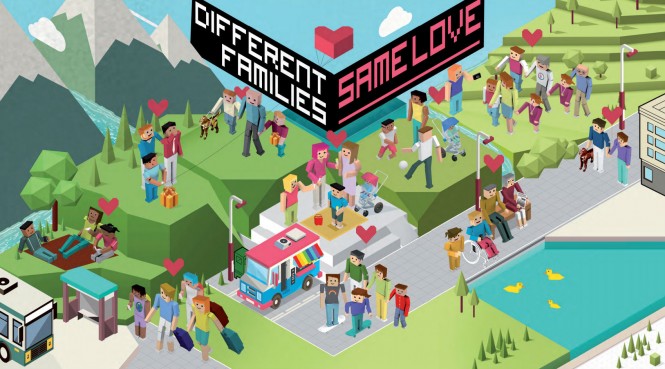
Different Families, Same Love

30/09/2015 By ACOMSDave Leave a Comment

Pro-Family Poster

Look: ‘Different Families, Same Love’ poster set to go into each Irish school

  • In: Carousel, Media Of Note
  • |
  • On: September 27, 2015
By John Mack Freeman
Just in time for same sex marriages to begin in Ireland in the next two months, a new poster has been released by the government that will go into each school. Called “Different Families, Same Love” (and featured above), it shows the full diversity of families, hopefully exposing children to the idea that family means a lot of different things. Via PinkNews:

Launching the poster, Education Minister Jan O’Sullivan directed: “This practical resource will be invaluable to teachers in creating inclusive classrooms. It will also aid in successfully implementing the compulsory Anti-Bullying Procedures.
“These procedures require every school in the country to engage in preventative and educational strategies to tackle homophobic and transphobic bullying. This poster will contribute to the work that primary schools are already doing in this regard and furthermore sends out a clear message to the LGBT children and LGBT-headed families of our society that they are welcome and cherished in our schools.”
General Secretary of the INTO Sheila Nunan added: “The INTO strongly endorses this poster and its use in all primary school classrooms.
“This resource sends an affirming and welcoming message to LGBT children and LGBT-headed families.

Filed Under: Anti-Bullying & Homophobia Tagged With: different families, education, Irish politics, same love, schools

London – Ronan Parke & Heather Peace headline Equality Ball

30/09/2015 By ACOMSDave Leave a Comment

Share
Tweet
Forward

Ronan Parke & Heather Peace headline Equality Ball

Fundraiser for the human rights work of the Peter Tatchell Foundation
Saturday 28 November, 7pm to 12.30am, Stratford, London
Singers Ronan Parke, Heather Peace and the acclaimed Delta Band will headline the Peter Tatchell Foundation’s inaugural Equality Ball on Saturday 28 November 2015 at The Old Town Hall, Stratford, London E15 4BQ. The theme is ‘Baubles & Bling’. Dress to impress.
Teen sensation Parke was runner up in Britain’s Got Talent and will perform Stand Up For Love by Destiny’s Child.
Both Ronan and Heather Peace will be attending the whole event, including dinner.
Delta Band – who have worked with Olly Murs, Bryan Ferry and Girls Aloud – will lead the late night dancing with cover versions of pop classics.
Our honoured guest on the night is Sir Ian McKellen.
Other invitees include Peter Tatchell Foundation (PTF) patrons: Lord Waheed Alli, Baroness Joan Bakewell, Caroline Lucas MP, Baroness Liz Barker, Lord Michael Cashman, Baroness Helena Kennedy QC, Paul O’Grady and Pragna Patel.
The palatial Old Town Hall, Stratford, once described as the ‘finest building in Essex’, is Grade II listed; having been restored to its full Victorian splendour.
See here: https://goo.gl/6q3lQa
Tickets are £50 per person, which includes a welcome drink and buffet dinner. Tables of 10 can be booked for £450.
Tickets here: http://tinyurl.com/equalityball2015
7pm for 7.30pm start
8pm buffet dinner
9.30pm Heather Peace & Ronan Parke
10pm Delta band
Peter Tatchell will be available for photos with ticket holders.
All proceeds from the Equality Ball will fund the human rights work of the Peter Tatchell Foundation, which includes a mixture of LGBTI and broader human rights initiatives, both in the UK and internationally.
November 28 is our inaugural Equality Ball. It is scheduled to take place annually on the last Saturday in November, with a different theme each year.
The Chair of the PTF Board of Trustees, Jeremy Hooke, said:
“This is a great opportunity for our friends and supporters to have a glamorous night out that contributes financially to our human rights endeavours. Peter Tatchell has been very ill from overwork because we don’t have enough staff. I hope the revenue from The Equality Ball will enable us to take on an extra worker to take the pressure off him and make our work even more effective.”
Peter Tatchell, PTF Director, added:
“Heather Peace and Ronan Parke are amazing singers. I’m grateful they’ve agreed to generously donate their talent to make The Equality Ball a night to remember. It’s going to be a fabulous evening. For one night only, I’m going glam – all in the cause of fundraising for human rights.”
If you cannot attend the Equality Ball but would like to support the PTF financially, please consider making a donation here:
http://www.petertatchellfoundation.org/donate
LISTING
THE EQUALITY BALL 2015
Theme: Baubles & Bling
Dress to impress.
7pm Saturday 28 November 2015. Carriages from 12.30am
Stratford Old Town Hall, 29 Broadway, London E15 4BQ
Guest performers: Heather Peace, Ronan Parke & Delta Band
Tickets: £50 – includes welcome drink, buffet dinner and entertainment
Booking: http://tinyurl.com/equalityball2015
Photos of the headline performers & venue for download:

Sample music from the headline performers
Ronan Parke: https://www.youtube.com/watch?v=NdJOCstPhQ4
Heather Peace: https://www.youtube.com/user/HeatherPeaceOfficial
Delta Band: http://www.delta-band.co.uk
Further information:
Peter Tatchell
Director, Peter Tatchell Foundation
0207 403 1790
Peter@PeterTatchellFoundation.org
Jeremy Hooke
Chairman, Board of Directors, Peter Tatchell Foundation
0778 862 8400
Jeremy@petertatchellfoundation.org
For more information about the Peter Tatchell Foundation’s human rights work, to receive our email bulletins or to make a donation:
http://www.PeterTatchellFoundation.org

Facebook
Facebook
Twitter
Twitter
YouTube
YouTube
Website
Website
Email
Email
Copyright © 2015 Peter Tatchell Foundation, All rights reserved.

Filed Under: Anti-Bullying & Homophobia Tagged With: Equality Ball, Heather Peace, Peter Thatchell, Ronan Parke, Sir Ian McKellan

This bizarre animation perfectly sums up the ‘gay cake’ row

30/09/2015 By ACOMSDave Leave a Comment

bakery2
 

You’re probably already tired of stories about homophobic bakers refusing to make gay wedding cakes – but this one has a twist

 
Earlier this week, Colorado bakery ‘Masterpiece Cakeshop’ become the latest to be told by a court that it is not allowed to refuse to make cakes for gay weddings.
The incident is the latest in a long long long line of similar cases – from Oregon’s Sweet Cakes By Melissa to Northern Ireland’s Ashers Bakery, there’s apparently no shortage of ignorant bakers in the world.
However, a group of Taiwanese Animators have attempted to breathe fresh life in to the row – with a bizarre animation.

The clip features bakery owner Jack Phillips, who insisted it was his religious right to not bake a cake for the wedding of Charlie Craig and David Mullins.
He is pictured in a Christ-like denial – before crying as the more successful bakeries get all the business from happy gay people.
The animation is plenty quirky, however – also featuring him baking a same-sex couple into a cake and putting up a ‘no homo’ sign.
The group specialises in satirising current events in their animations – recently bringing to life the row at online news site Gawker, after an article ‘outing’ a businessman was pulled down.
The Gawker staff were portrayed as babies with assault rifles – while the businessman was shown being literally ‘forced’ out of the closet
https://www.pinknews.co.uk/2015/08/16/this-bizarre-animation-perfectly-sums-up-the-gay-cake-row/

Filed Under: Anti-Bullying & Homophobia Tagged With: animation, gay cake, Oregon, Taiwanese Animators

  • « Previous Page
  • 1
  • …
  • 16
  • 17
  • 18
  • 19
  • 20
  • …
  • 72
  • Next Page »

Categories

Copyright ACOMSDave.com © 2026