
Ed: Edmund White

This big fat book is not for wee Gay people but is a collection of not-very short stories. The editor, Edmund White’s own writing style is ornate, and most of the stories, from America anyway, are over-written. White does not realise that “fine writing” gets in the way of narrative.
In his ‘Introduction’ he mentions the fact that an informal group of Gay (he uses the word to mean simply homosexual males) writers met in New York in th early 1980s. By 1990 most of them were dead or dying, these were men in their twentieSeand thirties in 1980.
Surely this should come across with the force of an explosion? Here, it all passes the reader by: style is everything.
The ornate language of most of the stories from America, not to mention the fact that all of the characters appear to live on air, saps one’s interest. Most of them aren’t especially interesting as stories.
Gore Vidal iSean exception to this, and William Burrough’s The Wild Boys carries the reader along, even though it is nonsense. The wonderfully name Armistead Maupin (who has written Tales of the City, a series of comic novels about San Francisco – yes, AIDSeand all) turns in a good lively story, as is to be expected.
This side of the Atlantic is different, structure is all: E M Forsters Dr Woolacott is beautifully thought-out, and well-written. It is also dead as mutton. The best piece in the book – and by far the shortest! – is Tom Wakefield’s likable slice of life Darts.
This is something of a literary person’s stroke-book and for it’s price you can get three or four honest stroke-books. It’s a book to be requested for the public library shelves, as different individuals will like and respond to different stories. But nobody could possibly like or respond to them all.
Archives for 2008
Bullying and Suicide
Tragedy of teen’s last day
|
Jan 30 2006 |
|
|
David James, South Wales Echo |
|

|
Tragic Jonathan Reynolds left teachers with the impression he ‘didn’t have a care in the world’ just hours before killing himself. The chair of governors at Bryntirion Comprehensive, Bridgend, said the 15-year-old gave no clue as to the strain he was under as he left school last Wednesday. Reverend Edward Evans said: ‘My understanding is that this young man appeared to be very happy. ‘I was talking to the member of staff who left the premises with him that day. ‘He gave the impression that he didn’t have a care in the world.
‘He was going home to do his homework.’ Just hours later Jonathan left his home in Parkfields Road, Bridgend, and lay down in front of a moving train at Pencoed Railway station. Police are investigating allegations that the bright, handsome youngster was bullied. Parents of other youngsters at the school have said he was picked on – and that the abuse included name calling, spitting, and being beaten-up. But Reverend Evans of Rogers Lane, Laleston, said Jonathan appeared a ‘very nice, likeable young man’ and that bullying had not been reported to the school. ‘I have gone on record to say that bullying will not be tolerated,’ he said. ‘The headteacher would have brought it to my attention.’ He added: ‘The problem is this can go on out of school and by people who are not connected with the school. ‘It iSean incredible tragedy that a young man felt there was no one he could turn to. I feel desperately sorry for him, his family and friendSeand also for the driver of the train.’ His predecessor as chair of governors, Mal Francis, said that there had always been a very strict regime towards bullying during his 15 years associated with the school. He said: ‘I can assure you that the regime was always very strict. On the rare occasionSeanyone was caught bullying, they were suspended from school. ‘It was dealt with straight away.’ Jonathan’s devastated parents Mark and Caroline Reynolds have paid tribute to their ‘beautiful son’ who reportedly contacted them just before killing himself.
|
Mapping 100 Years of Belfast: Gay Life – Part I
Gay geography and history: 1903-2003
According to Roger Casement’s  diaries, from 1903 to 1911, the gay cruising areas in Belfast were at the Albert Clock (probably also around the Customs House toilet), Botanic Gardens, Ormeau Park, and the Giants Ring. Cottaging went on in Victoria Square in an elegant wrought iron edifice (which was still operating in the 1960Seand may be in the Ulster Folk Museum) and at the Gasworks.
From then until after the 2nd World War, the GNR station in Great Victoria Street and DuBarry’s bar at the docks were recognised haunts, the latter, as in other cities, being shared with prostitutes. The blackout from 1939, and the arrival from 1943-44 of 100,000 American troops in Northern Ireland had a huge impact and special place in gay memories.
The Royal Avenue (RA) Bar in Rosemary Street (the hotel’s public bar, opposite the Red Barn pub) as portrayed in Maurice Leitch’s fine 1965 novel The Liberty Lad (probably the earliest description of a gay bar in Irish literature) was the first in the city. It operated from some time in the 1950s being shared at times with deaf and dumb customers who often occupied the front of the bar. The two (straight) staff in the RA ran a tight but tolerant ship. Two lesbians, Greta and Anne, were the only females who in the 1960s were regular customers. At that time and until the end of the 1970s, pubs closed sharply at 10 p.m.
When the Royal Avenue Hotel was on its last legs due to the troubles, Ernie Thompson and Jim Kempson (who have both recently died), from 1974, ran, in its elegant ballroom, Belfast’s first ever and highly memorable discos in Belfast (probably the first in Ireland).
After the Royal Avenue closed, the Casanova Club (prop. Louis Wise) in Upper Arthur Street (presently part of the British Home Stores site) flowered briefly until bombed by the IRA in c. 1976.
Meanwhile the Gay Liberation Society (GLS) was meeting at Queen’s University Students Union from 1972 with significant town as well as gown membership. Initiated by Andy HindSeand Martin McQuigg it was taken forward by Dick Sinclair, Maeve Malley, Joseph Leckey and Brian Gilmore. Later from about 1975 until the early 1980s it ran highly successful Saturday night discos in the McMordie Hall, attended by up to 300 gays (and indeed many apparent straights). Key helpers included Kevin Merritt, Billy Forsythe, John McConkey, and Michael McAlinden. This was at a time, during the most brutal years of the troubles, when there was next to no night life in the city and only gays ventured out.
Cara-Friend www.cara-friend.org.uk started its befriending and information operation as a letter service in 1974. After a brief telephone service at the Students Union which ended in the switchboard collapsing, it moved on to a permanent telephone service in about 1976, operating first from Doug Sobey’s flat in Ulsterville Avenue (Doug is still a Cara-Friend officer after 30 years). Lesbian Line and Foyle Friend developed later. Cara-Friend was grant aided by the Department of Health and Social Services, at Stormont, from as early as 1975.
NIGRA started in the summer of 1975 when USFI became corrupted. Early NIGRA Presidents have included Dr Graham Carter (who sadly died young), former life-President Richard Kennedy, and Tim Clarke ably supported by Sappho sisters Geraldine Sergeant and Maureen Miskimmin. A noticeable number of NIGRA officers married and had children which was baffling for some: The Strasbourg case taken by J eff Dudgeon to the European Court of Human Rights, which in 1982 ultimately resulted in the ending of life imprisonment for gay men, was started by NIGRA in 1975. P.A. MagLochlainn, current NIGRA President, has filled the post longer than any of his predecessors.
From about 1975 until the early 1980s Gay Lib (OLS) met in No. 4 University Street, a large house loaned by the university, where Cara-Friend had a room with a telephone cubicle. It was in constant use for regular Thursday meetingSeand parties. From there was organised the successful case at the European Court of Human Rights in Strasbourg against the British Government funded by the Queen’s discoSeand the singer Tom Robinson. 1976 was also the year of the gay raids when all the NIGRA and Cara-Friend committee were arrested and the Director of Public Prosecutions (DPP) decided to charge Jeff Dudgeon, Doug Sobey and Richard Kennedy. Only a political intervention forced the DPP to drop the cases in 1977.
The Strasbourg case took seven years to go through the court and was won in 1981 when the UK was found guilty of a human rights violation. This was because it criminalised all gay male sexual activity with a possible sentence of life imprisonment for buggery, and two years jail for any other sexual act (“gross indecency”) thereby interfering with the right to a private life. A year later a reluctant British government pushed an Order in Council through Westminster legalising certain gay sexual activity with an age of consent of 21.
The Chariot Rooms in Lower North Street was the first gay-run bar in Belfast, which was operated successfully, and with flair by Ernie and Jim in the darkest years of the troubles. It had its own disco. The reasons for its closing are obscure although it was well frequented. It is now the site of the NI Human Rights Commission.
(End of Part I)
[Jeff Dudgeon]
Lost Language of Cranes: The Devil’s Advocate – gay movie review
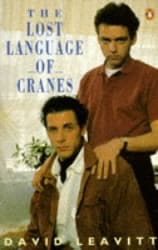
I sat down to write a review of “The Lost Language of Cranes in the middle of the night. And on the telly came a movie to which I was immediately attracted because there was a rather nice young man in it, who took his clothes ff quite a lot. He did this for an English painter who had gone to Italy to paint landscapes but had discovered the local attraction of greater interest, to wit: our young friend.
But – there’s more, his brother (the painter’s that is, who in another sub-plot is the model’s father) did something heroic against the Nazis In the war, and there is a move afoot to have him beatified (made a saint). The Catholic Church has sent a rather dowdy English priest to stop this cult because the painter’s brother although a great man was politically “difficult”
The first job our priest sets himself, however, is to disrupt the love between the painter and his model, preaching Catholic rhetoric at them. He succeeds in this and promptly sets about undermining the notion that the painter’s war-hero brother is a saint. Here he comes a cropper, he discovers that the war hero was better than himself and the Church, and goes through a realisation that his role in the life of the village is really quite destructive. When he gets back to his Italian bosses he doesn’t recommend the war hero as a saint as a slight to the Church.
There was far more to this story that I have described, and the characters were far greater in their roles than the story demanded. When one turns one’s mind to the Lost Language of Cranes this was noised about by the media as being noteworthy, one realises in comparison the above-mentioned movie (The Devil’s Advocate – a 1980 West German Religious Drama starring John Mills) with what a load of bogus pomp it was – full of vacuous ambiguity which has been misread as art.
[Patrick James]
Stars
Links:
ONCE ON THIS ISLAND – A Broadway Musical

Book by: Lynn Ahrens
Lyrics by: Lynn Ahrens
Music by: Stephen Flaherty
Some time ago I was lucky enough to get tickets for the penultimate night of the musical Once On This Island. The theatre was a hive of activity, with small stalls selling West African and West African artefact’s in the main foyer, in conjunction with an appetising smell wafting over everyone, from food being prepared for the party to happen afterwards – food which you would have difficulty finding normally in the United Kingdom.
The story iSean old one, which we have all heard about in various guises. A village has a iegend that a lovely girl will save the village, but in the process will die through the love for a man who was unobtainable due to birth and position.
The stage was made up into a West African village, with palms, hutSeand a semi-circular pier which disappeared up to the ceiling. It was eye-catching, and very atmospheric, particularly when the appearance of waves happened on the backdrop.
The cast were wonderful, and the singing exciting and excellent. The range of calypso, jazz, Caribbean rhythms, and operatic production, were blended so well, and the actors so buzzing with energy, that you soon became soaked into the plot, hoping for a different ending.
I came away from the theatre refreshed, feeling alive and wanting more…
Unfortunately, it will not be – as the show is now closed, having been on in the West End for only some six months. Why, you might ask. A surplus of musicals? The price of the tickets? But I believe it was the cost and problems of getting it transferred from New York, and produced in Great Britain.
I can only hope that some enterprising amateur group will endeavour to put this musical on in the future. I, for one, would go to it every night – for a slice of happiness.
[TMcF]
QUEENS

Auth: ‘Pickles’
Pub: Penguin
This book consists of 274 pages of text, some with relatively few words. There are fifteen pages of drawings ironically called ‘Plates’, (in the manner of a text-book) presumably also the work of ‘Pickles’.
I read this book in two sittings (and would probably have read it in one if I hadn’t been interrupted), ‘Pickles’ can certainly carry the reader along. I had assumed that it was going to be something good natured like Kate Charlesworth’s Exotic Species or the locally-produced Superdyke. Good-natured Queens is not.
In a Preface to the 1986 edition (it was first published in 1984) ‘Pickles’ writes “… gladness [is not] compulsory …”. Fair enough; but what is to be made of the following (P. 98): “An incestuous relationship with Uncle Brian probably made them what they are, along with a little love from mummy, and too much time spent playing with their sisters’ toySeand friends”? It could be ironic. But irony is something! to be used sparingly, like vinegar. Like vinegar, it should stimulate the taste and appetite – not kill both stone dead.
gain, on page 110, “It is reasonable enough to expect a masculine figure to behave like a man – but watch it walk”. That “it” is alienating: ‘Pickles’ is saying that he is not one of these people. This quotation and the one above comes from a description of Heaven (the London disco). This is where his gallery of queens ends up, after he has paraded them. They are all true-to-life, but ‘Pickles’, who in his 1984 Preface praises the “great queens” “colourful and sensational” challenge to drabness, clearly loaths his characters.
A reviewer, quoted on the back of the book uses the word “dis- relish”, but there is more to it than that. Genuine [self-]hatred is in there too, and so is sentimentalism. “Ben’s diary”, a thread through the whole book, ends in something like fulfillment for young Ben. Two elderly queens in the last few pages regret the past and criticise the present, in particular “rubbing people’s noses in it”. (Queers not being themselves “people”).
This book reads as if it had been written by Quentin Crisp’s reactionary alter-ego run riot. ‘Pickles’ (the vinegary pseudonym is well-chosen) can write brilliantly, but the repeated one-note jars, and is counter-productive. There’s plenty wrong with the commercial gay scene and Gay life in general, but this scab-tearing is futile. There is no sense of people being trapped on the treadmill of commerce, or even just human solidarity: these people are on the same level as the creatures which scuttle about when a stone is turned over.
The cover has a detail from St Mark on the Throne with Saints, …by Titian, or more likely, one of his apprentices. The detail is a picture of St Sebastian. The arrow is clearly sticking out of a rib, the Ilegs are a job-lot, which do not connect with the trunk. The exquisitely handsome face is the image of a semi-hippy boy I used to drool over in the early seventies … but I digress. This book is vile.
[Richard Lyttle]
No Sex Please – We're Cuban
Strawberry and Chocolate
- Actors: Jorge Perugorr a, Vladimir Cruz, Mirta Ibarra, Francisco Gattorno, Joel Angelino
- Directors: Tom s Gutierrez Alea, Juan Carlos Tab o

Coming to this film without any preconceptions, I found it a charming love-story. The Gay, bourgeois Diego (Jorge Perugariia) bets his camp, sculptor friend that he can pick up the sweet-faced David, a serious-minded young Communist. He doesn’t (quite) but a cagey relationship develops, where David (Vladimir Cruz) shares his interest in verse with Diego, who, in return, gets him into Scotch whisky, Marboro, Art and suppressed elements of Cuba’s cultural identity. (By no means all of it suppressed by the Castro regime). It iSean asexual version of the role of homosexual as mentor praised by, for example, Bryan Magee, in his 1957 book One in Twenty.
Diego places himself in an awkward position by complaining to Ministry of Culture about the aborting of a dissident art exhibition he had arranged with help from foreign embassies. He tries to prevent the disappointed artist from smashing his sculptures. These are gigantic representations of Catholic repository tat-art. This is the nearest the film gets to substantiating Diego’s claim to be “religious”.
David, in the meantime, has to stonewall (as in Jackson, not the zeatlot who shares his university accomodation. David is study ing engineering for social/socialist reasons. He gets [most of] his kit of at this juncture, and very satisfying it is too. The way he behaves, the way he allows his macho friend’s presuppositions to work to his advantage means that David is behaving like a closeted gay man. Contrasting with Diego who is right in-your-face.
As the film proceeds Diego becomes softer, as in less brittle and David’s presence. Eventually they embrace after Diego has escorted David around the dying Havana (looking stunning in this episode) “one of the most beautiful cities in the world”, prior to Diego going into unwanted, but inevitable exile.
This film was the object of a lengthy and ill-tempered review in , Sound, the high-brow answer TVQuick. The reviewer took the Director (Tomas Gutierrez Alea)* to task for making ‘a film of the sort that was made, on the subject of homosexuality, in the UK in the 1960Seand in the USA in the ’70s. Given the sexual culture of Cuba and Spanish America in general, that means that this film is more “advanced” than say, Victim [UK, 1962] or practically anything from the States before 1982’s Making Love.
Diego, despite what the above reviewer thought, isn’t a reactionary, or even a mere snob. He is a Cavalier. David is a Roundhead, Castro is Cuba’s Cromwell. That is why there is ambiguity about him in the Cuban population. He is leading them down a Via Dolorosa: but it is being paved by Uncle Sam. When Diego rails at his beloved Havana disintegrating into “the shit”, he is not only, (or even) railing at the Revolution, but at America which will not allow a bag of cement – or baby-food – into the Republic of Cuba.
* Alea was a very distinguished director, of Memories of Under -development for example, he was dying of cancer in the course of the making of this film. He was helped by another director called Carlos, Tabio – upstart
upstart has no view on the current regime in Cuba. But when the German Democratic [?] Republic allowed a Gay-themed film to be made the state collapsed! )
[Sean McGouran]
MARY RENAULT – A Biography
 Auth:David Sweetman
Pub: Harvest Books
The blurb on the [paper]back of this book claims it is "well-written . In the sense that all the facts are in their proper order and it isn’t actually ill-written, this is accurate. But it’s quite pedestrian, especially compared with RenauIt’s own writing, which Sweetman analyses in terms of “deviant sexuality”. .
Despite the fact that he uses words like “gay” (even though on one of its first appearances it is in inverted commas); this being an incident during Mary’s second visit to Greece, in 1962, when, wearying of a search for the distinguished musician Mikis Theodorakis, she insisted on going to a club her (male, straight) hosts considered …notoriouSeand hardly the place for a woman. It was a gay club. It is typical of Sweetman’s approach, on this as on other occasions in his biography he mentions the incident in passing. He is not interested in how, or why a woman in her late fifties, who lived at the other end of a different continent, acquired the knowledge of such an establishment.
This would be quite acceptable if he had not offered the reader interminable information about Mary’s shabby-genteel upbringing. Her mother, Clementine Challans (the name is Huguenot in origin) comes in for a great deal of criticism, but the poor woman only had normal, ordinary, human, faults. A snob, having married a doctor, she had the odd experience of sliding down the social scale. Her husband was not wealthy and could not buy a ‘smart’ practice so they spent most of their married life on the border of London’s East End.
Mrs Challans found the tom-boyish Mary hard to control, and turned to her other child, the more amenable Joyce. The Challans’s refused to divorce, though they argued incessantly. Sweetman places, the responsibility for this at the wife’s door, but Dr Challans’ aloofness (it seems to me) would have vexed Job. Clementine lived to a great age and Joyce nursed her in her last illness.
Mary Renault (she pronouned it Ren-olt: it was taken from a character in a Jacobean play), loved the theatre, but was spectacularly bad at acting, after a number of false starts, simply walked off the street in Oxford, and into the Radcliffe infirmary, saying she wanted to be a nurse. She was 28. She met her lover Julie Mullard, in her first place of work, and remained a professional nurse until taking up residence in South Africa in 1948.
Renault’s literary life is divided by the latter event, she wrote five books before and during the war. Her first was well-received but war-weariness soured the response to the later ones. She dealt with lesbianism in some of them, which, along with the (male) homosexuality dealt with in The Charioteer of 1953 almost put paid to her chances of publication in America.
Her New York publisher, Morrow, were scared by the anti-Gay hysteria raised by Senator Joe McCarthy, and his help-meet, the odious faggot Roy Cohn. Her first "Greek" novel The Last of the Wine was published in 1956 by Parthenon, a smaller imprint than she imagined (she remained over here, with Longmans, until she found she’d been sold to Allan Lane [Penguin] with the rest of their chattels in 1972. She then moved to John Murray). Sweetman implies that it was Parthenon’s marketing that made the Americans take Renault Sun more seriously than the British. The idea that the Yanks might be more perceptive than the Brits doesn’t seem to have crossed his mind.
But it is clear that they were more perceptive and welcoming of a major talent – so was America’s Gay scene, which was purchasing (in great numbers) Mary’s books on the most exulted form of male homosexual love well before Gay Liberation came along.
Sweetman does not ask why a lesbian, brought up in a repressed age (she was nine when the Great War broke out in 1914) should have exaulted (and she did!) in male beauty. There are, from her private letters, lyrical descriptions: of a Xhosa youth, of surfers on the beach near her Cape Province home, and of rioting (!) Zulus. It was the men who attracted her to ballet. There are interesting, but not strong, women in her "hospital novels, but only one genuine central character is female: Eurydike, Alexander the Great’s sister in law, in Funeral Games, her last novel. She is a destructive Kali-like figure.
This is a straightforward chronicle of Renault’s life, her battles, victories … and defeats. He is good on the war-weariness afflicting Europe, during and immediately after, WWII. It and an award of a large amount of money from MGM – drove Mary and Julie Mullard to South Africa. Mary became involved in the anti-Apartheid “Black Sash” movement in the ’50s/’60s, but was accused of being a reactionary in the 70s/80s. This was due to her insistence on the PEN (the international association of writers) Centres in Cape Town – of which she was Honorary President – and Johannesburg not lowering their entrance requirements.
Renault’s imagination dwelt in ancient Hellas (many scholars deemed her the greatest of their company), her dealings with contemporary politics are of little real consequence. Peter Elstob, sent to the RSA by PEN’s International Centre, in London, had been shocked by Renault’s attitude when he met her at the very start of his tour. He wasn’t so sure that he had all the answers by the end of it. The Xhosa and Zulu loathed each other, Black and Cape Coloured had problems relating, the two White tribes were at odds. Renault realised, after a while, that many Anglos in “Black Sash” were motivated by distaste (or worse) for the Boers, rather than a commitment to liberal values. She was quite right in refusing to patronise Black and Coloured writers by allowing PEN to lower its’ standards in South Africa.
[Sean McGouran]
ALTERNATIVE LOVES
Edited by David MARCUS
Pub: Martello Press
This collection of stories, edited by a man who surely haSean encyclopaedic knowledge of the modem Irish short story, proves rather conclusively (I fear) that alternative sexualities were not a major concern of Iish authors.
I found the first item, Sean O Faolain’s How to Write a Short Story rather unpleasant, indeed anti-Gay, and rather awkwardly written. William Trevor’s Torridge iSean oddity in this setting. All of the characters are of the English public-school type. The story is well constructed, but hardly life-enhancing. (I realise that this collection is not liberationist agitation, but surely the fact that most
of the stories are down-beat is relevant to a review of the first such collection?) .
I will deal with the “well-made” traditional stories fIrst. They are all well written. Ita Daly’s Such Good Friends, Ray Lynott’s: April, Val Mulkrn’s Memory and Desire, and John Jordan’s He Lay: Down on Me, all end in rejection or despair, or both. Ray Lynott’s’ story being the best-written and most subtle, Jordan’s being quite crude and unpleasant.
Of the others, Edna O’Brien’s The Mouth of the Cave barely exists, while Padraig Rooney’s Tabernacles is too ornate for its own good. Colum McCann’s Breakfast for Enrique is a trifle dour, but: well-written and heartening. It reads like the precis of a novel, rather than a ‘real’ short story. It deals with full-blown AIDS. Terry Prone also deals with HIV/AIDS, in a tremendously spirited and invigorat ing way, in Blood Brothers, Soul Sisters.
Three of the stories are meant to be funny, or at least amusing. Julia O Faolain’s The Widow’s Boy – a well-trodden path, but very well done. Frank Rowan’s Ringsend is a very funny yarn about a prissy Dublin queen who faces the ultimate horror… no, My Lips Are Sealed – read it yourself.
I enjoyed Patrick Boyle’s Shaybo, even though it is positively raucous. He is the only person from The (Wee Black) North represented in this collection.
I also found Emma Donoghue’s story Going Back very enjoyable and, thankfully, upbeat. But while it involved two Gay-identified young Irish people (of different sexes, having what reads remarkably.like a sexual relationship), they are in London.
Irish writers seem to fmd alternative loves rather exotic, as witnessed by the settings – France, San Francisco, London (it’s exotic if you’re queer in Kiltimagh). We also have the Stage, the Gaeltacht (in Ray Lynott’s April the unrequited love of a young priest for a beautiful brown-skinned ferryman) and in Desmond Hogan’s A Poet, and an Englishman the English poet is discovered by his complaisant wife in the arms of a teenage Traveller. You don’t get much more exotic than that.
Like all anthologies, this is uneven, but one hopes that the next such effort is full of the likes of Emma Donoghue and Colum McCann, and isn’t padded out with stuff from old hands like William Trevor, whose story here is from a British and specifically English tradition. It is not really about love: it is about wild justice.
Brian Finnegan’s cover is a bit odd (it shows two fully-dressed’ men being intimate), given that the book is sub-titled Irish Gay and: Lesbian Stories, and that half the contributors are women.
[S. McGouran]
WHEN LOVE COMES TO TOWN by Tom Lennon – Book Review
Auth: Tom LENNON
Pub: The O’Brien Press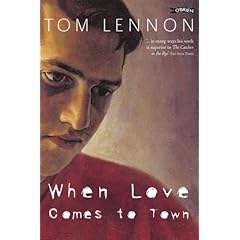
The central figure (hero, if you like) of this story (When Love Comes To town) is 17-year-old Neil Byrne. He is a sportsman and a good scholar. He is implicitly middle-class (his parents incessantly gripe about money, that’s how one knows). His response to the trauma of coming out, or being outed by circumstances, simply does not ring true.
Neil responds to an ad in what’s Hot Press, but aborts actual contact because the other man (the advertiser) is not as appealing as he claimed. Surely, an intelligent youth would have noticed ads for Tel-a-Friend, or articles on various Gay campaigns. He makes Sean intervene on a radio phone-in programme, but doesn’t hang around for the phone number (or numbers) which usually follow such broadcasts.
There wouldn’t have been much of a story then, admittedly, but one got the distinct impression, reading this, that we were not dealing with the 1990s (it was first published in 1993) but with the 70s, even ’60s. Master Byrne is just going to experience certain emotions and prejudices, whether these ring true or not.
The other characters in ‘When Love Comes to Town’ are rather shadowy, and authorial prejudices show:- sissies (including married transvestites!) are sound; bisexuals-are abused as what people in Belfast called “bendy-tries. “. The blurb claims Neil is “a new type of hero” in Irish fiction, but there are stock characters. The Mother is loving, suffering and forgiving (but, naturally, uncomprehending). The Da’s a bastard – as are nearly all of the heterosexual men, Neil’s fellow students for example. The treatment of the women is a bit off-hand, even slightly misogynistic. Neil’s lover is a grumpy Belfast man called Shane who loves him and leaves him (but not before introducing him to the joys of classical music)!
Tom Lennon (it’s a nom-de-plume [de guerre?]) has his cake of a happy ending, while giving us the full tragic-suicide finale (this happens inside Neil’s head: he is a bit of a Drama-Queen on the quiet). It is a well-made, entertaining naturalist/realist novel. But one is left rather wishing for something a bit more substantial and a bit more real.
Not everything in this island is rosy for Gay people – young, old, women or men – but l7-year-olds knew in 1993 (and know today) that there iSean infrastructure, built by Gay people, of telephone helplines, campaigning and social groups, as well a sporting and religious ones, bookshops, bars, bistros, saunaSean safer-sex projects. There’s a social group in deepest Fermanagh! Since law reform in the Republic, GCN’s listings have grown to include six of the smaller towns.
All of this suggests a dramatic change, which is surely worth writing about.
[Sean McGOURAN]
Links:
- « Previous Page
- 1
- …
- 5
- 6
- 7
- 8
- 9
- 10
- Next Page »