
ACOMSDave

Community Journalist

  • Home
  • Community Journalist
  • Events
  • Media Page and Press Kit
    • Projects and Work
  • Resources & Documents
    • LGBTQ+ Support Groups and Documents
  • NIGRA
  • Archives
  • Contact

Gay blood donation: Thirty men turned down over sex ban

12/10/2015 By ACOMSDave Leave a Comment

BBC News LogoBy Peter CoulterBBC News NI


Whole Blood

The NIBTS has stopped 30 men from donating blood at their clinics since 2011 after they said they had sexual contact with other men


Thirty men have been stopped from donating blood at clinics in Northern Ireland because they have had sexual contact with another man, a BBC investigation has found.

Elsewhere in the UK, there is a one-year deferral period for men who have had sex with men (MSM) to donate.
Northern Ireland has an outright ban.
But a judge ruled that former health minister Edwin Poots did not have the power to retain that ban. His ruling will be appealed in court later.
In the Northern Ireland Appeal Court on Monday, the current on-off health minister, the Democratic Unionist Party’s (DUP) Simon Hamilton, is appealing the judgement, alongside Health Secretary Jeremy Hunt.
They shall be asking who is in charge of blood policy and whether or not this is a devolved issue. The appeal is expected to last four days.

Screened

Following a Freedom of Information request, BBC News NI has seen emails sent between Northern Ireland’s Department of Health and the Northern Ireland Blood Transfusion Service (NIBTS), which is responsible for the collection, testing and distribution of blood.
The NIBTS also said it had stopped 30 men from donating blood at their clinics since 2011 after they informed staff that they had sexual contact with other men.
The BBC asked the NIBTS how confident it would be that its blood is screened correctly and that it would be safe for MSM to donate after the one-year deferral period.
It said: “All blood donations are subjected to the testing regimes required by the Blood Safety and Quality Regulations 2005.
“As such, NIBTS is confident that all blood samples are screened correctly.”

Direction

The BBC has also seen instructions sent to the NIBTS from Dr Elizabeth Mitchell, the deputy chief medical officer, instructing the organisation how to respond if approached by the media about the ban remaining in place.
Dr Kieran Morris, the former chief executive of the NIBTS, replied showing some concern about the process and how he would answer questions from his own staff.
“As chief executive officer and accountable officer for the NIBTS special agency service, I require from the Department of Health a written direction, giving me a clear line as to how we manage and control the situation,” he said.
“There is no doubt in my mind that referring all matters to the Department of Health press office will not be sustainable for more than a few days.”
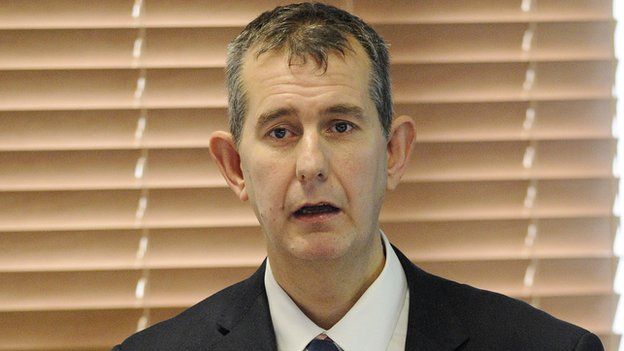
Edwin PootsImage copyrightPAcemaker
Image captionEdwin Poots, the former health minister, said he kept the ban on the basis of ensuring public safety

A BBC investigation earlier this year found the Department of Health does not have any medical evidence of its own to support a permanent ban on gay men donating blood.
The ban was put in place across the UK during the Aids crisis of the 1980s, but was lifted in England, Scotland and Wales in November 2011.

Irrational

New rules were introduced that allowed blood donations from men whose last sexual contact with another man was more than a year earlier.
But Northern Ireland did not follow suit.
A gay man, granted anonymity due to his perceived vulnerability, launched a judicial review challenge over then health minister Edwin Poots’s decision not to adopt the same policy on this side of the Irish Sea.
A judge ruled that Mr Poots’ decision was “irrational” and “infected with apparent bias”.
Mr Poots said he had kept the ban on the basis of ensuring public safety.
In April, the European Court of Justice (ECJ) ruled that a lifetime ban may be justified in member states if no effective detection techniques exist within the country.

Devolved

The ECJ said countries must establish if such donors were at high risk of acquiring infectious diseases like HIV.
Mr Hamilton said he would study the ruling.
A number of issues will be looked at in the Court of Appeal, including whether blood policy should be a devolved matter.
The appeal is expected to last for four days.
The NIBTS did not respond to the BBC to give an additional comment.
A Department of Health spokesman said: “It would not be appropriate at this stage to comment on matters that are before the courts.”

Filed Under: Anti-Bullying & Homophobia Tagged With: blood, blood donations, donation, gay, Northern Ireland, politics, Stormont

Gay marriage, abortion, euthanasia: 3 charts that show what Catholics and Protestants really think about the moral issues dividing Christianity

01/09/2015 By ACOMSDave Leave a Comment

Belfast Telegraph logoPUBLISHED31/08/2015

Catholics more liberal towards gay marriage than Protestants

Catholics more liberal towards gay marriage than Protestants

Catholics have a more liberal attitude towards gay marriage than Protestants – but are more conservative when it comes to euthanasia and abortion, a survey suggests.

YouGov questioned 863 Catholics and 1,707 Protestants in Great Britain – who strongly agreed with the statement “my faith is important to me” – on the three issues.

  • SHARE
  • GO TO

The results show that both groups are less accepting on the issues than the public as a whole.
Both same-sex marriage and euthanasia have been widely discussed within sections of the two churches recently.
Pope Francis is widely perceived to be a liberal influence on the Catholic Church – in 2013, when asked if there was ‘gay lobby’ in the Vatican, he replied: “If someone is gay and is searching for the Lord and has good will, then who am I to judge him?”
Last year meanwhile, the Church of England opposed legislation to legalise gay marriage in the UK.

More Catholics support gay marriage than Protestants

gaymar.jpg
Source: YouGov Get the data
Same-sex marriage was made legal in the UK in March 2014, with the exception of Northern Ireland.
It remains illegal for the Church of England to carry out same-sex marriages.
Previous YouGov research found 38 per cent of the Church of England clergy said same-sex marriage was right while the majority, 51 per cent, said it was wrong.

Protestants are more likely than Catholics to support euthanasia

euth.jpg
Source: YouGov Get the data
Both groups remain more conservative than the general population on voluntary euthanasia.
The former Archbishop of Canterbury Lord Carey has previously said that it is a “profoundly Christian and moral thing” to allow people to “end their lives with dignity”.
An assisted dying bill is expected to be debated in Parliament on 11 September.
Former Crown Prosecution Service chief Sir Keir Starmer has said it is time for politicians to legalise assisted dying.

Catholics want more restrictions on abortion laws

abortion.jpg
Source: YouGov Get the data
Both Protestants and Catholics are more opposed to abortion than the general population.
While abortion is legal in Britain, it is illegal in Northern Ireland, where it remains a contentious issue.
Last month, a United Nations committee said Northern Ireland’s abortion laws were putting women’s lives at risk.
The report concluded by calling upon Northern Ireland’s authorities to amend the country’s laws on abortion “with a view to providing for additional exceptions to the legal ban on abortion, including in cases of rape, incest, and fata foetal abnormality”.
Independent
Full Story at Belfast Telegraph

Filed Under: Anti-Bullying & Homophobia, History Tagged With: gay marriage, marriage equality, Stormont, survey

Minister’s vow on gay blood ban

19/05/2015 By ACOMSDave Leave a Comment

Belfast Telegraph
 

Simon Hamilton (right) and Edwin Poots (left) have been at the centre of controversy over the issue of blood donations

18 MAY 2015

Northern Ireland’s new health minister has said he will be guided by science and patient safety when deciding whether to lift the ban on blood donations from gay men.

The prohibition was lifted in England, Scotland and Wales in 2011 and replaced with rules allowing them to donate a year after their last sexual encounter with another man.
Former DUP health minister Edwin Poots kept the lifetime deferral in operation in Northern Ireland, citing “blood safety” issues.
Current minister Simon Hamilton said: “I will be guided by the science and medical evidence.
“There is an emerging body of evidence…I will monitor that, I will examine it, I will look at it carefully.”
He added: “This is a matter of patient safety. We must have an assurance.”
Mr Poots lost a judicial challenge to his ban and inferred he would not get a fair hearing from a court should he appeal against the decision.
Responsibility rests with the UK Health Secretary and an appeal has been taken to try establish authority in Northern Ireland, Mr Hamilton said.
In 2013 a judge said Stormont’s health minister did not have the power to keep an “irrational” lifetime ban on gay men giving blood in Northern Ireland.
The High Court also found that Mr Poots had breached the ministerial code by failing to take the issue before the Stormont Executive.
The ex-minister maintained the ban in Northern Ireland on the basis of ensuring public safety. But a gay man granted anonymity due to his perceived vulnerability launched a judicial review challenge to Mr Poots’ position.
The judge heard claims that the minister had displayed apparent bias that went beyond religious beliefs and into the realms of prejudice.
Sinn Fein Stormont assembly member Caitriona Ruane told Mr Hamilton it was an equality issue.
“I was glad to hear him say, however, that he will be guided by science and medical evidence, which is to be welcomed given the fact that his two predecessors based their stance on faith.
“The minister now needs to stand up and signal his intent to overturn this discriminatory ban.”

Filed Under: Anti-Bullying & Homophobia Tagged With: gay blood ban, health minister, politics, Simon Hamilton, Stormont

Stockport Academy Tackles Homophobia

15/05/2015 By ACOMSDave Leave a Comment

Editorial: When will homophobia be stopped in our schools in Northern Ireland.  When will Stormont and our politicians come together to fight homophobia.  We have just had an election, it will be interesting to see if they stand by the Friday Agreement on Human Rights.

The following article was republished from Gay Times

Students produce moving video in light of Anti-Homophobia Week

Students at the Stockport Academy have made a moving drama piece to coincide with Anti-Homophobia Week.
The short video is called Everybody’s Disapproval and is set to Hozier’s song Take Me To Church.
The emotive piece is shot in black and white, recreating and reinterpreting scenes from Hozier’s original video. It features both a young gay and lesbian couple being the victims of homophobic abuse.
Their short video concludes with a few statements and statistics to reinforce the overall message. “End homophobia today.”

The Academy is renowned for their zero tolerance to bullying and has previously received the Diana Award in 2014 for their campaign work in anti-bullying.
Words Tom Richardson, @tom20richardson

Filed Under: Anti-Bullying & Homophobia Tagged With: homophobia, Human Rights, politics, Stockport academy, Stormont

Scrapping Human Rights Act ‘would breach Good Friday agreement’

13/05/2015 By ACOMSDave Leave a Comment

Republished from The Guardian –

Henry McDonald Ireland correspondent

Tuesday 12 May 2015 11.34 BST

Belfast-based human rights organisation says Conservative government’s plans to ditch HRA will also violate international treaty

Theresa Villiers

The Committee on the Administration of Justice is seeking an urgent meeting with the Northern Ireland secretary, Theresa Villiers, about the implications of scrapping the HRA. Photograph: Will Oliver/EPA


Scrapping the Human Rights Act would be a breach of the Good Friday agreement that sealed the peace process in Northern Ireland, a Belfast-based human rights organisation has said.
The Conservative government’s plans to ditch the HRA would also violate an international treaty as the agreement in 1998 was an accord between two sovereign states – the UK and the Irish Republic, according to the committee on the administration of justice.
The CAJ (Committee for Administration of Justice) is seeking an urgent meeting with Theresa Villiers – who was re-appointed by David Cameron as Northern Ireland secretary in his new cabinet – about the threat to the HRA.
In a letter to Villiers, the CAJ’s director in Northern Ireland, Brian Gormally, points out that European human rights law was incorporated into the 1998 agreement.
He says article 2 of an annex to the Good Friday agreement binds the UK internationally to the multi-party deal, which was endorsed in joint referenda on both sides of the Irish border in May 1998; and, after it was ratified, both governments lodged the agreement as a treaty with the United Nations.
Gormally notes that in the section of the agreement guaranteeing the rights of minorities, the British government commits to “complete incorporation into Northern Ireland law of the European convention on human rights, with direct access to the courts, and remedies for breach of the convention, including power for the courts to overrule assembly legislation on the grounds of inconsistency”.
This part of the agreement is going to be used, for example, by campaigners who are seeking to overturn the ban in Northern Ireland on gay marriage, a challenge that has been blocked by the assembly in Belfast but will now be taken to the European courts.
Advertisement
The CAJ director says any move to tamper with or dump the HRA would undermine Northern Ireland’s fragile peace settlement.
“The secretary of state should urgently clarify the government’s position as to whether it intends to breach the Belfast/Good Friday agreement in this way. Such a step would make the UK an international outlaw and significantly roll back the peace settlement in Northern Ireland.”
Gormally stresses that the Human Rights Act and and the European court of human rights, and states’ compliance with them, had nothing to do with EU membership.
Founded in 1981, the CAJ monitors human rights abuses by the state and the security forces in Northern Ireland.

Filed Under: Anti-Bullying & Homophobia Tagged With: Act, Human Rights, Northern Ireland, Northern Irish politics, Stormont, Theresa Villiers, Westminster

Thousands in Northern Ireland are demanding referendum on gay marriage

29/04/2015 By ACOMSDave Leave a Comment

Reprinted from Belfast Live: Exclusive: Thousands in Northern Ireland are demanding referendum on gay marriage

19:29, 28 April 2015 By Jilly Beattie

Three people a minute are signing an online petition calling for the public to have the final say on the future of civil marriage

Chris Torbitt

Chris Torbitt


Three people a minute are signing an on-line petition calling for a referendum on gay marriage in Northern Ireland.
More than 5,000 people already signed up to the change.org petition created by Newtownabbey man Chris Torbitt in its first 24 hours, and the figure is rising fast.
The Northern Ireland Assembly yesterday rejected a proposal calling for the introduction of gay marriage, after debating the issue for a fourth time.
A total of 96 MLAs took part in the vote and 49 voted against the Sinn Féin motion calling for civil marriage equality for all. An other 47 were in favour and of 53 unionists, only four voted yes.
Sinn Féin, SDLP and five Alliance MLAs supported the motion. The DUP opposed it and the Ulster Unionists were given a free vote on the issue.

Now Chris says the people of Northern Ireland should be given the chance to decide.
The 26-year-old, who came out to his mum 13 years ago, told Belfast Live: “Equality is not a luxury, it is a right and at the moment in Northern Ireland civil marriage is not open to everyone therefore people are not being treated with equality.
“I want this to change, thousands of people want this to change and now I am asking people to sign a petition on-line to see how many people feel strongly about this. Our world needs to change, and only we can change it for the better.
“Being gay is not a crime or a choice. I came out to my mum 13 years ago and told my dad two years ago. He shook my hand and hugged me and they both told me I am their son first and foremost and anything else comes after their love for me. I wish there were more people like them and I think many people would support civil marriage for all if they were given the chance.
“Today the people of Northern Ireland have the power to effect change here.
“We have the ability right now to show our support to not only our LGBT family and friends but to all LGBT people throughout Northern Ireland, the United Kingdom and the Republic of Ireland.”
Chris spoke to Deputy First Minister Martin McGuinness on a live radio show and asked him if he feels the time has come for the NI electorate to supersede the Assembly and vote through a referendum on the LGBT civil marriage issue.
Deputy First Minister Martin McGuinness

Deputy First Minister Martin McGuinness


Deputy First Minister Martin McGuinness
He said: “His response to this was that he would be in support of a Northern Ireland referendum around this issue as he believes it would be successful.
“So now I’m asking people to send a message to Europe and the rest of the world that Northern Ireland is not the backward, bigoted, sectarian, stuck-in-the-past country that we are perceived to be.
“Instead we can be seen as a nation of people that will stand up for what’s right, stand up for equality, support one another and welcome all people of difference to our shore.
“Let’s show our politicians that it’s not up to them, we the people demand to be heard.
“For more than 30 years this little country has been plagued by bitter, bigoted, sectarian issues that even today are still unfortunately finding roots.
“Thankfully in today’s society this is a considerable minority as most of the inhabitants here want to move beyond to a bright and prosperous Northern Ireland where everyone is treated with respect, dignity and equality.
“This is not a political issue. This is not ‘orange and green’. This is simply about people who love one another so much that they would like to spend the rest of their lives together.
“Some may ask why they need to get married – can’t they just live together and share their life together or even get civil partnered? Won’t this change the definition of marriage?
“Civil Partnership does not provide the same protections to a spouse that Civil Marriage would. It is not the same thing.
“Marriage is something that everyone contemplates growing up. By not allowing LGBT people access to this they are being treated like second-class citizens; unworthy of the same legal standing as heterosexual couples.
“This in turn tells young people that it is wrong to be LGBT and therefore encourages a negative environment in which they feel they are abnormal and there is something wrong with them. This can have serious ramifications on mental health and physical wellbeing.
“Why shouldn’t they have the opportunity to get married the same as heterosexual couples? LGBT couples should be able to live life the same as heterosexual couples, make similar plans.
“Northern Ireland is the only part of the United Kingdom that does not have equal marriage legislation in place.
“The Republic of Ireland will vote through referendum to accept or reject equal marriage legislation. Polls currently indicate that equal marriage will pass in the ROI referendum.

The change.org petition is attracting huge support
“Civil Marriage will not change the definition of marriage to the detriment of what it currently represents. If we really look at what marriage is about then there is no reason to exclude LGBT people.
“The very essence of marriage is about love. Love between two people that want to spend the rest of their life together. Religious institutions will not be forced to provide same-sex ceremonies.
“Churches, mosques, temples etc will not be used for services celebrating same-sex ceremonies unless welcomed by that institution/organisation. Various protections will be built into equal marriage legislation for religious institutions/organisations.
“We need to do this, we need to look forward and move forward together.”

Filed Under: Anti-Bullying & Homophobia Tagged With: Chris Torbitt, gay marriage, Martin McGuinness, referendum, Stormont

Conscience clause: 'No anti-gay law' billboard tours Northern Ireland

20/03/2015 By David McFarlane Leave a Comment

All-Out's billboard against the 'conscience clause' Bill

All-Out’s billboard against the ‘conscience clause’ Bill

Reprinted from Belfast Telegraph – 19 MARCH 2015

A huge pink billboard objecting to the DUP’s “conscience clause” Bill has been touring around Northern Ireland in an attempt to convince Paul Givan to drop his proposed legislation.

The van has been paid for by a crowdfunding campaign among people around the world, who believe the MLA is introducing an anti-gay law that will legalise discrimination.
Mr Givan Private Member’s Bill was sparked by a case involving Ashers Bakery, whose Christian owners rejected an order for a cake iced with a message supporting same-sex marriage.
Ashers is facing a court battle over its decision to refuse to make the cake. The Equality Commission, which has taken the case against the business on behalf of the customer whose order was declined, has alleged the bakery’s stance was in breach of equality legislation.
But Mr Givan said he believed this was wrong and wants the law to be “rebalanced”.
Last month, 230,000 people signed a petition by gay rights campaign group All Out against his Bill.
Following this, 900 members crowdfunded the billboard van – paying for it to drive around Belfast and in Paul Givan’s constituency, Lagan Valley.
It parked up outside Stormont, Titanic Belfast and St Anne’s Cathedral, displaying the message “230,000 say no anti-gay law in Northern Ireland”.
All Out co-founder Andre Banks said: “The DUP’s anti-gay amendment would make it legal for businesses to refuse to serve lesbian, gay and bi people, just because of who they love. 230,000 All Out members signed our petition to make it clear that this just isn’t OK.  Not in Northern Ireland – not anywhere.
“Hundreds of thousands of voices opposing the proposed anti-gay amendment were taken straight to politicians in Northern Ireland. More than 900 of us chipped in a small donation, so a giant billboard van with our message for equality could drive non-stop around Belfast and Paul Givan’s constituency, to push him to drop his anti-gay plan.”

What does the proposed bill mean?

  • Paul Givan says the focus of his Northern Ireland Freedom of Conscience Amendment Bill is “making space for rights that clash”. He says it aims to “make space for providers” and proposes that businesses may refuse a situation where they feel they are required to “endorse, promote or facilitate a same-sex sexual relationship in violation of his/her faith identity”.
  • For example, a Catholic adoption agency could refuse to place a child with a same-sex couple, a Muslim printer could refuse to print a book promoting same-sex sexual relationships and an evangelical photographer would not be required to choose between taking photographs at a civil partnership ceremony and losing their livelihood.
  • But, Mr Givan says, an evangelical grocer could not refuse to sell an apple to a gay man, or a Muslim printer could not refuse to print a brochure publicising coffee tables made by a lesbian cabinet maker.
  • The Rainbow Coalition, which supports gay rights, has claimed that under the Bill restaurants could deny a same-sex couple, a mortgage provider could deny a mortgage to a same-sex couple, and hoteliers could deny a room to a same sex couple as all could be seen as endorsing or facilitating same-sex relations.
  • The draft Bill has been published on the DUP website. The party is inviting responses about its contents to be submitted to its headquarters on Dundela Avenue in east Belfast. The consultation will close at 5pm on Friday, February 27.

All-Out's billboard against the 'conscience clause' Bill

All-Out’s billboard against the ‘conscience clause’ Bill


Filed Under: Anti-Bullying & Homophobia Tagged With: anti-gay law, conscience clause, crowfunding, Stormont

Church of Ireland split over gay rights and DUP's conscience clause Bill

09/03/2015 By David McFarlane Leave a Comment

I am reprinting an article which appeared in the Belfast Telegraph on March 4th, 2015 about the proposed ‘conscience clause’ being introduced into Stormont.  What I find interesting is the rhetoric being used by both the politicians and the church in favour of this clause.  In November 2010, The Daily Telegraph published a letter from religious leaders urging the then Labour government to reconsider the lowering of the agent of consent.  It was signed by 17 signatories, including the former Archbishop of Canterbury, George Carey and Cormac Murphy-O’Connor, head of the Roman Catholic Church and the secretary general of Muslim Council of Great Britain.

The letter stressed strong ‘moral’ objections to the lowering of the age of homosexual consent: that it brought alleged health risks, and ran counter to “the beliefs of many religious people – Christians, Jews, Muslims, Hindus,” and that the legislation was contrary to public opinion.
To accept this ‘conscience clause’ is to accept a step back to the days where we had no rights.  I honestly urge you to write to your councillors, MPs, Stormont representatives and tell them that this clause is wrong.
The Stop the Clause petition had more than 148,000 people who have signed the petition against the Northern Ireland DUP-backed “conscience clause” bill that would permit anti-gay discrimination.


Church of Ireland split over gay rights and DUP’s conscience clause Bill

Canon Charles Kenny, left, and Rev Adrian DorrianCanon Charles Kenny, left, and Rev Adrian Dorrian
Canon Charles Kenny, left, and Rev Adrian Dorrian
BY JOANNE SWEENEY – 04 MARCH 2015
A split has opened in the Church of Ireland over its attitude to the DUP’s ‘conscience clause’.
An article in tomorrow’s Church of Ireland Gazette newspaper has sparked off an angry reaction from a pro-LGBT pressure group.
In the article, the Rev Adrian Dorrian, chairman of the Church and Society Commission, said he broadly welcomed the Bill introduced by the DUP’s Paul Givan.
If passed, the Lagan Valley MLA’s Private Members Bill would allow those with strongly-held religious beliefs to refuse to provide certain services.
Mr Dorrian said he would seek amendments to the bill to “ensure it cannot be used to facilitate discrimination against members of the LGBT community”.
The Bill was introduced by Mr Givan after the Equality Commission took legal action against Asher’s Bakery over its refusal to make a cake with a message promoting gay marriage.
Rev Dorrian said: “We will certainly encourage a comprehensive conversation around religious and civil freedom in Northern Ireland and I will be affirming the Church of Ireland’s position that marriage ‘is part of God’s creation and a holy mystery in which one man and one woman become one flesh’.”
However, Canon Charles Kenny from the Church of Ireland’s gay rights group Changing Attitude Ireland said Rev Dorrian’s views may not be representative.
The Church of Ireland did not make a formal written response to a consultation process on the bill which ended last Friday.
Rev Kenny said: “I hope that the Rev Dorrian’s view is not shared by all members of the Commission or the wider membership of the Church of Ireland.”
“This is more Mr Dorrian’s views, as he’s known as a social conservative, rather than the views of the Church and Society Commission as they have not put out any official response to the DUP over the consultation.
“He seems to be making this an issue between gay people on one hand and Christians on the other.
“And it’s not. There are lots and lots of members who do not accept the hardline, fundamentalist, biblical literalistic line that Mr Givan and the DUP has as a whole.”
He said that he was dismayed at the anti-gay motivation and tone of the DUP’s conscience clause but was heartened by the nearly quarter of a million signatories to an online petition against it.
Last night Mr Dorrian confirmed that the Church and Society Commission had yet not met to discuss its official response, although he and several other Commission members met Mr Givan yesterday.
He said: “With regard to the Ashers Bakery cake I think the vast majority of Christians seem to think that there is mismatch between the Ashers case in relation to the charges being brought against the bakery and what actually happened. The Church of Ireland is very clear that there can be no room for discrimination, but that doesn’t mean that there can’t be a disagreement about how to interpret the morality of such things.”
In 2012, the church’s Synod voted to reaffirm its support of traditional marriage between a man and a woman.

Filed Under: Anti-Bullying & Homophobia Tagged With: church of ireland, conscience clause, DUP, Stormont

What Does the Northern Ireland Assembly Know on Homosexuality?

29/07/2013 By David McFarlane Leave a Comment

A reflection of our times:
 

The City Hall in its coat of many colours

The City Hall in its coat of many colours


Stormont Northern Ireland

Stormont remains in its ‘vanilla’ coat


The following two motions were put forward to the Assembly in December 2012, both motions highlight just how the assembly still is failing the LGBT part of the community, because both motions have still be acted upon.
 

  • Lifting the Ban on Homosexual Men Donating Blood

That this Assembly notes that Northern Ireland is now the only region in the United Kingdom where homosexual men are banned from donating blood; further notes the findings of the report on Blood Donor Selection Criteria Review in April 2011; considers it to be unreasonable and intolerant to continue to turn away suitable donors; and calls on the Minister of Health, Social Services and Public Safety to lift the ban and to adopt the same safeguards as those that have been implemented across the rest of the United Kingdom.
[Mr J McCallister]
[Mr S Gardiner]
 

  • Bullying in Schools

That this Assembly acknowledges the negative impacts of bullying in schools; recognises the increase in cyber bullying and the endemic nature of homophobic bullying in schools in Northern Ireland; notes that bullying is linked to an increased risk of isolation, depression, self harm and suicidal ideation among young people; calls on the Minister of Education to acknowledge the particular issue of homophobic bullying; and further calls on the Minister to develop immediately a comprehensive and wide ranging anti-bullying action plan and to begin a programme of work, with schools, to make them safe and welcoming environments for all our young people.
[Mr S Rogers]
[Mrs D Kelly]
[04 September 2012]
Notes from the Northern Ireland Assembly
An article by Eamonn McCann ‘Stormon in Dark Ages over homosexuality’, published  in the Belfast Telegraph 18 July 2013,  would seem to give further evidence towards this in a small way, but what was more enlightening was the off-the-cuff comment by the young woman at the desk of the British Museum on being told that there was little represenation of the Celts or the Ulsters Scots in the British Museum’s sumptuous collection of gay artifacts from civilisations across the globe and down the ages – “Well, they’ve always been a bit odd over there, haven’t they?”
In July 2011, Dolores Kelly said ‘…members of the lesbian, gay, bisexual and transgender community must “push” to make their voice heard.
“I think they need to push hard and hold to account their political representatives,” Ms Kelly said.
“Particularly the leader of the biggest party here in the north which is of course the DUP and I think they have to be challenged on all fronts.”
Politics in Northern Ireland is not just about religion, it is about bias and ignorance on many fronts,  The LGBT community needs to organise itself and to communicate with and pursue its local and national representatives into supporting the needs of our community.  (UTV Report)
 
Just after I wrote this piece, I was forwarded an notification on the

UN Human Rights Office Launches Unprecedented Global Campaign for Lesbian, Gay, Bisexual and Transgender Equality

I am attaching a copy of the document for information and look forward to our community being actively involved in delivering ‘Equality for the LGBT Community’

UN Human Rights Office Launches Unprecedented Global Campaign for Lesbian, Gay, Bisexual and Transgender Equality

human rights defenderUnited Nations HUman Rights - Office of the High Commissioner

 
human-rights-not-an-option

Filed Under: History Tagged With: Belfast Telegraph, British Museum, gay, homosexuality, Human Rights, human rights defender, LGBT, Stormont, united nations

  • « Previous Page
  • 1
  • 2

Categories

Copyright ACOMSDave.com © 2026