For queer people, in many ways, there has never been a time in history like the present. Although oppression and inequality are still rampant, there have also in recent years been a number of firsts, breakthroughs and other positive developments that once seemed like they would never come.
2014 was an especially good year for queer equality in the U.S. Over 60 percent of Americans now live in states that permit same-sex marriage, and advocates in ever-increasing numbers are speaking out for the cause.
We don’t mean to suggest that there haven’t been setbacks, or that things aren’t still wildly unjust in almost every part of the world. But at the same time, we think it’s worth observing, and celebrating, the real progress that the 21st century has brought to many.
Below, we’ve rounded up some of the most important milestones in queer rights from the past 14 years. We can’t wait to see what’s in store for 2015 and beyond.
Note: For ease of navigation, we recommend viewing on a non-mobile device.
Link to Timeline
Outburst Queer Arts Festival
The Outburst Queer Arts Festival runs from the 14th to 22nd November 2014. It’s programme is wide ranging and will have something for everyone, so please do try and get to at least one event and support a cracking organisation and series of events
Click HERE to be taken to their website check out the events

Cafes and restaurants in Botanic
Comment by Sean:
I recall queer kids being shoo’d out of cafés and restaurants in Botanic Avenue in the 1980s, because they couldn’t really afford refills of their teas and coffees. And there were no caffs outside of Botanic; and elders on the queer’s bench (beside the Gents) didn’t like then hanging about, partly because they were cute – and partly because they scared-off the closets who used the Gents for pick-ups or quick relief….
LGBT HISTORY MONTH: A pre-Stonewall LGBT sit-in
Special to the online edition of Windy City Times
by Ray Simon, Philadelphia Gay News
2014-10-28
The sit-in at Dewey’s, which occurred at a Philadelphia restaurant in the spring of 1965, is not as well known as the Stonewall Riots, but it deserves wider recognition.
On the evening of Sunday, April 25, 1965, staff at the diner turned away more than 150 people they believed to be LGBT. According to the August 1965 issue of Drum magazine, which mixed beefcake pictorials with news for gay men, the restaurant’s staff refused “to serve a large number of homosexuals and persons wearing non-conformist clothing.”
Eventually, three teenagers — two boys and one girl — refused to give up their seats, in effect beginning a sit-in. In the week that followed, LGBT activists used tactics borrowed from the civil-rights movement to put pressure on the restaurant’s owners until the ban was lifted.
On closer examination, the sit-in at Dewey’s suggests that gay militancy began at least a few years before Stonewall. It also hearkens back to a time when gays, lesbians and transgender people clearly saw their struggles as intertwined.
For Marc Stein, a professor of history at San Francisco State University, the sit-in at Dewey’s not only adds to our knowledge of the past, it also prompts us to reevaluate our current understanding of LGBT history.
“I think one of the important things to see is that there was a history of these episodes for at least five years before the Stonewall Riots,” Stein said during a telephone interview.
“I think for a lot of us,” he continued, “if there’s one thing we want to challenge, it’s the notion that the movement began at Stonewall or the notion that Stonewall was the first time that gays and lesbians, that LGBT people, fought back.”
The story of the sit-in at Dewey’s may very well have been forgotten if it were not for Stein. The mainstream media ignored the incident then and it received scant attention from scholars before Stein began his research. Fortunately, a handful of men and women mentioned the restaurant to the historian while he was interviewing them for his book, “City of Sisterly and Brotherly Loves: Lesbian and Gay Philadelphia, 1945-72.”
Dewey’s was a small, family-owned chain of diners that operated in Philadelphia from the 1940s to the 1970s. When the chain’s owner, Farrel Yesner, passed away in 2003, his obituary stated that “Dewey’s doled out tasty comfort food to customers at restaurants that were mostly old-fashioned lunch counters.”
The all-night eateries served customers from all walks of life, but its 13th Street and 17th Street locations drew many LGBT customers, especially after the bars closed. According to Laurie Barron, one of Stein’s interviewees, the restaurant was known as “Fag Dewey’s.” And another, Joan Fleischmann, told him that at Dewey’s “you’d find streetwalkers, you’d find drag queens, you would find everybody.”
Why things came to a head on Sunday, April 25, 1965 is unclear. The June 1965 newsletter of the Janus Society, the local homophile organization, indicates that the diner’s management had grown tired of a group of young LGBT kids just sitting around, being rowdy and ordering little, so it encouraged its employees to shoo them away.
As Stein put it, “What I do know is that in the months or years leading up to the Dewey’s sit-in, that Dewey’s had become a late-night hangout, especially for young people and for lots of people we would now call trans.”
That night, staff interpreted the directive zealously. Eventually, three teens refused to budge, the police were called and so was Clark Polak, a local LGBT businessman and advocate. At the time, Polak was head of the Janus Society and also published Drum magazine.
Exactly what Polak did that night is unknown. The businessman claimed that he was advising the teens of their rights, but Stein acknowledges it’s easy to imagine him getting cantankerous.
“We know from other stories that Polak would scream and curse at the police, but he would also argue. He was almost fearless. So I’m sure emotions got intense,” Stein said.
The police promptly arrested Polak and the three teenagers. The savvy businessman quickly organized a picket outside Dewey’s. Roughly 1,500 pieces of literature were distributed to customers and passersby over the next five days. Finally, on Sunday, May 2, just one week after the initial confrontation, a handful of teenagers began a second sit-in.
The police were once again summoned, but this time they refused to arrest anyone. Both parties spoke to one another, the situation was defused and the restaurant resumed serving LGBT customers.
This was no small victory. Writing in the Janus Society’s May 1965 newsletter, its editor, Barbara Horowitz ( who signed her work Barbara Harris ), asserted, “There is no reason to assume that this cannot be called a job well done.”
That same editorial also makes it clear that Horowitz, and, by extension, Polak, recognized that what took place was about more than just being able to order a cup of coffee. As Horowitz wrote:
“All too often, there is a tendency to be concerned with the rights of homosexuals as long as they somehow appear to be heterosexual, whatever that is. The masculine woman and the feminine man often are looked down upon by the official policy of homophile organizations, but the Janus Society is concerned with the worth of an individual and the manner in which she or he comports himself.”
That statement suggests that at least some LGBT activists saw the limitations of pursuing a policy of militant respectability, which was, roughly speaking, the notion that straights would accept LGBT people if only LGBT people could demonstrate that they were just like everybody else.
There is still more work to be done regarding Dewey’s. Who were the three teenagers arrested that first evening? Were they the same teenagers who initiated the final night’s sit-in? Who manned the picket lines? Were the people involved in the action radicalized by it? What happened to them as the years passed? These remain unanswered questions.
Perhaps fighting for the opportunity to sit in a diner and order a meal appears trivial, but it is important to remember that the civil-rights movement had already demonstrated that seemingly mundane actions could have profound implications.
Studying the sit-in at Dewey’s, Stein discerns significant implications for our understanding of LGBT history. Later in the 1960s, a new kind of LGBT activism emerged: the gay liberation movement, which was more radical than the earlier homophile movement.
For many, Stonewall was the momentous beginning of that next phase of activism, but Stein believes otherwise. In the sit-in at Dewey’s, he finds evidence of LGBT militancy beginning much earlier than 1969.
“The idea of fighting back, the idea of borrowing tactics from the civil-rights movement, that stretches back 20 years before Stonewall,” he said.
As Stein and his fellow LGBT historians do more research, a fuller picture of LGBT life in the decades after World War II is taking shape. The sit-in at Dewey’s, for example, can no longer be dismissed as an isolated, random event, thanks to the work of transgender scholar Susan Stryker.
Her 2005 documentary, “Screaming Queens: The Riot at Compton’s Cafeteria,” examines a 1966 incident in San Francisco that is strikingly similar to the sit-in at Dewey’s with one difference: at Compton’s, the drag queens literally punched, kicked and scratched to defend themselves.
Obviously, more work must be done. But recognizing the significance of what a ragtag group of LGBT teenagers and the adults who supported them accomplished at Dewey’s is a good first step.
Ray Simon is an editor and freelance writer in Philadelphia. He has written about everything from cryptograms to drag kings, and environmental sustainability to video games.
View the leaflette handed out at the Dewey’s demonstration April 1965 at the link:www.windycitymediagroup.com/pdf/DeweyLeaflette1965.pdf .


Found – Queer political publication from World War II
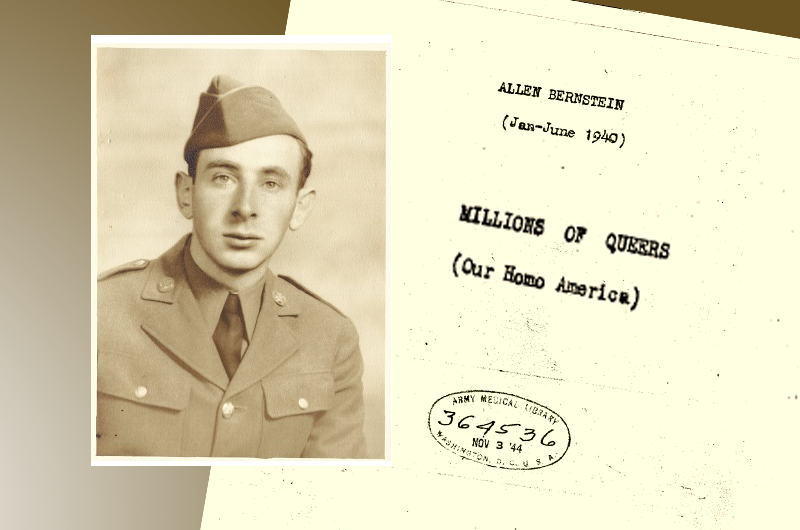
Allen Bernstein and his 1940 paper | Drexel | 14031
A previously unknown 149-page manuscript from 1940 defending homosexuality, entitled “Millions of Queers (Our Homo America).” by Allen Bernstein has been discovered. Drexel University’s Randall Sell found the manuscript in 2010 while searching the National Library of Medicine for the earliest uses of the term “queer” in reference to homosexuality.
Mr Sell is an avid and accomplished LGBT history researcher with a track record of unearthing early gay manuscripts.
Bernstein offers a libertarian argument that homosexuals don’t hurt anyone, should not be criminalized and stigmatized and should be left alone to work out their non-conforming lives by themselves. Expressing such a view, and signing his name to it, as Bernstein did in several essays, was a daring, radical act in its day.
Bernstein’s essay is unusual for its use of common, derogatory terms, especially “homo” and “queer”, as casual, value-neutral labels, decades before the term “queer” was reclaimed with pride by LGBT groups beginning in the 1990s.
Bernstein’s document is also a rich source of historical insight into gay culture from the 1920s and ’30s. It offers glimpses into hundreds of lives based on Bernstein’s direct observation and a network of pseudonymous informants. Included are anecdotes about an active Boehmian queer culture in Boston, stories about gay men’s lives in heterosexual marriages, legal persecution of homosexual behavior, and the deaths of queer friends by suicide.
Gay History – Found – Queer political publication from World War II
Mayors Join in Queer Festive Fun, Celebrating Christmas in Queerspace
Queerspace celebrated Christmas in style with support from Andrew Muir, the Mayor of North Down, Lord Mayor of Belfast Máirtín Ó Muilleoir and the Rev. Chris Hudson MBE from All Souls Church. The festivities commenced with a packed bus tour, generously supported by the Department of Social Development. A sea of red Santa hats brightened up the streets of Belfast and back to a Christmas Party with refreshing mull wine and fine snacks prepared by a small army of volunteers.
The Lord Mayor of Belfast said “I am delighted be here at the LGB&T Centre in Waring Street celebrating
Christmas with our friends from the LGB&T Community. It has been my experience over the last 6 months as Lord Mayor that the gay community makes an enormous contribution to Belfast, is a great contributor to the City of Belfast and by being here I am giving thanks for that and renewing my support for the concept of including all our people in celebrating diversity in the City”.
The Mayor of North Down said that there has been massive change in Northern Ireland society since he came out in 1996. “The city has also evolved and became a lot more prosperous and peaceful and we have much further to go. We have got to create a city and a Northern Ireland of equals where people are treated equally and celebrated as valued citizens and to do that we need leadership from people to say that diversity is good and should be embraced”. Mayor Muir continued to say “it is great to be here with leaders of change from within the lesbian and gay community and also people from civic society and to transform our society we need more leadership and I am glad to be with people who have been very inspirational”.
Rev. Hudson gave credit by saying “You people yourselves have been a real catalyst for change here in the
wonderful city of Belfast and in many ways the peoples voice is ignored and it’s important that it is heard and how it is heard is when people like Máirtín and Andrew use their office for good authority”. Rev Hudson continued to say “They look at people who appear to be on the margins who are excluded and say that’s not going to happen on my watch and we are really fortunate both in North Down and here in Belfast to have two people of excellent authority who have actually stood up showing new light to how this city and how this province can change and you people are part of that change”.
Queerspace is a vibrant volunteer led community group, based on collective planning and action which has served the Belfast LGB&T community since 1998. It’s run through open community meetings which are held on the 1st and 3rd Saturday afternoons of every month followed by a social space where members can relax, enjoy some free refreshments and meet with friends, old and new. Queerspace promotes and organises a wide range of social and cultural activities for the benefit of the LGB&T community and friends throughout the year.
For more information email info@queerspace.org.uk or visit the web site at www.queerspace.org.uk or find it on Facebook.
A Mom Almost Talks to Her Gay Son

The Non-Normative Conversation:
A Mom Almost Talks to Her Queer Son
Words by The Mothership
I was looking for a parking space in West Hollywood the week before Gay Pride.
“Mom, what’s Gay Pride?” said my eight-year-old daughter, Shannon. I guess she’d read the signs while I was trying to park.
“It’s a big party for gay people,” I said.
“What’s gay people?” asked her brother, Danny, who was five.
Whoa, I thought. This is a Formative Moment. This is One of Those Discussions They Remember Forever and I am without a thought in my head. How strange. I have plenty of long-time gay friends, I’ve lived in West Hollywood—I’ve even done summer stock! I should know what to say.
“Well,” I tried. “Boys who are gay like boys better than girls, and girls who are gay like girls better than boys.”
There was a long silence from the back seat.
“Mom, are we gay?”
Truth is always good, right?
“Well,” I said. “I’m not. But you might be.”
You can cringe if you want. I completely understand. To this day, I’m not sure if I gave the World’s Best Answer or the World’s Worst Answer, or if I just said something stupid. But then that describes all of parenting—you’re never really sure if what you say or do is good, bad, harmful, lame, ridiculous, or might actually make an impact and turn these moldable little creatures into magnificent human beings.
The parental paradigm, in other words, is always shifting.
So when I got the email from Danny, now in college, that started, “Well here’s an email for you, potentially surprising (probably surprising), maybe totally predictable, but read all of it, and understand that things will be different once you read it!” was I surprised? Yes. No. Maybe a little.
Dan apologized for coming out via email. His father had been visiting him at school and he told him the night before. Now Dan wanted me to know. He wrote, “Something about the ‘coming out’ proclamation 
seemed totally unsuitable for me, so I never wanted a grand statement. But I think the reality is, this kind of relationship is effectively non-normative, and there is no social apparatus for talking about it (at the beginning) normatively.”
Uh…
Normative (Adjective)
1: of, relating to, or determining norms or standards <normative tests>
2: conforming to or based on norms <normative behavior> <normative judgments>
3: prescribing norms <normative rules of ethics> <normative grammar>
The boy always did love his vocabulary. But I saw he was right. I wanted to find a common language with my son. I wanted to talk about it, normative or not, but somehow like that day in the car, the words just didn’t come as easily as I thought they should.
So Danny and I took refuge in the language of academia. And Google chat. And text messages. Sometimes I think that Danny is impatient with what must feel like my slow grappling with this information. When I asked him if he told his sister, he wrote, “Yeah, yeah. I will. The whole point is to not make it a big production.”
“It’s kind of a big production,” I wrote back.
“I mean,” he responded, “it’s just like there’s not a societal apparatus for having non-normative sexualities. Your difference has to be announced, which is problematic, and useful, to be sure, in a political way.”
And then the killer: “There’s something symbolically violent about the identity game. IS THIS PERSON SO-AND-SO, I TOTALLY KNEW IT.” And then, even more damningly, “Which, for the most part, is done by traditionally straight people, done from a position of stable gender identity.”
That’s me. Stable gender identity. I suppose I have something that Danny, at this point, does not. And even pre-“announcement,” I totally knew he was gay. And I felt so very traditional, almost embarrassed, when I read those words.
A few months ago, I asked Danny if he wanted to come home for spring break, maybe even bring his boyfriend, Scott. (“I prefer partner,” Danny responded, which was refreshingly earnest non-gender-based early-twenties enthusiasm for the current relationship, which will undoubtedly go on forever.) During his previous two years of college, Danny had always politely refused. But this year, he emailed, “You know, I think I would.”
I told Danny I would like to give a party.
“That might freak Scott out,” Danny wrote.
“He’ll deal, “ I wrote back.
“Who would you invite?” Danny asked suspiciously.
“People,” I responded.
“I might not book something yet,” Danny said. “Scott might be totally embarrassed.”
Some general talk about plane fares followed, then “Scott is voicing his anxiety about being thrown a party” and then a plea for money to buy “suit things” for an upcoming interview.
Another message appeared on the screen: “Scott is attacking me for mincing his words. He, in fact, WANTS a dinner party, thus…throw a party!”
I hesitated before sending the invitations. By calling Scott “Danny’s boyfriend” am I making an “announcement”? Turning the event into a “production”? Where are the rules? Where’s the handbook?
I finally settled on “special guest, Scott,” figuring it was about as neutral as I could get.
Immediately, Danny emailed back, “Why is Scott a special guest?”
“Why not?” I answered.
“It’s a little weirdly ambiguous is all, I mean,” he wrote. “I guess our relationship will be news that night!”

The party was a huge success. People either figured it out, or didn’t, or were just glad to see the young man who was once the chubby-cheeked little boy that they knew and loved. But when one friend offered to take Danny and Scott out clubbing in West Hollywood, Danny told me, “I don’t know about that!” Danny was only willing to take his new self so far. The living room was fine—more or less—but Santa Monica Boulevard? Not so much.
And here’s the odd thing, or maybe it’s not: Danny and I have never once spoken in person about his new—ah, what? Identity? Orientation? Newest personality that Danny’s trying on for size? In all honestly, I’m a little worried to talk about it. Gay or straight, it’s not easy to negotiate the ground rules with a newly formed adult. As much as I’m not sure what my role is, I’m not sure he knows what his role is, either.
A few days ago, while I was at work, Danny sent me a message with a link to his newest college project website. I clicked on the link and QUEER CULTURE: ART, STABILITY AND CHANGE in very large letters popped up on the screen.
“Look, everyone!” I said with pride. “It’s my kid’s newest work!”
I told him it looked fantastic.
And he told me that meant a lot.
We stumble on.
Images: Photos.com, for illustrative purposes only.
When I read this article it reminded me of this book published in 1975 by Laura Z Hobson “Consentint Adult” – a series of letters from other and son on him coming out, and how impacts on the family. There are 37 years of history between the book and the article, but in some ways I must ask has society really moved on?
QUEER HUMANISM
In the article Queerish London I made a smart-alecky remark about Gay / Queer Humanism. Then I found the notes I took on the occasion of the talk by the novelist Jonathan Kemp… It was a substantial and interesting talk. He felt that Humanism like ‘queer’ was questioning and critical. ‘Queer’ questioned ‘normality’ and the ‘normative’. Is homosexuality simply a variant sexuality – or is there more to it than that? ‘Homosexual’ was coined in 1869; in 1878 came ‘heterosexual’. This had to do with the (presumably national – upstart) ‘identity politics’ as practised in ‘Britain’, France, the US and Germany – a Gay Pride demonstration at any time between 1890 and 1970 is simply unimaginable.
‘Homosexual’ held fire for some decades, but between 1895 and 1905 over a thousand books were published on the matter. They expressed every possible reaction to ‘the problem’. Except what we today would regard as a liberationist one. Even Edward Carpenter, (a very famous poet / advocate at the turn of the 19th / 20th century), was craving indulgence. There is still debate about whether or not ‘homo / hetero’ is a dichotomy, Jonathan quoted Foucault’s rejection of the notion and his reassertion of Freud’s idea that everyone is born ‘polymorphous perverse’. Those who label themselves ‘Lesbian and Gay’, want (in the title of Bruce Bawer’s book, A Seat at the Table), ‘queers’ want to burn the table.
Only connect
It is a vivid image, but ‘Gay’ people – as in the Gay Liberation Front – also wanted to burn it. We did not merely grow old, crabby and ‘reformist’, and add an ‘L’ to our titles. We realised that we did not have the social power to bring about a revolution. The ‘Gay’ movement was a product of the feminist / Women’s movement, and similar trends in the 1960s and 1970s, including the African-American Civil Rights (and after, ‘Black Power’) movements. A major strategist of the former was the ‘shamelessly’ Gay Bayard Rustin. The Black Panthers, as a movement, supported GLF. Most early members of the NI Gay Rights Association had been members, or at least supporters of, the NI Civil Rights Association. (When EM Forster wrote “only connect’…” he articulated something substantial.)
What homosexual, bisexual, transsexual, queer (and ‘L&G’) people want to ‘integrate’ into today (2012 / 2013) is a society we have done a great deal to change. I’m not suggesting that Mr. Kemp is claiming that British / English society is an unchanging monolith – but the change in the UK since I was 13 (March 1, 1960) seems barely credible. Abortion was illegal, as was suicide (incredible though that may seem). Trade unionists appeared on television justifying strikes against the employing of some people, because of their skin-tint. Reputable journals campaigned against homosexual men – simply for being. Most never mentioned ‘the problem’ unless it became impossible to ignore. The Observer, the Times, and some enlightened provincial papers (CHE [Campaign for Homosexual Equality]-founder Allan Horsfall’s local Nelson Leader for example), took a rational attitude to homosexuality, and to law reform.
‘Queer theory’ is deconstructionist (a problem with this is that ‘queer’ and ‘deconstruction’ are nebulous concepts – SMcG). It is, apparently, a political metaphor without any fixed reference. In its critique of politics, arts and the rest ‘queer’ can never settle. Meaning it has, thereby, no points of contact with matters of substance? Surely one can only ‘critique’ if one has some solid core values? Our history is in law court transcripts and in ‘gay porn’. This, surely, ignores much literature and art produced by cultures which were not homophobic, including our own, ‘western’, ‘Christian’ one at points in its history.
Hollywood values?
The fact that Hollywood has dominated the culture of the ‘Anglosphere’ for a century ought not to blind us to the fact that it is a lop-sided culture. Hollywood leans very heavily towards northern European, Protestant, norms and not those of southern (and Irish) Catholic Europe, the Jews, or the many other cultures on the planet – or even just in the USA. Native American cultures largely found a role for people who were not prepared to accept the one their gender implied – one of the reasons why they were marked down for physical extermination.
The working class voice
The ‘working class voice’ is not heard in our (LGBT) history. But working people were excluded from general
history, except sometimes as ‘the mob’, until fairly recently (historically speaking). And it could be argued that that ‘voice’ is still pretty muted, and it is being ‘cultivated’ by the enlightened element in the traditional ‘ruling class’ / bourgeoisie. (This tends not to apply to Ireland, but the urban working class were not the majority class until recently.* And the rise of DTP – ‘desk top publishing’ – is making history, even ‘literature’, genuinely democratic.) We queers are not the authors of our own history mainly because we were, at best interesting oddities – like dancing bears. Or at worst, human garbage who do not deserve to live alongside ‘normal’ people (the attitudes of the British Realm and the Nazi Realm were, as in many other cases, only matters of degree).
I am aware of the fact that the above reads like a rather ill tempered rejection of nearly everything Jonathan said. It isn’t (and my notetaking is probably quite wayward, too), but his diversion into ‘queer theory’ was quite lengthy and needed to be dealt with. I’m also aware that reportage and comment are rather intertwined above. It is a pity this fascinating talk was not recorded. Possibly Jonathan Kemp has a transcript or notes that can be written-up.
Seán McGouran
* ‘Ireland’ today means ‘the Republic’ / ’26 Counties’, excluding ‘Northern Ireland’. But I mean (above) the whole island. It’s true to say that the urban working class was large in ‘the North’. Because of ethno-sectarian division it didn’t have the muscle it ought to have had.
Belfast was the fer de lance of the great 1919 strike, involving dock and railway workers, coal miners, encompassing London and ‘Red Clydeside’. The lance was blunted. There was no ‘Red Laganside’ due to sectarianism, sharpened by anti-Sinn Féin / ‘Bolshevik’ rhetoric from Orange platforms.