ACOMSDave

Community Journalist

  • Home
  • Community Journalist
  • Events
  • Media Page and Press Kit
    • Projects and Work
  • Resources & Documents
    • LGBTQ+ Support Groups and Documents
  • NIGRA
  • Archives
  • Contact

Gay blood donation: Thirty men turned down over sex ban

12/10/2015 By ACOMSDave Leave a Comment

BBC News LogoBy Peter CoulterBBC News NI


Whole Blood

The NIBTS has stopped 30 men from donating blood at their clinics since 2011 after they said they had sexual contact with other men


Thirty men have been stopped from donating blood at clinics in Northern Ireland because they have had sexual contact with another man, a BBC investigation has found.

Elsewhere in the UK, there is a one-year deferral period for men who have had sex with men (MSM) to donate.
Northern Ireland has an outright ban.
But a judge ruled that former health minister Edwin Poots did not have the power to retain that ban. His ruling will be appealed in court later.
In the Northern Ireland Appeal Court on Monday, the current on-off health minister, the Democratic Unionist Party’s (DUP) Simon Hamilton, is appealing the judgement, alongside Health Secretary Jeremy Hunt.
They shall be asking who is in charge of blood policy and whether or not this is a devolved issue. The appeal is expected to last four days.

Screened

Following a Freedom of Information request, BBC News NI has seen emails sent between Northern Ireland’s Department of Health and the Northern Ireland Blood Transfusion Service (NIBTS), which is responsible for the collection, testing and distribution of blood.
The NIBTS also said it had stopped 30 men from donating blood at their clinics since 2011 after they informed staff that they had sexual contact with other men.
The BBC asked the NIBTS how confident it would be that its blood is screened correctly and that it would be safe for MSM to donate after the one-year deferral period.
It said: “All blood donations are subjected to the testing regimes required by the Blood Safety and Quality Regulations 2005.
“As such, NIBTS is confident that all blood samples are screened correctly.”

Direction

The BBC has also seen instructions sent to the NIBTS from Dr Elizabeth Mitchell, the deputy chief medical officer, instructing the organisation how to respond if approached by the media about the ban remaining in place.
Dr Kieran Morris, the former chief executive of the NIBTS, replied showing some concern about the process and how he would answer questions from his own staff.
“As chief executive officer and accountable officer for the NIBTS special agency service, I require from the Department of Health a written direction, giving me a clear line as to how we manage and control the situation,” he said.
“There is no doubt in my mind that referring all matters to the Department of Health press office will not be sustainable for more than a few days.”
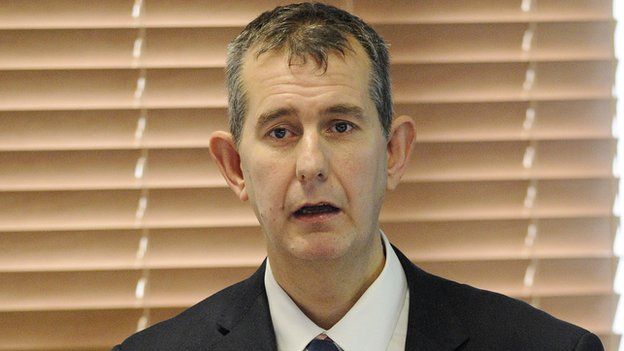
Edwin PootsImage copyrightPAcemaker
Image captionEdwin Poots, the former health minister, said he kept the ban on the basis of ensuring public safety

A BBC investigation earlier this year found the Department of Health does not have any medical evidence of its own to support a permanent ban on gay men donating blood.
The ban was put in place across the UK during the Aids crisis of the 1980s, but was lifted in England, Scotland and Wales in November 2011.

Irrational

New rules were introduced that allowed blood donations from men whose last sexual contact with another man was more than a year earlier.
But Northern Ireland did not follow suit.
A gay man, granted anonymity due to his perceived vulnerability, launched a judicial review challenge over then health minister Edwin Poots’s decision not to adopt the same policy on this side of the Irish Sea.
A judge ruled that Mr Poots’ decision was “irrational” and “infected with apparent bias”.
Mr Poots said he had kept the ban on the basis of ensuring public safety.
In April, the European Court of Justice (ECJ) ruled that a lifetime ban may be justified in member states if no effective detection techniques exist within the country.

Devolved

The ECJ said countries must establish if such donors were at high risk of acquiring infectious diseases like HIV.
Mr Hamilton said he would study the ruling.
A number of issues will be looked at in the Court of Appeal, including whether blood policy should be a devolved matter.
The appeal is expected to last for four days.
The NIBTS did not respond to the BBC to give an additional comment.
A Department of Health spokesman said: “It would not be appropriate at this stage to comment on matters that are before the courts.”

Filed Under: Anti-Bullying & Homophobia Tagged With: blood, blood donations, donation, gay, Northern Ireland, politics, Stormont

Transgender woman targeted with a PIPE BOMB ‘for being LGBT

08/10/2015 By ACOMSDave Leave a Comment

pinknews_logoNick Duffy
6th October 2015, 10:32 AM


Pipe Bomb
 
Police are investigating after a trans woman’s home was bombed in Northern Ireland.
27-year-old Rachael Keys of Derry/Londonderry was forced out of her home after the incident on Saturday.
A pipe bomb that had been left on her windowsill exploded, shattering the window and showering her with glass.
Ms Keys, who luckily escaped without serious injury, told Belfast Live that police believe she was targeted for being trans.
She said: “I am a member of the LGBT community. The police feel that I may have been attacked because of that reason.”
Five homes were evacuated after the bombing, with families forced to seek shelter in a local community centre.
Ms Keys added: “I was just watching TV in my living room. Suddenly the window came through, there was glass everywhere and there was a big bang and a flash. I was covered in glass.
“To be honest I was completely dazed, I didn’t know what was happening. It scared the life out of me. I just ran out of the house screaming to my neighbours.
“I didn’t even have time to lift my poor cat, Jessie, who was sleeping in the bedroom. I was terrified, shaking, upset.

She continued: “The police came and cordoned the place off and evacuated us all to the community centre. I was totally dazed.
“One of my neighbours is epileptic and I was really worried about her not being able to get her medication. Another neighbour has a child who is autistic, another is a pensioner. It was awful for them. Just awful.
“We all had to sleep in the community centre overnight. I was distraught. Someone gave me a tablet to help calm me down and help me sleep. I didn’t sleep though.”
A Police Service of Northern Ireland officer told the newspaper: “We are lucky that no one was injured by this device, or by the window smashing.
“This is being treated as a sectarian hate crime and I would appeal to anyone with any information about this incident to contact detectives at Strand Road police station on the non-emergency number 101.”

Filed Under: Anti-Bullying & Homophobia Tagged With: Northern Ireland, pipe bomb, politics, transgender

Unsung Northern Ireland LGBT Heroes

24/09/2015 By ACOMSDave Leave a Comment

In the USA the Chicago Gay and Lesbian Hall of Fame — this year being rechristened the Chicago LGBT Hall of Fame — is the only municipally supported institution of its kind in the nation.
lead-chicago-x750_0

Who are our LGBT Heroes in Northern Ireland?  why submit your nominations and then we put them up on our site for you!

Snap 2015-09-24 at 12.26.23
 

Filed Under: Anti-Bullying & Homophobia, History Tagged With: heroes, LGBT, Northern Ireland, politics

Northern Ireland: 20,000 March In Favour Of Gay Marriage

15/06/2015 By Dave McFarlane Leave a Comment


Campaigners attend a rally in Belfast to show their support for marriage equality

Campaigners attend a rally in Belfast to show their support for marriage equality

Belfast demo seeks equality for LGBT people


by Mike Hamilton
in Belfast
ABOUT 20,000 gay rights supporters marched through Belfast city centre on Saturday to demand that the legal recognition of same-sex marriage be extended to Northern Ireland.
The protest wound its way through the main shopping district to Belfast City Hall, where a large open-air rally took place.
The action was jointly organised by the Irish Congress of Trade Unions (ICTU), Amnesty International and the Rainbow Project.
Participants included a wide range of individuals and movements, including LGBT groups, trade unions, charities, human and civil rights organisations, churches, political parties and pressure groups.
The huge turnout surprised even the organisers, who were forced to make repeated calls for participants to use all available space at both sides of the staging to allow thousands more people in to hear from a variety of invited guests.
Among the speakers was ICTU LGBT committee chairman Daire Toner, who said: “I dream one day of getting married, but my dreams are shattered by the laws that govern this state.
“Even if I got married elsewhere, a flight or a train journey would make it invalid.”
Rainbow Project director John O’Doherty added: “The numbers here say it all. We want our voice heard. We need to go out and tell our story, play our part in a new Northern Ireland. They can’t ignore us any more.”
Amnesty International Northern Ireland director Patrick Corrigan put it simply: “All people are equal — the state should protect all people equally.”
In 2005, while under direct rule by Westminster, Northern Ireland became the first part of the UK to introduce civil partnerships, but since the power-sharing institutions were restored at Stormont, the fight for equality has gone into reverse gear.
The most obvious manifestation of this was an attempt to introduce a “conscience clause” amendment to equality law which would have allowed firms owned by people of faith to discriminate against LGBT customers.
Members of the Northern Irish Assembly proposed motions supporting equality in civil marriage four times in the last parliament.
But, each time, the Democratic Unionist Party blocked it, using a device known as a “petition of concern,” which requires majorities on both the nationalist and unionist benches.
Further links:

  • Newsletter – Thousands attend gay marriage march
  • Belfast Telegraph – Thousand attend gay marriage march


Filed Under: Anti-Bullying & Homophobia, History Tagged With: Belfast, gay marriage, gay politics, Irish politics, Northern Ireland

Scrapping Human Rights Act ‘would breach Good Friday agreement’

13/05/2015 By ACOMSDave Leave a Comment

Republished from The Guardian –

Henry McDonald Ireland correspondent

Tuesday 12 May 2015 11.34 BST

Belfast-based human rights organisation says Conservative government’s plans to ditch HRA will also violate international treaty

Theresa Villiers

The Committee on the Administration of Justice is seeking an urgent meeting with the Northern Ireland secretary, Theresa Villiers, about the implications of scrapping the HRA. Photograph: Will Oliver/EPA


Scrapping the Human Rights Act would be a breach of the Good Friday agreement that sealed the peace process in Northern Ireland, a Belfast-based human rights organisation has said.
The Conservative government’s plans to ditch the HRA would also violate an international treaty as the agreement in 1998 was an accord between two sovereign states – the UK and the Irish Republic, according to the committee on the administration of justice.
The CAJ (Committee for Administration of Justice) is seeking an urgent meeting with Theresa Villiers – who was re-appointed by David Cameron as Northern Ireland secretary in his new cabinet – about the threat to the HRA.
In a letter to Villiers, the CAJ’s director in Northern Ireland, Brian Gormally, points out that European human rights law was incorporated into the 1998 agreement.
He says article 2 of an annex to the Good Friday agreement binds the UK internationally to the multi-party deal, which was endorsed in joint referenda on both sides of the Irish border in May 1998; and, after it was ratified, both governments lodged the agreement as a treaty with the United Nations.
Gormally notes that in the section of the agreement guaranteeing the rights of minorities, the British government commits to “complete incorporation into Northern Ireland law of the European convention on human rights, with direct access to the courts, and remedies for breach of the convention, including power for the courts to overrule assembly legislation on the grounds of inconsistency”.
This part of the agreement is going to be used, for example, by campaigners who are seeking to overturn the ban in Northern Ireland on gay marriage, a challenge that has been blocked by the assembly in Belfast but will now be taken to the European courts.
Advertisement
The CAJ director says any move to tamper with or dump the HRA would undermine Northern Ireland’s fragile peace settlement.
“The secretary of state should urgently clarify the government’s position as to whether it intends to breach the Belfast/Good Friday agreement in this way. Such a step would make the UK an international outlaw and significantly roll back the peace settlement in Northern Ireland.”
Gormally stresses that the Human Rights Act and and the European court of human rights, and states’ compliance with them, had nothing to do with EU membership.
Founded in 1981, the CAJ monitors human rights abuses by the state and the security forces in Northern Ireland.

Filed Under: Anti-Bullying & Homophobia Tagged With: Act, Human Rights, Northern Ireland, Northern Irish politics, Stormont, Theresa Villiers, Westminster

Gay rights dominates the social media conversation in Northern Ireland

28/04/2015 By ACOMSDave Leave a Comment

Reprinted from BBC News (Trending)


Dinosaurs

Attitudes towards gay people have become a big election issue in Northern Ireland.

It began with a viral video that’s now all over the news. Northern Ireland Health Minister Jim Wells – who is standing in the UK general election for the Democratic Unionist Party (DUP) – was filmed at a hustings last Thursday. “You don’t bring a child up in a homosexual relationship. That a child is far more likely to be abused and neglected,” he said.
When the video hit social media it sparked fierce debate. Wells apologised several times for making the comment, saying that he had been under a lot of pressure over recent weeks because his wife is currently unwell and receiving treatment in hospital. On Monday he released a statement saying that he was standing downas health minister to help his wife Grace in her “fight for life.”
The video was uploaded to Twitter by 17-year-old Clare Calvert, who told BBC Trending that she doesn’t support any particular political party “I was attending the hustings because I was there to ask a question to the panel on what they could bring to South Down (the local area) to allow me to live there when I finished university.”
She says that she actually thought Wells did a good job as health minister, but that “his views have alienated so many members of society” that there was no way he could continue in the position.
The video she posted and the intense debate around it are significant developments, given that the DUP is currently the largest Northern Irish party at Westminster. Wells’ name and the debate about attitudes towards gay people have been trending ever since in Northern Ireland – with more than 14,000 tweets so far.
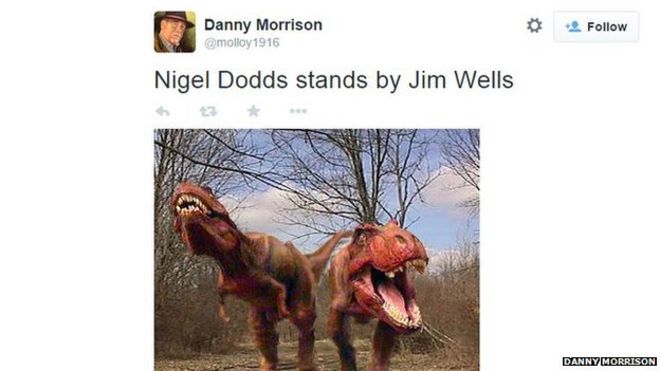
Opponents of the DUP sought to make political capital out of it all. The republican author Danny Morrison has been particularly active, tweeting: “So, Jim Wells suffers from narcolepsy. Looked wide-awake to me.” He also retweeted a widely shared picture of dinosaurs mocking the DUP candidate’s attitudes.
Members of the Labour Party of Northern Ireland also joined in. Writer Adrianne Peltz tweeted: “the next time politicians ask why so many young people are leaving NI, just direct them to @Jim_Wells_MLA & his state sponsored hate speech.”
The SDLP announced on Twitter that they had planned to submit a motion of no confidence in Wells had he not resigned. “He is no longer fit to hold office,” they tweeted. The Sinn Fein assembly member and spokesperson Maeve McLaughlin shared a post by a gay rights charity which read: “We are not a lobby we are a community. Disgusting lies which are harmful and full of hate.”
The chair of the Alliance party’s LGBT group, Mickey Murray, created a petitionwhich called for Wells’ resignation. “Over 8,500 signatures asking for his resignation, over 3,000 more signatures than votes Jim Wells received to get into the assembly,” he tweeted. The Ulster Unionist leader Mike Nesbitt said Wells “had done the right thing in resigning.”
But some DUP members tried to turn the controversy against rival parties. Doug Beattie wrote: “Jim Wells quits over gay child abuse comments … meanwhile Gerry Adams remains although he knew about child abuse & said nothing.” It was a reference to Sinn Fein’s Gerry Adams, whose brother Liam was convicted of sexually abusing his daughter (In 2013, Gerry Adams gave an interview in which he admitted that his brother had told him about the abuse).
Wells’ comments came as the Northern Irish assembly held a private members’ debate on marriage equality. And next month in the Republic of Ireland, voters will take part in a referendum on same-sex marriage. A similar law proposed by Sinn Fein was defeated in Northern Ireland by the leading unionist parties in 2013.
Despite stepping down from his ministerial post, Wells is still standing as the DUP candidate in the South Down constituency. The other candidates in South Down are Felicity Buchan of the Conservatives, Chris Hazzard of Sinn Féin, the UUP’s Harold McKee, Henry Reilly of UKIP, the SDLP’s Margaret Ritchie and Martyn Todd of the Alliance Party.
Blog by Hannah Henderson

Filed Under: Anti-Bullying & Homophobia, History Tagged With: Election Fever, gay rights, Northern Ireland

Exhibition to combat Homophobia

12/03/2015 By David McFarlane Leave a Comment

I have republished this article as a challenge to the LGBT community in N Ireland – I know that we have put together photographs in relation to homophobia, but have we had an exhibition, if so when was it, and when will we have it again.  If we haven’t done it, whey not?

Photo exhibition sets out to “combat homophobia”

Reprinted from the East London Lines: February 24, 2015 | Posted by: Grace Darlington | Filed under: Arts,News

#outcome exhibition. Pic: Tom Dingley.
A series of portraits aimed to “shine like a beacon of hope” for the future of young LGBTs has gone on display in Forest Hill today.
The #Outcome project, by Lewisham-based photographer Tom Dingley, 28, showcases portraits of men and women from the LGBT community holding pictures of themselves as children alongside visual displays of their current profession.
According to Dingley, the main intention of the selected photos, now displaying at Seniors: “is to develop a wide sense of diversity and variety that exists within the lesbian, gay and transgender community.”
“I want the portraits to shine like a beacon of hope & optimism for the future of young LGBTs or those confused by their identity. My portraits show that you do grow up, you can come out and still lead a successful & happy adult life.”
However, Dingley states, he is not trying to “sugarcoat” the coming out process: “It can sometimes be the most fearful thing someone overcomes, but I am saying it’s worth doing because there are great opportunities as an out adult and a community that enjoys life and looks out for each other.”
“The portraits show the adult holding their own childhood photo and just how far they’ve come.”
#outcome exhibition in Forest Hill. Pic: Tom Dingley
The images form part of a larger ongoing project that Dingley hopes to develop throughout the year. Having already photographed La Voix  from Britain’s Got Talent and John Waite, winner of the Great British Bake Off, next on his celebrity wish list are Tom Daley and Stephen Fry.
“I want the #Outcome project to be a recognised tool that can help combat homophobia, challenge stereotypes, promote equality but also enrich the lives of our own LGBT community”, he said.
“If the project were to be used as a tool in schools and communities, like the current exhibition in Lewisham is, then I will feel a great sense of achievement.”
The exhibition, co-produced by Lewisham Positive Ageing Council and Library and Information Services, is part of a series of events from Lewisham Positive Ageing Council and Lewisham Council to engage older adults with LGBT history month and to encourage understanding across generations.
#Outcome will run until March 17 at Seniors Club in Forest Hill before moving to Lewisham Civic Centre from March 18 onwards.

Filed Under: Anti-Bullying & Homophobia Tagged With: challenge to LGBT community, Lewisham, Northern Ireland, photographic exhibition

Could one court ruling force Northern Ireland to allow gay marriage ?

15/01/2015 By David McFarlane Leave a Comment

Gay couple married in England are hoping to have their marriage recognized in Northern Ireland
13 JANUARY 2015 | BY JOE MORGAN
Northern Ireland's gay marriage ban could be overruled this week.

A gay couple married in England could be the key in same-sex marriages being recognized in Northern Ireland.
In a court ruling this week, to be heard at Belfast high court, a decision could lead to the UK as a whole allowing gay couples to get legally married.
The couple, who have asked to remain anonymous, will call on Northern Ireland to make a declaration their marriage remains lawfully constituted where they are living now and should be recognized on Thursday (15 January).
John O’Doherty, director of The Rainbow Project, is backing the couple.
‘We are very happy to support this important legal challenge. While same-sex marriage legislation in Westminster had many positive aspects, we believe that its provision forbidding the recognition of lawful same-sex marriages in Northern Ireland is irrational, contrary to principles of British constitutional law and incompatible with the European convention on human rights,’ he said.
‘We are resolute in our assertion that no one can be married in one part of the United Kingdom and then not married in another.
‘Once a couple is lawfully married in the UK, we contend that their relationship cannot be reclassified as a civil partnership without their consent, which is exactly what the law currently does.
‘The legislation says to lawfully married people that they are no longer married. This is unconscionable and cannot be permitted to continue.
‘Marriage is a fundamental human right, which is now recognised in the UK as including same-sex couples. We will work to ensure that this right is realised for everyone in the United Kingdom and we are confident that marriage equality will be achieved in Northern Ireland.’
Without the ruling, Northern Ireland is expected to be the only main part of the British and Irish islands that ban same-sex marriage by the end of the year.
Ireland itself will be voting in a referendum in May. In the last Irish Times/Ipsos MRBI poll, it found 71% supported marriage equality in Ireland.

– See more at: http://www.gaystarnews.com/article/could-one-court-ruling-force-northern-ireland-allow-gay-marriage130115#sthash.QY9YasKu.dpuf

Filed Under: Anti-Bullying & Homophobia Tagged With: courts, gay marriage, legal, Northern Ireland

Northern Ireland Annual Human Rights Commission Report – 2014

17/12/2014 By David McFarlane Leave a Comment

This annual human rights statement which has a useful traffic light system to highlight where the rights are from “done” to still to be started shows the situation in Northern Ireland.

[Read more…]

Filed Under: History Tagged With: Human Rights, Northern Ireland, reports

Rise in homophobic attacks in London, Greater Manchester, South Wales and Northern Ireland, say police

27/11/2014 By David McFarlane Leave a Comment

Republished from
PSNIPolice forces across the UK have reported a rise in the number of homophobic crimes this year – with the biggest increases in London, Greater Manchester, South Wales, and Northern Ireland. Hundreds of lesbian and gay people have been assaulted so far this year. LGBT (lesbian, gay, bi-sexual and transgender) charities have responded by saying it was “encouraging” that more people were reporting hate crimes, but said many victims felt “silenced” by abuse on the street. Some 19 police forces recorded more attacks which were motivated by a person’s sexuality between January and October 2014, when compared with the whole of last year. In London alone, the Metropolitan Police recorded 1,073 violent homophobic offences between January and October – up 66 from 1,007 last year, a Freedom of Information request by the Press Association uncovered. The overall figure for the capital for 2014 included 315 assaults, and 747 harassment offences – which saw a sharp rise from 693 last year. Greater Manchester Police recorded 278 violent homophobic offences between January and October, up from 231 in 2013; while South Wales Police recorded 162 violent crimes motivated by a person’s sexual orientation between January and October, up from 132 last year. The Police Service of Northern Ireland (PSNI) revealed that homophobic crimes had increased year on year since 2006/2007. In 2013/2014, 280 incidents were recorded by the force – up from 245 in 2012/2013 and 200 in 2011/2012. This included 133 violent homophobic crimes this year”
There have been over 1000 attacks motivated by the victim’s sexuality in London so far this year
Police forces across the UK have reported a rise in the number of homophobic crimes this year – with the biggest increases in London, Greater Manchester, South Wales, and Northern Ireland.
Hundreds of lesbian and gay people have been assaulted so far this year. LGBT (lesbian, gay, bi-sexual and transgender) charities have responded by saying it was “encouraging” that more people were reporting hate crimes, but said many victims felt “silenced” by abuse on the street.
Some 19 police forces recorded more attacks which were motivated by a person’s sexuality between January and October 2014, when compared with the whole of last year.
In London alone, the Metropolitan Police recorded 1,073 violent homophobic offences between January and October – up 66 from 1,007 last year, a Freedom of Information request by thePress Association uncovered.
The overall figure for the capital for 2014 included 315 assaults, and 747 harassment offences – which saw a sharp rise from 693 last year.
Greater Manchester Police recorded 278 violent homophobic offences between January and October, up from 231 in 2013; while South Wales Police recorded 162 violent crimes motivated by a person’s sexual orientation between January and October, up from 132 last year.
The Police Service of Northern Ireland (PSNI) revealed that homophobic crimes had increased year on year since 2006/2007. In 2013/2014, 280 incidents were recorded by the force – up from 245 in 2012/2013 and 200 in 2011/2012. This included 133 violent homophobic crimes this year

Filed Under: Anti-Bullying & Homophobia Tagged With: attacks, Freedom of Information, homphobic, NI, Northern Ireland, PSNI, UK

  • « Previous Page
  • 1
  • 2
  • 3
  • 4
  • Next Page »

Categories

Copyright ACOMSDave.com © 2026