
| Australia has just guaranteed that lesbian, gay, bisexual and transgender (LGBT) refugees, who arrive by boat, will be sent to Papua New Guinea – where being gay could get you 14 years in jail.Australia is one of the few countries in the region that openly accepts LGBT people. It has always been a safe haven for refugees fleeing persecution. Now, only weeks out from an election, the government has thrown together this controversial policy in the hope of winning votes. Worse yet, the opposition party are proposing an even more extreme policy. The policy has already begun to backfire, with Australians taking to the streets in protest and former Prime Ministers publicly denouncing the move. Local outrage has all parties contesting the election scrambling to respond. Will you join the call for Australia to drop its dangerous new policy that denies hope and safety to those who they need it most? www.allout.org/australian-home In Papua New Guinea, it’s a crime to be gay. Because of that, any person seeking asylum there can automatically be turned away. Every LGBT person who arrives by boat will have little choice but to lie about who they are to avoid being sent home. With their reputation under attack, Australia’s leaders could be pushed to stop violating the Geneva Conventions and protect the most vulnerable. Sign this petition and tell Australia that you won’t stand for this: www.allout.org/australian-home The full policy states that all people arriving by boat to seek asylum will be relocated to Papua New Guinea where their refugee claims will be assessed, and only then allowed to settle in the community. Legal experts have already denounced the plan for breaching international law. It is singling out people on boats for taking the last resort available to them. Hiding on a leaky boat, crossing some of the world’s most dangerous oceans, is the most difficult way to reach such an isolated country. No one would take such a risky boat journey if their very lives weren’t on the line. Will you sign the petition against the Australian government’s plan to force people back into danger? www.allout.org/australian- All Out’s first ever campaign successfully halted the deportation of Ugandan lesbian Brenda Namagadde from the UK back to her home country. Since then, we’ve become a powerful movement of over 1.7 million people fighting anti-gay laws around the world. Take a stand against Australia’s unfair targeting of asylum seekers – sign the petition: www.allout.org/australian-home Thanks for going All Out. Andre, Hayley, Jeremy, Marie, Marie-Marguerite, Sara, and the rest of the All Out team. SOURCES: UN refugee agency raises more concerns over Labor’s PNG solution – The Guardian, 26 July 2013 www.theguardian.com/world/ Rudd plan in tatters as camps labelled ‘gulags’ – Sydney Morning Herald, 25 July 2013 www.smh.com.au/federal- Coalition wants military led campaign against people smugglers – ABC, 25 July 2013 www.abc.net.au/news/2013-07- How to break the people smugglers real business model – Inside Story, 25 July 2013 www.inside.org.au/how-to- More than a legal issue, PNG plan challenges core principles – Sydney Morning Herald, 23 July 2013 www.smh.com.au/comment/more- |
||||
|
||||
|
||||

Queers in Exile: the Unforgotten Legacies of LGBTQ Homeless Youth
LGBT Homeless Youth Documented In ‘Queers in Exile’ At The Leslie Lohman Museum (PHOTOS)
The Huffington Post | By Priscilla Frank Posted: 07/16/2013 8:09 am EDT | Updated: 07/17/2013 10:01 am EDT
An exhibition entitled “Queers in Exile: the Unforgotten Legacies of LGBTQ Homeless Youth” will provide a historical narrative and abundance of images to the long-silenced tale of homeless queer youth.
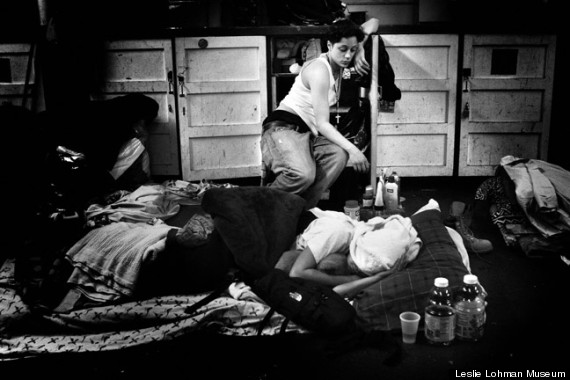
The exhibition, curated by Alexis Heller, will illuminate the untold street stories from 1969’s Stonewall riots to present day, revealing years of persecution, determination and hope. From pop master Andy Warhol to LGBTQ documentary photographer Samantha Box, the selected artists capture the all too invisible generations of survivors, creators and revolutionaries who call the streets their home.
The show takes its name from Sylvia Rivera’s essay “Queens in Exile, The Forgotten Ones,” which demands respect and change for LGBTQ communities. In the spirit of Rivera’s essay, the Leslie Lohman Museum explains how their exhibition does not just seek to revisit the past but change the present and what is to come.
“It is a view of history told by those who live/lived it within a community often silenced and ignored, but the vision goes beyond visibility. It is about collective memory and conscience, and repositioning queer homeless young people from ‘other’ to ‘our own’… It offers homeless youth a place by grounding them within an empowered history and lineage, honors their struggle, and reflects that they matter.”
“Queers in Exile” runs from July 18 – July 28, 2013 at the Leslie Lohman Museum of Gay and Lesbian Art in New York. See a preview of the exhibition in the slideshow below and let us know your thoughts in the comments.
Why should society be inclusive?
As you may know Lesbian, Gay, Bisexual and Trans History Month is celebrated every year in February. During 2011 and 2012, the focus of the Month has been sport. But inclusivity is not just restricted to sport and the month of February.
A report from Canada has shown that workplace barriers persist for LGBT employees. Respondents cited three factors that affected their career advancement and the formation of critical relationships in the workplace: a lack of awareness regarding LGBT issues, discriminatory behaviours, and exclusion from important connections with others. LGBT women reported less positive relationships with their managers than LGBT men and non-LGBT women and men did. LGBT employees at organizations with diversity and inclusion programs, policies, and practices, as well as those with broader talent management programs, were more satisfied and committed, described their workplace as more fair, and had more positive relationships with their managers and colleagues. (Building LGBT-Inclusive Workplace)
In Equality Britain they site the following:
Equality Britain believes that individuals have the right to be free from prejudice and discrimination.
Fairness and equality is not just a “good thing” but imperative in a changing and complex world.
It has been proved that by valuing diversity, organisations bring benefits to the people they work with and their local communities, as well as to themselves.
A diverse organisation draws upon the widest possible range of views and experiences, so it can listen to, and meet, the changing needs of its staff, volunteers and partners.
So where is this article leading? Well on the 20th June the marriage of X-Men hero Northstar and his boyfriend Kyle is set to take place the the publication Astonishing X-Men #50, published by Marvel Comics. (Polari Magazine)
Why is this an important landmark; well inclusivity is about recognising differences and including them within all areas of society – and this is just as important for all areas of writing – if the LGBT community is seen to be visible and incorporated within natural things and traditions of society then we are included and accepted and homophobia and bullying will cease!
Gay Marriage Support
I welcome Mary Kenny’s wonderful article ‘I’m wedded to the idea gay couples deserve equality’, and it is a wonderful to see phrases like ‘the issue of ‘equality’ has proved persuasive.’ And …why shouldn’t they enjoy the same rights?… – published in the Belfast Telegraph January 31, 2012.
My only observation is that ‘deserve equality’ would seem to indicate that we have suddenly done something to change the status quo – we haven’t!!
The LGBT community is the same as it has always been, with the same rich diversity as any other community – what we have always asked for is parity – apply the same rules to everyone equally.

LGBT Heroes – 1
February 2012 is LGBT History Month, and ‘upstart’ wishes to start its first entry with a mention for Lance Corporal James Wharton.
Lance Corporal James Wharton was one of the first openly gay men in the British Army – since coming out he has been a role model for the Army and has participated in school visits throughout Great Britain and also got married in a civil ceremony in March 2010.
James openness and engaging personality has ensured that he has made friends were ever he has gone, leaving behind a more open and welcoming environment for gay youth in schools.
He has also taken part in the ‘It gets better project’ with a very positive supporting video.
‘upstart’ salutes you James.
"RUC"…out!
Out-take from upstart, June 1998
The last upstart did not have space to mention the “Queer Action” in Belfast, in solidarity with the ILGO (Irish Lesbian and Gay Organisation) of New York. ILGO has been refused permission by the Ancient Order of Hibernians in America (AOHA) to walk in the St. Patrick’s Day parade. The ILGO slogan was: Year Eight – end the Hate! Yes, this has been dragging on for all of the 1990s. (Parallel to Belfast Pride — something ILGO could use in its publicity). The Queer Action was comparatively large, and noisy, it drew plenty of attention. People stopped and had the situation explained to them.
To that extent, it was a very useful exercise, but there were a number of things wrong with it; and (in the interests of our friends in New York, who are engaged in a genuine struggle for civil rights), it would be cowardly not to deal with them head-on. NIGRA (the Northern Ireland Gay Rights Association), which has organised solidarity actions for six years now, issued a statement which was published (in amended form) by GCN (Gay Community News, Dublin), prior to any actions. Part of the burden of this, was that NIGRA had picketed the US Consulate-General a number of times, and the staff, (while sympathetic to the aims of the picket) had pointed-out that the dispute was between ILGO, the AOHA, and to an extent, the New York City authorities.
This is the reason why NIGRA, in Dublin, picketed the Aer Lingus office on O’Connell Street. Aer Lingus, Bord Fáile, and Guinness are among the biggest ‘corporate sponsors’ of the Parade.
The Queer Action in Belfast was held outside the Consulate. No harm in that. It is a big, noticeable, public building (with ‘Old Glory’ flying outside of it — it must be the biggest flag in Belfast). But the banners bore the following legend:
AOH,
NYPD, RUC,
Unholy Trinity.
There are practical objections to this slogan. The first one is that most people would not know what AOH stands for. They might recognise the term Hibs. Even then, they might assume it was a Scottish football team. The AOH has experienced a great fall in Ireland, including Ulster.
(Without boring the arse off readers, the Hibs in Ireland, the Board of Erin, were different from the American organisation; which was connected to the AOH in Scotland, but had only a small following in Ireland. One of the reasons why this ban is disgraceful if that the AOHA has genuine radical traditions: the ‘Mollie Maguires’ and all that.)
Most people would not know what NYPD meant, even insomniac fans of NYPD Blue. We may be fascinated by Americana, but meeting it in Queen Street in the middle of the afternoon, is disconcerting (again, it may not be a bad thing, it pulls people up, and makes them think.)
NIGRA could have noted that Rudi Giuliani’s web-site lists one of his achievements, as Mayor of New York, (as well as – allegedly – cleaning up crime) as keeping ILGO off the streets! (There’s an awful lot of votes in red-neck Irish America, all those ‘Reagan-Democrats’ – virtual ‘Dixiecrats’ – in the New York Police Department).
The inclusion of RUC in the slogan is surreal. What point is being made here? An obvious one is that he RUC is directly involved in the oppression of the ILGO. Or possibly that the RUC goes over to New York to get at Irish queers as a sort of hobby.
It is politically unwise to use slogans which are not to the point in a particular situation.
The RUC are not implicated in the situation in New York. The fight for civil rights for Irish queers to walk in (what everyone knows is a Parade open to every other citizen of New York — to all the world. The Parade was host to militants of the Indian National Congress in the 1920s), is not served by dragging in extraneous matters. This is especially so as the RUC have, apart from the bruising encounters outside Gardners bookshop in 1977, been well-behaved even sympathetic, at Gay events in Belfast.
Despite that, it may well be that we will have to have to picket the Chief Constable, other senior officers, or particular RUC stations, because of their refusal to take a reasonable attitude to the treatment of [homo]sexual offenders. And the biased classification of sex crimes, which emphasises the behaviour of gay men, but disguises sexual, violence against women and children.
Something else which should be discussed is the state of mind of some on the Queer Action. One participant said he was getting rid of a “lot of anger”. That should happen at an encounter session, or a therapist’s chambers. It definitely is not the state of mind that one should have on a picket. What would a person in such a state of mind have done of the police had got heavy?
We are, or should be, in the business of getting he ILGO onto the St Patrick’s Day Parade in New York, sooner rather than later. That will not come about as a result of self-indulgent posing about the RUC, or any other group, especially if they are not involved in the case.
Belfast, and this region, is important in the campaign against the AOHA, because they have signed-up to a large number of ‘civil rights’ campaigns over the last quarter century. This is partly the result of guilt: they threw people trying to unfurl a NI Civil Rights Association banner off their march in 1969. And we mean threw. (If someone tried to unfurl a NI Gay Rights Association banner…?)
There are other ‘ethnic’ marches in New York, and other US cities — ILGO’s fight (like NIGRA’s in Europe), as a ‘test case’. If ILGO do not succeed, all may return to the status quo ante. It might also be seen as a signal to unpeel the queers from the African-, Italian-, Greek-, You-name-it-American parades, and corral us into our ghetto — which can then be ignored.
1999’s actions will have to be effective — we should start thinking about them now, rather than a week or two before St Pat’s Day.
Until the next one…?
 A 40th anniversary celebration of GLF (the Gay Liberation Front) was held in the Electric Cinema, Notting Hill on the Saturday before London’s Gay Pride parade (June 2010). (It is an odd venue, having less than a hundred seats, which though fitted to the floor, feel like armchairs rather than cinema seats. A young man in the front row was eating a meal – from the rather posh (i. e. expensive) restaurant attached to the Cinema – it looked a bit messy, in all honesty.)
The event was billed Come Together (the title of the GLF’s ‘travelling’ publication. It ‘expired’ in Lancaster in 1973, in my presence, but it wasn’t my fault — honest. It was organised by young Tom Barber, and presided over by the DJ Stewart Who? All went swimmingly — at first — we saw film of (contemporary (1972)) interviews with early London GLF figures. It was difficult for non-London GLF survivors to tell who was who. The two main interviewees were a bearded Canadian, and a very pretty English chap. (I decided the latter was Aubrey Walters – ‘Aubrey Walters’ suggests ‘pretty’.) The man in question was, I should say, very intelligent. He, and the Canadian guy, mentioned evangelising ‘the provinces’. Richard McCance (Nottingham GLF, né Lisburn) made an amused intervention at the end of this, being doubly from ‘the provinces’, Ulster being the genuine article..
(This was a very interesting and absorbing part of the event. I’m not sneering at ‘the past’. There was film of early GLF demonstrations — but not ‘Zaps’.) Even in the (very) early 1970s ‘the provinces’ sounded somewhat patronising. I shudder to think what Aubrey and the bearded Canuck thought of Belfast GLF (technically still in existence). GLF in London supported ‘troops out and a united Ireland’. I was a committed Republican in 1972 / 73, but even then I thought the slogan was internally contradictory. One pointed question, from Julian Pettifer (Panorama, BBC) on what was the difference between GLF and other Left groups, was rather fumbled by the interviewees. (The ‘Left’ generally was quite horrified by ‘Gay Lib’. The ‘Stalinist’ B&ICO (British & Irish Communist Organisation) met with London GLF in 1972). It was a strength, and a weakness, of GLF that the ‘membership’ (a nebulous notion anyway) ranged from Irish Republican through every degree of Communist, Socialist and Labourite to people like Luke Kennedy, a Tory. He wore his GLF badge representing Lancaster on University Challenge, on all-UK television in 1973 – 74. GLF was a state of mind, and not a political programme.
After this (comparatively cosy) section, we got on to a ‘panel discussion’. It included Alan Wakeman  (London GLF veteran standing-in for Peter Tatchell, in Moscow that weekend) and Sami Chakrabarti (General Secretary of Liberty (formerly NCCL – the National Council for Civil Liberties)). Alan read out “a three sentence e-mail” from Tatchell. It asked why Liberty had unilaterally expelled CHE (the Campaign for Homosexual Equality) from membership. Even in the early 1970s, many in GLF were in CHE. It had ‘National Membership’, for people who found joining a local group inappropriate. Most current members of CHE are of GLF origin.
Ms. Chakrabarti stonewalled on the matter. Michael Brown (ex-London GLF / CHE) walked towards the panel wagging a ferocious finger. He was physically prevented from getting at them by Stewart Who?. Nettie Pollard (London GLF / CHE) suggested a walkout. I dumped all of my bits of paper into my bag. We decided that sitting it out was the better policy. Chrakabarti still stonewalled, eventually saying she was not prepared to deal with the matter. Stewart Who? claimed Peter Tatchell was a ‘one-man band’ who represented nobody. He (‘Mr. Who?’ – as Quentin Crisp might have put it) seemed to think that it was his duty to police, rather than preside over, the event. He’d been standing near me as I was preparing for the walkout. I tottered towards the toilet at the end of all the excitement. He seemed prepared to push me away from the panel. Discos are not places where things are really allowed to be spontaneous.
Young Tom (Barber) expressed “disappointment” at the course of events. Why? He witnessed a genuine, spontaneous, GLF ‘Zap’ — a classic of the genre. I am glad he did. We old dears were there to be patronised. We showed we are geriatric delinquents who still have fire in our bellies. (Even if our joints are not quite up to legging it across even the relatively small space of the Electric Cinema anymore).
****
The Dispute Between CHE And Liberty
Early in 2010 CHE sent a resolution to Liberty for discussion at its AGM. It was to the effect that a statute of limitation should be put on certain categories of ‘sex crime’. Specifically ‘crimes’ to do with sex between (male) ‘adults’ and people under the age of consent. The resolution may have been badly drafted and CHE’s office-holders should maybe have been easier to contact (by Liberty) but the latter was too quick off the mark finding fault with CHE.
CHE is not an unknown quantity, and certainly not to Liberty / NCCL, (which CHE helped keep afloat financially in the 1970s), CHE was well-off and the Council was skint. At that time the Council had no problems with PIE (the Pædophile Information Exchange) and NF (the fascistic National Front) being members — and having their civil liberties strenuously defended. Liberty (it appears to me) is attempting to become a Blairite organisation that only deals with the squeaky clean.
CHE’s resolution came about as a result of the activities of its Court Monitor. Allan Horsfall and Ray Gosling have attended proceedings against ageing men accused of ‘underage’ sex. Quite often the people they are accused of having sex with were not much younger than they were at the time. Until comparatively recently the Gay (male) ‘age of consent’ was a ridiculous 21 years old. These retrospective prosecutions – most ‘offences’ took place 30 (and more) years ago – must amount to ‘oppression’ under any rational interpretation of the Judges Rules? Many, probably most, of the men brought to Court are not Gay, are closeted, and thereby isolated from any sort of Gay help. They don’t know about the various Gay groups, or even very much about the burgeoning social ‘scene’. Quite often, they don’t want to know about such matters.
They may well have been told the old lies about the police being able to keep their names out of the papers. (The police are well able to keep prosecutions quiet — especially if they involve colleagues, — or they’ve made a balls-up of the case). Quite often with malice aforethought they inform the journalists who inhabit the lower Courts, about upcoming cases. And what journo could resist the temptation to destroy the life of a harmless neighbour?
These personal tragedies are not large in number. That does not mean they are not unjust. They are probably also ‘unsafe’. But there will be a long wait before one of these men is found prepared to put up a fight against the whole concept of retrospective ‘justice’.

CHE seems to have come to terms with its expulsion by Liberty. The latter will, clearly, not experience a bad conscience about giving a member of over 40 years standing the shove. Sami Chakrabarti claimed (before she clammed-up) that Anthony Grey (of the Albany Trust) had withdrawn his own resolution attacking the expulsion. As he had just recently died, nobody was in a position to challenge her assertion.
Seán McGouran
GENET AND THE ZEN OF SEX an article by ANTHONY WEIR
Reprint: Gay Star, No. 13, Spring ’84
It is assumed by many that homosexual men have become ‘liberated’ since the limited legal tolerations of 1967 and later. But the increasingly predominant bland, bourgeois, American-style, pseudo-butch ‘clone’ stereotype (over the T/Vs and ‘effeminates’ one the one hand and the leather / rubber masters and slaves on the other) is in fact a quasi-heterosexual, self-oppressing way of avoiding the perceptions and opportunities which homosexuality uniquely offers. It is a pity that this unliberated insipidity dominates male homosexuality.
For France at least has known much truer forms of psycho-sexual liberation – as exemplified in tow of the most interesting writers of the last century or so; Paul Verlaine and Jean Genet. They are very different kids of men (the former turned pietist Catholic in his old age, the latter lionised by the radical Left though completely unSocialist), yet both are very radical in their approach to sex and sexuality.
Neither hived sex off as quick relief after work or socialising. Both knew great poverty and deprivation. Genet’s was partly by choice in Borstals and jails, Verlaine’s by circumstance of penury and alcoholism. Though dissimilar both are the antithesis of the modern hygienic Gay clone, whose only difference from the rest of the consumer blancmange around him is his same-sex preference.
Verlaine was bisexual. His violent affair with the seventeen year old poet and infant terrible, Arthur Rimbaud, is famous. His relationships with bloodsucking women proved equally disastrous. His verse collections Femmes (Women) and Hombres (Men) celebrate the cunt, the cock, and the arsehole, their smells, secretions and excretions.
He was a passionate, disreputable and gorgeous teddy-bear with a zest for life and sex, both of which (being a poet and passionate) he took seriously. Not for him the pallid relief which passes for sex among so many allegedly homosexual men. His enthusiastic poems about male attraction rejoice in the cottage cheese of cocks and in shit, delight in the textures and odours of he scrotum, celebrate the taste and consistency of semen and honour the noble appearance of glans and foreskin.
He is not interested in middle-class pretence and pretensions.
He liked his lovers in their dirty working clothes – but without feeling that he was ‘feasting with panthers’ as Wilde put it. He loved armpits and sweat, not sickly artificial scents. He would engage in wanking sessions under bar tables, and other perfectly natural behaviour outrageous to society at large. Nor was he a ‘size-queen’ either, appreciating the fine quality of small cocks as much as the impressive quantity of large ones.
The collection Hombres was written in 1891, and was never suppressed. Though coming up to one hundred years old, its robust language and wholesome attitudes brilliantly couched in metre, would be shocking to many post-“liberation” Gays. Even at the Coleherne1, Verlaine would stand out as perhaps a bit too real and unhygienic.
Genet is a different kettle of phallic fish altogether, because he is not so much a celebrator as a celebrant. His view of sex is, rightly, mystic; his writings profoundly and chthonically philosophical. For him homosexuality is an essential part of a whole anti-bourgeois metaphysic which celebrates robbery and crime, ‘perversion’, the violence of the police, penitentiaries and extreme machismo. Precisely because they are in opposition to the bland superficial bourgeois society which he rightly despises — and loves.
He is no boozy cuddly teddy-bear, but a deliciously hard-looking skin-head in baggy prison trousers and donkey jacket. He made a true religion out of sexual and physical domination. He is a mystic who dwells on the essential solitude of each island / man, a solitude which is quintessential in orgasm. His novels and plays are largely concerned with the search for the Absolute. For him absolute good and absolute evil – being symbolic rather than actual – are interchangeable, for he has the Jungian perception that everything contains or turns into its opposite.
The finding of the Absolute is Grace – not the simplistic Catholic grace that the terribly ill and battered Verlaine slobbered to priests for in his last syphilitic and ulcerated years, but the Grace that comes from Orphic descent into the Underworld, which is through a mirror – as in the Cocteau film Orphée.
Grace for Genet is, as it must, be a Fall. His homosexuality is a religious rite of great importance, involving sado-masochism and murder (Querelle) and hero-worship of thugs and murderers (Miracle of the Rose). Murder, being an inhuman act is thereby Divine – the name of one of the murderers he celebrates.
He writes in symbols. His own name is Genista or broom-plant (Plantagenet). His most important symbol, Rose, is the name of a particularly vicious criminal. Querelle is a sailor – voyaging through fog on a sea of the Unconscious – whose name means ‘quarrel’. Again and again the image of the mirror occurs in his plays (The Maids; The Balcony; The Blacks) – and novels. Mirrors as reflection, opposite, mask, image, mystic lens, and magic passage through the world of appearances.
Appearance is not ‘just reality’ as Sartre the ‘inventor’ of Existentialist philosophy claimed, but super-reality for Genet. Truth is extremity of falsehood. Sex is the most spiritual of acts. Thus he sees the paradox – the truth of the mirror, the false image – the only way of resolving Enatriodromia – the tendency of human acts, ideas and attitudes to become their opposite.
Everything in human life requires its opposite: the judge and police are unemployed without criminals, therefore crime is the raison d’être of such people and they are both right and hypocritical to denounce and punish it. Crime is defined by its punishment, so without judge, policeman, prison warder, tabloid press, there is no crime. For Genet all reality is a synthesis of dynamic opposites.
Genet is also greatly concerned with existential authenticity. But though a reasonably accomplished burglar, he never reached what he considered to be the ultimate in authenticity – the convicted murderer. The first step towards authenticity of self is isolation, ad the best way to achieve this is to cause the deepest possible offence to bourgeois society. So he celebrated the teenage thugs who worked for the Gestapo.
For him convicts and anchorites follow identical solitary paths to Grace. The prison at Fontreville, about which he writes, was a famous monastery, founded by the troubadour-Duke of Acquitane. Grace is obtained through rejection of the world, and this is best achieved by making the world reject you – as Jesus said.
Thus, Hitler acquired at least as much Grace as St. Teresa or St. Francis, and Judas was incomparably superior to Jesus because,
a) he was absolutely necessary to make Jesus’s statement of authenticity,
b) he was the mirror image of Christ,
c) he betrayed Jesus – and Genet considers betrayal the highest form of mystical beauty, and
d) because Judas, being an instrument, almost a thing, asserted the passive life principle.
But Genet is not a mere word-juggler. Hitler is not a saint simply by dialectical inversion of appearances, but by virtue of the unparalleled enormity and hideousness of his crime and the utter – if brief – desolation and isolation of his punishment amidst the ruins of the Third Reich in the Berlin bunker.
The greater the crime – he does not use the word Sin – the greater the redemption and Grace. These terms are not Christian for Genet. Christianity has merely debased them into dogmatic claptrap. Genet uses words and symbols which are universal – like the mirror; like the rose which is for him the passive life principle so utterly devalued in our hyperactive thorn-producing culture.
Genet is passive. He is a vehicle – like a priest. His shaved head is that of a priest and a convict. He received the active in graciousness and grace in humility and ecstasy. He took the cocks of the butchest men he could find – and in doing became butcher that they by acquisition and reception. The victim kills his murderer at the moment of death, by similar magical possession. Genet’s Rose means love, friendship, death and silence; it is a cock ramming into him; it is the guillotined head – the severed head was the phallic emblem of the Celts -; it is a passion, mourning, mystery, he crown of thorns, the complete sacrifice of Judas, the miracle.
But an old man cannot be passive. As the Greeks so well knew, young men should be fucked, and older ones should fuck. He longs for young men to fuck him, but this is not right. Older men are authority, they must move from passive to active. Here he perceives and approves the whole sado-masochistic power-structure of our patristic society, ruled by old men — Prison Governors and Lords Chancellor.
The homosexual man is, at his most passive, apparently an object, hence a thing given life and new identity by the active Other, the virile male. By taking the cock and seed of the conqueror, he becomes greater than the conqueror; the victim inhabits the murderer… This is all very complex, poetic, mystic. He sees through the mirror into the black hole – his head, his arse, his birth, his dream, his Shadow.
Being a thing, a sexual object, unites him animalistically2 with the world about him. It makes him a threshold, a Shaman. This runs counter to our whole hierarchical and dualistic culture, which sets man up as a demigod, higher than woman. In sex, sexuality, mysticism and symbol, Genet points a path out of the Christian morass of double-standards, sentimentality, abattoirs, Auschwitz and the nuclear holocaust.
Genet identifies with the Beast – but more subtly than Aliester Crowley (who founded a new religion to replace Christianity earlier in this century. It was based partly on ancient Egyptian religion and on the notion of the Superman). For Genet the Beast is not only Satan (and Lucifer – the son of Morning), but the sacrificial bull, the Saviour, and life itself. The Beast is the soul; and sex being animal is entirely and chthonically (i. e. of the earth, the soil) mystical. His message is Orphic and Eleusinian.
He never mentions fist-fucking, but I suspect that for Genet a death by colonic rupture literally at the hands of a neo-Nazi or KGB thug would be a supreme act of Grace.
Verlaine celebrated the ‘sordid’ as both real and desirable. He was not a mystic, but saw sex as an expression of his zestful self. He was a man of passion who almost became a murderer when he shot Rimbaud in a drunken rage. Genet celebrates reality as death, seeing sex as a means to self-realisation and authenticity. He is not a passionate man, yet he believes that by loving the enemy — the police, judiciary, ‘businessmen’ and the rest — one loved the enemy within and thus became more whole.
The average, frivolous Gay male of bars, clubs, saunas and cottages celebrates nothing, not even his homosexuality.
Afraid of thinking about it, he relieves himself as inconspicuously as possible.
1 The Coleherne (aka ‘The Coalhole’) was a large gay bar in West London. It catered for leather-ladies (of both genders) and their admirers.
2 A misprint for ‘animistically’. ‘Animism’ is the attribution of magical, religious and even moral qualities to natural phenomena.
QUEERS, TERROR and The Closing of the Western Mind (?)
Dr Rahul Rao (School of ‘Oriental’ and African Studies) gave a talk – more properly led a discussion – (Thurs., 10.02.11) Queer in the Time of Terror, as part of LGBT History Month. It was held not in a SOAS building but in the Sir David Davies lecture theatre (University College, London) in the Roberts Building. I was late partly because the Roberts Building does not describe itself as such (on the wall facing Torrington Place). For some reason I kept assuming that I was in, or ought to have been in, an LSE (London School of Economics) building.*
Dr Rao asked ‘how do we protect… respect… multiple identities in a global society?’. This was a challenge to (western) LGBT activists. I think Dr Rao noticed a white bearded ‘noddy’ in the corner of the lecture theatre (which has ‘concealed’ but ‘third degree’, sight destroying bright lighting). His argument was much the same as this publication. ‘Western’ Gay activists are often in too much of a hurry to ‘solidarise’ with apparently oppressed Gay women and men in the developing world to actually examine the real circumstances. Dr. Rao discussed the execution of two male mid- to late teenagers in Iran some years ago, and the current situation in Uganda.
The Iranian 16-18 year olds were depicted in the western Gay and liberal (and even right wing) media, as victims of an oppressive homophobic Islamist (Islamo-fascist) regime. The complication that they had raped and killed a twelve year old boy was not allowed to interfere with our moral outrage. Dr. Rao noted not particularly subtle elements in the Persian / Farsi language. Crude translation allowed western media to claim that the trial and punishment were the outcome of a simple, consensual sexual encounter — and not a crime against the youngster’s person, and life.
He noted another aspect of this case. It led to homophobic Islamophobic politicians and commentators in the USA, and elsewhere, (the British writer Melanie Phillips, for example) using this, alleged homophobia, as a stick with which to beat Iran. This is upstart‘s major problem with these various cases. Gay activists are prepared to think the worst of those who run, as examples, Iran, Uganda, and Zimbabwe. They appear not to have similar problems with the US’s and UK’s establishments. Section 28 (UK) was introduced at the height of the AIDS crisis. The Conservatives in the current Cabinet, ‘bag-carriers’ at that point, raised no objections. The current US Administration is not a great improvement on George W Bush’s, despite Obama getting most of the – substantial – Gay vote.
Gay people should be extremely careful about being seen as the ‘human face’ of ‘Western’ imperialism. Particularly when it wears its ‘human rights’ mask. That is not to argue that some punishments are acceptable. Hanging even particularly brutal 16 year olds is pretty gross by upstart‘s standards — but not by the standards of the rulers of the United States of America. The USA has the biggest per capita prison population on the planet. It is second on the list for persons executed. If you are a young male African-American, the likelihood of your being in prison, and on ‘Death Row’ is very high. This is emphasised because some of Dr Rao’s audience implied that he approved of Iran’s punitive policies. That is almost certainly not accurate. Even if it were accurate it is, (presumably deliberately), tangential. This was a discussion of our rights and not of the judicial and penal policies of individual states. ‘The West’ has hardly covered itself in libertarian glory on these matters.
Dr Rao examined the attitudes of various British and American bodies to this case. Peter Thatchell and Outrage used the ‘Islamo-fascist’ handle (which is relatively subtle, as it implies that there are non-fascist followers of Islam). Andrew Sullivan (UK-born, but based in the US) claimed that Islam was simply anti-Gay, Doug Ireland said much the same. Scott Long took a more ‘nuanced’ view of the matter. (The latter two are American activists dealing with matters outside the USA, mostly through the San Francisco-based ILGHRC – International Lesbian & Gay Human Rights Commission). Iran is an independent – democratic – state. Amnesty International pointed out that Iran had signed various international agreements and treaties concerning the execution of juveniles.
My own response to this was a series of little thrills of recognition. Gay activists in Northern Ireland, in the NI Gay Rights Association (named in emulation of NICRA, the NI Civil Rights Association), got plenty of ‘advice’ from activists in the rest of these islands. (We got some gratuitous advice from the US. There was some – but not much – from mainland Europe). The advice was mostly to the effect that we should throw our mighty organisation behind the ‘national [or national liberation] struggle’. Our response that it was not as straightforward as they appeared to believe. There were (close up) all sorts of complications to take into consideration. We were told that we should not be asking the British Government to change the law. Nobody ever suggested an alternative – other than to contain ourselves in humility and patience – or support the IRA. (The fact that there were two – even three – credible Republican armies rarely entered into these discussions).
The fact that NIGRA, and associated organisations – like Cara-Friend – would have been rendered totally ineffective mattered not a jot. Even the 1981 (European Court of Human Rights) ‘Dudgeon judgement’ was deemed to be a mistake. Gays Against Imperialism (GAI, a short-lived group consisting mainly of persons from Cork and Dublin) shortly after the judgement claimed that NIGRA was seeking ‘respectability’. We were snuggling up to the Thatcher Government. We had just forced Mrs T do an (unwanted and unwonted) U-turn. We were embattled with the police over the killing of Anthony McCleave. (The RUC (Royal Ulster Constabulary) had claimed it was an accident and not a murder. Despite GAI (and the police), NIGRA and Anthony’s family, got this assertion overturned in the longest Coroner’s Inquest in Commonwealth history.)
This sort of absurdity continued for years. A favourite example was the assertion, by a young woman attending the NUS (National Union of Students) Lesbian and Gay Liberation conference, that she had visited the ‘Falls Hill Road’. There is no such place. Simple faith is a wonderful thing. It’s just a pity it can get people killed. We probably ought not to have been (as one suspects people in the actual ‘third world’ / ‘global south’ were and are) so polite with such visitors. Derisive laughter would have been the best response to a lot of the nonsense.
To return to Dr Rao’s talk, the Iranian elite, in embracing ‘modernity’ embraced homophobia (that was ‘modernity’, in Hidden from History ISBN 0453006892 (Penguin / NAL) Simon Karlinsky writes that the ant-Gay laws introduced by Tsar Peter in the early 18th century were part of his modernisation of Russia.) Ireland underwent a somewhat similar experience. According to the imperial authority the Irish were effeminate, flighty, ungovernable and probably unable to govern themselves. The Irish toughened themselves up – though anti-Gay feelings, as such, were always pretty low-key. (Fianna Fáil’s Máire Geoghegan-Quinn dumped the anti-Gay laws in part because they were imperial leftovers). Iran was deemed to be part of Burton’s ‘Sodatic Zone’ where people were more prone (than manly white Europeans, anyway) to sodomy. Men, and particularly teenage boys, in Iranian art could be portrayed as beautifully androgynous. All this was derided, and dumped in closets, when Iran decided to become ‘western’.
Today, legalising homosexuality is ‘western’ but places like Iran have turned their backs on modernity, and are re-embracing a ‘masculinist’ version of their own traditions. (Dr. Rao did not mention it, but the collapse of Bolshevism cut off a path to ‘modernity’ that was not humiliatingly ‘western’-imitative). He pointed out that some versions of ‘modernity’ have ambiguous implications. The British in India abolished suttee (the suicide, of wives on their husband’s funeral pyres). It was a matter of brown-skinned women being saved from brown-skinned men — by white-skinned men.
Peter Thatchell (who asked Seán Óg Garland if NIGRA President, PA Mag Lochlainn (a founder member of John Hume’s SDLP) was ‘pro-British’) got a lot of (partly unintentional) ‘stick’ in this discussion. In an interview in 2007 he said he would keep on campaigning (about Iran, for example) “regardless of the consequences in the world”. Could this be a misunderstanding? Such a position is simply fanatical. Peter does seem to have opinions that appear not to change when circumstances change. (He has been less inclined to pontificate about ‘Ireland’ lately.) LGBT people in Nigeria and Uganda did not all welcome his interventions. His claim that groups opposed to the one he wanted to (patronise?) in Uganda were motivated by jealousy was not – to put it mildly – diplomatic.
Two people in the audience attacked Dr Rao. One was a thirty-something man, the other a man of my age (sixty-something). The latter man seemed to agree with the proposition that ‘metropolitan’ people had to right to make their feelings (we were definitely dealing with feelings here) known, and damn the consequences. The younger man defended Peter Thatchell’s record. He’d been around since 1968 / ’69. In 1972 he’d been ‘beaten up’ while engaged in a ‘zap’ of the Royal College of Psychiatrists. If the RCP, and other agencies, had been treated ‘sensitively’ nothing would have happened. (The first editor of Gay Star, Peter Brooke, took part in that same zap – he managed not to get beaten up).
This man’s argument is based on the notion that society, and Societies, are monolithic. Even in the DUP (Democratic Unionist, Dr Paisley’s Party) there are people who are not obsessed with other people’s sexuality. There are a fair number of Gay women and men active in the Party. It is the ‘democratic’ and the ‘unionist’ that attracted them. There is the old cliché ‘horses for courses’. It is pointless fixing bayonets and charging at the Methodists in Ireland — the Anglican and Roman Catholic churches might be in need of a jag now and again. But only ‘now and again’, most Prods and Papes are pretty easy-going about queers.
There were other questions and comments, including from an African-American man and woman, presumably students. The man said that ‘third world’ states “pushing-back” against Western values is understandable, if regrettable, especially as many western states, societies and individual politicians are being hypocritical. The young woman had such a strong accent that I did not really understand her intervention. (Possibly a touch of the snow calling the cocaine… I did not get to speak. My accent would probably have been incomprehensible to her).
This was a very interesting discussion. It is a pity it could not have gone on longer, or possibly it could be reconvened. It is a pity it was not reported. Gay / LGBT London is becoming an intellectual dust bowl. The substance of Dr Rao’s talk touches on a crucial aspect of the work of Gay organisations in the ‘global North’ / ‘advanced’ world. Which is, these days, solidarity with our sisters and brothers in the ‘developing’ world / global South.
Many Gay liberationists appear to have no problems echoing the glib (and often racist) language of our various Establishments. As implied above, our (Gay) press has become almost entirely commercialised — it’s nearly all fucking and fashion. The odd time politics (especially the politics of the Islamic world) intrudes, one might as well be reading handouts from the English Defence League (led by a chap called Lennon – a fine, ancient, County Armagh name). I have – I am afraid – no solution to this problem. Western Gay peoples’ minds are closing at the same rate as those of our fellow-citizens.
Seán McGouran
The title of this talk / discussion Queer in the Time of Terror is the same as Dr Rahul Rao’s chapter in a book:
Queer Perspectives on the Law,
edited by Arvind Narrain and Alok Gupta
Yoda Press, New Delhi — (can’t find an ISBN number)
* To read about various LSE events read Labour & TU Review, Irish Political Review and other publications — try www.atholbooks.org.
PHELIM TRIUMPHANS, IRIS REDUX?
The Brighton-based magazine 3SIXTY dealt with Iris Robinson in its Aug 08 edition. The front cover carries a sub-heading God Bless Iris Robinson. Which is meaningless? Possibly it is post-modern irony. Which is as dead as the Dodo. On page 9 there is a short report about Iris’s falling over her mouth comparing homosexuality – to its discredit – with pedophilia, in a Westminster debate. The headline is Provincial attitudes get worse. Hasn’t Brighthelmstone got grand since it became the City of Brighton (and Hove)? ’Provincial attitudes’ begorrah!
Local attitudes in Northern Ireland have not got worse. Iris may well have clarified such matters for a majority in the place; and not in favour of happy-clappy, glazed-eyed Pentecostalism. An article Oh Please, Mrs. Robinson is billed in the Contents on page 3. It has the sub-heading How has Iris Robinson’Seanti-gay comments affected the gay community? It appears on page 15, under the title Oh Please, Mrs. Robinson. There is no explanation for the emphasis on ‘Oh Please’. Is it an actual plea? Is it more irony? Did someone’s mouse take on a life of it’s own? The article is authored by Phelim Mac Cafferty (Media Officer for LGBT Greens, www.lgbtgreens.org.uk), whether this means local Brighton Greens or the Party ‘nationally’, whatever that may imply on England’s south coast, is not made clear. Phelim Mac Cafferty is “somewhat of a refugee from ‘the North’” (‘of Ireland’ is presumably to be understood – there is a distinctive ‘North’ of England). He does not remember the place clearly. He claims the Save Ulster from Sodomy slogan “was emblazoned in ten-foot tall letters across the Victorian dome of Belfast City Hall”. Phelim probably recalls the Ulster Says ‘No’! banner (slightly obscured under the dome) of the City Hall in the wake of the Hillsborough Accord (sic) of 1984.
Sodomy law had been brought into line with what NIGRA (the NI Gay Rights Association) described as the “insulting and discriminatory” laws extant in the rest of the UK state – in 1982. NIGRA had sponsored Jeff Dudgeon’s successful case (on his right to privacy) at the European Court of Human Rights. (The ‘Dudgeon Judgment’ has been quoted in the Supreme Courts of Romania, Columbia, the USA, and other states). The law (the 1967 Act) was extended to Northern Ireland in 1982, by Order in Council. The delay was due to Thatcher (latterly, author of Clause 28).
The money for the ‘Strasbourg Case’ came from places as far apart as Seattle and Sydney (with Brighton supplying the most generous set of contributions). This context should be kept in mind, (as should the boycott of ‘the North’ by the UK’s Parties of State), when discussing Iris Robinson, the DUP, or ‘Northern Ireland’. In 1994 NIGRA plugged the gap that opened between Northern Ireland and the rest of the UK state, on the matter of sodomy law, in a matter of weeks. That (and the influence of Mo Mowlem), is probably why we have been included in further changes in the law.
ON GOOD FRIDAY “This is quite apart from the ‘equality’ measurements included in the Good Friday Agreement (alias the Government of Northern Ireland Act 1998). The LGBT community was included in the equality agenda on the insistence of Dr. Steven King, an Ulster Unionist representative on the committee helping to draw-up the overall Agreement. He is a ‘Nigra-person’. The DUP (which was a minority party on Belfast City Council during the campaign against the Hillsborough Accord) have to obey what is now the law of the land. They are making valiant efforts not to obey the law, by withholding funds from various Gay organisations. It will not work, as the rest of the Assembly parties (including the one Green MLA) are largely committed to the ‘equality’ agenda. The DUP, of course, got to be the majority Unionist party by being more-Loyal-than-thou, and claiming that it would never (never, never ” never) share power with ‘Sinn Fein / IRA’ as they (interminably) described the people they are now ” sharing power with. It is more than conceivable that the DUP is grandstanding on Gay matters to save its (political) arse. (See the article DUPlicity? in the September edition of this publication). Phelim makes a number of relatively small points that need to be cleared up. He writes, “last year” bigots threw dog excrement at Pride marchers”. This is not accurate. It is difficult to know where such disinformation comes from. Belfast does not really have “a large turnout from the Bible-basher brigade”, and now (try not to gloat) they are in two separate protests. ((See Out On Our Geg?) for a report of this year’s Belfast Pride dander). This is partly because the Stop the Parade (they were too bigoted to mention Gay or LGBT, or Pride) Campaign insisted that the Pride Committee appear before the Parades Commission. The tactic blew up in their face – they – as well as the queers, had to obey the rules led down by the Commission. (As noted in the Out On “? article, they find obeying the rules somewhat trying). It should be said that the police, the RUC (Royal Ulster Constabulary), then PSNI (Police Service of NI) have been businesslike-to-friendly on all of the Pride danders since 1991.
Is there really “documented” evidence that there is more anti-Gay violence in Northern Ireland than in other parts of these islands? When the Dunbar Link pub was bombed in 1989, the metropolitan Gay press took a fairly detached attitude to the matter – then Soho’s Admiral Duncan was bombed a decade later. Simultaneously a detachment of religious head-bangers led by Baroness Young surfaced in the House of Lords to oppose Gay law reform. If some academic or journalist went to the trouble of documenting England, Scotland or Wales (or the Republic) the differences between those enlightened landSeand ‘our wee Ulster’ might not be that significant.
(I recall black’n’white telly from the early 1960s. Damp-eyed social workers used to appear (relatively) regularly to discuss domestic violence. It was called ‘wife-beating’ in those far-off days. The rubric was always “Of course, the Irish are the worst”. (It was the ‘of course’ that always got me). When some sort of organised examination of the problem was actually engaged-in, the working class Irish were near the bottom of the list). In the lee of the first ceasefire in 1994, the incidence of anti-Gay violence shot up. So did violence against women and against ethnic minorities. We should get out of the habit of tunnel-vision in regard to our own problems and position in society. Even in Brighton.
STRAW BERRY (?)
Phelim Mac Cafferty sneers at Paul Berry “a DUP councillor for Lisburn”, it was Armagh, and he was also an MLA (Member of the Legislative Assembly) which doesn’t legislate. Berry was “allegedly caught red-handed using the services of a male prostitute” in 2005″. Phelim “salute[s]” the rent-boy (masquerading as a ‘masseur’) “who exposed Berry’s activities”. It was to the tabloid Sunday World, which has a quite extensive history of similar homophobic ‘exposures’ (some of which have driven victims to suicide). This incident is used to attack the DUP as “not only homophobic but also hypocritical”, which is fair enough. But surely they go together like peaches and cream everywhere?
More to the point, Berry wrote in a letter to a constituent that he did not agree with the homophobic elements in DUP policy. There are a number of others in the DUP who find the obsession with what queers get up to irritating as well as socially inconsequential ‘ and politically debilitating. Some are MLAs, though probably not MPs. As in many other organisations, it isn’t always the cream that floats to the top. Together, Berry (who may have had an ulterior motive) and these others could conceivably have turned the DUP into a more inclusive party.
Some of the remarks by DUP representatives that Phelim parades seem to me pretty fair comment. Edwin Poots, when a minister, said that Gay rugger was a form of ‘apartheid’. It may be an ill-chosen analogy, particularly as the DUP was hardly at the cutting-edge of anti-Apartheid campaigning. But it’s hardly a hanging offence. Iris Robinson and Ian Paisley junior drivelling on about being disgusted, and in the latter case “repulsed” by Gay women and men (why did they have to ‘repulse’ him, what was he up to?) is trivial. They have never shown signs of being put off their food by the presence of Gay people. (Iris, it need hardly be said, is something of a ‘fag hag’).
SMALL BEER
The DUP is, even in terms of Northern Ireland, rather small beer. As noted above they got the majority of Unionist votes at the last elections (those for Westminster, as well as for Stormont (the site of the NI Assembly)) on an uncompromisingly anti-Sinn Fein ticket. They were ‘in bed’ with SF within days of getting elected. And Sinn Fein has a powerful weapon to use against them. They could withdraw from Stormont (SF, despite having five MPs, does not attend Westminster), and leave the DUP to the wrath of an electorate it has (by anybody’s standards) betrayed. (Dr. Paisley’s resignation becomes rather more ‘politic’ seen in this light.) On a more earth-bound note, Sinn Fein’s representatives give their salaries to the ‘movement’ and take a reasonable wage in return. DUP MLAs are not in the same position. They stand to lose a very nice package ( £20k plus all sorts of expenses) if they lose their present cushy numbers (two days a week attendance at Stormont – when it actually ‘sits’).
Phelim Mac Cafferty rather alarmingly writes “we must push” the government for laws which prohibit homophobes from holding office “”. Has New Labour not passed enough restrictive laws without our asking for more? How is homophobia to be measured? Who is going to do the measuring? The problems in drawing up such legislation are endless.
Like most people who have been at the wrong end of discrimination, I want to know when people (particularly organised, powerful people and groups) hate me because I am queer, because of my ‘perceived religion’, political views, or skin-tint.
New Labour insists, in the Government of Northern Ireland Act 1998, that everybody in Northern Ireland is either Protestant or Roman Catholic – to get to be ‘Other’ is impossible for those of us born in ‘the jurisdiction’. (I am probably a ‘Protestant’ due to my over-clever attempts to avoid answering the seven questions on the 2001 Census form soliciting one’s ‘birth-religion’ – a very curious concept apart from anything else).
Open, blatant bigotry, in the DUP manner should be mandatory – there are plenty of racists, homophobes and Islamophobes in Westminster using smooth inoffensive patter to disguise their hatred. We should not provide them with another layer of cant to hide behind.
Sean McGouran
- « Previous Page
- 1
- …
- 67
- 68
- 69
- 70
- 71
- 72
- Next Page »