
 We are recruiting for staff and volunteers The Equality Network is a leading Scottish lesbian, gay, bisexual, transgender and intersex (LGBTI) rights charity. We work to change the law, policy and society of Scotland to deliver full equality for all LGBTI people. Scottish Transgender Alliance Policy Officer Full time 35 hours per week, flexible hours Salary: £23,697 (SJC point 27, AP4.1) Fixed term post until 31st March 2016 (subject to finalisation of funding) (We also hope to continue the post after that, subject to funding) Based in Edinburgh We are looking to recruit a full-time Scottish Transgender Alliance Policy Officer to join our dedicated staff team, to support the development and delivery of the Scottish Transgender Alliance project to improve gender identity and gender reassignment equality, rights and inclusion in Scotland. This post will include developing policy and good practice guidance and informing, equipping and supporting transgender people, equality organisations, government policy makers and other employers and service providers to engage together. Closing date for applications: 9.00am, Tuesday 3rd March 2015 Interviews will be on Tuesday 17th March 2015 We are an equality organisation. We welcome applications from all communities, and in particular from trans women, non-binary people and minority ethnic people, who are currently under-represented in our staff team. Disabled people who meet the essential requirements of the person specification will be guaranteed an interview. Download the application pack for this vacancy from: www.equality-network.org/vacancies or call 0131 467 6039 or email Lynne Davies,lynne@equality-network.org for an application pack or further information. Equality Network Board members We are seeking to recruit at least two new members to join our team of volunteer Board members, who oversee the work of our dedicated staff and volunteers, and develop our strategy and vision. We would like one of the new members to take on the role of Treasurer. The Board meets seven times per year in Edinburgh, usually in the evening. Travel and all other expenses are paid to attend meetings from any part of Scotland. We are an equality organisation and we very much welcome applications from all communities, and in particular from minority ethnic people, who are currently under-represented on our Board. More details are available from www.equality-network.org/vacancies or by email from Lynne Davies lynne@equality-network.org or call Tim Hopkins, Director for an informal chat on 0131 467 6039. Closing date for applications: Monday 16th March 2015 Yours for equality,
Tim Hopkins
Director
|

Homophobic Attack in North Belfast
The surviving partner of a gay married couple has been targeted by a group of thugs. This attack was not  isolated, indeed it has been reported that the home of the couple was targetted more than 20 times.
In a statement made to the BBC News channel, Supt Paula Hillman said police were aware of a number of reports made by a resident in north Belfast since August 2013.
“These reports vary in nature and investigations have been conducted and local neighbourhood police officers have been in contact with and continue to liaise with the victim,” she added.
“As with any incident reported the victim is updated and signposted to additional support services where applicable.”
In 2013, at the launch of Anti-Homophobia Week at the city hall, it was revealed that anti-gay violence in Northern Ireland is massively underplayed, with eight out of 10 attacks not reported to the police, according to research. A report by the Equality Commission revealed that nearly half of the gay community in the province (44%) are unaware that the law can protect them.
This current, homophobic attack highlights just how serious we must take these attacks, and why we ust report them to the authorities and also to our own LGBT monitoring groups who will support you and your family through the crisis.
This was a cowardly attack, on a vulnerable person who is grieving for his partner, the instigators of this homophobic crime must be brought to justice in the courts.
Further reading:
- BBC News – Homophobic attacks ‘force grieving man from Belfast home
- The Guardian – 80% of homophobic attacks in Northern Ireland not reported – study
- News Letter – DUP rejects blame for homophobic attacks
Book review: Only Heaven Knows by Alex Harding
reprinted from Gay Star Spring 1991.
Our resident dramturge (I think that’s the word) rather looked down his nose at this wee book. I quite liked it. The musical is set mostly in Sydney 1944, the early summer. It is a sentinmental story of young (gay) love and of experience, in the form of a couple of middle-aged sissies. That is about all there is to the whole thing – bot on the stage the whole thing has life and energy.
I’d recommend it to any group of gay people who might be thinking of putting on a show celebrating our lives – if you think this is a broad hint you might just be right
1990 Old Nick production of Alex Harding’s Musical “Only Heaven Know’s”
Book Review: Foreign Parts by Ivor C Treby
Reprinted from Gay Star Spring 1991. Reviewer Sean McGouran

Ivor C. is very clever writer, in fact he sometimes verges on the clever-clever – which may be one of the reasons why I have always like his stuff. If you’re a smart Alec you may as well be Smart Alecky with style.
This wee book is in three parts (not unlike Caesar’s Gaul) the middle section is Foreign Parts, the poems being often quasi-experimental. Lisboa for example, being written over two pages to give an impression of the great earthquake which ruined Lisbon of the classical era.
On the train to Leipzig, written when East Germany (the Deomcratic Republic) still existed, is written in very good standard verse; it scans and it rhymes. This section involveds visits to other parts of the erstwhile Soviet boc, including Romania, but Treby does not fall into the trap of jibing at “the sytem”. I was very struck by An Embalmed Revolutionary, about George Dimitrov, who defied the Nazi in their own People’s Courts:
“When young
and full of fire
did he expect this state,
the marble tomb, and all his trips
re,pved?”
Lost bright waters is about travelling to and through Australia and New Zealand. The poems are a sort of crescendo and diminuendo up to and away from transmitted in the blood, at least that’s how it appears to one reader.
Mr. ICT has a certain amount of Carollian fun at the expense of the kakapo, the ground parrot in lost bright waters. In fact there is a Carrollian air about ICT’ use of language – it is precise but off-centre, not deliberately eccentric but the product of a way of looking at the world which is inborn.
Book Review – John by Ron Schreiber
Originally published in Gay Star in Spring 1991,
This book consists of what read like a series of entries into a journal or diary. They do not rhyme and the rhythm is that of everyday, if not banal speech, cut up and set down on paper like traditional verse.
It isn’t verse and it isn’t poetry. It does not have the vigour, the precision or the power of poetry. It only springs into life when Schreiber turns for the situation of his lover John McDonald, to describe animals. This is very striking in midsummer’s day, 1986 and in canaries, which ends in a tension-relieving joke. There is also in protocols (4-16-86) an image of “hope”.
“…wriggling
“it’s wormy body into a
kind of life”
Although Ron Schreiber discusses katharsis (his spelling) the terror and pity of the drama of life and death, he does not achieve it here. the book as a whole achieves a sort of power – the simple exposition of someone dying with dignity could nto help but be moving, but the railing against McDonald’s family rather mars this dignity and power. this is not to say that they do not deserve the criticism, they seem to be standard=issue fundamentalists who took their son away to “save” him from Ron Schreiber – and the Devil.
What Mr. Schreiber seems to me to have written, possibly inadvertently, is the synopsis for a television mini-series. Spread over three nights and with realistic dialogue, this story could do a great deal of good, in the world, especially now that it has been purged from the system of Ron Schreiber and John McDonald’s other friends and companions
Book Review: Stealing Time
Originally published in Gay Star Spring 1991. Review written by RB
The blurb on the back says: “A lesbian feminist novel that brings today’s vicious politics to their illogical conclusion while offering a rascally hope for the future.”
The novel is set in the future where hard cash has been abolished and legal transactions are done via direct transfers between computerised bank accounts Controlling which organisations get these accounts is one way the establishment suppresses subversive activity. Also, each citizen has a Social Credit status which affects what kind of privileges, such as the quality of education or health care, they can get from the state.
As a dig at the New Right the novel does not really work. The New Right is certainly not in my experience interested in class and social status. Rather it is more interested in material things such as hard cash. A free market in health care and education it may well be capable of providing an ideological justification for. It would shun any kind of system based on an abstract concept of Social Credit.
As a story it is not exactly gripping. The highest level of suspense for me was whether Alison, the adolescent computer hacker, was going to have grommets put into her ear by the end of the story. Physical action peaked when the police were around though I found the police scenes in Tom Sharpe’s Wilt more exciting.
If you are going to have computer hacking or some other technical pursuit as a fore-ground activity in a novel it needs to be convincing and in this book it sadly is not. Computers are not as easy to hack through down telephone lines as she implies – a lot more can be done to protect against unauthorised access than just having static passwords. For example, a protection system where the central computer had to telephone the user’s terminal back would have flummoxed our heroines as the authorities would known exactly which telephone numbers had been used for accessing their computer.
The book does not make lesbian squats sound very attractive. Too much tension. Marlene, Kerry and Ruth would probably have been much happier if they had beaten each other up occasionally
If you are looking for a book to inspire your children/sprogs/weens. I would not recommend Stealing Time as the highest level of action is Bobbies raiding a squat and the technical detail is very thin.
Better, but not perhaps so ideologically sound from Onlywomen’s Press’ perspective, is Robert Heinleins’s Podkayne of Mars and Have Space Suit Will Travel.
Book Review: Serious Pleasure
This review was published Spring 1991 in Gay Star and was written by Stella Mahon
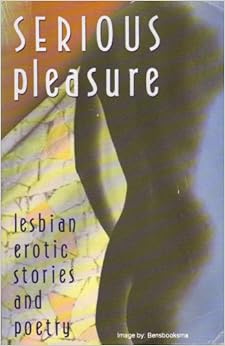
It a ‘serious pleasure‘ to find lesbian sex and sexuality celebrated by those to whom they belong. But there are problems on several levels with this book.
The Sheba Collection are only too aware of some of these and assure us in their well-considered introduction, that they discussed them at great length. For example, one of the things they invite us to ponder is the thinness of the differential line ‘between erotica and pornography’. How do we cope with the fact that there are some men ‘out there’ who will inevitably use the book as a turn-on, written as the stories and poems often are, with frank and uncompromising abandon. Sheba obviously feel that there is a further general – and important – debate, around lesbians taking ownership of how we are represented. And I believe that they feel that they have taken a step within that debate, challenging us to rise towards finding ‘the fine balance between political correctness and personal experience’.
And there, of course lies another possible problem, colouring how individuals are likely to react to this volume. It is, I would guess, improbable that every lesbian will identify with all the fantasies and romps through its pages. It is also conceivable that there might be those who fail to identify with any of it and that not merely because personal experience precludes identification but also because personal politics, which, of necessity, have a collective focus and significance, will raise too many questions.
That larger debate aside, though never forgotten, there is one further problem to be addressed in reviewing the book: are the stories and poems a good read? Disappointment will not be yours if all you want to do is absorb and react to many and varied visions of lesbian sex in full flow. On that level, the stories are indeed a good read. Some are headily passionate, others questing and sometimes finding. Yet others are sheer fun, one, in particular Parting Gift by MIndy Meleyal with punchline which almost takes the breath away.
But is it wrong to want more than that level of expectation grants? Does writing erotica have to mean, as it sometimes does here, that quality – of language, of story construction, of character creation – has to go by the board? The essence of many of the stories is most definitely ‘grunt and thrust’, and that occasionally quite aggressively so. (I am thinking on particular of the poem by Storme Webber, Like a Train). There were occasions when I felt that what mattered was not the characters, but how quickly they could be got into bed or under the shower, so as not to lost space for exhaustively describing them at it. As if the only vital thing is the fantasy. Perhaps it is in erotica and I am looking at this book from a completely wrong premise.
But then, you see, not all of the book is like that. Cherry Smith’s Crazy about Mary Kelly is a case in point. Not that it is devoid of what I have called ‘grunt and thrust’. But the presence of sexual desire and its fulfilment serves Cherry’s characters, helping to make them and their angers, fears and needs recognisable. How they are together physically mirror their individual emotions and reactions to each other – and for a brief while we have the tensions of whether they will be able to grow past these to respond to each other as they need to The story has a wholeness which some of the other lack.
And there are others which, while giving themselves over quite fully to fantasy, also carry something of universal about them. In Ambivalance by Tina Bays, we see before us something which most, if not all of us have expereinced – that electric insecurity of wanting and needing, which one is wary of voicing in case the other is not feeling the same way.
All in all, though I suppose I did feel rather overshelmed by the experience of reading this book. I think I felt rather like the speaker in the last piece in the book – a poem of Cheryl Clarke (whose work as represented in Serious Pleasure is worth the folling up and I intend to). I’m almost convinced that Sheba Collective, aware of the possibility of many shell-shocked readers, deliberately put this poem last, in a moment of wry humour, to slow things down, and bring other perspectives to bear.
Here it
is:
Sexual Preference by Cheryl Clarke
I’m a queer lesbian
Please don’t go down on me down yet
I do not prefer cunnilingus
(There’s room for me in the movement.)
Your tongue does not have to prove its prowness
there
to me
now
or
even on the first night
Your mouth all over my body
then there
Report: Senators, Queers and Northerners
Senators, Queers and Northerners – originally printed in Gay Star Winter 91 Vol 2 No 5 (which cost £0.50 to punters)
On Saturday October 26 the Northern Ireland Gay Rights Association held a Tenth Anniversary Victory Celebration in the Unemployed Resource Centre, in Central Belfast. The tenth anniversary in question was that  of Jeff Dudgeon and NIGRA in Strasbourg over the government of the United Kingdom; the actual date was being October 22nd. Happenstantially, it was the actual third anniversary of David Norris’s victory, although we did not know that at the time.
The other guest was Stephen Jeffrey-Poulter the author of Peers, Queers and Commons, a book recounting the past forty years of gay liberation politics in the UK. Stephen was amazed at the turnout in Belfast, which was roughly fifty gay women and men and some non-curvaceous persons. He had spoken to a grand total of three people in Edinburgh the day before.
Admittedly, there was food and drink on offer, which consisted of lots of dead beasts wrapped in various artistic forms. There were also a lot of cocktail sausages, or “pig’s dicks” as they were called by someone, who did not come into the meeting room – I couldn’t help noticing that the pig’s dicks had diminished by about three quarters when we emerged from the actual talkfest.
[You meet a nicer class of person at NIGRA functions].
“Talkfest” is an appropriate word as the celebratory air affected even by Mr Jeffrey-Poulter, who had a rather sombre tale to tell. The whole thing was introduced by PA MagLochlainn, with Jeff Dudgeon speaking first. He said he’d been loitering about Westminster in 1967, when “the Act” was being discussed. Judging from Stephen’s book, practically all the others in the Strangers Gallery during that time were Gay.
Heaven knows how they kept their faces straight while listening to some of the nonsense talked, but that was the way of the world the way of the world then. Gay people were, generally speaking, closeted and ashamed.
About t=his own assault on the UK government, he said that he “knew politics” and “how to organise” and that saw him through. His parents also were supportive and his mother opined that “…even a black beetle’s mother loves it…”, one got a general sense that the audience were discommoded at this but decided to laugh. Jeff demanded a drastic change in the law in effect equality for Gay women and men.
Soldiers are we?
David Norris spoke next and abused the Soldiers of Destiny quite strongly, (flicking through David Alvey’s book  Irish Education – The Case for Secular Reform, – earlier in the day – one could not help but noticed that the Soldiers of Destiny [Fianna Fail] have been most active in reforming education in Eire. David described himself as a “retired homosexual” and made use of the libidinousness of the likes of Family Solidarity and various judges making use his allegedly energetic sex life and trying to humiliate him by describing homo-sex (which is, of course, invariably anal sex). This was used by the Save Ulster from Sodomy people, and as David said they are never subjected to the same treatment. “How would Donal Barrington like to have his sexual dealings with his shrivelled up old stick of a wife made public?”
Galloper Norris
David took a quick gallop through the history of homosexual law in Ireland. Under the old Brehon law it was not  illegal, but it could be used as grounds for divorce by a wife if her husband slept with a boy “when it was not strictly necessary”.
The monks were, of course, very put out about this and wrote about people’s sexual misbehaviour at great length. In 1533 Henry VIII of England [it became Britain in 1536 with the Act of Union between England Wales] stole the monasteries and their lands. Thereby, the ecclesiastical courts were absorbed into the state’s statues, and the “abominable act of buggery” became a law oppressing the general population, and not just men who had chosen life-long celibacy.
This was not extended to Ireland, David says this was an accident, but the Poynings Law which made the Irish parliament a vassal of Westminster was not two-way. Laws passed by Dublin had to be approved by the Imperial Parliament as it took to styling itself, but Dublin was not obliged to pass every law passed in Westminster.
Grooms
In 1631, the Earl of Castlehaven was snitched on by his own son, he [the Earl] was having a relationship with his groom. Condemned by his Peers he was executed. A bishop, Atherton of Lismore, started a campaign to make sodomy illegal in Ireland. . This became law, a hanging offence, on November 1634.The first victim, by a nice irony, was the self-same bishop, who was having a similar relationship to the Earl with his own groom. This man, David said ran alongside the tumbril in tears until he was driven off with a whip.
There was a jump of several hundred years and we came to the Offences Against the Person Act 1861 which was a reforming act, replacing hanging with threat of life imprisonment and the Labouchiere Amendment of 1885. The latter criminalised “gross indecency” between males. The disparity in treatment of Gay men and lesbians in this matter was brought up in David’s own case – and the judges decided that while women might be able to behave indecently they could not be grossly indecent – “perhaps it is unladylike”.
A big problem facing David’s case was the de Valera Constitution of 1937 with its provisions on the family. Mary Robinson, David’s barrister discovered [invented?] “unenumerated rights” in Bunreacht na hEireann, and used these to bring about the right to contraception in the Republic.
The absurdity of the same judges putting their names to ajudgement claiming that anti-homsexual laws had to remain on the Statue book because Gays had to be terrorised into marriage and then handing down annulments because of a spouse’s homosexuality was touched on. So was a particular case from the ‘70s where two men had been spotted by a cop emerging from the closet in a public toilet. They were foolish enough to own up to the fact that they had been having sex. In court the younger man claimed that he had “proof” that he could be “cured” and could get married. The other man who was held [more] responsible had his wiefe in cort as a character witness.
Show Trial
David and Mary Robinson (other lawyers wer mentioned, Garret Sheehan especially) had wanted a “political show trial” in Dublin to expose the conspiracy of silence on the topic.
The State had tried to discredit each of the witnesses. They decided that one of the expert witnesses was Gay. One of them was – they choose the wrong man: a Dr Speigl who had got the American Psychological Association to remove homosexuality from its list of diseases – “…instantly hundreds of millions of people throughout the world wer cured – wouldn’t it be nice if flu, or the common clold could be cured with a show of hands!”
Despite all this David said that the Republic is a more comlex state and society tan many people think, “We elected the first woman MP. Had the first woman Cabinet Minister. Have a woman President. I was the first openly Gay man to be elcted to a national legislature. There are sexual orientation clauses written into a number of laws and this may become a common practice.” [The Soldiers of Destiny may well be led by a woman, Mary O Rourke quite soon].
Stephen [Jeffrey-Pulter] felt rather as if he were the stick to David’s carrot, he had been in six cities in as many days and asked forgiveness if he became somewhat confused. He launched into the 1967 Act immediately describing it, despite its mere six pages, as a “vicious little number”. It actually increased terms of imprisonment for some acts and excluses Service personnel and merchant seamen, there is also a procuring clause in it under which a person introducing two other parties to each other could b eimprisoned themselves.
[In case some people are confused by all this, it should be said that the period between the Wolfenden Report 1957 and the enactment of “the Act” in ’67 brought about an unprecedented level of discussion of homosexuality. Most of this was carried on at a vastly higher level than people are used to today. Even the popular press took a reasonable and usually sympathetic attitude towards the matter. The Act was supported by nearly all of Fleet Street.
It was this atmosphere that encouraged the Homosexual Law Reform Society to become the Campaign for Homosexual Equality (CHE). The law itself was not a great victory but the situation created by (mostly) closeted Gay women and men was of great benefit].
Unfortunately this cannot be said of the position today. The popular press is full of full of foul-mouthed abuse of gay people, and the AIDS crisis has spurred them on to even greater spleen. This led to the enactment of Clause 28 in 1988, “a complicated political cocktail” which made explicit what was implicit in the 1967 Sexual Offences Act, to give it its full title – homosexuality is inferior.
Stephen sprinted through gay history, in 1969 there was the Stonewall riot, where (as Norris said) it was “silly little queens, despised in the scene itself who did the fighting” – of New York’s finest [big butch Irishmen, with their biggest muscle in their brain cavity]. This led to the setting-up of GLF (Gay Liberation Front) in London in 1970 and – gasp! – in Belfast in ’71. Stephen obviously regards this as the Golden Age of Gay Liberation.
But the CHE (Campaing for Homosexual Equality – organised in England and Wales because the Act was not extended to Scotland or Northern Ireland) organised conferences which were attended by thousands of people. These included GLF activists who were also members of CHE, it had something called “national membership”.
This is why the differences between Stonewall, with its allegedly “respectable” approach and OutRage and ActUp are not quite the same as the differences between GLF and CHE, Firstly NIGRA and SMG (the Scottish Minorities Group) – later SHRG) had very strong GLF connections. Secondly, Stonewall and OUtRge are very small and by and large London-bound.
CHE went down the tubes after it moved from Manchester to London.
AIDS has also brought bisexuality to the fore and bisexuals find no place for themselves in Gay groups. What is needed is something like what Jeff had asked for, an Equal Opportunities Act not just within the UK but for all of Europe. Most European states have more rational laws than the UK; 18 year old men who in Denmark can have a perfectly legal association with the same footing as marriage, could be put in prison if they decided to settle in the UK.
Stephen ended by quoting from the GLF Manifesto.
The Dog that didn’t bark
The treatment of the local newspapers of the above celebration – which is quite important, what other element within civil society in the North has changed a law for the good in the past twenty years? – was a case of “the dog that didn’t bark”. Not a word was printed about the event, not even in their What’s On columns. Radio Ulster’s Sunday Sequence had interviews with “Gerard” and with David Norris, but not with Stephen Jeffrey-Poulter or, surprisingly, with Jeff Dudgeon. Radio Ulster gave a lot of time to the first Gay Pride festivities.
I went out in the middle of the meet around the corner to the Sunday News office but the journos who had expressed interest were out in the pub. I have been told that “we weren’t that far away”. Fair enough, but there ae half a dozen pubs they could have been using, and anyway, why should the makers of the news have to search the streets for the reporters of the news?
Fr Pat Buckley, gave the whole of his column in the following week’s Sunday News to the implications of the celebration. The Irish News carried an article on Monday October 28 on a groups set up by NI AIDS Helpline for carers of PWAs. Generally, the Irish News does not handle Gay stories, but it has taken to reporting sleazy stories about cottaging and so forth. Its television critic chose to whinge about having the word “gay” stolen as well as “out” when discussing the eight hours of Gay programming on BBC 2 television. Most of what he wrote was about one of the homophobes, Auberon Waugh – should the Beeb not have a number of Gay women and men on every night telling the viewers why they dislike the socio-sexual goings-on? The Belfast Telegraph also takes a high and mighty attitude to Gay people. This did not prevent one of its pompous columnists, one Laurence White, from sneering about Gay people wanting representation on the St Patrick’s Day Parade.
Sunday Life, the companion paper to the BT has decided to get right down into the gutter and attack gay men in particular, there was a slighting story about the Gay Pride march, there was a full page on Hazelbank on the northern shore of Belfast Lough which apparently is hiving with predatory homosexuals. The same edition carried an editorial condemning homosexuals in the same breath as drunken hooligans and drug [ab]users.
In the cross-channel press, as Radio Ulster rather coyly describes it, the Independent and the Guardian are pro-Gay. The Independent regularly, unfortunately, carries obituaries of lesbians and homosexual men, the latest one being Tom of Finland.
Scotland on Sunday and so far as one can tell the Glasgow Herald and the Scotsman (the companion paper to SonS) have good policies on Gay mattes.
In Northern Ireland we have no friends among the press except Sunday News, which may be dragged down with the News Letter, but this seems to rather little effect, on The Stand on BBC1 NI, a sixth form student asked the chief executive of Amnesty International about the organisation’s attitude to homosexuality..
Further Reading: Stephen Jeffrey-Poulter
Gay Star News has new shareholder
 Lord Browne of Madingley has become a shareholder in Gay Star news, taking a 12.5% stake,on the 12th February 2015.
Lord Browne wrote The Glass Closet, after his resignation as CEO of BP, seven years ago. He has continued to work for greater openeness in the corporate world for LGBT people in business.
Gay Russian couple have just won a major award

Photographed by Danish photographer Mads Nissen, it is part of a larger project called Homophobia In Russia highlighting what life is like for the LGBTI community under anti-gay laws
He has said he sees the image, shot in St Petersburg, as a ‘modern-day Romeo and Juliet’ story about two people in love but facing outside forces who want to deny them that love.
‘Today, terrorists use graphic images for propaganda. We have to respond with something more subtle, intense and thoughtful,’ World Press Photo jury member Alessia Glaviano said in a statement.
Nissen won a €10,000 euro ($11,330) cash prize.
– See more at: http://www.gaystarnews.com/article/incredible-picture-gay-russian-couple-has-just-won-major-award120215#sthash.rWNLhnYa.dpuf.
- « Previous Page
- 1
- …
- 7
- 8
- 9
- 10
- 11
- …
- 41
- Next Page »