
Huffpost Gay Voices – Kevin Dale McKeown – Posted:
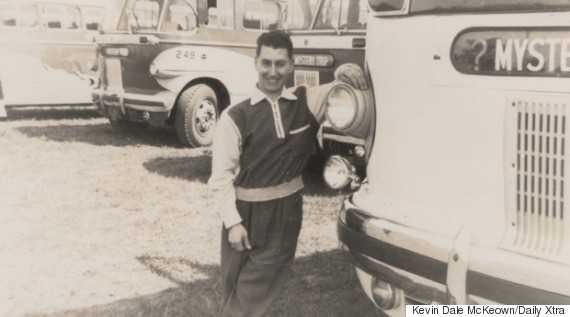
I have a new guy in my life. His name is Joseph, but his friends and family called him Joe so I will too.
I met Joe a few months ago through Don Stewart, the proprietor of MacLeod’s Books where I was in browsing one Saturday morning when Don suggested I take a look at a shoebox full of papers and photos that he thought might interest me.
The contents of the box proved to be memorabilia of the life of one Joseph R. Selsey, late of Vancouver’s West End. The reason that Don thought I might want to see these discards, retrieved by a savvy binner from where they’d been dropped next to a dumpster, was that several pieces of this collection indicated that Joe was a gay man living in our neighbourhood in the 1940s, ’50s, and ’60s; decades for which we have few records of our community’s existence.
Don’s first clue might have been the paperback copy of Richard Amory’s Song of the Loon, an interracial and intergenerational gay love story from the early ’60s, before either of those loaded terms had been coined.
Or the flyers from Trojan Book Service offering such titles as America’s Homosexual Underground by Antony James (quote: “The good-looking boy with lily-white skin was husky but the man sensed a kind of effeminacy as he watched the boy leaning against the stair steps with his crotch bulging.”).
Or the handbill from International Nudist Sun, boasting “frontal nude photographs” of hunky young “body builders.”
Certainly the Tom of Finland-style greeting card with three studs, naked except for toques and scarves and boots, carolling in the snow, was a clear giveaway.
Yeah, Joe was a friend of Dorothy’s, and I quickly scooped up the remains of his days for a closer look, and perhaps some clues to the lives of that generation of gay men who lived their youth in the years before Stonewall.
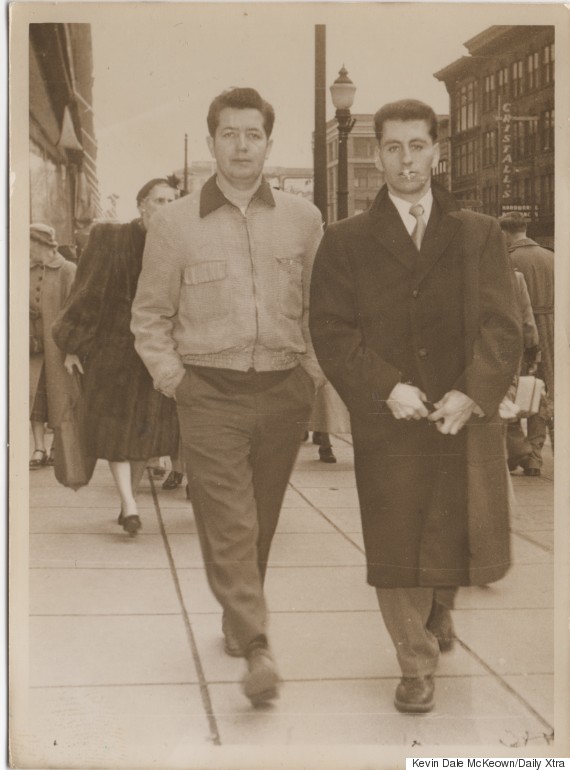
I have spent many pleasant hours with this material, wondering what kind of life we might imagine for Joe from these crumbs.
Much of it was lived at 1031 Harwood St., according to the handsome leather baggage tag with Joe’s name and address.
A well-dressed, happy, busy life with good friends, if the many photos of Joe and pals are any indication. And a life not entirely in the closet, hints a card signed “Merry Xmas to Joe from Kitty & Bob. PS: And a gay New Year!” Nor a life of rejection by family, according to several notes and photos inscribed “To Uncle Joe” from various wholesome looking children.
Joe’s wallet revealed that he had been born on March 19, 1927 in Saint Norbert, Manitoba, and that during his Vancouver years he was a joiner. He held membership cards to several establishments and organizations, most intriguingly to something called The Happytime Social Club, at 1022 Davie St. If that address sounds familiar, it might be because you gave it to the cab driver the last time you were dropped off atCelebrities.
I wonder what was going on in the Happytime Social Club in 1956? Was this a gay club after its turn as The Embassy Ballroom and before it became the notorious ’60s rock palace, The Retinal Circus?
Joe also had quite a number of passes to a Palm Springs Health Spa at 2405 West Broadway, which in the late ’50s offered, for a $2-surcharge, the “Complete Guest Treatment.”
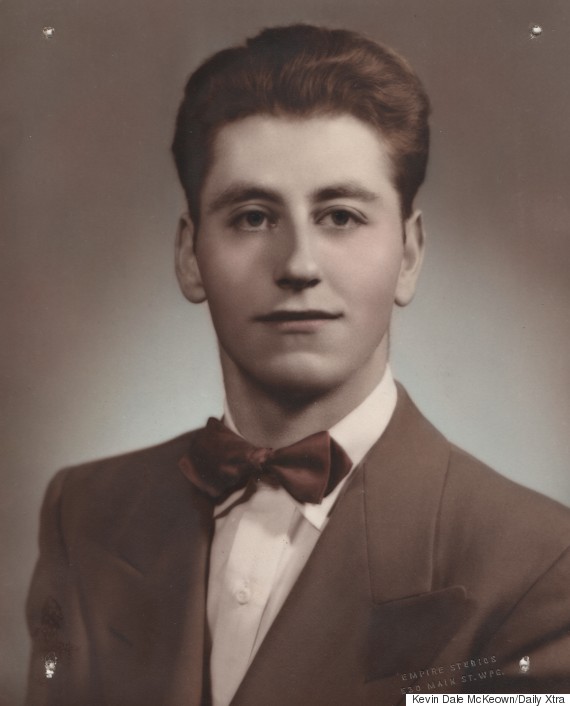
This time capsule also held a tiny key on a string (but nothing to open with it), a miniature silver keychain charm toaster, and a ratty rabbit’s foot. Does the collection of little sewing kits gathered from various hotel rooms suggest that our Joe might have been good with a needle?
Would the bolo tie with the bull and matador woggle indicate a butch streak, or does the baby blue cord of the tie suggest otherwise?
The stick of dried-out Wrigley’s chewing gum hints at less than fastidious housekeeping (really Joe!) and the little bundle of Irish Sweepstakes tell us that Joe liked a flutter on the ponies.
Most poignant among the scraps was a simple black and white, business-card sized piece, with a psychedelic pattern enclosing the words “You Are Not Alone.”
I admit to having qualms about outing Joe, even several years after his demise, until I found his Vancouver Sun obituary online. Noting his death at Vancouver General Hospital on April 26, 2007, aged 80, the obit proudly stated that Joe was “survived by his loving companion of 27 years, Ralph Gotell.”
Having weathered the challenges of life as a gay man in the 1940s and ’50s and ’60s, Joe was lovingly partnered and proudly out at the end. I don’t think he’d mind our spinning this little tale around these bits and bobs his life.
So far my digging has turned up no further records of the lives of either Joe or Ralph.
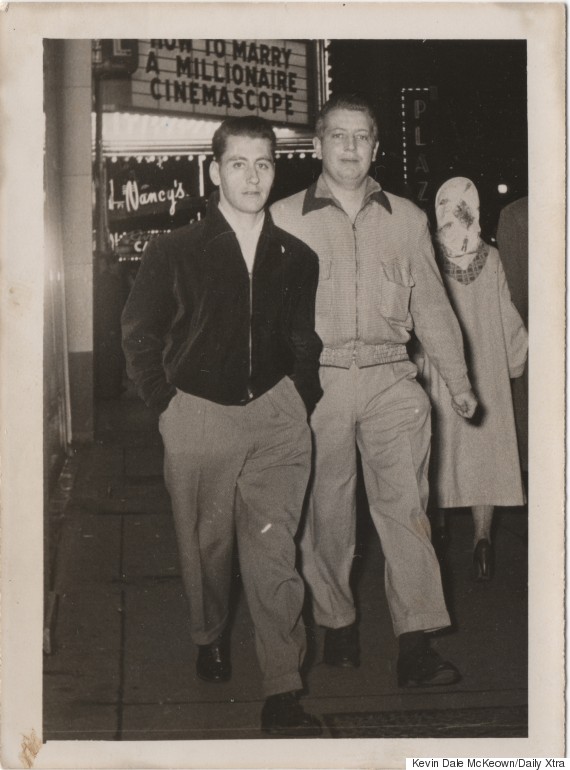
I share these random musings about Joe Selsey and how he might have lived his life as a gay man in the Vancouver of his day for two reasons: To help us realize that there is at least two generations worth of local, verifiably gay history that is slipping beyond our grasp; and to ask you, gentle reader, to share this story and these photos with any friends you may have of Joe’s generation.
Ask if they knew him, and if they recall the Happytime Social Club, and can tell us just how happy those times were?
Even if they didn’t know Joe or Ralph, perhaps something of these notes will jog a memory and stir up a story that we should add to our rich history. Before it’s too late.
If you have such friends, and they’re willing to chat, coffee’s on me!
You can contact the writer at stillqq@dailyxtra.com.
(This column first appeared on Daily Xtra.)
Archives for 2015
Ground breaking findings for those affected by HIV

New study finds earlier treatment is beneficial
Those affected by HIV stand a “considerably lower risk” of developing AIDS or other serious illnesses if antiretroviral drugs are administered earlier, according to a new study conducted by the International Network for Strategic Initiatives in Global HIV Trials – INSIGHT.
The START – Strategic Timing of Antiretroviral Treatment – trial is the first large scale randomised clinical trial to figure out if taking HIV medication earlier than currently recommended is beneficial.
At the moment, the World Health Organisation HIV treatment guidelines recommend that people infected with HIV begin antiretroviral therapy when their CD4+ cell count – white blood cells – drop to 500 cells/mm3 or less.
The new trial is “clear cut proof” according to NIAID – National Institute of Allergy and Infectious Diseases – Director Anthony S. Fauci, that starting treatment regardless of white blood cell count per mm3, is massively beneficial.
During the study, people were randomised and put into one of two groups. One group were given treatment when their CD4 count was above 500, and the other waited until their count was below 350.
According to Ibase, one of the biggest surprises was that even at very high CD4 counts, treatment was shown to reduce the risk of AIDS and other serious illnesses.
Jens Lundgren, M.D., of the University of Copenhagen said: “This is an important milestone in HIV research. These results support treating people irrespective of CD4+ T-cell count.”
Dr Rosemary Gillespie, Chief Executive at Terrence Higgins Trust, said on the study:
“This ground-breaking research adds to the growing body of evidence that shows there should be no delay in starting HIV treatment. Early diagnosis and treatment mean that people living with HIV can expect to live long and healthy lives, and can also reduce the chances of HIV being passed on unwittingly. They are key tools in our efforts to stop the spread of HIV in the UK
The results have been released earlier than expected. They were due to be concluded in 2016 – the trial will still continue until then – after having started in 2011; however the Data and Safety Monitoring Board found on 13 May this year that the results were so clear that they recommended the study be changed and all participants now have the option to change to the early treatment.
Until now, large database tests had not managed to find benefits of starting treatment early and because the START study was randomised, it makes the results very unlikely to be by chance.
The findings are ground breaking and a massive help for those affected by HIV.
More detailed results from the study are expected to be released at the International AIDS Conference in Vancouver in July.
Words Paul Greenough, @paulsgreenough
FOI Man’s Guide to Making FOI Requests
 Reproduced from the Foiman site.
How to make responsible and effective FOI requests
The Freedom of Information Act 2000 (FOI) and Environmental Information Regulations 2004 (EIR) introduced a right to information held by public authorities which came fully into force in 2005. However, like all rights, it should be used responsibly by those who exercise it.
Here, FOI Man, a public sector employee with several years’ experience of advising on and answering FOI and EIR requests, outlines the best way to make sure you get the most out of both regimes without creating unnecessary burdens on public authorities.
Except where otherwise specified below, FOI is used to denote both pieces of legislation.
Why should I care?
FOI is a right. Full stop. You absolutely have the right to ask a public authority for any information that you like. Unless your request is invalid, vexatious, covered by one of the exemptions, or the authority doesn’t hold it, they have to make the information available to you. To an extent, you’re even allowed to dictate in which format they should provide it to you. So you have the power.
But should you use that power? And if you do use it, should you consider the impact it might have on the public authority concerned? In these times of cuts and mass redundancies, is it right that scarce resources are spent digging around for information that you might have lost interest in by the time you get a response? And if you’re a campaigner, trying to engage your local politicians, do you really want to risk getting on the wrong side of them through your use of FOI? Is it a Pyrrhic victory if you get your information at the cost of officials’ time that could have been spent on doing the things you’re campaigning for?
And there could be implications further down the road if we don’t use FOI responsibly. In other countries where FOI has been in place for years, enthusiastic early adoption has often led to a backlash from politicians and the courts. In Ireland, a prohibitive fees regime was introduced; in New Zealand, the courts considering appeals began to interpret exemptions restrictively. Over here, we’ve seen an attempt by politicians to remove themselves from FOI (thankfully rewarded with contempt from all sides), and there are regular calls from senior officials in various parts of the public sector for their particular area to be excluded from the legislation.
It’s really easy to fire off an email asking for information. You can even send it to several thousand public authorities in one go. But be aware of the resource and other implications of that simple act. Here are my ten top tips on how to make effective, responsible use of FOI.
FOI Man’s Ten Top Tips on Making Responsible and Effective FOI Requests
1. Count to ten before clicking ‘Send’
Or better still, sleep on it. Consider if you really do want the information, and if you do, whether you have asked the right questions.
2. Do your research
Is the information already available on the authority’s website, perhaps in their Publication Scheme? Is there information there that could be used to make your question(s) more relevant or incisive? Has the question been asked before? There may be a ‘Disclosure Log’ on their website, or failing that, you could check WhatDoTheyKnow.com.
3. Take care when making ‘round robin’ requests
Remember that the more organisations you send your request to, the more public money will be spent on answering your request. And use your research to weed out authorities that the request isn’t relevant to.
4. Try an informal approach first if possible
You may already have a professional relationship with somebody within the public authority. Alternatively, the authority may publish direct contact details for the department that deals with the issue you’re concerned about. Try contacting them first to sound them out. At the very least they may be able to advise you as to what to ask for, and occasionally, they may even be able to give you more information than you would be entitled to under FOI.
5. Be specific
If you do decide to make a FOI request, cite the Act in your request (you don’t have to but it can help to avoid confusion). Make your request as clear as possible. Don’t be ambiguous. You can’t blame a public authority for misinterpreting your request if you’ve not specified clearly what you want.
6. Don’t be greedy
It’s tempting to throw everything including the kitchen sink into your request. Don’t. Keep your request short and to the point. You can always make other requests later if you want more information.
7. Be polite
Try not to assume that the person reading your request is determined to avoid answering your question(s). It’s likely that members of your own family, perhaps some of your friends, are public servants. Would you feel content to send them your request?
8. Be patient
Your request isn’t the only request that will be received by the authority. The people who have to answer your request will also have a number of other responsibilities to meet. Try to be patient and accept that you may not get an answer as quickly as you would like. In the vast majority of cases you will get a response before the statutory deadline of 20 working days (and note that phrase, ‘working days’ – in effect, organisations have a month to respond, give or take a couple of days).
9. Read the response carefully, and if necessary, use the Appeal process
A lot of effort goes into answering FOI requests, even (often especially) when your request is refused. Make sure you’ve understood the response.
Accept that in some cases, the authority just does not hold the information you’ve asked for. You may think they should, but if they haven’t, you can’t use FOI to force them to create it. Often the authority will explain why they don’t hold it – try to read their explanation with an open mind.
If your request has been refused using one of the exemptions (FOI) or exceptions (EIR), the authority should have provided you with an explanation of which ones apply and how. Where a public interest test has been applied, they should have explained the arguments for and against disclosure.
Try to take a step back and consider whether their arguments make sense. For instance, although you might like to have access to information about employees, you probably understand that some of that information is protected by the Data Protection Act. Whilst you may not be happy with the response, it may be that the Act has been applied correctly.
If the arguments don’t make sense or you disagree with them, and you still want the information, use the authority’s Internal Review process. The authority should have sent you details of this process with their response. All you really need to do though is to write to them, asking for an internal review. It will help your case if you set out the reasons why you think the exemptions/exceptions don’t apply. Where a public interest test has been applied, you can put forward your own arguments for disclosure if you don’t think these have been considered.
Again, be patient whilst waiting for a response, and when you do receive it, read it carefully. If you are still dissatisfied with it, consider contacting the Information Commissioner and asking him to review the response. Bear in mind that this may take some time – though turnaround times at the Commissioner’s Office have improved considerably in the last year.
10. Use the information you receive responsibly
If you want to use the information you’ve been sent, do so responsibly. One example of this is asking for permission if you want to reproduce a document that’s been sent to you (or at the very least acknowledging the source). Even though you’ve been sent the information, the copyright will normally still belong to the authority concerned or whoever gave it to them.
If you’re reporting on the information disclosed, try to provide context. Often the response will include an explanation of why, for instance, so much was spent on the particular activity you’ve asked about, or how spending compares with other similar organisations. Even if it doesn’t, it will often be a straightforward task to find contextual data or background. Whilst it may not make for as spectacular a story, excluding these facts could distort the impression given to your audience. This impression may well be convenient in the short term, but it could damage your reputation with the organisations that provide information to you, and ultimately with your audience if they learn that they are being misled.
Other resources you may find useful
Information Commissioner’s guide to making FOI requests
Information Commissioner’s Charter for Responsible FOI Requests
Information Commissioner’s guidance on appealing decisions
NCVO guide to using FOI for campaigning

Court Decision: Lee v Ashers Baking Co Ltd
The Equality Commission for Northern Ireland welcomes the judgement given in Belfast in the case of Lee v  Ashers Baking Co Ltd. This case raised issues of public importance regarding the extent to which suppliers of goods and services can refuse service on grounds of sexual orientation, religious belief and political opinion.
The Court’s decision confirms the legal responsibilities on all service providers not to discriminate against their customers on these grounds.
The Commission’s Advisory Services Team can provide advice to employers and service providers. For further information Tel: 028 90500600 or email edenquiries@equalityni.org
Belfast Book Festival 2015
Belfast Has A Book Festival!


Festival Director, Keith Acheson said: “Every year the Belfast Book Festival provides an opportunity for authors, poets and performers, to showcase their work. Yet again we reveal another packed programme of events which we hope will appeal to everyone – no matter what age or level of interest in literature.

Kate Newman reading from poetry anthology ‘Grim’
“Whilst we are delighted to welcome returning supporters we are keen to reach out to those who have never participated in our festival before and encourage them to join us in trying something new. I would also like to take this opportunity to thank our key funders the Arts Council of Northern Ireland and Belfast City Council for their continued support as well as all of our many festival sponsors and partners.”
Kate Newmann, read from her wonderfully atmospheric collection of poetry , Grim.

Conor Maguire performing from his one man show of Moby Dick
Conor Maguire, also performed an extract from his one man representation of ‘Moby Dick’, which was atmospheric and riveting. Herman Melville’s epic prose From 1851 still has much to tell us about the nature of man and is brought to the stage by Conor Maguire, who has performed Oscar Wilde in ‘De Profundis’ and Brendan Behan in ‘The Confirmation Suit’ for the Belfast Book Festival.
 The festival is of course about books, and central to its ethos is that of bringing books to schools through it Writers in Schools workshops in creative writing, from short stories to poetry and even the odd Haiku! – all supported by featured artists.

Thomas Hitzlsperger in his Everton days. Photograph: Martin Rickett/PA
But, for the LGBT community we have a treat, NIGRA has been working with Keith Acheson to introduce an LGBT element into the festival, and indeed a first, in that Thomas Hitzlsperbger, a former German footballer who played the early part of his career with Aston Villa, before returning to Germany to play for Stuttgart. Following a series of injuries, he retired from football in 2013, and he announced that he was gay.
We welcome this inclusion, and hope that the community will make every effort to support the night by coming along. I for one am looking forward to hearing his conversation with Denise Watson.
…He had thought about coming out while still playing for Wolfsburg in 2011-12 but then listened to people who warned him of the negative consequences. “They all said ‘don’t do it, a big wave will crash on you’,” he says…
I urge everyone to come along to as many events as you can, there is something for everyone, of every age, gender, colour or creed. I have already picked my events.

Belfast Book Festival 2015
Further reading:
It's Raining Men down at Beyond Bollywood

Something to brighten your day…
Now open at the London Palladium, new musical Beyond Bollywood has a little treat for you all as we come out of the bank holiday weekend.
As featured in the show – and totally our favourite moment, obviously – the boys feature their own rendition of It’s Raining Men. And before you ask, no – it isn’t the Geri Halliwell version.
In true camp style, they lip sync through the track and serve true show business glamour, much to the applause of the audience.
Ticket information on how you can join the party can be found here. Beyond Bollywood remains at the London Palladium until 27 June.
Words William J Connolly, @wjconnolly
Equality law will change to protect gay teachers, says Ó Ríordáin
The Irish Times – May 28th, 2015 – Ruadhán Mac Cormaic
Schools and hospitals will not be able to discriminate over sexuality, Minister says

Luke Field from Cork and Minister of State for Equality Aodhán Ó Ríordáin at the count centre in Dublin for the same-sex marriage referendum. Photograph: Cyril Byrne.
A planned change to equality law will “raise the bar” so high that schools and hospitals will not be allowed to discriminate against staff or job applicants because they are gay, Minister of State for Equality Aodhán Ó Ríordáin has said.
The Government is working on an amendment to the Employment Equality Act, which allows religious-run schools and hospitals to discriminate in order to maintain their ethos. Advocacy groups and unions say the law has a chilling effect on gay and lesbian teachers, who feel their sexuality could hinder employment or promotion prospects.
Mr Ó Ríordáin said he believed an attempt to repeal section 37.1 of the Act, which gives religious-run workplaces an exemption to discrimination law if an individual undermines their ethos, could be unconstitutional.
Instead, the Government would amend the law so as to “raise the bar of the ‘undermining’ to be so high as to be irrelevant what somebody’s personal life would be”.
Promotion prospects
“Effectively you have a situation where an awful lot of teachers in primary and secondary schools would have voted Yes [in the marriage referendum] on Friday, would have gone out and celebrated over the weekend, possibly went back into their staff rooms on Monday morning and didn’t tell anybody what they were up to because they felt it would impact on their promotion prospects in the school,” Mr Ó Ríordáin said.
He believed this was a workers’ rights issue that affected not only the LGBT community but people who were remarried or cohabiting with their partners.
Mr Ó Ríordáin was speaking on The Irish Times Inside Politics podcast, where he clashed with the chair of the Iona Institute’s board of directors, John Murray.
Commitment
Mr Murray said section 37 should not be changed, but if it was, new text should include a commitment to denominational education. He said schools had a “live and let live” attitude to diversity and respect for people’s private lives.
“There are hundreds of teachers around Ireland who are divorced or remarried. There are many teachers who are living together with somebody, who aren’t married at all. That happens in loads and loads of cases,” he said.
“I’m involved in education for the last 30 years and I’m not aware that there’s a major problem about this, in terms of people being sacked or people losing their jobs or people not being able to do their jobs. It simply isn’t true.”
Under current law, educational or medical institutions controlled by religious orders which promote religious values are not considered to be discriminating if they favour an employee or prospective employee “in order to maintain the religious ethos”.
Repeal or amendment of section 37.1 has been discussed since the early 2000s, when the Equality Authority said it should be reviewed. Any amendment must strike a balance between the right to equality and the right to earn a livelihood, on one hand, and the right to the profession and practice of religion.
Mr Ó Ríordáin hopes the law will be amended by the new school year in September.
Why Thousands Of Catholics Voted For Marriage Equality In Ireland
 BY JACK JENKINS
 POSTED ON

Marriage equality supporters celebrate outside of Dublin castle, Ireland after learning the final result of the nation’s referendum on same-sex marriage over the weekend.
CREDIT: AP
Last week, famously Catholic Ireland voted overwhelmingly to legalize same-sex marriage in a national referendum, making it the first nation in the world to enact marriage equality through a popular vote. Within hours of the results,several journalists and pundits painted it as a victory for secularism and a telltale sign of Ireland’s willingness to abandon the Catholic Church, which staunchly condemns same-sex marriage and whose leaders urged their congregants to vote against LGBT equality. The Church’s longstanding influence on Irish life, they concluded, was ending.
But while the narrative of a dying church is tidy, it fails to account for a religiousand distinctly Catholic movement for LGBT equality quietly triumphing in Ireland and elsewhere. To be sure, recent census results show a markedgrowth in Irish who don’t affiliate with any religious tradition, and a notable drop in the number who attend mass each week. This is largely due to the dark specter of the child sex abuse scandal, which was particularly horrific in Ireland, as well a younger generation fed up with conservative views of homosexuality. But for all this talk of a vanishing Catholic Church, Ireland remains a deeply Catholic nation: although more than 62 percent of Irish who voted in the referendum supported same-sex marriage, a full 83.2 percent of the population still claims to be Catholic.
 So how did so many self-identified Catholics vote for something their Church blatantly forbids? There were no
national exit polls for the referendum, but Ursula Halligan, a prominent Irish TV news presenter in Ireland, offered a clue earlier this month in an op-ed for the Irish Times. In it, she detailed her own struggle with sexual identity — explaining how she fell in love with a girl at 17 — before boldly claiming that her support for same-sex marriage was not a rejection of her faith, but a passionate embrace of the person God compels her to be.
“As a person of faith and a Catholic, I believe a Yes vote is the most Christian thing to do,” Halligan wrote. “I believe the glory of God is the human being fully alive and that this includes people who are gay.”
Commentators have rightly placed much of the credit for the vote on high turnout among younger, non-religious Irish people, yet support for equality transcended age and church attendance. As an 83-year-old woman told the Irish Times on her way to mass earlier this month, marriage equality is a challenge for the Church, not her faith.
“I think it’s a stupid carry-on the way the church is going on at the moment, ridiculous,” she said.
But it wasn’t just lay Catholics who lobbied for same-sex marriage in Ireland. Marching alongside them at pro-equality parades were several practicing Catholic clergy, many of whom openly endorsed the right to marry over the past year. Like their parishioners, they framed their position as a natural outgrowth of their faith.
“A lot of people who vote ‘yes’ on Friday will be at church on Sunday,” Rev. Pádraig Standún, a Catholic priest in Western Ireland, told the Washington Post. “They won’t be any less Catholic. In fact they might be even more so, because they’re following the words of Jesus and showing more love.”
Standún and other priests are sometimes dismissed as radical or fringe, but they represent a growing contingent of the Church’s own leadership. At least one priest — Rev. Tony Flannery, who was suspended in 2012 for supporting reforms such as women’s ordination — told BuzzFeed he predicted at least 25 percent of the country’s clergy would got to the polls and quietly vote “yes” for same-sex marriage. Among their number was Rev. Martin Dolan, a priest whocame out to his Dublin, Ireland congregation in January during a sermon, encouraging his flock to support the referendum before declaring “I’m gay myself.”
The congregation’s response? A standing ovation.
Embodied in their applause was the simple belief that one’s Catholic identity is not erased by standing up to the church on same-sex marriage, a position shared by a growing global chorus of their fellow faithful. Catholics in the U.S., home to the world’s fourth-largest Catholic population, are actuallymore supportive of same-sex marriage than any Christian group in the country, and have launchedsustained protests across America against Catholic institutions that fire employees for being LGBT. In Brazil, the world’s largest Catholic nation,65 percent of Catholics endorse the right to marry, which is now legal there after a 2013 federal court ruling. And over in Pope Francis’ home nation of Argentina, where over 70 percent of the population is Catholic, same-sex marriage has been legal since 2010. That move was supported by more than 60 percent of the population at the time — including, of course, millions of Catholics.
These pro-equality Catholics achieved all of this not by renouncing their faith, but by fervently claiming it — just as the Irish did. Church leaders already appear to be at least hearing the message, even as they refuse to abandon old understandings of sexuality. Although no immediate change is on the horizon, Pope Francis’ oft-discussed conciliatory tone toward LGBT people and his high-level conversations about homosexuality offer a peek into a church striving to come to terms with the progressive theology of its laity. And while Rome hasn’t offered an official statement on the Irish vote, a Vatican newspaper called it a “defeat”, a sentiment echoed by Catholic Archbishop of Dublin Diarmuid Martin on Sunday.
“The church needs to take a reality check,” Martin told the New York Times. “It’s very clear there’s a growing gap between Irish young people and the church, and there’s a growing gap between the culture of Ireland that’s developing and the church.”
Martin, of course, didn’t support the referendum. But his other commentsahead of the vote show a deeper — albeit conflicted — sensitivity to the issue: “Anybody who doesn’t show love towards gay and lesbian people is insulting God. They are not just homophobic if they do that—they are actually Godophobic because God loves every one of those people,” he said.
There are cynical progressive Catholics who will dismiss these efforts to change the Church from below or within. Wounded by decades of culture wars, they understandably see the hierarchy as too stiff, too immobile, too much of a literal old boys’ club. But history proves that the church does listen to the spiritual concerns of those it serves — it just usually takes a lot of effort and a really, really long time. The Protestant Reformation, divisive and bloody as it was, still sparked a flurry of changes within the Church that eventually manifested in theCounter-Reformation, a fraught period (it included the Roman Inquisition) that nonetheless saw the introduction of many internal reforms such as curtailing the much-critiqued selling of indulgences. Centuries later in the 1980s, several Church officials, including then-Cardinal Ratzinger (later Pope Benedict XVI), condemned the emergence of Liberation Theology in Central and South America, railing against several aspects of a Catholic movement that decried corrupt clergy and sought to lift up the poor. Yet just last week, Pope Francis — the first Latin American pontiff — invited the father of liberation theology, Gustavo Gutiérrez, to speak at the Vatican as a guest. Several of Gutiérrez’s contemporaries were officially rejected by the Church, but their shared core assumption — that God is on the side of the poor and oppressed — is clearly alive in Francis’ own popular papacy.
Meanwhile, conservative Catholic pundits have begun blaming Pope Francis for potentially splitting the Church, casting him as a divisive pope whose rhetoric strays from true Catholicism, especially his approach to LGBT people. But the Church was divided on LGBT issues long before Francis ascended to the papacy, and it is a genuine religious movement — not just a secular one — that is pushing for it to change. If the Church does schism (and it almost assuredly won’t), it will be for many more reasons than sexuality, but it likely won’t be a radical left wing abandoning the pious. Instead, it will probably be a minority right-wing that has refused to heed the wisdom of a theology already guiding the daily lives of millions of everyday Catholics.
Which brings us back to Ireland. If the Irish are known for anything, it’s for their rollicking history of fighting to bring oppressive powers low before God. Their various revolutions and struggles with the English crown are a testament to that, when many Catholic Church officials were close allies of revolutionaries, risking their lives to stand up for the oppressed. Last Wednesday a new band Irish Catholics — clergy and laity alike — simply reengaged that old spirit in the form of a vote, but this time with a message for the Church itself: “We are Catholic, and we support marriage equality,” they implicitly proclaimed as they cast their votes, filled Dublin streets with rainbow flags, and flooded gay pubs to raise triumphant pints of Guinness. “What of it?”
__________________________________________________________________
This post has been updated to expand the section detailing the church’s reaction to Liberation theology.
Poll finds 85% of people support marriage equality as demonstrations set to take place in Belfast
 : MAY 28, 2015
 What’s next for LGBT rights in Northern Ireland?
MARRIAGE EQUALITY DEMONSTRATIONS:
RALLY – SATURDAY 30TH MAY – 2PM ASSEMBLY AT BELFAST CITY HALL.
MARCH AND DEMONSTRATION – SATURDAY 13TH JUNE 2015 – 2.30PM ASSEMBLY AT WRITER’S SQUARE.
As Northern Ireland’s neighbours each began to embrace marriage equality it was becoming obvious that as a nation we would soon be left out in the cold when it comes to LGBT rights.
Now following an historic result in Ireland’s Yes vote in the Marriage Equality Referendum there is a prominent patch of inequality in the UK and Ireland.
Northern Ireland is the only part of the UK which does not allow gay marriage after England, Wales and Scotland introduced marriage equality legislation last year.
The DUP, the biggest party in Northern Ireland has steadfastly refused to follow suit. Motions to legalise same-sex marriage have been rejected four times in the assembly.
The last motion in April fell after 47 MLAs voted in support while 49 voted against. The result, however, was a forgone conclusion as it had already been blocked by a DUP petition of concern.
The issues surrounding the rights of the LGBT community are bubbling to the surface more frequently now.
Recent news and events involving the former Health Minister Jim Wells, Northern Ireland’s blood ban, the Ashers Bakery gay cake row, reports of homophobia during the Westminster election campaign and recent blocks on introducing marriage equality have only served to highlight the difficulties experienced by LGBT people here.
Amnesty International’s Northern Ireland Programme Director Patrick Corrigan has criticised Northern Ireland’s politicians for blocking the equality legislation.
“This historic result [in the Republic of Ireland] will echo around the world – it shows how a once socially-conservative country can transform itself into a beacon of equality,” he said.
“Northern Ireland is now the last bastion of discrimination against gay people in these islands.
“Northern Ireland’s discriminatory laws are a badge of shame – not to be worn by the people of Northern Ireland, a majority of whom support same-sex marriage, but by those politicians who oppose equal treatment for the LGBTI community.
“The Northern Ireland Executive should waste no more time in fulfilling its first duty to its people – to ensure that none are treated as second-class citizens.”
Amnesty, along with The Irish Congress of Trade Unions and The Rainbow Project, will hold a mass rally in support of equal marriage (facebook event page link) rights on June 13.
A statement from John O’Doherty, Director of The Rainbow Project, last week reads:
“Northern Ireland is now the only region in Western Europe where marriage equality is not a reality. This is a shameful injustice which cannot be allowed to continue.
‘To highlight this injustice, The Rainbow Project and our partners in Amnesty International and the Irish Congress of Trade Unions have announced a march and rally for marriage equality to be held in Belfast on Saturday 13th June, assembling at Writers’ Square for 2.30pm.
The March for Civil Marriage Equality through central Belfast will culminate in a rally in front of Belfast City Hall.
‘We will continue our fight to ensure that Equality becomes a reality for all the peoples of these islands.’
Some people are calling for a referendum on the issue whilst others are hoping that the outcome of an on-going court case will result in the implementation of marriage equality legislation.
Besides the marriage equality march in Belfast on June 13th there will be another protest at City Hall being organised this Saturday 30th May held at City hall.
The event has been organised by the party People Before Profit and has over 4,000 confirmed attendees on the Facebook event page. 
The event description for the protest on Facebook reads:
“The referendum in the Republic of Ireland has given great hope to the LGBT community around the world. The referendum was not just about equal marriage, as important as that is. It also gives us all hope that we can build a more equal and fair society.
“However, in Northern Ireland we still do not have the right to marry and elected representatives have failed to get a motion passed for same sex marriage 4 times. Shame on our Assembly!
As a young member of the LGBT community myself I am disgusted at this. But I feel now that the result in the South should spur us on here in the North. Equality can’t wait!
“Let’s get out and make our voices heard. Fellow Members of the LGBT community and everyone who believes in equality, I urge you to join us in a rally, Saturday 30th May, at 2pm, City hall!
“I hope to see many people there, it’s urgent that we organise a large movement to fight against this oppression and demand equal marriage status!”
In a post on the Facebook event page, People Before Profit councillor, Gerry Carroll said:
“This could be the start of a big movement. Well done everyone! Let’s make it a big one! And now the great people at the Rainbow Project and others have called for a big rally in June too! Fantastic! Let’s get everyone down next Saturday as a start for a really big movement that will shake the Assembly to its core. And then get everyone down in June!”
The news of the planned demonstrations comes with a surge in support for equal marriage.
A recent survey in the Belfast Telegraph has found 85% of people believe same sex marriage should be allowed in Northern Ireland (13% said No, 2% said they “Don’t care”).
TGS are encouraging as many people as possible to get involved in the events and put further pressure on the Assembly to embrace equality legislation.
Ashers Bakery Owners to Appeal
Editorial: The McArthur family, who having taken a contract decided that they couldn’t fulfil it due to their Christian beliefs, and then who were taken to court by the Equality Commission NI and had judgement made against them, is to appeal the judgement.
This is a perfectly natural move, and it is one that must be expected. The fees are not exorbitant (see Civil Appeals Office Fees from 4 April 2011) but the time for a case to heard can be lengthy, currently some cases are in excess of 9 months.
I do honestly believe that both of the two participants in this case would like to get on with their lives, but unfortunately the case has now got a political angle; in particular with some Northern Irish MLA’s and MP’s taking very right of centre positions against the LGBT community. Allied to which some church groups, in particular the Christian Institute which is funding the McArthur’s case for them.
I will also stress to everyone that the decision to go to the Appeal Courts at this time is controlled by the laws governing when you can submit your Notice to Appeal, and that it has ‘nothing’ to do with the ‘Yes’ vote on marriage equality which has just occurred in the Republic of Ireland.
The two are not linked in any way that I can see.
I am putting links to various news articles here for you to look at and for you to make your own judgement:
- The Guardian – Northern Ireland bakers guilty of discrimination over gay marriage cake
- BBC News – ‘Gay cake’ case: Ashers bakery to appeal discrimination decision
- The Belfast Telegraph – Ashers bakery to appeal ‘gay cake’ ruling

Bakery owners Daniel McArthur and his wife Amy arrive at court for the verdict. Press Eye – Belfast – Northern Ireland – 19th May 2015 Picture by Jonathan Porter / Press Eye
- « Previous Page
- 1
- …
- 55
- 56
- 57
- 58
- 59
- …
- 89
- Next Page »