ACOMSDave

Community Journalist

  • Home
  • Community Journalist
  • Events
  • Media Page and Press Kit
    • Projects and Work
  • Resources & Documents
    • LGBTQ+ Support Groups and Documents
  • NIGRA
  • Archives
  • Contact

Archives for December 2015

X-men’s Shawn Ashmore would be interested in playing a gay Iceman

09/12/2015 By ACOMSDave Leave a Comment

Gay Times Logo8th December 2015

by Josh Withey

This year Iceman, one of the original X-men, came out as gay in Bran Michael Bendis’ superb All-New X-Men #40.

Speaking at the 2015 Game Awards, Shawn Ashmore – who has played Iceman for the last 12 years in the movies – said that it’s one of the most interesting things to happen to the character, and that he’d be interested in playing Iceman again
Shawn told IGN:  “Obviously the comics and movies are separate. I wonder what the transition would be because we’ve sort of established Bobby as having a love interest in Rogue and having a love interest in sort of Kitty Pryde, but I think it’d be really interesting.
“I think it’d probably be the most interesting thing that could happen to Bobby in the films. If they decided to take the story that way, it’d be incredibly dramatic, it’d be an interesting storyline, and it would give Bobby a great character arc. I’d definitely be open to that, but again, I’m not sure if they want to take the character in that direction. I have no idea how they would play that out. I think it’d be very interesting.”
Last month, comic book writer and creator of X-men Stan Lee, discovered that Iceman was gay during a live radio interview.
While appearing on BBC Radio 4’s Today programme, Stan said: “I wasn’t involved in that, that may have been after I stopped writing the books. I didn’t really have any gay characters. If they were gay I didn’t play up to the fact that they were. I wasn’t aware of my characters sexual proclivities.”
He then admitted: “In fact your telling me that is the first time I’d heard. Is Iceman really gay?

“Wow! I never knew that. I don’t care what happens as long as they tell good stories.”

Filed Under: Movie Reviews Tagged With: comics, iceman, Marvel, Shawn Ashmore, x-men

COMING OUT: I FELT LIKE IT WAS SO DIFFERENT TO WHAT I KNEW

09/12/2015 By ACOMSDave Leave a Comment

GNI LogoDecember 9, 2015


James

James knew he was gay since he was small.  He’s had the usual ups and downs, but this Belfast lad is about to achieve his life-long dream of jetting off with British Airways…

When did you first realise you were gay?

I always knew I was gay. Ever since I was very young I knew I was a little bit different. I didn’t play with Action Men, but my mum was a childminder so I would play with the dolls of any of the little girls she minded. I grew up surrounded by a lot of girls and women, but my best friend who lived next door was a boy.

Tell me about your coming out experience?

I came out to my close friend Stephanie when I was 17. I was on my lunch break with her in school. It felt like I had reached the stage where I needed to tell someone, and I trusted her with my life. It took me a very long time to say “I’m gay,” whenever I talked about it to people I always said “I liked boys,” I never said “I’m gay.”

How did they react when you told them?

I came out to my close friend first of all. I guess she already knew. I came out to the rest of my friends a month later, then my mum about a half a year later. It was the biggest weight of my chest. I was so relieved. I was really emotional, but I wasn’t as emotional as I thought I would be because I guessed she already knew. I was so much happier after coming out. I was like a totally different person. Coming out made me the person I am now. It took a while but I am so much more confident. I’m really glad I did it.

Was coming out a big deal for you or did it feel natural?

It was definitely a big deal. I had a girlfriend when I was very, very young. We kissed, and I did fancy her, but it never felt right. There was a boy in my year who I really fancied when I came out; he was gorgeous, really tall, and really nice arms. He was so sexy, and he had the best smile. That summer we flirted with each other non stop, but it was just banter.

Did you find it difficult to accept you were gay?

Yeah, I did. I felt like it was so different to what I knew. No one else was gay but me and I was scared of their reaction. I knew my friends would be supportive, but I found it really hard to tell my best friend Stephen because we were so close, even though he is straight. Coming out to him was the biggest relief of all. He knew as well so he acted as normal. His family became my second family after that.

How did your family react when they learned you were gay?

I thought my mum would have been fine, and she was, but I knew it would be harder with my dad because we were so close. I love him, and we do get on, and he is really comfortable being around gay people, but I didn’t feel like I could tell him. It’s so much different when it’s personal for you. Mum said she knew I was gay, but she didn’t want to show it. But for dad it was a real shock. It was a really tough couple of months, especially since mum felt stuck in the middle between me and Dad. I didn’t stay in my house a lot, I stayed with my fiends, and I didn’t really socialise with my immediate family during that time. But I was about to start a new job after leaving school and I wanted to be me.

Has anyone’s opinion of you changed since you came out?

No, I honestly feel like my family and friends love me more for being who I truly am than for living in secret. They wouldn’t have wanted me to be in the closet, and I was so miserable right up until I came out.

Did you ever feel the need to seek professional help?

I didn’t feel like I had very much gay support, but since coming out I’ve made so many gay friends that have helped me in so many ways.

Where do you live? How accepting are people there of LGBT people?

I live in North Belfast. I have never once encounteered homophobia in the streets. I’m always really affectionate when I’m on a date. I don’t mind holding hands and kissing in public, and no one has ever said anything to me. But you have to be sensible about these things. I feel comfortable enough being gay in Belfast because….

READ THE REST OF JAMES’ STORY HERE

Filed Under: Anti-Bullying & Homophobia Tagged With: bullying, closet, coming out

Tinderella, Cinders Slips it In is a real sparkle of a production!

08/12/2015 By ACOMSDave Leave a Comment

 
the-gay-uk-logo
 

By The Gay UK, Dec 7 2015 08:18PM
Above the Stag theatre has done it again and produced another hilarious panto in ‘Tinderella: Cinders Slips it In.’ ★★★★
CREDIT: PR Supplied

CREDIT: PR Supplied
The theatre has produced many a camp panto in years past. These include ‘Dick Whittington: Another Dick in City Hall’ in 2009, ‘Sleeping Beauty: One Little Prick’ in 2011, and last year’s ‘Treasure Island: The Curse of the Pearl Necklace.’ But with ‘Tinderella: Cinders Slips it In‘ the Stag has outcamped, and outdone, all its previous pantos. It’s as camp as christmas and as gay as eggnog. And it’s hilarious.
The title says it all. The show is a take off on Cinderella, and in the Stag’s version Prince Charming is searching the kingdom for a man (and NOT a woman) who fits into the glass slipper, in the kingdom of Slutvia. And that man is Cinders. He cooks and cleans and does the chores for his wicked evil stepmother Countess Volga and her two vile daughters Nicole Ferrari and Maude Escort. But then one day, while on a gay app on his mobile phone, he meets Prince Charming, and it is love at first sight for both of them. But Cinders’ phone gets ruined (I won’t say how!), and he’s unable to contact, or be contacted by, the very handsome young Prince.
But there is a Fairy Godmother, in the form of The Fairy, and she’s the one who, with the help of the adorable Buttons, makes sure that Cinders gets to the ball to be reunited with Prince Charming, though the Prince’s father, King Ludwig, has no clue that his son is jonesing for another man. It’s all a laugh a minute when the show takes us from the Countesses’ kitchen to the King’s office to a courgette that gets turned into, funny enough, a mode of transport to which Cinders to the palace! We also are treated to songs about balls, a clever slow-motion scene that involves the entire cast, and enough campiness and cute boys to make even Alan Carr blush. And to top it off, we are spoiled with Slutvia’s Eurovision song!
What can one say about a show that has ok acting, ok singing, and an ok script? Well – it’s brilliant! You’ll be laughing from the opening scenes which include a giant rat, to the audience participation bits (there are quite a few and boy are they clever!), up to the final heartwarming and groin inflaming scenes. It’s a show that’s over two hours but it flies by. And the cast are perfect, from Joseph Lycett-Barnes as Prince Charming to Lucas Meredith as Buttons and Grant Cartwright as Cinders – everyone does their part, and they all act very well with each other! From the writers and director of total sell-out hits ‘Get Aladdin,’ ‘Jack Off the Beanstalk,’ and ‘Treasure Island – The Curse of the Pearl Necklace’ (Martin Hooper and Jon Bradfield) and directed by Andrew Beckett, Above the Stag has put on another memorable show.
Tinderella: Cinders Slips it In is playing until January 16th, 2016. Most performances are sold out but there are a few tickets left on various dates. To book, please go here: http://www.abovethestag.com/shows/
Reviewed by Tim Baros

Filed Under: Theatre Reviews Tagged With: fairy tale, Prince Charming, theatre review, Tinderella

I Can’t Keep My Gay Kid Safe

08/12/2015 By ACOMSDave Leave a Comment

huff-post-gay-voices-logo-1I Can’t Keep My Gay Kid Safe | Amelia

Mother, wife, breadwinner

Posted: 12/07/2015

Hold my hand

Hold my hand


I Can’t Keep My Gay Kid Safe

A lot goes through your mind when your kid is hit by a car. Most of it is best described by those symbols at the top of the keyboard, because normal swear words just aren’t good enough. But what also went through mine was “I can’t keep him safe.”
As the mom of a young gay kid I think about safety a lot. I talk about it a lot too. I talk with my husband about where are the safe places to wear his very “out” t-shirts. I talk with the principal and teachers in my son’s school about the measures I expect them to take to against anti-gay hate speech at school. I talk to my son about the people of the world who hate him for just being himself. And I do all kinds of things to keep him safe too. I keep him away from old homophobic relatives. I try to keep our family outings in accepting and affirming environments. I reinforce to him in dozens of little ways that we think he’s perfect exactly the way he is.
I do all these things because I worry. “Will my kid get bullied at school?” is something most parents worry about, but it takes on a whole new level of intensity when dealing with an asking and telling gay kiddo. There’s also the physical threat. Some people, who act like normal, rational human beings at other times, become ape-shit crazy-faced when confronted with an actual gay person.
Is every LGBTQ person a victim of physical threats and violence? No, of course not. Of my friends who are gay and around my age, very few of them have actually gotten into a physical altercation because of their orientation. But it does happen. We’ve all seen the news. (Or Twitter and Facebook, because who watches local news these days?) In 2014 there were 1,248 official victims of sexual orientation-bias hate crimes in the US. And that’s just the official ones. We’ve all heard stories of incidents we think should be hate crimes, but the perpetrators dodge that prosecution by some legalese or another. I don’t want my kid to end up one of those statistics, so I talk, I prepare and I worry.
But none of that matters when someone is carelessly speeding on a quiet side street, talking on their phone and not paying one damn bit of attention to the kid desperately trying to get out of the way. It wasn’t personal. The driver wasn’t targeting my kid. It was a classic case of wrong place/wrong time. It was an accident. It was reckless driving. It was a lot of things, but it had nothing to do with the fact my kid is gay.
ldskafj
The off duty cop who witnessed the accident and the firefighters who first arrived at the scene didn’t know that my kid was gay. They just took care of him. One by one they added to the undercurrent of pissed off that grew as each new arrival was informed that the driver just said “I’m sorry” and drove away. When the ambulance arrived to carry us away to the hospital, they didn’t know he was gay either. In fact one of the paramedics tried to distract my son from his worry and pain by telling him about all the pretty female nurses that would be at the hospital when we got there. Even through my son’s pain and fear, he managed to make eye contact with me and roll his eyes. I decided I wasn’t in any mood for a rational “teaching moment,” and let the comment pass. We had bigger things to worry about.
After we were at the hospital, and things had settled down, and we were waiting for tests, one of the nurses brought in a stack of pillow cases for my son chose from. Some local charity project makes pillowcases for our children’s hospital to help the patients feel more comfortable. The nurse made a point to tell me that this was the “boy” pile. Again, I let that pass. It works for my kid — he’s a stereotypical boy — but it wouldn’t have worked for all those gender non-conforming LGBTQ kids out there. I flashed for a second on how annoying it would be in an emergency to have to explain that, no, my son would like to see the princess collection, please.
Everyone who responded to the accident was great. They took care of my child, and they cared that he had been so callously hurt, and none of them knew he was gay. But it mattered. It mattered to him, and it mattered to me. When we least expected it, the fact my kid isn’t straight was right there with us in an ambulance. Because being gay is something he is 24 hours a day, 7 days a week, 365 days a year. It isn’t all he is, but it is an important part of him. And it’s a part that should be respected.
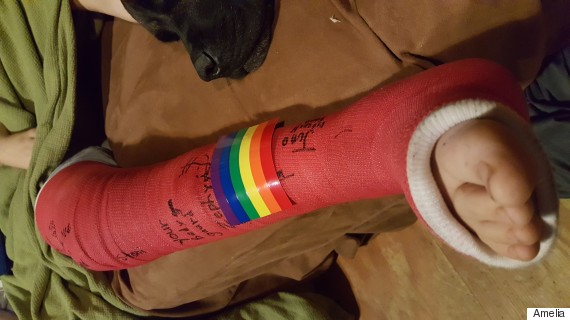
And don’t worry, he’s going to be ok. He has a crazy complicated broken ankle, but that’s the only big damage. The cast goes all the way up his thigh and it’s awkward and weird, but we’re coping.
So, no. I can’t keep my kid “safe.” I couldn’t if he was straight either. Because life isn’t safe. No matter what I do, life will keep happening, and we have to adjust. I can’t let my worry keep him from being happy, having fun and figuring out dance to “Up Town Funk” on crutches. But I will keep doing my best.

Filed Under: Anti-Bullying & Homophobia Tagged With: Parenting, Parenting Gay Children, Parenting Gay Kids, Parenting Gay Sons

This man hopes to end the stigma surrounding male rape by telling his story

08/12/2015 By ACOMSDave Leave a Comment

LGBTQ Nation
Monday, December 7, 2015

Misty

A must-read essay by Dean Eastmond recounts his harrowing experience being raped, and the aftermath.


In a powerful new essay published by The Independent, writer Dean Eastmond opens up about being raped three years. Eastmond was 16-years-old when the 2012 Olympic games took place in London. “My quaint little hometown of Weymouth hosted the sailing events,” he recalls, “and I ended up as an Olympic attendant, serving food to athletes and their crews. Not a bad first job, I guess.” During the course of the job, Eastmond befriended another guy who was a couple years older than him. “We used to get the same bus into work each morning,” he writes. “He looked and acted like a nice enough guy. He was always smiling, and popular with our other colleagues. As a shy and closeted teenager, I looked up to him as a friend.” One evening, the man asked Eastmond if he could hang out at his flat before Eastmond had to go and work the late shift. Thinking nothing of it, Eastmond said yes. “Before I knew it, my trousers had been pulled down and he was on top of me,” he recalls. “All I remember is the pain, and my vision becoming blurred by the intense fear that swept over me. It was my first ever sexual encounter.” After the encounter, Eastmond still managed to go to work that night. “I left the house to go to work, but he stayed inside my room,” he writes. “I was terrified at the thought of still finding him in my room when I got back from my shift. This was a nightmare that haunted me for weeks after: walking into my bedroom at any time, and finding the man who raped me sitting there.”This man hopes to end the stigma surrounding male rape by telling his story – LGBTQ Nation – Page 2

Three years later, Eastmond says he still feels “an indistinguishable sense of fear, doubt, worthlessness and discomfort” over the incident, which he never told his parents about or reported to police.
“I was trapped within what my rapist had done, and unable to reach out to anyone for help,” he writes. “I thought I’d be outed as gay and rejected. I know this sounds silly. But it was what I thought, and I know it’s the same for others who have been sexually abused.”
Citing a group called Rape Crisis, Eastmond says as many as 12,000 men are raped in England and Wales every year.
“We should make sure that we’re addressing the issue of male rape,” he says, adding that as many as 98 percent of male rape victims don’t report the crimes. “And I’m included in that figure,” he adds.
“Unless such issues are spoken about and understood more, I doubt this statistic will ever change.”
Eastmond hopes that by sharing his story he can be a part of the change.
“I’m talking because I know it’s the right thing to do,” he writes. “No one should let their experiences rot away within themselves. No means no, no will continue to mean no — and male rape needs to be spoken about, urgently.”

Editorial:

If you are in Northern Ireland 

You are not alone, if you want to talk to someone then you can contact:

  • Carafriend Telephone – 0808 8000 390 FREE – Free from landlines and most mobiles: 3, EE, O2, Virgin and Vodafone

  • NIGRA – 07719576524 and we will ring you back to take the call charges

Filed Under: Anti-Bullying & Homophobia, Campaigns Tagged With: Dean Esmond, male rape, Rape Crisis, rapist

Beautiful new Nordstrom holiday ad stars a gay couple and their dog

08/12/2015 By ACOMSDave Leave a Comment

LGBTQ Nation

Nordstrom demonstrates why they have a 100 percent approval rating from the Human Rights Campaign Buyers Guide.
The upscale fashion retailer has created a dazzlingly beautiful holiday ad titled The Homecoming that features a man coming home with a suitcase and a Nordstrom shopping bag to be reunited his partner and their gorgeous dog.
The two handsome men featured in the video are a couple in real-life and are engaged to be married soon so Nordstrom gets extra props for not simply hiring two photogenic actors.
Naturally, not everyone is pleased.
Back2Stonewall reports that right-wing site American Thinker expressed outrage that Hulu dared broadcast the ad during classic programming, such as The Rifleman and Dennis the Menace, that don’t include a “large proportion of Haight-Ashbury and Greenwich Village types” viewers and when innocent people and children might see the horror of two grown people in love exchanging a warm greeting.
Watch the commercial below.
https://youtu.be/wMT4oWqcr2c

Filed Under: TV programme reviews Tagged With: advertisements, gay advert, holiday, Nordstrom

The Albert Kennedy Trust

08/12/2015 By ACOMSDave Leave a Comment

Albert Kennedy Trust Logo
 
It’s cold out there. And right now 4,800 young lesbian, gay, bisexual and trans peopleare homeless or living in hostile environments. In most cases they have been driven outof their family homes because of parental rejection, abuse from within the family, and aggression or violence.
It’s unacceptable. There’s should be no room for hate.

At The Albert Kennedy Trust we offer support and accommodation to get young people back on their feet. But we need your support.
Your cash pledge to The Albert Kennedy Trust will make a difference to the lives of young, homeless LGBT people.
PLEASE visit http://www.akt.org.uk/2/spg357/albert… and give what you can to ensure no young person is cold and at risk of harm on the streets this Winter.

Filed Under: Anti-Bullying & Homophobia, Campaigns Tagged With: Albert Kennedy, Christmas appeal, homelessness

“We Know Who We Are” Vid Supports LGBTs in World’s Most Homophobic Countries

07/12/2015 By ACOMSDave Leave a Comment

OUT dot com logo
 

BY LES FABIAN BRATHWAITE
NOVEMBER 19 2015
we_know_who_we_are


The new track by Steven James and Quentin Sound raises money and awareness for those suffering from homophobia in Russia, Uganda and Jamaica.

In a powerful new music video, Steven James and Quentin Sound send a message of hope and support to LGBT people living in some of the most homophobic nations in the world: Jamaica, Russia and Uganda.
In Jamaica, sexual acts between men are punishable with up to ten years in prison, while Human Rights Watch documented 56 cases of anti-LGBT violence in 2013—only four led to arrests or prosecutions
Russia’s rampant homophobia has been well-documented. Though there are no laws criminalizing same-sex activity, a law passed in 2013 banning the spread of propaganda of “non-traditional” sexual relations among minors has led to an increase in homophobic violence.
Uganda’s so-called “Kill the Gays” bill drew interntaional ire, and though the country’s parliament didn’t succeed in passing the death penalty for homosexual acts between men, “carnal knowledge against the order of nature” carries a potential life sentence in prison.
Check out the video for “We Know Who We Are” below (which features some distrubing imagery of homophobic violence) and buy the single here on iTunes. 50 percent of proceeds from “We Know Who We Are” will be donated to LGBT youth organizations in Russia, Jamaica and Uganda—Children-404, JFLAG and Sexual Minorities Uganda (SMUG), respectively.
https://youtu.be/9F5tJWBYVWg


Filed Under: Anti-Bullying & Homophobia Tagged With: homophobia, POPNOGRAPHY, support, vid, video

‘Being Gay Isn’t As Sexy As ISIS’

07/12/2015 By ACOMSDave Leave a Comment

huff-post-gay-voices-logo-1
Lucy Sherriff
Posted: 19/11/2015

One Young Man’s Fight For Rights For Iraq’s Queer Community

“Being gay isn’t as sexy as ISIS. So no-one pays us any attention.”
These are the words of Amir Ashour, a 25-year-old Iraqi and the founder of the country’s only organisation for its queer community.
Amir left behind his home and family a year ago and is currently living in Sweden. There, he hopes to register and expand his charity IraQueer, as it is illegal to do so in Iraq.

He has received multiple threats from both officials and his friends because of who he is and the work he does.
“It’s incredibly difficult being away from my family – I’ve been missing birthdays, everything – and the more work I do for IraQueer, and the more people know about it, the harder it’s getting for me to be able to return to Iraq,” Amir says.
amir ashour

Amir Ashour, the 25-year-old founder of IraQueer
Politicians and other influential personalities see us as a threat, and no longer see us just as a young group that is publishing information on a website,” he explains.
“It’s hard to be so far from home and everything I know, but it would’ve been harder to be home and be forced to be away from myself and what I believe in.”
Back in Iraq, Amir was attacked by his own friends, “both because of my work and who I am”.
He was ridiculed for his clothes, his voice, his size, “everything”.
“People would make everything relevant and try to connect it to my sexuality and of course use it as an insult. A lot of people stopped hanging out with me because they were afraid of the stigma that came with hanging out with me.”
Although he says he could ignore most of it because he had a good circle of friends, being gay affected his everyday life.
“It’s just not possible to even talk about the queer community inside Iraq,” Amir explains. And that was the reasoning behind launching IraQueer, which aims to provide support and information for the queer community in Iraq and Kurdistan.
“We’re sharing stories of people who lived their entire life in Iraq and are from Iraqi families. They went through the normal education system and work the normal kind of job, and they are no different from anyone else. The only difference is that their sexual orientation is different.
“So, we bring it closer to home. And we try to publish anything that is related to the queer community, even if it’s just a rumour, because sometimes rumours are the only thing that we have.”
One of the main threats to the queer community in Iraq, Amir explains, is the armed militias in Baghdad and other cities.
“The main one that has been practising all the killing campaigns in Iraq actually announced a partnership with our government a few months ago, under the name of ‘fighting ISIS’.
“The last campaign we documented was in January this year, while in July 2014, [the militia] killed 35 gay people and sex workers in one day. Not even one report was made about that.
“Not one single person has been imprisoned for killing a gay person.”
And, Amir adds, that’s just the numbers they’re aware of. “How many more people have just disappeared? Especially with what’s happening with ISIS and people being displaced.. We can’t keep track. And the government is making it impossible for civil society organisations to run safe houses. If an organisation wants to do that, then they are charged with running brothels and prostitution.”
amir ashour
Amir has been forced to expand IraQueer from outside Iraq
Earlier this year, Iraq submitted a periodic report to the UN, which Amir says glossed over its treatment of the queer community.
“The Iraqi government was presenting so many perfect things about what it is doing, and how it is trying its best,” Amir says. “But this is such a cliché.
“So since then IraQueer has been highlighting all the violations they are doing.”
With the help of OutRightsAction International, IraQueer wrote “a lot” of recommendations for the Iraqi and international communities on how they can force the government to commit to basic human rights standards for LGBT+ people.
“Even if homosexuality is against religion and Islam is the main force of law in Iraq, killing is illegal. That is not something people can debate and argue.”
I ask whether the rest of the world underestimates the battles faced by the LGBT community in Iraq and Kurdistan.
“I love that you asked this question,” Amir enthuses. “It is the first time anyone has asked me this question.”
That’s when he points out “sexier things” are happening in Iraq.
“ISIS is sexier,” he states simply. “When it comes to Iraq, people think ISIS is the main problem. It’s the same with Syria, for example. People are not paying attention to what Assad is doing, they’re watching what ISIS is doing.
“Unfortunately we [the queer community] is not as sexy as ISIS, and until that is solved, we cannot compete with that attention.”
Amir cites human rights not being a political interest as the reason “almost no-one” is doing anything about what the queer community is facing.
“Even though it is a human rights violation.”
“Iraq has ratified so many of the international treaties that should make sure there are equal rights for people, regardless of their sexuality and gender identity. So why isn’t the international community holding Iraq accountable for these things?”
In August, Iraq criminalised homosexuality, a huge step back in IraQueer’s fight for LGBT+ rights.
“In its report to the UN, the Iraq government clearly said homosexuality is a sinful act according to Islam and it’s illegal. That it’s something that could disturb the public and create problems.”
And, according to Amir, Iraq is excusing its human rights violation by using the fact it is fighting terrorism and it is “normal” for a country in its situation to have such violations.
Whether or not there is room for homosexuality in Islam is still up for debate. But Amir says the question is not whether Islam should create room for the queer community, as they are simply “two different things”.
“I know a lot of people who are Muslims and queer at the same time.
“Islam does criminalise sexuality – that is clear. But Islam also promotes love and peace and no killing and all these human values, so why not go with these instead of violence?”
Iraq needs to be a secular state, he adds. “Because Islam was sent to people more than 1,500 years ago, and that alone just tells you that it is really outdated when it comes to laws.
“Maybe it had great laws back then and maybe people still want these values in their life, but religion should be a private practice that you choose to follow or not, instead of a law that everyone needs to follow.
“You are born with your sexuality but you are not born with your religious beliefs.”
Although he comes from a family with a “long religious history”, Amir converted “or whatever you want to call it” from Islam seven years ago.
“It’s not that I have anything against Muslims,” he explains. “It’s just that Islam doesn’t work for me.
“Not just because of my sexual preferences, but just the whole thing. I think I have values and principles that work as good as having a religion.
“I have a lot of people who are Muslims in my life, including my family, and I respect them. We both respect that we have different views.”
Unfortunately, not everyone shares Amir’s values of respect.
Working for IraQueer is dangerous job for Amir’s colleagues, all of whom have to work underground for fear of being exposed.
“A lot of our members don’t even know each other,” Amir explains. “The main reason we want to do that is because some of our members agreed to join but didn’t want to know anyone else and we decided we would work this way for a while until everyone is comfortable with being connected to each other.
“We didn’t want to put unnecessary pressure on the others. Everyone connects with each other through me. I’m the only public face associated with the organisation.”
There are few – if any – resources for the queer community in Iraq and Kurdistan. And very little is published on the subject by the outside world.
“Even if journalists are sent to Iraq, they could actually put their lies in danger if they ask about these questions, especially if they don’t know who to ask.
“There were five to 10 pieces on the queer community in Iraq on the internet before we launched. Now, IraQueer has about 3,500 readers visiting the site every month. We have 4,000 followers on social media and our weekly posts on social media reach around 2,000 people. These numbers are of course small compared to other bigger outlets but compare that to almost non-existent.. it’s something that we are really trying to work on.”
iraqueer
Amir’s colleagues have to work in secret for fear of reprisals
The people of Kurdistan, Amir says, have no information on homosexuality, bar what IraQueer provides.
Amir continues: “People are not only exposed to what’s happening but they’re also exposed to our side of the story. We are telling our own story.
“The most important thing that we’re doing is reaching out to the LGBT community. We have a section dedicated to the stories of the community.
“The stories of the people who are telling their own experiences proves that people are wrong. A lot of people say that we did not have homosexuality and that the US brought it with their invasion in 2003.”
Amir pauses, then adds: “Like they dropped a gay bomb or something.”
Despite the severity of the situation, we can’t help but share a giggle at the ridiculousness of the idea.
But it’s no laughing matter for those who lead a double life in order to preserve a single one.
“A lot of people are married and have a secret life on the side,” Amir explains. ” know no-one who is publicly gay in Iraq. It is definitely going to get you killed if you are public. Best case scenario is that you’re going to lose your job, education, whatever you have in your life – even if it is a volunteer project.
“It is impossible to live an openly gay life.”
Even though IraQueer’s staff work in secret, it is still a huge risk. “That’s why a lot of our meetings are very small, four or five people so that it’s not suspicious. And that’s why they don’t happen on a regular basis.”
Amir started working in human rights during his second year at Sulaymaniyah University, in Iraq, when he was 19. “In the beginning I was just volunteering for some local and international NGOs and working with kids and women.”
But, he says, he started his “real career” in human rights after graduation – around three years ago – when he landed work with two organisations based in New York.
“I was their representative in Iraq and my main focus was working with sex workers and women who were fleeing from crimes and facing violations.”
However, it wasn’t long before Amir realised he was not fulfilling his calling.
“When I was working with the charities, the project was really important but it was more an emergency response. That was not leading us to start a real change, it was more reacting to events. I had the idea of starting something like IraQueer in the last year of my work with the charities – but of course I had to move out of the country.
“I was already very public about my sexuality and activism – through talks and attending conferences – so I thought why not just take it to the next level?
“I wanted to start something where we don’t only help the LGBTQI+ community but actually turn them into active agents and making a change.”
Amir continues: “When people started realising what I was doing and who I am was not a phase, I started facing a lot of problems with the projects I was leading.
“Funders stopped funding, members stopped working and volunteering with us. It affects every single aspect of your life. People are forced to live double lives.”
But Amir says he never “came out” to his family and friends.
“I don’t believe in that term. Because I was never ‘inside’ anything.
“If people ask, it depends on how relevant it is that I answer. I never said that I wasn’t gay and now if some people are questioning my sexuality, I’ll make a ‘come out’ video that is one second long and it’ll just be ‘I’m gay’, and just be done with it. For me, it’s irrelevant, and no-one says ‘the first straight Prime Minister of this country’. No-one points out the sexuality of straight people.”
And, speaking of Prime Ministers, Amir is admirably positive about the future.
“If I ever go back I want to be able to run for the Prime Minister. I want that opportunity to be available. And, if it’s not available, then we will work until it is.”
First on Amir’s list, however, is stopping the killings.
“We need to make it impossible for people to be killed or attacked based on their sexual orientation. That’s our number one demand.
“But of course, like any other country in the world, we want to be an active agent in rebuilding Iraq. And Iraq is in desperate need of being rebuilt. It is facing problems on so many levels.
“The country needs all the capacities of the citizens that they have, regardless of who they sleep with. That is is irrelevant.
“We want equality in everything.”
Amir is an ambassador for One Young World, a global forum for young leaders aged 18-30 which gathers youths from every nation in the world to develop solutions to some of today’s – and tomorrow’s – most pressing issues.
 

Filed Under: Anti-Bullying & Homophobia Tagged With: Amir Ashour, gay, Iraq, IraQueet, ISIS, sexy, Sweden

Is religion ever going to give LGBT Students a break?

07/12/2015 By ACOMSDave Leave a Comment

Editorial:  I have reprinted this article from the Advocate as it shows why keeping schools separate from religion is a necessity, and why the government in Northern Ireland should take heed and remove the various religious inputs that they keep ensuring.  I accept that religion and belief is a right for everyone that wishes to follow one, but not at the expense of other peoples (and in this case LGBT students) well being and safety!

advocate_logo

three-dozen-schools-ask-for-title-ix-waivers-to-discriminate-against-lgbt-students-x750

There has been a spike in requests for waivers from compliance with federal nondiscrimination requirements.

BY TRUDY RING
DECEMBER 06 2015 8:00 AM EST

 
With the expansion of LGBT rights, there has been a spike in the number of religiously affiliated colleges and universities seeking exemptions from federal antidiscrimination laws.
Title IX of the Education Amendments of 1972 forbids sex discrimination at any educational institution that receives federal funding, which most do in some form, be it research grants or student financial aid. But it allows any school “controlled by a religious organization” to apply for a waiver from the nondiscrimination requirement if complying with Title IX “would not be consistent with the religious tenets of such organization.”
“These ‘right-to-discriminate’ waivers were relatively rare until the last year,” reports The Column, a Minnesota-based nonprofit LGBT news site, with “a handful” of schools seeking them to avoid putting women in leadership positions. But in 2014, the U.S. Department of Education held that Title IX’s ban on sex discrimination also banned discrimination against transgender and gender-nonconforming people, leading many more schools to apply for waivers. Also, the spread of marriage equality, now nationwide after June’s Supreme Court ruling, has conservative institutions worried they would be required to treat married same-sex couples the same as opposite-sex ones — in access to student housing, for instance.
In the past 18 months, the Department of Education has granted 27 colleges and universities waivers from Title IX compliance, The Column reports. The schools are located throughout the nation, but the majority are in the South and West. Their combined enrollment exceeds 80,000, and in 2014 they received nearly $130 million in federal research grants and student aid. As of August of this year, another nine such waivers were pending.
The schools that have been granted the exemptions include Belmont Abbey College in North Carolina, Franciscan University of Steubenville in Ohio, Judson College in Alabama, East Texas Baptist University, Oklahoma Christian University, Spring Arbor University in Michigan, and Simpson University in California. Those with waivers pending include Biola University in California, Colorado Christian University, Ohio Christian University, and Multnomah University in Portland.
Some schools have sought the waivers so they could bar or expel transgender students, and some have targeted lesbian, gay, and bisexual students and staff as well, reports the site, which obtained the data through a Freedom of Information Act request. Many of them have used a sample policy by the Christian Legal Society.
“The trend of religiously affiliated, but publicly financed, colleges receiving exemptions from the U.S. Department of Education in order to discriminate against LGBTQ students and employees is disturbing,” attorney Paul Southwick, who has represented students in discrimination suits, told The Column. “While we are seeing increased protections for transgender, intersex, and LGB students through Title IX, we are also seeing the protections of Title IX gutted at the very institutions where students need those protections the most.”
This is recourse, however, Southwick said. He suggested that students or staff who have experienced discrimination file an internal appeal, with the help of a lawyer if possible. “Additionally, students should file a Title IX complaint with the U.S. Department of Education’s Office of Civil Rights,” he said. “This is important and should always be done. Even if their college has a religious exemption from Title IX, the exemption may not apply or it may not stick after being challenged.

Filed Under: Anti-Bullying & Homophobia Tagged With: christianity, education, LGBT youth, MLAs, N Ireland, politics, religion, schools, Stormont, TITLE IX, transgender

  • « Previous Page
  • 1
  • 2
  • 3
  • 4
  • 5
  • 6
  • 7
  • Next Page »

Categories

Copyright ACOMSDave.com © 2026