
Comment by Sean:
I recall queer kids being shoo’d out of cafés and restaurants in Botanic Avenue in the 1980s, because they couldn’t really afford refills of their teas and coffees. And there were no caffs outside of Botanic; and elders on the queer’s bench (beside the Gents) didn’t like then hanging about, partly because they were cute – and partly because they scared-off the closets who used the Gents for pick-ups or quick relief….
LGBT HISTORY MONTH: A pre-Stonewall LGBT sit-in
Special to the online edition of Windy City Times
by Ray Simon, Philadelphia Gay News
2014-10-28
The sit-in at Dewey’s, which occurred at a Philadelphia restaurant in the spring of 1965, is not as well known as the Stonewall Riots, but it deserves wider recognition.
On the evening of Sunday, April 25, 1965, staff at the diner turned away more than 150 people they believed to be LGBT. According to the August 1965 issue of Drum magazine, which mixed beefcake pictorials with news for gay men, the restaurant’s staff refused “to serve a large number of homosexuals and persons wearing non-conformist clothing.”
Eventually, three teenagers — two boys and one girl — refused to give up their seats, in effect beginning a sit-in. In the week that followed, LGBT activists used tactics borrowed from the civil-rights movement to put pressure on the restaurant’s owners until the ban was lifted.
On closer examination, the sit-in at Dewey’s suggests that gay militancy began at least a few years before Stonewall. It also hearkens back to a time when gays, lesbians and transgender people clearly saw their struggles as intertwined.
For Marc Stein, a professor of history at San Francisco State University, the sit-in at Dewey’s not only adds to our knowledge of the past, it also prompts us to reevaluate our current understanding of LGBT history.
“I think one of the important things to see is that there was a history of these episodes for at least five years before the Stonewall Riots,” Stein said during a telephone interview.
“I think for a lot of us,” he continued, “if there’s one thing we want to challenge, it’s the notion that the movement began at Stonewall or the notion that Stonewall was the first time that gays and lesbians, that LGBT people, fought back.”
The story of the sit-in at Dewey’s may very well have been forgotten if it were not for Stein. The mainstream media ignored the incident then and it received scant attention from scholars before Stein began his research. Fortunately, a handful of men and women mentioned the restaurant to the historian while he was interviewing them for his book, “City of Sisterly and Brotherly Loves: Lesbian and Gay Philadelphia, 1945-72.”
Dewey’s was a small, family-owned chain of diners that operated in Philadelphia from the 1940s to the 1970s. When the chain’s owner, Farrel Yesner, passed away in 2003, his obituary stated that “Dewey’s doled out tasty comfort food to customers at restaurants that were mostly old-fashioned lunch counters.”
The all-night eateries served customers from all walks of life, but its 13th Street and 17th Street locations drew many LGBT customers, especially after the bars closed. According to Laurie Barron, one of Stein’s interviewees, the restaurant was known as “Fag Dewey’s.” And another, Joan Fleischmann, told him that at Dewey’s “you’d find streetwalkers, you’d find drag queens, you would find everybody.”
Why things came to a head on Sunday, April 25, 1965 is unclear. The June 1965 newsletter of the Janus Society, the local homophile organization, indicates that the diner’s management had grown tired of a group of young LGBT kids just sitting around, being rowdy and ordering little, so it encouraged its employees to shoo them away.
As Stein put it, “What I do know is that in the months or years leading up to the Dewey’s sit-in, that Dewey’s had become a late-night hangout, especially for young people and for lots of people we would now call trans.”
That night, staff interpreted the directive zealously. Eventually, three teens refused to budge, the police were called and so was Clark Polak, a local LGBT businessman and advocate. At the time, Polak was head of the Janus Society and also published Drum magazine.
Exactly what Polak did that night is unknown. The businessman claimed that he was advising the teens of their rights, but Stein acknowledges it’s easy to imagine him getting cantankerous.
“We know from other stories that Polak would scream and curse at the police, but he would also argue. He was almost fearless. So I’m sure emotions got intense,” Stein said.
The police promptly arrested Polak and the three teenagers. The savvy businessman quickly organized a picket outside Dewey’s. Roughly 1,500 pieces of literature were distributed to customers and passersby over the next five days. Finally, on Sunday, May 2, just one week after the initial confrontation, a handful of teenagers began a second sit-in.
The police were once again summoned, but this time they refused to arrest anyone. Both parties spoke to one another, the situation was defused and the restaurant resumed serving LGBT customers.
This was no small victory. Writing in the Janus Society’s May 1965 newsletter, its editor, Barbara Horowitz ( who signed her work Barbara Harris ), asserted, “There is no reason to assume that this cannot be called a job well done.”
That same editorial also makes it clear that Horowitz, and, by extension, Polak, recognized that what took place was about more than just being able to order a cup of coffee. As Horowitz wrote:
“All too often, there is a tendency to be concerned with the rights of homosexuals as long as they somehow appear to be heterosexual, whatever that is. The masculine woman and the feminine man often are looked down upon by the official policy of homophile organizations, but the Janus Society is concerned with the worth of an individual and the manner in which she or he comports himself.”
That statement suggests that at least some LGBT activists saw the limitations of pursuing a policy of militant respectability, which was, roughly speaking, the notion that straights would accept LGBT people if only LGBT people could demonstrate that they were just like everybody else.
There is still more work to be done regarding Dewey’s. Who were the three teenagers arrested that first evening? Were they the same teenagers who initiated the final night’s sit-in? Who manned the picket lines? Were the people involved in the action radicalized by it? What happened to them as the years passed? These remain unanswered questions.
Perhaps fighting for the opportunity to sit in a diner and order a meal appears trivial, but it is important to remember that the civil-rights movement had already demonstrated that seemingly mundane actions could have profound implications.
Studying the sit-in at Dewey’s, Stein discerns significant implications for our understanding of LGBT history. Later in the 1960s, a new kind of LGBT activism emerged: the gay liberation movement, which was more radical than the earlier homophile movement.
For many, Stonewall was the momentous beginning of that next phase of activism, but Stein believes otherwise. In the sit-in at Dewey’s, he finds evidence of LGBT militancy beginning much earlier than 1969.
“The idea of fighting back, the idea of borrowing tactics from the civil-rights movement, that stretches back 20 years before Stonewall,” he said.
As Stein and his fellow LGBT historians do more research, a fuller picture of LGBT life in the decades after World War II is taking shape. The sit-in at Dewey’s, for example, can no longer be dismissed as an isolated, random event, thanks to the work of transgender scholar Susan Stryker.
Her 2005 documentary, “Screaming Queens: The Riot at Compton’s Cafeteria,” examines a 1966 incident in San Francisco that is strikingly similar to the sit-in at Dewey’s with one difference: at Compton’s, the drag queens literally punched, kicked and scratched to defend themselves.
Obviously, more work must be done. But recognizing the significance of what a ragtag group of LGBT teenagers and the adults who supported them accomplished at Dewey’s is a good first step.
Ray Simon is an editor and freelance writer in Philadelphia. He has written about everything from cryptograms to drag kings, and environmental sustainability to video games.
View the leaflette handed out at the Dewey’s demonstration April 1965 at the link:www.windycitymediagroup.com/pdf/DeweyLeaflette1965.pdf .


Archives for 2014
Welsh History Month: South Wales’ first ever gay pride march took place in Cardiff with marchers parading down Queen Street
Picture 83: These activists envisioned this march in Cardiff as a “coming out” for gay and lesbian activism in South Wales and an occasion to celebrate and affirm Wales’ sexually diverse and gender-blended

Those who have recently seen the film Pride in the cinema will be familiar with images like this. No, it’s not a picture of the group “Lesbians and Gays Support the Miners” marching in London, but it was taken in the mid-1980s.
Dating from 1985, this image, right, depicts South Wales’ first ever gay pride march. It took place in Cardiff with marchers parading down Queen Street to the bemusement of shoppers and pedestrians. According to the editorial piece accompanying the image, “many [onlookers] shook their heads in disbelief – others laughed and laughed away”.
The presence of policemen and placards in this picture may give the impression of a demonstration, but the theme of this march was pride, not protest.
Holding signs which read “Gay love is good love”and “sing if you’re glad to be gay”, these activists envisioned this march in Cardiff as a “coming out” for gay and lesbian activism in South Wales and an occasion to celebrate and affirm Wales’ sexually diverse and gender-blended society.
The gay rights movement has come a long way since 1985, and Wales’ population continues to be made up of individuals with differing sexual orientations. Nowhere is this diversity celebrated more openly than in Cardiff’s annual LGBT Mardi Gras festival, now Pride Cymru.
Established in 1999, Cardiff’s gay pride festival is held every summer in Cooper’s Field in Bute Park and is the largest event of its kind to take place in Wales. It’s serious and it’s loud, but it is primarily a celebration of diversity, with thousands of people (gay and non-gay) taking part each year.
Gay pride events such as this are not limited to the confines of Wales’ capital city, however. Similar events have been held and continue to be held in other towns and cities in the country such as Aberystwyth’s “Pride on the Prom”, Bangor’s North Wales Pride and Swansea Pride.
Wales has an interesting history of gay activism, one which stretches back further than the late 20th and early 21st centuries. Leo Abse (1917-2008), the Cardiff-born solicitor and Welsh Labour MP for Pontypool and Torfaen between 1958 and 1987, for instance, was an active gay rights campaigner and noted for promoting legislation to decriminalise male homosexual relations in the United Kingdom in the 1960s.
Cai Parry-Jones: “I am a Welsh-speaking Cardiff-born historian. I was awarded a doctorate in History from Bangor University in 2014 and I now work in academic publishing. I have a great interest in the histories and cultures of minority groups and I am currently in the process of turning my PhD thesis on the modern history of Jewish individuals and communities in Wales into a book.”
Republished from Wales Online
Oscars’ Foreign Language Preview: Gay Contenders Come Out With Pride

SHOUT FOR VARIETY
At last year’s Cesar Awards, three of the top contenders for France’s top film prize — specifically, “Blue Is the Warmest Color,” “Stranger by the Lake” and “Me, Myself and Mum” — centered on LGBT issues. Compare that with the Oscars, where just one of the nine best picture nominees — “Dallas Buyers Club” — even so much as acknowledged homosexuality as a part of human existence.
What gives? It’s not merely a question of France being more progressive than the U.S. (It’s not, judging by widespread protests against marriage equality seen in Gaul over the past year.) Other countries, including several we think of as more conservative than the States, are also getting behind gay-themed pics.
Study the list of submissions for the upcoming Oscar foreign language prize — always an interesting indicator, since selection committees from each country are allowed only one film to represent them at the Academy Awards — and it’s clear that the U.S. lags in its willingness to make, much less celebrate, films dealing with homosexual themes.
Brazil picked Daniel Ribeiro’s “The Way He Looks,” a coming-out story centered on a blind teen.
Portugal went for Joaquim Pinto’s first-person documentary “What Now? Remind Me,” in which the HIV-positive helmer reflects on living with the virus. It was awarded the Fipresci prize at the Locarno film fest.
Switzerland’s selection, “The Circle,” above, from director Stefan Haupt, blends scripted reenactment and non-fiction interview segments to convey a sense of the country’s nascent post-war gay scene.
Finally, France is sending Bertrand Bonello’s “Saint Laurent,” a Cannes-anointed biopic on the influential fashion designer that doesn’t shy away from its subject’s sexual proclivities.
(One could also count Canadian submission “Mommy,” from openly gay director Xavier Dolan, whose flamboyant protagonist isn’t identified as gay, per se, but certainly defies Hollywood’s heteronormative paradigm in nearly all respects.)
Past Is Prologue
Considering the Academy’s historical reluctance to reward films with queer content (exceptions being “Boys Don’t Cry,” “Brokeback Mountain” and “Milk”), it’s surprising to see five countries submit pics that, were they competing in other categories, show little precedent for nominations. Such a move suggests that regardless of how Oscar voters might feel, a group of key influencers in each country sincerely believes these films are the best they have to offer.
It’s hard to imagine an American committee deciding to throw its support behind a “gay movie.” But then, Americans seem uniquely inclined to pigeonhole films according to the sexual persuasion of their protagonists, whereas foreign directors have been far more successful in achieving mainstream success with human-interest stories in which the characters happen to be gay — though it hardly goes for all countries, with serious cultural obstacles in Russia, Iran, the Middle East and Japan.
Meanwhile, in the U.S., cinematic representations of homosexual identity are typically relegated to one of two categories: either “gay movies” (typically low-budget fare made for LGBT auds and released, often directly to homevid, by a handful of specialty distribs) or as side characters in mainstream movies (a relatively recent phenom for pics looking to score PC points, often revealing the news as a third-act surprise, a la “ParaNorman’s” gay jock).
Rare Crossover Success
This year brings an interesting exception in Ira Sachs’ “Love Is Strange,” a sweet, low-key romantic drama centered on a longtime gay couple, finally allowed to marry, who find themselves kicked out of their New York apartment and forced to rely on family and friends for housing — essentially a same-sex twist on Leo McCarey’s 1937 “Make Way for Tomorrow.” Sachs’ film was a rare crossover success, overcoming the obstacles one imagines facing a film in which the characters are not only gay, but gray (that is, well past the age of the average American moviegoer). This, of course, is what filmmakers want: for their work to appeal beyond the rigidly defined demographic of the characters themselves.
“If you look at the bulk of the work coming out of other countries, they’re still making human dramas about everyday life that are not being made here,” says Sachs, who deliberately — and somewhat defiantly — chose to tell stories centered on gay lead characters (first “Keep the Lights On” and now “Love Is Strange”) after a gap of 15 years.
The vast majority of independent helmers responsible for making the landmarks of American queer cinema — Todd Haynes, Gus Van Sant, Kimberly Peirce, Gregg Araki — have subsequently gravitated toward more mainstream (i.e. straight) subjects in order to sustain their careers and court a wider audience. Sachs blames the system, not the filmmakers, since American distribs remain gun-shy about supporting directors who incorporate that aspect of their identity into their work.
“If there’s no economic incentive or possibility of sustaining a career as an American filmmaker making strictly personal, human films, there’s no way for those filmmakers to develop or become better over time,” notes Sachs, whose freedom comes from working outside the system. “I’ve built a community (of individual investors) around me that has supported my own personal filmmaking.”
Alternative to Hollywood
In other countries, where big-budget Hollywood tentpoles make it tough for local cinema to compete, there remains a wide gap for relatively inexpensive adult dramas, which have all but disappeared from American studios’ diet.
That creates an opportunity for foreign directors working to tackle stories not being done bigger and better by Hollywood — which is where gay-themed pics stand to shine and be recognized in their respective countries. The phenomenon is hardly limited to LGBT stories either: In Germany, a modest, black-and-white portrait of a twentysomething slacker called “Oh Boy” (retitled “A Coffee in Berlin” for U.S. release) connected in a big way, winning six Lolas.
The same was true in France of “Blue Is the Warmest Color,” “Stranger by the Lake” and “Me, Myself and Mum”: All three connected with audiences because they presented mature, human-interest portraits seen lacking among the flashier American imports.
Ironically, the most commercially successful — Guillaume Gallienne’s “Me, Myself and Mum,” about an effeminate young mama’s boy who’s the last to accept himself as gay, whereas his entire family has long since accepted his identity — has yet to find distribution in the U.S., where it has two big strikes against it: The film is not only perceived as “gay,” but it’s also foreign to boot (whereas “Blue Is the Warmest Color” and “Stranger by the Lake” had a more sexually explicit hook, landing distribution from Sundance Selects and Strand Releasing, respectively).
Just because a film is submitted by its country to compete for the foreign-language Oscar doesn’t mean it’s assured a U.S. release. Of the five pics mentioned, only “Saint Laurent” (Sony Pictures Classics) and “Mommy” (Roadside Attractions) stand to do much business in the U.S. But they also represent what pics like “Love Is Strange” and British-made Alan Turing biopic “The Imitation Game” got right: They tell compelling human-interest stories in which the characters’ sexuality is acknowledged, but not the pic’s sole focus.
“People are always asking me, ‘Don’t you think this is a great time for gay cinema?’ And I think, what about Visconti, Fassbinder, Chereau? There’s a history that I feel connected to, that American cinema has forgotten, that existed of gay filmmakers making films that were not culturally positioned:They were part of art cinema in a larger way,” says Sachs.
Granted, there is more gay representation on American screens than ever before, but it’s been pushed to the margins: supporting characters and niche pics. However progressive its politics, the U.S. could stand to learn from other countries, where such stories are getting the treatment — and recognition — they deserve.
An Interview With Michael Denneny
The problem with writing for the LGBT community and being based in Northern Ireland is the limited access to the movers and the shakers within our community. I would dearly love to have the finances and the time to rove around the world and interview a long list of people that I have been putting together, however as this is not likely to happen anytime soon (hic) then I am afraid that I will sometime have to resort to reposting articles which I believe are interesting for your the readers.

EXPANDING THE LGBTQ CONVERSATION
OCT. 27 2014 3:52 PM
The History of Gay Publishing in One Career: An Interview With Michael Denneny

Photo by Khary Simo, used with permission of LambdaLiterary.org
When I started in publishing more than 20 years ago, answering phone calls at a customer service desk, the only gay man in the industry whose name I knew was the renowned editor Michael Denneny. Most editors spend their career, however distinguished, unknown to the average person—sometimes even unknown to their fellow publishing colleagues. Michael was different, and so were his books. To be sure, there were other gay editors who published gay books, most notably Sasha Alyson, but as far as I could tell, only Michael and Sasha had done what I aspired to do back then: edit a line of quality gay titles.
The following conversation with Michael, conducted via email, underscores that gay literature doesn’t just “happen.” There are individuals behind it, so to speak, and it’s about more than writers and readers.
Since book editors don’t typically grow up wanting to be editors—indeed, many have never taken an editing class or been formally trained—what led you to become a book editor?
In 1971, as a result of Stonewall, I moved to New York City, mainly to be gay. I didn’t have a job or an apartment or even a concrete plan, so the first few months were difficult: sleeping on friends’ couches, walking to job interviews because I didn’t have subway fare, watching my few dollars shrink. Among other things, I tried for publishing jobs since I’d worked half-time for two years at the University of Chicago Press. When a friend told me he was leaving his editing job at the old Macmillan publishing company to go to Paris and be a poet, we arranged it so that I came in for an interview a couple of hours after he handed in his resignation. On paper we looked like the same person (except that I did have some experience in publishing), and they hired me. It was an accident, really. I was just desperate for a job.
I thought it was a bit of a coup, since I skipped the usual step of first being an editorial assistant. But in retrospect that was a mistake. The wear and tear of the first few years, when I had to figure out what the job was while actually doing it, was enormous, and in retrospect, I don’t think it was worth it. I think the only way you really learn this job is by watching someone else do it for some time, like an apprentice, since it actually is a craft skill.
In the early ’70s at Macmillan everyone wore suits, white shirts, and ties and had two martinis at lunch. That wasn’t me. I had spent the ’60s at the University of Chicago being a hippy intellectual and a political activist. I thought the job would only last a few months, until they discovered who I really was. It amazes me in retrospect that I lasted 30 years. What happened was I got involved with a couple of books that really intrigued me and gradually realized that one might be able to do something interesting in publishing.
I’m curious about those suit and tie/two-martini days of publishing: What was it like being an openly gay man in that old school world?
It wasn’t exactly the case of “being an openly gay man.” In the early ’70s, in spite of the fact that there were quite a few gay men and lesbians working as editors, it was something never spoken about. I swore to myself I wouldn’t lie about it or try to hide it, but on the other hand I didn’t go out of my way to broadcast it, either.
I remember the first time I had to confront that decision. It was at the Christmas party my first year working there. In the ’70s, publishing companies had these really terrible Christmas parties where everyone got drunk out of their minds and all sorts of indiscreet things got said (and done). At one of these parties, the head of Macmillan’s warehouse and inventory control, a short, really feisty Puerto Rican lesbian whom I liked a lot, came up to me, clearly very drunk, and asked if I was bisexual. When I said, “No,” her face really fell, and she realized she’d gone a step too far, but then I added, “I’m gay” and she broke into this terrific smile. And she was one of my best allies in the company from then on.
I suppose I really came out to the whole company because of a book by Alan Ebert, the first gay book I ever published, called The Homosexuals: Who and What We Are. Great title, right? (Laughter.) I’d actually been fired over it when the CEO of the company, a man called Raymond C. Hagel, found out about the book as we were preparing for an upcoming sales conference in Phoenix. But after I was fired, every other editor, right up to the editor in chief, refused to present the book at sales conference, and since legal told the company they were obliged to publish it, they ended up hiring me back—really, just to present one book!
One of our New York sales reps who was a friend of mine had been reading the manuscript, I think in order to support me from the floor. And he had come to an interview in the book with a gay rabbi who, among other things, described fist fucking. And my friend didn’t believe there could be such a thing as a gay rabbi, or that fist fucking was physically possible. This was said at sales conference in front of everyone, and I’m standing on stage at the microphone in front of 250 people. It was one of those moments when you just wish the earth would open up and swallow you. I had a split second to make a decision, and I realized that the whole credibility of the book—as well as my own—depended on the answer.
I took a deep breath and said, “Chuck, you know that bar at the very western end of 14th Street [his territory was lower Manhattan], on the south side of the street in the triangular building? It’s a gay bar [it was the old Anvil] that, among other things, has sex acts performed on the bar. It’s a place I’ve been to a few times and I can assure you that it’s physically possible,” and I held up my right hand and with my left measured off about halfway up my forearm and said, “You can get it in about this far.” You could have heard a pin drop. “And as for the rabbi, I happen to know him socially, and I guarantee you he’s a real person.” So the cat was definitely out of the bag.
What else did you acquire and edit initially, and how long was it before you decided there was a market for LGBT lit?
That took a while—I was a bit dense, I guess. The first books that really hooked me on publishing were political. I might not have known much about editing or publishing, but politics was what I knew from the ’60s, and the earliest books I really got involved in were political.
I soon came to see that this could be an interesting job, and I started feeling my way into it. The most notable book I edited in the beginning was probably for colored girls who have considered suicide/ when the rainbow is enuf. It was actually Ntozake Shange who raised the issue of gay books with me, saying, “You’re publishing all these women’s books and black books, how come you aren’t publishing more gay books?”
Which was a good question.
In New York City at the time, in the years following Stonewall, there were intense discussions going on among gay people as to whether or not there was such a thing as gay literature, or gay culture in general. I’d gotten involved with the Gay Activists Alliance, and in time we’d started our first gay magazine, OUT, in 1973, but it only lasted two issues before folding. During that period I’d gotten close to a young guy just out of grad school named Chuck Ortleb, and we continued that discussion—intensively!—for the next couple of years. These discussions with Chuck ended up convincing me there was such a thing as gay literature and, more importantly, that a change of consciousness, a change in our imaginations, had to be the first step in fighting for gay rights. The best way to do that was through a literary magazine. Electoral politics was not at all a promising avenue at the time. So we ended up founding Christopher Street in 1976, one of the first gay literary magazines—and that got me fired for good from Macmillan.
So I needed a job. By then I was a hot young editor, my books were getting a lot of attention, and, more importantly, making good money. I had, if memory is correct, 47 job interviews. (It’s hard to remember but in the mid-’70s there were something like 280 publishing houses in Manhattan. Today there are five, and a handful of small presses.) At each one I’d put a copy of Christopher Street on the table and say, “Look, I’m gay and publicly involved with this gay literary magazine, so if that gives you a problem, we should just forget about the job and enjoy lunch, since this is a very good restaurant and you’re paying for it.” (In those days they always took you to these incredibly fancy restaurants for the interview.) And they would say, “Oh no, no,” picking up the magazine and leafing through it, “how interesting … interesting.”

And of the 47 interviews, I got exactly one call back, from a guy named Tom McCormack, who was running a small place called St. Martin’s Press in the Flatiron Building. Most of my publishing friends had never heard of St. Martin’s. I only knew it because they had published a couple of the earliest gay books (George Weinberg’s Society and the Healthy Homosexual, along with Roommates Can’t Always Be Lovers and Fire Island by Lige Clark and Jack Nichols). I ended up having five interviews with Tom, telling him that I was convinced there was a new market for gay fiction, and I wanted to try to publish to it—without a huge hullabaloo every time I tried to sign up a gay book. He agreed, and so I moved to St. Martin’s in 1977.
If I hadn’t run into Tom, I don’t think I ever would have had a career in publishing; it would have just been a five-year adventure in the business world.
Who, besides you, was openly gay and publishing gay titles in a mainstream house back then? I’m talking about gay men who’ve made a career publishing gay literature.
In corporate publishing? Nobody. We’re talking mainstream New York publishing here. I don’t know about the rest of the country, but in New York publishing there was no one who was out. Which is why it was such a big deal when I came out publicly. And there were no small gay presses at the time with the exception of Gay Sunshinemagazine, which put out a couple of gay books. Interestingly enough, there were already several lesbian/feminist presses; Daughters in Vermont and a couple of others. One of the things that motivated me was that I had several very close lesbian friends, and I saw that they had several presses, and a number of magazines, but by 1976, gay men had virtually nothing comparable, except The Advocate.
Of course, lesbians had the advantage of the Women’s Movement. The women’s presses were basically lesbian (in most of their personnel and an awful lot of what they published) but were presented to the world as feminist presses. That’s why at the time lesbian literature was way ahead of gay literature; they had an allied audience of straight women interested in the work of lesbians, which made publication of such books and magazines financially viable, if limited. But gay men had no such allies who could augment the audience for gay books, so there were no small gay presses. Sasha Alyson started Alyson Books some years later, and when he did, he came to me for advice.
What were the challenges for you as a gay book editor, beyond the expected homophobia? Were there gay writers with books lined up to be published now that there was a prominent outlet for their writing?
I think I made the same mistake at St. Martin’s that we initially made at Christopher Street. Knowing there was some samizdat gay literature going around (W.H. Auden’s “Ode to a Blow Job,” for instance, and other stuff), we assumed that gay writers had all this material in their bottom drawers because there was no outlet for publishing it, and it would come gushing in. But gay writers are no dummies; since there hadn’t been any outlets, most didn’t waste their time writing work that could never be published. This we discovered to our chagrin at Christopher Street, where we were always scrambling to fill up the new issue. Once Edmund White wrote, I think, four different articles under four different names to fill the issue at the last moment, although I think the title goes to Andrew Holleran, who once did five articles under five aliases. (Laughter.) If we’d known anything about magazine publishing, we would never have tried to start Christopher Street, which, mind you, lasted for over 20 years. When I went looking for gay books, the pickings were slim. There was Wallace Hamilton who had published a novel called Coming Out. He wrote a Biblical, historical novel for me about King David and Jonathan (David at Olivet), and Pete Fisher and Marc Rubin (old friends from the Gay Activist Alliance who had worked on OUTmagazine) wrote Special Teachers, Special Boys about a gay high-school teacher. Now you could say that this was ideological fiction, akin to the old socialist realism school of fiction. But you had to start somewhere. You had to show that gay books could be published if you wanted to encourage gay books to be written.

Then there came along Ed White’s Nocturnes for the King of Naples. Ed’s first novel, Forgetting Elena, had been published by Random House and then in paperback by Penguin and had gotten rave reviews—and, in a comment endlessly repeated in publishing circles, Nabokov had declared Ed the best young American novelist (or something like that). So it was a scandal that he couldn’t find a single publisher willing to take on his second novel because it dealt with homoerotic love (although the beloved was safely dead and gone, which should have made it easier for straight people to deal with). So I published the novel in 1978, to rave reviews I might add. And quite decent sales for a literary book.
In fact, 1978 was a banner year for gay writing; it really marked the dawn of the new gay literary movement that would swell into a torrent over the next 15 or 20 years. Among the books published that year were Ed’s Nocturnes, Andrew Holleran’s Dancer From the Dance, Paul Monette’s Taking Care of Mrs. Carroll, Larry Kramer’s Faggots, and Felice Picano’s The Lure. After that we were off and running, and 10 years later enough gay books were being published that I could start a new paperback line, Stonewall Inn Editions, totally devoted to gay writing, both fiction and nonfiction.
And what was the impact of all this on gay writing, gay literature? What changes were seen as a result of the culture opening up more?
By the early ’80s there was this remarkable flowering of a new literary culture. And everybody everywhere was busy building the necessary infrastructure. When I started there were something like eight or nine gay bookstores; within a few years there were 45 of them, and my sales people loved those stores; they were among their best customers. People were creating new magazines, new local gay newspapers, which were a fabulous review outlet for these gay books. I could get 20 or 30 reviews for a first gay novel and a bunch of author interviews, whereas publishing a first novel by a straight person you might gather four or five reviews—if you were lucky. National gay literary conferences, like Outwrite, were started, and all sorts of new organizations. David Groff and me, along with others, founded the Publishing Triangle, a professional networking organization for gays and lesbians working in book publishing.
Before the threat of AIDS started darkening our horizon, there really was a halcyon moment that people today forget. It was morning in gay America, for sure.
You can get some sense of that time if you look at the fiction Christopher Streetpublished during those years. The magazine introduced writers like Robert Ferro, John Fox, Brad Gooch, Andrew Holleran, David Leavitt, Ethan Mordden, David Plante, Felice Picano, Christopher Bram, and, of course, Edmund White.
The point is, there was this huge social movement going on; gay people were emerging everywhere and organizing into coherent communities, into neighborhoods, into professional associations, religious associations, athletic associations. There was a cultural revolution going on, and the emergence of the new gay writing was an exuberant manifestation of that.
But I think this historical moment, say 1977 to ’83, has been so overshadowed by the catastrophe of AIDS as to be nearly forgotten. It needs a name, a label, something better than borrowing “morning in gay America” from President Reagan. But this is why I think if you were considering the history of gay writing, you’d have to break it into two periods here: the dawn, the new beginning, post-Stonewall/pre-AIDS, and then the writing that arose as a response to the great disaster of AIDS.
So what did the landscape look like, then, in the first years of the epidemic? And how did AIDS transform the new writing you mention earlier, the gay writing of the late ’70s and early ’80s?
The first public notice of this new disease appeared in Christopher Street’s sister publication, the New York Native, two or three weeks before the first report by the CDC, which was then picked up by the New York Times, in a little article on Page 18, I think. And the Native continued to have the best medical as well as political coverage of the new disease for the first five or so years of the epidemic. Chuck Ortleb should be proud of that, I am for him.
By 1983, it had become utterly clear: AIDS was a catastrophe, an epidemic, an event unleashed like a hurricane, and this event threatened our very existence. AIDS seemed so unbelievable at first; it looked like a metaphor for the homophobia of the whole society—but reality isn’t supposed to come prepackaged in metaphors, I kept muttering. Larry Kramer’s great 1983 essay, “1,112 and Counting,” ended all that for me and I think for an awful lot of gay men across the country. (After being published in the Native, that essay was reprinted in virtually every gay newspaper and magazine in America, one of the most successful pieces of political rhetoric ever seen.) After two years of confusion, denial, evasions, fear, and growing panic, we realized that AIDS was going to be the major event of our time; that it threatened our continued existence, not only as individual gay men but as a community, as a culture, and that we had to mobilize every resource within our power against it,”
And in that moment of crisis, it was the gay writers who, disproportionately, led the way—who sounded the alarm, who told the stories of what was happening, who tried to repeat in the imagination the desperate lives we found ourselves living. And I think this is a very unusual event in the history of writing. Writers have a spotty history in terms of political involvement, if they get seriously involved at all. But, for once, a community’s writers turned all their energies, their resources, their talents, their work, toward a political end, mobilizing the community against an ultimate threat. We can’t go into it in detail here, of course, but I think the gay writers of the ’80s rose magnificently to the challenge history had presented us with. To my mind, it made a whole generation of writers heroic and raised some of the most elemental questions about the nature and value of writing that I’ve ever encountered in my career.
And again, to my astonishment, I think this whole remarkable episode has been forgotten, has slipped under the waters in our historical wake. I mean, a few academic books have been published about this AIDS literature, but mostly it seems to be forgotten, as we’ve waded further into the “post-AIDS” moment, which you can probably date from 1996, the year they discovered combination therapies, the year it went from being an epidemic to being a so-called manageable condition.
So maybe both these episodes of gay history, of gay writing, will be forgotten. Or maybe it will be like the Harlem Renaissance, whose writers seemed to disappear in the ’40s, ’50s, and ’60s, only to be unearthed again. We’ll see.
So where do you think gay writing is going now?
Lord only knows! Let me tell you about the last two gay books I published, just before losing my perch in corporate publishing for good. This was 2002 and I thought they reflected where we were at the time as a community. There was An American Family, by Michael and Jon Galluccio (with David Groff), two gay men in New Jersey who became foster parents and fought, successfully, for the legal right to adopt their child, and later for marriage equality. And there was David Nimmons’ The Soul Beneath the Skin: The Unseen Hearts and Habits of Gay Men, which brilliantly marshals evidence of the social sciences to argue that gay men have since Stonewall created new and valuable forms of community, relationships, and masculinity. One book asks us to assimilate into the dominant culture; the other wants to change it radically (the liberationists).
As anyone can plainly see, the assimilationist wave has been dominant for the last decade, balancing the first decade (the ’70s) dominated by the liberationists—the middle two decades essentially devoted to the fight against AIDS. I suspect these two poles of the culture will always be with us. Which is the right strategy depends on the historical moment. We’ll see what emerges.
And for you personally, what came after corporate publishing?
A surprisingly soft landing. Besides giving me a plethora of business and literary adventures, which I really enjoyed, 30 years of this work had given me the opportunity to thoroughly develop and hone a craft skill.
And that is what manuscript editing is: what the academics call a praxis, an art. And craft skills can only be developed by actual practice, preferably a couple of decades’ worth. Malcolm Gladwell has calculated in one of his essays that mastering a skill—violin playing, tennis—takes approximately 10,000 hours of actual hard practice. Which seemed about right to me—that would be, say, 20 years as a working editor.
And, given how corporate publishing has evolved, there is a great need for freelance manuscript editing today, as so much more of it is being done outside of publishing houses. So I get to keep doing what I always loved best, working with writers and their manuscripts. And get paid for it. What’s not to like?
This article is reprinted with permission from Lambda Literary Foundation and LambdaLiterary.org, where it originally appeared. The Lambda Literary Foundation is a nonprofit organization dedicated to promoting LGBT literature.
BBC to air film about trans teen on children's TV
‘I just want people to finally see me the way I see myself’

Photo by BBC.
The BBC will be airing a film about a transgender teen on a children’s TV channel next week.
The film will star Leo, a 13-year-old guy, will tell the story of his life interchanged in a sequence of moving diary sequences.
Called ‘My Life: My Name Is Leo’, he will explain the bullying he’s encounted from people who could not accept who he is.
The film is set across seven months, following Leo and his family as he undergoes hormone therapy, meet other trans kids and eagerly waiting for a new passport that confirms his real identity to the world.
‘I just want people to finally see me the way I see myself,’ he says.
‘I had wanted to do a story on a transgender child for a while, because I know there are kids out there having a tough time. But up to now, we hadn’t found the right story to tell, and we trusted Nine Lives Media to tell this one sensitively,’ Kez Margrie, executive producer, told BBC’s in house magazine Ariel.
‘It feels very much like his journey and story, as told by him.’
Cat Lewis, Nine Lives executive producer, said: ‘The great thing about making documentaries like this for children is that they’re not born with prejudices.’
Or as Leo himself concludes in the film: ‘Everyone’s different somehow.’
My Life: I Am Leo will be broadcast as part of CBBC’s anti-bullying week on 17 November at 6pm.
– See more at: http://www.gaystarnews.com/article/bbc-air-film-about-trans-teen-childrens-tv121114#sthash.Dy8eqDyY.dpuf
Found – Queer political publication from World War II
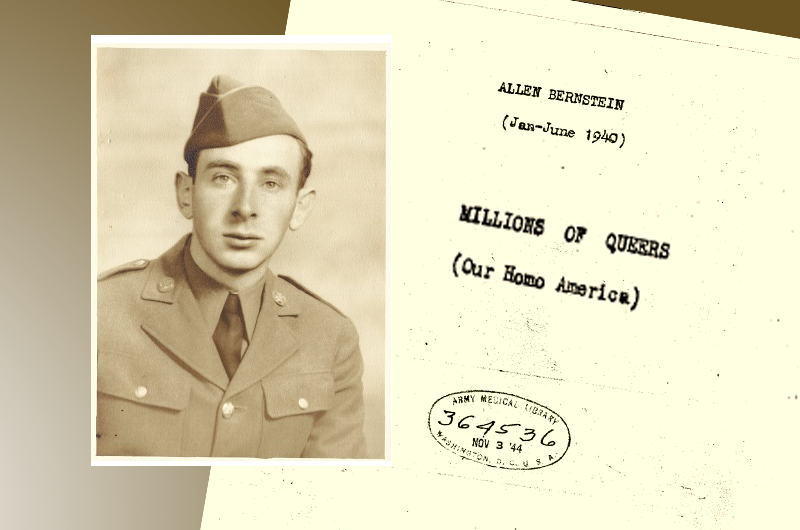
Allen Bernstein and his 1940 paper | Drexel | 14031
A previously unknown 149-page manuscript from 1940 defending homosexuality, entitled “Millions of Queers (Our Homo America).” by Allen Bernstein has been discovered. Drexel University’s Randall Sell found the manuscript in 2010 while searching the National Library of Medicine for the earliest uses of the term “queer” in reference to homosexuality.
Mr Sell is an avid and accomplished LGBT history researcher with a track record of unearthing early gay manuscripts.
Bernstein offers a libertarian argument that homosexuals don’t hurt anyone, should not be criminalized and stigmatized and should be left alone to work out their non-conforming lives by themselves. Expressing such a view, and signing his name to it, as Bernstein did in several essays, was a daring, radical act in its day.
Bernstein’s essay is unusual for its use of common, derogatory terms, especially “homo” and “queer”, as casual, value-neutral labels, decades before the term “queer” was reclaimed with pride by LGBT groups beginning in the 1990s.
Bernstein’s document is also a rich source of historical insight into gay culture from the 1920s and ’30s. It offers glimpses into hundreds of lives based on Bernstein’s direct observation and a network of pseudonymous informants. Included are anecdotes about an active Boehmian queer culture in Boston, stories about gay men’s lives in heterosexual marriages, legal persecution of homosexual behavior, and the deaths of queer friends by suicide.
Gay History – Found – Queer political publication from World War II
Coming out at work: how easy is it?
 The Employment Equality (Sexual Orientation) Regulations 2003 meant that LGBT workers had the right to be openly gay at work without being fired.
This law, along with the increasing number of rights that LGBT (lesbian, gay, bisexual, transgender) people have been given in our everyday lives, should have made us feel freer to participate fully in the business and social side of our jobs. But is this actually the case on the ground?
YouGov polling shows that in the last five years 2.4m people of working age have witnessed verbal homophobic bullying at work. A further 800,000 people of working age have witnessed physical homophobic bullying at work. Further polling shows that over a quarter of lesbian, gay and bisexual people are not at all open to colleagues about their sexual orientation.
 This is why we need to keep on challenging injustices and outdated thinking – everyone has the right to believe and think what they want, but not at the costs of someone else’s well-being and civil liberties – and I challenge the politiicans, clergy and employers to lead from the front in terms of tackling homophobia.
World Book Day

The Belfast Book Festival was launched at Crescent Arts Centre in May of this year, with principal funders Arts Council Northern Ireland and Belfast City Council, and generous supporters Nicholson Bass and Belfast Calling, a programme of almost 90 events in one week was celebrated.
Speaking at the launch, Keith Acheson, Festival Director said: “This year’s Festival is the biggest and best yet, having grown to encompass almost 90 events over the course of the week.
Following this wonderful festival, I had the opportunity to meet with Keith last week on Friday in the Centre to discuss how we can incorporate relevant books and DVDs in forthcoming events. I was able to advise on the booklists and DVDs that NIGRA has published on its website, (NIGRA Booklists)
LGBT Asylum Seekers Say They Face Homophobic Abuse in UK Detention Centers
 Gay and lesbian asylum seekers face homophobic abuse and sexual harassment in UK detention centers, former detainees have told VICE News.
The LGBT individuals fled persecution in their home nations to seek asylum in the UK on the grounds of their sexual orientation. They say they were bullied, threatened, or sexually harassed while they waited weeks – or even months, in some cases – for a judgment on their applications. The former detainees agreed to speak about their experiences only on the condition of anonymity.
One asylum seeker told VICE News that he waited longer than six months for the Home Office to reach a decision on his application, and was prescribed sedative antidepressants to cope with stress, anxiety, and depression stemming from the homophobic abuse he encountered in government accommodations.
Another said he was sexually assaulted at Harmondsworth immigration removal center by a fellow detainee, and that he felt “totally unsafe” in detention.
Italy is about to shut down the sea rescue operation that saved more than 90,000 migrants this year. Read more here.
In March, UK Home Secretary Theresa May ordered a review of how border officials handle asylum claims and pledged that all claimants would be treated with “respect and dignity.”
However, the UK Lesbian and Gay Immigration Group (UKLGIG) said its LGBT clients “regularly complain about bullying, verbal abuse and threats of violence,” while in detention or community accommodation, according to the group’s submission to a parliamentary inquiry into the use of immigration detention in the UK filed last month. The group also criticized the lack of published statistics relating to sexual and gender identity asylum claims.
Tahir, 35, came to London as an IT student in 2006. He applied for asylum earlier this year after he was almost beaten to death by his brothers over his sexuality on a visit to his home in southern Punjab, Pakistan.
Tahir was detained for three weeks in April at Harmondsworth removal center, which was then run by private contractor GEO Group Ltd, but has since been taken over by Mitie, an outsourcing company. There is no suggestion of any wrongdoing by Mitie.
The facility, located near London’s Heathrow Airport, houses approximately 620 men. Five inmates have died there since 2000, including three who were found hanged in their cells.
Tahir described the facility as “totally unsafe” for LGBT asylum seekers. Once inside, he was subjected to verbal abuse and sexual harassment. On one occasion, he says that he was pulled into another detainee’s room and sexually assaulted.
Europe is failing refugees from Syria. Read more here.
Tahir, who was granted asylum on May 6, says he reported the incident to a staff member, but no action was taken. Instead, staff members told him that he was “very visible,” and advised him to “keep yourself down.”
“I always just keep quiet,” Tahir told VICE News. “I always focus on my stuff. And the officer, instead of taking any action, he’s saying to me you have to keep down. For what? What did I do? Did I take off my shirt? Have I invited anyone in my room? Did I ever provoke anyone to do anything to me?”
Maajid, 24, came to the UK as an English language student from Pakistan, where his family disowned him for being gay. His lawyer told him that he had a strong case for asylum, but he was held in a detention center for three weeks and then community accommodation for a further six months while he waited for the Home Office to make a decision on his application.
Maajid says he was bullied and threatened with violence during his time in the G4S-run community accommodation — a type of non-secure housing provided by private contractors to asylum seekers, who are not allowed to work while they await the outcome of the asylum claim.
From the end of February until mid-July, Maajid shared a room in Doncaster in northern England with a Muslim roommate and was bullied by other asylum seekers. He says his mental state deteriorated during this period as he was threatened with violence and regularly slept in the kitchen.
“I put a picture of Zayn Malik in my room,” he told VICE News, referring to the One Direction singer. “Just a picture! And [my roommate] said if you put this picture, I can’t pray. Then he tried to punch me.”
Young and Gay in Belgrade. Watch the VICE News documentary here.
Maajid was prescribed sedative antidepressants for anxiety and depression throughout this period.
In a recent letter recommending Maajid for priority housing owing to mental health symptoms, his doctor said that he had been “suffering a lot of stress and anxiety symptoms as well as depression,” some stemming from “homophobic abuse” he had received in Doncaster and concern of recurring abuse in Sheffield.
Maajid’s application for asylum was accepted on August 15.
UKLGIG Executive Director Paul Dillane said Tahir and Maajid’s experiences “are all too familiar to our
 organization where we regularly receive complaints of bullying, verbal abuse, threats of physical violence and even sexual harassment in immigration detention centers and community accommodation.”
Dillane emphasized that, “the Home Office must ensure that LGBTI people whose lives are at risk are granted refugee protection, but also that they are treated with dignity and respect during the asylum process.”
A Home Office spokesperson told VICE News that, “the UK has a proud history of granting asylum to those who need it and applications are considered carefully in line with the immigration rules before a decision is made.”
Addressing alleged instances of abuse, the spokesperson said, “it is totally unacceptable for any individual to be subject to bullying, verbal abuse or threats of violence because of their gender or sexual orientation and we expect all complaints to be dealt with to the highest standards by our staff and service providers.”
The fight to end anti-gay conversion therapy is amplifying. Read more here.
A G4S spokesperson acknowledged that Maajid made complaints to staff.
“We work hard to ensure the safety and well-being of asylum seekers in our care,” the G4S spokesperson said. “We have a zero tolerance policy towards abuse of any kind, and we take all complaints very seriously. There is a robust process in place to deal with any issues raised by service users. In this case, no complaints of abuse regarding sexual orientation were made to G4S by the individual concerned.”
A GEO UK spokesperson told VICE News that the contractor no longer operates the Harmondsworth immigration removal center, but said, “prejudice would not be tolerated in any form by or against anyone.” The spokesperson insisted that the center had “a very good record in its support for LGBT detainees.”
“There were various channels through which a LGBT detainee could register complaints or concerns about the conduct of other detainees (or for that matter about a member of staff failing to act on a complaint),” the GEO UK spokesperson said.
In 2010, asylum seekers won the right not to be deported from the UK if they would be persecuted in their home country because of their sexual identity.
An investigation into the interviews process for LGBT detainees by the office of the Chief Inspector of Borders and Immigration published last week found that more than ten percent of Home Office interviews included “intrusive or unsatisfactory” questions about their sex lives.

https://news.vice.com/article/lgbt-asylum-seekers-say-they-face-homophobic-abuse-in-uk-detention-centers
Gay rights should be centre of UK’s relations with Commonwealth
Former Foreign Secretary says Britain must use its influence with Commonwealth to end ‘shocking’ anti-gay laws
By John Bingham, Social Affairs Editor
 Britain must make defending the rights of gay and lesbian people a key plank of its relations with other Commonwealth countries, the former Foreign Secretary William Hague has insisted.
He said it was “shocking” that homosexuality is still illegal many countries with historic ties to the UK and argued that Britain must use what influence it has to press for change.
His comments came as he addressed a reception in Parliament at which the annual PinkNews awards were presented.
Mr Hague, who is leaving the Commons at the next election, said he was proud of Britain’s record on the issue during his four years as Foreign Secretary including putting pressure on countries such as Uganda over draconian new anti-homosexuality laws.
But he said more must be done and accused countries which ban homosexual acts of breaking international law.
“While we are making progress in Britain and elsewhere, the situation in many countries in the world is not only difficult, it is actually worsening,” he said.
“It is completely incompatible with international human rights laws to make illegal consenting same-sex relations and to deny rights to people on the basis of their sexuality.”
Homosexual acts are classed as a criminal offence in around 80 countries and territories around the world including many former British colonies.
“One of my last acts as Foreign Secretary was to write to the Commonwealth Secretary General urging him to use his position to urge member states to live up to their responsibilities to promote the rights of their LGBT citizens,” he said.
“It is shocking that homosexuality is still illegal in so many member states and it must be an important part of our relations with those countries to persuade them to do better.”
Mr Hague presented a “peer of the year” award to Lord Fowler, who served as Health Secretary under Margaret Thatcher for his work combating HIV and Aids.
Speaking at a dinner following the awards, a serving Church of England bishop said he was “ashamed” of the church’s record on gay rights.
The Rt Rev Alan Wilson, the Bishop of Buckingham said the world would be a better place if Christians spent less time obsessing about the “minutiae of the Book of Leviticus”, which contains passages condemning homosexuality.
Speaking as he prepared to say grace before the meal, he told guests: “I want to say how honoured and privileged I felt to be here tonight knowing that the institution that I represent has not got a glorious record in terms of its dealings with its own LGBT people and the community at large.
“I am ashamed and I need to say that.”
Quoting a passage from the book of Micah, he added: “Doing justice, loving mercy walking humbly with God – if it was about that rather than some of the minutiae of the Book of Leviticus, perhaps the world would be a better place.
“And I look forward to a day when frankly the institution I represent, the Church of England, would stop being part of the problem and start being part of the solution.”
He added: “Take it from me, the day will come when I promise that faith communities in this country will be very much more part of the solution than the problem.”
Benjamin Cohen, publisher of PinkNews said: “We were delighted when William Hague offered to use the PinkNews Awards to make his first major speech on gay rights.
“The Foreign Office under his leadership radically altered its approach to LGBT issues placing gay rights at the heart of its human rights agenda.
“Hague is a perfect example of a politician on a journey when it comes to gay rights – from the party leader who opposed the repeal of Section 28, to one of the proud sponsors of the Marriage (Same-Sex Couples) Act.”
“The bishop spoke with honesty and from the heart, revealing the shame that he feels for the way that the Church of England has dealt with the issue of homosexuality.
“We look forward to the day when the bishop’s views are not a rarity in the world’s great religions and instead before part of the mainstream reality.”
http://www.telegraph.co.uk/news/politics/11199047/Gay-rights-should-be-centre-of-UKs-relations-with-Commonwealth-William-Hague.html
- « Previous Page
- 1
- …
- 5
- 6
- 7
- 8
- 9
- 10
- Next Page »