
ACOMSDave

Community Journalist

  • Home
  • Community Journalist
  • Events
  • Media Page and Press Kit
    • Projects and Work
  • Resources & Documents
    • LGBTQ+ Support Groups and Documents
  • NIGRA
  • Archives
  • Contact

5 Artist Exhibition – The Albany Gallery

13/12/2008 By David McFarlane Leave a Comment

(74b

Albany Road, Cardiff, CF24 3RS

)

5 Artist Exhibition The Albany Gallery


  • Caroline Bailey – studied Printed Textile at Manchester and graduated in 1978.

  • Claire Griffiths – studied at the Royal Forest of Dean College and also at the University of Wales, Cardiff where she acquired a BA Fine Art Degree in Printmaking.


  • Matthew Lopas – Matthew Lopas was born in 1965 in Chicago. An Artist all his life, he has been painting interiors lit by warm light for about ten years

  • Mhairi McGregor – RSW was born in 1971. She studied at Glasgow School of Art from 1989 – 1993, gaining a BA (Hons) in Fine Art. She has exhibited very widely in Scotland, in England and Australia.

  • Aled Pritchard-Jones – Born in Bangor, Aled has lived in Snowdonia until he trained aSean architect at Bath University, retiring in 2000, when he then concentrated on painting the landscapes of Gwynedd which he has loved and walked since childhood.


I have visited the gallery three times in as many weeks, each on Sunday morning as a prelude to my walk around Roath Park. Each time I have found some new nuance which I failed to see before. The various forms of art cover seascape and land Across the Bay inspired pieces by Caroline Bailey to those of her check tablecloths with flowers in vases lead into those of Aled Pritchard-Jones’ Welsh countryside, mountains, lakes riverSeand the most beautiful of all (in my opinion) his track/road through a glade of trees name ABERDUNANT PRENTEG.
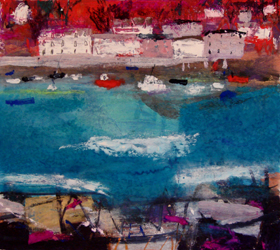
painting titled 'ANNANDALE, PEI 'Mhaira McGregor’s paintings are almost like looking at solid pieces of coloured plastic overlaid to give us buildings which look substantial enough for you to walk into. She maintains this technique when handling her flowerSeand containers though her glass containers seem to have a fragility against her flowers.

Claire Griffiths work moves through ranges of figures either set in an almost classical ballroom pose for tango, waltz etc to farmers meetings at a market in ‘welly’ boots, walking stickSeand tweedsPICTURE TITLED 'tHE fARMERS' each clearly identifiable as being created by her as they have no discernible face.


Finally I come to Matthew Lopas’ work. His interiors seem very flat and drab against the high colours shown by the other artists in the exhibition, but they are no less deserving of attention HANNAH AND DAD for one bares looking at and will tug the heart strings of many a parent.
I have enjoyed this exhibition,, as I have enjoyed others held in this unique, small gallery located on two upstairs floors of the main road.
You might walk past it easily, but to do so would be a shame you would loose an opportunity to look at some original art from wonderful artists.

Filed Under: History

Fascistic Fags

13/12/2008 By David McFarlane Leave a Comment

STANDING OUTSIDE St. JOHN’s, Waterloo Road, (south, just about, London) a while ago one encountered an unforeseen aspect of the fascistic (oh yes, it is, Mr Editor!) ban on smokingBan on Smoking Logo. People have taken to smoking just outside ‘enclosed areas’, meaning ‘fresh air’ freaks get a face (and lung) full of tobacco smoke, while trying to enjoy a bit of said fresh air. Technically, I suppose, this is the ‘fault’ of the smokers. The law ought to have been even more fascistic and banned the weed altogether. Or it could have simply restricted areas where one could smoke. ‘Speakeasies’ for smokers could have been written into the Act forbidding smoking; even if it was only every tenth boozer in every town.

My last visit to a pub in the Republic of Ireland before the imposition of its tobacco-prohibition was in the ‘town’ (rather than the ‘gown’ / tourist) end of Galway’s Eyre Square. After a few pints one noticed something odd about the atmosphere, in a largely male, largely working class bar ‘ practically nobody was smoking. There were four or five people of student age smoking in a crowd of about a hundred. That situation was probably due to the tax-regime in ‘ ire’, which at that point decidedly favoured the wealthy. Working people could not afford to smoke and have the odd pint. The health message was probably also having an effect.

The ‘ban’ in ire has led to an innovation in Irish (or at least Dublin) architecture. Pubs with space at the back have sprouted practically all-enclosing glass screens. They’re nearly, but not quite, conservatories, for smokers who are technically not on the premises. They are also not drinking ‘on the street’ which is also illegal. Presumably the G rda Siochana nods as such quasi-legal matters, having more urgent things to do in a multi-national conurbation that has grown five-fold in twenty years. And has a huge problem with hard drugs, and even harder drug dealers.

In the meantime, in England, smokers will simply have to suffer, like the poor bloke on Seven Sisters Road standing just outside the Enkel Arms. He was trying to enjoy his fag, and a pint simultaneously, it’s just a pity there was a gale force wind (complete with lots of rain) blowing as he was making the attempt.

Filed Under: Anti-Bullying & Homophobia, History

Happy 250th Gay Times!

13/12/2008 By David McFarlane Leave a Comment

GT‘s December (2007) edition was its two hundred and fiftieth ‘ that’Sean awful lot of pages ‘ and editors. Not to mention sub-editors, art-editors, and heaven knows what else. It’s been on the go for more than twenty years. That is worth (genuinely) celebrating, especially as GT was a very useful addition to the Gay press in the mid-1980s. And there was a Gay press. Journals were being produced in nearly every town of any size on a regular, mostly monthly, basis. They were largely run on co-operative lines, largely non-profit making, being produced because a Gay press ought to have been produced. There was a culture of the rolling up of sleeves to produce punchy and provocative material. The short-lived, London-based Gay Noise was one such. Belfast’s Gay Star, and in particular upstart were based on Gay Noise‘s strictly non-deferential style, (if not on its somewhat ‘PC’ outlook). Gay Noise also attempted to resurrect the spirit of GLF’s1 Come Together publication. Come Together was produced by GLF in different places. Mostly large cities, there were just more people available to do the dull bits as well as the writing. Gay News arose out of the fact that Come Together dissipated through lack of energy or commitment on the part of some groups (GLF waSean anti-organisation, ranging from anarchists to Maoists to Tories. Getting them in the same room, much less working on the same project waSean exercise in diplomacy. GLF couldn’t really last ‘ except in disguise NIGRA2 is GLF in collar’n’tie. GN was London-based, but encouraged other magazines, it was a co-operative and generally supported CHE3. More to the point, it appeared on a regular basis, was well written, and was not London, or ‘scene’ fixated.Some people (increasingly, it seemed) disliked this situation. After ten years existence, during which it became something of an institution, and was involved in the notorious ‘blasphemous libel’ case, things came to a head. There were a number of scandalSeand schisms. The editor, Denis Lemon, sold the publication, (which he did not own) to a chap who did not have the money to buy it. Prior to that a number of the staff had walked out. They argued that there were ‘too many’ lesbians on the writing staff (one: with about half a dozen ‘stringers’). They also insisted that the punters did not like ‘politics’ (this was before ‘PC’ was invented). They flounced off (the only phrase for it) and set up Gay Reporter, which rarely reported anything, and then it was only ‘scene’ events along the London Underground Victoria and Northern lines.GR shrivelled and died in a matter of months. GN was revived as a pale but uninteresting shadow of itself – complete with glossy cover – featuring, as Gay Star‘s ‘trypesetter’ as she described herself, Ann Cleave, put it “male tarts”. It ran into the ground and was sold to the combine that produced a range of glossy male porn magazines. It had taken in the waifSeand strays from GN and GR, and produced GT. It proudly carried Incorporating Gay News on its masthead for a long time. Boasting about having absorbed the ‘legendary’ GN in edition No. 100. It was mentioned again in edition 150. Then masthead was re-designed and references to GN disappeared.Why, one wonders? Is this a triumph for the mindless consumerism exemplified by Gay Reporter? If we had been slightly less ‘consumerist’ in Thatcher’s heyday we might not now be dependent on the People’s Republic of China. For every household item you care to think of. What does Gay Times actually stand for – other than being part of the Stonewall / New Labour nexus?upstart and Gay Times are the same age ‘ we’ve had somewhat different histories.Se n McGouran
1 The Gay Liberation Front – it was very widespread – from London to Derry.2 The Northern Ireland Gay Rights Association – named in emulation of the NI Civil Rights Association – still out there fighting.3 The Committee, then Campaign for Homosexual Equality – it’s still campaigning – see www.gaymonitor.co.uk.

Filed Under: History

So much for Church's remorse over the sex abuse scandal

13/12/2008 By David McFarlane Leave a Comment

There are occasions when I genuinely despair of the direction our society is headed. Within the past seven days, the Government has sentenced the family of an autistic child to a future of bankruptcy; a cache of secret files has been unearthed, recounting the most abominable abuse of helpless residents in our nursing homes; and the Roman Catholic Church has proved yet again that it has absolutely no intention of dealing with the predators it has harboured and protected for decades.Of the three bitter injustices listed above, the latter is perhaps the most infuriating, as the Church hierarchy has had ample time to come to terms with the horrific damage their callous mismanagement of abuse cases has inflicted on countless victims.The hypocrisy of ‘moral leaders’ like Cardinal Connell is almost laughable. The thought of him scuttling to his lawyers in an attempt to stem the avalanche of criticism and condemnation that was surely about to rain down on him would actually be funny, if it were not for the fact that the documents he is trying to suppress could mean the end of a cycle of anguish for so many.“Anger doesn’t even begin to describe what’s inside me right now” Ben (not his real name) told me. Ben is a survivor of clerical abuse, and his case is awaiting trial. “There is a culture of secrecy and collusion within the religious community in Ireland. It’s obvious that nothing has changed.

“If the Church really wanted to see those bastards brought to justice, they would have stopped Cardinal Connell from getting his injunction. He’s part of a larger organisation, and has to follow orders. They’re all in it together.”Ben was abused by two different priests. His ordeal began when he was four years old, and ended when he was 16. He is in his 30s now, and tells me that he still carries the memories of what happened to him “like a tattoo — I see that damaged kid every time I look in the mirror.’So far, one of his abusers has been prosecuted, but not for his molestation of Ben. “I was so young when he did it to me, I couldn’t remember dates or precise details. So, when they were putting the case together, my situation wasn’t much good to them. “You read about these monsters who have been raping kids for decades, and they’re put away for five years on 20 counts of indecent assault — the reality is they interfered with children literally thousands of times. But they can only get them on what they can prove.”Ben is very clear about how the behaviour of Cardinal Connell makes him feel. “Worthless,” he says. “At the end of the day, this man was the boss of the creeps who ruined my life, and here he is saying that he values them more than he does me. He is telling me very directly that he doesn’t give a damn about the frightened kid that I was. I know it shouldn’t hurt, but it does.”Ben is articulating a prominent aspect in the psychology of the abuse victim, something that is particularly relevant for survivors of clerical abuse. We must not forget that for countless children who experienced abuse at the hands of the clergy during the SeventieSeand Eighties, a major barrier to disclosure was the apparent unbelievability of their experience.PriestSeand nuns were supposed to be closer to God than anyone else, and therefore beyond reproach. Sex was still a taboo subject. The suggestion that a priest or nun might behave in such an abhorrent manner was utterly unthinkable.Therefore, recognition of the suffering experienced by clerical abuse survivors is a hugely symbolic thing. To have somebody in authority in the Church — as Ben puts it, ‘the boss’ — acknowledge the rightnesSeand truth of their plight validates what happened.In one fell swoop Cardinal Connell has demonstrated complete and utter apathy towards the foul social evil his organisation allowed to flourish unchecked, begetting levels of hurt, grief and despair that he probably cannot even begin to comprehend.The Roman Catholic Church has many things for which it should feel remorse. The industrial schools, the Magdalene Laundries, the persecution of the gay community, the marginalisation of women, the suppression of contraception, the condemnation of the labour movement — all these things illustrate an institution clearly out of step with the needs of the people it professes to serve.As the investigations into clerical abuse continue, the Church haSean opportunity to show that it is truly sorry for what it did (and failed to do).It is time for someone in the Church to stand up and cry: ‘enough’. The sleight of hand, the smoke and mirrors has to stop.Shane Dunphy is a child protection expert and lecturer. He is the author of ‘Wednesday’s Child’ and ‘Last Ditch House’ Sean Morrin
Youth Support Worker
The Rainbow Project
12A

Queen Street, Derry BT48 7EG

Telephone 028 71283030www.rainbow-project.orgRegistered Company Office

2-8 Commercial Court, Belfast

.

Filed Under: Anti-Bullying & Homophobia, History

and still the niffy Liffey flows

13/12/2008 By David McFarlane Leave a Comment

The Second All-Ireland Gay Conference

The following impression of the Dublin Conference is partial, pig-headed, probably ego-maniacal and, I hope, accurate and entertaining.1

I arrived at the Conference venue (the Junior Common Room at Trinity College, Dublin) at ten o’clock or thereabouts on Saturday morning. Having parted with my registration fee, I nipped into a biggish room and borrowed a corner of the Derry Community Bookshop Bookworm‘s table to layout my wares: two editions of your favourite organ, and some of the Ayatollah’ posters.2

Almost immediately, two people swept down and said that the posters were racist. How do ye mean sez I. It’s got slant eyes sez they. Aye sez I, but they slant downwards!. This confused both parties, and my interlocutors went off muttering about the Steering Committee disapproving of the posters. So did Ian Paisley odd auld world isn’t it?

The first Workshop I sat-in on was called Coming Out / Personal Liberation. If you are interested, I was accused of being a racist, again, by a person who persistently used the scientifically neutral term Brit.

We didn’t really get beyond the Coming Out stage in this Workshop, partly due to the fact that most of us hadn’t, but mainly because of the small number of women in this group. One man had the odd experience of discovering his Gayness in the Curragh Prison Camp.

We broke for socialising and snack-freebie tea / coffee and nibbles, and also very tasty veggie meals supplied by a pleasant couple and (presumably) their child. It is very unusual in find Dublin whole-foodie types with smiles on their faces. They take the British Road, I am sour, therefore I am serious. Belfast is more American people like to display their (very healthy) teeth.

The next Workshop was Gays in a Patriarchal Society, which became largely a conversation between the Dublin Gay Collective and some Gays from Manchester (organised around the magazine The Mancunian Gay), with sensible comments from (largely independent) women. Some of the Dublin men were very sharp in their criticism of Gay male pornography as part of capitalist and therefore patriarchal society it was no different from pornography featuring women. The Mancunians said that Gay (male) porn is not intrinsically oppressive of the Gay men on either side of the camera. One of this group also defended cottaging.

In opposition to this a DGC person said that he did not even accept the definition man any more, and that he rejected phallic, capitalist, society with it sexploitation and its emphasis on the notion that sex (in men) equals ejaculation. Then he said that we should solidarise with the Republican Movement and the IRA is it political axe-grinding to point out that guns could hardly be more phallic?

I tried to make the point against the same person’s contempt for both camp and macho men, that these stereotypes are at least an attempt to create a niche for Gay men. And I still do emphasise the creative element in the construction of these stereotypes. No matter how unpalatable it is to some of us, capitalism is generally a progressive factor in the short term liberation of Gay people. Gay USA may be appalling, but at least it is open, up-front and brazen. Gay USSR or the Gay PRC (Peoples’ Republic of China) are unknown factors.

Sharon from Belfast made the point that women are, to a very great extent, entrenched in their mother / homemaker roles, and that anew consciousness has to be created before we talk of drastic changes in society. Most of the women in the Workshop rejected the idea of joining the standard political parties. I detected a note of condescension towards people who were not politically-aware. Some men innocently made some fairly crass remarks about women and their role in society. But they were there and seemed willing to learn.

The next event after a wee break (incidentally, to get from the JCR to the dining / socialising area, one had to duck through what had been a fireplace, it was a bizarre, Lewis Carrollian sensation) was GaySeand the Media. Again this was pitched high, the Dublin radicals claiming that all bourgeois media were anti-Gay. The Mancunians again took up the issue, and pointed out that they had used local radio to good effect. So, also, I thought, had the IGRM (Irish Gay Rights Movement), but apparently this wasn’t Kosher, so to speak. The question of [London] Gay News was raised, and a broad front to oppose its banning was mooted this appears not to have got off the ground. Irish Gay News was discussed, and no conclusion was come to. It will inevitably be the organ of the Dublin Gay Collective, the biggest of the various Collectives. This Workshop struck me as being largely a matter of craw-thumping on he part of the radicals against the big two (the IGRM and NGF (the National Gay Federation)) and against the media in general.

At the end we all adjourned for tea / coffee, then EVERYONE rushed out to watch videos of Bette Midler doing her wonderfully off-colour politically-unsound stuff. This left two persons in the dining areas both bureaucrats’, one from NIGRA and one from NGF. The NGF apparatchik had a brush in his hand and busied himself sweeping up. Your own NIGRA Orgman offered to help, then wandered off feeling pretty redundant. At four o’clock the next morning I found my host. I doubt if any other city could show such cool in the face of such an appalling guest. Just think what you would do in Derry or Belfast if a loony rang your doorbell at that time.

The first session next day (Sunday) was Gays at Work / In the Trade Unions. I sneaked off to Roy Holmes’s piano recital (his first in Dublin) at the Hugh Lane Gallery. It was a demonstration of how capitalism enforces ifs basic ideas. There is no entry-fee for these performances, so we had touristSeand their children milling about making noise. The audience were, without a doubt, the worst-behaved I have ever sat among. Holmes’s playing was wonderfully apt in Faure and Mozart. He isn’t heavy-handed or humourless enough for Liszt. He might as well have been telling dirty jokes to banjo accompaniment for all eh interest it evoked at the back of the hall. It had not been paid for therefore it could not be worthwhile.

Back at the talk-in we were told that a picnic was to be held on College Green. As nobody bothered to tell me where this place was, I wandered off to St. Stephens Green and, of course, feeling silly, wandered back almost immediately. Then we got down to something called Structures for Development. This displayed an alarming gap between the radicalSeand ordinary Gays. There waSeanger to the point of shrillness, with NGF and IGRM over the Charles Self3 affair. NIGRA was quite sharply criticised for the handling of the Kincora affair,4 but nobody actually suggested anything concrete. I was shaken by the lack of historical perspective shown by some people in this discussion. Ten years ago, Gay Ireland lived in the shadowSeand conducted its affairs in a very few grotty pubSeand even grottier public conveniences. The various Gay Collectives (well, Dublin and Cork) also struck me as incubating yet another Bureaucratic org.

This developed into a closing Plenary Session, which I had to leave early, at which, mysteriously NIGRA was accused of excluding women from the Carpenter Centre.

(This was not explained, as the Minutes of the Conference simply stated the above. NIGRA did not own a brick of the Carpenter’ even our describing it as a Centre’ was a bone of contention with the actual owner. The accusation probably arose out of Jeff Dudgeon’s refusal, in his capacity as manager, to sanction a free women-only disco. It may have been a short-sighted judgement. But the enterprise was losing money hand over fist, it appeared to be disappearing down the s-bend, taking Jeff’s mortgage with it. If he had agreed to the fund-raiser it might have brought in a whole new clientele. It equally might have bust the bank. This was shortly before the (voluntary) staff asserted themselveSeand chucked out the scruff who were repelling reasonable people from coming to the place. It is a great pity that such an eventuality occurred but a number of women just cut themselves out of an interesting adventure.

There might have been a suspicion that NIGRA was a rich powerful corporation (m r dhaidh) but we grizzled all through the 1980s that Thatcher’s government had denied us our costs 26,000 from the Strasbourg case. We had brought the UK government to the European Court of Human Rights in the matter of the denial of Jeff Dudgeon’s right to privacy. Mrs. T was not happy at our win and we got 2,000, which was invested in the Carpenter’, and then a further 2,000 in 1984.)

1 These Conferences, there were three of them, in Cork, Dublin then Belfast, were held in August.

2 These were pasted up around Belfast as part of a campaign against Dr. Paisley’s Save Ulster from Sodomy campaign and also against the (UK) government’s hiding behind this. It alleged that Dr. Paisley had tapped-in to consensus opinion in Northern Ireland. We suggested he had not we were vindicated.

3 Charles Self, an employee of RT (Radio Telef s ireann the nation broadcaster) was killed (1982) rather than pursue his killer, or killers, the Garda S och na emulated British police forceSeand investigated’ hundreds of people in Mr. Self’s address books, and others in theirs. This caused a great deal of anger among the Gay community in fact it may have been the making of a Gay community.

4 This had become a generic’ term for a series of cases of (sexual) abuse of children in care in the greater Belfast region. Actual children were raped in Williamson House, in north Belfast and were seriously sexually abused in Marmion House in Bangor, Co. Down. Kincora was a hostel for employed teenagers (16 – 18), and not children. It is likely that MainSeand Semple who worked in the facility from the early 1960s suspected what the other was up to, but they probably did not conspire with each other. And they most certainly did not confide in the busybody William McGrath. The latter, the Beast of Kincora’, is accused to having molested a large number of teenagers, but he was tried for only one such incident.

It was our (NIGRA the Northern Ireland Gay Rights Association, and its publication Gay Star that the concentration on Kincora and McGrath had to do with anti-Unionist politicSeand not the welfare of children. There was practically no publicity about Williamson House, or Marmion House, despite their being facilities for actual at-risk’, orphaned, or disturbed children). We also felt that the insinuation (some of it quite blatant) that Gay men were inherently child molesters’.

It is likely that some of the anger even on the part of self-consciously radical Gay men (the Collectives split along gender lines shortly after this Conference) was that we refused to join in the campaign of vilification of the Unionists on the grounds that some of them might be homosexual (the Unionists did not return the compliment). McGrath had founded a strange paramilitary’ group Tara, which had a British-Israelite’ ideology, and wanted to outlaw the Roman Catholic Church (it would be a cosy fit in the current Gay Establishment in GB). He had some sort of relationship with British Intelligence, but that probably had to do with his smuggling Bibles into the USSR, in the Sixties, and not with Ulster in the Seventies.

Filed Under: History

Support for the older gays

13/12/2008 By David McFarlane Leave a Comment

I came across the following article at ‘The Derby Gripe‘ – the title iSeanything but supportive, yet the article is short, to the point and is at least non discriminatory. I wonder who wrote the article’s title?
HOMOSEXUALITY WILL BECOME COMPULSORY
Homosexual pensioners in Wales are to be provided with gay-only retirement homes. The Stonewall study found that gay OAPs need to be provided with separate sheltered accommodation and counselling to cope with being old and homosexual. Conservative Assembly member Mark Isherwood said, “We know of older people who are being forgotten by the system just because they are homosexual. Older people from the gay community have no family to support them in old age and often live in isolation.”

Filed Under: Anti-Bullying & Homophobia, History

FORTY YEARS ON

13/12/2008 By David McFarlane Leave a Comment

Channel 4 commemorated (rather than celebrated) the enactment of the Sexual Offences Act of 1967) which only applied in Britain‘ (meaning England and Wales). The latter entity was destined to be absorbed so thoroughly that the law of Britain is called English Law’. Thomas Cromwell’s law of 1533 That the Law of Wales be the same as the Law of This Realm ( this Realm’ being England) wound up the customary law of the (Anglo-Norman) Welsh Marches, and the law code of Llewellyn the Great. Scotland and Northern Ireland had to wait until the early 1980s, and other bits of Her Majesty’s Realm until well into the 1990s before they got parity with England‘.

40 Years On ran (mostly) from Saturday to Saturday 21 to 26 July (2007) first out was A Very British Sex Scandal, about the Peter Wildeblood Peter Wildebloodaffair’ of 1954. In many ways this was the full stop at the end of a quite hysterical witch hunt’ (the clicheis very apt, for once) in the early fifties (mostly in England, and mostly in London I am more than prepared to be corrected on this matter). The Wildeblood affair was every New of the Screws-type sub-editor’s wet-dream. Wildeblood (Martin Hutson) was a very successful journalist on the Daily Mail (always good for a bitching from the less successful in the profession), several aristos were involved and a couple of National Servicemen. (The latter description means men conscripted into the Armed Forces for two years. National Service, for most (male) citizens ran from the eighteenth to the twentieth birthdays, so the two lads Edward McNally (Sam Heughan) and Johnny Reynolds (Karl Davies) would have been under age’ until quite recently.

Wildeblood meets McNally, like a fair number of other pick-ups’ at or about a railway station public convenience’ (little did the stuffed shirts naming these facilities know ”). They were standard meeting places prior to the down-grading of the railways, coach stations took over somewhat in America, but not over here’. They hit it off socially, in so far as that was possible in the early 1950s in England (McNally is Scottish), and he is the one who pushes for something more than a one-night stand. We see, in a clunky kind of way, Wildeblood’s journalistic career in the ascendant. He is appointed Royal correspondent, (a rather important job in those days, especially as he has to cover the Coronation), and then Foreign correspondent. The latter entails his moving abroad, thus the country party with Lord Montagu, in a house by the sea shore.

News of this gets to the police and McNally and Reynolds are arrested by the Military Police, an unpleasant, violent, experience for them. The civilian police offer them the usual inducements, if they tell on the others they will get off with a lighter sentence. Young Reynolds falls for it, but McNally’s attitude to Wildeblood is more honourable and is motivated by more than the prospect of sex and presents. (Reynolds tagged along to the house party as a mate, possibly a fuck-buddy’, of McNally’s, while doing National Service.) While it is clear that the police are after Wildeblood and Montagu, as the older men’ from superior’ social positions who corrupted the two young men they are treated, relatively speaking, with kid gloves the young soldiers just get thumped. (Their sentences at the end of the trial were just as long as the other three, middle and upper’ class defendants.)

This is a very good drama-doc’, though I did feel that the police and lawyers verged on caricature, but it was more than half a century ago in England. (The people of Scotland, Wales and Ireland (the geographical expression) have been less inclined to look up to the quality’, to use the sardonic Irish expression. This is a reason why Tony Hancock’s humour, hilarious in the 1950s, and early 60s, is either quaint or inexplicable to anyone born since 1960.) Lord Hailsham is seen giving evidence’ to the Wolfenden Committee to the effect that queers recruit’ and that it was the mixing of men from all sorts of backgrounds during the War’ (presumably WW2) that has caused to problem to multiply. Maybe people were too busy Revolting after the Great War of 1914- 18 for their sexual proclivities to be noticeable.

The climax of this drama is when in answer to a direct question Wildeblood owns up, in a Crown Court, to being homosexual. He got a longish prison sentence, and when he came out of prison he campaigned against the law. He was also employed by the BBC as, apparently a very good, and creative, television Producer. McNally and Reynolds simply disappear. But a very good drama could be made out of their lives. McNally iSean Irish name, as is Reynolds (Mac Raghnail), they were Scottish, and probably RC, which three attributes apart from being working class nobodies would have been enough to unperson’ them in 1954. In fact, they would have been barely personned’. McNally and Reynolds might have first met as altar servers in the RC chapel in whatever cold, damp, dump of a garrison they were serving in.

This sort of class blindness iSean example of how people behaved in the 1950s. There were a number of similar situations in Paul Nicholls in Clapham Junction, (set in 2007), to be discussed after the actual drama. Kevin Elyot has been described as writing an anti-Gay’ play, but I wonder if he was writing any sort of Gay’ play. It is heavily populated, almost Jacobean in its large cast, including such persons as, Tough Man’, Man in Toilet 2′ and Man on Bench’, despite which it is not a standard realist’ telly-script. I feel this is what annoyed a great many people. We are so used to realism from Anglo-Saxon’ film makers that the utter unreality of what they make escapes us. How many times has Deirdre Barlow’ of Coronation Street been married? The central figure in Clapham Junction is (according to the press) Terry’, (Paul Nicholls). The latter appears not to have given any interviews about it. Most of what I read was nonsense, one magazine had Terry beating up the Alfie character (David Leon), which is inaccurate.

Terry, who hasn’t surname, is a conundrum, he may be a man struggling with his sexuality’. He may be a man who enjoys inflicting violence on others, and has discovered a sub-culture individual members of which are still (even in cosmopolitan London) comparatively fatalistic about having physical violence visited on them. This is, I believe, creative ambiguity, and Paul Nicholls has understood that it is really impossible to fathom whether or not he is sexually turned on by Gay male sex, or just despises potential victims. It is interesting that he surely realises that the man who inflicts violence on him at one point, is going to do so. This sort of thing is not psychologically improbable it is probably having a background in small scenes’ the current[ish] tiny Belfast one and the sub-atomic particle in Lancaster in the early Seventies, which makes me think along such lines. Most of those complaining about this play resided in London, (some in Clapham!), which has a huge scene’ (which is not the same as a society’ or community’- but overlaps them). Gay Londoners can easily avoid other Gay people whose sexual behaviour they disapprove of, or just find personally distasteful. It can be done semi-consciously, as nearly all the barSeand other places of entertainment, advertise what exactly is their speciality, either globally’ or on particular nights. Some nights are for flabby old honkies in underwear, others are for beautiful young athletic Afro-Caribbean men ” you pay’s your money ”

Terry encounters Alfie in a disco, complete with a pole dancer ignored by the clientele (just like in straight bars). Alfie (the lovely David Leon, whom any red-blooded poof would love to have as a Close Personal Friend) is not interested. Largely because he has had a heavy-duty encounter with a participant in a Civil Partnership celebration. It was one half of the Civil Partnership, a problematical situation for a skint waiter, dealing with the attentions of a very wealthy man. The latter could, and probably would, have complained to Alfie’s bosses if he had not been amenable to his attentions, jobs are not that easy to find. After evading Terry, Alfie chooses to walk round Clapham Common, and enters a public toilet. He encounters two heavies, who make it clear they think he’s a queer. He legs it, but is hunted down and beaten so badly that he does not last the night. Terry happens along and steals a ring on his finger, which he’d remarked on in the disco, but makes no effort to help or comfort Alfie, some passers by find him and send for an ambulance.

This is where the slightly redundant dinner party, in one of the big houses surrounding the Common touches on the main theme of the drama. One guest is a closeted lawyer who was in the same cottage an hour or two before Alfie’s killing, being fucked by a large brute of a man. (Incidentally his membrum virile, is like Terry’s (seen earlier in the proceedings) rather large. One did wonder about stunt doubles’. Far be it from me to give cognisance to the outrageous rumour labelled the Irish curse’, but they seemed bigger than they had a right to be). The lawyer is quietly irritated by a writer with whom he had had sex some time before. They are played by James Wilby and Rupert Graves respectively, who played the eponymous Maurice Hall in the 1987 film and Alec Scudder, his game keeper lover. The two women at the party are slightly anti-Gay, because of the behaviour’ on the Common. The third man is a sexual liberal, demonstrated later in the play, where he is prepared to accept a situation, which in all honesty would have most parents running to the police. (This iSean encounter between their early-teen son Theo and the twentysomething Tim).

The ring which Terry stole from Alfie is something of a leitmotif in the latter part of the drama. When Terry is taken to the A&E in a nearby hospital after he in turn is bashed, the person who deals with him is the other half of the Civil Partnership, who wonders how Terry acquired the gift he gave to his partner’. They had had an argument about what had happened to it. The drama stops at this bitter moment. It is not remotely up-beat, and the situation implies more drama and bitterness. Possibly this is what troubled many viewers, which is, again probably a consequence of the homogenisation of television drama. We are used to fifty minutes of bland drama interrupted by advertisements, which are often more creative than the actual drama which end in all the loose ends being tidied up, in a little apotheosis. A drama with raw edgeSeand unresolved sexual issues, like p?”dophilia, where the younger party Theo’ (Luke Treadaway) forces the issue with the sex criminal’ (whose flat has been petrol bombed) Tim’ (Joseph Mawle), is disconcerting. Presumably it is meant to be.

Another element linking the various disparate elements in the play is the case of young Danny’ (Jared Thomas), who is a violinist. He is also the only child of a single mother, and she has invested extremely high hopes in him. He is a talented musician, a violinist, and his playing of a Bach Gigue is heard over some quite shocking parts of the drama, (somewhat in the manner of the film Clockwork Orange). A number of people, described in the cast list as Black Youth’ there are a number of them hang around the house of his music teacher. I found this element in the drama difficult to relate to, I have a feeling that the music mad Black sub-culture of south London would be inclined to cherish a talented Black musician, no matter where his talents lay. This has been roundly sneered at by other London dwellers. But the implications of Danny’s stance when not playing, and when having to pass the Black Youths’ are that he is afraid of them. We see his violin smashed to pieces in a long underground passage, near to what appears to be a public toilet; Danny is nowhere to be seen. This may be based on a real incident in Belfast some year’s ago. A fourteen year old walking through Botanic Gardens, just across the road from his school, Methodist College ( integrated’ for more than a century) was hospitalised by some youths from Annadale flats. They decided that he and his mate were queers, and they paid special attention to the boy’s hands. He will never play the guitar or any other instrument again. He was a brilliant musician looking forward to great career as a classical’ guitarist. The difference between south London and south Belfast is that the latter has something of an excuse for this sort of nihilism. It was recovering from a thirty year civil war. South London‘s main problem is that it needs the Tube extended and connected.

As noted above, I fund the treatment of (working class) Black’ youth in Clapham Junction somewhat disturbing. The treatment of white working class people wasn’t exactly heartening either. Terry works as (apparently) for the Council’ or binman’ if you like my former avocation. The bashers’ are all plebes, as is the p?”dophile [?] Tim tormented by his neighbours in the Council Estate opposite the bourgeois semi owned by Theo’s parents. Alfie is a mere waiter, and is something of a cipher he is pictured as, in essence, too stupid to protect himself. Two of the three prominent women in the play are middle class homophobes (possibly a rather subtle touch. Don Milligan, author of The Politics of Homosexuality [Pluto] wrote to the Guardian a decade ago, to point out that he had never been attacked by working class people. His two encounters with physical violence were in nice, middle class environs, in one case a university campus, and in another at the opening of an art exhibition[!].)

The Stonewall, Gay Times, New Labour nexus has been pushing this line for over a decade now, that working class people are (almost inherently) homophobic. This iSean extension of the attitude which led to the destruction of Gay News, and the setting up of the pseudo-libertarian Gay Reporter, which was a commercial failure. The reading Gay public did not especially like misogyny, metropolitan self-obsession, and whinging about politics’ (it was too early for political correctness’). People wanted sex and politics just as well, too Section 28 was in the future. The Gay community of communities mirrors society at large, most of us work for a living, and in the nature of things are found in every political formation (clearly we are, largely, in political formations attempting to extend the rights of the citizen).

***

Other aspects of the 40 Years On were a mixed bag, one was a studio debate 40 Years Out chaired by David Aaronovitch with a what am I doing here’ look in his eyes. This would have worked much better in an After Dark format. After Dark was screened by C4 in the late 1980Seand early ’90s, it was a spectacularly simple format. A group of people were sat around in a circle of comfortable seats, with some nibbles’ and a fair amount of drink’, then talked until they, became incomprehensible, walked out, or fell asleep. One programme lasted until seven the next morning, having started about 10.30 or 11 p). In 40 Years Out we got a different collection of talking heads every ten minutes, it was choppy and not very enlightening. The only person talking sense was the rapper QBoy, who presented a C4 show called Out in Class aimed at school students earlier in the year. He was fairly sanguine about the violence and against Gay school students, and their alienation from there peers being countered, but it was going to be a long haul. Mark Simpson (author of Anti-Gay) seemed to be objecting to Clapham Junction, he muttered about not wanting pro-Gay agitprop’ same as a number of bloggers what’s wrong with Gay agitprop? He said something sensible about homophobia’ to the effect that people ought to be allowed to express distaste for queer folk. The problem with such an attitude (I tend to agree with it), is that such matters cut both ways. Would we shirt-lifters be allowed to jeer publicly at the notion of Richard Littlejohn or Kelvin Mackenzie, having sweaty and un?”sthetic heterosex? The vocabulary of anti-Gay abuse is rather large. Simpson said that he now lives in Leeds, maybe some of his (rather smugly metropolitan he coined metrosexual’) attitudes laid out in Anti-Gay, are changing.

I didn’t really understand what Mathew Parris (A Castle in Spain, among many other publications) was talking about I assume he was edited to tatters. Simon Fanshawe (The Done Thing) was also a bit odd he wants us to behave ourselves but do the others’ behave in the done’ way. If he wants a return to elements of the sort of social co-operation that existed as late as the 1970s, one would agree with him. Most of our fellow-citizens (hetero-, homo-, and anarcho-sexual) want discipline and orderliness for other people. Young people and queers being at the top of the list, as for Gay youth, they should be neither seen nor heard, in fact they probably should not exist. Brian Paddick, the queer ex-cop, partly helped into early retirement by creeps like Littlejohn, might have had something interesting to say, but there was no time to say it. Other people involved were the comedian Paul Sinha, a doctor, and a Gay Asian, (and a Catholic? Sinha’ has a Goan ring to it) and Julie Bindel (co-editor, among other things, of The Map of my Life, The Story of Emma Humphreys) who was a pleasing presence, but they like Paddick, did not really get time to say anything of consequence

Queer As Old Folk (July, 26) Queer As Old Folkwas interesting, and I thought heartening, with two old dears having a Civil Partnership, after forty five years of living with each other. There was also a fascinating coupling of a man in his sixties with a male stripper less than half his age. There was, admittedly, a lot of attention paid to the chap in his late forties (how old is Old’?) who was living the adolescence he did not experience. A number of correspondents of C4’s various internet forums (fora?) were irked by this, but it has to be said people do that sort of thing. They did not want pro-Gay agitprop, but then some bloke turns up not behaving like St Francis of Assisi (after he’d changed) and there is a chorus of indignation. Was it the sex they objected to, or that fact that some oldster was getting it?
There was also some griping about stereotypes’ effeminate old souls being, largely, the target. But as Jeff Dudgeon (Roger Casement: The Black Diaries With a Study of His Background and Irish Political Life) put it there are definite, and definable types in Gay and in general society live with it, this was in regard to the film The Boys in the Band (1970). This was also part of the response to How Gay Sex Changed the World, (July, 24) which consisted to talking heads’ mostly the usual metropolitan suspects. It was a gross misnomer Gay sexuality and the acceptance thereof, may have changed the Anglo-Saxon’ world, or even just England. It was, until quite recently, the conviction of the metropolitan bien pensant that persons living outside of England (they meant inner London) were living in a sexual Ice Age. Ireland waSean especial object of opprobrium, David Norris was (credibly) canvassed as a candidate in the last Presidential election in the Republic, and earlier this year a Paisleyite’, Northern Ireland Assembly Minister, confirmed a grant to Belfast LGBT Pride.

Times change, mainly because we trivial Gays made demands on the State and on society, the world’ outside of the US and UK did not need changing, especially those parts of the world in which Napoleon’s Criminal Code was the legal norm. Latin America used to be portrayed as steeped in machismo, but millions marched in an LGBT Pride demonstration in S o Paulo, Brazil. Millions more walked in Seville, Spain. These things did not happen because some Brit queers were able to have a gay old time in Soho discos in the late SeventieSeand pre-AIDS Eighties. It was GaySeand pro-Gays’ in Brazil and the rest of Latin America, and in Spain and the rest of southern Europe, who brought about such situations.

The films shown during the week (some shown on Film 4) are to be commented on in a different article. Here are the titles, Prick Up Your Ears, Un chant d’amour, Victim, Maurice, and on ITV 4, Midnight Express. Most of these films are worthwhile, though Maurice was described by one fan on the as a great film based on a great book’. The book is second-rate, especially in the context of EM Forster’s other works. It was Lady Chatterley’s Lover for Cambridge sensitives’ who loved a bit of rough and the desk drawer. Forster’s musing on its publishability where based on its ?”sthetic worth, not on his alleged closetry. Midnight Express and Prick Up Your Ears, are on the high end of competent, and Jean Genet’s Un chant d’amour is in its own way an erotic masterpiece. A complaint about Midnight Express was posted: it made prison sex a pop-culture joke. Prison sex was being joked about long before the film was made in a nervous cum panicky cum fascinated sort of way. Presumably one had to keep specialised company to appreciate such matters. There were some very odd comments on Un chant d’amour, by the above person, who ” can’t believe that all four reviews ” are preoccupied by the homosexual aspect of the film. That’s because it is all homosexual aspect’, m chroi.


[Sean McGouran]

Filed Under: History

St Patrick's Day – 2008

13/12/2008 By David McFarlane Leave a Comment

NIGRA (the Northern Ireland Gay Rights Association) has picketed Irish Government, or semi-state bodies (Aer Lingus, for example) in Belfast (and once in Dublin) for over a decade now, in solidarity with the ILGO (Irish Lesbian and Gay Organization) of New York.
ILGO have, since 1991, been barred from the famous New York St. Patrick’s Day Parade, by the organisers, the Ancient Order of Hibernians, on the spurious grounds that the Parade is a Roman Catholic devotional demonstration.
The argument is absurd, as can be demonstrated by the most cursory view of any Parade of the twentieth, or of this, century. The Ancient Order of Hibernians while a fraternity of Catholic Irish-Americans, has never been a strictly devotional group. It was suspect in the eyes of Church authorities for the first century of its existence.
It was involved in American Labour politics from the mid-19th century. It sponsored a body of armed men, the Hibernian Rifles, which took part in the 1916 Easter Rising in Dublin. It had connections with the Congress Party of India and with other anti colonialist groups.
Banning the ILGO is homophobic bigotry on the part of a powerful body with a genuinely radical history.
There have been three pickets in London since 2005, on or about St Patrick’s Day. The Irish Embassy’s Passport office in Brompton Road (opposite Harrods famous store) is the best ‘pitch’.
I am asking interested people to contact me about the picket in 2008 – the larger the picket the greater our impact -and the quicker this situation will be resolved in ILGO’s favour.
Pickets could also be mounted at the Irish Consulates in Cardiff (Wales) and Edinburgh (Scotland) – and. possibly other large urban areas. Most cities in Great Britain (England, Scotland and Wales) have some sort of Irish Government or semi state body’s office.
If you are interested contact:
Sean McGouran
127 Tollington Way
London
N76RD
Mob: 07952 223 986
e-mail: seanmcgouran776@hotmail.com

Filed Under: History

H. Montgomery Hyde, the Ulster Unionist MP (Part 2)

13/12/2008 By David McFarlane Leave a Comment


He was called to the Bar in 1934 working in London and the North East circuit. His first salaried employment was with the 7th Marquess of Londonderry whose wife Edith was a famous London political hostesSeand whose influence on Ramsay MacDonald was held by some to be suspect. From 1935-9, Hyde was librarian and Private Secretary to the Marquess [1] in his appeasement’ period, hired specifically to research the family paperSeand write its history. His works on the family included Londonderry House and its pictures (1937), The Rise of Lord Castlereagh [i] a book which remains very highly regarded, and The Londonderrys: A Family Portrait.

Lord Londonderry had been a Northern Ireland Education Minister in the 1920s, famous for trying to integrate schooling. He was later Air Minister in the MacDonald and Baldwin cabinets, and who, against the progressive or parsimonious view, heightened the RAF’s budget and encouraged the early development of radar and the Spitfire. He built the airport in Newtownards near his family seat. Hyde always defended Londonderry whose entertainment of Ribbentrop [2] at Mount Stewart and his meeting with Hitler haunted him politically until his death.

In 1939, Hyde married Dorothy Mabel Crofts from Cheshire, an artist and linguist, later a vendeuse running a fashion shop in London. The Dublin raconteur and Senator, Oliver St John Gogarty proposed the toast at the London wedding.

Lt. Col. Hyde, as he became, and was so addressed throughout most of his parliamentary career, had a good war, mostly in intelligence but he continued writing and publishing. He first served aSean Assistant Censor in Gibraltar in 1940, was then commissioned in the intelligence corpSeand engaged in counter-espionage work in the United States under Sir William Stephenson, Director of British Security Co-ordination in the Western Hemisphere. [ii] He was also Military Liaison and Security Officer, Bermuda from 1940 to 1941 and Assistant Passport Control Officer in New York from 1941 to 1942. He was with British Army Staff, USA from 1942 to 1944, attached to the Supreme HQ Allied Expeditionary Force in 1944, and then seconded to the Allied Commission for Austria until 1945. After the war, he became assistant Editor of the Law Reports until 1947 and was legal adviser to the British Lion Film Corporation, then managed by Alexander Korda, up to 1949. And in 1948 he published The Trials of Oscar Wilde, a precursor of three more Wilde books. [3]

The background to Hyde’s political career in Northern Ireland is that Ulster Unionist MPs took the Conservative whip at Westminster, tended to be aristocratic, officer class or barristers, and were largely left to their own devices. Prior to the 1972 reform, key power and patronage was at local government level, particularly Belfast Corporation and not at Stormont. The Unionist Party was a Protestant all-class alliance, more of a movement than a party. It had started as something of a broad church but was ossifying by the 1950Seand was no longer representative, although it remained hyper-democratic in structure.

The British Labour Party had declined to take members in Northern Ireland or organise there since 1918 so the Ulster Unionist Labour Association and the Communist Party seized the Labour franchise, leaving no outlet for genuine progressiveSeand trade unionists, Protestants in particular, to this day. And no purpose in politics except sectarianism.

Hyde had planned a parliamentary career since the 1930Seand actively scouted for seats however the war intervened, postponing an election until 1945. He then applied for the South Belfast Unionist candidature and was unfortunate enough to miss the nomination by one vote. Five years later, North Belfast was to select him. [iii] He could have expected to hold his seat for a quarter of a century or more. In the event, he represented the constituency for just nine years. His maiden speech was on the uncontentious subject of the unenforceability of Northern Ireland maintenance orders [4] in Great Britain, and the consequent problem of border hopping husbands.

He was a UK Delegate to the Council of Europe Consultative Assembly in Strasbourg from 1952 to 1955, majoring on simplifying European visa and border controls. He was also an incessant traveller, a visit in 1958 to East Germany and Czechoslovakia getting him into difficulty with political exiles when he lamely defended himself saying, there are terrible things going on. Cultural matters are a safe subject in common.

In 1954, as the foremost author on the subject, he presided over the unveiling of a London County Council plaque to Oscar Wilde at his home in Tite Street in Chelsea. In 1956 he argued successfully for the preservation in legislation of Trinity College Dublin’s copyright library status. During the 1950s, he wrote a regular column in the Empire News and Sunday Chronicle newspapers, and much other journalism. [iv]

Contrary to concerns expressed at home, he did involve himself in Northern Ireland affairs, despite properly realising he was sent to Westminster, to be a United Kingdom MP. In the economy debate on the Queen’s speech on 12 November 1957, Hyde managed a rare break in the convention that the province’s internal affairs were not discussed in the House of Commons, which ban was due to the existence of a parliament at Stormont in Belfast.

In the section on productivity, he drew attention to Ulster industry’s difficulties, which he said were not least due to the credit squeeze and the fact that overdraft rates are still higher in Northern Ireland than they are across the border in the Republic of Eire. This waSean issue remarkably similar to the current debate on corporation tax rate differentials, north and south. He also blamed a combination of civic disturbance and general economic problems, this being the second year of the IRA’s 1956-62 campaign pointing out there have been more than 200 incidents caused by illegal organisations resulting in damage in excess of 600,000. He alluded to the high number of unemployed in Northern Ireland amounting more than 29,000 people or 6.2% of the total number of insured employees.

His earliest gay-related parliamentary intervention was a question tabled on police agent provocateurs after the acquittal in 1954 of Weng Kee Sam, a young Singaporean. He and another man, Frederick Beauchamp, who committed suicide before the trial, had been charged with gross indecency at Gloucester Road tube station. Weng Kee Sam later successfully sued the British Transport Police for 1,600 for malicious prosecution. [5] The Home Office strenuously denied Hyde’s suggestion of provocateurism when police carried out such distasteful duties said to be essential to the preservation of public order and decency. [v]

He first debated the question of Casement’s diaries in the Commons on 3 May 1956 when the junior Minister, William (now Lord) Deedes declined to depart from the (government’s) policy of silence, [vi] and again on 2 May 1957 when the Home Secretary, R.A. Butler only admitted that certain confidential documents of Casement’s existed. Butler was still not prepared to explain their nature and declined even to say if any diaries existed. This debate led to Hyde starting an extensive, 20-year correspondence with all the proponentSeand opponents of the diaries’ authenticity, their letters duly responded to, typed and neatly filed. He also wrote two substantive pieces in the Sunday Times in April 1957 on the Casement controversy, which made the MP’s interest in the subject of homosexuality plainer in Belfast.

In July 1959, the Home Secretary was asked again about the Casement diaries when Hyde called for the Home Office both to admit they existed and to allow the public to see them. As Singleton-Gates’s book, replicating some of them, had just been published, limited access to view them was then granted. [6] The fact that there were five, not three, diaries then first emerged. The erotic fifth diary was only published in my Casement book in 2002, as publication had previously been threatened with an obscenity prosecution.

After Wolfenden’s publication, the House of Lords on 4 December 1957 was the first to debate the report on a motion proposed in its favour by Lord Pakenham (later the Earl of Longford). It was not taken to a vote.

On 21 May 1958, Hyde came second in a Commons ballot for notices of motion and announced he would call attention to the Wolfenden Report in three weeks. The day before that debate, and backed by Hyde, the Desmond Donnelly [vii] (who with Bob Boothby [7] in 1953 had called for a Royal Commission “to investigate the law relating to the medical treatment of homosexuality”) pressed the government to allow enough time. The Home Secretary prevaricated, so on 13 June, Hyde was required to propose that the House took note of the report of the Departmental Committee on Homosexual OffenceSeand Prostitution.

Hyde stood up, and said he begged to move. He only managed 37 words: I regret that there is not more time to develop the subject. I hope that in the minute that is left to me I can express the opinion that this is a most valuable social document and ‘. The Speaker then cut him off.

The next day the remarkably modern looking, Daily Mirror headline was ONE MINUTE’. The accompanying, supportive article read, It is nine months since the Wolfenden Committee made their recommendations. The Committee took three years to collect their evidence ”and one minute [was] given to the subject yesterday. And so the matter disappeared off parliament’s timetable for a further six months. This courageous moment was to be Hyde’s political undoing.

In November 1958, when the government relented and allowed a debate, Hyde contributed a half-hour speech which was wide-ranging and thoughtful, and covered both aspects of the report. He concluded by demanding equality for the homosexual and the prostitute. Earlier he quoted a letter from a consenting adult who had been gaoled and released, only to be informed on again, losing his new job. He pointed out three popular fallacies that have been exposed by the Report; that male homosexuality always involves sodomy; that homosexuals are necessarily effeminate and that most relevant court cases are of practising male homosexuals in private. Only one hundred men a year, he said, were convicted of sex in private with consenting adults.

These ideas, novel to the wider public in 1958, can be directly traced back to the 1890s works of Havelock ElliSeand J.A. Symonds. The final government speaker David Renton, who died last month as Lord Renton, concluded definitively, unlike Butler, saying, we believe it is the instinct of most members of the public and most members of both Houses of Parliament to decline the Wolfenden proposal. Decriminalisation was now shelved for a decade.

Reports of Hyde’s speech at home were not extensive. The Belfast News Letter did title its story as Montgomery Hyde in Wolfenden debate’, but reported his remarks after the comments of R.A. Butler and Labour’s front bench spokesman Anthony Greenwood who said there is no justification to impose legislation on homosexuals. Hyde’s reading of a letter from a homosexual was quoted, as was his warning against dropping the legal requirement to prove annoyance by prostitutes before conviction.

Ironically on 26 November 1958, the day of the Commons debate, Ian Harvey, the Conservative MP for East Harrow, resigned both as a junior Foreign Office Minister and an MP, being gazetted as Steward of the Manor of Northstead. [viii] On 11 December, he was in court charged with an offence in St James’s Park against public decency and was fined 5 as was his partner of the night, Coldstream Guardsman Anthony Plant. Hyde had been asked in 1950 by David Ogilvy, a colleague from MI6, to make contact with my old fag from Fettes days, now an MP for Harrow and another admirer of yours. Name is Ian Harvey.” [8] He was later to become a vice-President of the Campaign for Homosexual Equality (CHE). [xi]

But such seriously liberal views had already begun to pull Hyde down along with the traditional complaint that he did not visit the constituency sufficiently often. He was also a convinced abolitionist on capital punishment and was a co-sponsor with Sidney Silverman in 1956 of a bill to abolish hanging. It passed in the House of Commons only to be defeated in the Lords. [9] Tribune picked him out as one of four key players in that first success. Indeed he was drifting toward Labour, as he had presciently begun to doubt the wisdom or efficacy of the Unionist Party’s rigid alliance with the Conservative Party. Ironically Hyde also successfully moved an amendment to which Silverman agreed, excluding Northern Ireland because of its devolved status (presumably also to try to stop antagonistic Ulster MPs voting). He pointed out however that in the previous twelve years there had been no executions in the province. And only eleven since partition.

The Belfast newspapers reported extensively on Hyde’s considerable attempts in early 1959, the general election year, to stem opposition to his reselection, On 6 January, he addressed the Shankill branch’s AGM. Questioned for two hours on the death penalty and the Wolfenden report, he said, I believe I have the support of the Shankill. I have threshed capital punishment out with my constituents before and they know my views. On 8 January, he was noted in the Belfast Telegraph as a Suez rebel, apparently the only time he voted against the whip. Next day he averred, I must plead guilty to being the best known of the Ulster MPs. Although accepting he was a Suez rebel, Hyde said he thought subsequent events had proved him right, adding, My primary interest is the prevention of crime and the treatment of offenders.

Henry Holmes, the Shankill’s Stormont MP, defended him saying, although he has sponsored one or two unpopular causes I do not believe these are sufficient grounds for discarding him. His opposition to the death penalty, and his support of the Wolfenden recommendations on homosexuality and prostitution were all declared to be non-party matters.

Hyde was heavily backed in the English liberal press, with favourable editorials in The Guardian and The Sunday Times. There was however little or no controversy in the letters columns of the Belfast papers about his progressive views. Licensing law was then the biggest controversy not gay law reform. However, Robin Bailie, later a Stormont MP, in a rare letter of 11 December 1958 did call on the church to stick to preaching morality and leave law making (including that on homosexuality) to men. There was no apparent response.

A few weeks after Hyde’s speech in the Commons, and in the absence of any hope of law reform, Northern Ireland’s police and prosecutors accelerated their work of rooting out and imprisoning gay men for on 18 December 1958, nineteen Lurgan men were charged with gross indecency and other charges involving indecency.

Their cases were heard before Lord Justice Curran [x] at Belfast Winter Assizes. Before sentencing seven of them to terms of imprisonment, he remarked, Cries of repentance after an act had been committed was no new thing in his experience.

You seem to have been a cancer in the society of Lurgan, said Curran when sentencing William Wells aged 64 who was not professionally represented to three years in prison. Of the remainder, six were gaoled for a year: Thomas Burton 30, lorry driver, George Haddock 43, optical lens maker, George Hunter 27, engineer, now living in London, Edward Stevenson 38, unemployed, James Walker 30, packer, and Thomas Kerr 52, labourer. Of those bound over, James Robinson 32, a grocer was defended by E.W. Jones MP (later Attorney General) with a plea that he was liable to mental illness. This was accepted by the judge who said he was treating Robinson as a special case, declaring, you have had a week in prison and you know what it is like. I hope it will make some impression on your mind.

The other ten [10] were given recorded sentenceSeand also bound over. Thomas Jenkinson 23, linesman, denied the offence, pleaded not guilty and was acquitted. He said he had only made a statement to keep police from approaching his girl friend and family. The crimes were not described except in his case, where he had initially stated an incident took place at the entrance to some garages. The police claimed to have three witnesses to prove it. The judge commended the police officer concerned, Detective Constable Ernest Drew, saying, I think you have done a very useful piece of work in cleaning up this mess in Lurgan.

What seemed unusual in this trial was the sheer number charged and the severity of the sentences. However not much has changed in relation to such small town round-ups, exemplified by the 2006 Coleraine events, when a dozen men were convicted and publicly shamed (with their houseSeand cars duly attacked) for trivial cottaging offences. Such trials studded the English newspapers in the 1950s, but extensive group arrestSeand prosecutions [xi] continue to be an Ulster peculiarity, perhaps indicative of an institutionalised homophobia in the police, prosecution and judicial system.

Under the radar, opposition was building to Hyde’s Wolfenden and Casement activities which unfortunately only muddied already troubled waters so far as his constituency association was concerned. In the event, he faced a challenge for the parliamentary nomination from Air Marshall Sir George Beamish, once an Irish rugby international.

The MP went to the Unionist Party selection committee meeting on 12 January 1959 armed with a letter of endorsement from Edward Carson’s widow (which looked and read suspiciously as if he had written it himself). The vote was 70 for Hyde, 60 for Beamish and 12 for David Carlisle. After his elimination, it was 77 to 72, a five vote win for Hyde, a result greeted with prolonged applause. Reselection with nearly 150 voting was a remarkable achievement given the worrying publicity. This defeat knocked Sir George out of the running. Hyde’s enemies however fought on.

The ratification meeting, normally a formality was on 13 February 1959, but Hyde was in the West Indies on what was described aSean industrial parliamentary West Indies committee tour of the Caribbean to promote trade and business contacts. A local news story ominously read, in the event of the association rejecting Hyde against whom there is some feeling in the constituency the matter will be considered again.

Unwisely, Hyde chose not to cut short his trip and thus missed the full North Belfast Imperial Association ratification meeting in the Belfast YMCA. Despite pleas from his wife and certain Belfast friends, he chose instead to appeal to the chairman, Mr David McClelland, for a postponement.

That plea was in vain as McClelland was already hostile. He simply replied, Wire received. Regret you cannot attend meeting. Must go on. Management Committee decision. Writing letters, from a hotel in Kingston Jamaica, to his number one enemy in wintry Belfast, the association secretary Mrs Noble who thought him a bad man [11] was also bordering on the politically insane.

In a much bigger turnout, and by 171 votes to 152, Hyde’s reselection failed to be ratified. By 19 votes, the Unionist Party lost its one respected voice at Westminster and abroad, and the only MP who ever advised his people of changing times, while attempting to modernise and moderate Unionist opinion. Unionism’s failure to send a consistently liberal voice to Westminster since remains a dangerous deficiency that has done it considerable damage, not least with Labour governments.

The Belfast Telegraph reported, Mr Hyde’s rejection is a result of criticism amongst constituents over his attitude over certain problems particularly the Wolfenden report, capital punishment and the return of the Lane pictures to Ireland; further there was a feeling he did not visit the division sufficiently. One view expressed was that as the vote was so close he might have carried the day, had he been present.

Two days later, now in Belize city, Hyde complained that it was a rank discourtesy holding the meeting without him, especially as there were 3,000 members in the constituency. His wife in London the next day said, I shall advise him to cut out the rest of his tour if that is possible and deal with the matter on the spot. She had however written earlier to him in Jamaica: SO THAT’S THAT. I’m sorry darling perhaps it’s for the best. No more politics. No more Belfast politics. Oh bliss. He did make efforts to have the decision overturned by Unionist Party headquarters on procedural grounds but he had no high-level political support.

Although he had made little secret of his progressive views during his the capital punishment debates, the campaign for access to the Casement diarieSeand his writings on Oscar Wilde, Hyde’s political undoing was his parliamentary interventionSeand outspoken views on the decriminalisation of homosexuality. [xii]

Ironically, if he had managed to effect the Wolfenden report recommendations at Westminster, the reform would not have applied in Ulster. In the event, the 1967 England and Wales Sexual Offences Act was not extended to Northern Ireland until October 1982, by a vote of 168 to 21 in the House of Commons. This was only after my 7-year European Court of Human Rights case succeeded 12 months earlier, vindicating Hyde’s efforts of 25 years before.

With Stormont back up and running, the no change; no reform’ policy is likely to prevail again in relation to implementing proposed sexual offences reform, adoption and other gay anti-discrimination measures, due in particular to having the Rev Ian Paisley, leader of the 1977 Save Ulster from Sodomy campaign, as First Minister.

Hyde vacated his seat at the election in October 1959, not standing aSean independent as had been mooted, and despite having received many letters of support from within North Belfast including a number from his Hebrew constituents, as he put it, and beyond. There was (and is) a folk view that the North Belfast Unionist Association at that time was conducted out of the Synagogue, explaining to a degree its apparently liberal approach, although no such aspect to the dispute surfaced in the press. The one (anonymous) antagonistic letter in the Public Record Office of Northern Ireland (PRONI) fileSeand postmarked Worthing, stated Ulster has no time for an advocate for homosexuality. It also accused him of gallivanting in the sunshine.” [12]


[1] Lady Mairi Bury, daughter of the 7th Marquess of Londonderry, who still resides in Mount Stewart, has recollections of Hyde.


[2] Count Joachim von Ribbentrop, later German Foreign Minister was then Ambassador in London. In 1935, he negotiated the Anglo-German Naval Agreement. He was hanged in 1946 in Nuremberg for war crimes.


[3] The four books were Oscar Wilde (1975); Oscar Wilde: the Aftermath (1963); Lord Alfred Douglas (1984) plus the aforementioned Trials of Oscar Wilde (1948).


[4] Hyde’s maiden speech was on the Maintenance Orders Bill.


[5] News of the World, 5 February 1956. ThiSeand many other relevant cuttings were provided by the Lesbian and Gay Newsmedia Archive (LAGNA) at Middlesex University. My thanks go to Robert Thompson (r.e.thompson@mdx.ac.uk) and the Hall Carpenter Archives for supplying them: see http://hallcarpenter.tripod.com/lagna/cuttings.htm


[6] The Casement author, Roger Sawyer, recalled to the author (in 2007) Herbert Mackey, the doyen of the diary forgery theorists, telling him preposterously that Hyde was having an affair with R.A. Butler, which explained the decision to release the diaries.


[7] Bob, later Lord Boothby, was the long-time lover of the, then Prime Minister Harold Macmillan’s wife Dorothy, and was himself reputedly gay. Like Liberace, he was none the less successful in winning libel damages of 40,000 from Mirror Newspapers in 1964 over an accurate accusation in relation to his association with the Kray twins.


[8] PRONI D.3084/A/7


[9] The reverse happened with the Earl of Arran’s 1965 Sexual Offences Bill which passed first in the House of Lords. Humphry Berkeley’s Bill which succeeded in getting a 2nd reading in the Commons fell due to the calling of the 1966 general election when he lost his Lancaster seat to Labour. He blamed his defeat on the Bill although the overall swing was against the Conservatives. Abse then took up the torch.


[10] The other ten, very ordinary martyrs bound over were George Wilson, 44, clerk; William Sharpe 55, TA watchman; Howard Thompson 44, fitter; David McKinley 44, hotel employee; George Fleming 48, packer; John McCappin 58, clerk; Thomas Neill, 52, weaver; William Magill 65, old age pensioner; William Taylor 44, power loom tenter; and William Dowds 32, unemployed. They were indeed martyred, as in the words of the Earl of Arran, on 21 July 1967 when his Bill finally became law: My Lords, Mr Wilde was right: the road has been long and the martyrdoms many, monstrouSeand bloody. Today, please God! sees the end of that road. (Quoted in The Other Love p. 268).


[11] Recollection of former Belfast Councillor John Harcourt, in conversation with the author in 2007.

[12] PRONI D/3084/I/A/2


[1] Lord Castlereagh, Robert Stewart, the 2nd Marquess of Londonderry, b. 1769, was Foreign Secretary from 1812 until he committed suicide in 1822, due to depression. It was suggested he was being accused or blackmailed for homosexuality, as he put it himself, the crime of the Bishop of Clogher’. Percy Jocelyn, a son of the 1st Earl of Roden was charged after being caught in a compromising position with a guardsman, John Moverley, at the White Hart public house in Westminster on 19 July 1822 and deposed as Bishop in October, after fleeing to Scotland. Hyde also wrote The Strange Death of Lord Castlereagh.


[ii] Sir William Stephenson’s biography was written by Hyde and published in 1962 as The Quiet Canadian.


[iii] His nearest rival for the North Belfast candidature was Brian McConnell, later a Stormont MP and life peer from 1995 until 2000. Hyde feared that his earlier listing of King William III, Prince of Orange, as a homosexual might come back to hurt him at this selection meeting. It did, but later. His somewhat unconvincing and unused crib, in 1950 was that he was only quoting another author. See also an Irish Times letter of 5 June 2007 from James McGivern about Ian Paisley’s son’s attack on homosexuals: Should we not judge Ian Paisley jnr by his actions rather than his words? Surely every July 12th, he, and indeed his dad, dress in gaily coloured clotheSeand regalia and honour that great homosexual – King Billy. Is this not definitive proof that Mr Paisley can hate this sin but still do his duty as Northern Executive minister and love the sinner


[iv] There is little Hyde broadcast material extant. BBC NI has, at Cultra (tel. 028 90395127), an arts programme on Oscar Wilde, broadcast in September 1976, in which Hyde participated, while BBC Motion Gallery (motiongallery@bbc.co.uk) has a networked 1972 Self Portrait programme featuring him. Its script is in PRONI; D.3084/A/5B.


[v] The Other Love, p. 210-11


[vi] Hansard, Commons Debates. Vol. 552, cols. 749-60. Deedes argued that verification of the diaries existence and granting access would be unfair as Casement, due to his execution, was now unable to answer the allegations!


[vii] Desmond Donnelly, the independent-minded MP for Pembrokeshire, was later a rebel against Harold Wilson’s steel nationalisation planSeand ultimately joined the Conservative Party. He committed suicide in 1974.


[viii] A device appointing someone to an office of profit under the crown thus compelling an MP to vacate his seat.


[ix] CHE, one of Britain‘s first gay organisations flowered in the 1970s.


[x] Ironically, Lord Justice Curran’s daughter Patricia had been murdered in November 1952 in a case where there were rumours of a homosexual connection between her brother and the young airman later convicted. He was known to have gay contacts in Belfast and Co. Antrim.


[xi] Ironically in 1893 the first prominent person convicted of gross indecency under the 1885 Act, preceding Oscar Wilde, was a fellow Belfast MP and Orangeman, Edward de Cobain. He was sentenced to 12 months’ imprisonment with hard labour (see The Other Love p 137-8).


[xii] In an Irish Times interview of 5 January 1985, Hyde stated, In fact Lord Boothby and I really initiated the whole thing and started the Wolfenden committee – the [Unionist Party] caucus said we cannot have our member condoning unnatural vice’. That was it. That really finished me.


[1] Lord Castlereagh, Robert Stewart, the 2nd Marquess of Londonderry, b. 1769, was Foreign Secretary from 1812 until he committed suicide in 1822, due to depression. It was suggested he was being accused or blackmailed for homosexuality, as he put it himself, the crime of the Bishop of Clogher’. Percy Jocelyn, a son of the 1st Earl of Roden was charged after being caught in a compromising position with a guardsman, John Moverley, at the White Hart public house in Westminster on 19 July 1822 and deposed as Bishop in October, after fleeing to Scotland. Hyde also wrote The Strange Death of Lord Castlereagh
[1] Sir William Stephenson’s biography was written by Hyde and published in 1962 as The Quiet Canadian.
[1] His nearest rival for the North Belfast candidature was Brian McConnell, later a Stormont MP and life peer from 1995 until 2000. Hyde feared that his earlier listing of King William III, Prince of Orange, as a homosexual might come back to hurt him at this selection meeting. It did, but later. His somewhat unconvincing and unused crib, in 1950 was that he was only quoting another author. See also an Irish Times letter of 5 June 2007 from James McGivern about Ian Paisley’s son’s attack on homosexuals: Should we not judge Ian Paisley jnr by his actions rather than his words? Surely every July 12th, he, and indeed his dad, dress in gaily coloured clotheSeand regalia and honour that great homosexual – King Billy. Is this not definitive proof that Mr Paisley can hate this sin but still do his duty as Northern Executive minister and love the sinner
[1] There is little Hyde broadcast material extant. BBC NI has, at Cultra (tel. 028 90395127), an arts programme on Oscar Wilde, broadcast in September 1976, in which Hyde participated, while BBC Motion Gallery (motiongallery@bbc.co.uk) has a networked 1972 Self Portrait programme featuring him. Its script is in PRONI; D.3084/A/5B.

[1] The Other Love, p. 210-11

[1] Hansard, Commons Debates. Vol. 552, cols. 749-60. Deedes argued that verification of the diaries existence and granting access would be unfair as Casement, due to his execution, was now unable to answer the allegations!

[1] Desmond Donnelly, the independent-minded MP for Pembrokeshire, was later a rebel against Harold Wilson’s steel nationalisation planSeand ultimately joined the Conservative Party. He committed suicide in 1974.

[1] A device appointing someone to an office of profit under the crown thus compelling an MP to vacate his seat.

[1] CHE, one of Britain‘s first gay organisations flowered in the 1970s.

[1] Ironically, Lord Justice Curran’s daughter Patricia had been murdered in November 1952 in a case where there were rumours of a homosexual connection between her brother and the young airman later convicted. He was known to have gay contacts in Belfast and Co. Antrim.

[1] Ironically in 1893 the first prominent person convicted of gross indecency under the 1885 Act, preceding Oscar Wilde, was a fellow Belfast MP and Orangeman, Edward de Cobain. He was sentenced to 12 months imprisonment with hard labour (see The Other Love p 137-8).

[1] In an Irish Times interview of 5 January 1985, Hyde stated, In fact Lord Boothby and I really initiated the whole thing and started the Wolfenden committee – the [Unionist Party] caucus said we cannot have our member condoning unnatural vice. That was it. That really finished me.Ø

Filed Under: Book Reviews, History

Political Correctness Gone Sane

13/12/2008 By David McFarlane Leave a Comment

Some commentators managed to introduce ‘political correctness’ into the discussion of the ‘Orchestral Manouvres’ article printed earlier in this publication. That is despite the fact that it was a simple matter of applying preordained standards to a relatively arcane environment. Nobody explained why artists should have lower health and safety standards than those of street sweepers or shop workers. Nobody referred to the fact that the HSE (Health & Safety Executive) has no power to enforce its judgements. Building workerSeand their Unions could tell you endless tales of employers avoiding their responsibilitieSeand weeping crocodile tears over the injurieSeand deaths that result from enforcing simple safety procedures. A bit of political correctness would not go amiss in the construction industry.
But what is this ‘political correctness’ or ‘PR’ business? It started about twenty years ago in the USA. One item that was made great play of was the insistence on University campuses (campii?) that male students sign a declaration that they would not take sexual advantage of their female colleagues. This was noised about the ‘Anglosphere’ (the term had not been coined at that point) as if it was being enforced everywhere from the Bob Jones University to Bryn Mawr to Harvard.
It was particular to Rutgers, in New Jersey, an ‘Ivy League’ university, meaning one of a half a dozen, mostly East Coast, elite (at least in the social sense) colleges. Prior to the declaration being introduced there had been sixteen particularly brutal rapes on the actual campus. A fancy Latin.:origin word (it means ‘field’) for the grounds of a college. The authorities refused to increase security on the campus, which would have been pretty easy as it is a relatively small area. Their ‘reasoning’ was that the rapes were either figments of the students’ imaginations, or they could not possibly have happened in Rutgers, even assuming they were genuine. The underlying ‘reasoning’ was that their male students would not engage in rape (neither would the male academic staff). There waSean implicit notion hanging in the air that lesser breeds (African-Americans, Latinos, and possibly pink-gray plebes) were responsible for the rapes.
That the latter idea did not absolve them from protecting women for whom they were technically in loco parentis, does not seem to have struck the authorities. Thus the declaration and the vociferous campaign to get the Regents to carry out what is a basic duty. And thus the accusation – largely by radio ‘shock jocks’ – that Rutgers, the rest of the Ivy League and indeed every third level college in America was under threat by ‘feminazis’. The accusation had a good ‘shelf life’ and led to attacks on other aspects of life in the universities.
This included new areas of academic endeavour like Women’s Studies and Gay and Lesbian Studies. These were deemed to be trivial and academically invalid – they could, and should be studied in the context of other long-established courses – though nobody ever indicated which course. The shelves in the psychology, anthropology, (less than a century old as academic disciplines in most universities), groan under the weight of homophobic garbage, the same in the medical and history departments. The sociologists like to congratulate themselves on being on the side of the angels in this matter. But there is still a frighteningly large literature in this discipline that takes a moralistic and punitive view of sexually variant people. We need hardly mention theology, theologians have not been unanimous on LGBT matters, but most in the Judeo-Christian-Muslim tradition have toed the line.
Slave Trade MonumentAfrican and African-American Studies have been attacked, and the academics teaching such studies have been heavily policed. They have to be extremely careful discussing the ‘Triangular Trade’ (the Slave Trade in plain English) any flaw in scholarship, will be pounced on by a whole movement ranging from ‘shock jocks’ to entrenched academic conservatives. This movement has a beautifully articulated propaganda that they are the oppressed, they are merely attempting and plain American patriots to keep the record straight. The Slave Trade and chattel slavery had positive elements – as above, they are at something of a loss to say what these were. Along with an element of sexual prurience in regard to Black academic’s behaviour in regard to their students (especially if they are ‘Caucasians’), this looks remarkably like old-fashioned racism. Which, as ever, is shored up by sexism and queer-hatred.
[Sean McGouran

Filed Under: History

  • « Previous Page
  • 1
  • …
  • 31
  • 32
  • 33
  • 34
  • 35
  • Next Page »

Categories

Copyright ACOMSDave.com © 2026